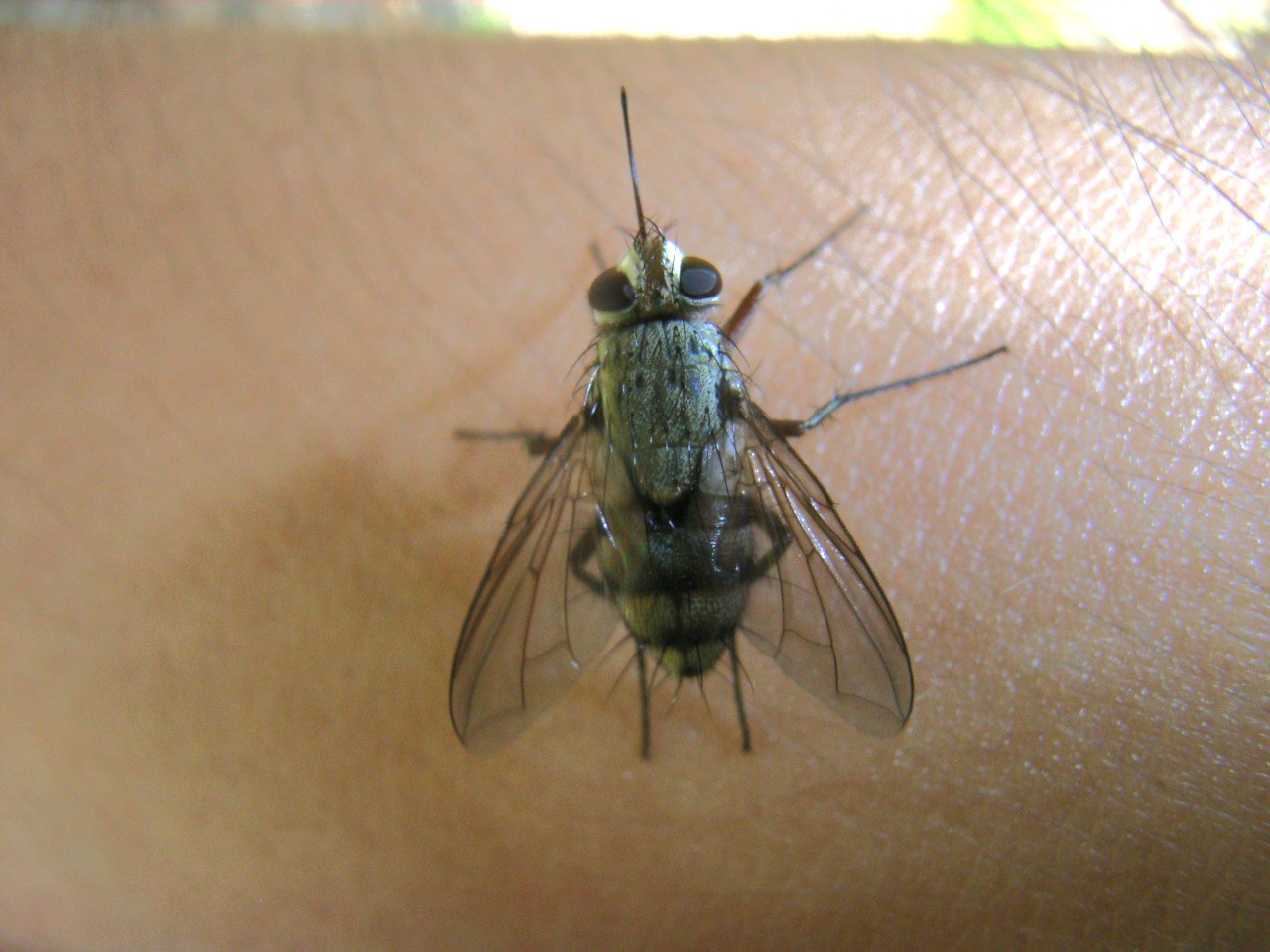
Are you familiar with the fly called Prosena siberita ?
As its name suggests, this fly is characterized by its long, slender proboscis. Because its proboscis is so long relative to its body, at first glance it may resemble a blood-sucking stable fly or a horsefly.
However, this fly does not belong to the Muscidae family, the Stantidae subfamily, or the Tabanidae family, but rather to the Tachinidae family.
The Tachinidae family is known for having larvae that parasitize other insects. The long-nosed tachinid fly is no exception, and is known to parasitize the larvae of scarab beetles (Sato and Nishigaki, 1998). For this reason, it is attracting attention as a beneficial insect in places where vegetation management is necessary, such as golf courses.
So why do parasitic flies have such long proboscises? At first glance, some might mistakenly think it's for sucking blood, like a horsefly.
A key clue to solving this mystery is the study by Krenn and Gereben-Krenn (2024). In this study, the flower-visiting behavior and proboscis morphology of the long-nosed dwarf fly were examined in detail using light and scanning electron microscopy.
As a result, it was revealed that the long-nosed flies visit flowers to feed on nectar, and that their proboscises are structured to suit this feeding behavior.
In other words, the long proboscis of the long-nosed flies is thought to be an adaptation for the adults to feed on nectar. This means that long-nosed flies are a harmless species.
This article explains the reason why the long mouthparts of the long-nosed pincushion fly are long, based on morphological and ecological information reported in the paper.
- What kind of insect is the long-nosed harrier fly?
- The length of the snout is approximately half the length of the body.
- What is the structure of the long snout?
- Why did long snouts evolve?
- Long-nosed pinecone flies are not the only flies with long proboscises.
- Does the long-nosed pygmy fly also contribute to flower pollination?
- Summary: The long proboscis of the long-nosed flies is an adaptation for the adult's nectar-feeding.
- References
What kind of insect is the long-nosed harrier fly?
Parasitic flies that infest the larvae of scarab beetles
Prosena siberita is an insect belonging to the family Tachinidae in the order Diptera (flies). Sato and Nishigaki (1998) reported on the ecology of this species, which parasitizes the larvae of scarab beetles such as Japanese beetle, small cherry beetle, small scarab beetle, and striped scarab beetle.
Therefore, it is attracting attention as a beneficial insect in places where vegetation management is necessary, such as golf courses. In the United States, the Japanese bean beetle has been introduced as an invasive species, and it was once considered a valuable tool for eradication.
Tachinid flies are parasitic flies that use other insects or other organisms as hosts during their larval stage. By growing inside or on the body of the host insect, they obtain the resources necessary for larval development.
Considering this ecology, you might have a strong impression that tachinid flies are "parasitic insects."
However, it's important to note that the question of what the larvae utilize and the question of what the adults eat are two separate issues.
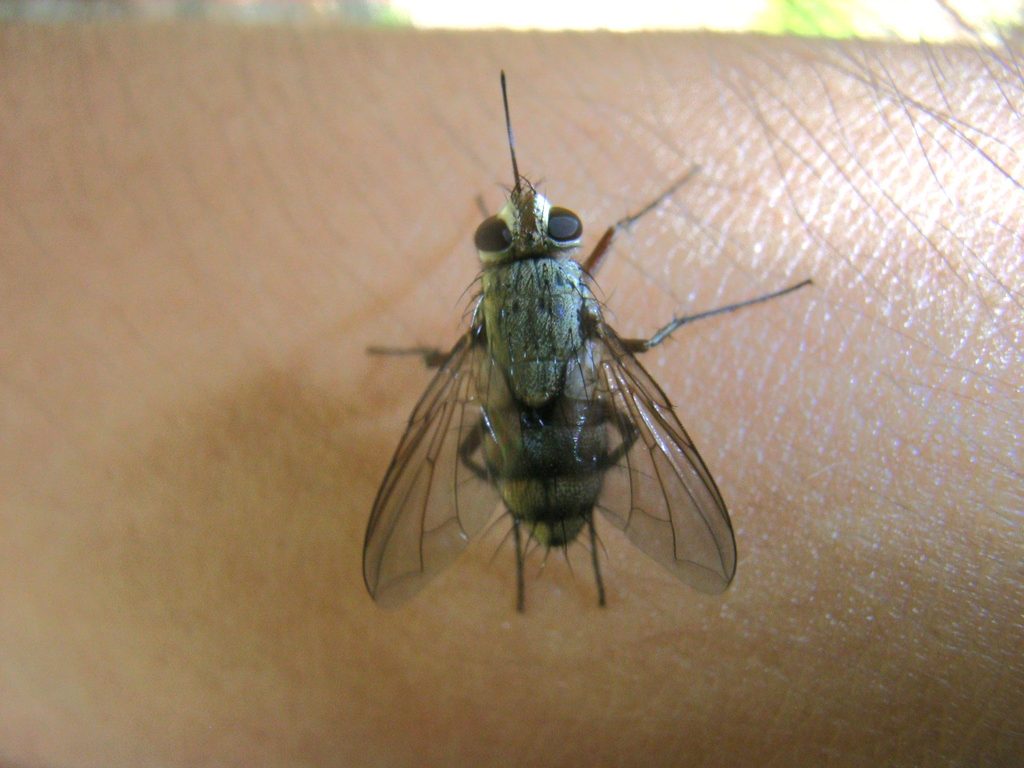
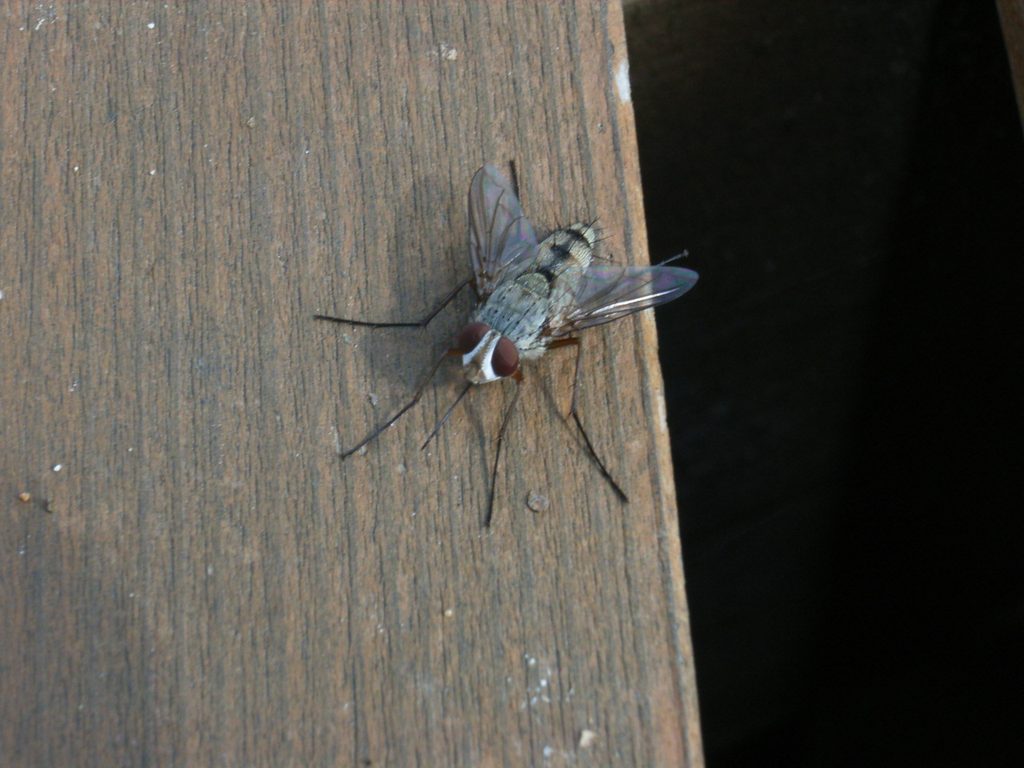
The adult insects visit flowers and feed on nectar.
Krenn and Gereben-Krenn (2024) investigated the flower-visiting behavior and proboscis morphology of the long-nosed pygmy fly and reported that adults collect nectar.
For insects, nectar is an energy source primarily composed of sugars. For adult insects, which expend energy on flight and movement, being able to utilize nectar is of great importance.
However, not all insects that visit flowers utilize them in the same way. Some rest on flowers, others feed on pollen, some drink nectar, and others act as pollinators involved in plant reproduction.
What's important about the long-nosed pygmy fly is that it has been reported to actually engage in specialized nectar-feeding behavior, and the structure of its proboscis corresponding to this behavior has been identified.
The length of the snout is approximately half the length of the body.
A distinctive feature of the long-nosed burrowing fly is its long, slender proboscis.
According to Krenn and Gereben-Krenn (2024), the proboscis of this species reaches approximately half the length of its body.
What advantages do such long proboscises offer insects when it comes to collecting nectar?
Some flowers store nectar in places that are difficult to access directly from the outside, such as deep within the petals or at the bottom of a long, narrow tube. In such flowers, being able to extend the proboscis to reach the nectar is crucial for successful feeding.
If the proboscis is short, the insect may not be able to reach the nectar even if it is present. On the other hand, if the proboscis is long, the insect may be able to reach the nectar in deeper parts of the flower without having to push its head or body deep inside.
What is the structure of the long snout?
The proboscis of the long-nosed pygmy fly is not a simple, elongated tube. Multiple mouthparts are combined to form a structure for collecting nectar and transporting it to the mouth.
Krenn and Gereben-Krenn (2024) describe the proboscis of this species by dividing it into a basal proboscis (rostrum) and an elongated nectar-feeding section (haustellum).
The base of the proboscis supports the movement during feeding.
The proboscis, which forms the base of the mouthpart, connects the slender nectar-feeding section to the head.
In this species, this base is elastic, allowing the proboscis to change direction via a joint with the nectar-feeding section.
When at rest, the slender nectar-feeding part faces forward. However, when feeding, it can be bent downwards via the joint with the base.
This structure is important for moving the long snout to the feeding position when needed.
A long proboscis isn't just good if it's long; it also needs to be angled correctly during feeding, guiding the tip to the location of the nectar.
Inside the proboscis, there is a passage for transporting nectar.
Inside the nectar-collecting part, a food passage is formed for collecting and transporting nectar.
Its structure is made up of multiple parts of the mouthparts that are combined together.
Near the base of the proboscis, the labrum–epipharynx unit (where the upper lip and nasopharynx are fused) and the hypopharynx are involved in the formation of the food pathway. Furthermore, the prementum, a part of the lower lip, encloses these structures from the posterior side.
On the other hand, the structure changes towards the tip of the proboscis. In this region, the anterior coxa of the lower lip becomes tubular and forms the food passage itself. The upper lip and hypopharynx do not extend to this apical section (Krenn & Gereben-Krenn, 2024).
In other words, the entire proboscis is not a simple tube with the same structure; rather, the passage for transporting nectar is formed by a combination of different mouthparts at the base and tip.
The tip has a structure involved in the collection of nectar.
At the tip of the proboscis is a short structure called the labellum.
There is a gap between these labial flap sections, from which three longitudinal pseudotracheae extend, connecting to the food pathway located inside the anterior coxa of the lower lip (Krenn & Gereben-Krenn, 2024).
In insect mouthparts, these apical structures play a crucial role in the intake of liquids. While the mechanisms for collecting nectar vary among insect taxonomic groups, flies have developed structures that receive liquid at the tip of their mouthparts and transport it to their mouths via a food pathway (Krenn et al., 2005).
Thus, the long proboscis of the long-nosed flies is not simply characterized by its length. It is a mechanism that supports a series of feeding behaviors, including changing direction at the base, transporting liquid through the internal food passage, and taking in nectar with the structure at the tip.
Why did long snouts evolve?
Considering its morphology and ecology so far, the reason why the long proboscis of the long-nosed pygmy fly is long can be thought to be related to the fact that the adult flies utilize nectar for their daily lives.
Adaptations for utilizing nectar
For insects that feed on nectar, the length and shape of their proboscis affect whether they can reach the nectar-producing areas.
Krenn et al. (2005) compared the mouthparts of insects that visit flowers and found that mouthparts adapted for nectar feeding come in a variety of lengths and shapes. In flies in particular, the tips for taking in liquid and the food passages are well-developed, and mechanisms for transporting liquid to the mouth by suction are observed.
In the long-nosed flies, a long nectar-feeding section and a mouthpart structure for collecting and transporting nectar have also been observed.
Therefore, it is thought that the long proboscis of this species is a morphological adaptation that is advantageous when adults utilize nectar.
The length of the snout is a characteristic acquired during the process of evolution.
The morphology of insects can be considered to have evolutionary significance in relation to their current living environment and behavior.
In the case of the long-nosed pygmy fly, the larvae parasitize the larvae of scarab beetles, and as adults, they visit flowers and feed on nectar. A notable characteristic throughout this life cycle is the long, well-developed mouthparts involved in the adult's feeding behavior.
Furthermore, Krenn and Gereben-Krenn (2024) point out that only a limited number of species within the Tachinidae family possess long proboscises, suggesting that the long proboscis may have evolved independently within the family.
In other words, it's not that they have long proboscises simply because they belong to the Tachinidae family. In the case of the long-nosed tachinid fly, it's thought that morphological features related to the adult's nectar-feeding have developed during the evolutionary process.
However, the selective pressures that led to the abandonment of pollen-feeding and specialization in nectar-feeding remain unclear and are currently unknown.
Long-nosed pinecone flies are not the only flies with long proboscises.
The long-nosed pinecone fly isn't the only fly that uses its long proboscis to suck nectar instead of blood.
For example, some species in the families Bryoptera and Bryoptera have proboscises that are much longer than their body length.
Karolyi et al. (2012) investigated the relationship between the morphology of the long proboscis and nectar feeding in the genus Prosoeca of the family Prosoecaidae, which inhabits southern Africa. Their study reported that the proboscis can reach 20–47 mm, and in some species, it can be more than twice the length of the body.
This group demonstrates that the length and internal structure of their proboscises are adapted for collecting nectar from elongated floral tubes.
Of course, since the long-nosed flies and the genus Prosoeca belong to different families, their proboscis structures are not exactly the same. However, a comparison between the two is a good example of how long proboscises can evolve in different insect lineages for the common function of utilizing nectar.
This phenomenon, where similar functional forms from different lineages evolve independently, is called convergent evolution.
The long proboscis is not a unique structure found only in certain insect groups, but rather a form that has developed in various insects to utilize nectar as a resource.
Does the long-nosed pygmy fly also contribute to flower pollination?
Insects that visit flowers and feed on nectar can contribute to plant pollination by carrying pollen.
It has been confirmed that the long-nosed pygmy fly also visits flowers. However, feeding on nectar does not mean that it is an effective pollinator of plants.
To determine their role as pollinators, the following information is needed, for example:
- When visiting a flower, does pollen adhere to the body or mouthparts?
- Will the attached pollen be carried to another flower of the same plant species?
- Does it actually contribute to pollination and seed formation?
By examining these factors, we can assess whether these insects are simply nectar users or if they also contribute to plant reproduction.
The Tachinidae family as a whole includes many species that visit flowers, and their role as pollinators has recently attracted attention. However, their importance varies depending on the species and the combination with the plant (Stireman & Cerretti, 2026).
While the nectar-feeding behavior and mouthpart morphology of the long-nosed pygma fly were revealed in a 2024 study, its contribution as a pollinator should be considered a subject for future research.
Insects with long proboscises generally engage in nectar robbing (the act of sucking nectar without touching pollen or providing any benefit to the plant). I'm curious to know if this is the case with the long-nosed pygmy fly.
Summary: The long proboscis of the long-nosed flies is an adaptation for the adult's nectar-feeding.
This article summarizes what research has shown about why the proboscis of the long-nosed fly Prosena siberita is so long.
Firstly, this species is a parasitic insect belonging to the family Tachinidae that preys on the larvae of scarab beetles. Looking only at its parasitic larval stage, the role of its long proboscis is unclear.
Secondly, the adults visit flowers and feed on nectar. A morphological study in 2024 revealed that the proboscis is approximately half the length of the body, and also identified structures that allow the proboscis to change direction at its base, as well as mouthparts for collecting and transporting nectar.
Thirdly, these characteristics are thought to be adaptations to the adult insects' life cycle of utilizing nectar. However, it is not possible to definitively conclude from the current evidence whether they are dependent on specific plants or to what extent they contribute to pollination.
In conclusion, the long proboscis of the long-nosed tachinid fly is thought to be a morphological adaptation that developed for the adult to feed on nectar, separate from its parasitic larval life as a tachinid fly.
Although it is a parasitic insect, it utilizes nectar during its adult stage. This difference in its life cycle is the most important point in understanding the long proboscis of the long-nosed pygmy fly.
References
Karolyi, F., Szucsich, NU, Colville, JF, & Krenn, HW (2012). Adaptations for nectar-feeding in the mouthparts of long-proboscid flies (Nemestrinidae: Prosoeca). Biological Journal of the Linnean Society, 107 (2), 414-424. https://doi.org/10.1111/j.1095-8312.2012.01945.x
Krenn, HW, Plant, JD, & Szucsich, NU (2005). Mouthparts of flower-visiting insects. Arthropod Structure & Development, 34 (1), 1-40. https://doi.org/10.1016/j.asd.2004.10.002
Krenn, HW, & Gereben-Krenn, B.-A. (2024). Functional morphology of the proboscis of the fly Prosena siberita (Diptera, Tachinidae). Entomologica Austriaca, 31, 9-25. https://ucrisportal.univie.ac.at/en/publications/functional-morphology-of-the-proboscis-of-the-fly-prosena-siberit/
Sato, Tokukazu and Nishigaki, Sadajiro (1998). Ecology (preliminary report) of *Prosena siberita Fabricius* (Diptera: Tachinidae), a parasitic fly that preys on scarab beetle larvae. Research Reports of the Faculty of Agriculture, Shizuoka University, 47, 15-21. https://agriknowledge.affrc.go.jp/RN/2010571062
Stireman, JO, III, & Cerretti, P. (2026). Tachinidae (Diptera) as floral visitors and pollinators in natural and managed systems. Entomologia Experimentalis et Applicata. Advance online publication. https://doi.org/10.1111/eea.70185

