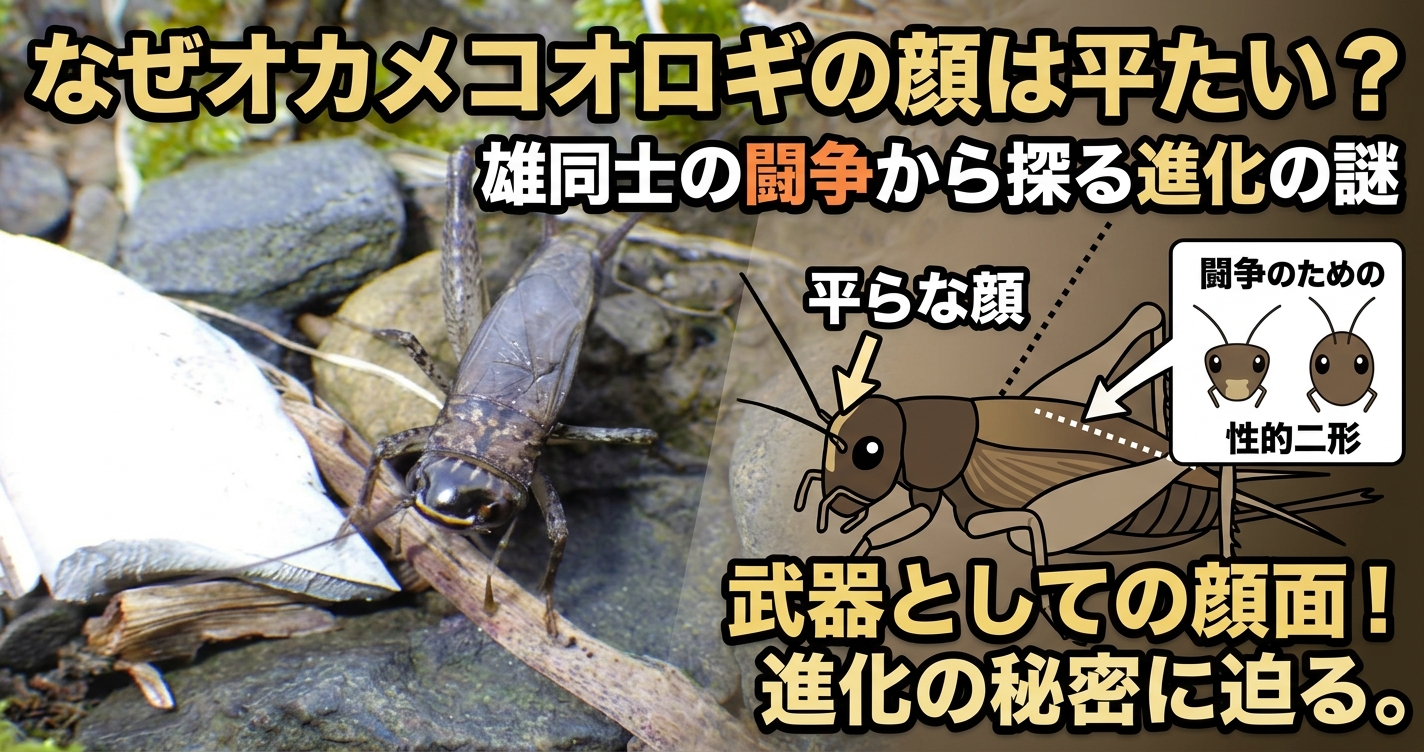
When observing male Loxoblemmus campestris, Loxoblemmus sylvestris, and Loxoblemmus doenitzi crickets, one notices that their faces are flattened, almost as if they have been cut off. Moreover, this flattened surface is tilted downwards and backwards. In the case of Loxoblemmus doenitzi, it even protrudes to the sides.
Why did such a unique face evolve?
In fact, some species of the genus Gryllus have males that have flattened heads and horn-like projections that are not found in females. Furthermore, studies of closely related species have reported that males use this flattened head to thrust at their opponents during fights.
From an evolutionary biology perspective, this fact can be interpreted as a trait that evolved through competition among males for mating partners. In other words, it is thought that "intermale selection (intrasexual selection)," a form of sexual selection, played a role in its evolution.
This article, based on scientific papers, explains why the faces of male cockatiels have become flat and how that shape is formed.
- Why do male cockatiels have flat faces?
- Competition among males led to the evolution of flat faces.
- Can horns be used as weapons? Research on the three-horned cricket
- The flat face is formed when the insect becomes an adult.
- Isn't a flat face a way to attract females?
- Why is the face tilted downwards and backwards?
- Did species like the Haraokame cricket and Moriokame cricket also evolve through male selection?
- Summary: The flat face of the male cockatiel cricket is a result of competition among males.
- References
Why do male cockatiels have flat faces?
Males of the genus Loxoblemmus have significantly different head morphologies from females (Orthopterological Society of Japan, 2016).
In the closely related species, the three-horned cricket (Loxoblemmus doenitzi), the male's face is particularly flat, and horn-like projections are well-developed on both sides of its head. On the other hand, the female's head is rounded and does not have the horn-like structure found in the male.
This phenomenon, where males and females of the same species have different body shapes, is called "sexual dimorphism."
In animals, competition for mates can lead to the development of horns, tusks, and powerful legs in males. These are not merely decorative; they are used in combat against other animals.
The flat face of male crickets in the genus *Cricketus* is also thought to be one of these male-specific weapon traits.
So why did this trait develop only in males?
The key to understanding the reason lies in "sexual selection."
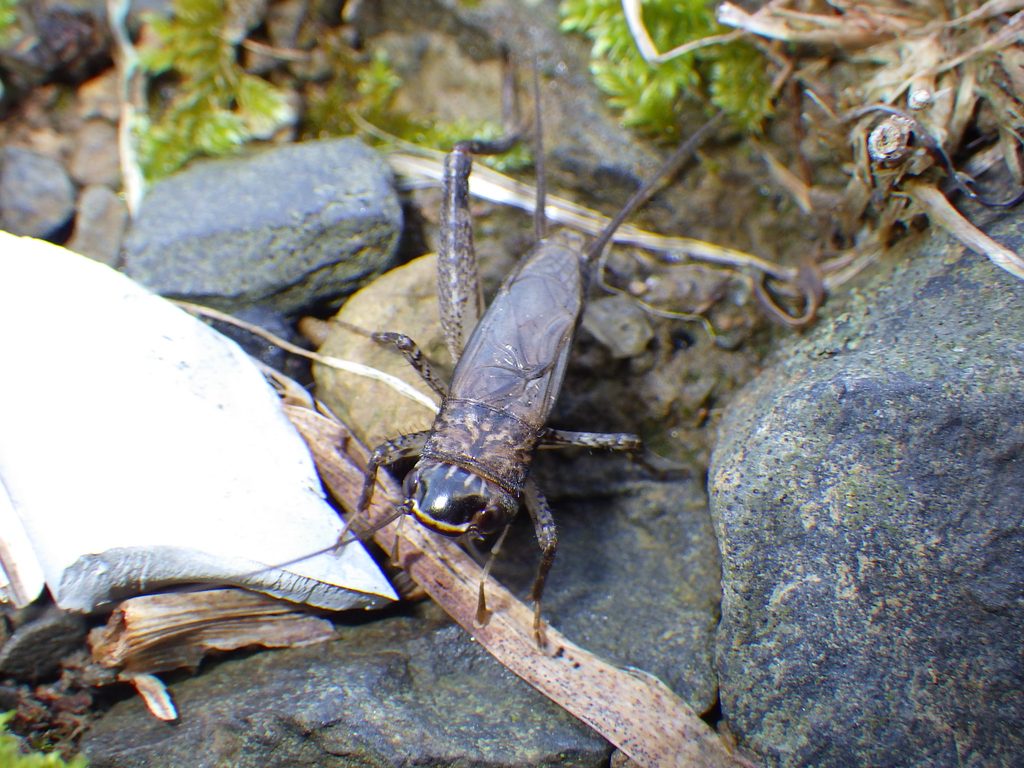
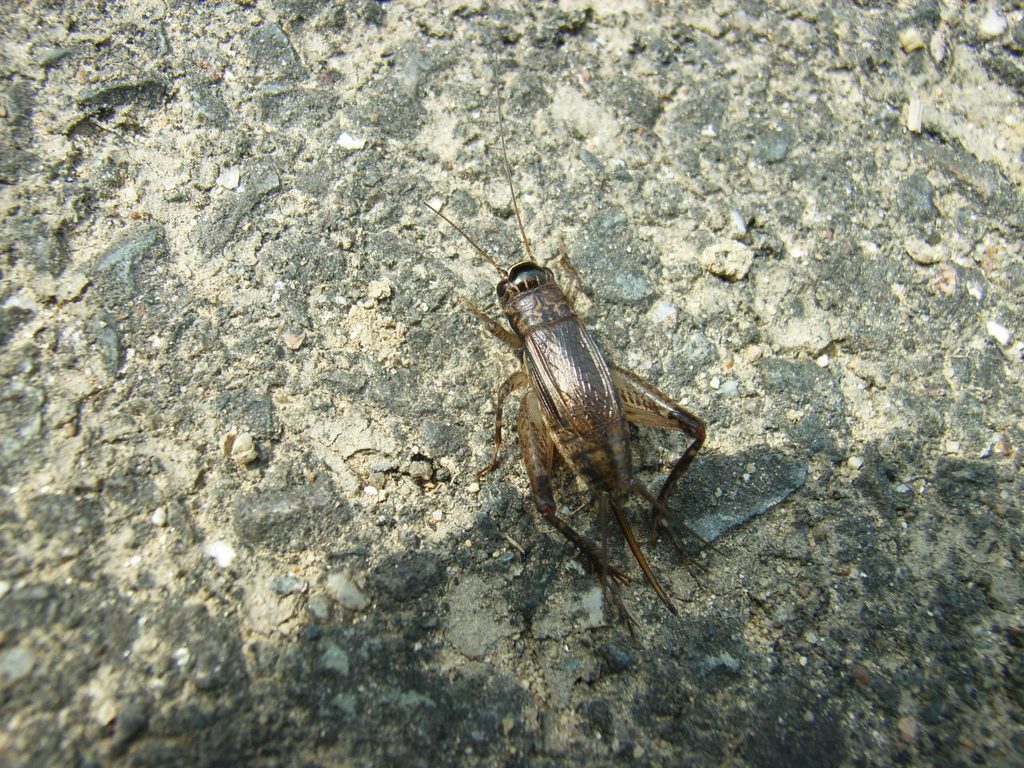
Competition among males led to the evolution of flat faces.
Sexual selection is the process by which traits that are advantageous in acquiring a mating partner evolve.
For example, if males fight and the winner gets the opportunity to mate, males with traits that give them an advantage in fighting may be able to produce more offspring than males without those traits.
Sex selection that operates through competition among individuals of the same sex is called "male-male selection" or "intrasexual selection."
This mechanism is crucial for understanding the head morphology of male crickets in the genus Gryllus.
A unique fighting behavior involving butting heads together.
Yoneda et al. (2025) studied the head morphology and developmental process of the tropical cricket Loxoblemmus equestris and also described the male-male fighting characteristic of the genus Loxoblemmus.
In addition to the intimidation tactics using antennae and grappling with mandibles commonly seen in crickets, males of this genus engage in a fighting behavior that is unique to males, such as thrusting their flattened heads at their opponents.
In other words, the flat face of the male is actually used in situations where males are fighting each other.
This is important evidence for considering the relationship between head morphology and male competition.
This feature does not develop in females, but is unique to males and is used in fights between males. This combination strongly supports the interpretation that the flattened head evolved through male selection.
Why does the head change due to male-to-male selection?
Let's assume that males who can effectively use their flat heads are more likely to win fights and find mates more easily.
If such males produce many offspring, the genetic characteristics involved in the formation of head morphology will be passed on to the next generation. Over generations, head morphology adapted to competition among males may evolve.
Thus, competition among males for breeding partners can lead to the evolution of male-specific morphological features.
Of course, multiple factors, such as body size, are involved in determining the outcome of actual fights. However, when considering the characteristic head morphology and fighting behavior of males in the genus *Gryllus*, male selection is a powerful mechanism that explains their evolution.
Can horns be used as weapons? Research on the three-horned cricket
One study that demonstrates that the head morphology of males is related to fighting is the paper by Kim et al. (2011).
This study focused on the horn-like projections on male three-horned crickets (Loxoblemmus doenitzi) and investigated how they are used in fights between males.
The research confirmed that males use their horns to strike the opponent's horns or to stab the opponent's body during fights.
In other words, the male's horns were a structure that was used in actual fighting.
This observation supports the idea that male-specific head morphology is related to male-male competition.
Having large corners doesn't guarantee a win.
On the other hand, this study found that horn length and how horns were used could not significantly explain the outcome of fights. Rather, male body size was more important in determining the outcome (Kim et al., 2011).
These results do not negate the idea that male head morphology is related to fighting.
Even if traits used in fighting exist, the actual outcome of a fight is determined by multiple factors, such as body size and the combination of opponents.
For example, even if two people are armed, the outcome of a fight can sometimes be determined by differences in physique or strength.
It's important to distinguish between the fact that the head morphology of male crickets in the genus *Cricketus* is a trait used in fighting and that this trait alone determines the outcome of the fight.
Nevertheless, the fact that male-specific head structures are actually used in fighting is important when considering evolution through male selection.
The flat face is formed when the insect becomes an adult.
Another interesting aspect of the male's flat face is its formation process.
Yoneda et al. (2025) investigated in detail how the male-specific head is formed in the tropical cricket Loxoblemmus equestris.
The results showed that there were no significant differences in head morphology between males and females during the larval stage, but after the final molt and becoming an adult, a flat head characteristic of males was formed.
The male's head undergoes a significant change during the final molt.
Insects have a hard exoskeleton, so they molt repeatedly as they grow.
In crickets, the final molt, just before transitioning from larva to adult, is a crucial stage in which the body shape changes dramatically.
A study by Yoneda et al. (2025) showed that the flattened head of male tropical cricket L. equestris is formed during this final molt.
Researchers are also focusing on the way the tissues that make up the surface of the head fold. Male-specific morphology does not arise simply from the overall increase in head size, but rather from differences in the developmental processes of males and females in parts of the head.
Evolution occurs by reshaping the existing body structure.
This research demonstrates that distinctive forms resulting from evolution are formed by altering existing body structures and developmental mechanisms.
The flat face of male crickets in the genus Gryllus is a morphological feature unique to males, formed during the process of becoming an adult.
Furthermore, considering that this form is used in fights between males, we can understand that the head morphology, which evolved through male selection, is created through developmental mechanisms.
In other words, the forms that arise through evolution and the developmental mechanisms that create those forms are closely interconnected.
Isn't a flat face a way to attract females?
If the distinctive morphology of the male is related to reproduction, it's possible that it's used to attract females.
However, while some studies suggest a correlation between the head morphology of the genus *Gryllus* and male-to-male conflict, none of the literature reviewed here directly demonstrates that females prefer flat faces.
The research by Kuriwada (2016) is helpful in considering this point.
Relationship between horn length and vocal behavior
Kuriwada (2016) investigated the relationship between horn length and vocalization behavior to attract females in male three-horned crickets.
As a result, no significant correlation was found between horn length and the effort involved in vocalization.
Furthermore, in experiments where the quality of food during the latter half of the larval stage was changed, males under conditions of lower food quality showed reduced effort in vocalization, but no similar effect was observed on horn length (Kuriwada, 2016).
This result indicates that horn length does not directly reflect the effort put into vocalization.
However, this study examined horn length and vocalization behavior, and did not directly investigate how females evaluate the facial features of males.
Therefore, focusing on the connection between flat faces and male-male fighting is a more accurate interpretation of the current evidence than assuming that flat faces evolved to attract females.
Why is the face tilted downwards and backwards?
As we have seen, the flattened head of male crickets in the genus Gryllus is thought to be a trait related to male-male conflict.
So why is the face not just flat, but also tilted downwards and backwards?
This slope may also be related to the fighting behavior of males butting heads against each other.
For example, it could be related to the posture when making contact with another person, the contact surface of the heads, and how force is transmitted when pushing against someone.
If a morphology is advantageous in competition among males, then such characteristics may have evolved through male selection.
However, direct mechanical verification is needed to determine whether the angle of the face itself increases the pushing force or whether it helps to adopt an advantageous stance against an opponent.
At present, there is evidence to support the idea that a flat head is used in male-male fighting and that its shape evolved through male selection, but it remains unclear what specific advantages the downward and backward slope provides.
To clarify this point, research is needed that examines in detail the head morphology, fighting posture, pushing force, and the outcome of the fight.
Did species like the Haraokame cricket and Moriokame cricket also evolve through male selection?
The studies described so far have primarily focused on the three-horned cricket and the tropical cricket.
On the other hand, regarding the subject of this article, * L. campestris* and * L. sylvestris *, no studies directly investigating the function of facial flattening or tilt angle were found in this literature search.
However, given that males have developed head morphologies specific to their sex, and that male-to-male combat using flattened heads has been reported in closely related species, the interpretation that male selection played a role in the evolution of head morphology in these species is quite reasonable.
In other words, the flat face of male crickets in the genus *Orobanchus* is thought to be a trait that evolved through competition among males for breeding partners.
While there may be differences in morphology and fighting behavior from species to species, the evolutionary mechanism of male selection is a central explanation for understanding this unique head morphology.
Summary: The flat face of the male cockatiel cricket is a result of competition among males.
The flattened, almost truncated faces seen in males of species like the Japanese cricket (Gryllus harai) and the Japanese cricket (Gryllus morii) are a very distinctive morphological feature.
Studies of closely related species have revealed that the male-specific head morphology is used in male-male fighting, and that a flattened head is formed during the final molt to become an adult.
Considering these findings together, it is reasonable to conclude that the flat faces of male crickets in the genus Gryllus evolved through male-male competition for mates, that is, through a form of sexual selection called intermale selection.
If individuals with morphological features that are advantageous in male-male competition gain a reproductive advantage, those features may evolve over generations. The distinctive facial features of male crickets in the genus *Gryllus* are an interesting example to consider when thinking about the workings of this sexual selection.
On the other hand, the specific mechanical advantages of the face tilting downward and backward, as well as its detailed function in *Crocothemis servilia* and *Crocothemis japonica*, are expected to be further clarified through future research.
Even the strange faces of familiar insects bear the marks of a history of competition and evolution surrounding reproduction.
References
Kim, H., Jang, Y., & Choe, J. C. (2011). Sexually dimorphic male horns and their use in agonistic behaviors in the horn-headed cricket Loxoblemmus doenitzi (Orthoptera: Gryllidae). Journal of Ethology, 29(3), 435-441. https://doi.org/10.1007/s10164-011-0277-x
The Orthopterological Society of Japan. (2016). Standard Illustrated Guide to Orthopterans of Japan. Gakken Plus. ISBN: 9784054064478
Kuriwada, T. (2016). Horn length is not correlated with calling efforts in the horn-headed cricket Loxoblemmus doenitzi (Orthoptera: Gryllidae). Entomological Science, 19(3), 228-232. https://doi.org/10.1111/ens.12190
Yoneda, M., Morita, S., Niimi, T., Daimon, T., & Ohde, T. (2025). Lineage-specific head development in the coffin-headed cricket Loxoblemmus equestris links the final molt with novel trait evolution. EvoDevo, 16, Article 13. https://doi.org/10.1186/s13227-025-00249-3