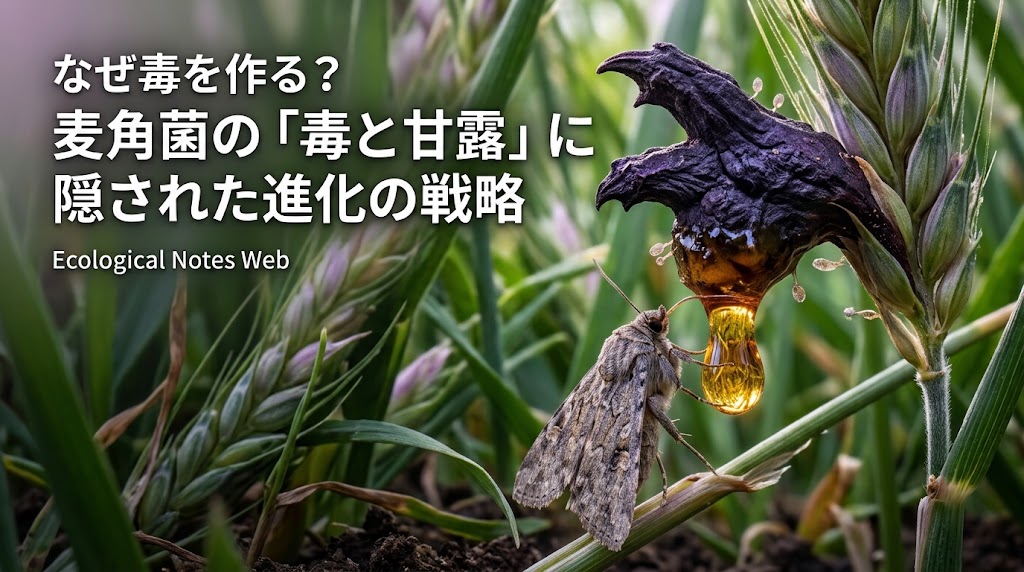
Ergot fungi are a type of fungus that infects grasses, including cereals. The ergot alkaloids produced by this fungus are known to be toxic substances that have strong physiological effects on humans and livestock.
歴史的には、麦角菌に汚染されたライムギなどを食べることで、痙攣や壊疽などを引き起こす麦角中毒(麦角病)が発生してきました。ヨーロッパでは「聖アントニウスの火」 (St. Anthony’s fire) とも呼ばれてきました。現代でも発生すると小麦粉の品質を著しく低下させるため、深刻な経済的損害をもたらします。
Furthermore, LSD (lysergic acid diethylamide), first synthesized in 1938 by Swiss chemist Albert Hofmann and regulated as a narcotic in Japan in 1970, is a highly addictive, semi-synthetic hallucinogen synthesized from lysergic acid found in ergot fungus. It carries a high risk of addiction and should absolutely not be used in Japan today.
However, it's not all bad; some ergot alkaloids are used as raw materials for migraine medications, uterine contraction drugs, hemostatic drugs, and medications for treating Parkinson's disease and hyperprolactinemia.
Regarding LSD, attempts to recreate the distorted visual world, vividly colored visions, and unique sounds seen through LSD resulted in the birth of "psychedelic rock" and "psychedelic art," characterized by its undulating designs and heavy use of primary colors. These genres became associated with hippie culture (counterculture), particularly in San Francisco, USA, in the late 1960s.
LSD was sometimes used to suppress the default mode network (DMN) and promote originality and creativity. It is well known that Apple co-founder Steve Jobs publicly stated that "taking LSD was one of the most important experiences of my life."
In recent years, a re-evaluation known as the "psychedelic renaissance" has brought attention to "psychedelic therapy," which uses appropriate doses to treat depression and anxiety disorders (Yehuda & Lehrner, 2023).
Thus, ergot fungus has produced extremely contrasting effects on human society, both positive and negative.
By the way, this raises a question.
First of all, why does ergot fungus produce substances with such strong biological activity?
What does it mean for ergot fungi to produce substances that are harmful to humans?
To answer this question, simply examining how alkaloids are synthesized is insufficient. The crucial point is to consider the evolutionary perspective: what benefits has the ability to produce ergot alkaloids provided to the survival and reproduction of ergot fungi?
In conclusion, it has been proven that the purpose of parasitic organisms is not only to protect themselves from predation by mammals and insects, but also to protect the plants they parasitize. However, it is not yet understood how the subtle differences in their components affect specific organisms.
It has also been found that the honeydew secreted by ergot fungi attracts insects such as flies and moths, and the conidia that attach to the insects' bodies are carried to other flowers, thus contributing to the spread of infection.
This article will first summarize the biological characteristics of ergot fungi and the properties of ergot alkaloids. Then, it will distinguish between proximate and ultimate causes, and in particular, examine the ultimate cause, that is, the evolutionary biological reason, based on scientific papers.
- What kind of organism is ergot fungus?
- What are ergot alkaloids?
- How ergot alkaloids are produced: Proximate cause
- Why do ergot fungi produce ergot alkaloids? Let's consider the ultimate cause.
- What is currently known about the ultimate cause of alkaloid production by ergot fungi?
- Why do ergot fungi secrete honeydew? How do they disperse spores using insects?
- Summary: Why does ergot fungus produce toxins?
- References
What kind of organism is ergot fungus?
Ergot fungi are a general term for fungi belonging to the Clavicipaceae family of the Ascomycota phylum, mainly those of the Claviceps genus.
A representative species is Claviceps purpurea, which infects rye and various grasses.
A key characteristic of ergot fungi is that they primarily infect the ovaries of flowers, rather than the leaves or stems of plants.
It has a very distinctive life cycle, unlike that of typical plant pathogens.
Life cycle of ergot fungus
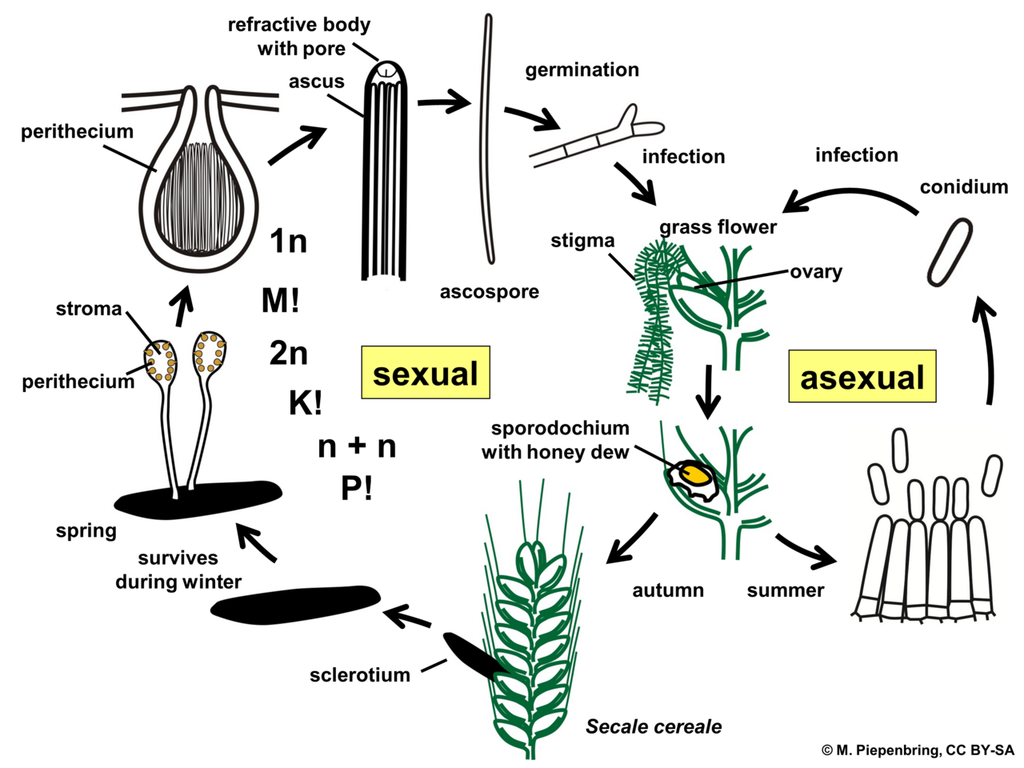
The life cycle of ergot fungi generally progresses as follows:
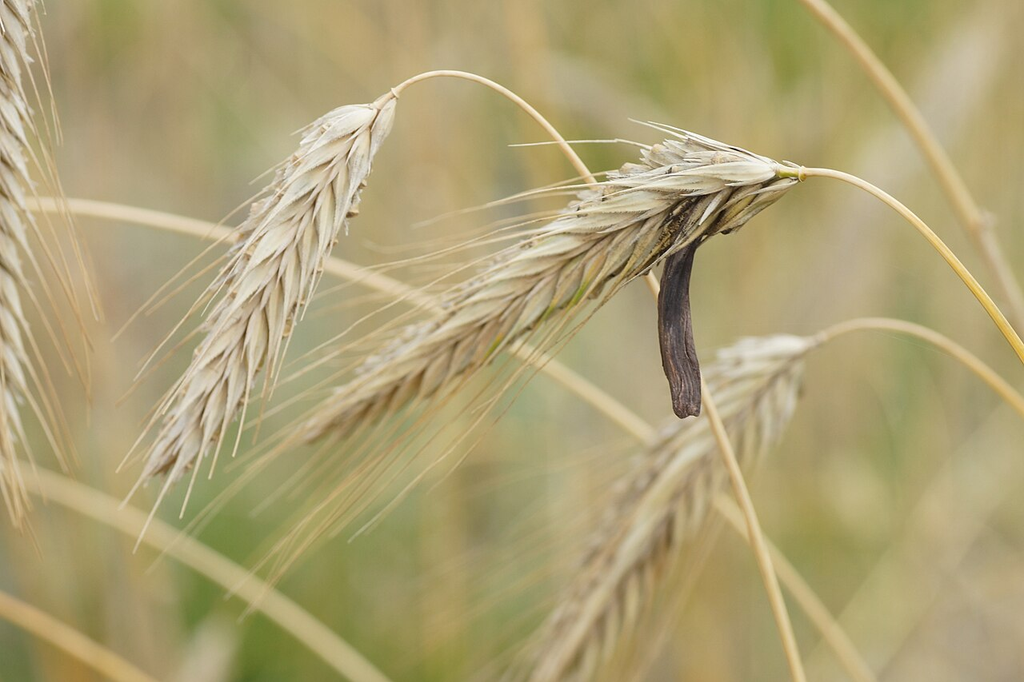
- Overwintering via sclerotia <br>Ergot fungi dormant and overwinter in hard structures called sclerotia, which they form instead of plant seeds. Sclerotia are blackish-purple to blackish-brown and have a shape resembling horns protruding from wheat ears.
- Formation of the fruiting body and release of ascospores <br>In spring, the sclerotia germinate and form a fruiting body (stroma). Ascospores are produced in the asci inside and released into the surrounding area.
- Infection of grass flowers <br>Ascospores reach the flowers of flowering grasses. They invade through the stigma and other areas, extending hyphae into the ovary to establish infection.
- Honeydew Formation <br>In infected ovaries, fungal hyphae proliferate, secreting a sugary liquid called honeydew. This liquid contains asexual spores (conidia), which are carried to other flowers by insects or raindrops.
- Formation of Sclerotia <br>As the infection progresses, the ovary is eventually replaced by banana-shaped sclerotia. Sclerotia are important structures that survive until the next season and initiate a new infection cycle.
Thus, ergot fungi infect plant flowers and live by combining asexual reproduction via honeydew with dormancy and overwintering via sclerotia (Tudzynski & Scheffer, 2004).
Of particular importance is the accumulation of ergot alkaloids in the sclerotia.
Sclerotia are not simply tissues that arise as a result of infection; they are important structures that allow bacteria to survive until the next opportunity for infection.
What are ergot alkaloids?
Ergot alkaloids are a group of secondary metabolites with an indole skeleton, mainly produced by fungi of the Clavicipitaceae family.
Secondary metabolites, unlike metabolites directly necessary for the basic life activities of cells, are compounds thought to be involved in interspecies interactions and adaptation to the environment.
Ergot alkaloids are characterized by their strong effects on the nervous system of animals.
It's worth noting that, although it can be confusing, ergot alkaloids are not only produced by ergot fungi (Clavipeps genus), but also by several other groups, including Epicloe and Aspergillus fumigata.
Main types of ergot alkaloids
Ergot alkaloids can be broadly classified into three groups based on their chemical structure.
- Clavines: Ergot alkaloids with relatively simple structures.
- Lysergic acid derivatives: A group of compounds based on lysergic acid.
- Ergopeptines: A complex group of compounds in which a peptide moiety is attached to a lysergic acid derivative.
Representative compounds include ergotamine, ergometrine, and ergocristine.
These drugs differ not only in their chemical structure but also in their physiological effects (Florea et al., 2017). Ergotamine is used as a migraine medication, while ergometrine is used as a hemostatic agent for uterine contractions.
Why is it toxic to animals?
A key characteristic of ergot alkaloids is their action on receptors for monoamine neurotransmitters such as serotonin, dopamine, and adrenaline.
By acting as agonists or antagonists on these receptors, these drugs exert various effects on the nervous system, vascular system, and other tissues.
As a result, the following effects occur depending on the type and amount of compound ingested.
- Vasoconstriction
- Smooth muscle contraction
- Effects on the nervous system
- Impact on eating behavior
- Impact on motor function
The toxicity of ergot alkaloids is not intended by ergot fungi to harm humans or livestock. Rather, their properties that affect the physiological functions of wild animals may lead to some ecological benefit in the natural world.
How ergot alkaloids are produced: Proximate cause
Before considering why ergot alkaloids are produced, let's first review how they are produced.
This corresponds to what is called a "proximate cause" in evolutionary biology.
Biosynthetic pathway of ergot alkaloids
The biosynthesis of ergot alkaloids begins with the amino acid tryptophan as a starting material.
The first important reaction is the addition of a dimethylallyl group to tryptophan. This reaction is catalyzed by DMAT synthase (dimethylallyltryptophan synthase).
Subsequently, through a series of enzymatic reactions, the ergoline skeleton characteristic of ergot alkaloids is formed.
Furthermore, depending on the type of fungus and the enzymes it possesses, it is converted into various ergot alkaloids.
Biosynthetic gene clusters
Multiple genes are involved in the synthesis of ergot alkaloids.
These form a group of related genes called the EAS (ergot alkaloid synthesis) gene cluster.
Representative genes include the following:
- dmaW: Involved in the addition of a dimethylallyl group to tryptophan.
- easA: Involved in the transformation of the initial intermediate.
- easD: Involved in the formation of clavicles.
- cloA: Involved in the conversion to lysergic acid.
- lpsA, lpsB: Involved in the formation of ergopeptins.
The presence or absence and differences in the function of these genes ultimately determine the type of alkaloid produced.
In other words, the reason why the alkaloid composition differs depending on the type of ergot fungus is because the composition of biosynthetic gene clusters and the function of enzymes differ (Florea et al., 2017; Young et al., 2015).
This explains the mechanism by which ergot alkaloids are produced, or the proximate cause.
However, this alone does not answer the main question.
Why have ergot fungi acquired and maintained such biosynthetic capabilities during the course of evolution?
Next, let's consider the ultimate cause.
Why do ergot fungi produce ergot alkaloids? Let's consider the ultimate cause.
The ultimate cause explains what adaptive benefits the traits possessed by an organism brought about during the evolutionary process and how they have been maintained through natural selection.
For example, the proximate cause of a bird having wings can be explained by the genes and developmental processes that form them. On the other hand, the ultimate cause can be explained in terms of the benefits that flight ability has brought to survival and reproduction.
Similarly, while the mechanism by which ergot fungi produce ergot alkaloids can be explained biochemically, the reasons why this process has been maintained evolutionarily need to be considered from an ecological perspective.
Currently, the following hypothesis is considered particularly important:
- Chemical defenses to prevent damage from animals.
- Indirect benefits of protecting host plants
- 生合成遺伝子の獲得と多様化による生態的適応
それぞれの仮説について、科学的な証拠を見ていきましょう。
To protect themselves from damage caused by animals
最も有力な説明の一つが、麦角アルカロイドは動物に対する化学的防御として機能しているというものです。
自然界では、植物や菌類は昆虫、草食動物、菌食性動物など、さまざまな生物から食害を受けます。
こうした捕食・食害に対抗する方法の一つが、毒性や忌避性を持つ化学物質を生産することです。
例えば、植物がアルカロイドやテルペノイドを作るのは、昆虫や草食動物による食害を減らすための防御機構として説明されることがあります。
麦角菌も同様に、麦角アルカロイドによって動物の摂食を抑制している可能性があります。
Ergot alkaloids inhibit feeding in mammals.
麦角アルカロイドが動物に対する防御として働くことを示す研究があります。
Wäli et al.(2013)は、麦角菌に感染した植物と草食動物との関係を調べました。
この研究では、ヒツジを用いた選択実験において、麦角菌に感染した植物を含む飼料が避けられることが示されました。
つまり、麦角菌の感染によって植物にアルカロイドが蓄積すると、草食動物がその植物を食べにくくなる可能性があります。
また、ヒツジが放牧されている牧草地では、放牧されていない周辺地域と比較して、麦角菌に感染した花序の割合が高いことも報告されています。
この結果は、麦角菌の感染が草食動物による食害を受けにくくする可能性と整合的です。
Ergot alkaloids inhibit insect feeding.
Clay and Cheplick(1989)は、イネ科植物に感染する内生菌が作る麦角アルカロイドについて、昆虫への影響を調べています。
This study investigated the effects of ergot alkaloids on the survival rate, food intake, and growth of fall armyworm (Spodoptera frugiperda) larvae.
このような研究は、麦角アルカロイドが昆虫の食害を抑制する化学的防御として機能する可能性を支持しています。
Furthermore, Laihonen et al. (2022) investigated the correlation between Claviceps purpurea infestation on Festuca rubra and aphid incidence, and found that plants not infected with Claviceps purpurea had approximately 4.5 times more aphids than infected plants. In addition, no aphids were observed at all in the Claviceps -infected strain 59%.
This study also shows that the fungus * Epichloë* promotes ergot fungal infection.
麦角アルカロイドが昆虫の生体防御・免疫応答を抑制する可能性
Panaccione and Arnold(2017)は、麦角アルカロイドが蛾の一種であるハチノスツヅリガにおける菌の病原性に関与することを示しています。
In this study, we used a mutant strain of Aspergillus fumigatus lacking a gene related to ergot alkaloid biosynthesis to conduct infection experiments with the insect model moth , Galleria mellonella.
その結果、麦角アルカロイドの生産能力を失った変異株では、野生株と比較して病原性が低下しました。
This suggests that, rather than being a toxin that directly attacks and repels the host, like in Claviceps purpurea, it may be contributing to the process of infection and proliferation of the living bacteria (for example, protection from the host's biological defenses and immune responses).
By protecting the host plant, the ergot fungus itself also benefits.
麦角アルカロイドの進化を考えるうえで、非常に興味深いのが、麦角菌と宿主植物との関係です。
Generally, Claviceps purpurea is classified as a plant pathogen because it replaces plant seeds with sclerotia.
しかし、植物と菌類の関係は、必ずしも単純な「病原菌と宿主」という関係だけではありません。
菌が植物に感染することで、植物側にも何らかの利益が生じる場合があります。
例えば、植物に共生する内生菌がアルカロイドを生産し、草食動物による食害から宿主植物を守る現象が知られています。
このような関係は「防御的相利共生(defensive mutualism)」と呼ばれます。
Why protecting the host plant is in the fungus's own best interest
一見すると、菌が宿主植物を守ることは、菌自身にとって不利益のように思えるかもしれません。
しかし、宿主植物と密接に関係しながら生活する菌にとって、宿主が生存し続けることは、自身の生存や繁殖にとっても重要です。
例えば、宿主植物が草食動物に食べられてしまえば、菌が利用できる生息場所や栄養資源も失われる可能性があります。
一方、アルカロイドによって宿主植物が食べられにくくなれば、菌にとっても生活環境が維持されることになります。
つまり、
- 菌がアルカロイドを作る。
- 宿主植物が草食動物から守られる。
- 宿主植物が生存し続ける。
- 菌も宿主とともに生存・繁殖する機会を得る。
という関係が成立する可能性があります。
これは、菌と植物の双方に利益が生じる仕組みです。
Does a similar phenomenon occur with ergot fungus?
Regarding this question, Wäli et al. (2013) investigated the relationship between Claviceps purpurea and grasses.
先ほど紹介した研究では、麦角菌に感染した植物はヒツジに食べられにくくなることが示されました。
Furthermore, when we examined wild Festuca rubra, we found that the reduction in seeds due to infection was not statistically significant. However, we observed a tendency for the formation of normal seeds to decrease as the number of sclerotia increased.
この結果から、研究者たちは、麦角菌が基本的には植物病原菌である一方、状況によっては宿主植物を草食動物から守るという間接的な利益をもたらす可能性を指摘しています。
そして、このような関係を「条件付き防御的相利共生(conditional defensive mutualism)」と表現しました。
菌にとってアルカロイド生産が有利であり、その結果として宿主植物にも利益が生じるならば、双方にとって有利な関係が成立する可能性があります。
However, Claviceps purpurea is also a pathogen that causes plants to lose their seeds.
したがって、感染による種子の損失と、草食動物から守られる利益のどちらが大きいかによって、植物にとっての感染の影響は変わります。
この研究は、病原菌と宿主植物の関係が、必ずしも一方的な搾取だけでは説明できないことを示す興味深い事例です。
The diversification of ergot alkaloids reflects adaptation to various ecological environments.
バッカクキン科の菌類が作るアルカロイドは、すべて同じではありません。
菌の種類によって、生産されるアルカロイドの種類や量が異なります。
例えば、ある菌はクラビン類を主に生産し、別の菌はリゼルグ酸誘導体やエルゴペプチン類を生産します。
このような化学的多様性は、進化生物学的にも興味深い現象です。
では、なぜ麦角アルカロイドはこれほど多様化したのでしょうか?
Gene acquisition, loss, and functional changes
Young et al.(2015)は、麦角アルカロイドの生合成遺伝子を比較し、その進化過程を詳しく調べています。
その研究では、麦角アルカロイドの多様化に関係する主な進化的プロセスとして、次の3つが挙げられています。
- Gene acquisition <br>By acquiring new biosynthetic genes, it may become possible to produce compounds that could not be made before.
- Gene loss <br>The loss of certain genes can alter the biosynthetic pathway, potentially changing the types of alkaloids that ultimately accumulate.
- Changes in gene function (new functions)
Changes in gene sequences can alter the substrate specificity and reaction products of enzymes, potentially leading to the creation of new compounds.
このような変化によって、菌の種類ごとに異なるアルカロイドの組成が生じてきたと考えられます。
さらに、遺伝子の発現量が変化することでも、特定の中間代謝産物が蓄積し、アルカロイドの組成が変わる可能性があります。
Why is there any significance in the diversification of alkaloid types?
アルカロイドの種類が違えば、動物に対する作用も異なります。
例えば、ある化合物は昆虫に対して強い毒性を示し、別の化合物は哺乳類の神経系や血管系に強く作用するかもしれません。
したがって、さまざまなアルカロイドを生産できることは、異なる動物群や生態環境に対する化学的防御の幅を広げる可能性があります。
Panaccione(2005)は、麦角アルカロイドの多様性が、異なる生物に対する作用を通じて生産菌に利益をもたらす可能性を論じています。
ただし、個々のアルカロイドの多様化が、どの動物に対する適応によって生じたのかについては、まだ十分に解明されていません。
つまり、遺伝子の多様化と化合物の多様化は明らかになっていますが、そのすべてを特定の生態的選択圧に結び付けることはできないのです。
Acquisition of biosynthetic capacity through horizontal gene transfer
さらに興味深いのが、麦角アルカロイドの生合成能力そのものが、菌類の進化の過程で水平遺伝子伝播によって獲得された可能性です。
水平遺伝子伝播(horizontal gene transfer)とは、親から子へ遺伝子が受け継がれる通常の遺伝とは異なり、生物間で遺伝子が移動する現象です。
Marcet-Houben and Gabaldón(2016)は、バッカクキン科の菌類が持つアルカロイド生合成遺伝子クラスターについて、系統解析を行いました。
その結果、麦角アルカロイドやロリンなどの生合成に関係する遺伝子群が、進化的に離れた菌類の間で水平遺伝子伝播によって移動した可能性を示しました。
これは、バッカクキン科の菌類がアルカロイドを作る能力を、すべて祖先から垂直に受け継いできたわけではない可能性を示すものです。
この研究では、植物と密接に関係する菌類が、植物を草食動物から守るための化学物質を生産する能力を獲得したという進化的シナリオも議論されています。
ただし、水平遺伝子伝播が確認されたからといって、アルカロイド生産能力の獲得時点での選択圧が必ずしも植物防御だったと確定するわけではありません。
遺伝子を獲得した当初の機能と、現在の生態系における機能が異なる可能性もあります。
この点は、二次代謝産物の進化を考えるうえで非常に重要です。
What is currently known about the ultimate cause of alkaloid production by ergot fungi?
ここまでの研究をまとめると、麦角アルカロイドの進化的な意義について、いくつかの重要な点が見えてきます。
まず、麦角アルカロイドは動物の神経系に作用し、昆虫や哺乳類の摂食を抑制する可能性があります。
このことから、動物による食害を防ぐ化学的防御として進化してきたという仮説には、一定の実験的な裏付けがあります。
また、宿主植物を食害から守ることによって、菌自身も生息場所や栄養資源を維持できる可能性があります。
さらに、生合成遺伝子の獲得・喪失・機能変化によって、菌類の間でさまざまなアルカロイドが進化してきたことも分かっています。
ただし、これらの知見には証拠の強さに違いがあります。
- 動物の食害を防ぐ化学的防御:摂食忌避や昆虫への影響を示す実験があり、比較的強い証拠があります。
- 宿主植物を保護する間接的利益:ヒツジの選択実験や野外観察による支持がありますが、利益は環境条件に依存します。
- 遺伝子の多様化による生態的適応:遺伝的多様化は強く支持されていますが、それぞれの変化がどの選択圧によって生じたのかは一部未検証です。
What's particularly important here is that there's no need to limit the reasons for ergot alkaloid formation to just one.
ある環境では、昆虫による食害を抑えることが重要かもしれません。
別の環境では、哺乳類による摂食を防ぐことが有利になるかもしれません。
また、宿主植物との関係や菌の生活環によっても、アルカロイド生産の利益は変わる可能性があります。
自然選択は、必ずしも一つの目的だけに向かって働くわけではありません。
麦角アルカロイドの進化も、さまざまな生物との相互作用の中で形成されてきたと考えるのが妥当です。
Why do ergot fungi secrete honeydew? How do they disperse spores using insects?
When the ergot fungus Claviceps purpurea infects the flowers of grasses, it secretes a sugar-rich liquid called honeydew. This honeydew contains a large number of conidia formed through asexual reproduction.
Why is this?
甘露自体は宿主植物の師部液に由来する糖を含み、菌の栄養獲得と密接に関係しています(Mower & Hancock, 1975; Tudzynski & Scheffer, 2004)。しかし、甘露はハエやガなどの昆虫を誘引し、昆虫の体に付着した分生子が別の花へ運ばれることで、感染拡大にも役立っていることも分かっています。
実際に、Butler et al.(2001)は野外で採集した昆虫を調査し、ガやハエなどから麦角菌の分生子を検出しました。この結果は、昆虫が麦角菌の胞子を運搬することを支持しています。蛾では最大100%、ハエでは75%、ヨコバイでは60%、アザミウマでは32%が胞子で汚染されていました。
日本のシマスズメノヒエを対象とした研究でもほとんど夜行性の蛾のみが甘露に集まることが分かっています(Sugiura & Yamazaki, 2007)。
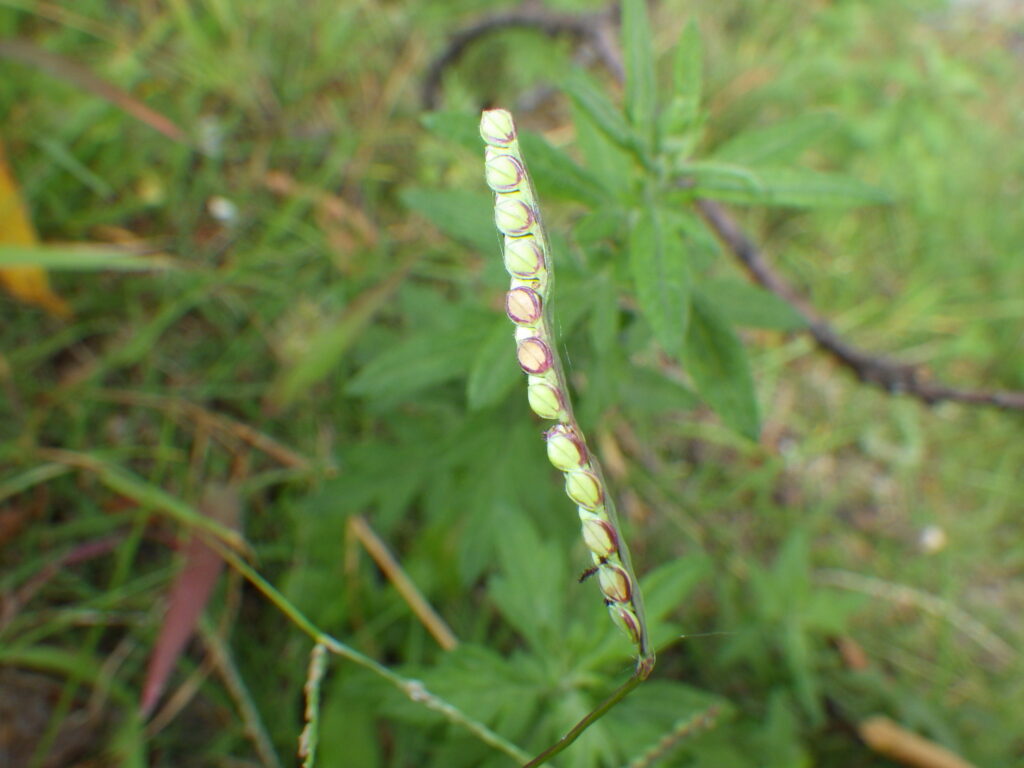
この現象を進化生物学的に考えると、甘露には宿主植物から糖を獲得するという生理的な側面だけでなく、昆虫を介した胞子散布を促進するという生態的な側面もあると考えられます。昆虫による胞子散布が菌の感染機会を増やすのであれば、甘露を伴う胞子散布システムは、菌の繁殖成功率を高める可能性があります。
Summary: Why does ergot fungus produce toxins?
From an evolutionary biology perspective, the most plausible explanation for why ergot fungi produce ergot alkaloids is that it functions as a chemical defense to suppress damage from animal grazing.
麦角アルカロイドは、昆虫や哺乳類の神経系に作用し、摂食行動や生存に影響を与えます。
この性質は、麦角菌自身や、菌が生活する宿主植物を食害から守るうえで有利に働く可能性があります。
特に興味深いのは、麦角菌が植物病原菌でありながら、状況によっては宿主植物にも防御的な利益を与える可能性があることです。
また、麦角アルカロイドの生合成遺伝子クラスターは、遺伝子の獲得・喪失・機能変化などを通じて進化してきました。その結果、菌類の系統ごとに異なるアルカロイドが生産されるようになったと考えられています。
ただし、すべてのアルカロイドが同じ生態的機能を持つとは限りません。また、麦角菌が現在生産しているアルカロイドのすべてについて、進化的な選択圧が明らかになっているわけでもありません。
今後は、特定のアルカロイドを生産できない変異株と野生株を比較し、昆虫や哺乳類による食害、菌核の生存率、菌の繁殖成功率などを調べることで、アルカロイド生産が麦角菌自身の適応度にどの程度貢献しているのかを明らかにする必要があります。
For ergot fungi, producing toxins may not simply be about accumulating metabolites, but rather an evolutionary strategy to secure opportunities for survival and reproduction through interactions with other organisms.
References
Butler, M. D., Hammond, P. C., & Berry, R. E. (2001). Association of insects and ergot (Claviceps purpurea) in Kentucky bluegrass seed production fields. Journal of Economic Entomology, 94(6), 1471-1476. https://doi.org/10.1603/0022-0493-94.6.1471
Clay, K., & Cheplick, G. P. (1989). Effect of ergot alkaloids from fungal endophyte-infected grasses on fall armyworm (Spodoptera frugiperda). Journal of Chemical Ecology, 15(1), 169-182. https://doi.org/10.1007/BF02027781
Florea, S., Panaccione, DG, & Schardl, CL (2017). Ergot alkaloids of the family Clavicipitaceae. Phytopathology, 107 (5), 504-518. https://doi.org/10.1094/PHYTO-12-16-0435-RVW
Laihonen, M., Saikkonen, K., Helander, M., Vázquez de Aldana, B. R., Zabalgogeazcoa, I., & Fuchs, B. (2022). Epichloë endophyte-promoted seed pathogen increases host grass resistance against insect herbivory. Frontiers in Microbiology, 12, 786619. https://doi.org/10.3389/fmicb.2021.786619
Marcet-Houben, M., & Gabaldón, T. (2016). Horizontal acquisition of toxic alkaloid synthesis in a clade of plant associated fungi. Fungal Genetics and Biology, 86, 71-80. https://doi.org/10.1016/j.fgb.2015.12.006
Miedaner, T., & Geiger, H. H. (2015). Biology, genetics, and management of ergot (Claviceps spp.) in rye, sorghum, and pearl millet. Toxins, 7(3), 659-678. https://doi.org/10.3390/toxins7030659
Mower, R. L., & Hancock, J. G. (1975). Mechanism of honeydew formation by Claviceps species. Canadian Journal of Botany, 53(23), 2826-2834. https://doi.org/10.1139/b75-310
Panaccione, D. G. (2005). Origins and significance of ergot alkaloid diversity in fungi. FEMS Microbiology Letters, 251(1), 9-17. https://doi.org/10.1016/j.femsle.2005.07.039
Panaccione, D. G., & Arnold, S. L. (2017). Ergot alkaloids contribute to virulence in an insect model of invasive aspergillosis. Scientific Reports, 7, Article 8930. https://doi.org/10.1038/s41598-017-09107-2
Sugiura, S., & Yamazaki, K. (2007). Migratory moths as dispersal vectors of an introduced plant-pathogenic fungus in Japan. Biological Invasions, 9(2), 101-106. https://doi.org/10.1007/s10530-006-9006-8
Tudzynski, P., & Scheffer, J. (2004). Claviceps purpurea: Molecular aspects of a unique pathogenic lifestyle. Molecular Plant Pathology, 5(5), 377-388. https://doi.org/10.1111/j.1364-3703.2004.00237.x
Wäli, P. P., Wäli, P. R., Saikkonen, K., & Tuomi, J. (2013). Is the pathogenic ergot fungus a conditional defensive mutualist for its host grass? PLOS ONE, 8(7), e69249. https://doi.org/10.1371/journal.pone.0069249
Yehuda, R., & Lehrner, A. (2023). Psychedelic therapy—a new paradigm of care for mental health. JAMa, 330 (9), 813-814. https://doi.org/10.1001/jama.2023.12900
Young, C. A., Schardl, C. L., Panaccione, D. G., Florea, S., Takach, J. E., Charlton, N. D., Moore, N., Webb, J. S., & Jaromczyk, J. (2015). Genetics, genomics and evolution of ergot alkaloid diversity. Toxins, 7(4), 1273-1302. https://doi.org/10.3390/toxins7041273