Orchid family

Sponsored Link
plant

What are the differences between agave and yucca? We'll explain how to distinguish between similar species! Is it a myth that they live for 100 years? Is it a myth that they're used to make tequila?

Agave, agave, Yucca, and Yucca all belong to the Asparagaceae family (formerly known as the Asparagaceae family). They are characterized by their large size, sometimes reaching the height of a child or adult, and their monocotyledonous leaves with parallel veins. Their impressive presence and drought tolerance...
Seed Plant Encyclopedia

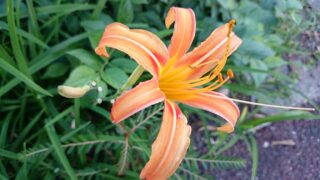
[Seed Plant Encyclopedia #085] What are the species of Hemerocallisaceae? Photo List

The family Asphodelaceae, also known as the Asphodeloideae family, is characterized by its linear leaves and flower stalks that rise from between the leaf clusters. (Asphodeloideae includes genera such as Asphodelus, Kniphofia, and Aloe...).
Seed Plant Encyclopedia

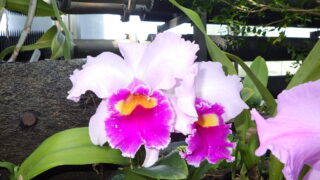
[Seed Plant Encyclopedia #074] What are the types of orchids? Photo list

Orchids (Orchidaceae) are terrestrial, epiphytic, lithophytic, mycoheterotrophic perennial herbs. Stems are monopodial (single-stemmed) or sympodial (compound-stemmed) with long stems, or they have rhizomes or enlarged pseudobulbs. Leaves are mostly flattened, with a tubular sheath at the base, sometimes reduced to scales. Flowers are...
Seed Plant Encyclopedia

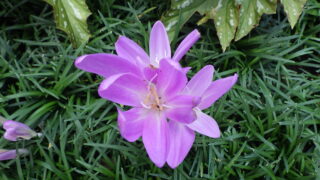
[Seed Plant Encyclopedia #069] What are the species of Colchicaceae? Photo List

Colchicaceae are perennial herbs. They have corms or rhizomes. Leaves are alternate, opposite, or whorled, sometimes clustered at the base of the stem. Flowers are solitary or borne in racemes or cymes, exhibiting considerable diversity. They usually bear bisexual flowers. Perianth segments are separate or fused, with 6...
plant

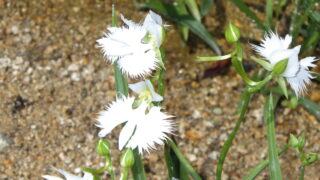
What species resembles the egret orchid? The flowers are visited by hawk moths! And not only that, tiny insects called thrips also play an important role in pollination! What is the "Egret Orchid Legend"?

The egret orchid (Habenaria radiata) is a perennial plant that inhabits slightly damp areas and is a popular choice for gardening. Unfortunately, due to the decline of its wetland habitat and illegal harvesting, it is listed as near-threatened on the Ministry of the Environment's Red List. There are many closely related species, and many that share the name "egret orchid," but this particular species has a flattened stem resembling a heron...
plant

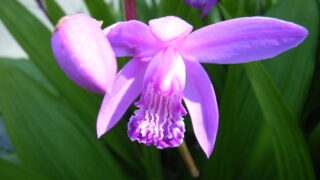
What species resembles the Bletilla striata (purple orchid)? Recent research has revealed that the flowers not only deceive bees, but also utilize male bees for courtship!

Bletilla striata is a perennial plant naturally distributed from Honshu to Okinawa in Japan, but wild specimens are classified as near-threatened. On the other hand, it's also a popular ornamental plant, and can be seen in almost every town. While it was once thought that the wild population in Japan consisted of escaped cultivated plants, it is now believed that the wild population is...
plant

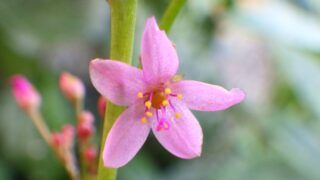
What are the differences between Portulaca grandiflora and Portulaca triangularis? How to distinguish between similar species! Where is it native? Why is it called "three o'clock grass"? There were hardly any insects visiting the flowers! Is it true that the fruit "bursts open" to scatter the seeds?

Portulaca grandiflora and Portulaca triangularis are two species of Portulaca grandiflora that produce pink flowers. Both are found in Japan as invasive species, either as cultivated plants or through escaped growth. Both species are native to the Americas. These two species differ in many ways, including the arrangement of the inflorescence, the presence or absence of ridges on the flower stalk, the size of the petals, and the shape of the stigma...
plant

What are the differences between Monotropa uniflora, Monotropa uniflora var. alba, and Monotropa japonica? We explain how to distinguish between similar species! Why did they lose photosynthesis? What insects visit the flowers? Cockroaches are responsible for seed dispersal!?

Monotropa uniflora, Monotropa uniflora var. japonica, and Monotropa uniflora are three plant species that grow in the dark forest floor where photosynthesis has been lost. They lack normal leaves, instead having reduced scale-like leaves. They have only stems and flowers, and their entire bodies are white due to the absence of chlorophyll. They are known as mycoheterotrophic plants, but the distinction is not always clear...
plant

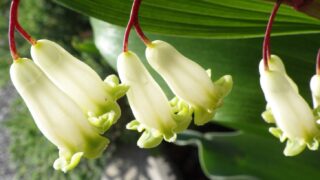
What are the differences between Polygonatum odoratum, Polygonatum sibiricum, Polygonatum humile, and Disporum sessile? What insects visit the downward-facing flowers? Polygonatum odoratum was producing flowers with only stamens due to nutrient deficiency!?

Polygonatum odoratum, Polygonatum sibiricum, Polygonatum humile, and Disporum sessile are all species that bloom in spring and are commonly found in gardens and as wildflowers, but they can be a little difficult to distinguish because they are often sold mixed together. Therefore, I have summarized the botanical distinguishing features of the Polygonatum genus. Mainly, the way the flowers grow...
plant

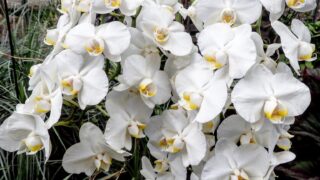
There are differences between Phalaenopsis orchids and other similar species! We'll explain how to distinguish between them! Why are they so popular? What's their history? Did the flowers attach pollen clumps to the backs of insects?! But the species is unknown?

Phalaenopsis orchids are very popular in Japan as high-end potted plants and cut flowers. They are the number one orchid species in terms of both production volume and value. However, they are also known as "Phalaenopsis," which can be confusing. Biologically, however, the terms refer to different species, with Phalaenopsis being the "Phalae..." orchid.
Sponsored Link