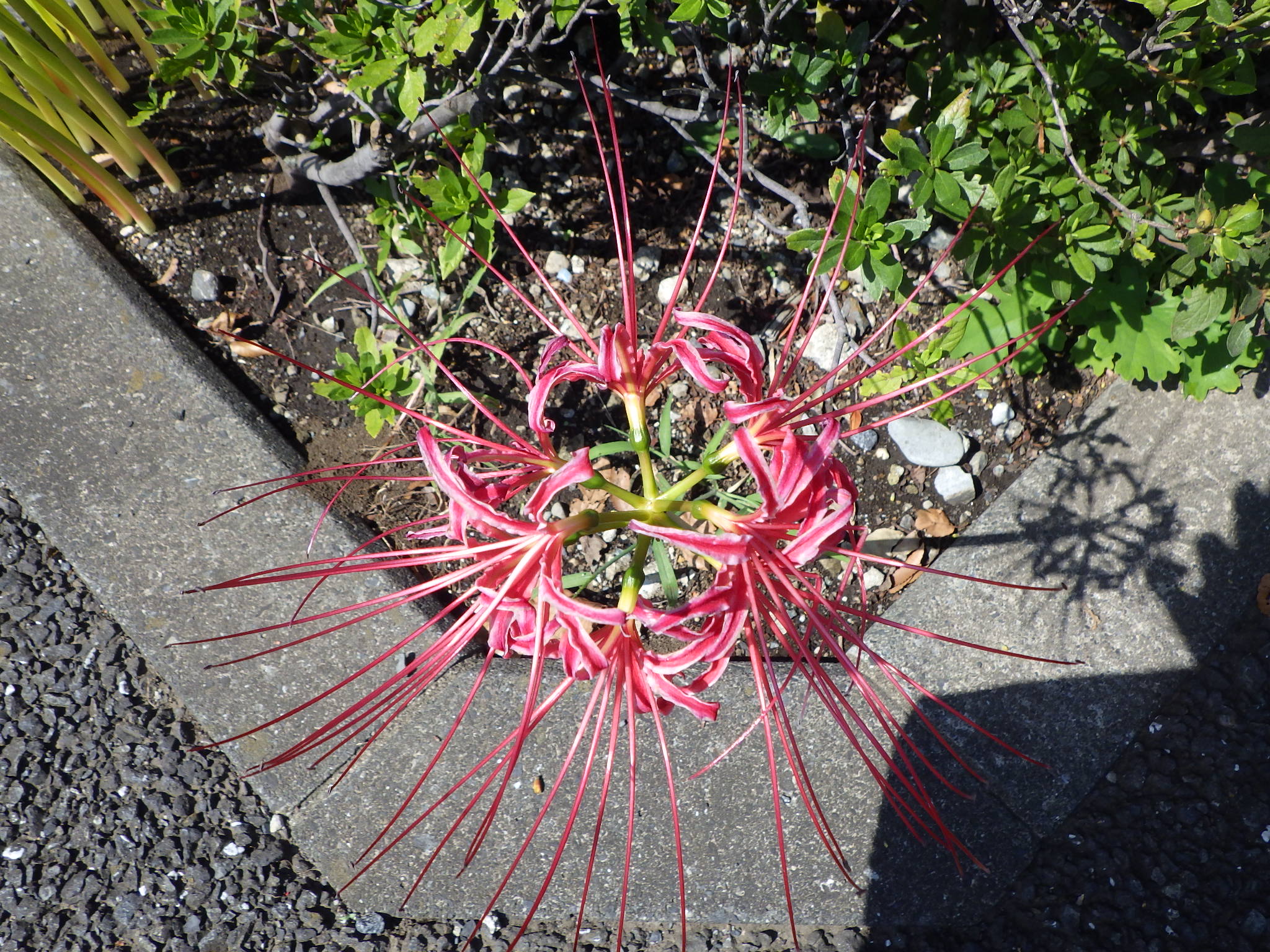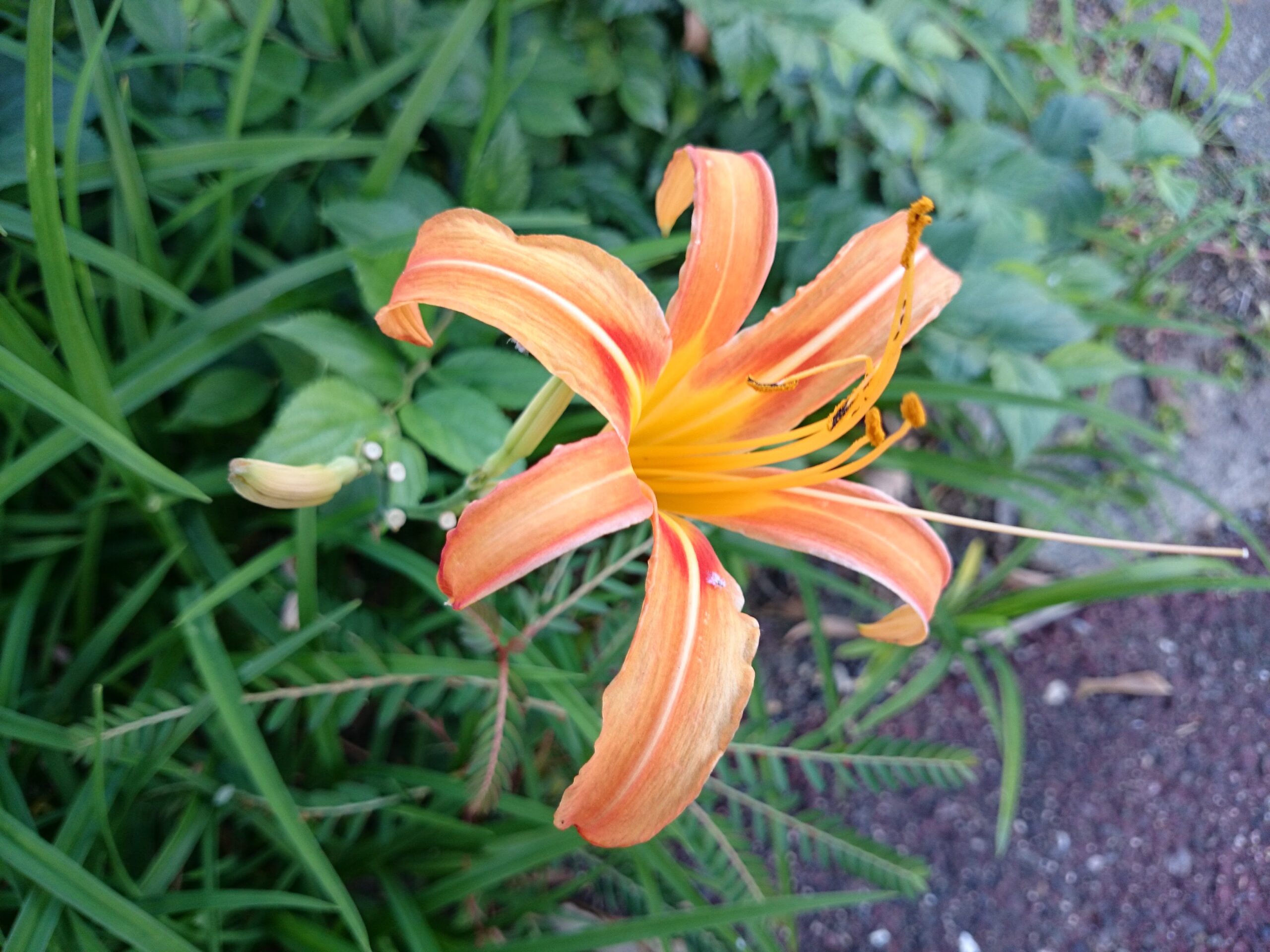
The family Asphodelaceae, also known as the Asphodelaceae, is characterized by its linear leaves and flower stalks that rise from between the leaf clusters. It consists of three subfamilies and approximately 35 genera: Asphodeloideae (about 15 genera including Asphodelus, Kniphofia, and Aloe), Xanthorrhoeoideae (only Xanthorrhoea in Australia), and Hemerocallidoideae (about 20 genera mainly in the Southern Hemisphere, East Asia, and Europe, including Dianella, Phormium, and Hemerocallis). In Japan, Dianella ensifolia (found in the Kii Peninsula of Honshu, Shikoku, Kyushu, the Ryukyu Islands, and the Ogasawara Islands) and Hemerocallis are native. In the APG III system, the family name Xanthorrhoeaceae was used, but in the APG IV system, Asphodelaceae is used. Regarding the Japanese names of the families, the former Xanthorrhoeaceae was called Susunoki-kae and the former Asphodelaceae was called Tsuruboran-kae, but since the genera Susunoki and Tsuruboran are not native to Japan and are unfamiliar taxonomic groups, the Japanese name "Wasuregusa-kae" has been proposed since the APG III system.
This article provides a comprehensive, illustrated guide to plants belonging to the Hemerocallis family.
The basic information is based on Tsukamoto (1994) and the Kanagawa Prefectural Flora Survey Association (2018). Photographs are replaced as better ones become available. While the identifications are made by the author, please note that they may be changed without notice if misidentifications are found.
No.0519 Maoran Phormium tenax
This evergreen perennial plant is also known as New Zealand flax or New Zealand hemp. Its leaves, which have yellow vertical stripes, are long, narrow, pointed at the tip, and glossy, reaching up to 2 meters in length. The leaves grow in clumps, from which flower stalks emerge, bearing bright red or yellow flowers. It is endemic to New Zealand and Norfolk Island in Australia. It is an introduced species on several Pacific islands and in Australia. It can be found in lowlands, riverbanks, and wetlands in low mountainous areas. After the arrival of the Maori people in New Zealand, its fibers were widely used in traditional Maori textiles. After the arrival of Europeans, it was also used as a material for ropes and sails, at least until before World War II.
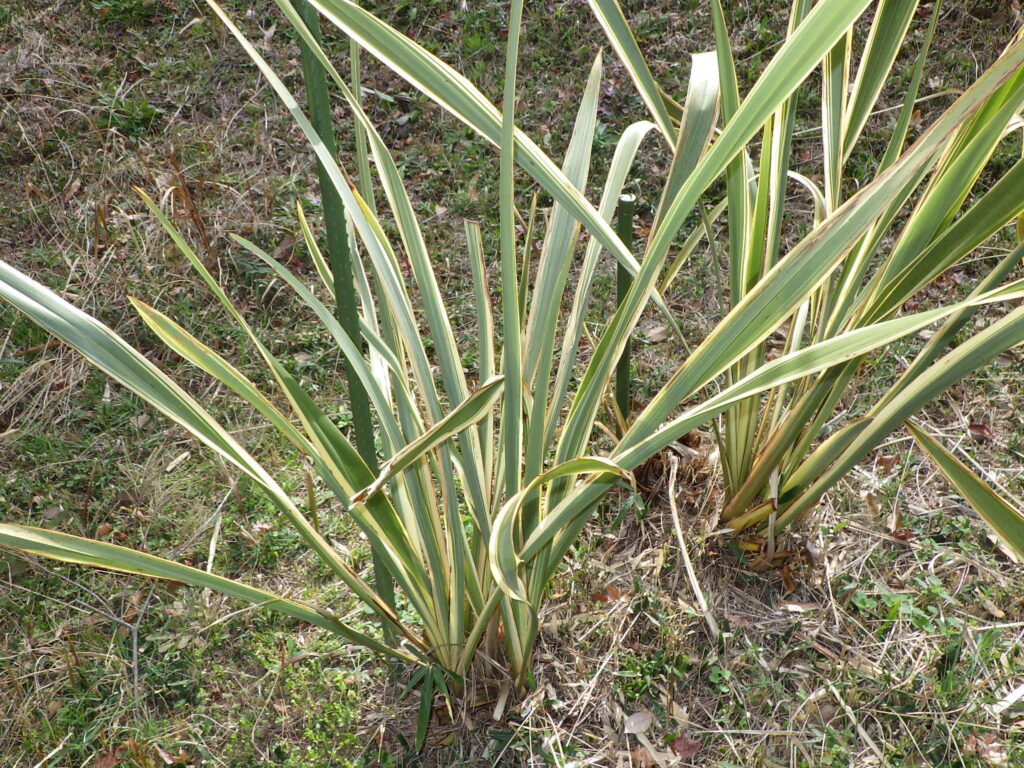
No.0520 Daylily Hemerocallis fulva var. longituba
This is a perennial herb. The leaves are narrow and green. It flowers in July and August. The flower stalks are 50-70 cm tall. The flowers have six petals. They are usually orange-red, but occasionally some lack the red markings. The leaves wither in winter. Typical characteristics include narrow leaves, a bifurcated inflorescence with a narrow flower stalk, and a long flower tube, but some individuals are difficult to distinguish from Hemerocallis fulva. After flowering, the flowers fall off along with the ovary, and fruiting is rare. It is distributed in Honshu, Shikoku, and Kyushu, and grows on riverbanks, rice paddy ridges, and grasslands at the edges of forests.
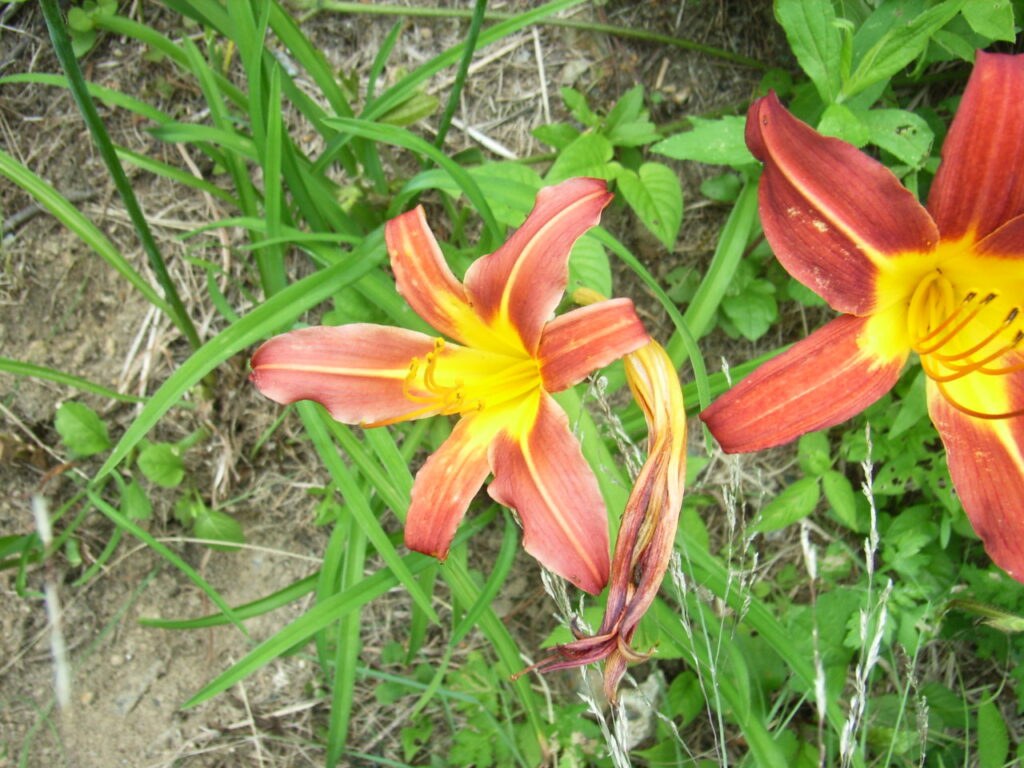
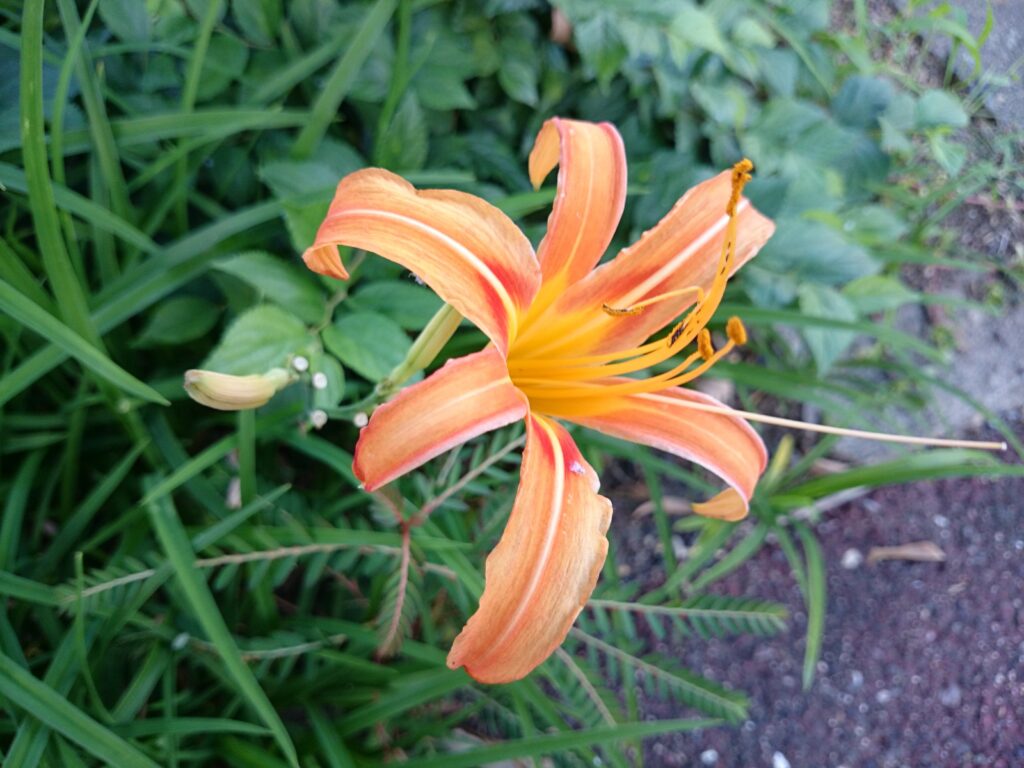
No.0521 Hemerocallis fulva var. kwanso
This is a perennial herb. Its leaves are broad, yellowish-green, and grow densely. It flowers from July to August, and in this prefecture, the flowering period is from the end of June to July. The flower stalks are 50 to 100 cm tall. The flowers are orange-red, double-petaled, and the stamens have transformed into petals. It is triploid and therefore does not produce fruit. It is distributed in Hokkaido, Honshu, Shikoku, Kyushu, and China. It grows on riverbanks, rice paddy ridges, and in gardens. Like the red spider lily, it is said to be a prehistoric naturalized plant that was introduced to Japan from China in ancient times, but it does not grow wild in China (although it is cultivated there), and the origin of its place of origin is unclear.
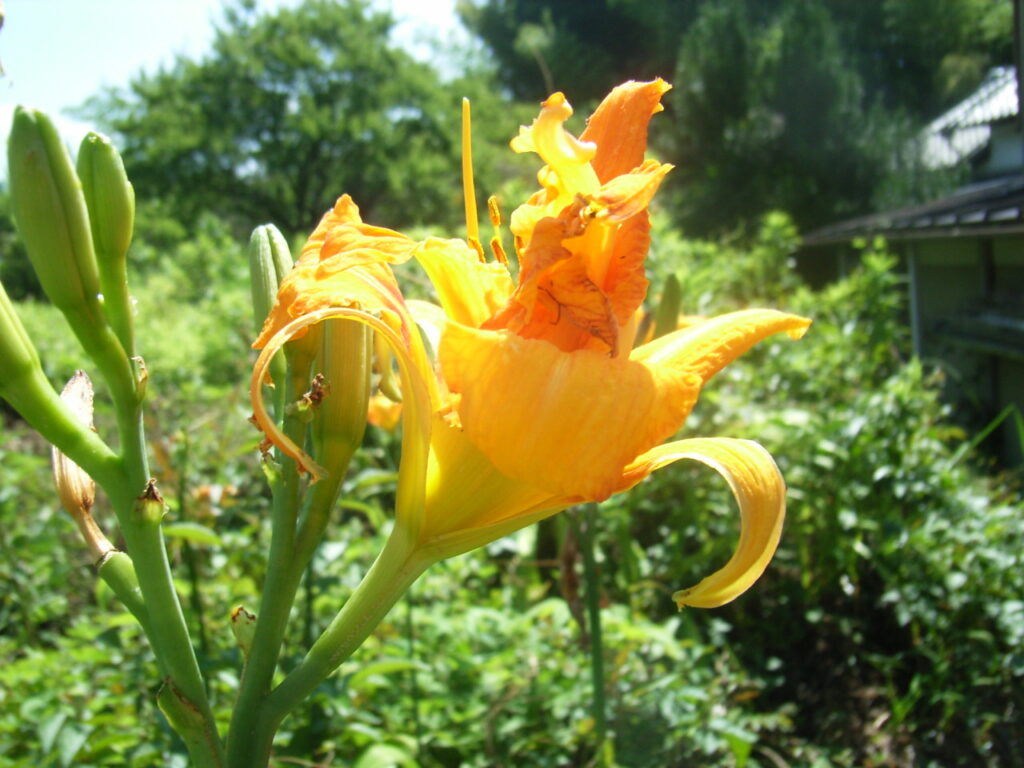
No.0524 Hemerocallis citrina var. vespertina
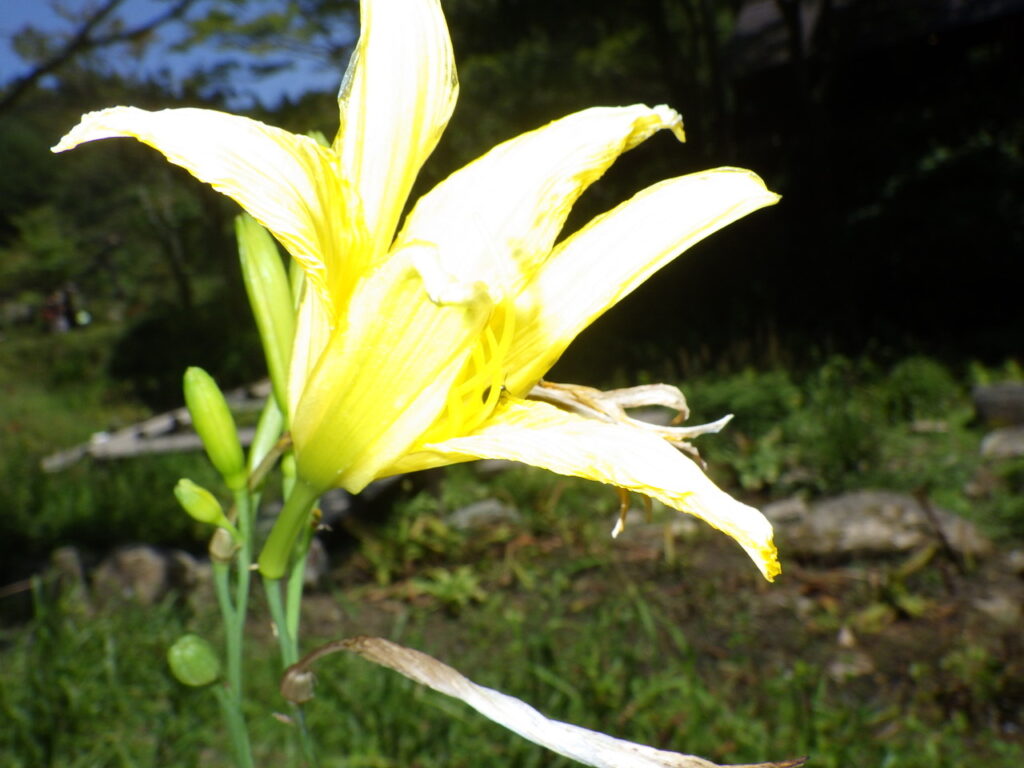
This is a perennial herb. Its Japanese name comes from the fact that its flowers open in the evening and wilt by the morning of the next day, and its leaves resemble those of a sedge. The stems reach a height of 100-150 cm. The roots are yellow and stringy and do not form clumps. The basal leaves are linear, 40-50 cm long and 5-15 cm wide, growing in two rows and fanning out, with only the upper part slightly drooping. At the tip of a single stem, the inflorescence branches out, bearing successive upward-facing, trumpet-shaped, lemon-yellow flowers. Unlike Hemerocallis fulva, anthocyanins are not synthesized in the flowers, and the petals are not reddish. The petals are deeply divided into six lobes and have a slight fragrance. The length and width of the perianth segments vary from individual to individual, with the perianth segments being 6.5-7.5 cm long and the corolla tube being 2.5-3 cm long. The stamens are shorter than the perianth segments, the anthers are blackish-purple, and the style is slightly longer than the stamens. The flowering period is from July to September. The flowers open in the evening and wilt by the following morning. The capsule is broadly oval, about 20 mm long, with a notched tip. The seeds are about 5 mm long, black, oval-shaped, and glossy. It is distributed in Siberia, northeastern China, the Korean Peninsula, and Honshu, Shikoku, and Kyushu in Japan. It grows in somewhat dry places such as mountain grasslands and forest edges. It is pollinated by hawk moths, and it is known that the yellow corolla, fragrant flowers, short pistil, and long corolla tube evolved from flowers pollinated by butterflies and bees (Nitta et al., 2007).
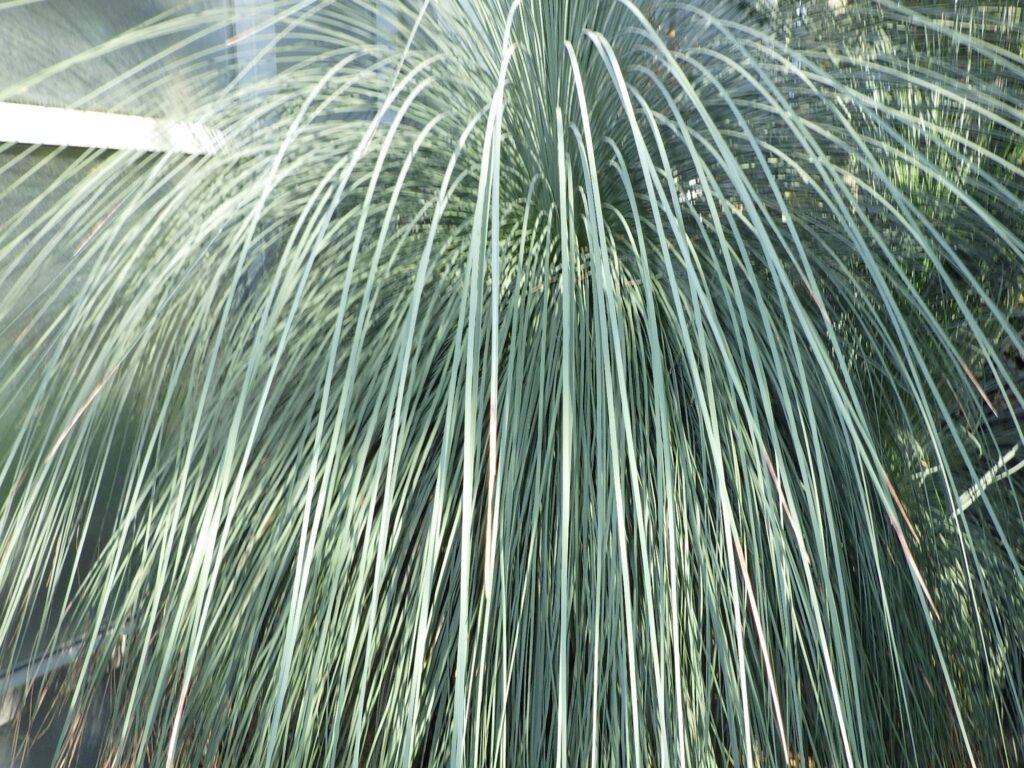
No.0524.a *Xanthorrhoea preissii*
An evergreen shrub, also known as grass tree. It grows to a height of 1-2 meters. The leaves are silvery-white, long, narrow, and very stiff. They are about 4 mm wide and 60-100 cm long. The flower stalks are very long, about 1 meter. The flowers are whitish-green and densely packed in spike-like inflorescences. The spike-like inflorescence itself is also about 1 meter long. It is a very slow-growing plant. Although bushfires are common in Australia's native forests, the grass tree can withstand them and survive, with only its surface being charred. It is found in the dry native forests of southwestern Australia. When the stem of the grass tree is wounded, a yellow resin is released, which becomes rubbery and is called grass tree gum locally.
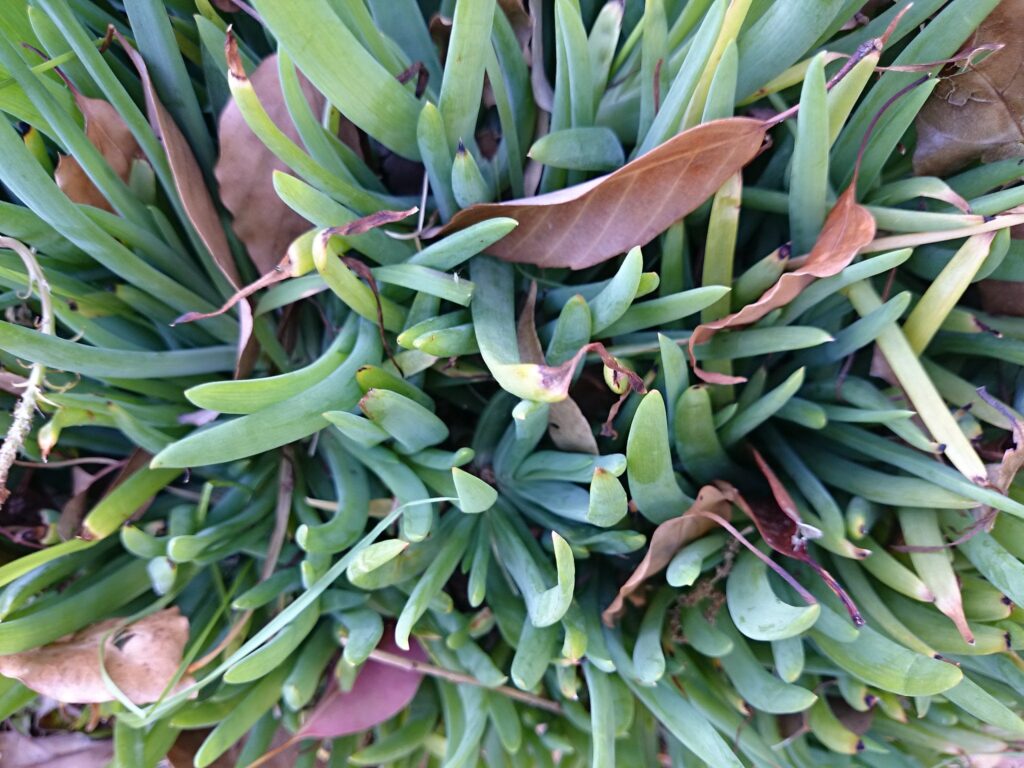
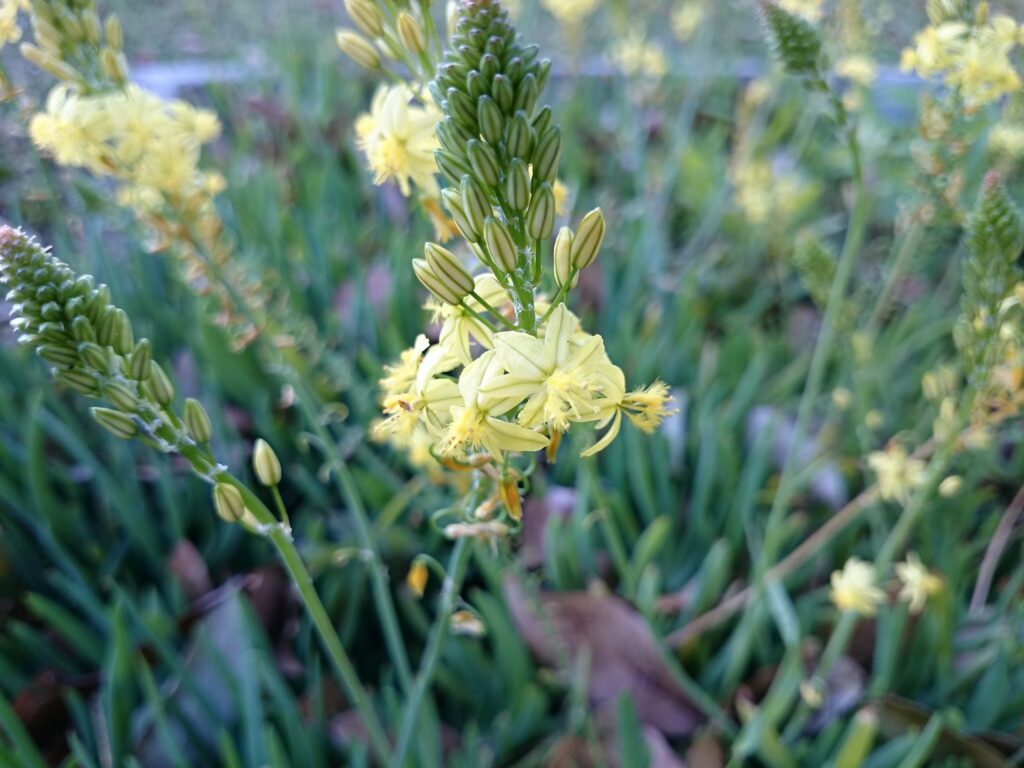
No.0525.a Hana Aloe Bulbine frutescens
An evergreen perennial herb, also known as Bulbine frutescens. It grows in clumps, reaching a height of 25-60 cm. The leaves are fleshy, narrow, lanceolate, and about 15 cm long. It flowers from April to November. Long flower stalks bear small, star-shaped flowers with six petals in a raceme. The petals are orange, yellow, and white. The stamens are densely covered with fine hairs. Each flower lasts only one day, but it blooms continuously. It is heat tolerant. Native to South Africa, it is cultivated in Japan.
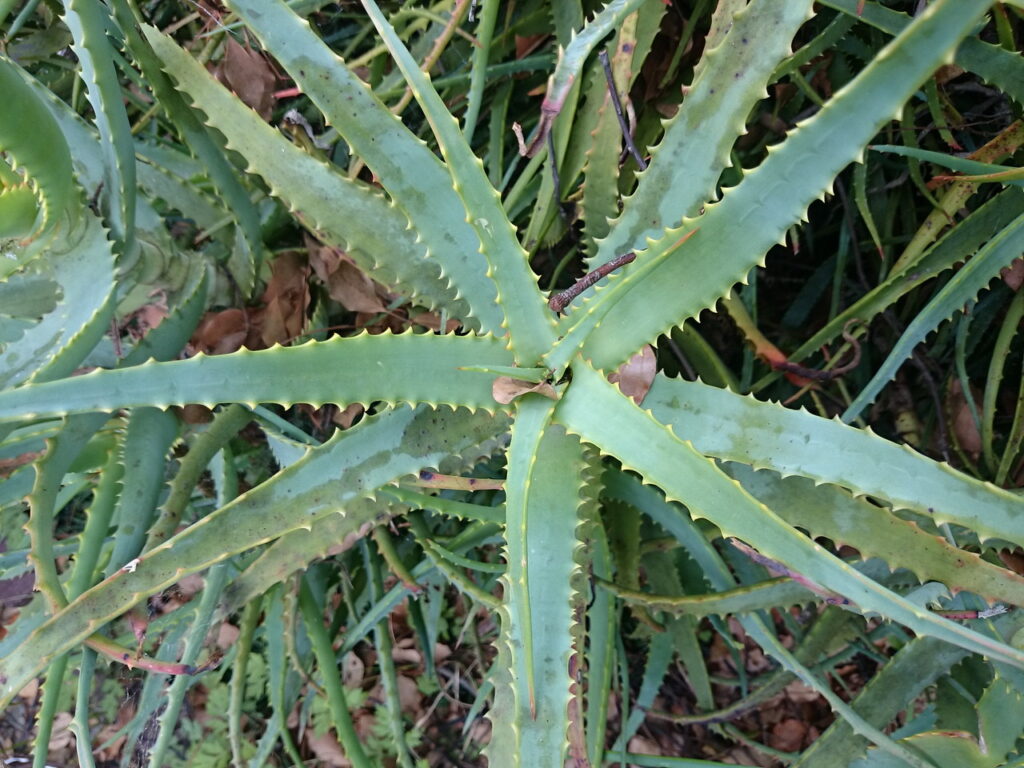
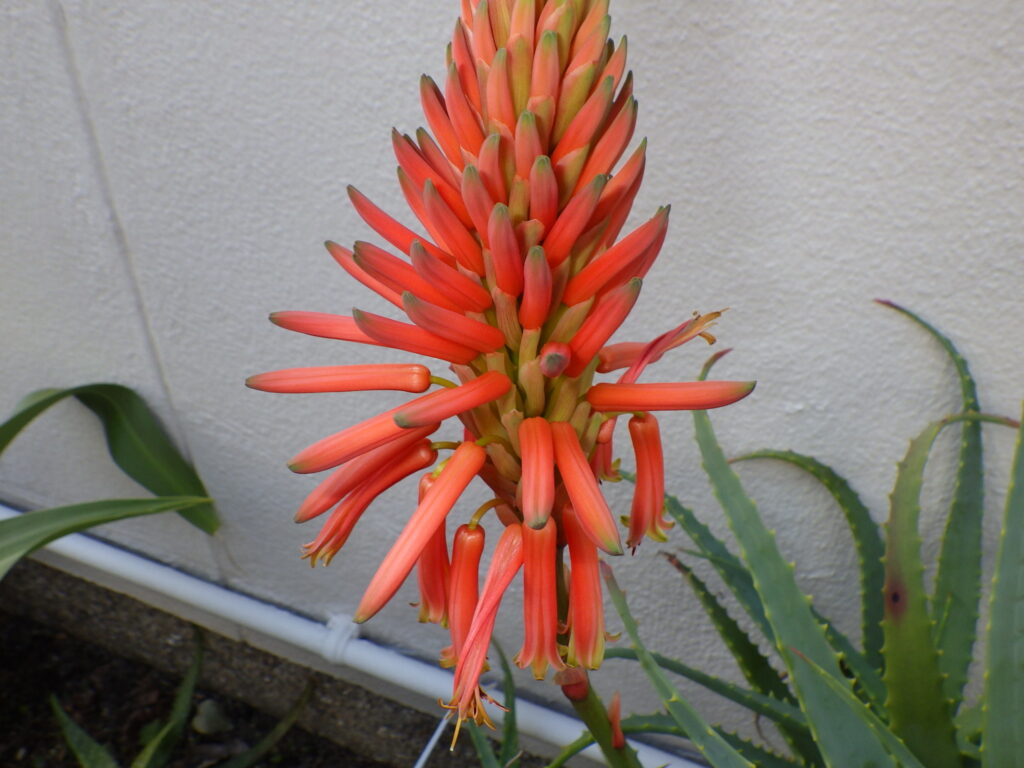
No.0526 Aloe arborescens
This evergreen perennial herb is also known as Aloe arborescens. The name "Rokai" is a phonetic pronunciation of its Chinese name, 蘆薈 (Luhui). Native to South Africa, it grows to a height of 1-2m, branching profusely and forming clumps. The leaves are densely covered with horny, triangular spines along the margins. The leaves are 45-60cm long and 5cm wide, grayish-green to green, sword-shaped, and densely arranged. The flowers are cylindrical, 4cm long, bright red, and form racemes. Native to southern Africa, it is used as a folk remedy for stomach ailments and constipation, with the transparent, fleshy part of the fresh leaves being eaten, the dried leaves being brewed as aloe tea, and the juice of the fresh leaves being applied externally to treat athlete's foot and burns. Because it is a medicinal herb that cools the heat in the stomach and intestines and treats inflammation, it is contraindicated for people with sensitive stomachs and pregnant women. In Japan, Aloe vera is more commonly consumed as food. A bird called the sunbird, which has a long beak, comes in search of nectar and pollinates the flowers (Hargreaves et al., 2012).
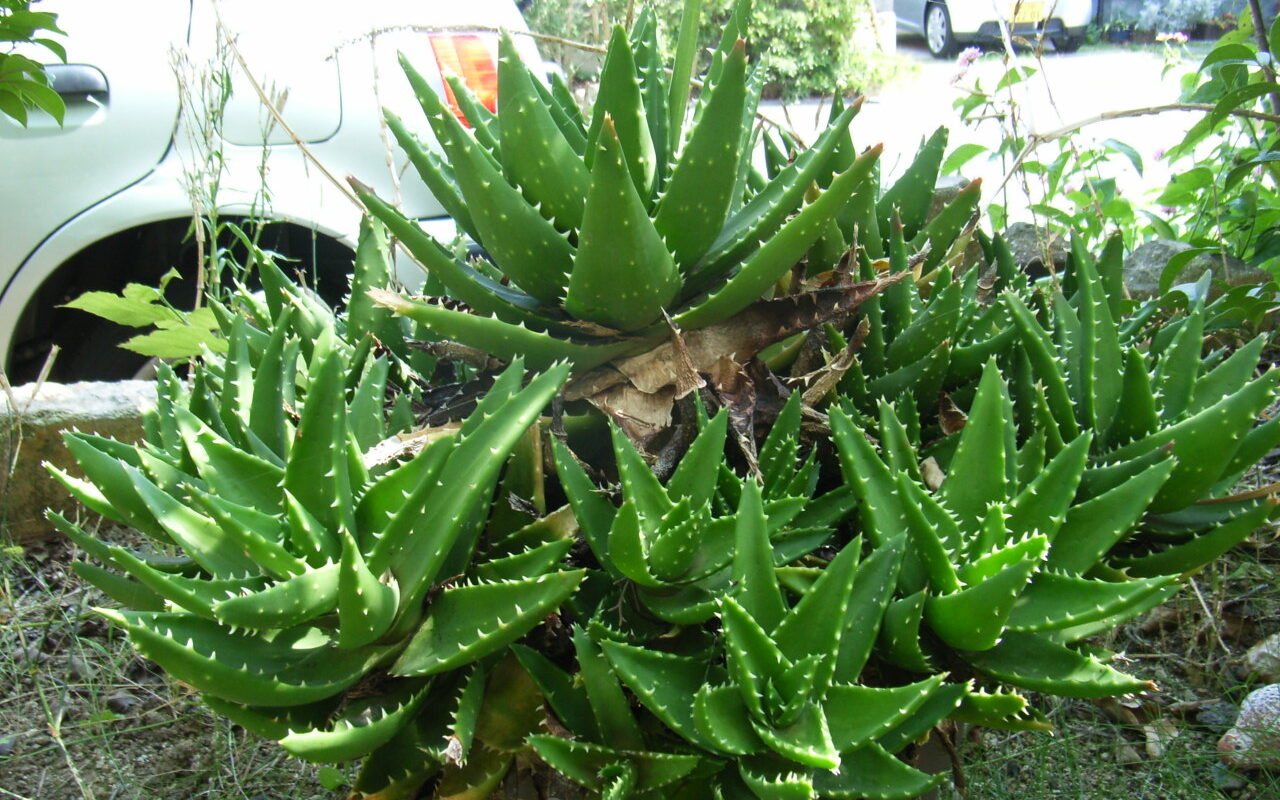
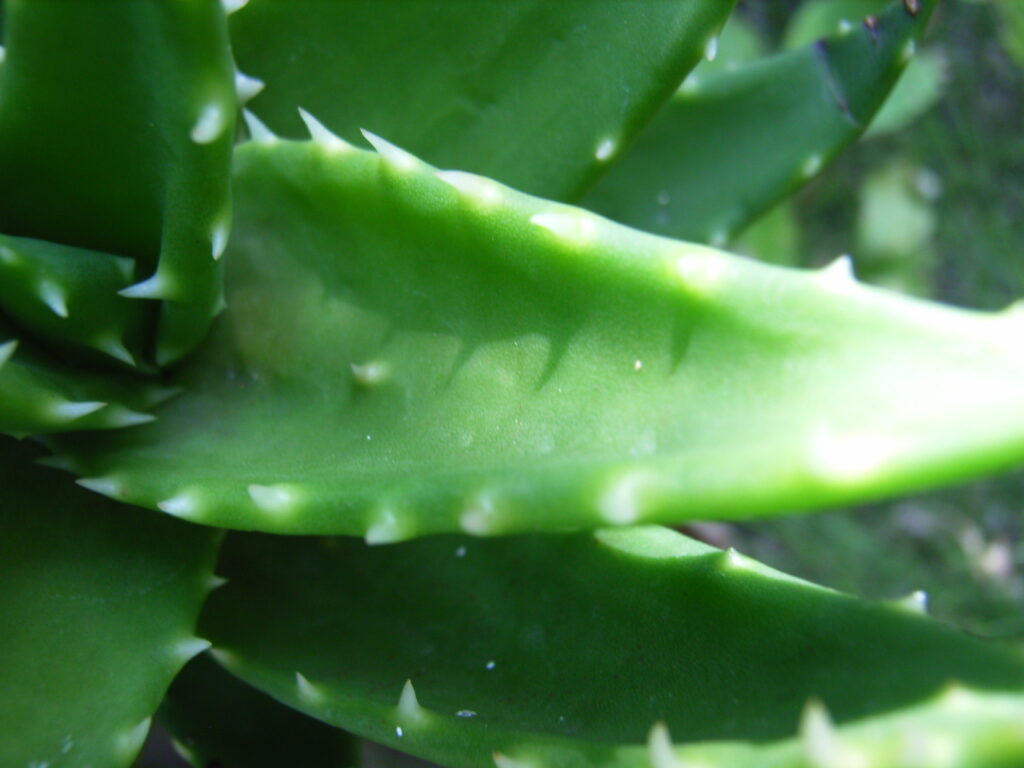
No.0526.a Aloe x nobilis
An evergreen perennial herb. Its name in Japanese is Fuyajo (不夜城), meaning "nightless castle." There are various theories, but it is generally considered to be an artificial hybrid of Aloe mitriformis (broad-leaved nightless castle), native to South Africa, and Aloe arborescens, or Aloe mitriformis and Aloe brevifolia (dragon mountain) (Smith & Figueiredo, 2015). It is succulent. The stems are erect, succulent, thick, and soft. The leaves are succulent, green, and triangular, with spiny serrations along the edges, and sparsely covered with short, yellowish-white spines on the outside of the leaves. They are densely arranged alternately in a spiral pattern. In winter, the leaves take on a slightly reddish tint. In plants several years old, around June, flower stalks emerge from the leaf axils, forming spindle-shaped inflorescences and bearing orange, tubular flowers. It is distinguished from *Hypochaeris erythrosora* by the size of its leaves, the shortness of its flowers, and the longness of its bracts. Since no wild individuals have been found in South Africa, it is thought to have originated from hybridization between cultivated plants in Europe. It has naturalized in parts of Portugal and is also cultivated in Japan.
References
Hargreaves, AL, Harder, LD, & Johnson, SD 2012. Floral traits mediate the vulnerability of aloes to pollen theft and inefficient pollination by bees. Annals of Botany 109(4): 761-772. https://doi.org/10.1093/aob/mcr324
Kanagawa Prefecture Flora Survey Association. 2018. Kanagawa Prefecture Flora 2018 (Electronic Edition). Kanagawa Prefecture Flora Survey Association, Odawara. 1803pp. ISBN: 9784991053726
Nitta, Kozue; Hasegawa, Masahiro; Miyake, Takashi; Yasumoto, Akiko; and Yahara, Tetsuichi. 2007. Investigating the genetic basis of floral traits related to pollination syndromes in Hemerocallis fulva and Hemerocallis fulva. Journal of the Ecological Society of Japan 57(1): 100-106. https://doi.org/10.18960/seitai.57.1_100
Smith, GF, & Figueiredo, E. 2015. Notes on Aloe × nobilis Haw. (Asphodelaceae: Alooideae). Haseltonia 21: 72-76. https://doi.org/10.2985/026.021.0110
Tsukamoto, Yotaro. 1994. Encyclopedia of Horticultural Plants, Compact Edition. Shogakukan, Tokyo. 3710pp. ISBN: 9784093051118