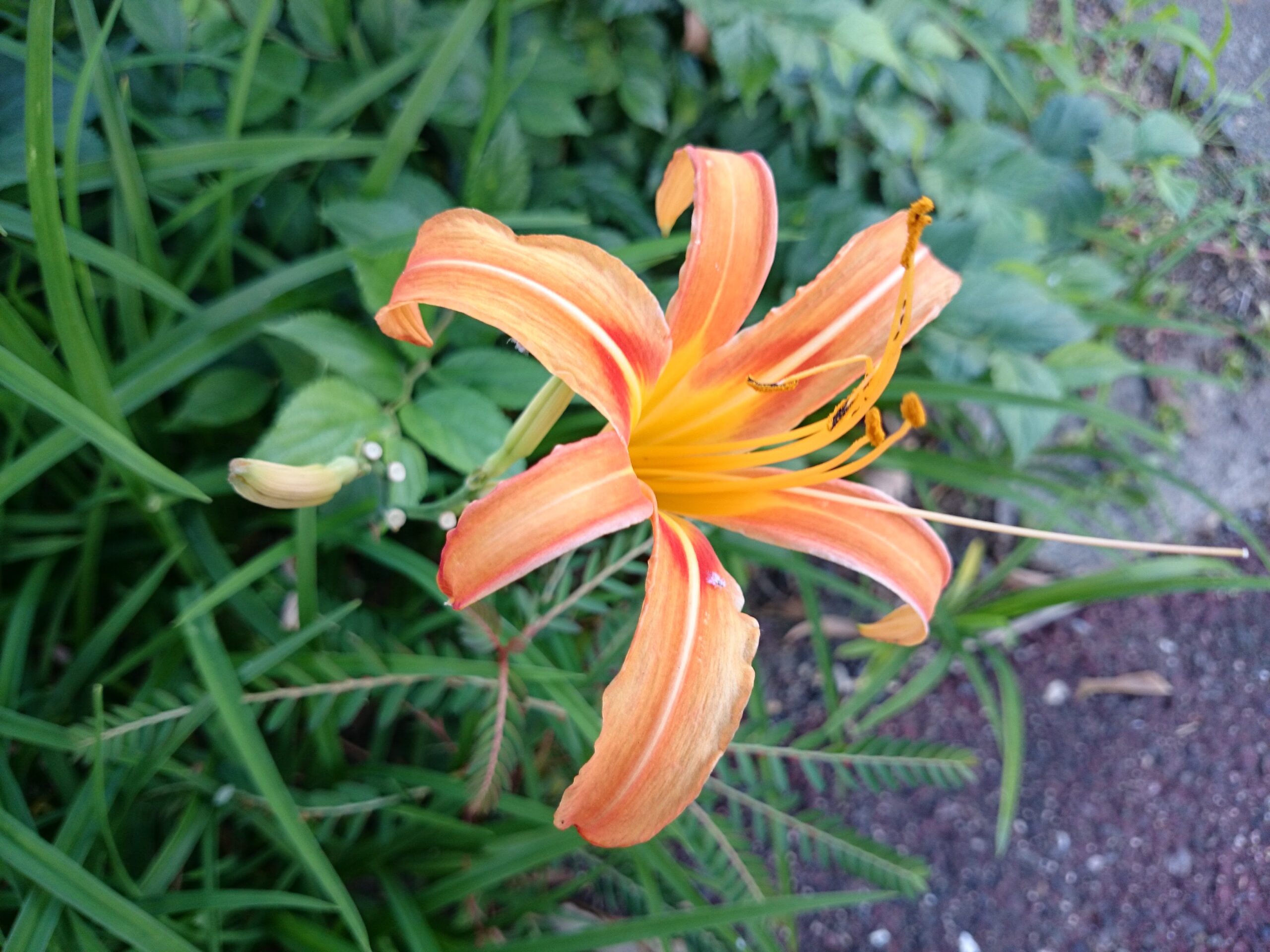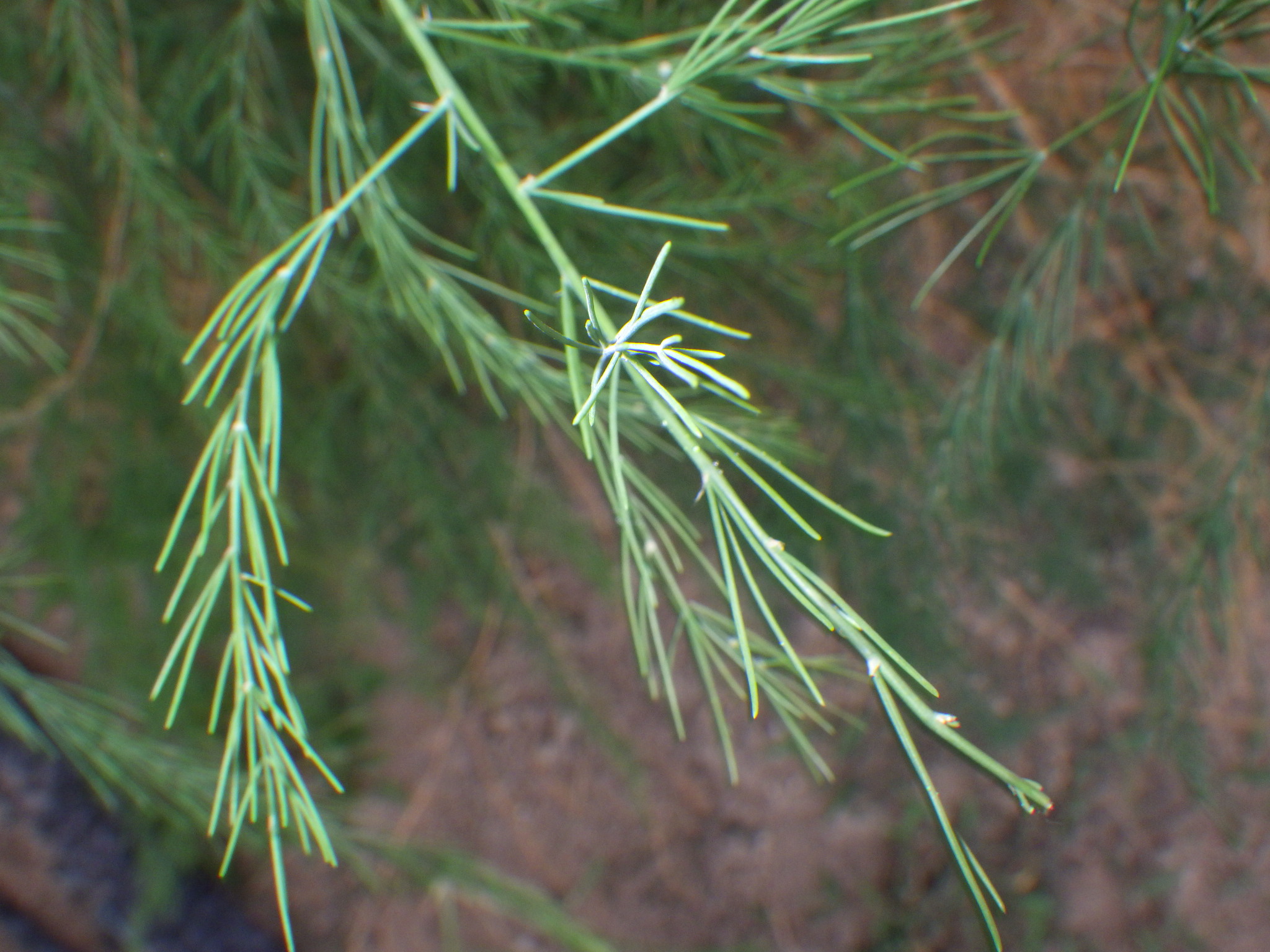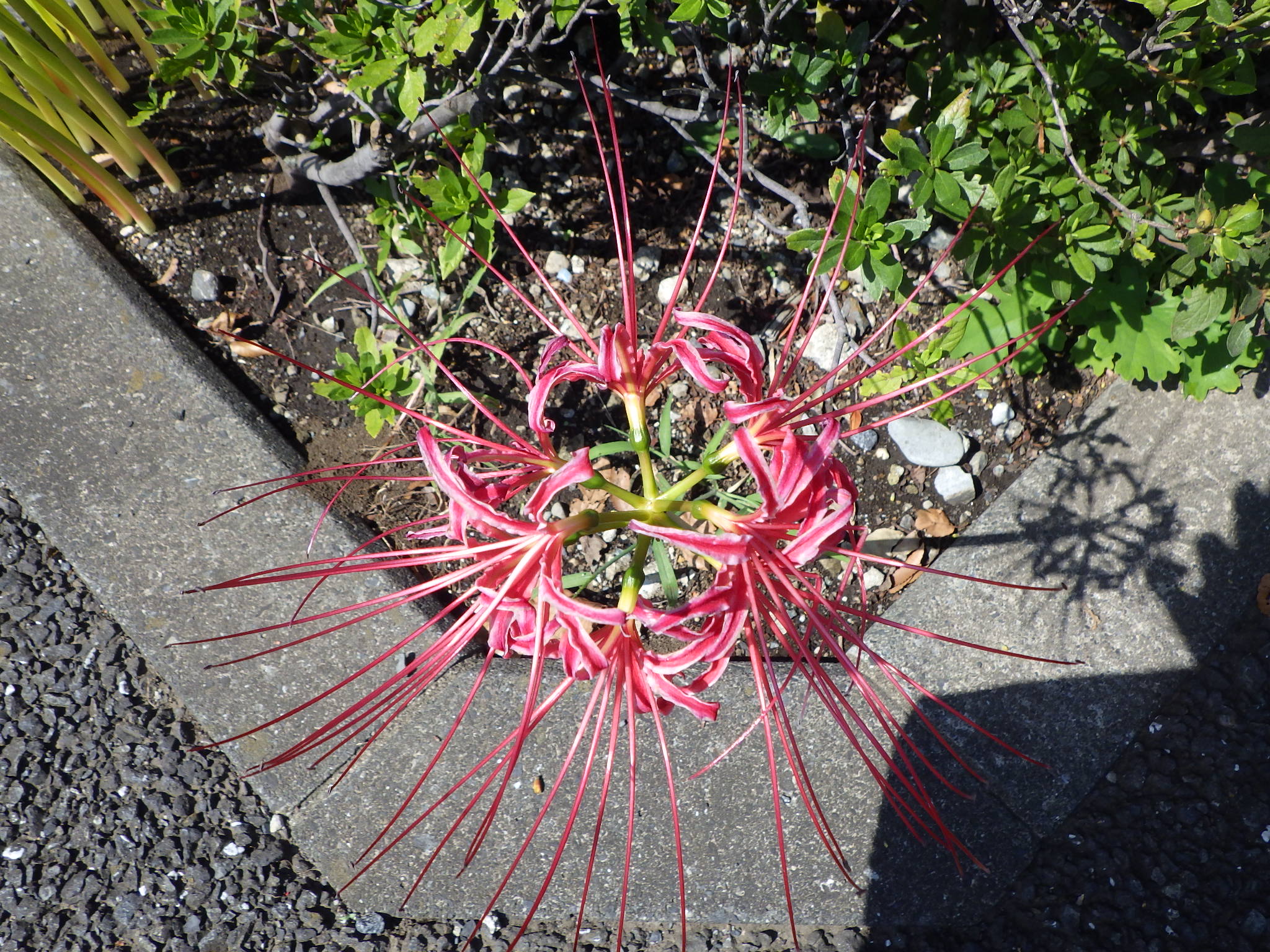
The Amaryllidaceae family consists of perennial herbs that usually have bulbs and basal leaves. The flowers are bisexual and radially or bilaterally symmetrical. They are borne singly in umbels at the terminal or on the flower stalk, with an involucre at the base of the inflorescence. There are three outer perianth segments and three inner perianth segments, and some have a corona. There are usually six stamens, and the ovary is three-chambered with axillary placenta. The fruit is a capsule, although berries are rare. The Amaryllidaceae family consists of the Agapanthoideae subfamily (Agapanthus only, not native to Japan, only cultivated varieties), the Allioideae subfamily (Allium, Ipheion, Allium, etc.), and the Amaryllidoideae subfamily (Crisis japonica, Lycoris, Narcissus, Zephyranthes, etc.). In the APG system, the Amaryllidaceae family became part of the Asparagales order, the entire Allioideae subfamily moved from the Liliaceae family, and the genus Ipheion, which was previously part of the Scilloideae subfamily, also moved. The former Allioideae subfamily and the genus Ipheion share similarities with the Amaryllidaceae family, such as having umbel inflorescences (sometimes single flowers) and membranous involucral bracts at the base of the inflorescence.
This article provides a comprehensive, illustrated guide to plants belonging to the Amaryllidaceae family.
The basic information is based on Tsukamoto (1994) and the Kanagawa Prefectural Flora Survey Association (2018). Photographs are replaced as better ones become available. While the identifications are made by the author, please note that they may be changed without notice if misidentifications are found.
- No. 0529 Allium macrostemon
- No. 0530 Chives (Allium tuberosum)
- No. 0532 Ezo leek (Allium schoenoprasum var. schoenoprasum)
- No. 0534 Wild Shallot (Allium thunbergii)
- No. 0535 Rakkyo (Japanese shallot) Allium chinense
- No. 0536 Garlic (Allium sativum)
- No. 0537 Leek (Allium fistulosum var. giganteum)
- No.0538 Onion (Allium cepa)
- No.0539.a Mitsukado Leek (Allium triquetrum)
- No.0539.b Otomenilla Allium neapolitanum
- No.0539.c Nothoscordum gracile (field chives)
- No.0539.d Nothoscordum bivalve (False Chives)
- No. 0540 Ipheion uniflorum
- No.0541 Hamaomoto Crinum asiaticum var. japonicum
- No.0541.1 Taiwanese Crinum asiaticum var. sinicum
- No. 0543 Red Spider Lily (Lycoris radiata var. radiata)
- No.0543.1 Lycoris radiata var. pumila
- No.0543.2 Lycoris radiata f. bicolor
- No.0544 White-flowered Red Spider Lily (Lycoris x albiflora)
- No. 0545 Lycoris traubii
- No.0547.a Amarcrinum memoria-corsii
- No.0549 Leucojum aestivum
- No.0549.a Acis autumnalis (Akizaki Snowflake)
- No. 0550 Japanese daffodil (Narcissus tazetta var. chinensis)
- No.0550.1 Double-flowered daffodil, Narcissus tazetta 'Plenus'‘
- No. 0552 Trumpet Daffodil (Narcissus pseudonarcissus)
- No.0552.a Cyclamineus Narcissus 'Tete a tete'‘
- No. 0554 Amaryllis Hippeastrum x hybridum
- No. 0555 Zephyranthes candida
- No. 0556 Zephyranthes carinata (False Saffron)
- No.0556.a Zephyranthes tubispatha
- No.0556.b Zephyranthes bifida
- No.0556.c Yellow-flowered Zephyranthes (Sternbergia lutea)
- No.0556.d Agapanthus praecox
- No.0556.e *Cyrtanthus mackenii subsp. mackenii*
- No.0556.f Clivia miniata
- References
No. 0529 Allium macrostemon
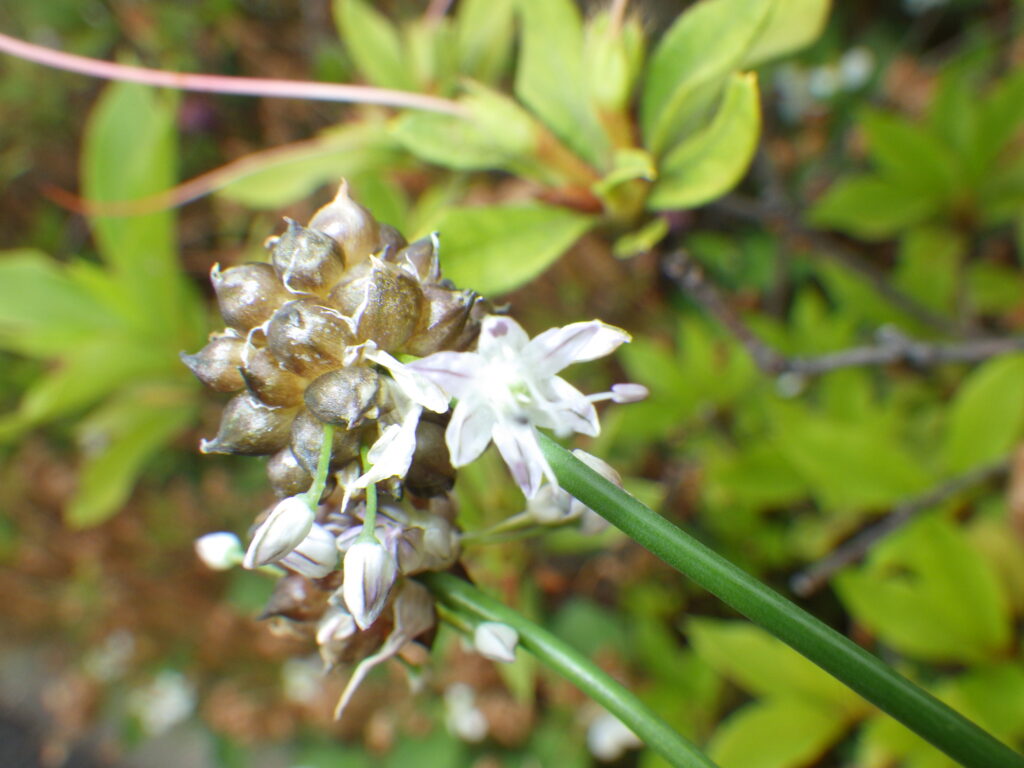
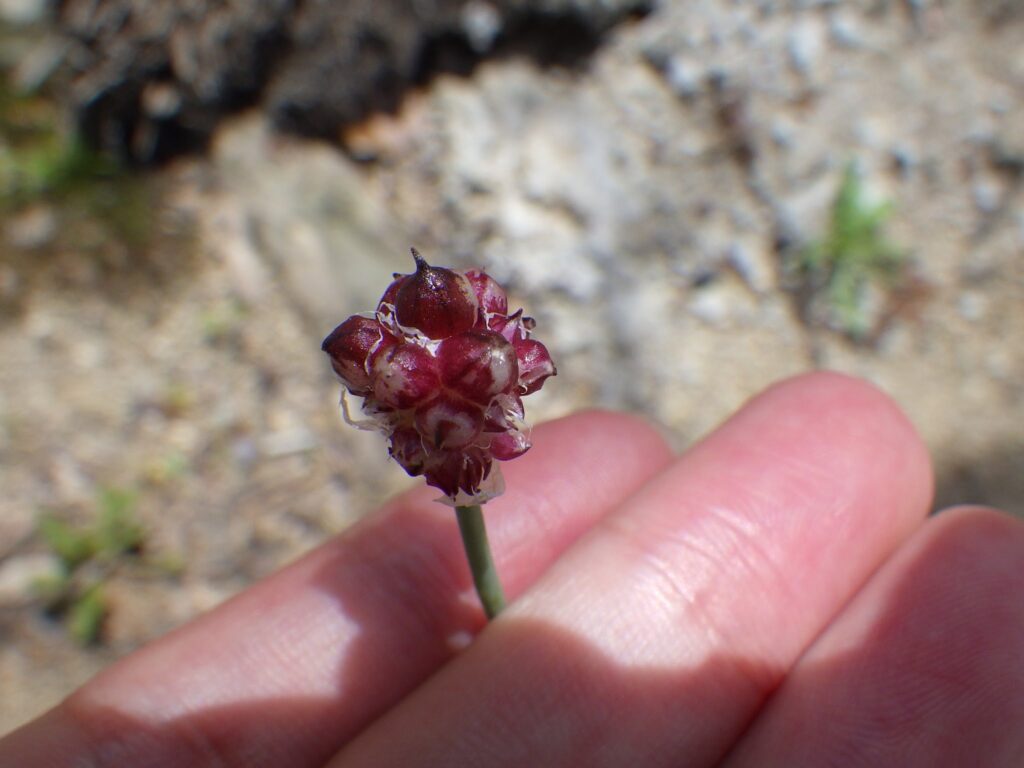
This is a perennial herb. The bulb is spherical and covered with a white, membranous outer layer. The leaves are linear, hollow, and crescent-shaped in cross-section. The flower stalk is 40-80 cm tall, and the flowers bloom in May and June, being pale reddish-purple. Often, some or all of the flowers on the inflorescence develop into bulbils. The plant reproduces by scattering these bulbils, which fall off and become new individuals. The reason why many plants with only bulbils and no flowers are found around rice paddies and fields is thought to be because frequent weed cutting by humans makes it more efficient for the plant to reproduce than to flower and produce seeds. It is distributed in Hokkaido, Honshu, Shikoku, Kyushu; Korea, and China. It is common throughout the prefecture, growing on the ridges and banks of fields and rice paddies. The bulbs and leaves are eaten as a wild plant, and because it is common near farmland, there is a theory that it was introduced from China a long time ago.
No. 0530 Chives (Allium tuberosum)
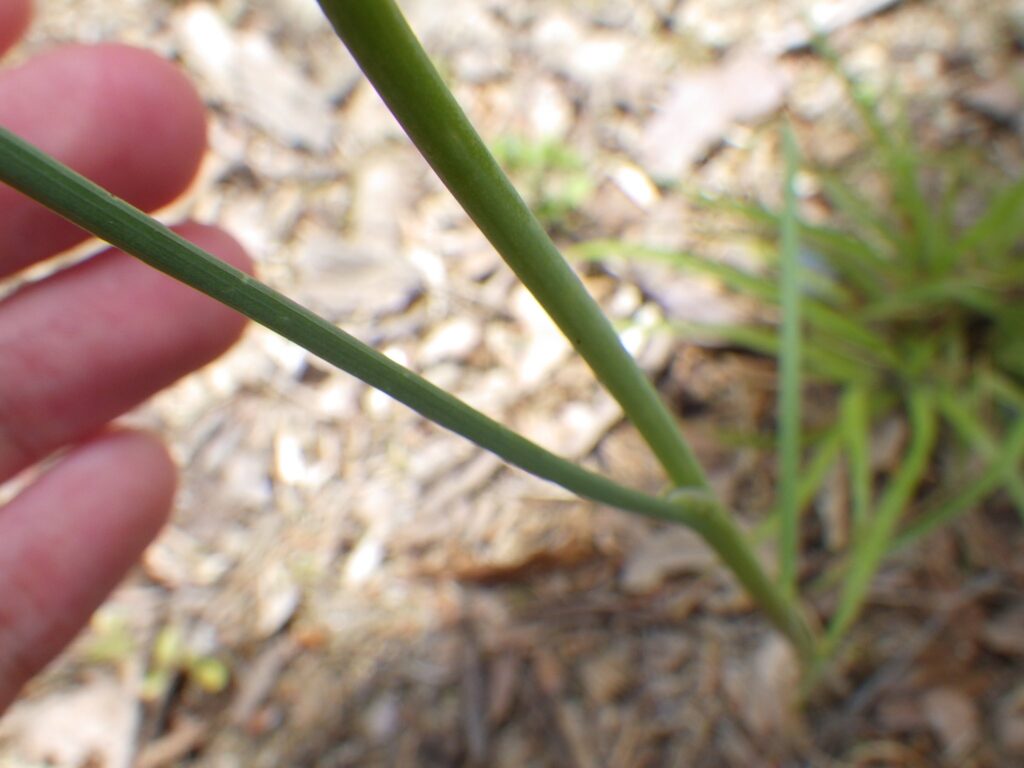
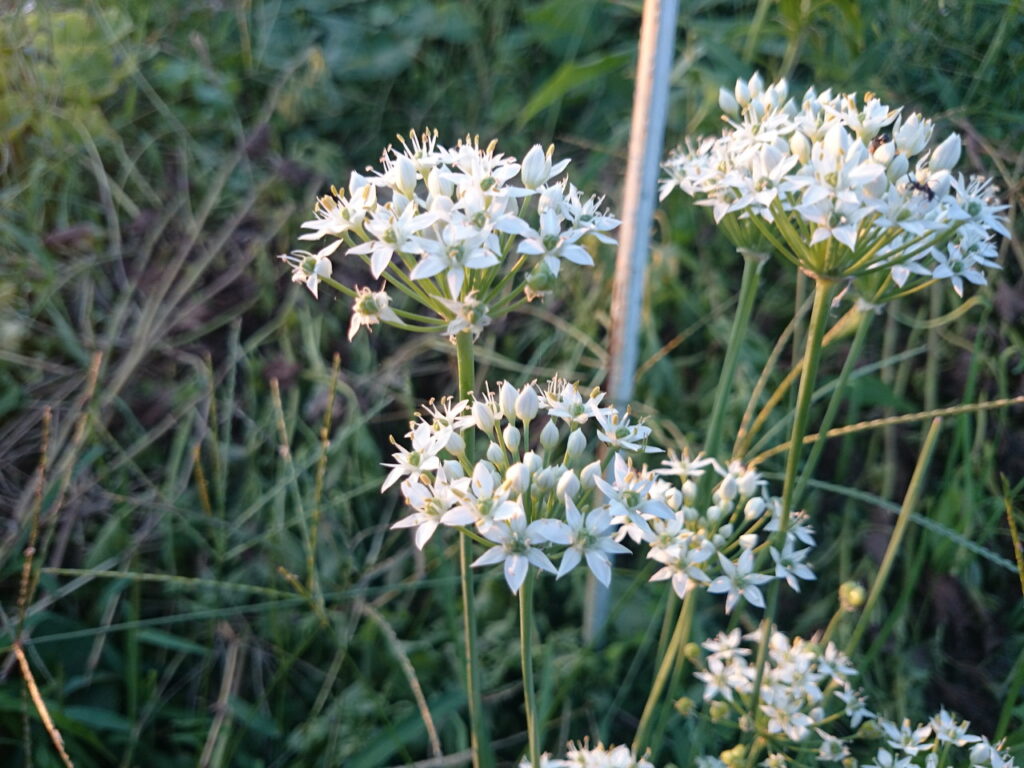
This is a perennial herb. The entire plant has a strong odor. From the lower end of the narrowly ovate to lanceolate bulb, distinct rhizomes emerge and connect to form a bundle. The base and bulb are covered with palm-like fibers. The leaves are flattened, 3-6 mm wide, and end at a blunt tip. The flower stalk is 30-50 cm tall, and the flowers bloom from August to October, with white flowers in an umbel inflorescence. The perianth segments are oblong-lanceolate with pointed tips, about 5 mm long, and spreading. It is said to be distributed in Honshu, Shikoku, Kyushu, Pakistan, India, and China, but it has been cultivated in fields as a vegetable since ancient times, and it is not well known whether it is truly wild in Japan or whether it spread after being cultivated. It is likely that cultivated plants have escaped cultivation and spread widely on embankments, ridges, and vacant lots. It is used in Japanese cuisine as an ingredient in soups, as a condiment, in blanched dishes, and in stir-fries, as well as in Chinese and Korean cuisine. Representative dishes include liver and chive stir-fry, chive omelet, chive dumplings, and gyoza.
No. 0532 Ezo leek (Allium schoenoprasum var. schoenoprasum)
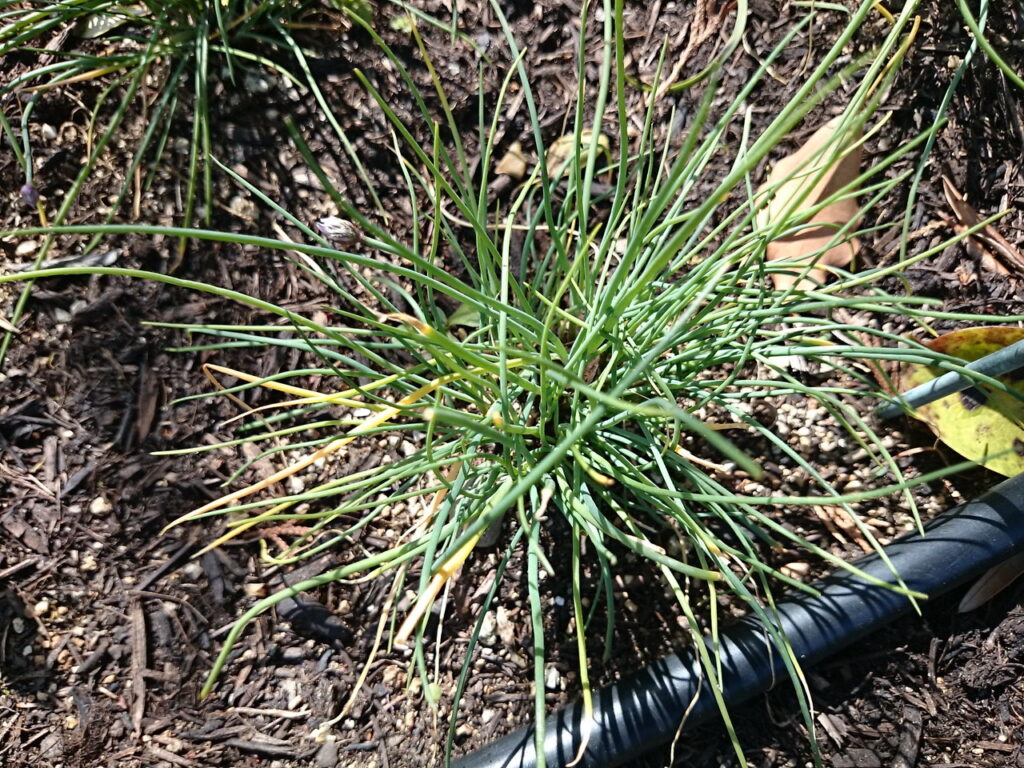
This is a perennial herb. It is treated as a variety of the basic species, * A. schoenoprasum* var. *schoenoprasum *. It is distinguished from *Chives* by the short, pointed shape of the tips of its perianth segments, the fact that its flower stalks sometimes emerge separately from the leaf clusters, and that its flower color ranges from white to pale reddish-purple.
No. 0534 Wild Shallot (Allium thunbergii)
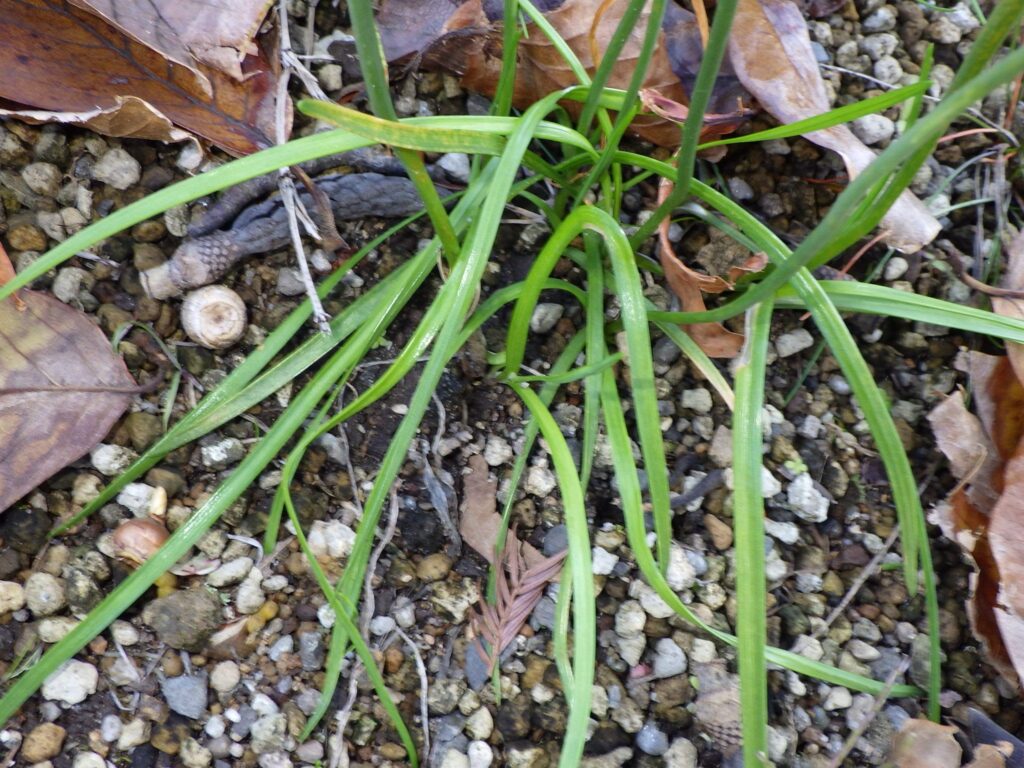
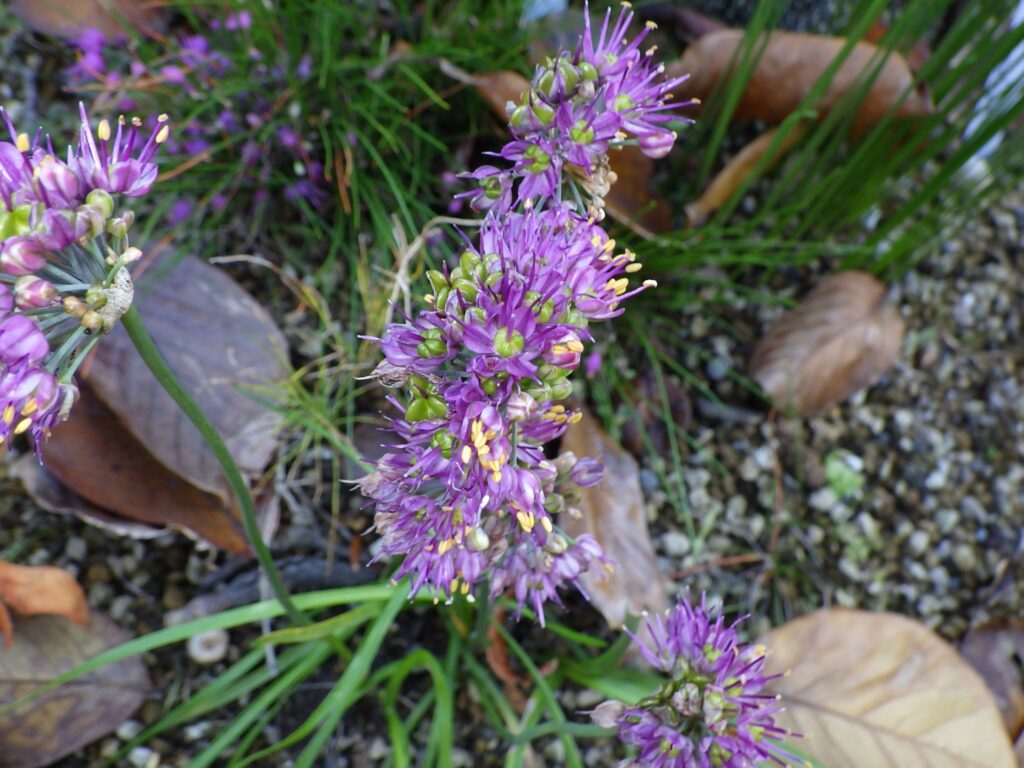
This is a perennial herb. The bulb is narrowly ovate with a hard outer skin that sometimes remains fibrous. The leaves are broadly linear and hollow, with a blunt triangular cross-section. The flower stalk is 30-60 cm tall, and the flowers bloom from September to November. The perianth segments are reddish-purple, oval-shaped, and about 5 mm long. The anthers are reddish-brown. The teeth at the base of the filaments are not clearly defined. The leaves wither in winter. It is distributed in Honshu (south of Akita Prefecture), Shikoku, Kyushu, the Korean Peninsula, China, and Taiwan. It grows in mountain grasslands, meadows, and embankments. The white-flowered variety is called Allium schonoskii f. albiflorum.
No. 0535 Rakkyo (Japanese shallot) Allium chinense
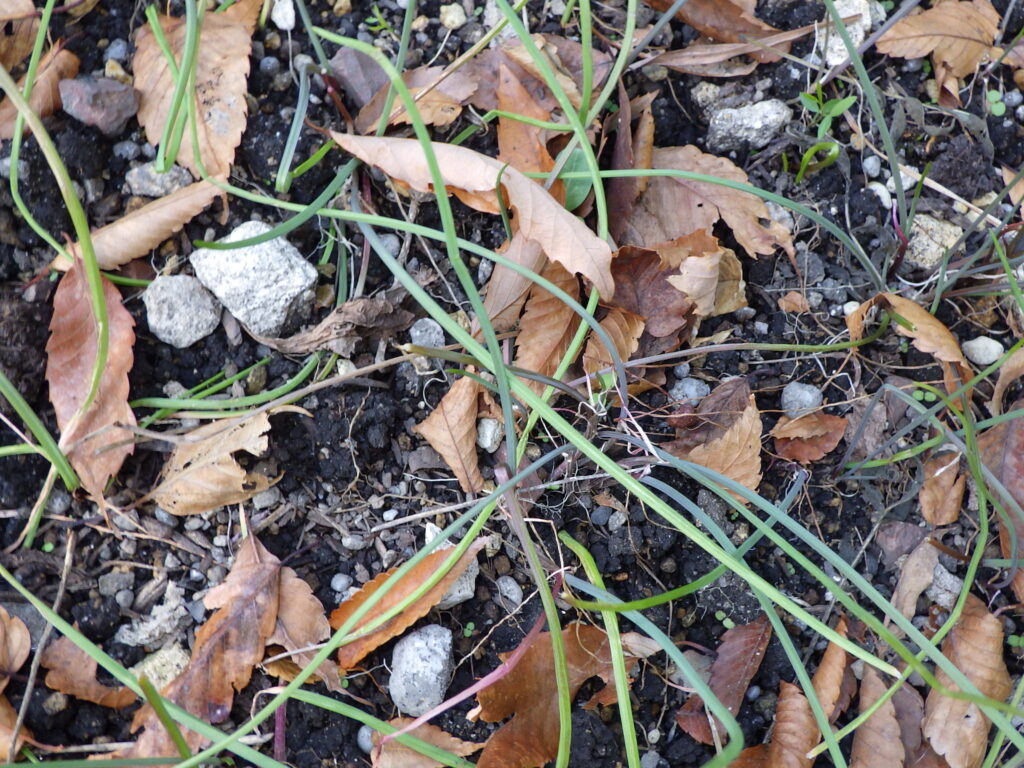
A perennial herb. The outer skin of the bulb is thin and membranous. The flower stalk is 30-50 cm tall, and the flowers bloom from September to November. The pedicels are long, 20-30 mm in length. The filaments have large teeth at their base. The leaves wither in summer and remain green from autumn to winter. Native to China, it is cultivated in East Asia. Cultivated plants often escape into fields and urban areas. In Japan, it is eaten as pickled shallots (rakkyo).
No. 0536 Garlic (Allium sativum)
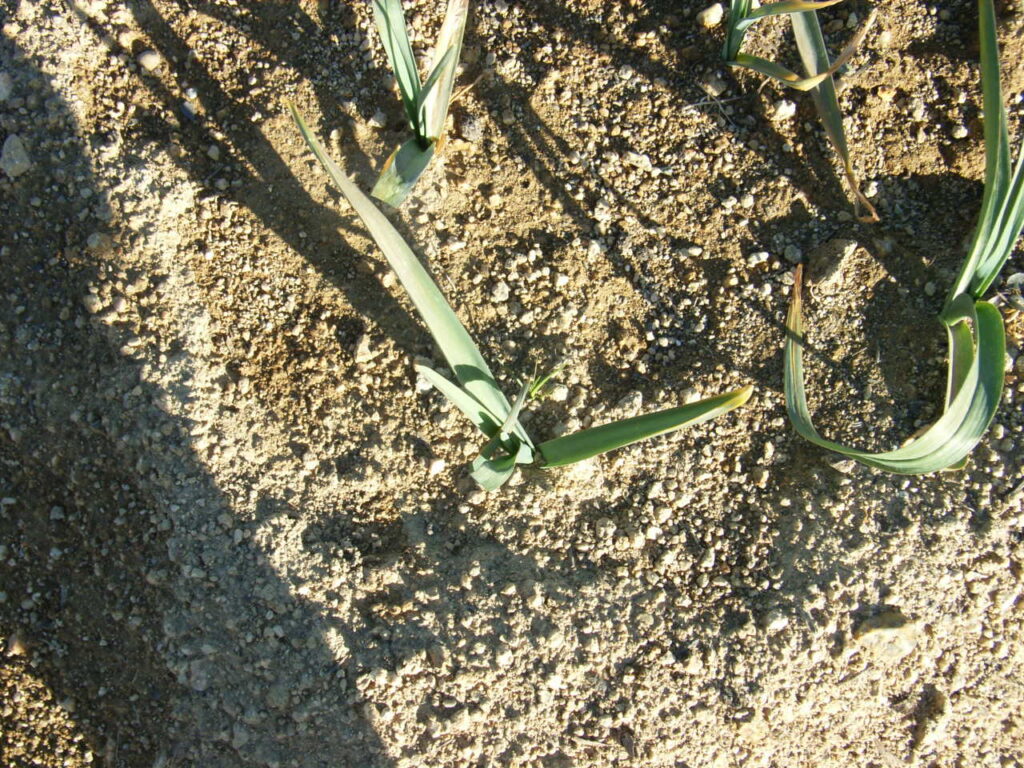
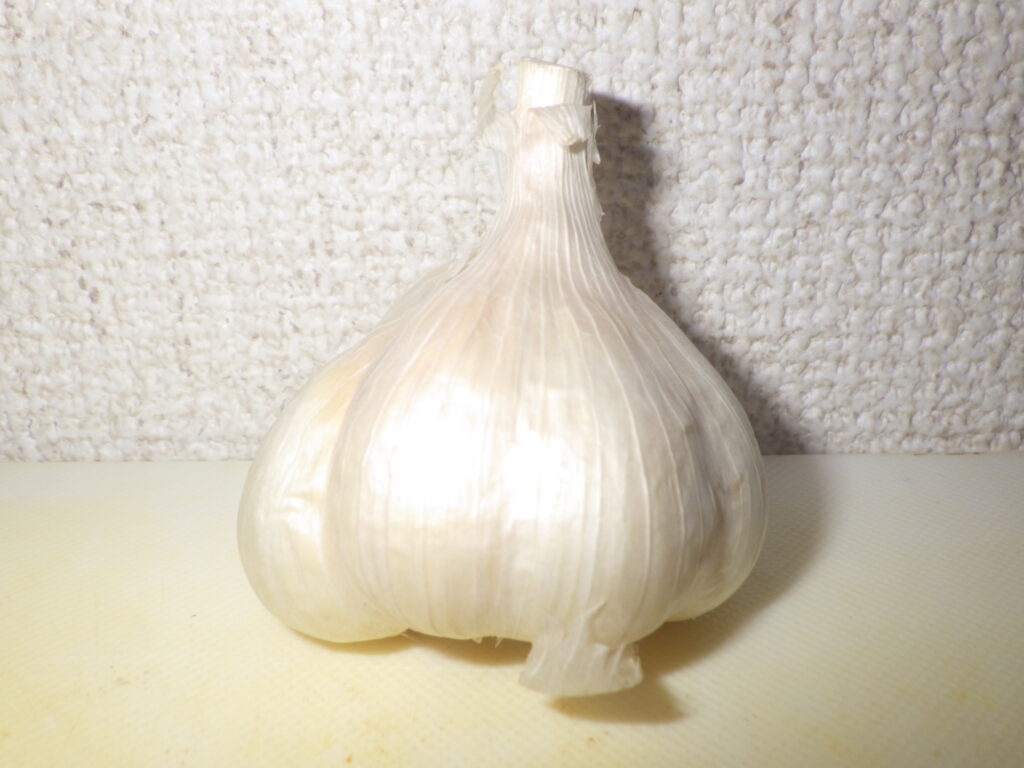
Garlic is a perennial plant. It is called garlic in English. It is believed to be native to Central Asia, but only cultivated varieties are known. The bulb consists of 4 to 10 scales, but in cultivated varieties that readily divide within the scales (forming secondary scales), the number of scales, including secondary scales, can be more than a dozen (more than 30 in some cases). The leaves are flat and there are 4 to 6 of them. The flower stalk grows to a height of 0.5 to 1 m and bears numerous flowers in an umbel inflorescence. However, the florets are generally sterile except for some varieties from Russia, and bulbils are mixed in with the involucre. The bulb is used as an edible vegetable. It seems to have spread to the West, India, and tropical Asia in ancient times, and was already being used in ancient Egypt (around 3200 BC). It was introduced to China during the Han dynasty, and to Japan via China during the time of the Kojiki, Nihon Shoki, and Manyoshu, but the earliest reliable description can be found in the Kusabetsu Wamyō (918 AD). Garlic is synonymous with aromatic vegetables because it eliminates the unpleasant odor of meat and adds an appetizing flavor to dishes. It is used in a variety of cuisines, including Chinese, Korean, Italian, French, Indian, and Brazilian. Representative dishes include garlic butter, garlic rice, garlic toast, peperoncino, ajillo, Japanese gyoza, soy sauce pickles, and tonkotsu ramen.
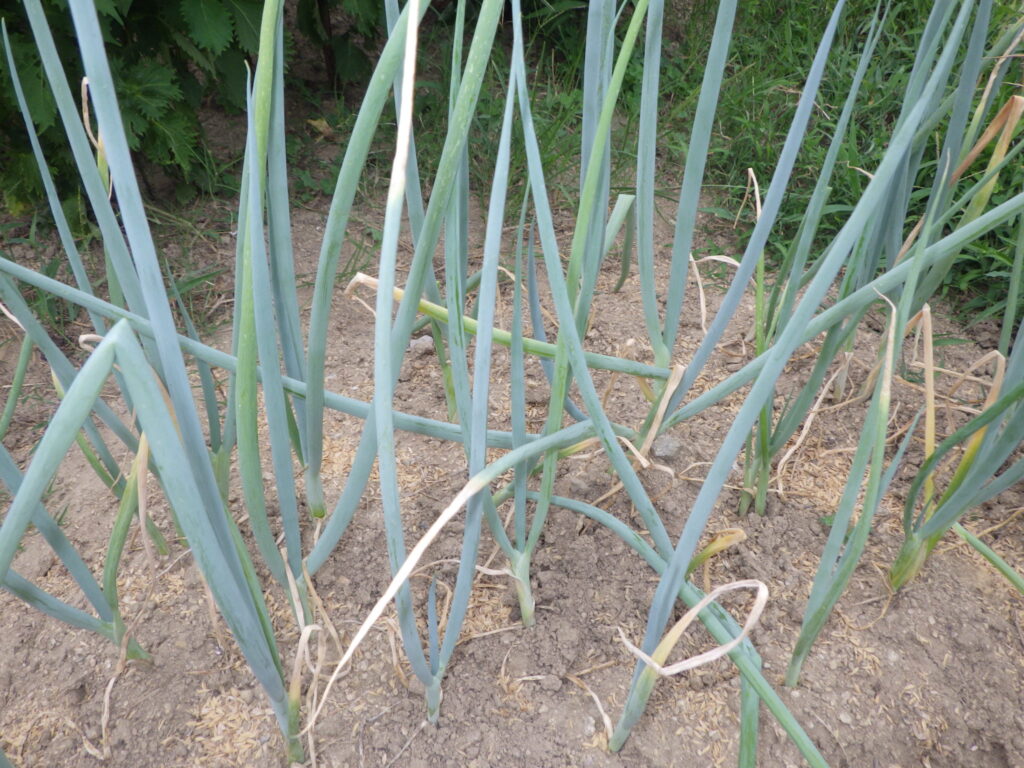
No. 0537 Leek (Allium fistulosum var. giganteum)
No.0538 Onion (Allium cepa)
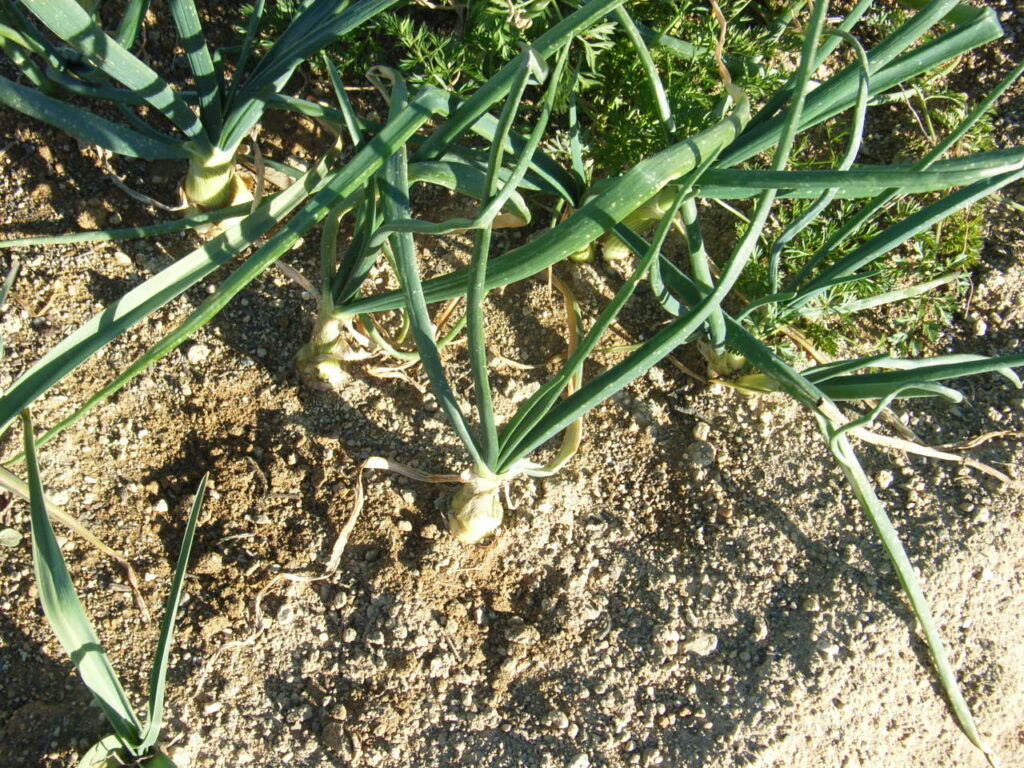
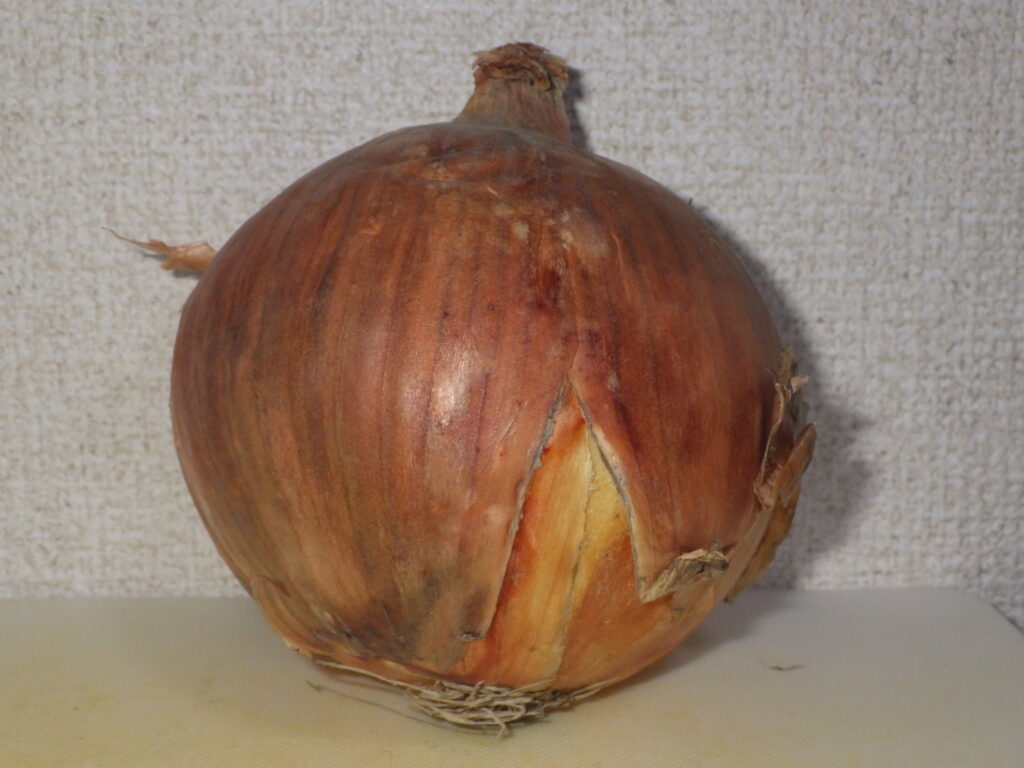
Although it is a perennial plant, it is treated as an annual or biennial in cultivation. The onion leaf blade is hollow and cylindrical, with a pointed tip and a waxy surface. The leaf sheath is cylindrical and thickens under long-day, warm conditions to form a bulb, which then becomes a sphere. The flower stalk is longer than the leaves, cylindrical with a swollen center, thick and fleshy, bearing an inflorescence at the top. The flowers are borne in compound umbels, with flowering beginning in each inflorescence, until the whole thing becomes spherical. It can be distinguished from leeks by its opening perianth. The bulb is used as a vegetable. It is native to the mountainous regions of Central Asia. It was cultivated in ancient Egypt and can be seen in murals. Cultivated varieties diversified during the Greek and Roman eras and are mentioned in the Old Testament. However, it did not spread throughout Europe and America until the 16th or 17th century. Its spread in China is relatively recent, but it is now widely cultivated. It was introduced to Japan at the end of the Edo period or the beginning of the Meiji era, and large-scale cultivation began after the Taisho era. The first introduction of onion seeds and trial cultivation in Hokkaido took place in 1871 (Meiji 4), and by around 1882 (Meiji 15), direct seeding cultivation had become established, making Hokkaido the top producer in Japan at the time. In addition to sliced onions, onions are commonly used in dishes such as fried onions, onion rings, and onion soup. They are also frequently used as an ingredient in curry, stew, nikujaga (meat and potato stew), miso soup, omelets, oyakodon (chicken and egg rice bowl), gyudon (beef rice bowl), demi-glace sauce, tomato sauce, tartar sauce, and salsa.
No.0539.a Mitsukado Leek (Allium triquetrum)
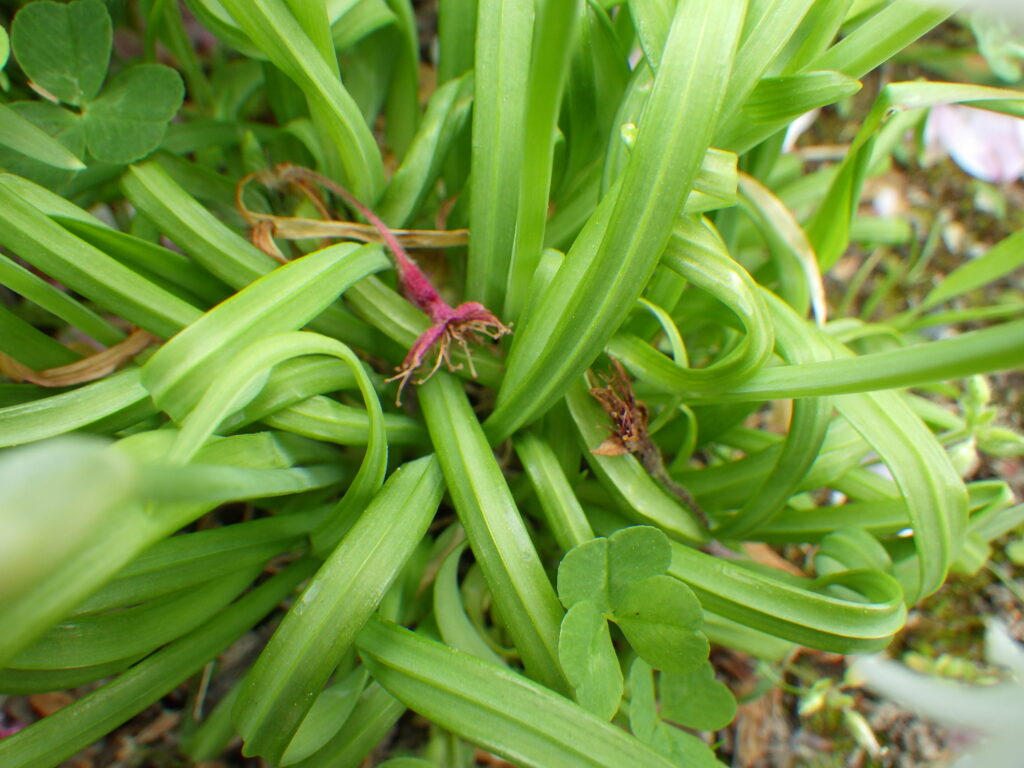
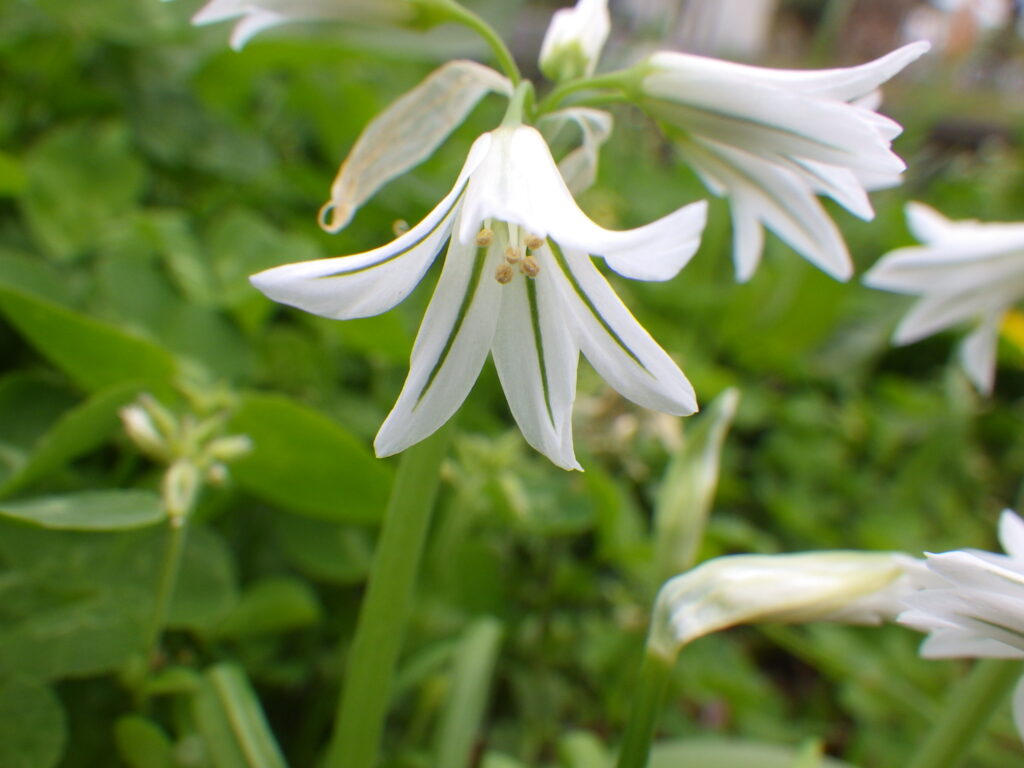
A perennial herb, also known as Allium triquetrum. It has a chive-like odor. The bulb is nearly spherical with a thin, membranous outer layer. The leaves are broadly linear, about 5-9 mm wide, and flattened. It flowers from April to June. The flower stalk has three ridges and a triangular cross-section. It bears 3-15 flowers in an umbel inflorescence with a slender bract at the base. The perianth segments are broadly lanceolate, about 10-15 mm long, white with green stripes on the inside. The flowers are large for an Allium species, bell-shaped, and drooping. Native to the Mediterranean coast, it grows wild in southwestern Europe, northwestern Africa, Madeira, and the Canary Islands, in pastures, clearings, riverbanks, and roadsides up to 850 m above sea level. It has also been introduced to the British Isles, New Zealand, Turkey, Australia, California, Oregon, and South America, where it is known as an invasive alien species. In Japan, it is cultivated for ornamental purposes and has recently become naturalized. The entire plant is edible; it can be mixed with butter to make garlic butter, the leaves and flowers can be used in stir-fries, and the bulbs can be used in pickles. It is said to have a "scallion-like or subtle onion-like flavor."
No.0539.b Otomenilla Allium neapolitanum
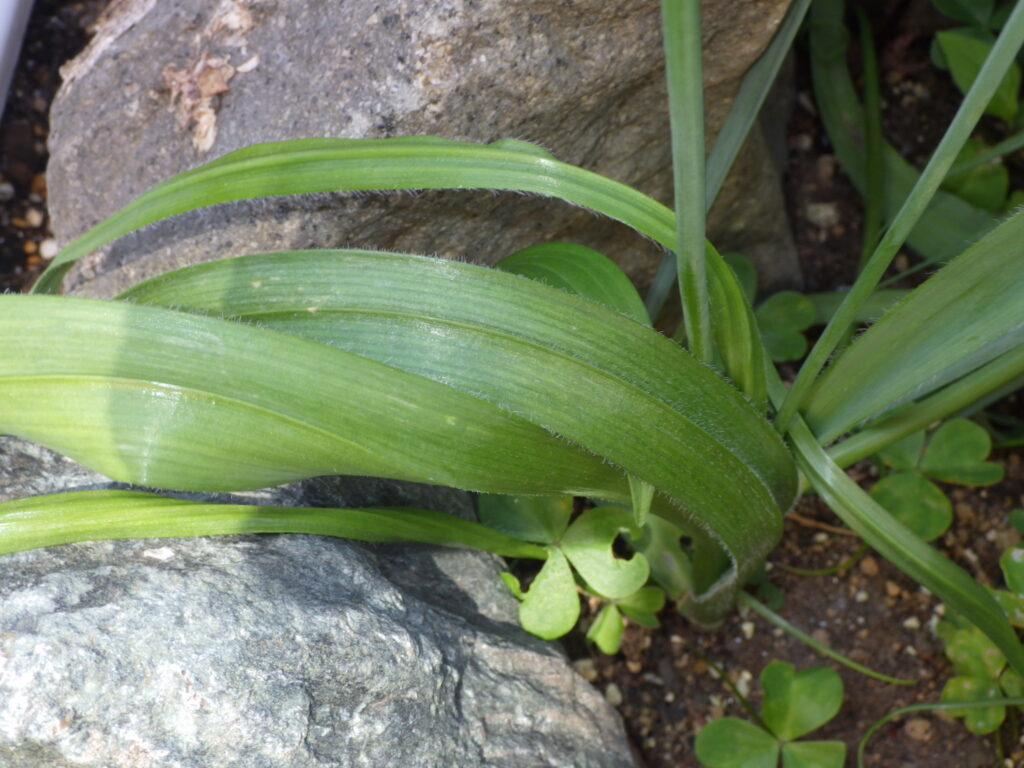
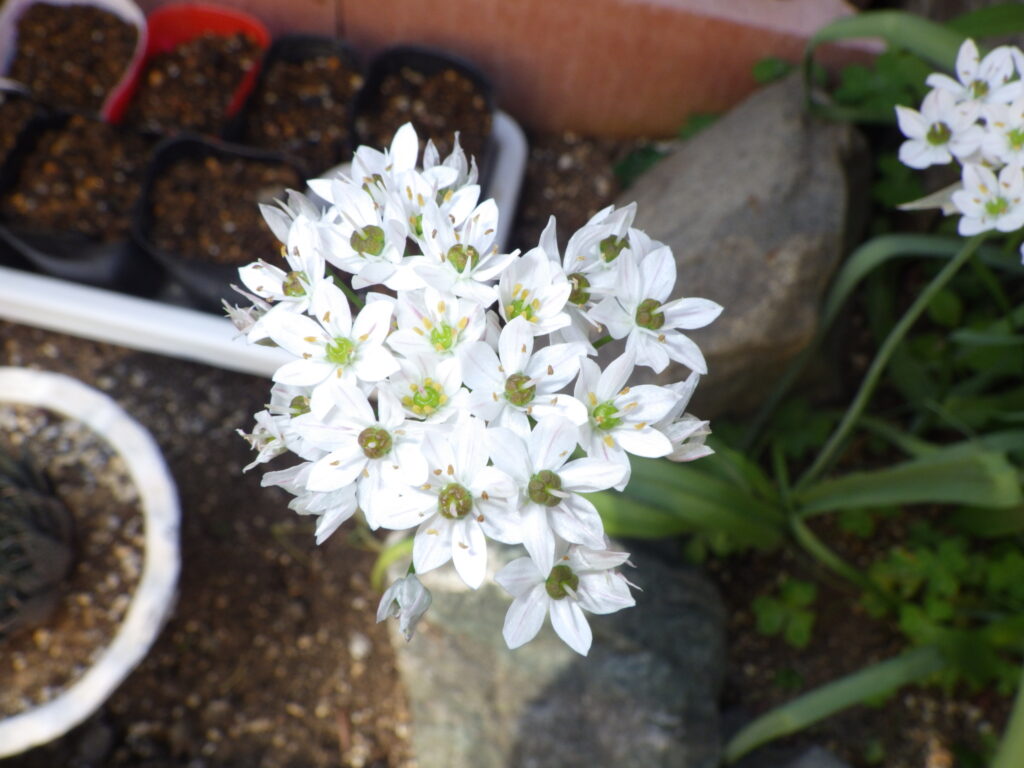
A perennial plant. Also known as Allium neapolitanum or Allium cowanii.
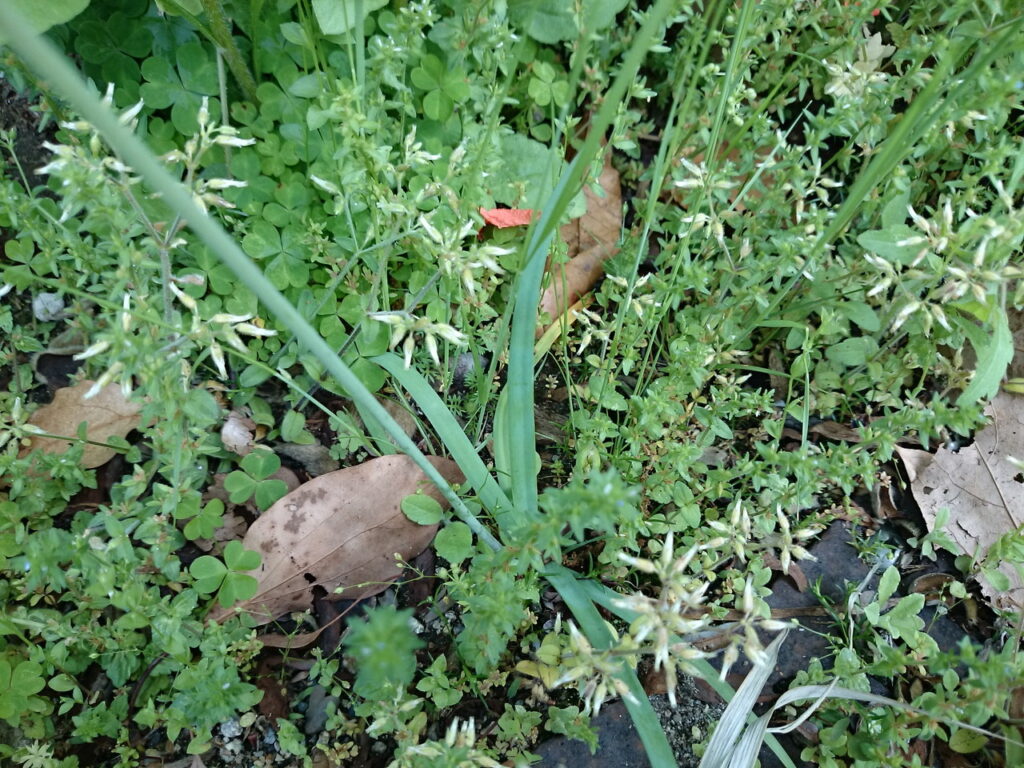
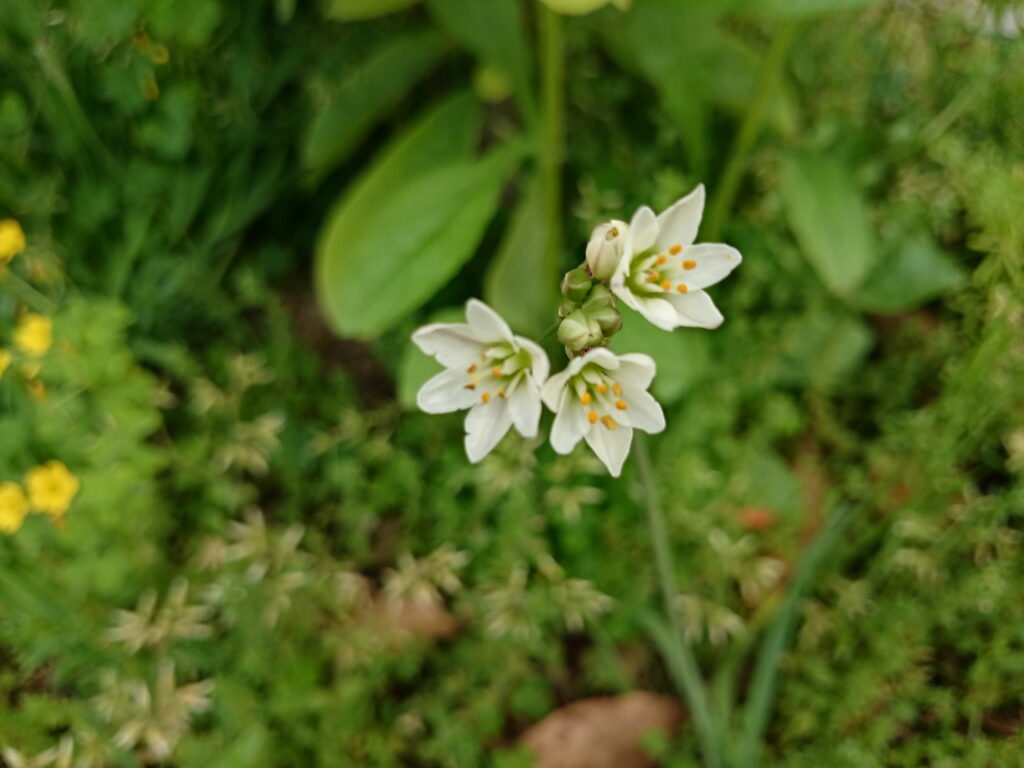
No.0539.c Nothoscordum gracile (field chives)
This is a perennial herb. The leaves are 20-40 cm long and 4-10 mm wide. The flower stalks are 30-50 cm tall. The flowers bloom in May and June and consist of 10-15 flowers. The perianth segments are white and fragrant, and the anthers and filaments are dark brown to reddish-purple when young, but eventually turn yellow. It is native to southern North America and tropical America. It belongs to the genus Allium, and this is the only species that has naturalized in various parts of the world. It was introduced to Japan in the mid-Meiji period. The perianth segments are white, and the midrib is pinkish, which distinguishes it from the related species Allium fragrans. Be careful as they are often confused on the internet. This species was previously given the scientific names N. fragrans and N. inodorum, but Stearn (1986) clarified that the above scientific name is the correct name.
No.0539.d Nothoscordum bivalve (False Chives)
This is a perennial herb. The leaves are 10-20 cm long and 2-4 mm wide. It flowers in May. The flower stalk is 10-30 cm long and has 5-12 flowers. The perianth segments are white with yellow at the base and veins, and are 9-13 mm long. The anthers are yellow and about 2 mm long. It propagates in summer by small bulbs forming at the base of the parent plant. Native to eastern North America, it is cultivated for ornamental purposes and escapes into the wild. It can be distinguished from Allium spectabile by its leaves, which are 2-4 mm wide, the 5-12 flowers, and the white perianth segments with yellow near the base. Be careful as they are often confused on the internet.
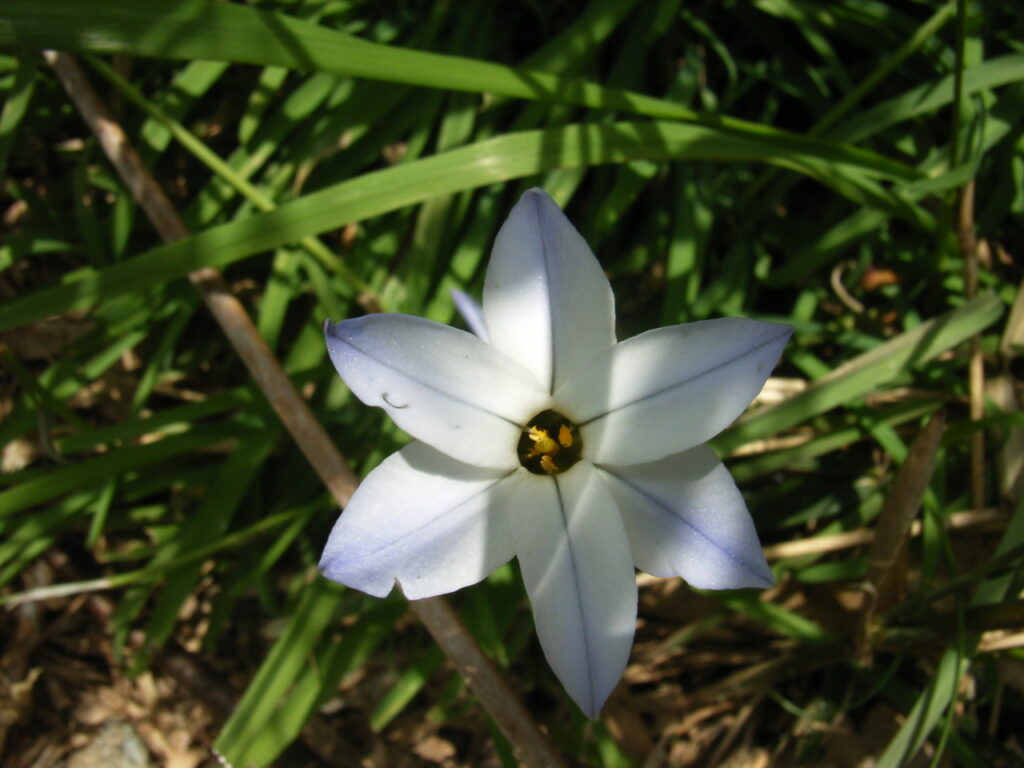
No. 0540 Ipheion uniflorum
Also known as European Star-of-Bethlehem. A perennial herb. The entire plant has a chive-like smell. The bulb is about 2 cm long and ovate. The leaves are broadly linear, twisted, flattened, fleshy, 10-25 cm long and 5-8 mm wide. The flower stalk is 10-20 cm tall. The flowers bloom in March and April, with 1-2 flowers opening upwards at the tip of the flower stalk. They are white with purple streaks, and a prominent purple stripe runs down the center of the perianth segments. The perianth segments are 3.5-4.5 cm in diameter. The perianth is 6-lobed, and the lobes spread outwards. There is a pair of bracts on the flower stalk. It only appears above ground in spring. Native to Argentina, it is cultivated all over the world. It was introduced to Japan during the Meiji period as an ornamental plant and has become naturalized in various regions.
No.0541 Hamaomoto Crinum asiaticum var. japonicum
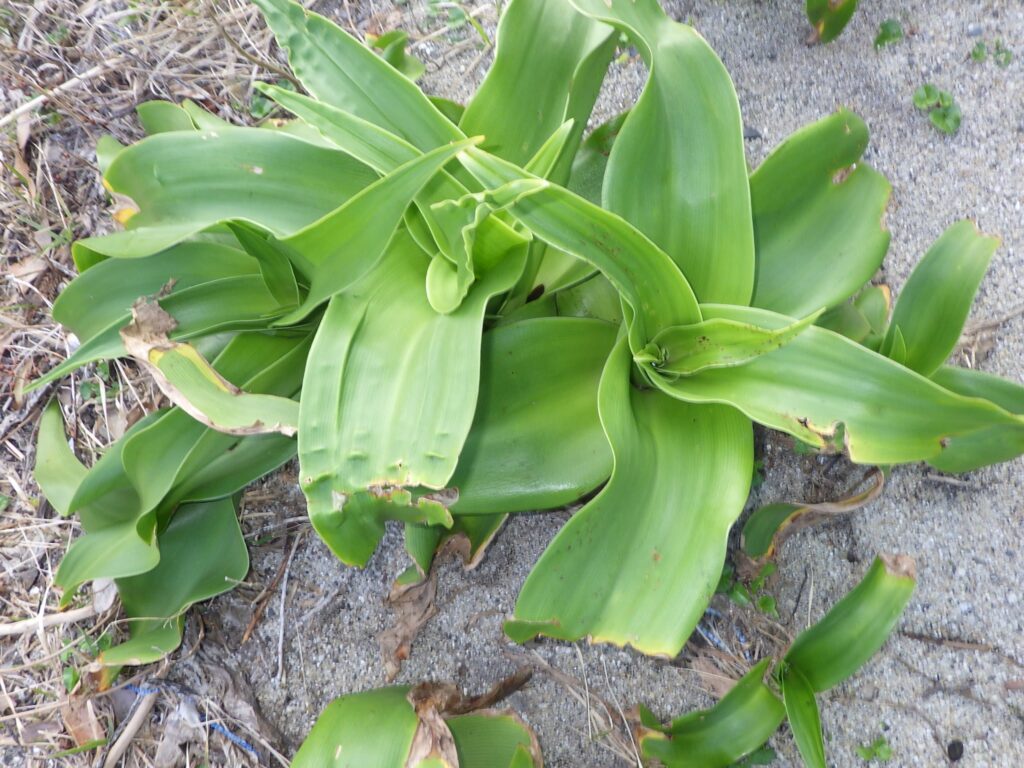
A perennial herb. Also known as Hamayu. The flower stalk is 30-50 cm tall and 3-7 cm in diameter. The leaves are evergreen, glossy, and lanceolate, 30-70 cm long and 4-10 cm wide. The base forms a leaf sheath that encloses the bulb. It flowers from July to September, with the flower stalk reaching 50-80 cm tall and bearing numerous flowers in an umbel. The perianth segments are white, linear, 7-8 cm long and 5-8 mm wide. They curl back when in bloom and are fragrant. The fused perianth tube is 5-6 cm long. The capsule is 2-2.5 cm long, and the seeds are spherical, 2-3 cm in diameter. It grows on sandy beaches along the coast. It is distributed in Honshu (west of southern Kanto), Shikoku, Kyushu, the Ryukyu Islands, China, Malaysia, and India. The northern limit is the isotherm with an average annual temperature of 15°C (minimum temperature of -3.5°C), which is called the Hamamoto line. It can also be found in southern Chiba Prefecture, but its northernmost limit is Tenjin Island in Sajima, Yokosuka City, on the Miura Peninsula.
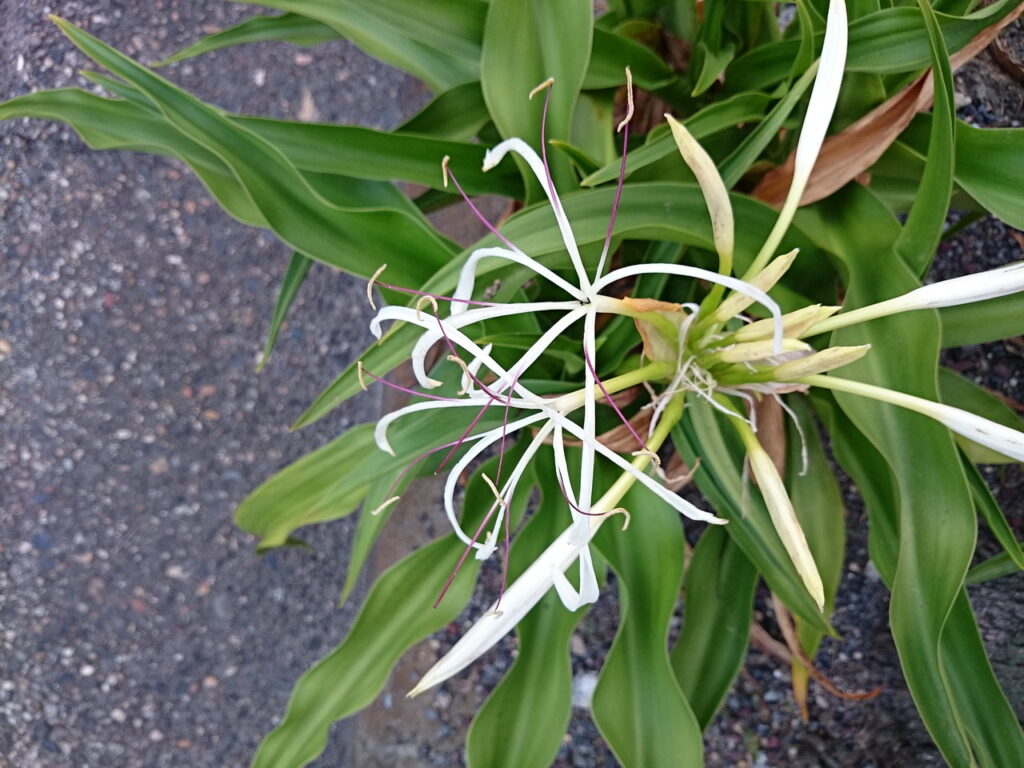
No.0541.1 Taiwanese Crinum asiaticum var. sinicum
A perennial herb. Also known as Ogasawara Hamayu, Ogasawara Hamayu, and Oohama Omoto. It grows to a height of about 1.5m. It is a large species, with the stem at the base of the root reaching 20cm in diameter. The leaves are 2m long. In June and July, it produces flat flower stalks from the leaf axils, bearing white, fragrant flowers. The petals are tubular, elongated, curve outwards, and droop. The fruit is about 4cm in diameter and ripens to a bluish-brown color. It is distributed in Japan (Ogasawara Islands and Ryukyu Islands), Taiwan, southern China, and the Pacific Islands.
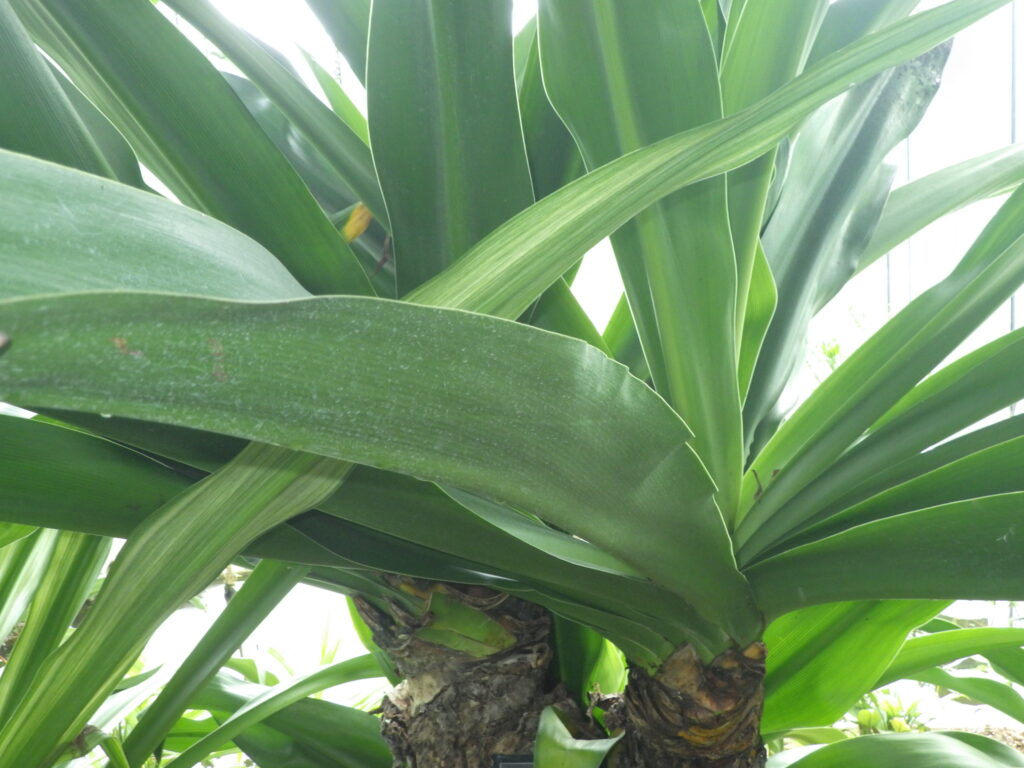
No. 0543 Red Spider Lily (Lycoris radiata var. radiata)
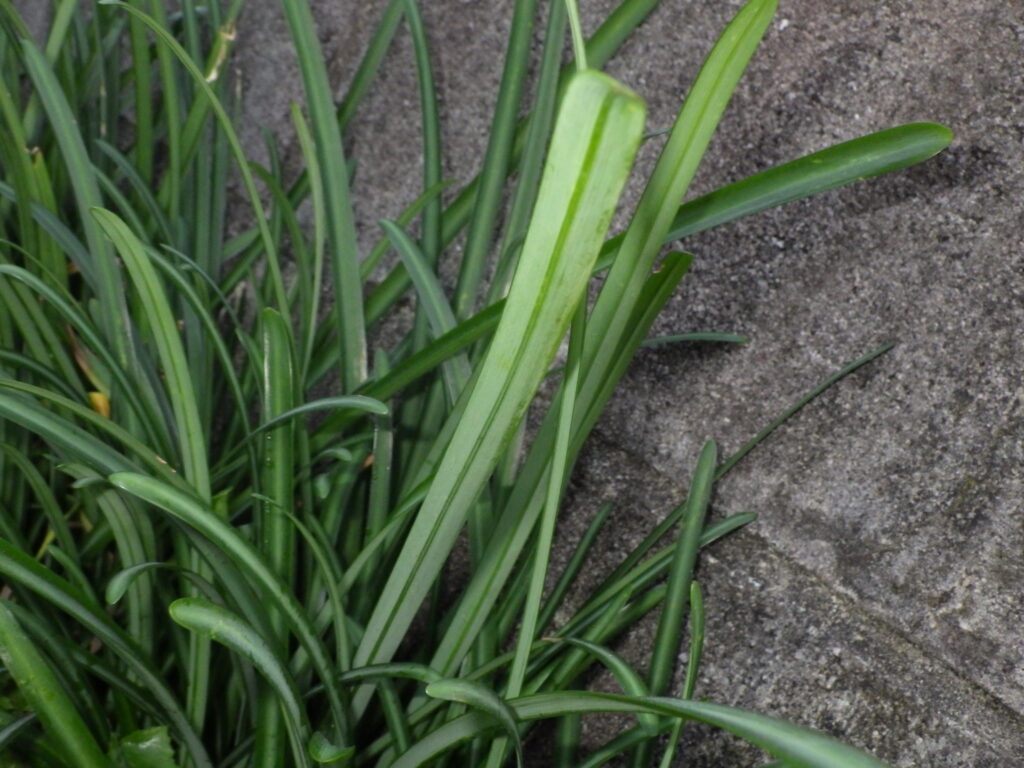
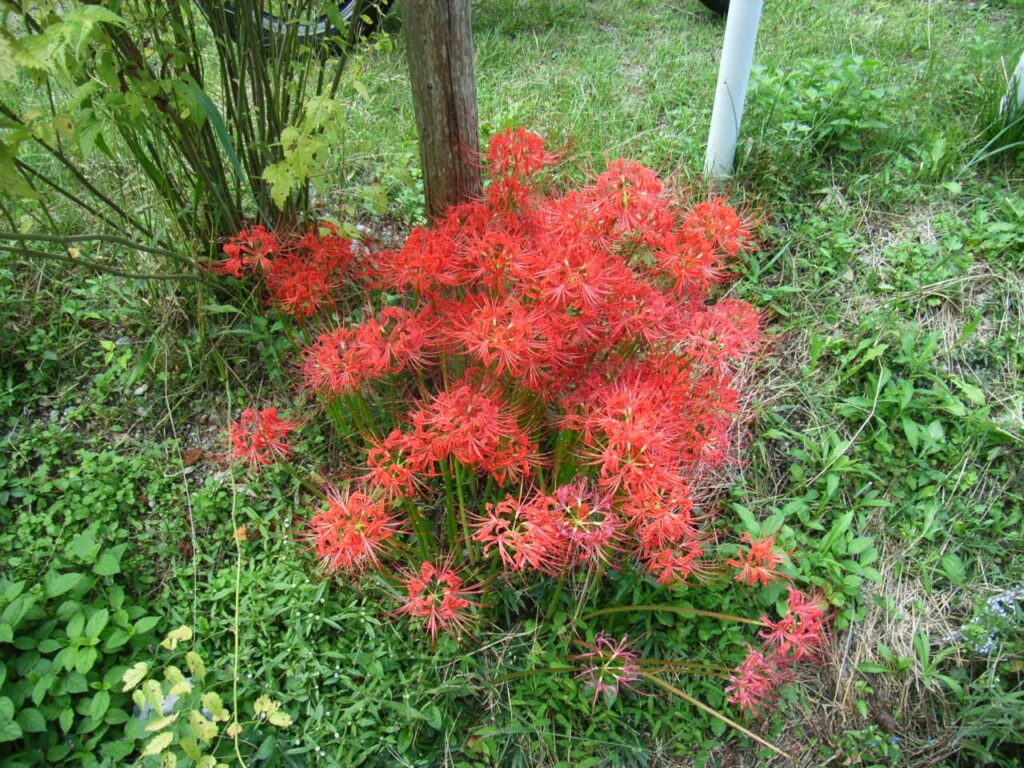
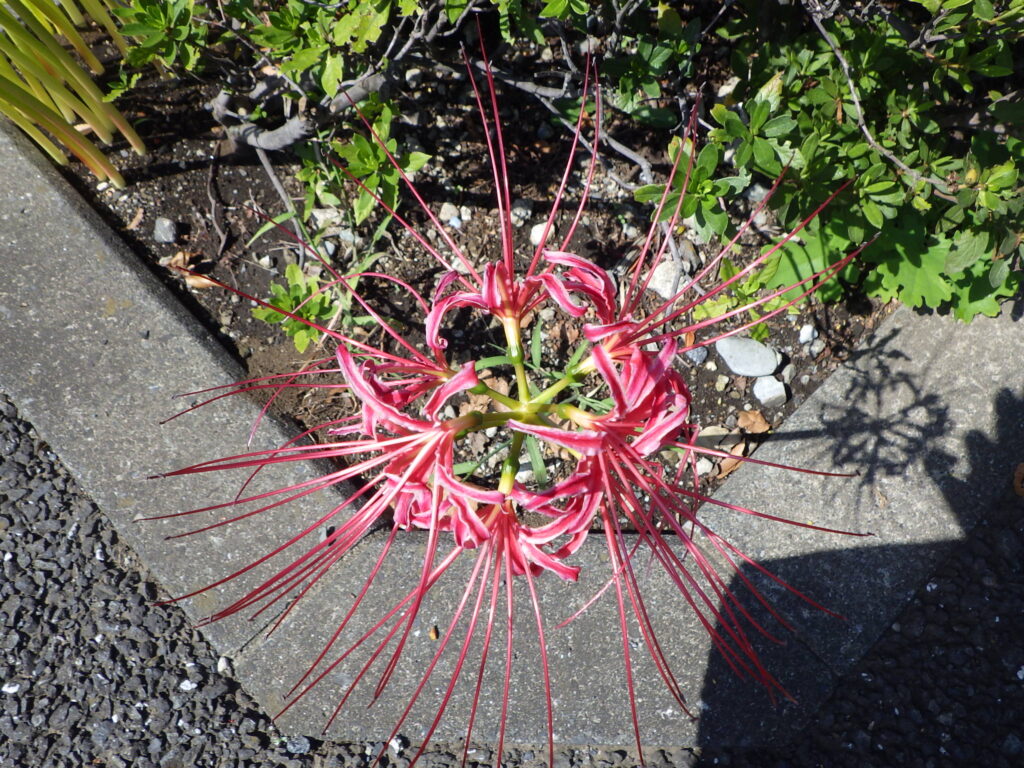
A perennial herb. Also known as Manjushage. The bulb is broadly ovate, about 3 cm in diameter, with a black outer skin. The leaves emerge in late autumn, forming clumps, and wither in April of the following year. They are glossy dark green, band-shaped, 30-40 cm long, and 6-8 mm wide. The flower stalk emerges in late September, reaching a height of 30-50 cm and bearing 5-7 flowers. The perianth segments are bright red, oblanceolate, 40 mm long, 5-6 mm wide, and strongly recurved. The tube is 6-10 mm wide. The stamens protrude conspicuously. The fruit is sterile and does not produce seeds. It is distributed in Honshu, Shikoku, Kyushu, and the Ryukyu Islands. The bulb, in particular, contains alkaloids such as lycorine. It is thought to be native to China and was introduced and spread in ancient times. It grows in clusters along the edges of fields, on embankments, and in cemeteries. There are theories that the bulbs were introduced along with the soil when rice cultivation was introduced, leading to the spread of the spider lily, or that the poisonous bulbs were deliberately brought in and planted on ridges and embankments to deter small animals that dig holes in the soil (moles, mice, etc.). Some believe that moles are carnivorous and therefore have no connection to spider lilies, but it is also said that earthworms, which are their food source, dislike spider lilies and do not live in the soil, so moles do not come near these spider lilies. However, the author has not confirmed the scientific basis for any of these theories. In one case where moles were actually given spider lily bulbs, they repeatedly ate and regurgitated them (Ando et al., 2016). It is well known that the bulbs can be used as medicine if used properly, and can also be used as famine food if the poison is removed by soaking them in water. Because it is a triploid (2n=33) and sterile, it is believed that the triploid spider lily, which suddenly appeared in China, was brought to Japan.
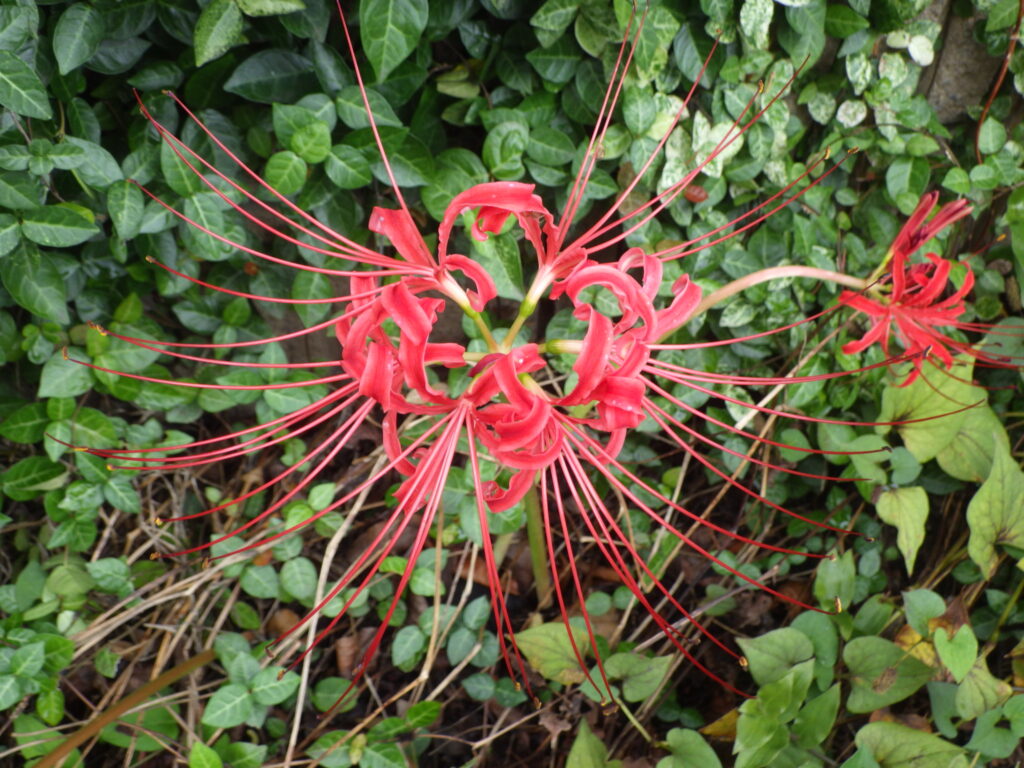
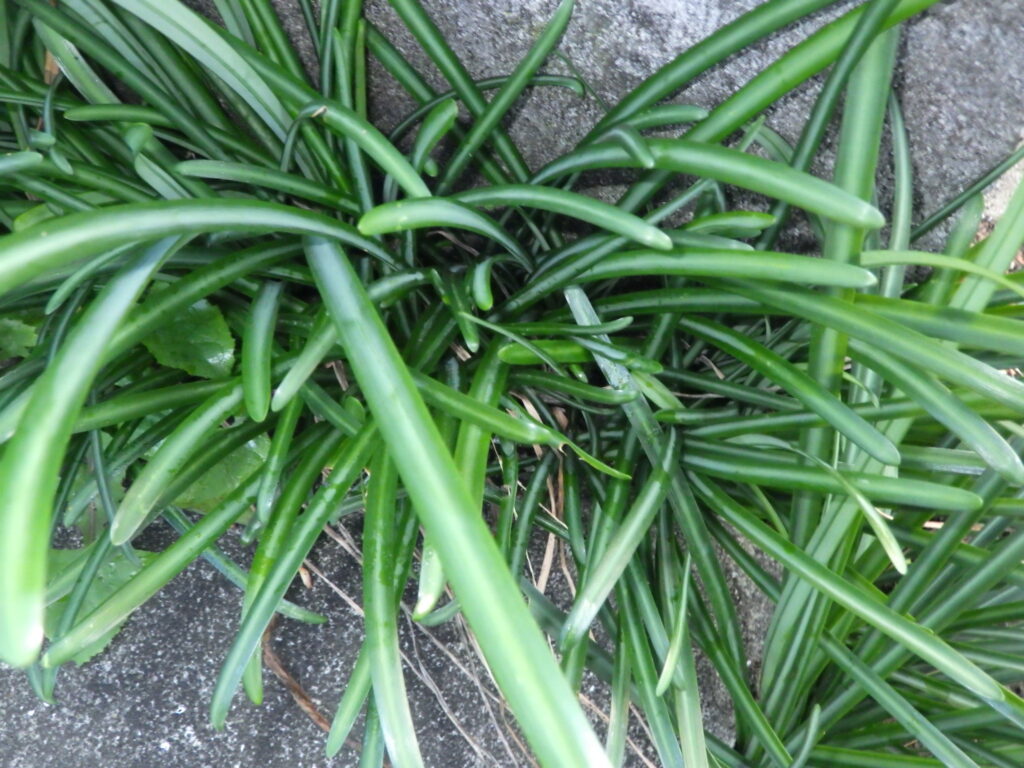
No.0543.1 Lycoris radiata var. pumila
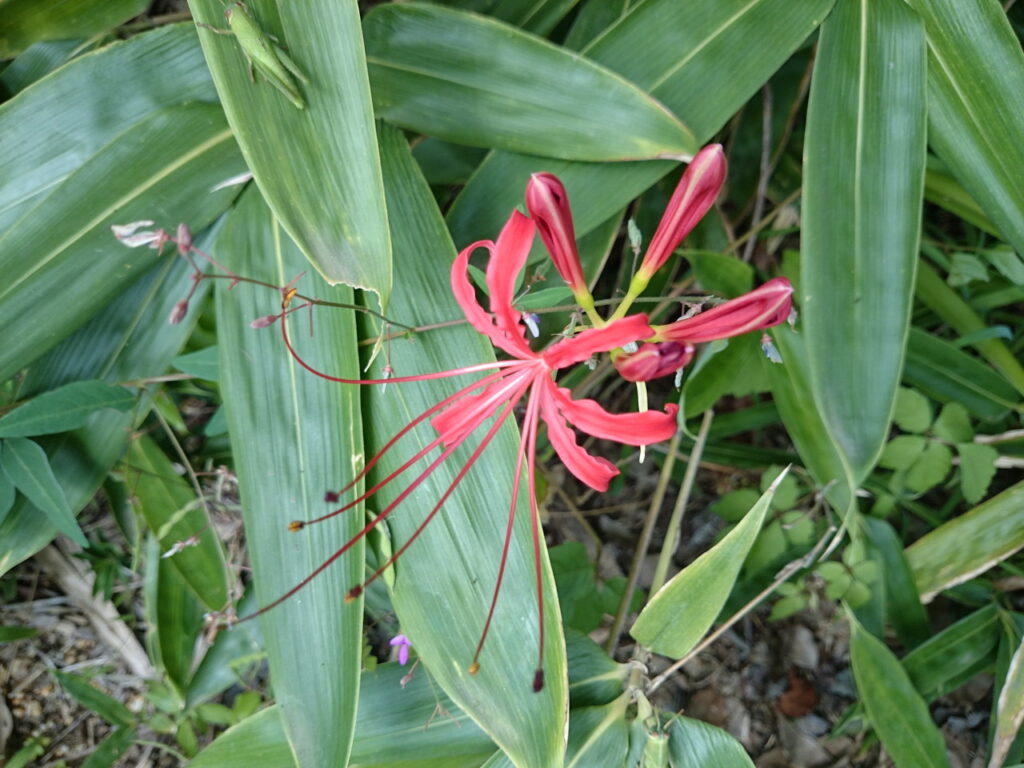
This is the wild species of the red spider lily (Lycoris radiata). Also known as the small red spider lily (Lycoris aurea), it is diploid (2n=22), making it fertile, and it is distinguished from the red spider lily (Lycoris aurea) by its early September flowering period and soft bulbs and leaves (Nishiyama, 1939). Furthermore, while the leaves of the red spider lily are dark green, those of the Chinese red spider lily are yellowish-green, and while the flowers of the red spider lily are deep red, those of the Chinese red spider lily are pale red. It is native to China and is cultivated in Japan for ornamental purposes. The individual in the following photograph is identified as the Chinese red spider lily because of its pale color and fewer flowers, but it could also be the red spider lily.
No.0543.2 Lycoris radiata f. bicolor
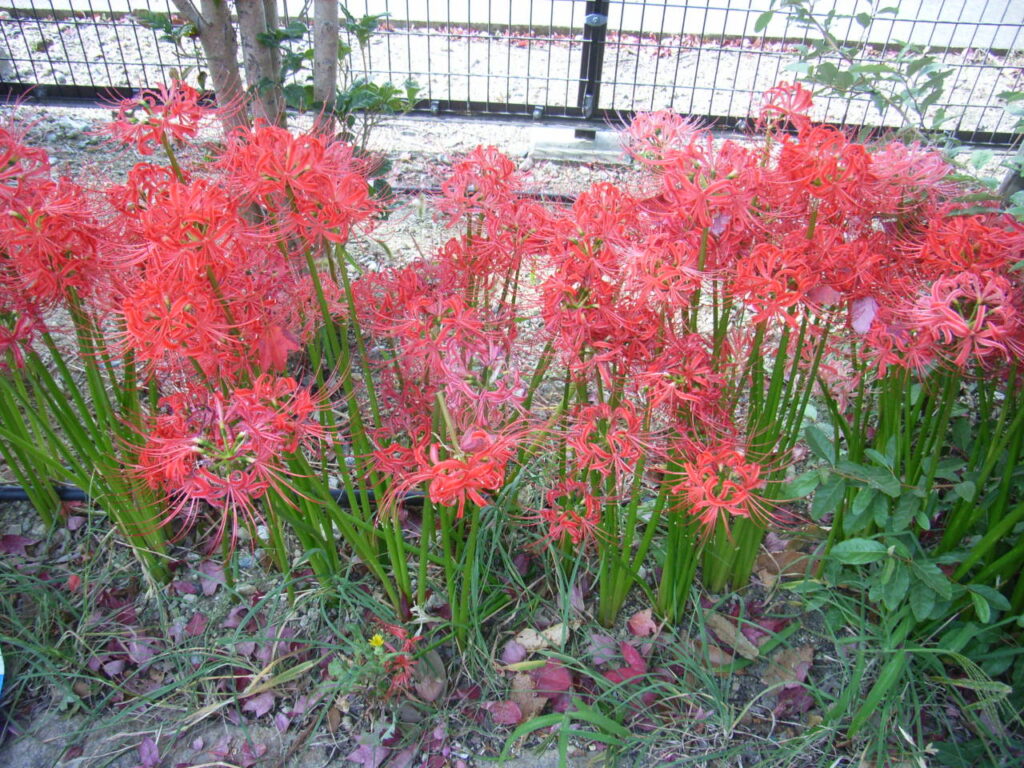
A rare variety of spider lily with a white border around the perianth. It is uncommon to see this variety. Some varieties have wavy edges on the perianth segments, while others do not.
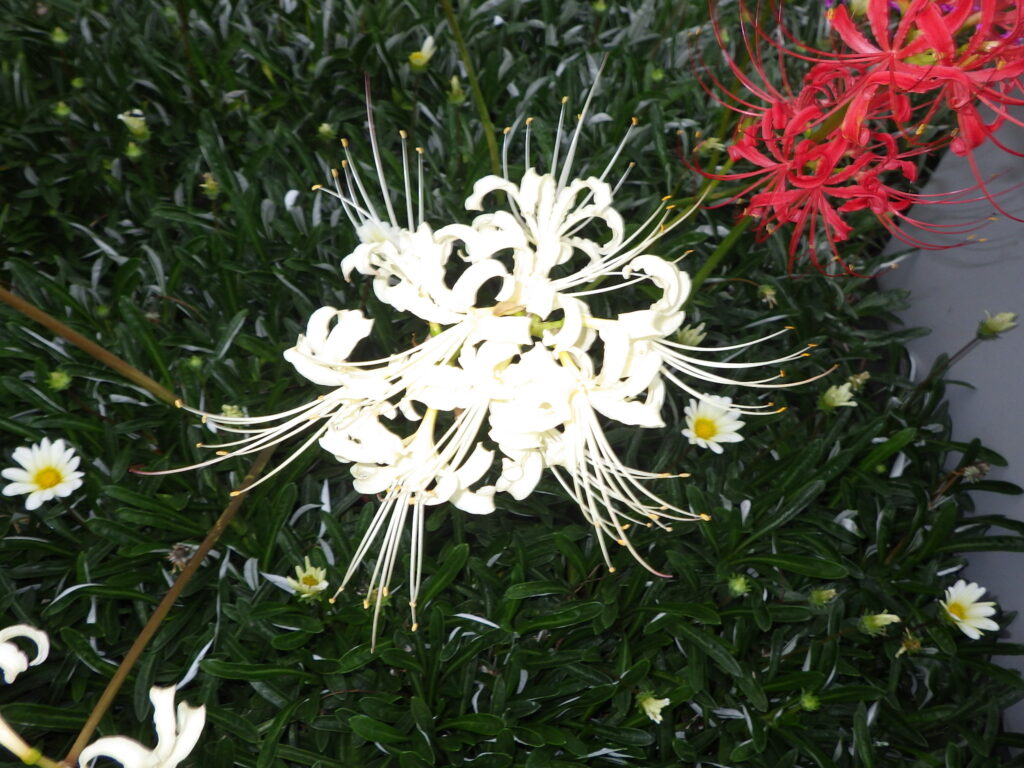
No.0544 White-flowered Red Spider Lily (Lycoris x albiflora)
A perennial plant. The flowers are white. Based on its karyomorphic shape, it is believed to be a hybrid of Lycoris radiata traubii and Lycoris radiata.
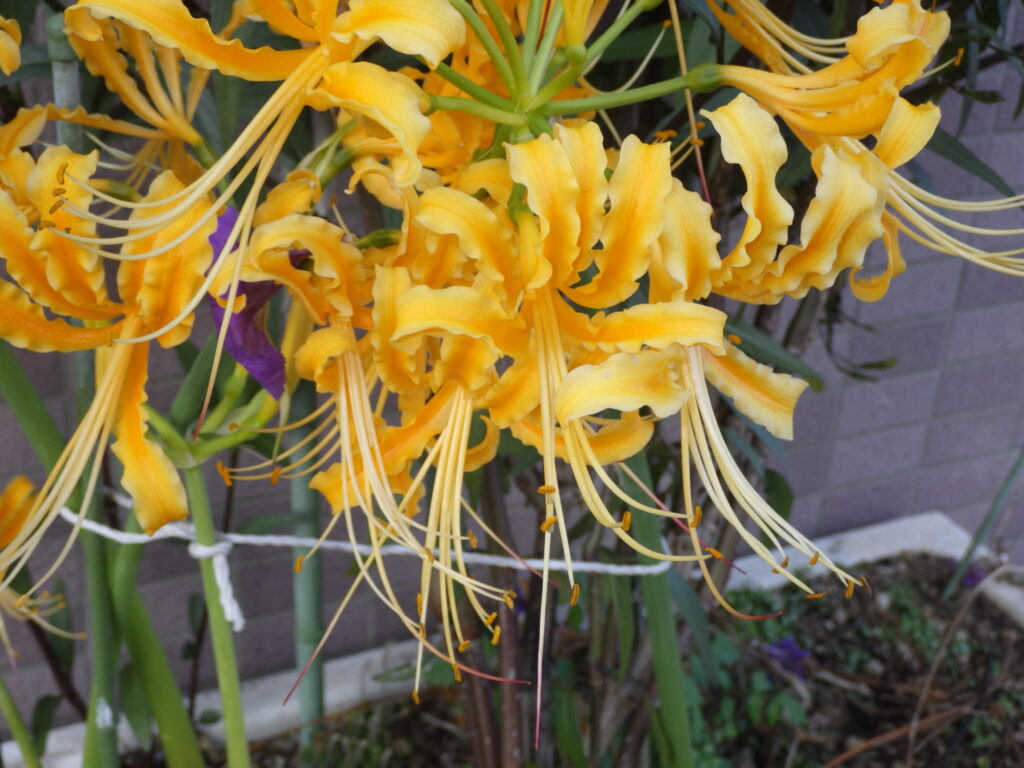
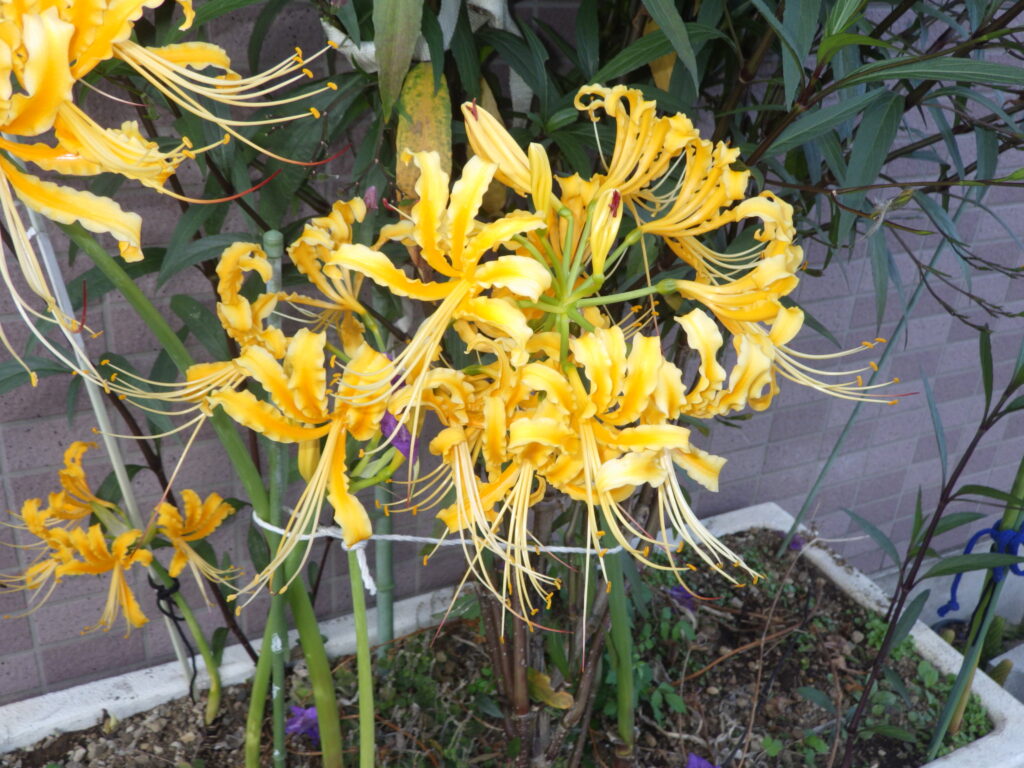
No. 0545 Lycoris traubii
Perennial herb. The bulb is ovate, about 5 cm in diameter. Leaves emerge in autumn, sword-shaped (broadly linear), about 60 cm long × 1.7–2.5 cm wide, with a pale midrib, gradually narrowing from base to apex. Flowering occurs from September to October. The flower stalk is about 60 cm long. The involucre consists of two lanceolate bracts, about 3.5 cm long × 0.8 cm wide. The perianth is yellow, with a tube 1.2–1.5 cm long. The lobes are strongly recurved, with a pale green midrib on the outer surface, oblanceolate, about 6 cm long × 0.4–1 cm wide, with strongly wavy margins. The stamens protrude slightly or long, 7–12 cm long. The filaments are yellow. The style has a rose-red tip. The capsule is triangular, dehiscing dorsally. Seeds are few in number, black, subglobose, about 7 mm in diameter (Flora of China). The Japanese name is said to come from the way the edges of the petals ripple, likened to the beard of Zhong Kui (a Taoist deity from Chinese folklore, depicted with a long beard), but its veracity is unknown. It also seems more likely to be a simple comparison to the way the stamens protrude in a ring shape. However, this characteristic is common to all plants in the Lycoris genus. It is distributed in Japan (Shikoku to the Southwest Islands), China, Taiwan, India, Pakistan, Indonesia, Laos, Myanmar, Thailand, and Vietnam, and inhabits shady and damp places such as slopes and rock crevices. It is also cultivated for ornamental purposes.
No.0547.a Amarcrinum memoria-corsii
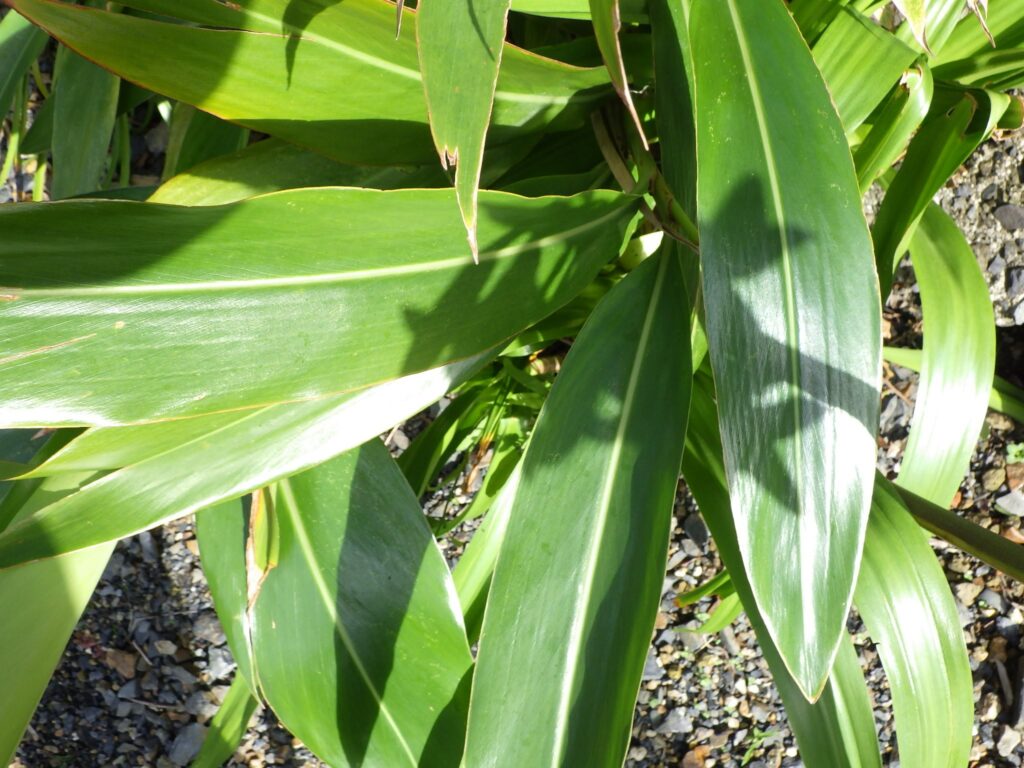
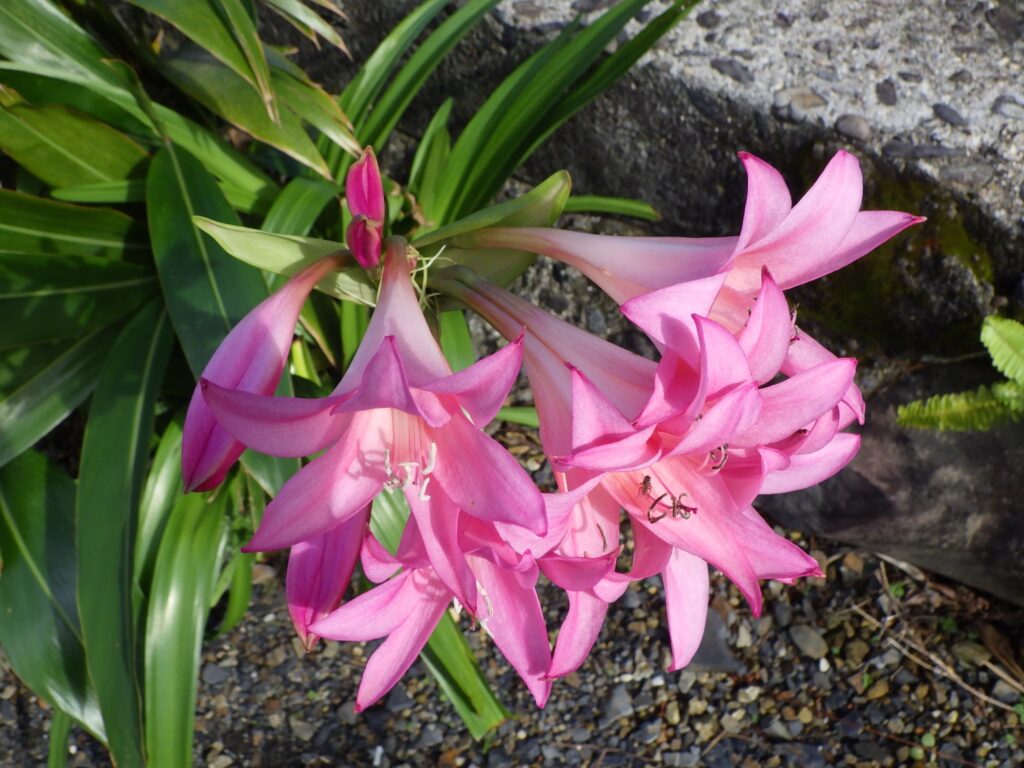
Memoriacorsii amalcrinum is a provisional name given by the author. If read according to the scientific name, it would be Amalcrinum memoriacorsii. Amalcrinum hawardii is thought to be a synonym, but the author has not confirmed its academic history. It is an intergeneric hybrid variety of Amaryllis belladonna of the Amaryllis genus and Crinum moorei of the Crinum genus. The flowers resemble Amaryllis belladonna, but the tube is narrower and curved, and the color is pink. It has a bulb. The leaves are basal, string-shaped, about 30-60 cm long and less than 5 cm wide. The flowering period is from August to October. The flower stalk is leafless, 50-80 cm tall, and bears 10-15 flowers in an umbel at the top, with 6-8 flowers blooming sequentially. The flowers are 7.5-10 cm in diameter, trumpet-shaped, rose pink, pink, shell pink or white, and fragrant.
No.0549 Leucojum aestivum
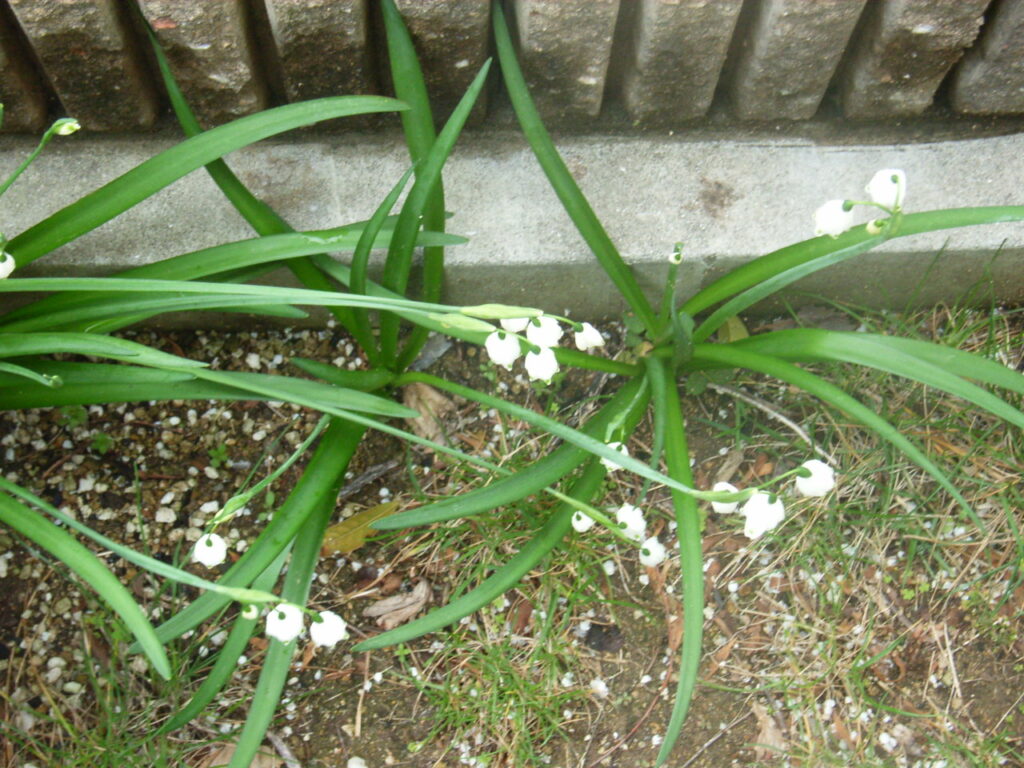
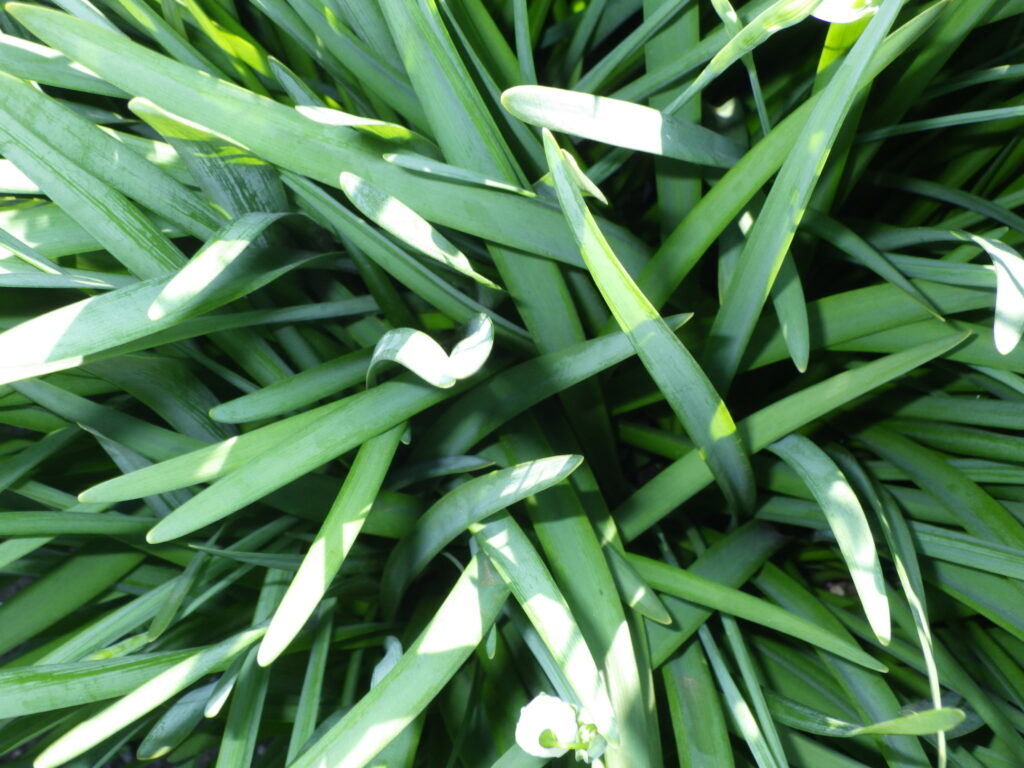
A perennial plant. Also known as snowflake or lily-of-the-valley daffodil. The bulb is 2-4 cm long. The stem is tubular. The leaves are flat, similar to daffodils, 30-50 cm long and 0.5-2 cm wide, with a slightly pointed tip. It flowers from March to April. The flowers are about 3 cm long, white, lily-of-the-valley shaped, and bloom facing downwards. There are 6 perianth segments, (10) 13-22 mm long and 10-12 mm wide, with green spots on the edges. There are 6 stamens. The seeds are 5-7 mm long and black. Native to the Mediterranean coast, it is cultivated in Japan for ornamental purposes.
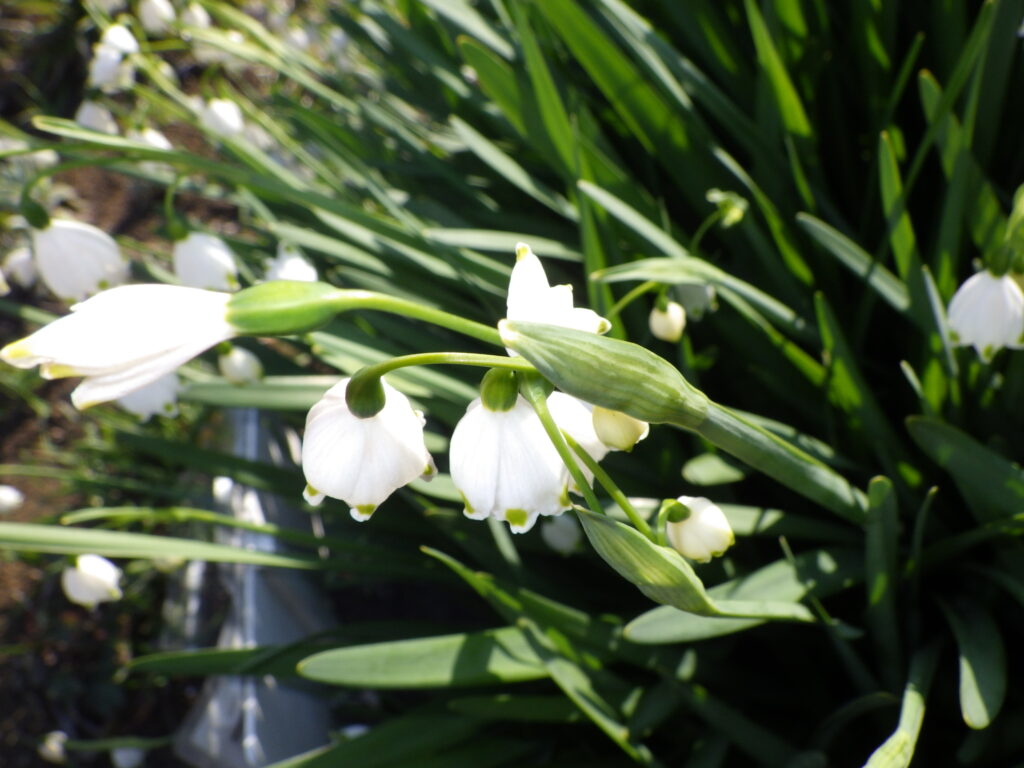
No.0549.a Acis autumnalis (Akizaki Snowflake)
This perennial herb grows to a height of 10-15 cm. It has a bulb 1.5 cm in diameter underground. The leaves are simple, basal leaves, numbering 6-7, and are very narrow and linear, 20-25 cm long. The leaves emerge after flowering and wither and go dormant before the rainy season of the following year; there are usually no leaves during the flowering period. One to four flowers bloom in an umbel-like arrangement at the end of a flower stalk that grows to a height of 10-15 cm, facing downwards. There are bracts at the base of the inflorescence. The flowers are 1 cm in diameter, bell-shaped, with six pale pink to white petals, and a pink base. It is found on both sides of the western Mediterranean, and is native to Portugal, Spain (including the Balearic Islands), Sardinia, and Sicily in Europe, and Morocco, Algeria, and Tunisia in North Africa. It grows on rocky areas and stony mountainsides. It is cultivated as an ornamental plant in various countries, including Japan.
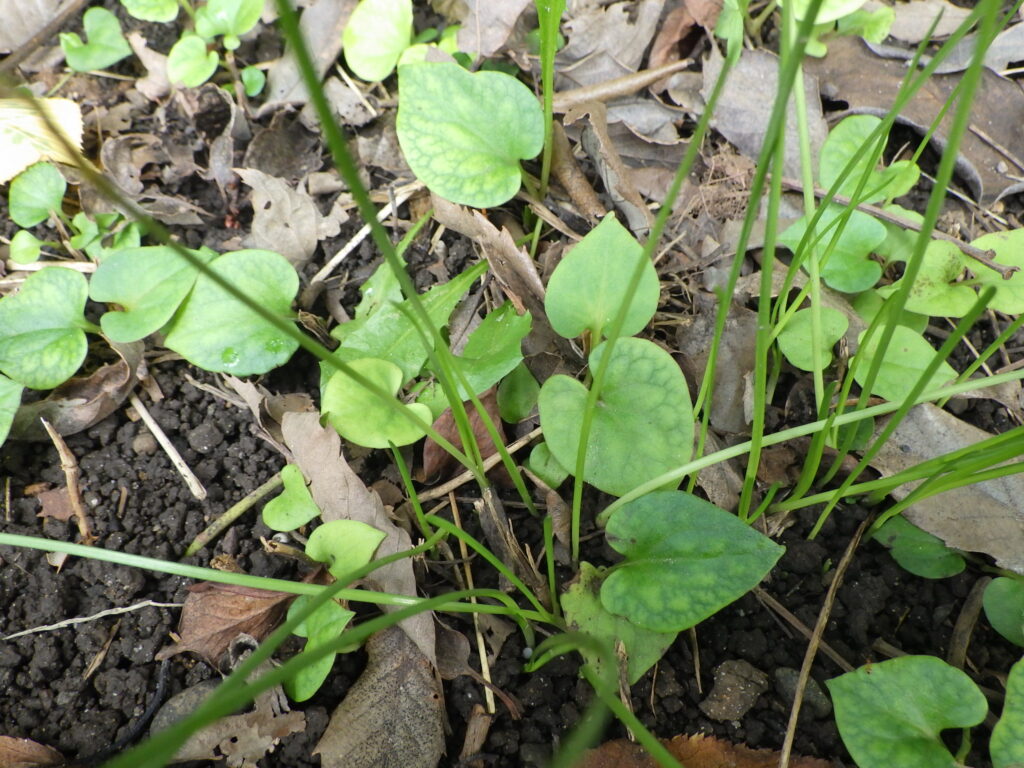
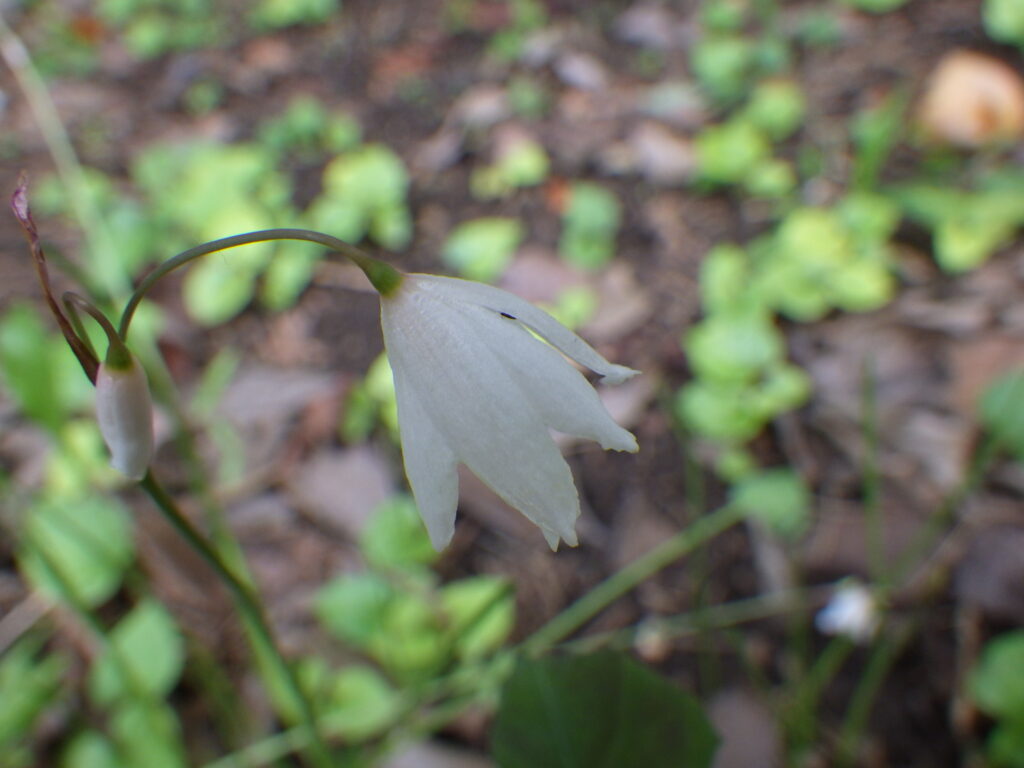
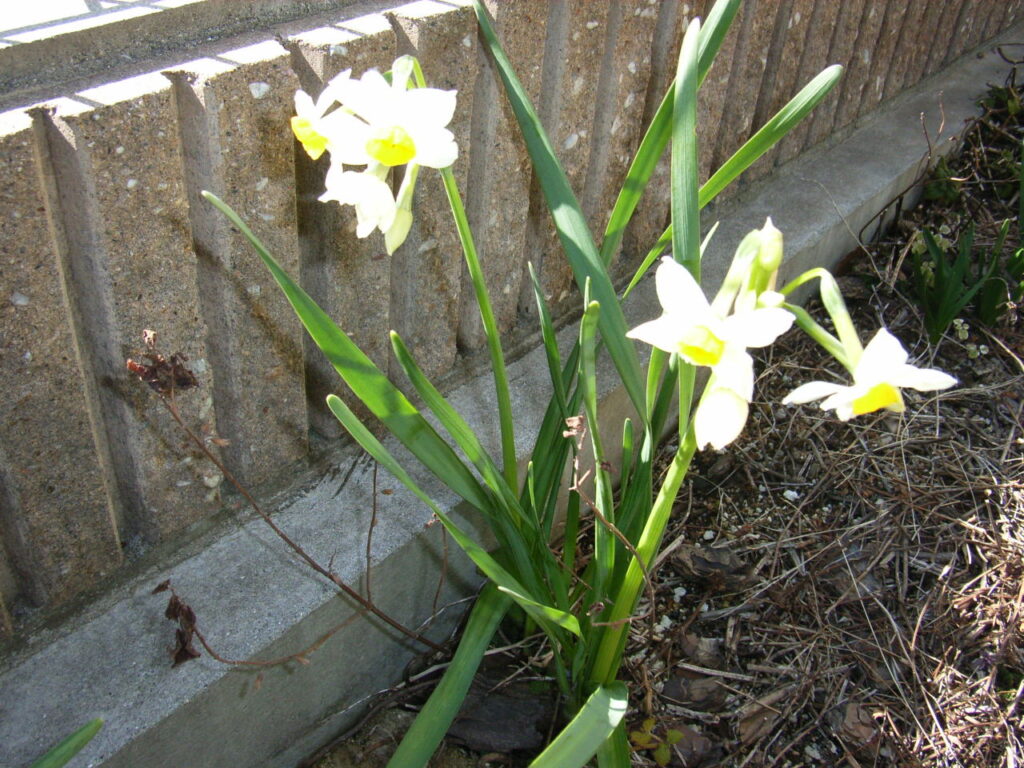
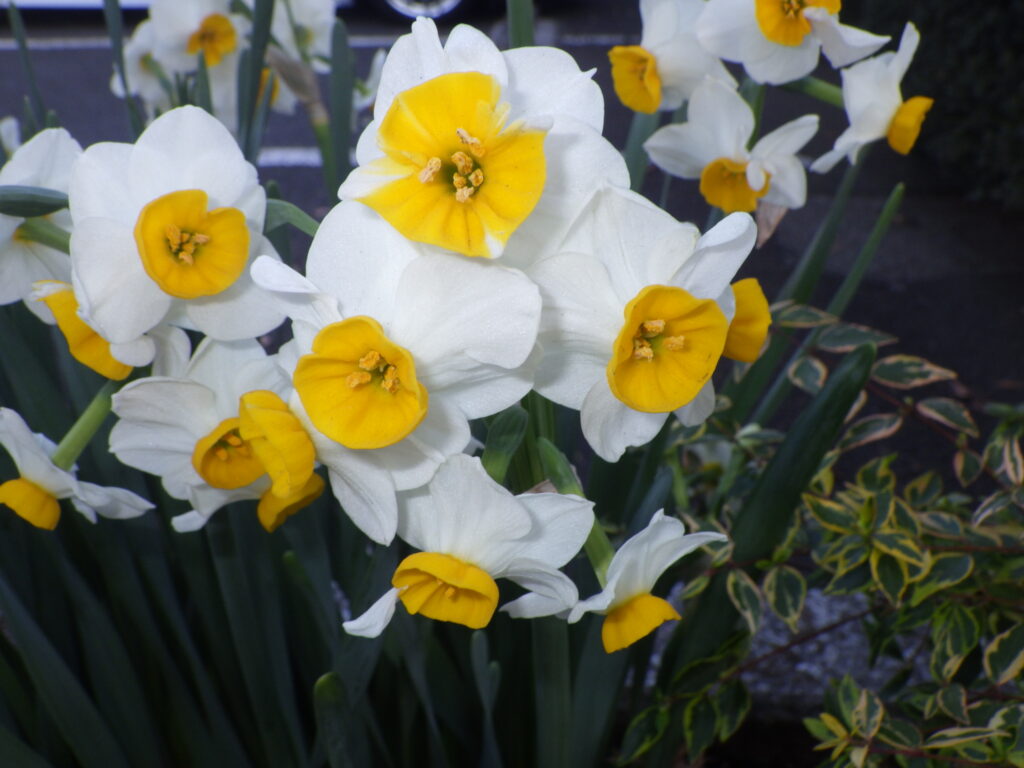
No. 0550 Japanese daffodil (Narcissus tazetta var. chinensis)
This is a perennial herb. The bulb is oval-shaped with a black outer skin. The leaves are greenish-white, emerge in late autumn, 20-40 cm long and 8-16 mm wide, with rounded tips. The flower stalks are 20-40 cm long. It blooms from December to March and is fragrant. The perianth segments are white, 15-18 mm long, and spread flat. The tube is 2 cm long. The corona is yellow and 4 mm high. It does not produce fruit. It grows wild on the coasts of Honshu (west of the Kanto region) and Kyushu, and is believed to have been introduced in ancient times. Varieties with yellow perianth segments, double flowers, and white coronas are horticultural varieties.
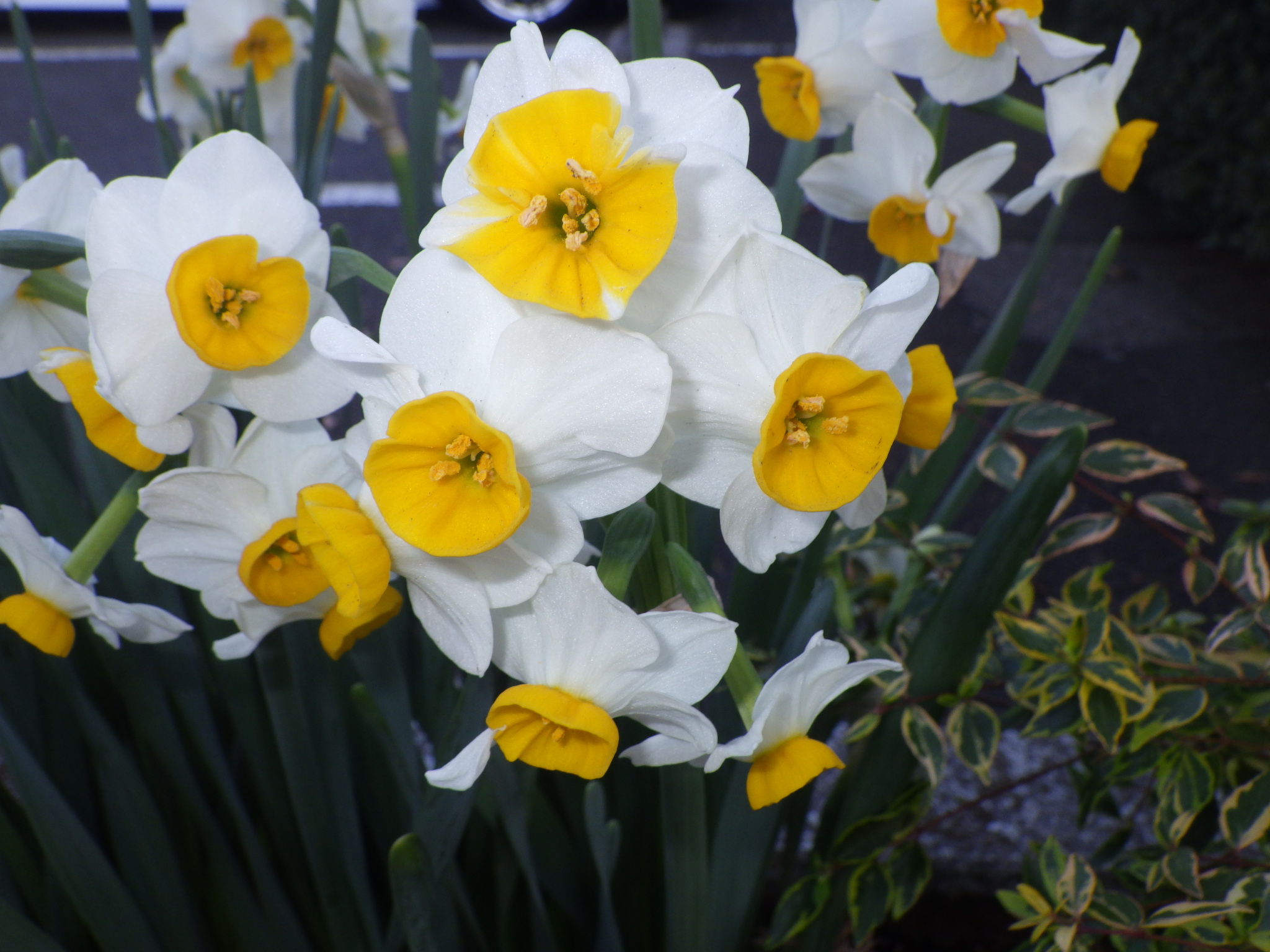
No.0550.1 Double-flowered daffodil, Narcissus tazetta 'Plenus'‘
Yaezuisen is a double-flowered variety of Japanese daffodil.
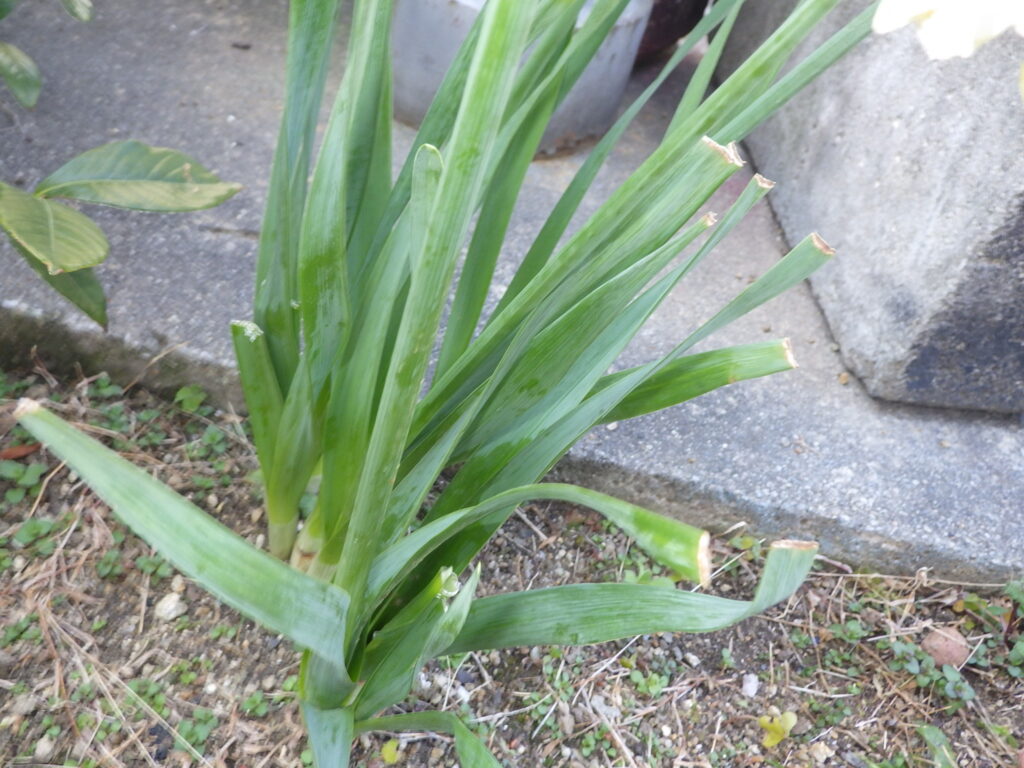
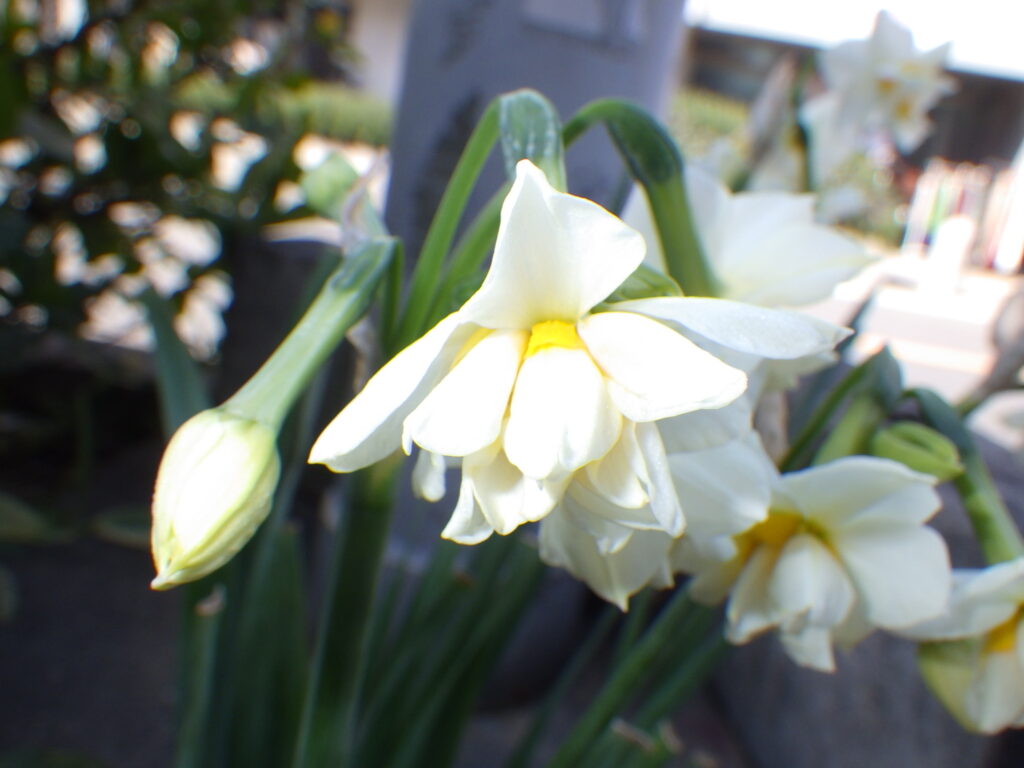
No. 0552 Trumpet Daffodil (Narcissus pseudonarcissus)
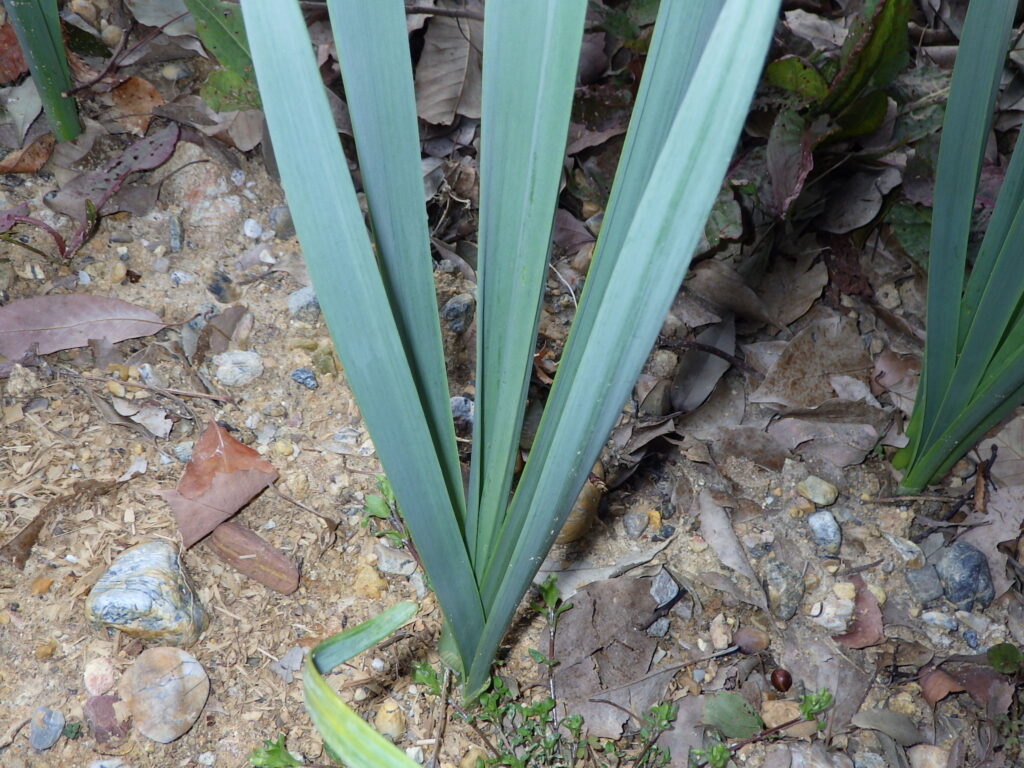
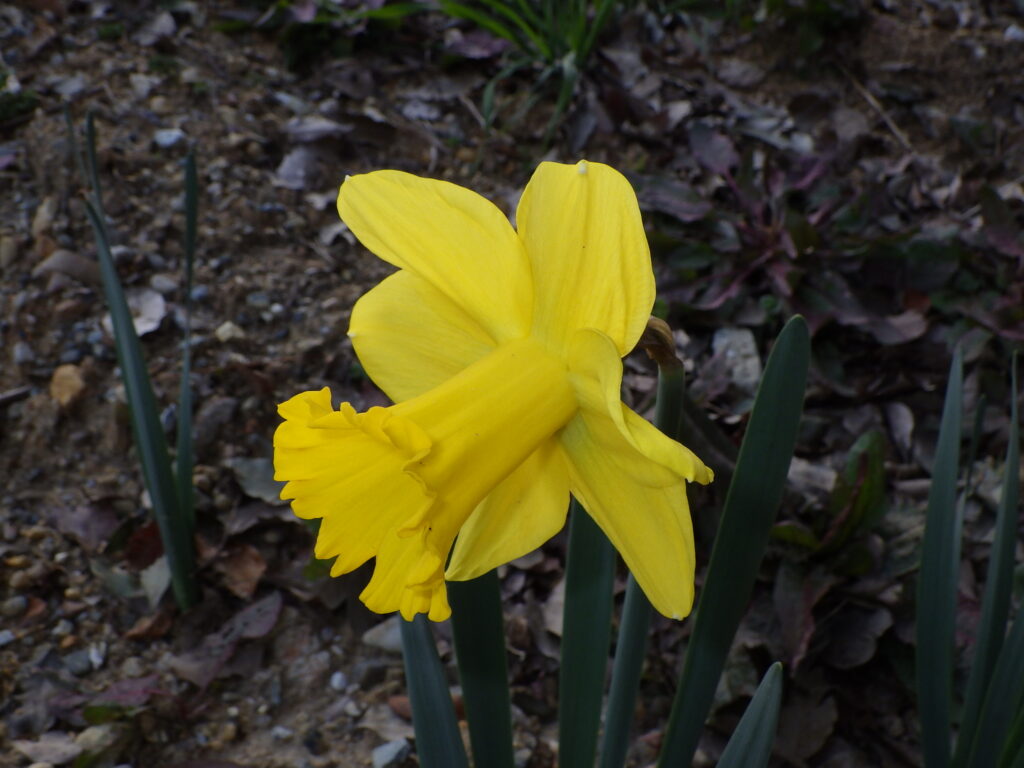
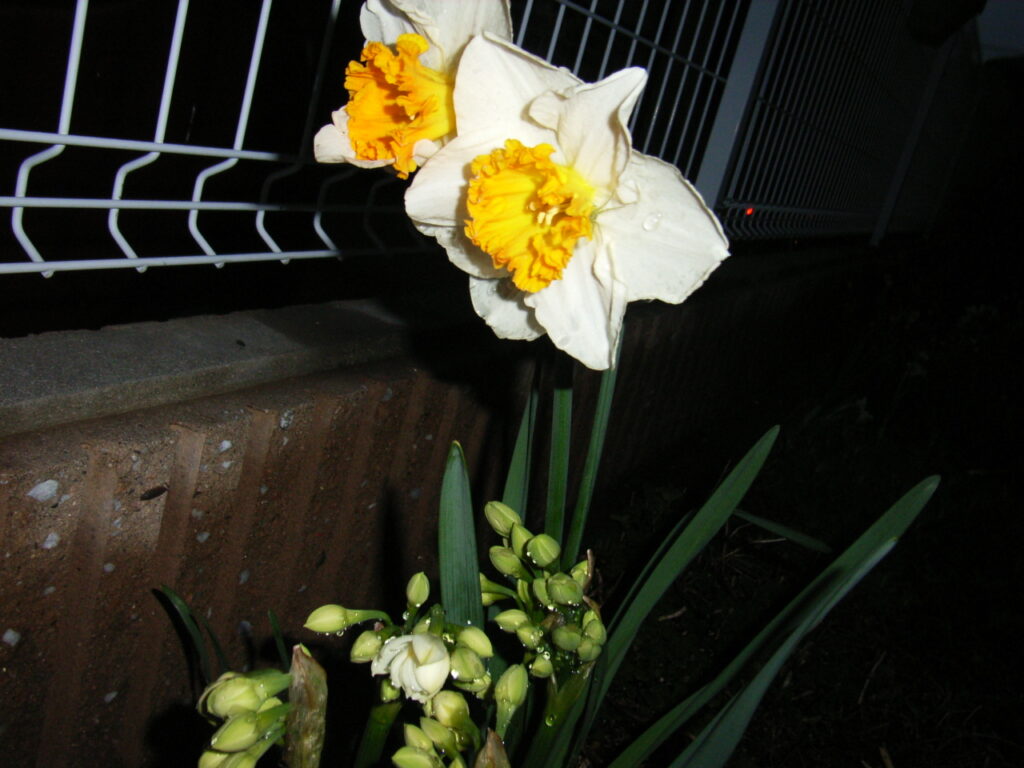
This is a perennial herb. The leaves are erect, up to 36 cm long and 0.6-1.3 cm wide. The flower stalks are roughly the same length as the leaves. The flowers are up to about 6.5 cm long, ranging from small to large, and are borne singly, facing downwards or sideways. The flower color is usually dark yellow or pale yellow, but some have white perianth segments and a yellow corona, and rarely, cream-colored or white flowers. The corona is trumpet-shaped with notches or serrations along the edges. The flowering period is from March to April. It is native to the Mediterranean coast of France, Spain, and Portugal, and is distributed as far as England, Germany, Belgium, and northern Italy. In Japan, it is cultivated for ornamental purposes.
No.0552.a Cyclamineus Narcissus 'Tete a tete'‘
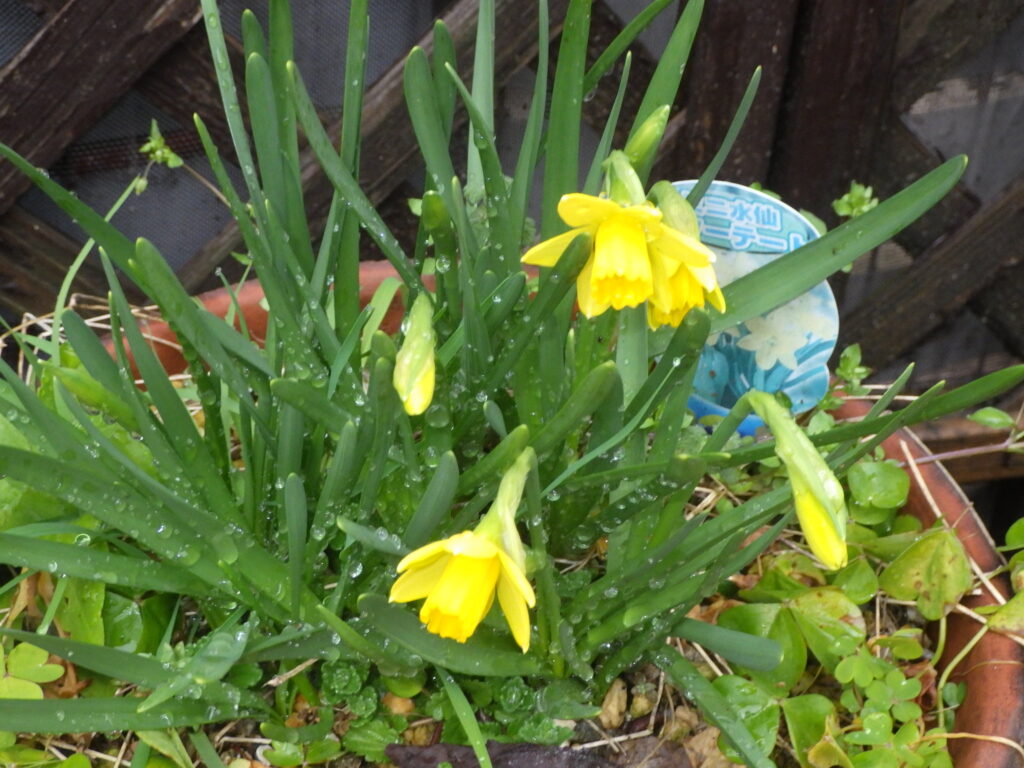
Cyclamineus narcissus is the author's provisional name. It is a perennial plant that grows to a height of 15-20 cm, with 1-5 downward-facing flowers per stem. The perianth segments curl back later, and the corona is cup-shaped, with the original species being particularly characterized by its long corona. It blooms in winter and spring, with yellow (lemon-colored) perianth segments and corona. Tete-a-tete is a variety of Cyclamineus narcissus, and "Tete a tete" means "to whisper a secret" in French. It is a short plant, and since the flowers are planted in clusters of roughly the same height, the name comes from the image of the flowers whispering to each other.
No. 0554 Amaryllis Hippeastrum x hybridum
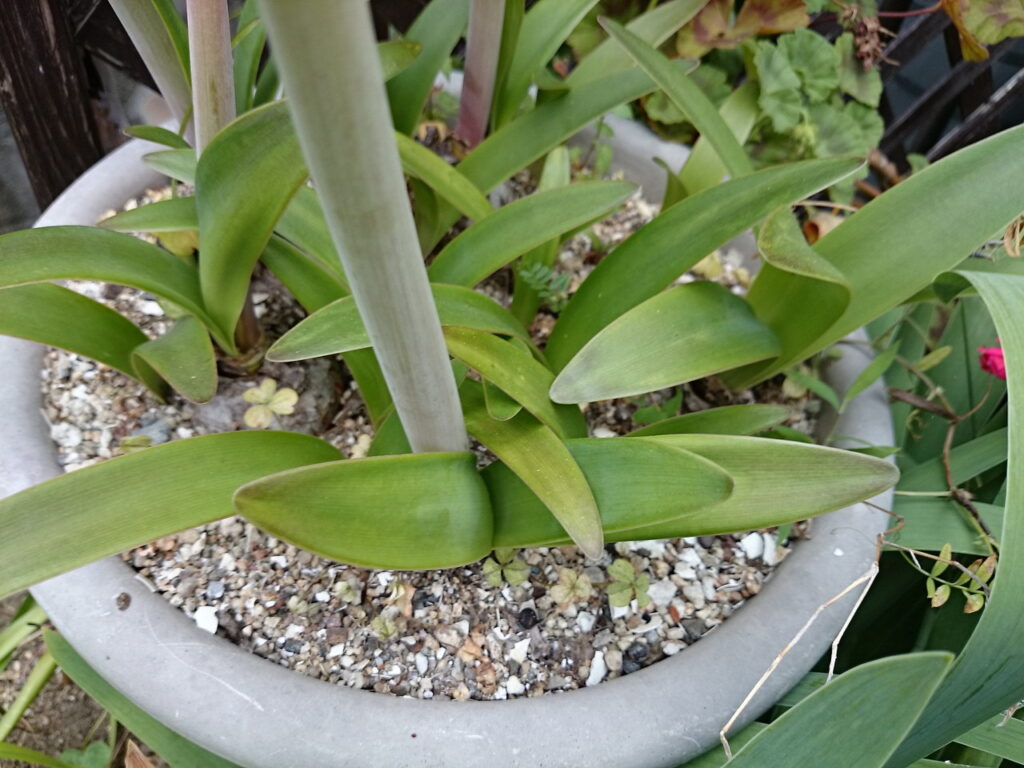
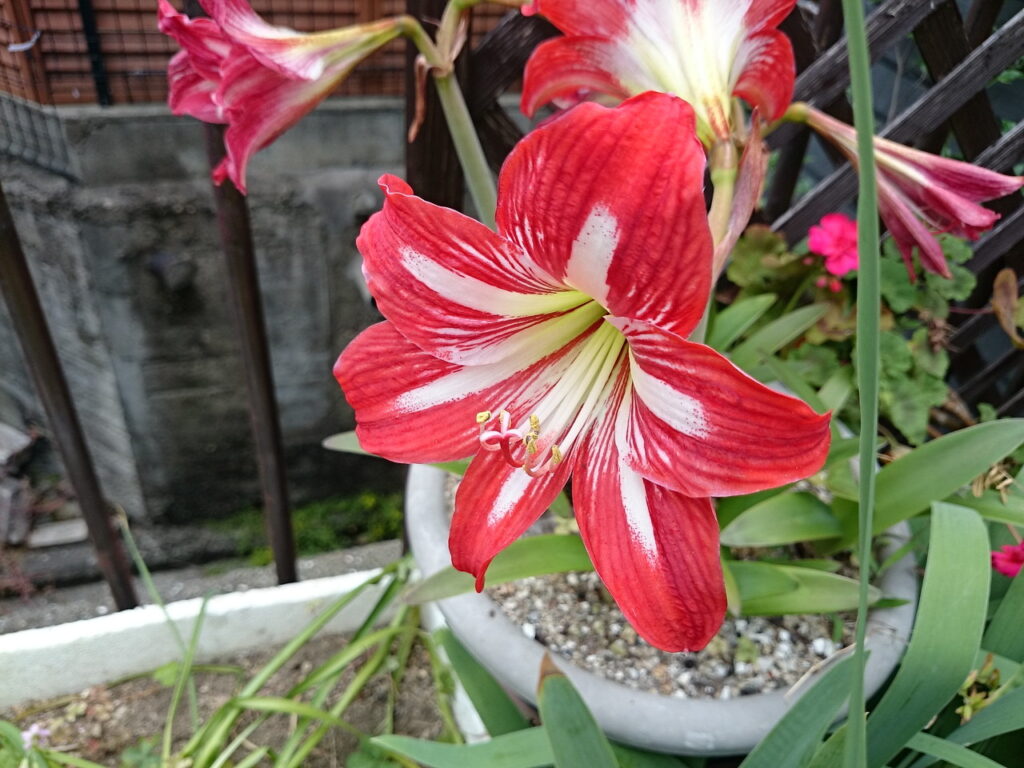
This is a perennial plant. Its Japanese name follows the "Ylist" designation. It was formerly classified under the genus Amaryllis, hence its name. Currently, it belongs to the genus Hippeastrum, and should technically be called by a different name, but it remains so due to convention. It was introduced to Europe from South America in the early 18th century and began to be cultivated. In 1799, the English clockmaker Arthur Johnson successfully crossed Hippeastrum vittatum with Hippeastrum reginae, resulting in the creation of Hippeastrum x johnsonii. Subsequently, cultivation became widespread, and numerous varieties were created through crossbreeding with various wild species, eventually leading to the current species. One or more sturdy, hollow, leafless flower stalks emerge from the bulb, reaching a height of 30-60 cm. The leaves are basal from the bulb, linear, 30-60 (90) cm long, green, entire, and parallel-veined. The flowers are densely clustered in groups of 2 to 6 at the tip of the flower stalk, funnel-shaped to bell-shaped, usually 10 to 20 cm in diameter, and orange, red, pink, purplish, or white in color, with or without various patterns such as stripes, spots, or veins. The capsule is round, about 1.3 to 2.5 cm in diameter. The flowering period is usually from April to July, although some varieties bloom in autumn.
No. 0555 Zephyranthes candida
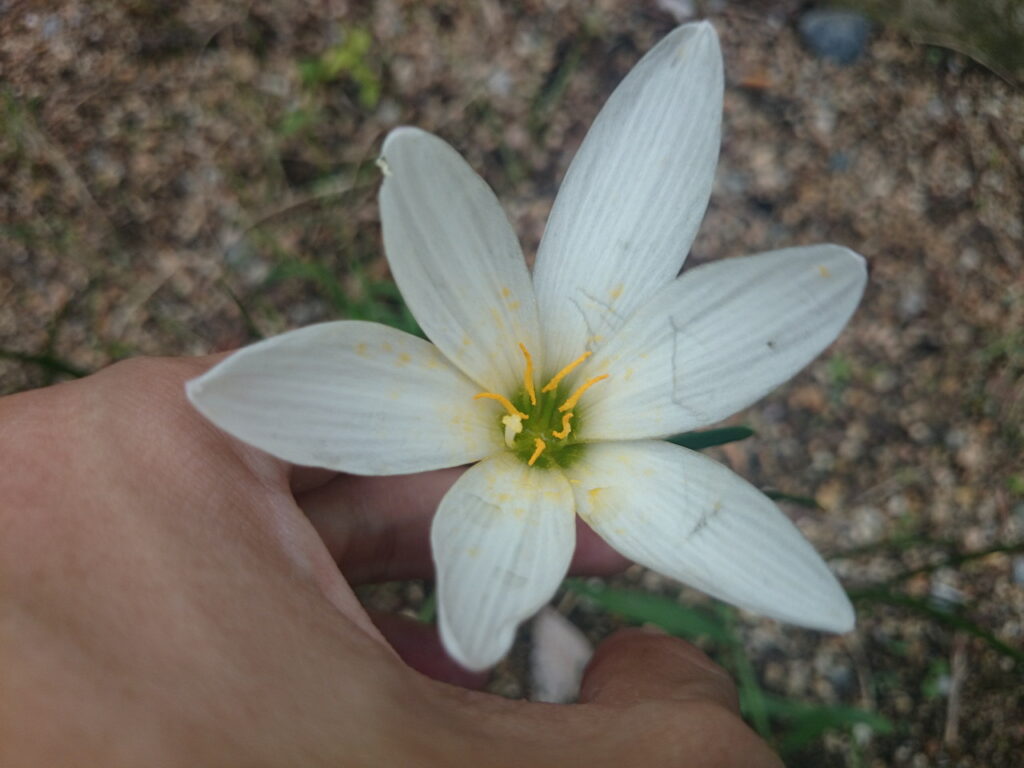
This is an evergreen perennial herb. The bulb is small and spherical, covered with a dark brown outer layer. The leaves grow in clumps, are narrowly linear, and erect, reaching about 20-40 cm in length. The flower stalk is 30 cm tall, bearing a single upward-facing flower at the terminal in summer. The perianth segments are pure white, with yellow to yellowish-green bases and veins. The perianth segments are about 4 cm long. There are bracts at the base of the flower, enclosing the ovary. The anthers are yellow, and the filaments are yellowish-green and erect. The stigma is rounded at the tip and divided into three lobes. Native to South America, it was introduced to Japan in the early Meiji period (around 1870). It is widely cultivated throughout Japan and has escaped cultivation around human settlements.
No. 0556 Zephyranthes carinata (False Saffron)
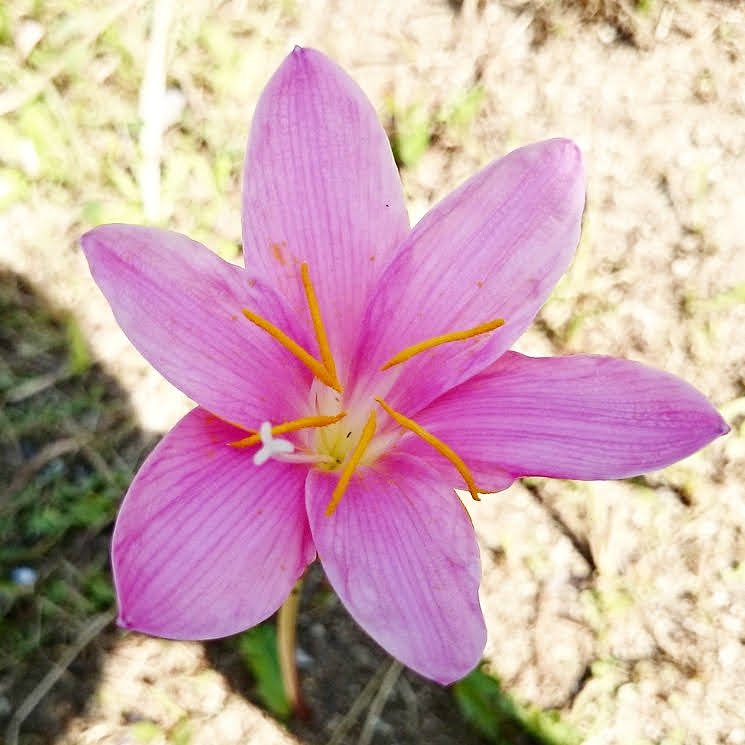
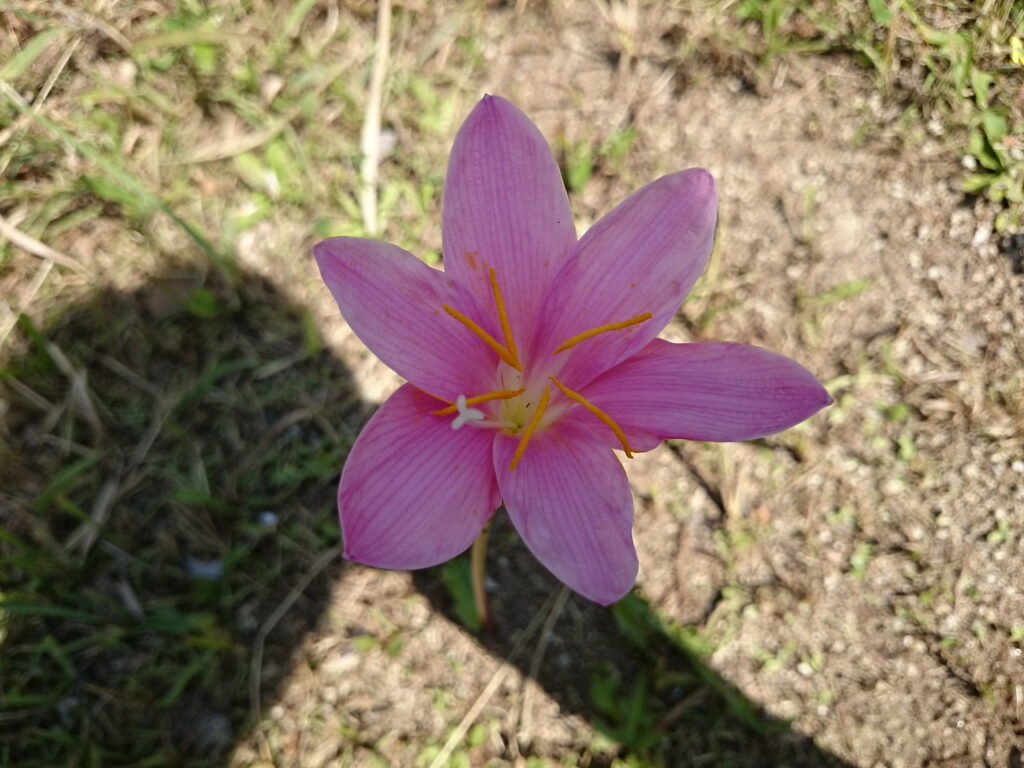
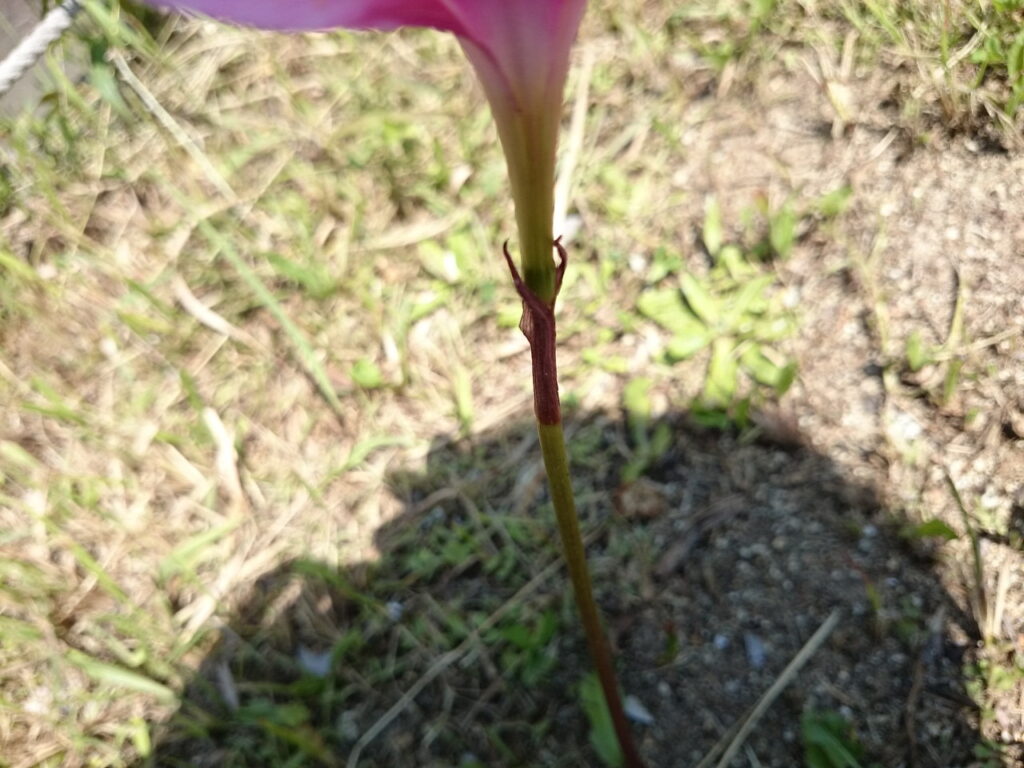
This is an evergreen perennial herb. The bulb is ovate, and the leaves are linear and clustered, 15-30 cm long. The flower stalk is about 30 cm long, with a single flower facing upwards at the end. The flower is bright pink, with perianth segments 6-8 cm long that spread flat, almost curving at the tip. The anthers are yellow and slender. The stigma is thick and three-lobed at the tip. Below the ovary is a pedicel enclosed by bracts. Native to Central America and the West Indies, it was introduced to Japan during the Edo period (around 1845) and has naturalized in warmer regions.
No.0556.a Zephyranthes tubispatha
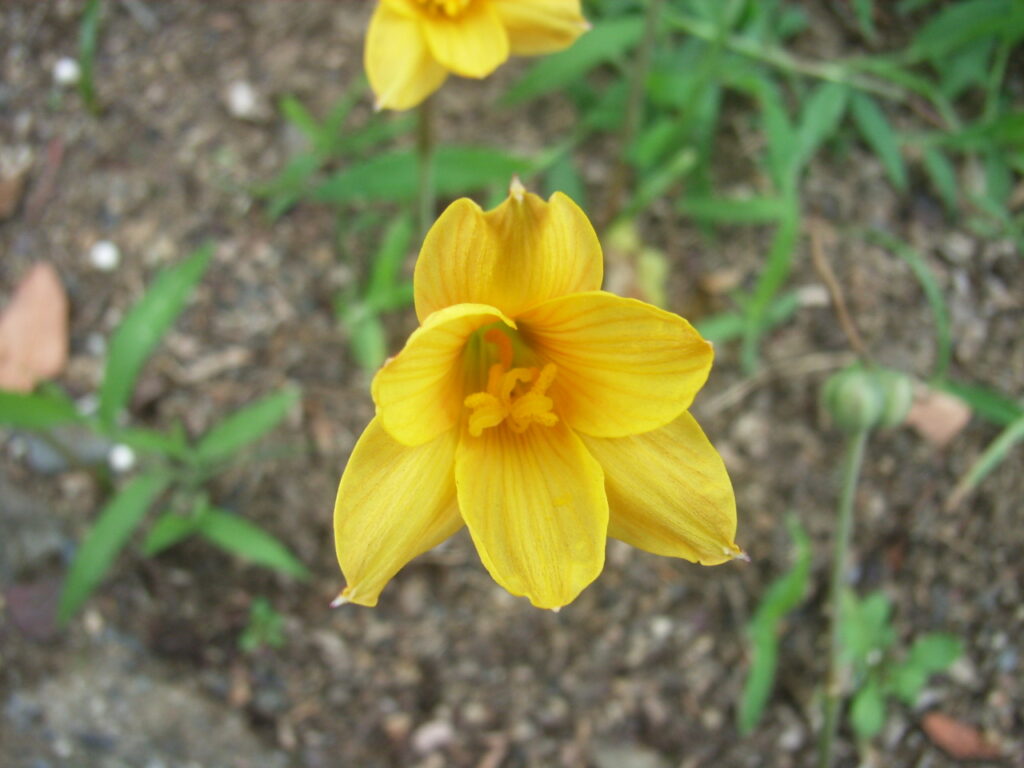
"Tubispatusatamasudare" is the author's provisional name. In Japan, it is known as Habranthus tubispathus, but García et al. (2019) considers it a synonym, and note that Zephyranthes tubispatha is the correct name. It is a perennial herb, growing to a height of 10-20 cm. It has a bulb underground. The leaves are basal, fleshy, linear, and wither by the time of flowering. It flowers from June to October in North America and from August to October in Japan. A single flower blooms at the tip of a flower stalk that emerges from the bulb. The flower is a funnel-shaped, six-petaled flower about 3 cm long, blooming slightly sideways. The flower color is yellowish-orange with darker veins on the outside. Each flower closes after one day. When it rains, the flower stalk grows and the flower opens. There are six stamens, and the tip of the stigma of the pistil is three-lobed. The fruit is a capsule. It is distributed in the United States (Alabama, Florida, Louisiana, Texas), South Africa, Argentina, Brazil, central and southern Chile, and southern Uruguay, inhabiting grasslands, plains, and disturbed areas. It is unclear whether its distribution in the United States is natural or anthropogenic, and there is a theory that it was introduced by Spanish missionaries via Mexico, but it is not currently found in Mexico (Flora of North America). It is cultivated in Japan for ornamental purposes.
No.0556.b Zephyranthes bifida
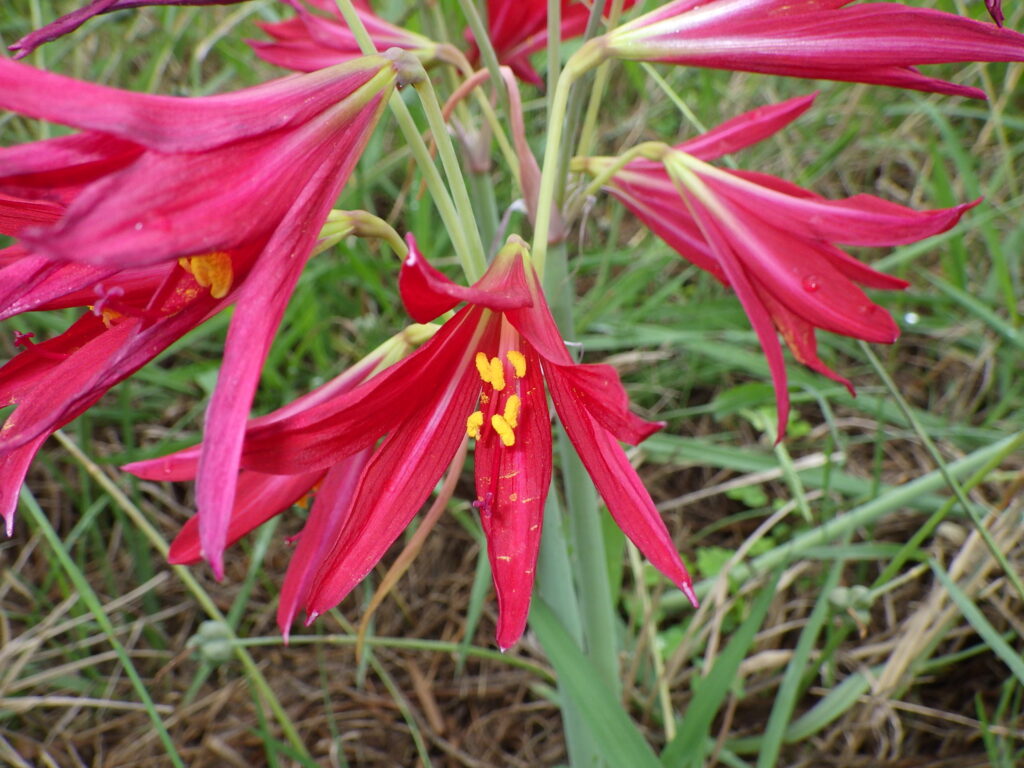
ビフィダタマスダレは筆者の仮称。国内ではロドフィアラ・ビフィダ Rhodophiala bifida として知られていますが、García et al.(2019)でシノニムとされ、Zephyranthes bifida が正しくなっているので注意。球根をもつ多年草。球根は直径3.7~5cm。葉は長さ20~30cm、紐形、花後に出て、初夏に枯れる。花期は(7~)8~10月。花茎は長さ25~30(~40)cm。花は散形花序に3~10個つき、トランペット形、赤色、暗赤色、ピンク色。北東部のミシオネス(パラグアイ)~東部のブエノスアイレス(アルゼンチン)に見られ、北部では赤色、ブエノスアイレス北部では暗赤色、ピンク色、ブエノスアイレスの南部では暗赤色。雄しべの葯は黄色。ブラジル・アルゼンチン・パラグアイ、ウルグアイ原産で日本では稀に観賞用に栽培されます。Zephyranthes advena(シノニム:Rhodophiala advena)と外見上類似します。この旧Rhodophiala属に関しての区別方法はネットで探しても皆無ですが、The European Garden Flora Editorial Committee(1986: p.298)に検索表が乗っていてそれによると Rhodophiala advena は「花被片が楕円形、鋭い、苞(spathe)が2.5~5cm」であるのに対して、 Rhodophiala bifida は「花被片が倒披針形、爪を持っている、苞が5~7.5cm」となっています。これに従えば以下の個体は Rhodophiala bifida ということになるはずです。しかし、ネットで Rhodophiala advena および Rhodophiala bifida を画像検索しても両方の形質が海外も含めて入り乱れており、意味が分かりません。可能性としては園芸で品種改良の過程で形態が変わったか、多くの人が Rhodophiala advena と Rhodophiala bifida の違いを理解できていないかのどちらかがあります。
No.0556.c Yellow-flowered Zephyranthes (Sternbergia lutea)
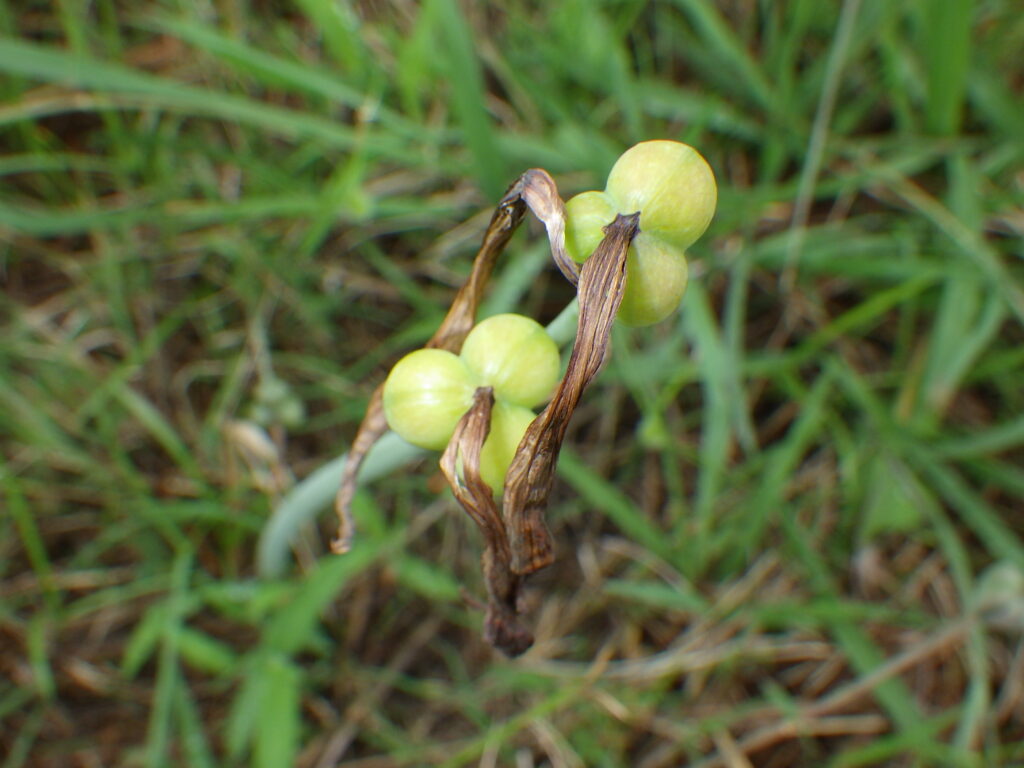
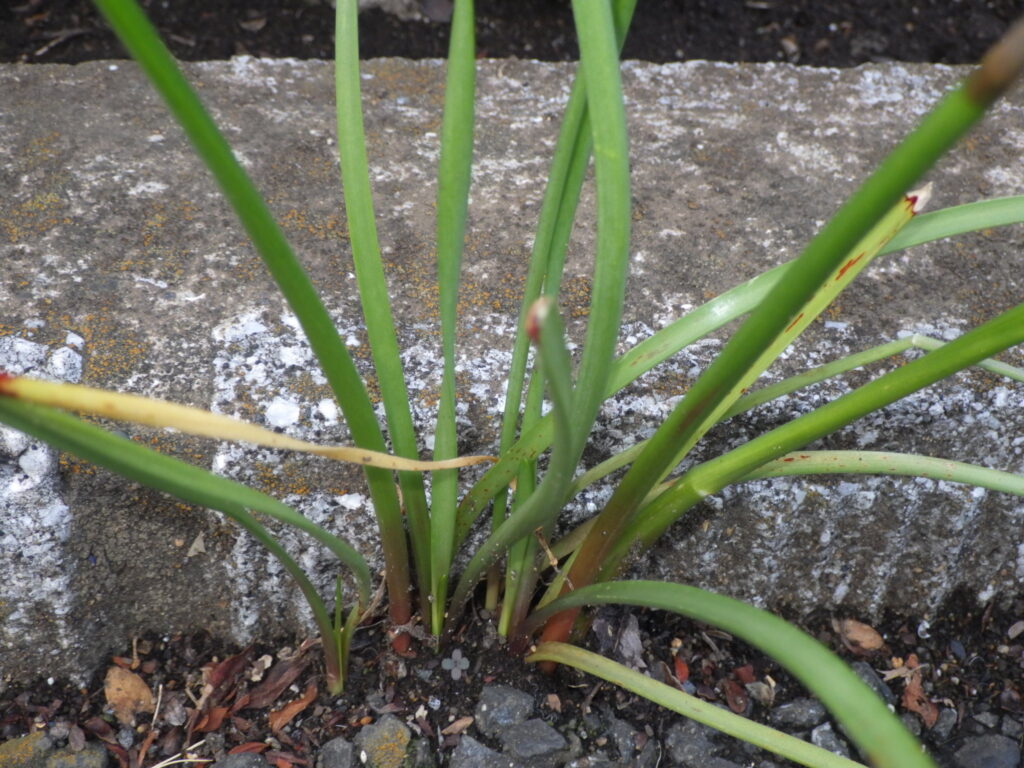
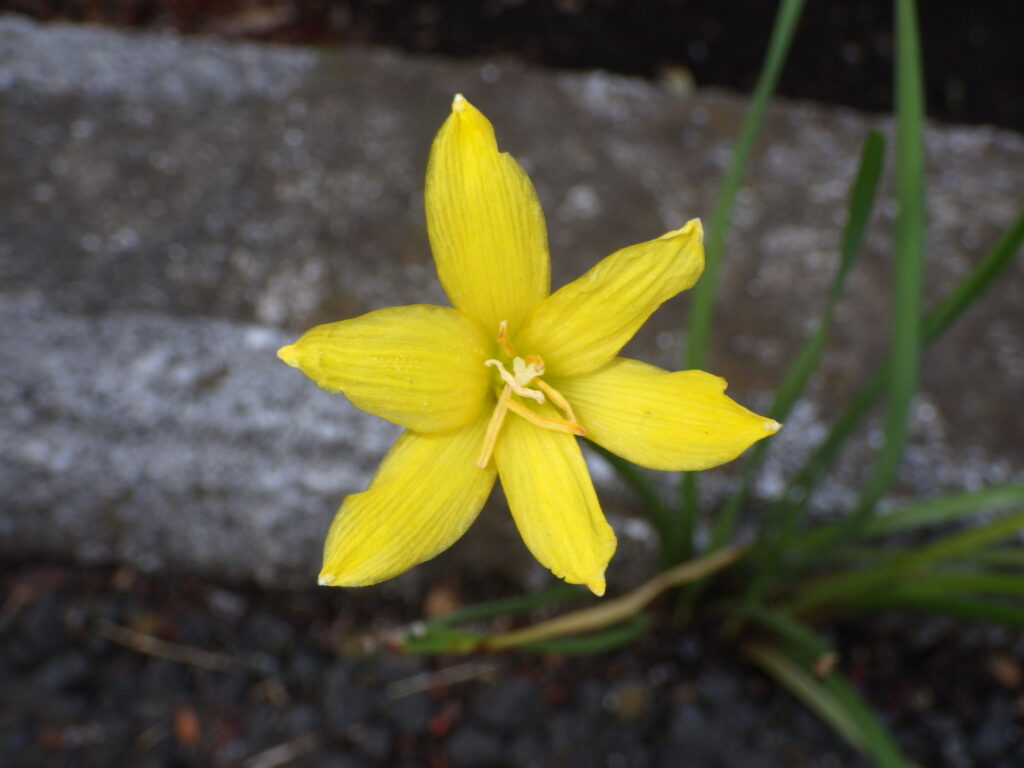
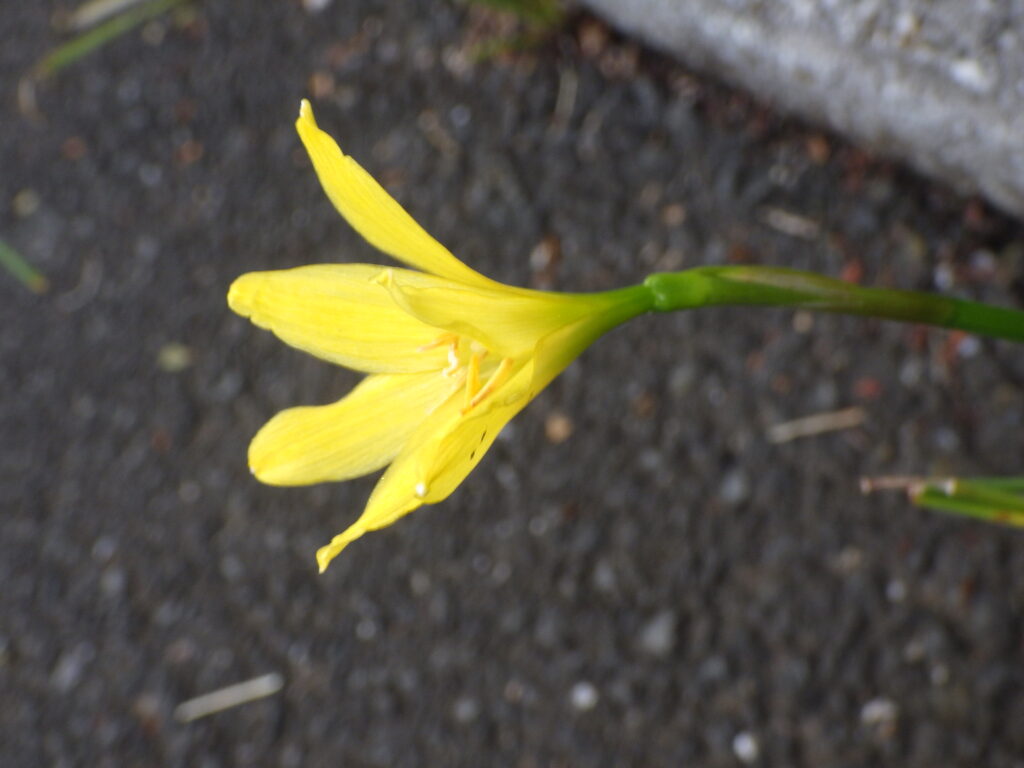
This is a perennial herb with a bulb. The bulb is subglobose. Leaves and flowers emerge simultaneously, or flowers emerge first. There are 9 or fewer leaves, 8-25 cm long and 1-2 cm wide, with a keel (midrib), a rounded apex, and papillae along the margins. The leaves remain after flowering, survive the winter, wither in early summer, and the plant goes dormant in summer. The bracts are partially green and acute at the apex. Two to three flower stalks emerge from the bulb, 5-20 cm long, bearing 1-3 flowers in clusters, yellow and resembling crocuses. The perianth is showy. The perianth segments are 3.5-7 cm long and 1-2 cm wide, spatulate-lanceolate, with rounded or short mucronate apex, and bright yellow. The ovary is sessile. The capsule is 1.5-2.5 cm long and 1-1.5 cm wide. Flowering occurs in autumn, from September to October. It is widely distributed from the Balearic Islands in the western Mediterranean to Tajikistan in Central Asia, and is cultivated for ornamental purposes in various countries, including Japan. Cultivated varieties are typically triploid, while wild varieties are diploid.
No.0556.d Agapanthus praecox
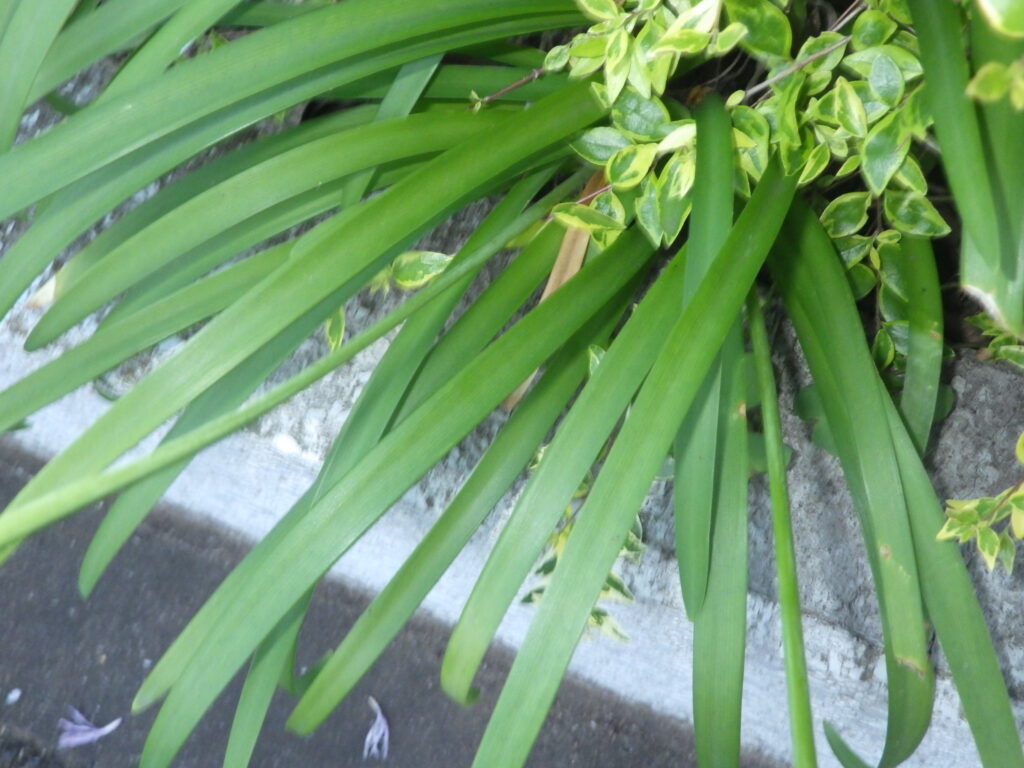
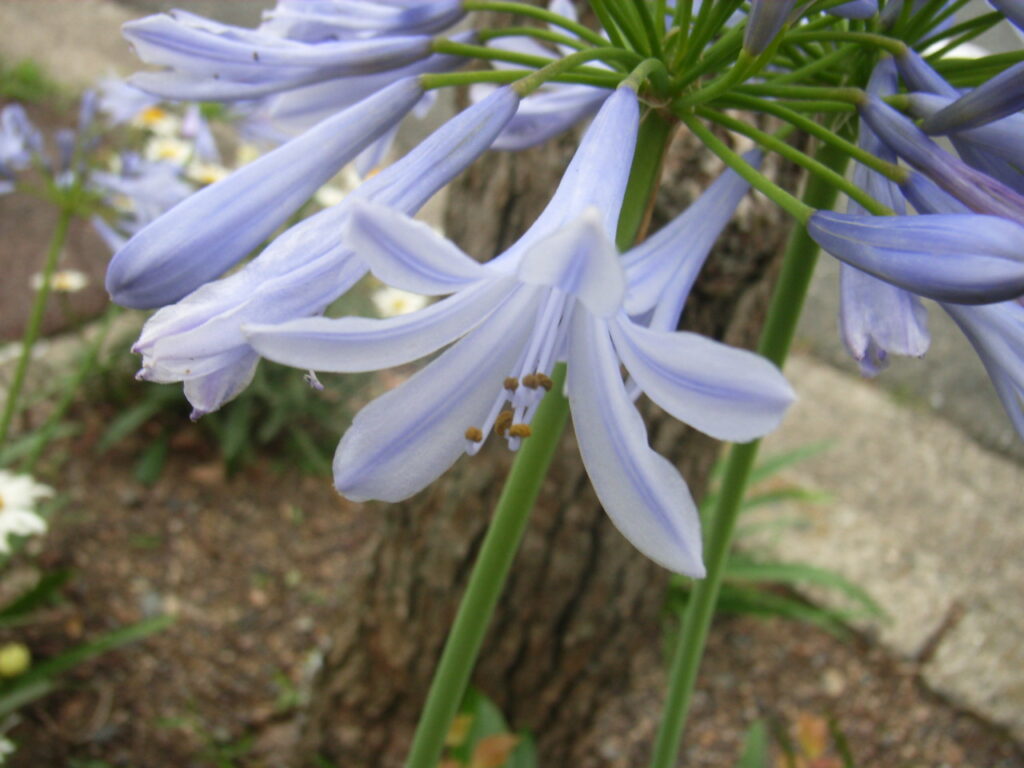
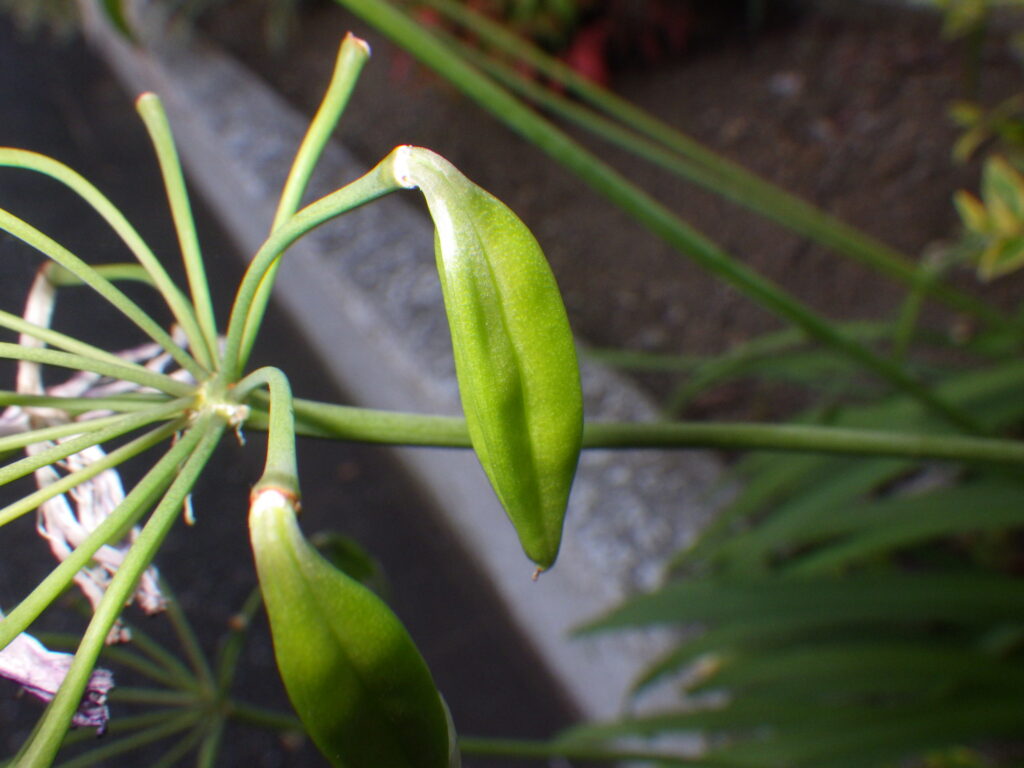
This is a perennial herb. Its rhizome swells like that of a taro root. The leaves are 10-35 cm long and 1-2 cm wide. It bears 20-30 flowers in an umbel at the end of the flower stalk. The corolla is funnel-shaped, 2.5-5 cm in diameter, and deeply 6-lobed at the tip. The flowers are blue, purple, or white. The fruit is a 3-chambered capsule that ripens in autumn, and the seeds have wings. Native to South Africa, it was imported to Japan during the Meiji era for ornamental purposes. There are many cultivated varieties. It can be seen growing next to fields and along roadsides, and its large size makes it conspicuous in early summer. Agapanthus africanus is a different species and is not commonly cultivated.
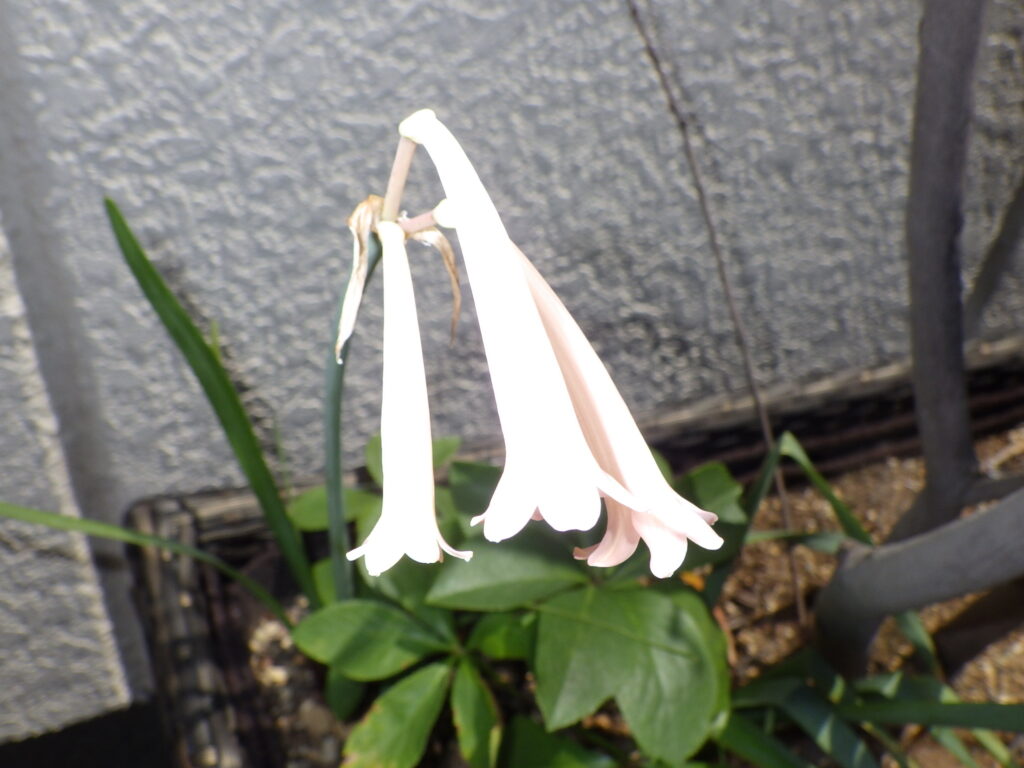
No.0556.e *Cyrtanthus mackenii subsp. mackenii*
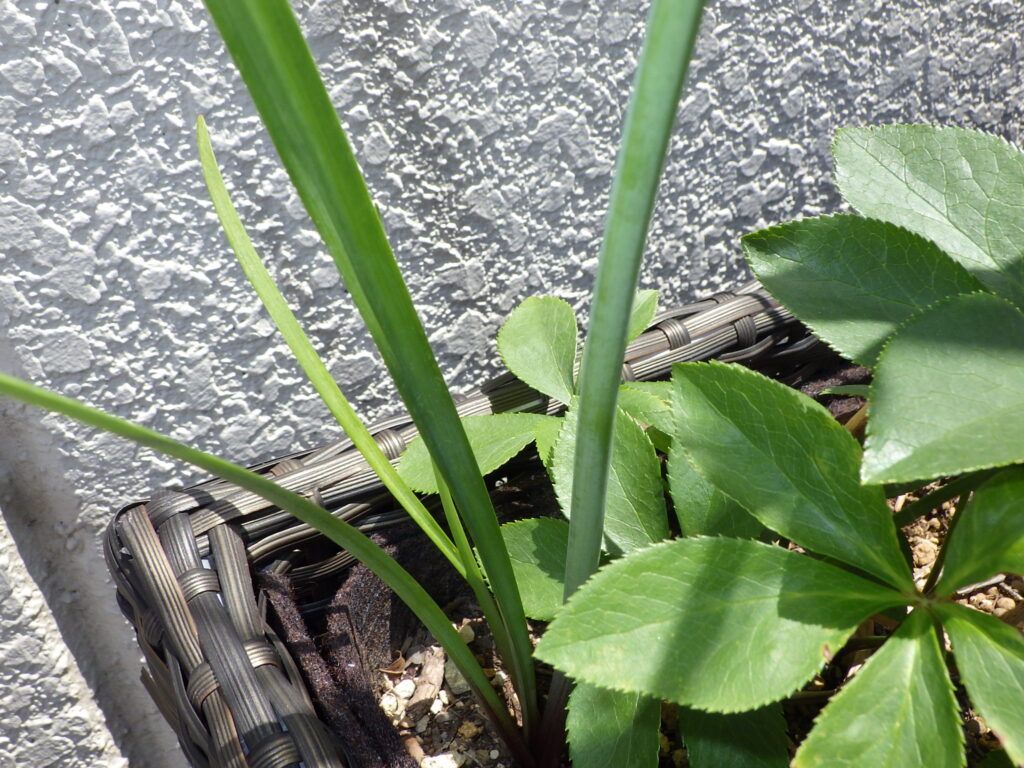
Also known as Cyrtanthus or Cyrtanthus mackenii. Its Japanese name is Petticoat Daffodil. Note that Narcissus bulbocodium is also sometimes called the "Petticoat Daffodil". It is a perennial herb, with a bulb 2-5 cm long and 1.5-3.5 cm wide, tapering to a slender neck. Four to five leaves emerge from the bulb, linear-lanceolate, (20-)30-40 (-50) cm long and 0.7-1.8 cm wide, hollow, ascending or curved, glossy green. The flower stalk emerges from the center of the leaves, 30-50 cm long, bearing 3-6 (-8) flowers (10-15 in cultivated varieties). There are two bracts below the inflorescence. The flowers are pale yellow or white (cultivated varieties can be apricot, orange, pink, red, white, or lemon yellow), slender and long funnel-shaped (tubular), 3.5–4.5 (–5) cm long, with a curved, long tube and ovate, bell-shaped or lobes 0.5–1 cm long, and have a sweet fragrance. The capsule is ovate, 1–2 cm long. The flowers bloom in winter. In the wild in the Southern Hemisphere, the flowering period is July–August (late winter). Cultivated varieties have a longer flowering period, from July to February (winter to spring in the Northern Hemisphere: November–May). Native to South Africa, it is cultivated in Japan for ornamental purposes. Subsp. mackenii has pure white flowers, while subsp. cooperi has yellow to cream-colored flowers. Butterflies and bumblebees visit subsp. mackenii, while hawk moths visit subsp. cooperi (Snijman & Meerow, 2010). The evolution, diversification, and flower-visiting ecology of this genus have been studied in detail.
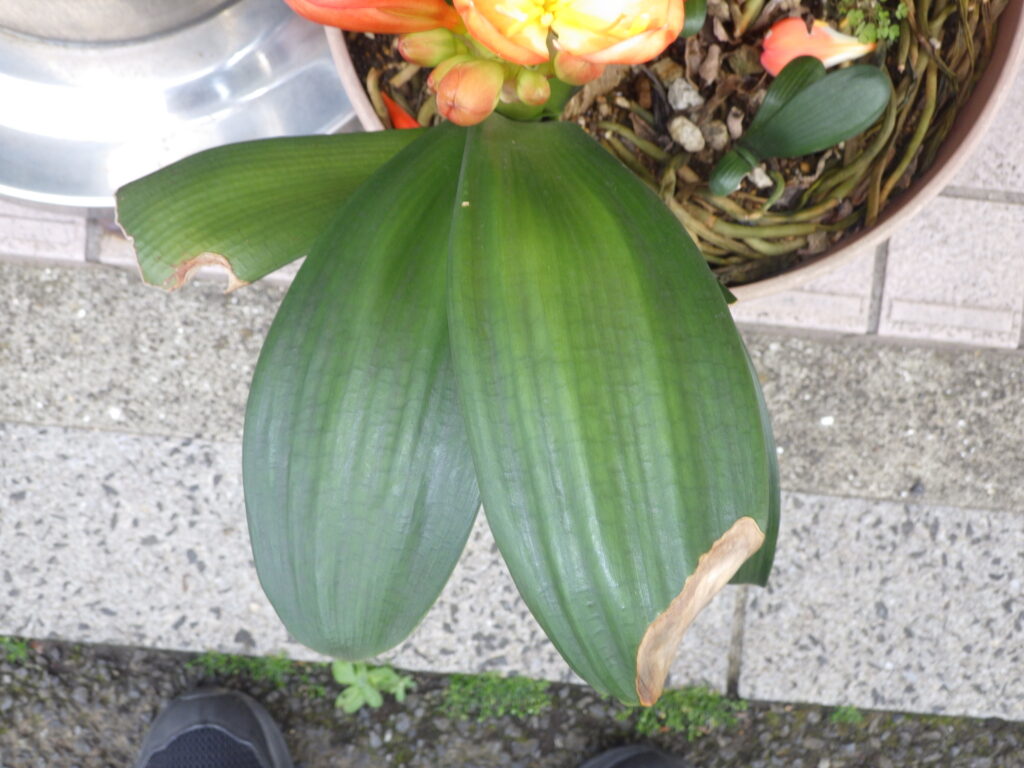
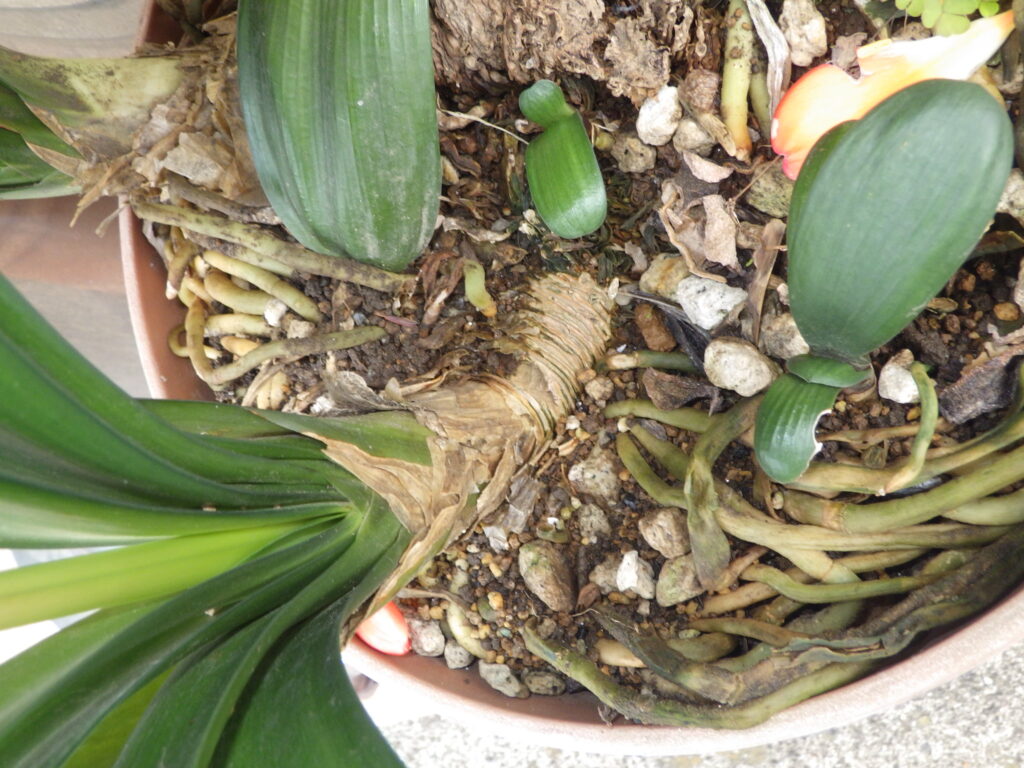
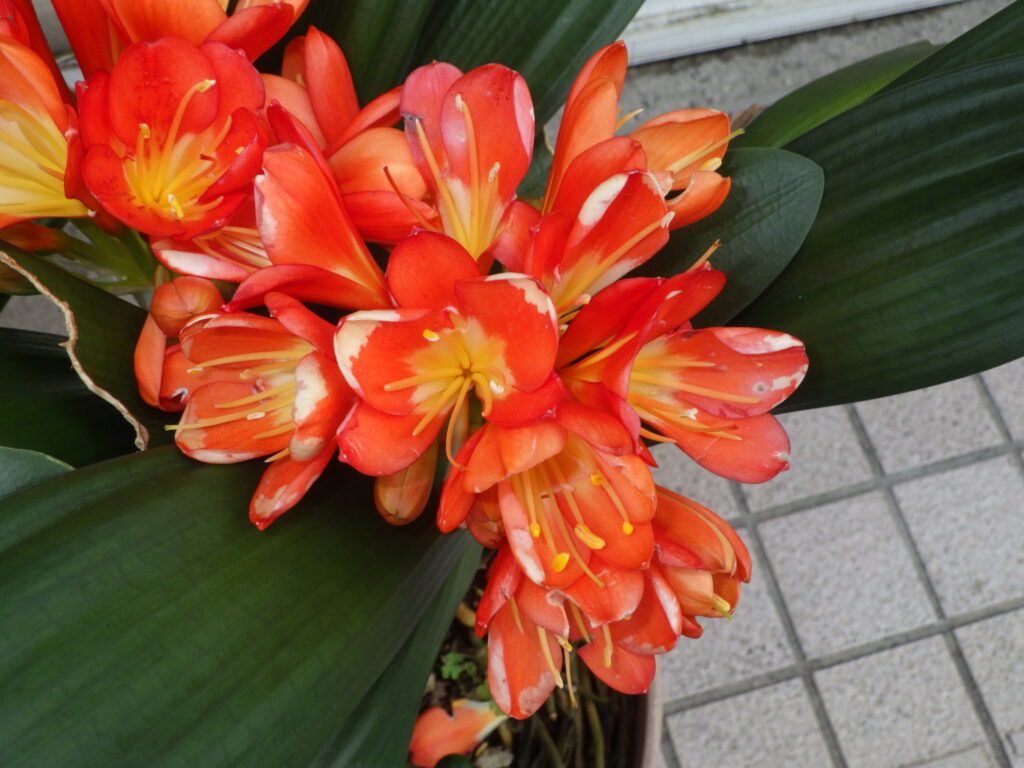
No.0556.f Clivia miniata
This evergreen perennial herb is called "upward-facing blooming" because, unlike its close relative Clivia nobilis, which has downward-facing flowers, this species blooms upward. It grows to a height of 40-50 cm. It has fleshy roots. The leaves are 40-60 cm long, broad, flattened, sword-shaped, and arranged in two longitudinal rows. The base of the leaves overlaps in a tubular shape, enclosing the growing point, so it forms a bulb-like structure at the base. A flower stalk extends from the center of the leaves, bearing an umbel inflorescence of 15-20 flowers at its tip. There are several involucral bracts below the inflorescence. The flowers are orange to scarlet, funnel-shaped, large, and bloom upward. The fruit is 1-2 cm in diameter and ripens in autumn. There are horticultural varieties with white or yellow flowers and variegated leaves. It is distributed in Natal, South Africa. It mainly grows in damp places that avoid strong sunlight, such as in forests and under rocks.
References
Ando, Motoichi; Hashimoto, Marina; Ueno, Shinichiro; and Tsuchiya, Kimiyuki. 2016. Efficacy tests of mole repellents in captivity and in the wild. Journal of the Japan Society for Odor and Fragrance Environment 47(2): 119-127. https://doi.org/10.2171/jao.47.119
García, N., Meerow, AW, Arroyo-Leuenberger, S., Oliveira, RS, Dutilh, JH, Soltis, PS, & Judd, WS 2019. Generic classification of Amaryllidaceae tribe Hippeastreae. Taxon 68(3): 481-498. https://doi.org/10.1002/tax.12062
Kanagawa Prefecture Flora Survey Association. 2018. Kanagawa Prefecture Flora 2018 (Electronic Edition). Kanagawa Prefecture Flora Survey Association, Odawara. 1803pp. ISBN: 9784991053726
Nishiyama, 3. 1939. Chromosome number of Lycoris from China. Journal of Genetics 15(2): 83-85. https://doi.org/10.1266/jjg.15.83
Snijman, DA, & Meerow, AW 2010. Floral and macroecological evolution within Cyrtanthus (Amaryllidaceae): inferences from combined analyzes of plastid ndhF and nrDNA ITS sequences. South African Journal of Botany 76(2): 217-238. https://doi.org/10.1016/j.sajb.2009.10.010
Tsukamoto, Yotaro. 1994. Encyclopedia of Horticultural Plants, Compact Edition. Shogakukan, Tokyo. 3710pp. ISBN: 9784093051118
The European Garden Flora Editorial Committee. 1986. The European garden flora: a manual for the identification of plants cultivated in Europe, both out-of-doors and under glass (Vol. 1). Cambridge University Press. 448pp. ISBN: 9780521248594