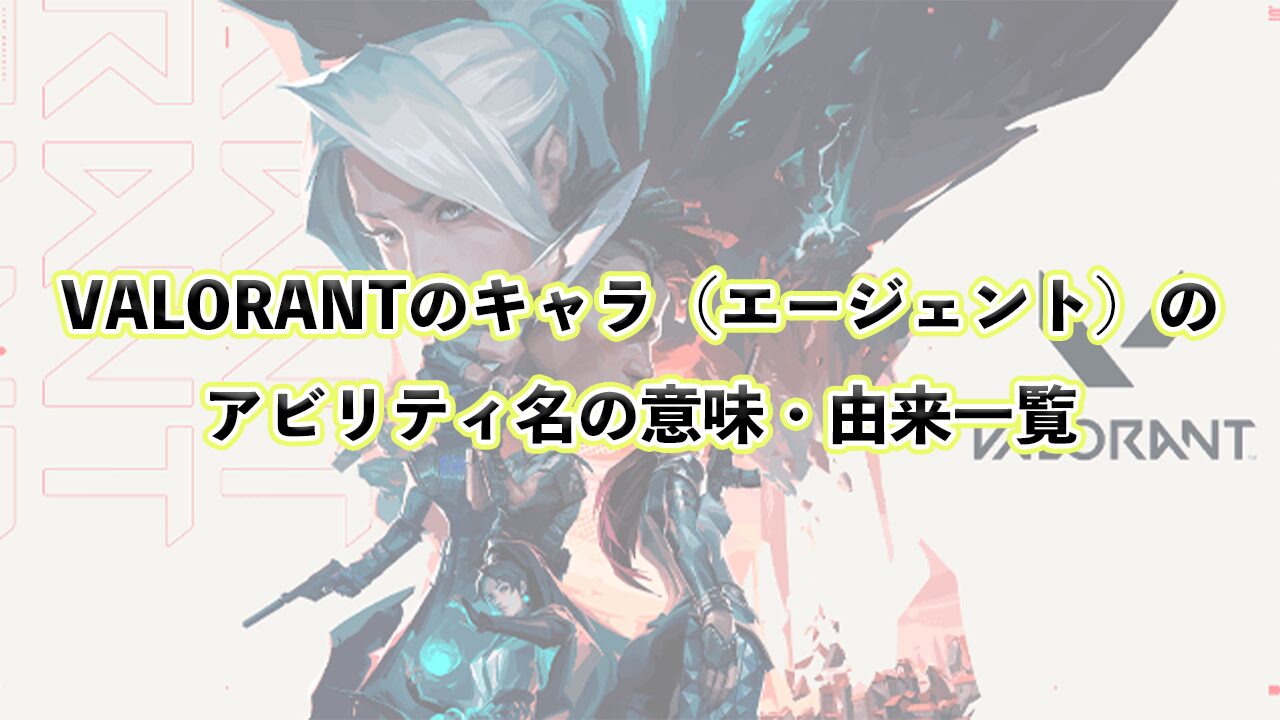
Are any of you playing VALORANT, the FPS game developed and operated by Riot Games? I've recently started playing it little by little after a friend invited me.
I've had trouble memorizing all the proper nouns that appear in the game. I usually look up the origin and etymology of new proper nouns and try to make connections to them, but there don't seem to be many websites that provide detailed summaries of VALORANT's character, weapon, and stage names.
Therefore, I created a list of origins and etymologies by researching the origins based on ChatGPT and supplementing it with information from the " Online Etymology Dictionary " and " Wiktionary." Since it's based on ChatGPT, there might be some inaccuracies, but since there doesn't seem to be much clear explanation from the official sources, I think it will be useful as a reference.
While you'll naturally learn things as you play, knowing the world setting, source material, and English vocabulary can be very educational, so please feel free to use this as a reference. As the saying goes, "a name reflects the character," and it also helps in understanding the character's concept.
By the way, PIE is an abbreviation for Proto-Indo-European, which is the original language from which European and Indian languages originated. The etymology section is basically for language enthusiasts. I've also included links so you can learn more.
This article summarizes the origins of the character (agent) names. For the origins of abilities, weapons, and stages, please see separate articles.


The origin of the names of the duelist characters (agents)
" Duel " means "a duel," and refers to a character specializing in one-on-one combat. Duelists are responsible for defeating enemies with an aggressive style and generally excel at fighting on the front lines. With high killing ability and mobility, a duelist's job is to actively confront enemies and lead the battle.
- Jett
- Raze
- Phoenix
- Features: Can control fire and revive itself.
- Origin: Derived from " phoenix," reflecting the power of fire and resurrection.
- Etymology: It is thought to be derived from the ancient Egyptian word bnw, "Bennu, a god created by himself in Egyptian mythology, in the form of a bird (heron in New Kingdom art)." However, the exact origin is unclear.
- Reyna
- Yoru
- Features: Invisibility and teleportation.
- Origin: Derived from the Japanese word for "night," it symbolizes a fighting style that blends into the darkness.
- Neon
- Features: High-speed movement using electricity.
- Origin: Derived from the gas " neon," associated with speed and electrical energy.
- Etymology: Derived from the Greek word neos, meaning "new." This comes from its discovery as a new element. neos is derived from PIE *newo-, meaning "new." It shares the same etymology as the English word "new."
- Iso
- Characteristics: Excels at acting independently.
- Origin: Derived from " isolation," it represents a trait that makes one strong when fighting alone.
- Etymology: Derived from the Latin word insula, meaning "island." It is cognate with the English word " isle." The etymology of insula is unknown, but one theory suggests it is derived from PIE *sal-, meaning "salt." In this case, the English word salt is also cognate.
- Waylay
- Features: Can move instantly, disrupt enemy actions, and retreat while invincible.
- Origin: Derived from " waylay " (to ambush), it represents the ability to ambush and fight even when aggressively pushing and entering a position. However, in practice, it is also seen being used to initiate attacks oneself.
- Etymology: Originally used to mean "to lie in ambush on the road, to block the way," it is a combination of "way" (noun: road) and "lay" (verb: to lie down), likely influenced by Middle Low German or Middle Dutch "wegelagen" ("to block the way, to lie in ambush on a public road with malice or hostility"). This expression is somewhat unique, as it expresses a concept that cannot be derived by considering "way" and "lay" in their individual meanings, and its aggressive nuance may have arisen from confusion with "lay wait" or "lie in wait."
The origin of the names of the Sentinel characters (agents)
" Sentinel " means "watchman" or "observer." This is a fitting name for a character that emphasizes defense and resilience. Sentinels are responsible for protecting specific areas of the map. Their main role is to support allies while using defensive abilities to stop enemy advances.
- Sage
- Features: Heals and supports allies.
- Origin: It means " sage " (a member of the mint family, Salvia genus, used as a medicinal herb), and is associated with healing and protective powers. It also means " sage " (wise person), which may be related to the biblical words spoken by sage.
- Etymology: The word "sage," meaning medicinal herb, is derived from the Latin word "salvia." "Salvia" is derived from the Latin word "salvus," meaning "healthy," which in turn is derived from the PIE *sol- meaning "whole, well-preserved." The word "sage," meaning wise person, is ultimately derived from the PIE *sap- meaning "to taste." At the Latin "sapere" stage, the meaning changed to "tasty, good-tasting, wise." It is cognate with the English word " sap," meaning "tree sap."
- Cypher
- Features: Information gathering and surveillance.
- Origin: It means " cipher," indicating his espionage role.
- Etymology: Derived from the Arabic word safara, meaning "empty." Originally meaning "empty," it came to mean "zero (0)," and then further evolved to mean "any number" → "secret number" → "secret letter."
- Killjoy
- Features: Trap placement using robots.
- Origin: Derived from " killjoy " (someone who ruins the fun, a spoiler), and is associated with the ability to restrict the enemy's movements.
- チェンバー (Chamber)
- 特徴: スナイパーライフルとトラップを使う。
- Origin: Refers to the " chamber " of a gun (the part in the barrel of a firearm or the magazine of a revolver where loaded ammunition is held), and is related to his use of weapons.
- 語源: PIE *kh₂em- 「曲げる、湾曲する、滑らかにする」から派生。英語 camera と同源。意味としては「アーチ状の屋根や天井」から「部屋」と派生し、そこから「会議場」や「薬室」になった。
- Deadlock
- Features: It immobilizes the enemy.
- Origin: Derived from " deadlock," it relates to the ability to disrupt the enemy's actions.
- ヴァイス (Vyse)
- 特徴: 敵を拘束する力。
- Origin: It refers to " vise " (a type of clamp, to hold down with a vise, to tighten), and describes a tactic of tightening the grip on the enemy. The spelling "vyse" is known as a Middle English variant of " vice " (bad habit, vice), so this may also be related.
- 語源: vise はラテン語 vītis「ブドウ、ブドウのつる」に由来し、PIE *wei-「回す、ねじる、曲げる」から派生。Vitis はブドウ属の学名として有名。vice はラテン語 vitium 「悪い」から派生し、更にこれは PIE *(d)wi-tyo- 「離れて、悪い」に派生した説もある。*(d)wi-tyo- はPIE *dwóh₁または *dwo- 「2」から派生したため、この場合、英語 two と同源。
- Vito
- Features: Specializes in disabling or destroying abilities (skills).
- Origin: Meaning " veto," it reflects the ability to deny enemy abilities.
- Etymology: Derived from the Latin word veto, meaning "to forbid or refuse quotation," and from the PIE *weth₂- meaning "to say."
The origin of the names of the Initiator characters (agents)
An " Initiator " is a character whose role is to initiate combat. They break down enemy defenses and support the entire team's attack. They take the lead in battle, causing confusion among the enemy and creating advantageous situations when entering an area.
- Bleach
- Sova
- Features: Uses a bow to scout for enemies.
- Origin: It comes from the Russian word "sova" (owl), reflecting the ability to spot enemies.
- Etymology: It originates from the Proto-Slavic word *sova, but its origin is unknown.
- スカイ (Skye)
- KAY/O
- Features: Disables enemy abilities.
- Origin: A play on the word "KO (knock out)," symbolizing the power to neutralize the enemy.
- Etymology: The word "knock" comes from the PIE *gnew-, *gen- meaning "to squeeze, pinch, twist, roll, concentrate".
- フェイド (Fade)
- Gekko
- Features: Attacks and support using small animals.
- Origin: Derived from " gekko " (gecko), and associated with the power to control small creatures.
- Etymology: It is believed to originate from Malay, but the exact origin is not well understood.
- Teho (Tejo)
- Features: Can not only scout but also stun, suppress, and attack.
- Origin: Derived from the Spanish word " tejo," it is a traditional Colombian throwing sport. A metal puck or discus filled with gunpowder is thrown at a small target, which explodes upon impact. It is associated with explosive skills.
- Etymology: The masculine form of teja, meaning "tile." Derived from Vulgar Latin *tegla, which in turn derives from Latin tēgula, and from PIE *tegdʰleh₂. Cognate with the English word "tile."
The origin of the controller character (agent)'s name
A " Controller " is someone who controls specific areas on the map or the movement of enemies. Controllers use skills such as smoke and area control to restrict enemy vision and movement. They specialize in limiting the enemy's range of action and creating an environment advantageous to their team. In particular, they use smoke and other means to obstruct vision and keep enemies at bay.
- The Omen
- Brimstone
- Features: Deploys airstrikes and smoke.
- Origin: The name comes from the English word " brimstone " (sulfur), and is related to his aggressive bombing capabilities. However, this is closer to an archaic word, and sulfur is now commonly referred to as sulfur. It is an ingredient in gunpowder, and the Romans used sulfur in the manufacture of fireworks and weapons. It may also be related to the fact that volcanic gases contain hydrogen sulfide and sulfur dioxide. In the Bible, "brimstone" also means "sulfur of hell, hell, divine punishment," and his remarks during the orbital strike may be a reference to this.
- Etymology: A compound word of brin- (derived from Proto-Germanic *brennan "to burn" and PIE *gwher- "to heat, to warm") and stan (English: stone).
- Viper
- Characteristics: Can manipulate toxic gases.
- Origin: Derived from " viper " (poisonous snake), it is associated with the power of attacks using poison.
- Etymology: A shortened form of the Latin *vivipera, derived from the compound word vivus "to live" (PIE *gwei- "to live") and parire "to give birth, to produce" (PIE *pere- (1) "to give birth, to produce"). This is because members of the Viperidae family, including the venomous pit viper, are ovoviviparous.
- Astra
- Harbor
- Characteristics: The ability to manipulate water.
- Origin: It comes from the English word " harbor," and is related to the control capabilities that utilize water.
- Etymology: Derived from the Proto-Germanic *harja-bergaz "protection, lodging," and a compound word of *heri "army, group" (cognate with English harry) and *burzjan- "protection, shelter" (PIE *bhergh- (1) "to hide, to protect").
- Clove
- Features: A skill that allows you to revive with the power of immortality.
- Origin: It comes from the plant " clove," which is difficult to interpret, but since cloves have antiseptic and analgesic properties and are often used to prevent and treat infections, it may be associated with the themes of "immortality" and "longevity."
- Etymology: Derived from the Latin word clavus, meaning "nail." Cloves are picked just before the buds open, dried in the shade, and used as a spice, and the shape of the buds resembles a nail. Clavus comes from the PIE words *klau-, *kleu-, klēu-, meaning "hook, winding branch."