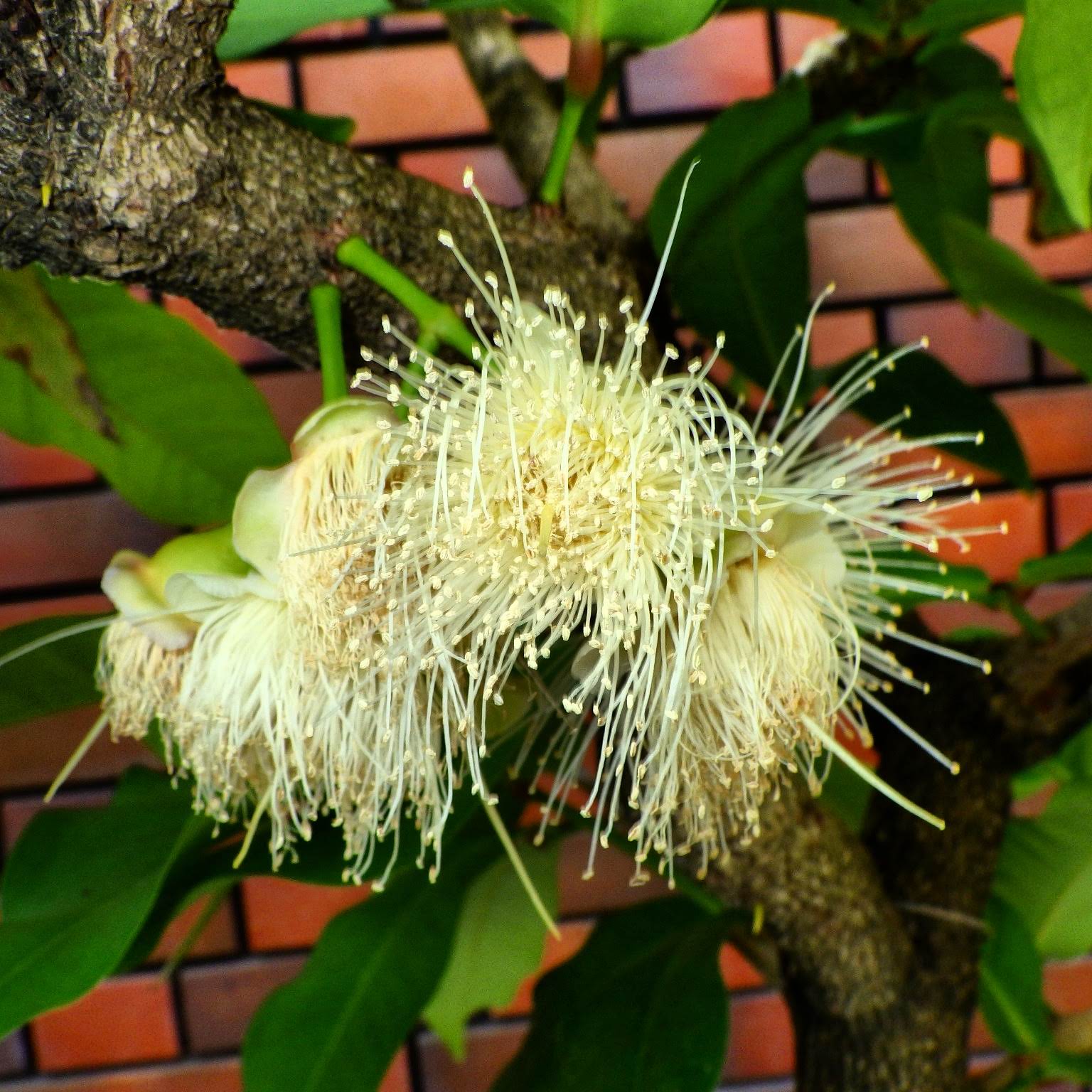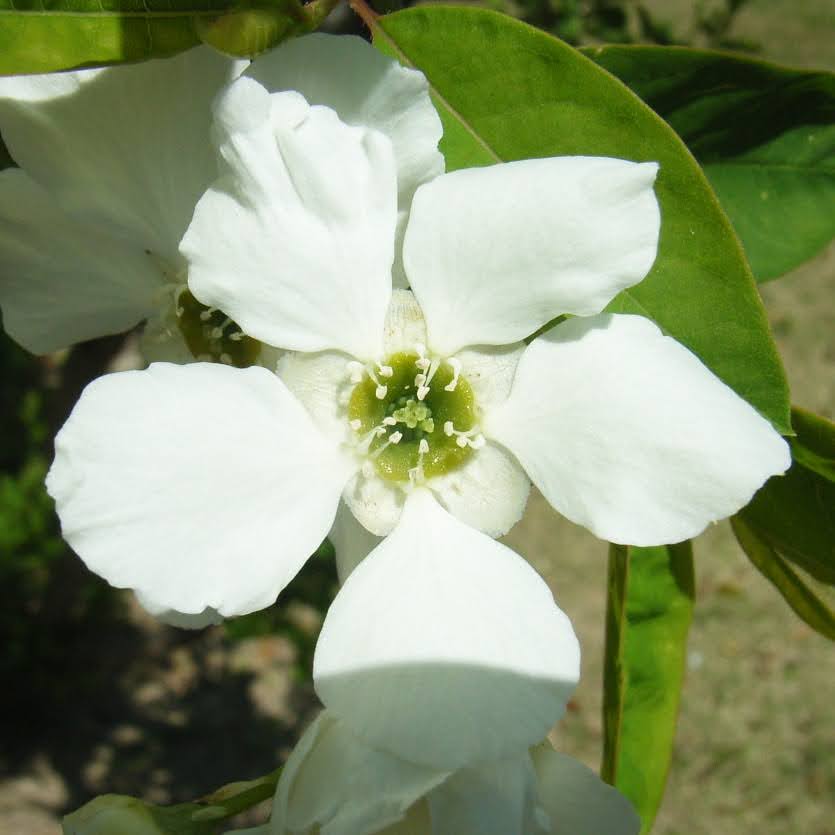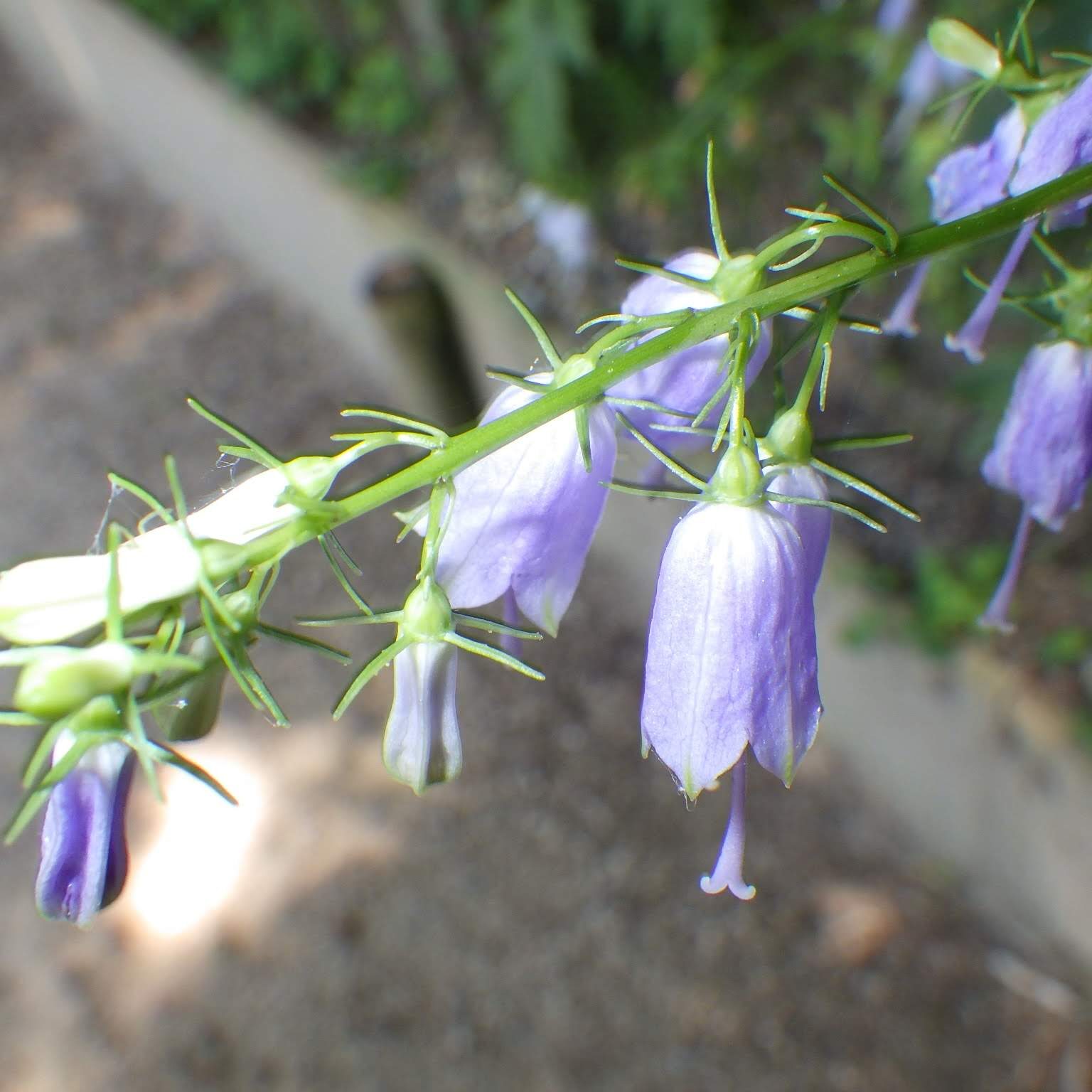
Adenophora triphylla, Adenophora fukushimaensis, and Campanula punctata are representative Japanese herbaceous plants that grow in forest edges and other areas, bearing numerous purple flowers. All belong to the Campanulaceae family and Adenophora genus, and are similar in that they grow in forests and bear downward-facing purple flowers, which can sometimes make them difficult to distinguish. However, if the flowers are in bloom, the shape of the flowers and the inflorescence can clearly distinguish the three species. The way the leaves are attached can also be a clue. The insects that visit and pollinate Adenophora triphylla flowers have been relatively well studied, and it has long been thought that the downward-facing purple flowers are attracted to bees, which are adept at hanging down, and that the same applies to Adenophora triphylla. However, further detailed research has revealed that it is not diurnal bees, but nocturnal moths that are directly involved in pollination. This has been revealed by studies on fruit set rates. It has also been found that Adenophora triphylla has adapted to be pollinated at night by opening its flowers and secreting nectar at night. However, other studies have shown that bees do contribute to pollination on some remote islands, which may explain regional differences and the large variations in flowers. The fruit is a capsule and the seeds are dispersed by wind. This article will explain the classification, pollination ecology, and seed dispersal of the Adenophora genus.
- A herbaceous plant that grows in forest edges and other similar areas, bearing numerous purple flowers.
- What are the differences between Adenophora triphylla, Adenophora fukushimaensis, and Campanula punctata?
- What are the differences between Adenophora triphylla and Adenophora triphylla? What are the other varieties?
- What is the structure of a flower?
- It's been said that flowers are pollinated by bees, but is that actually not true?!
- Why do only certain nocturnal moths contribute to pollination?
- Why do moths come to downward-facing blue flowers?
- The characteristics of flowers on Miyakejima Island have evolved even further!?
- The fruit is a capsule and the seeds are dispersed by wind.
- References
- Source
A herbaceous plant that grows in forest edges and other similar areas, bearing numerous purple flowers.
Adenophora triphylla (broad sense) is a perennial herb distributed in Hokkaido and the Southwest Islands of Japan, as well as Sakhalin, the Kuril Islands, Korea, China, and Taiwan. Adenophora triphylla var. japonica (narrow sense) is distributed in Sakhalin, the Kuril Islands, Hokkaido, Honshu, Shikoku, and Kyushu in Japan, and grows in mountainous areas, grasslands, forest edges, and managed riverbanks where grass is mowed (Kaizu, 1995; Baba and Onuki, 1996). It is also known for its edible and medicinal uses. Adenophora japonica is distributed in Honshu and the Izu Islands, and grows in grasslands near the coast. Adenophora hakusanensis var. hakusanensis is distributed in Hokkaido and Honshu (north of the Chubu region), and grows in high mountains. Adenophora triphylla var. triphylla is distributed in Honshu (west of the Chugoku region), Kyushu, Okinawa, and China, growing in mountainous areas and plateaus. Its Japanese name comes from the fact that its bell-shaped flowers resemble the thick roots of Panax ginseng, a traditional Chinese medicine.
Fukushima Adenophora divaricata, also known as Fukushima bellflower, is a perennial herb distributed in Honshu (north of the Chubu region) and Shikoku, as well as Korea and China (northern and northeastern regions), growing in bright woodlands and grasslands from hilly to mountainous areas. Its Japanese name comes from the fact that it was based on a specimen from Fukushima Prefecture. "Shajin" is the name of a crude drug made from the roots of Adenophora triphylla.
Adenophora remotiflora, also known as sobana, is a perennial herb distributed in Honshu, Shikoku, Kyushu, Korea, and China, growing in the forest floor, forest edges, and grasslands of hilly areas and fir forest zones. There are several theories about its Japanese name, but the most likely origin is that it was originally "soba-na" (buckwheat vegetable), and that the vegetable was steamed and then cut in the same way as buckwheat to make porridge (kon-gayu).
Both belong to the Campanulaceae family, genus Adenophora, and are similar in that they grow in forests and bear downward-facing purple flowers. Therefore, it may be difficult to distinguish between them.
What are the differences between Adenophora triphylla, Adenophora fukushimaensis, and Campanula punctata?
However, the three species Adenophora triphylla, Adenophora fukushimaensis, and Campanula punctata can be clearly distinguished when they are in bloom (Ohashi et al., 2017; Kanagawa Prefectural Flora Survey Association, 2018).
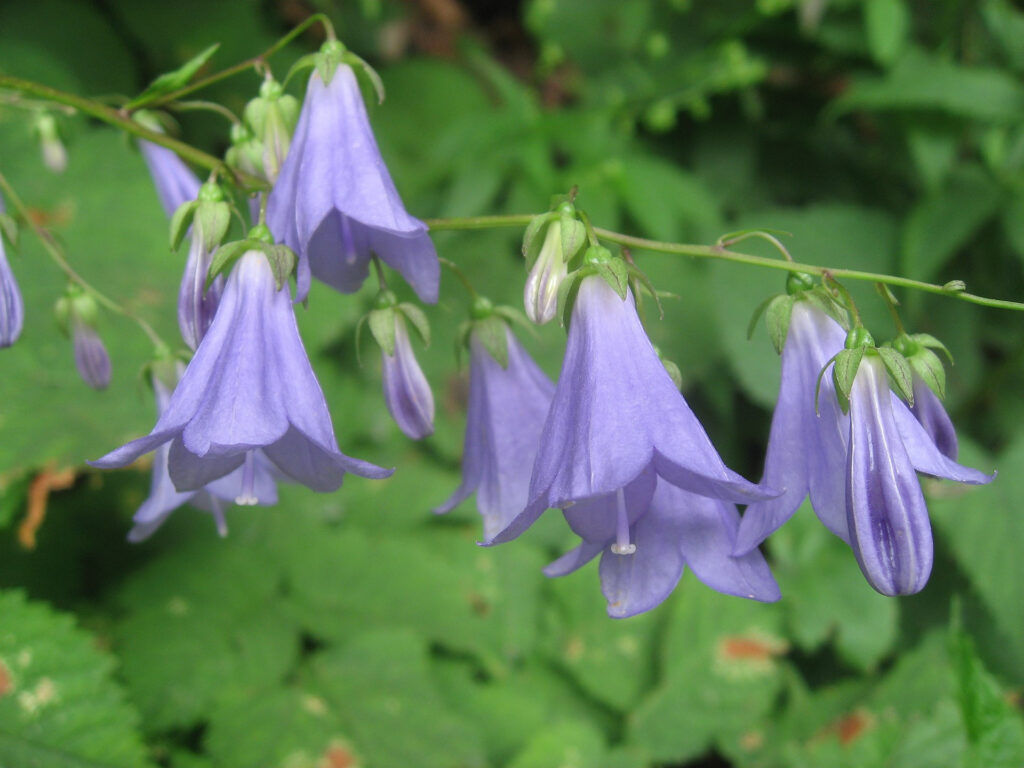
First, while the corollas of Adenophora triphylla and Adenophora fukushimaensis are bell-shaped, the corolla of Adenophora umbellata is funnel-shaped.
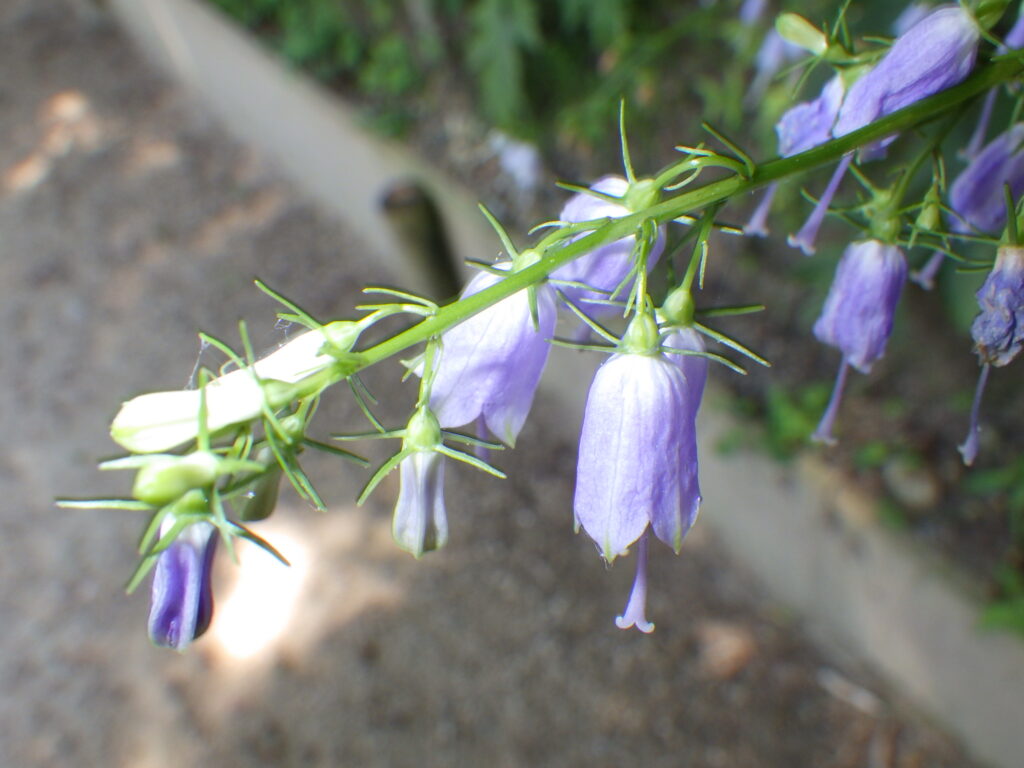
Regarding the two species, Adenophora triphylla and Adenophora fukushimaensis, Adenophora triphylla has linear calyx lobes with sparsely spaced serrations that end in glands, while Adenophora fukushimaensis has lanceolate calyx lobes with entire margins. In short, Adenophora triphylla has narrower calyxes.
Another difference is that the inflorescence branches of Adenophora triphylla are usually arranged in whorls, while those of Adenophora fukushimaensis are usually arranged alternately.
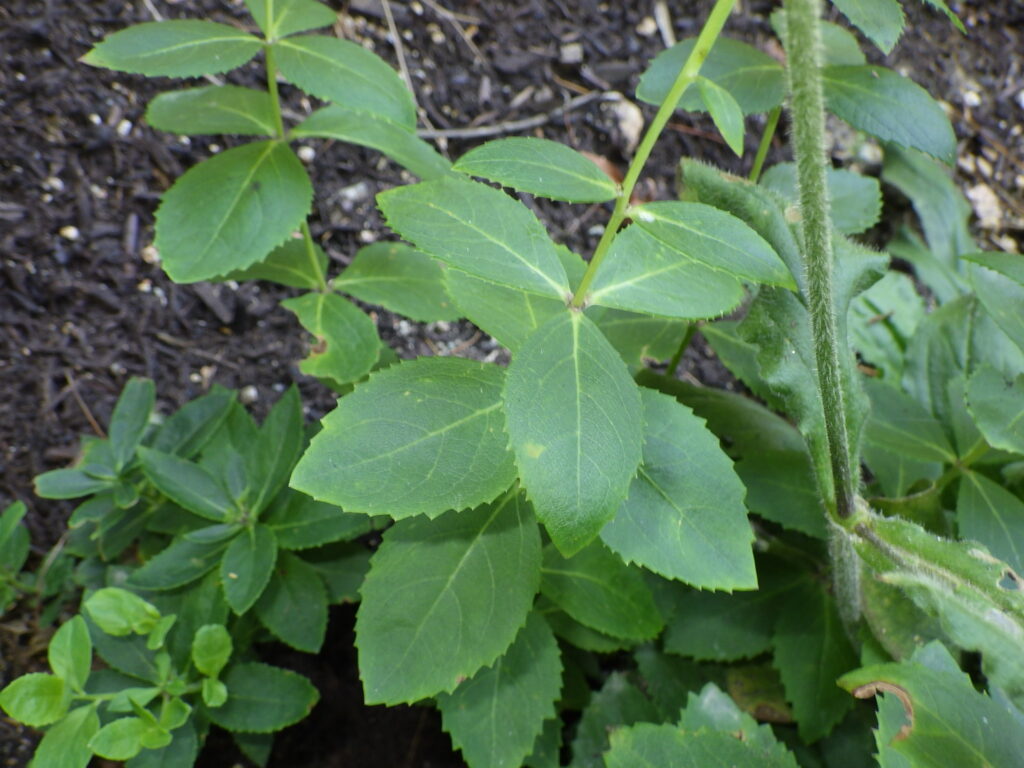
There may also be differences in the shape and arrangement of the leaves.
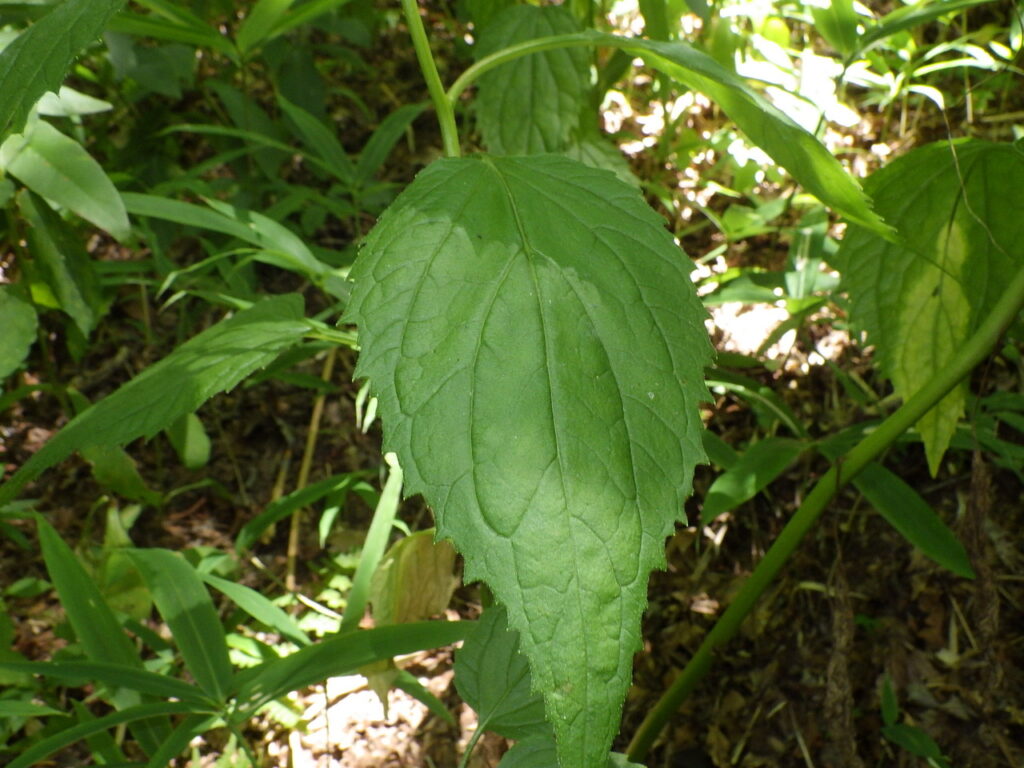
In Campanula punctata, the upper leaves are sessile, but the middle stem leaves are stalked, alternate, ovate or lanceolate, with coarse serrations along the edges. In contrast, in Adenophora triphylla and Adenophora fukushimaensis, the middle stem leaves are almost sessile, opposite or alternate, but usually whorled, ovate-elliptic, with fine serrations.
It can be difficult to distinguish between Adenophora triphylla and Adenophora fukushimaensis by their leaves alone, but Adenophora fukushimaensis is said to have slightly lighter leaves.
While the three species listed above are generally considered to be the genus Adenophora, there are actually 12 known species in Japan, including those mentioned above, and this list alone is insufficient to distinguish them all. Many have speciated due to adaptation to specific environments.
To give a few examples, Adenophora takedae is distributed in Honshu (southeastern Chubu region and western Kanto region), growing on slightly damp rocky areas and cliffs in mountainous regions, with slender stems that hang down from rocks and steep cliffs.
Adenophora nikoensis is distributed in Honshu (southern Tohoku region to central region), growing in rocky areas of subalpine and alpine regions. It resembles Adenophora fukushimaensis but is smaller, and its leaves are usually alternate.
Adenophora pereskiifolia, also known as Moiwa bellflower, is distributed in Hokkaido and Honshu (Tohoku region), growing on rocky areas in mountainous regions. It resembles Adenophora fukushimaensis, but is smaller in size.
Adenophora maximowicziana is distributed in Shikoku, grows in limestone areas, is quite small, and has linear-lanceolate leaves.

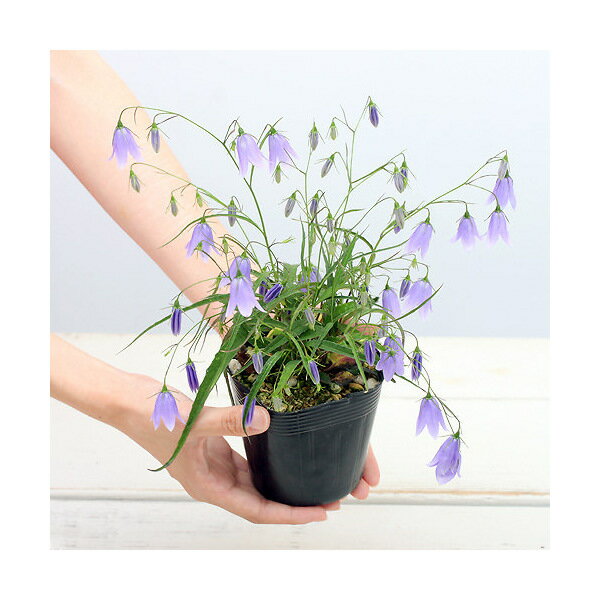
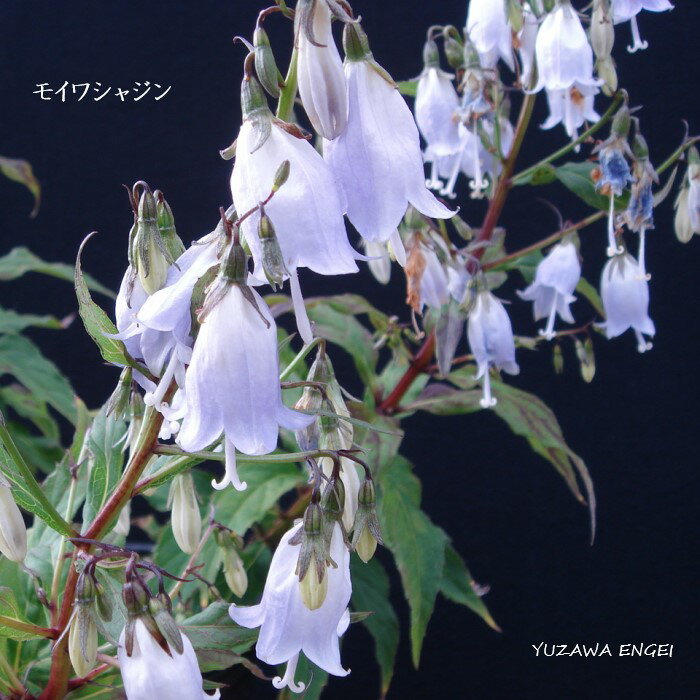
What are the differences between Adenophora triphylla and Adenophora triphylla? What are the other varieties?
The above gives you a general idea of the species, but several varieties of Adenophora triphylla (in the broad sense) are known (Ohashi et al., 2017; Kanagawa Prefectural Flora Survey Association, 2018). There are also many cultivars, but we will omit them here.
Adenophora triphylla var. triphylla is distinguished from Adenophora triphylla (in the narrow sense) by its slightly narrower, urn-shaped corolla and its long, protruding style. However, there doesn't seem to be a specific indicator of how long the style needs to be to be considered Adenophora triphylla. Judging from the photographs by Ohashi et al. (2017), the style appears to be about twice the length of the corolla.
Adenophora triphylla var. glabra is distributed in Honshu and the Izu Islands, growing in grasslands near the coast. Unlike Adenophora triphylla (in the narrow sense), its leaves are leathery and glossy on the upper surface.
Campanula hakusanensis is distributed in central and northern Japan, as well as Hokkaido. It grows in high-altitude areas and is smaller in size, but some argue that it should not be distinguished from Campanula hakusanensis because similar individuals can be found in lowlands (Ohashi et al., 2017).
Adenophora triphylla var. puellaris is distributed in Shikoku (Higashiakaishi Mountain, Ehime Prefecture) and grows on serpentine rock. Unlike Adenophora triphylla (in the narrow sense), its leaves are remarkably narrow and linear.
Adenophora triphylla var. insularis is distributed in the Southwest Islands of Japan and appears to be a type with a bell-shaped corolla and a pistil that does not protrude much, but the distinguishing features from Adenophora triphylla (in the narrow sense) are unclear.
Other species such as *Campanula japonica* var. *sasamotoi * and *Campanula fragrans* var. *verticillata* are not found in Japan.
What is the structure of a flower?
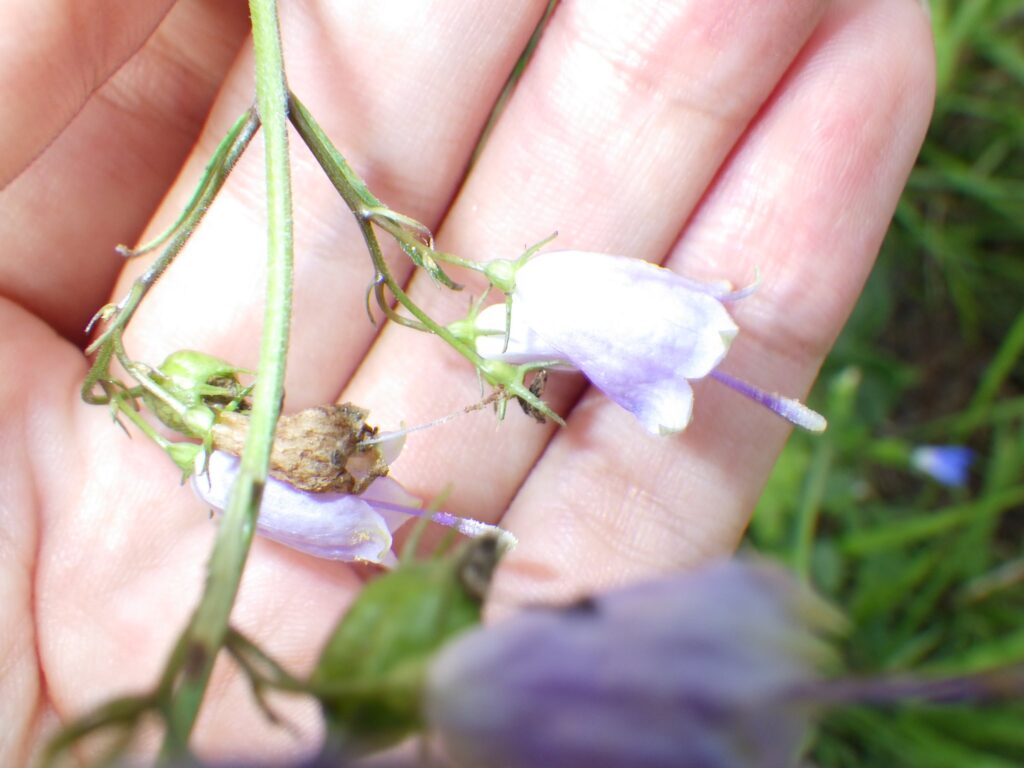
Adenophora triphylla blooms from August to October, producing conical inflorescences at the top of the stems, with one to several flowers arranged in whorls and slightly downward-facing (Kadota et al., 2013). The bell-shaped corolla is pale purple or white, 1.5–2 cm long, with five lobes that spread slightly at the tip. The style protrudes slightly beyond the corolla and is shallowly three-lobed at the tip. The calyx lobes are linear, 3–5 mm long, with one to four small serrations along the edges.
Fukushima Campanula flowers from August to September, with the lateral branches of the inflorescence extending horizontally and forming a sparse conical shape. The bell-shaped corolla is pale purple to white, 1.5-2 cm in diameter, and shallowly 5-lobed at the tip, slightly spreading out. The style is the same length as the corolla or slightly protruding. The calyx lobes are lanceolate, 4-8 mm long, and have entire margins.
Campanula punctata flowers from August to October, bearing sparse flowers in a conical inflorescence at the top of the plant. The flowers droop downwards. The bell-shaped corolla is pale purple, 2-3 cm long, and has five lobes that widen at the tip. There are five stamens. The style usually does not protrude beyond the corolla, but it can. The stigma is three-lobed. The calyx lobes are lanceolate and entire.
The purple color is a common characteristic of the Campanulaceae family, and although the shape of the corolla and the way the flowers are arranged differ slightly, they are basically very similar.
Adenophora triphylla is known to exhibit "protandry," meaning it is male first. In protandry, the stamens wither after releasing pollen during the male phase, then transition to the female phase, during which the club-shaped tip of the pistil develops and splits into three lobes.

It's been said that flowers are pollinated by bees, but is that actually not true?!
Among these species of Adenophora, the question of which insects visit the flowers of Adenophora triphylla and pollinate them has long been studied in Japan.
Generally, downward-facing purple flowers are well known to attract bees, which are adept at hanging from them. For this reason, it was long believed that the same was true for Adenophora triphylla (Tanaka and Hirano, 2000; Utsumi, 2003).
However, recent research suggests that different insects also engage in pollination at completely different times, and that these insects may be the ones making a significant contribution to pollination.
A study conducted over 24 years in southwestern Japan, investigating which moths visited the flowers of various plants (Ikenoue & Kanai, 2010), and a study examining daytime and nighttime pollinating insects in Ibaraki and Nagano prefectures (Funamoto & Ohashi, 2016; Funamoto & Ohashi, 2017; Funamoto, 2021), concluded that the insects contributing most to pollination are "nocturnal moths."
In particular, studies in Ibaraki and Nagano prefectures have not only meticulously observed and recorded pollinating insects for sufficient time both day and night, but have also investigated whether diurnal or nocturnal pollinating insects contribute more to fruit setting by attaching bags to flowers to prevent insects from approaching them only during the day and night.
The results showed that while insects were observed both day and night, with butterflies, bees, and syrphidae making up the majority during the day and moths at night, experiments with bags attached showed that only nocturnal pollinating insects contributed significantly to the increase in fruit set. The fruit set rate of flowers visited only by diurnal pollinating insects was almost the same as that of flowers where bags were attached all day to eliminate insect influence, indicating an extremely low fruit set rate.
Therefore, it is natural to conclude that the presence of moths at night, rather than insects during the day, is very important for the pollination of Adenophora triphylla.
This has been found to be the same for Campanula punctata (Funamoto, 2019).
Why do only certain nocturnal moths contribute to pollination?
However, it seems that not all moths visit the flowers of Adenophora triphylla. Specifically, two groups of nocturnal moths have been identified that visit: Noctuidae and Pyraloidea.
Why don't these daytime insects and moths other than the two groups mentioned above contribute to the pollination of Adenophora triphylla?
In the case of moths of the Noctuidae and Pyraloidea superfamilies, pollination occurs when the moth first firmly places its legs on the tip of the corolla or the style (the part slightly below the tip of the pistil) and then extends its proboscis inside, causing the moth's thorax or abdomen to come into contact with the anthers (the tips of the stamens) or stigma (the tip of the pistil) of the flower (Ikenoue and Kanai, 2010).
This behavior requires the insect to burrow deep into the flower, so even if moths or hoverflies with short proboscises come, they cannot properly contribute to pollination. Conversely, butterflies have proboscises that are too long, so they become nectar robberies that steal nectar without touching the stamens or pistils, and thus do not properly contribute to pollination.
There is another possible reason for this in the case of bees. Bees are known to have a high "pollen discounting" rate. This is a phenomenon in which the behavior of insects produces wasted pollen that does not contribute to pollination. Bees consume pollen as food or drop it during grooming, behaviors not seen in other insects, thus lowering their pollination rate.
Furthermore, although not mentioned in the paper, it is well known that some bees have the characteristic of visiting all the flowers on the same inflorescence in succession. When this behavior occurs, the pistil of the flower becomes covered with its own pollen, promoting self-pollination (stigma cover by neighboring flower pollination).
It is known that self-pollination of Adenophora triphylla results in a low fruit set rate. Furthermore, the inflorescence is densely covered with flowers, and neighboring flower pollination by bees may be inefficient for Adenophora triphylla in terms of seed production.
Why do moths come to downward-facing blue flowers?
By the way, you might find it strange that moths visit bellflower blossoms. As mentioned above, downward-facing purple flowers are well known to attract bees, which are adept at hanging down. In addition, moths are known to prefer upward-facing, white, and fragrant flowers.
What characteristics attract nocturnal moths to blue flowers?
First of all, the characteristic of hawk moths preferring white, strongly scented flowers applies to them, but ordinary nocturnal moths sometimes prefer blue-ish colors. Therefore, it's not that unusual for a moth to be attracted to a blue flower.
In addition to this, it is thought that three other characteristics of the Adenophora triphylla flower, besides its shape, are also involved.
These are the "timing of flowering," the "timing of the start of the female phase," and the "timing of nectar production."
Experiments have shown that Adenophora triphylla rapidly opens its flowers in the inflorescence starting around 6 PM.
Furthermore, while Adenophora triphylla changes the sex of its flowers from male to female over time, experiments have shown that this change occurs between 6 PM and 5 AM, with the sex change occurring gradually each time night falls.
Furthermore, experiments have shown that the best time to produce honey is between 6 PM and 5 AM.
These characteristics suggest that Adenophora triphylla flowers are more actively attracting insects at night than during the day, preparing for pollination. This is likely a factor that allows nocturnal moths to actively visit the flowers.
The characteristics of flowers on Miyakejima Island have evolved even further!?
However, some islands in Japan have shown results that differ from these studies.
A study conducted on Miyakejima Island revealed that, contrary to reports from the mainland, diurnal bees were observed visiting flowers, and their flower-visiting efficiency was remarkably high compared to nocturnal lepidopterans (Okazaki et al., 2019).
Since this study hasn't been formally published in a paper yet, we don't know the details such as the fruiting rate, but it points out that "the nectar-secreting disc is morphologically differentiated." If that's the case, it's quite possible that the nectar secretion time has also changed.
This can be considered an adaptation to the surrounding insect habitat.
Considering this, it's possible that Adenophora triphylla, originally designed to appeal to nocturnal insects, has adapted to appeal to diurnal insects, or vice versa, with its characteristics shifting depending on the region. This could also explain the significant variation in flower color and shape within the species or between species of the same genus.
It is well known that the characteristics of different species are not necessarily fixed but can change subtly depending on the environment. When looking at Adenophora triphylla, if you look at its physiological aspects from this perspective, rather than just its shape, you might discover something different.
The fruit is a capsule and the seeds are dispersed by wind.
As is common with the genus Adenophora, the fruit is a capsule.
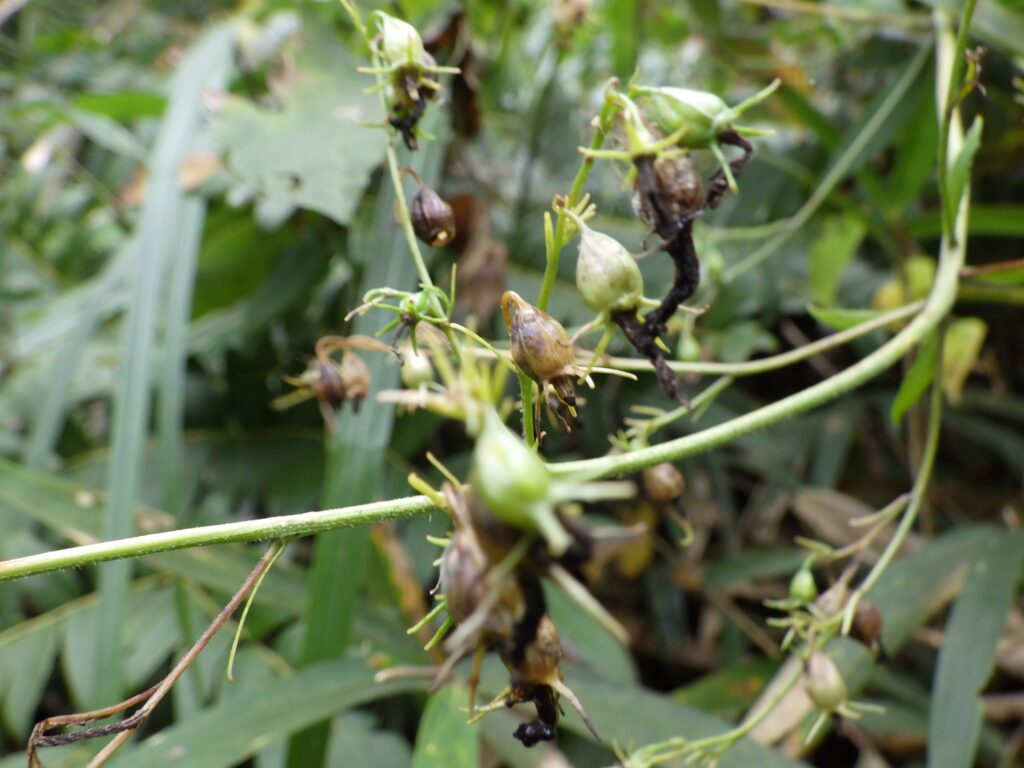
The capsules of Adenophora triphylla turn straw-colored in winter, hang down, and split open at the top. The seeds are about 1.5 mm long and have a narrow wing on one side.
The capsule of Adenophora umbellata dehisces through the intercostal spaces on the lateral wall.
Campanula punctata has a capsule that is flattened and spherical in shape, with distinct longitudinal veins and a persistent calyx.
The capsules of the Adenophora genus split open at the top, and when they are turned upside down by wind, the seeds fall out little by little. The seeds are quite small, and at least in Adenophora species, they have narrow wings, making it highly likely that they are dispersed by wind. Their distribution throughout Japan suggests that they have a reasonable capacity for dispersal, but the details are not well understood.
References
Baba, Atsushi & Onuki, Shigeru. 1996. 500 Medicinal Herbs: From Cultivation to Uses. Seibundo Shinkosha, Tokyo. 167pp. ISBN: 9784416496183
Funamoto, D. 2019. Precise sternotribic pollination by settling moths in Adenophora maximowicziana (Campanulaceae). International Journal of Plant Sciences 180(3): 200-208. https://doi.org/10.1086/701734
Funamoto, Daichi. 2021. Exploring the Co-evolution of Flowers and Animals: New Flower Forms Hidden in Familiar Wild Plants, Chapter 4: Moths that Carry Pollen from Adenophora triphylla. *Journal of Species Biology* 40/41: 81-92. ISSN: 0913-5561, ISBN: 9784829962084
Funamoto, Daichi & Ohashi, Kazuharu. 2016. Pollination mode mismatched with appearance: Pollination of Adenophora triphylla relies on nocturnal moths. Tsukuba Journal of Biology 15: 60. ISSN: 1347-7048, http://gradtex.biol.tsukuba.ac.jp/2015/tjb201601/201210593.pdf
Funamoto, D., & Ohashi, K. 2017. Hidden floral adaptation to nocturnal moths in an apparently bee-pollinated flower, Adenophora triphylla var. japonica (Campanulaceae). Plant Biology 19(5): 767-774. https://doi.org/10.1111/plb.12579
Ikenoue, Toshiyuki & Kanai, Hiroo. 2010. Nocturnal moth flower-visiting activity. Journal of the Botanical Society of Japan 85(4): 246-260. ISSN: 0022-2062, https://doi.org/10.51033/jjapbot.85_4_10230
Kadota, Y., Nagata, Y., & Azegami, N. 2013. Flowers Blooming in the Mountains (Revised and Expanded New Edition). Yama-kei Publishers, Tokyo. 616pp. ISBN: 9784635070218
Kaizu, Yoshitaka. 1995. Medicinal Herbs of Japan. Shogakukan, Tokyo. 279pp. ISBN: 9784092080164
Kanagawa Prefecture Flora Survey Association. 2018. Kanagawa Prefecture Flora 2018 (Electronic Edition). Kanagawa Prefecture Flora Survey Association, Odawara. 1803pp. ISBN: 9784991053726
Okazaki, Junko; Minamiguchi, Kosuke; Hasegawa, Masahiro; Abe, Harue; and Suzuki, Koji. 2019. Morphological variation and pollinating insect fauna of Adenophora triphylla, a Campanulaceae family species exhibiting protandry, in the Izu Islands. Abstracts of the Annual Meeting of the Ecological Society of Japan 66: P2-164. https://www.esj.ne.jp/meeting/abst/66/P2-164.html
Ohashi, Hiroyoshi; Kadota, Yuichi; Murata, Hitoshi; Yonekura, Koji; and Kihara, Hiroshi. 2017. Wild Plants of Japan (Revised New Edition, Vol. 5: Convolvulaceae to Caprifoliaceae). Heibonsha, Tokyo. 760pp. ISBN: 9784582535358
Tanaka, Hajime & Hirano, Takahisa. 2000. The Face of Flowers: Wisdom for Bearing Fruit. Yama-kei Publishers, Tokyo. 191pp. ISBN: 9784635063043
Utsumi, Shunsaku. 2003. Why are flowers beautiful? (2) Nectar guides and nectaries. Chiba University Faculty of Education Research Bulletin 51: 319-329. ISSN: 1348-2084, https://opac.ll.chiba-u.jp/da/curator/900026807/
Source
This article is a significantly expanded version of a piece originally published in the following book.