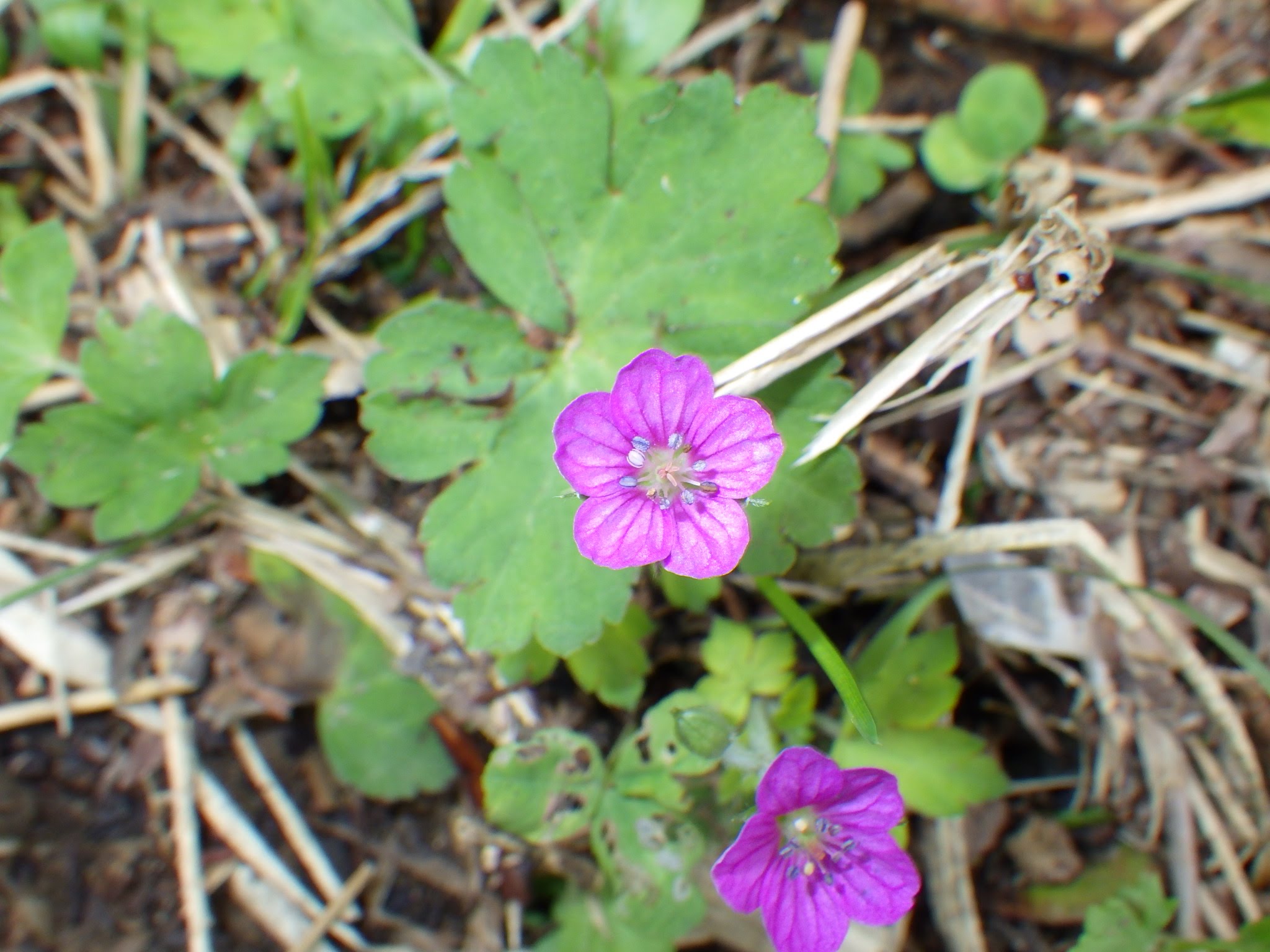
Geranium thunbergii, American cranesbill, three-leaved cranesbill, and common cranesbill all belong to the genus Geranium in the family Geraniaceae. Their flowers and leaves are very similar, making identification difficult. More than 18 species have been confirmed in Japan, so it is impossible to introduce them all here. However, the four species found in lowland areas can be distinguished by examining the leaf lobes and the condition of the glandular hairs. The flowers have five petals and are white to red. The fruit is a capsule that divides into five segments, and when ripe, it ejects the seeds. This article will explain the classification and morphology of the genus Geranium.
- What are Geranium thunbergii, American Geranium, Three-leaved Geranium, and Small Geranium?
- What are the differences between Geranium thunbergii, American cranesbill, three-leaved cranesbill, and small cranesbill?
- What is the variety of Geranium thunbergii?
- What is the structure of a flower?
- What is the structure of the fruit?
- References
What are Geranium thunbergii, American Geranium, Three-leaved Geranium, and Small Geranium?
Geranium thunbergii, also known as Gennoshoko (meaning "present evidence"), is a perennial herb distributed in Hokkaido, Honshu, Shikoku, and Kyushu in Japan; as well as in Korea and Taiwan. It grows widely in grassland-like environments, from vacant lots and roadsides in urban areas to grasslands in mountainous regions (Kanagawa Prefecture Flora Survey Association, 2018).
American cranesbill (Geranium carolinianum) is native to North America and has spread throughout Japan since its discovery in Kyoto in 1932. It is an annual plant that is extremely common in all areas except mountainous regions, and can be found growing along roadsides and in vacant lots in urban areas.
Geranium wilfordii, also known as Mitsuba-furo (three-leaved cranesbill), is a perennial herb that grows in mountainous grasslands and is distributed in Hokkaido, Honshu, Shikoku, and Kyushu in Japan, as well as around mainland China.
Geranium tripartitum, also known as Kofuro (small cranesbill), is a perennial herb distributed in Honshu, Shikoku, and Kyushu in Japan, as well as in Korea (Jeju Island), growing from the edges of forests in mountainous areas to within woodlands.
All of these plants belong to the genus Geranium in the family Geraniaceae, and their flowers and leaves are very similar. The genus Geranium has many species, and the differences between species are not easily discernible, so careful identification is necessary, and it can be a group that can be difficult to identify.
What are the differences between Geranium thunbergii, American cranesbill, three-leaved cranesbill, and small cranesbill?
The genus Geranium has 12 native species in Japan, and more than 6 naturalized species have also been identified, so it is difficult to list all the ways to distinguish them here (Kanagawa Prefecture Flora Survey Association, 2018).
However, we can distinguish between the four species that are relatively commonly found in lowland areas.
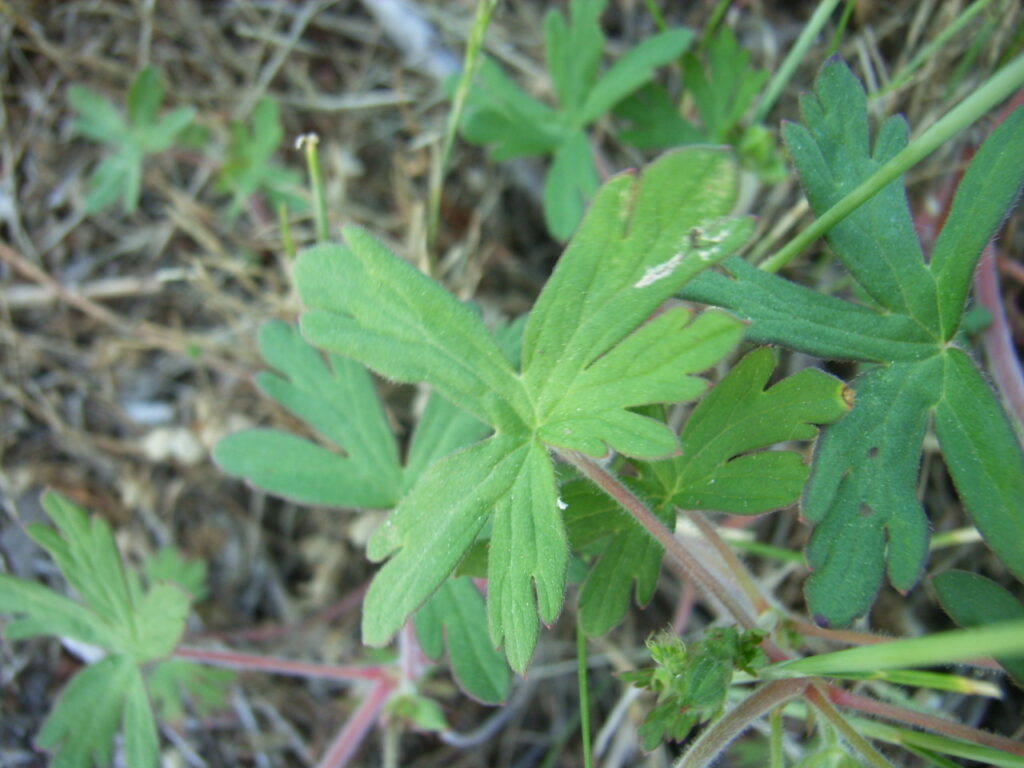
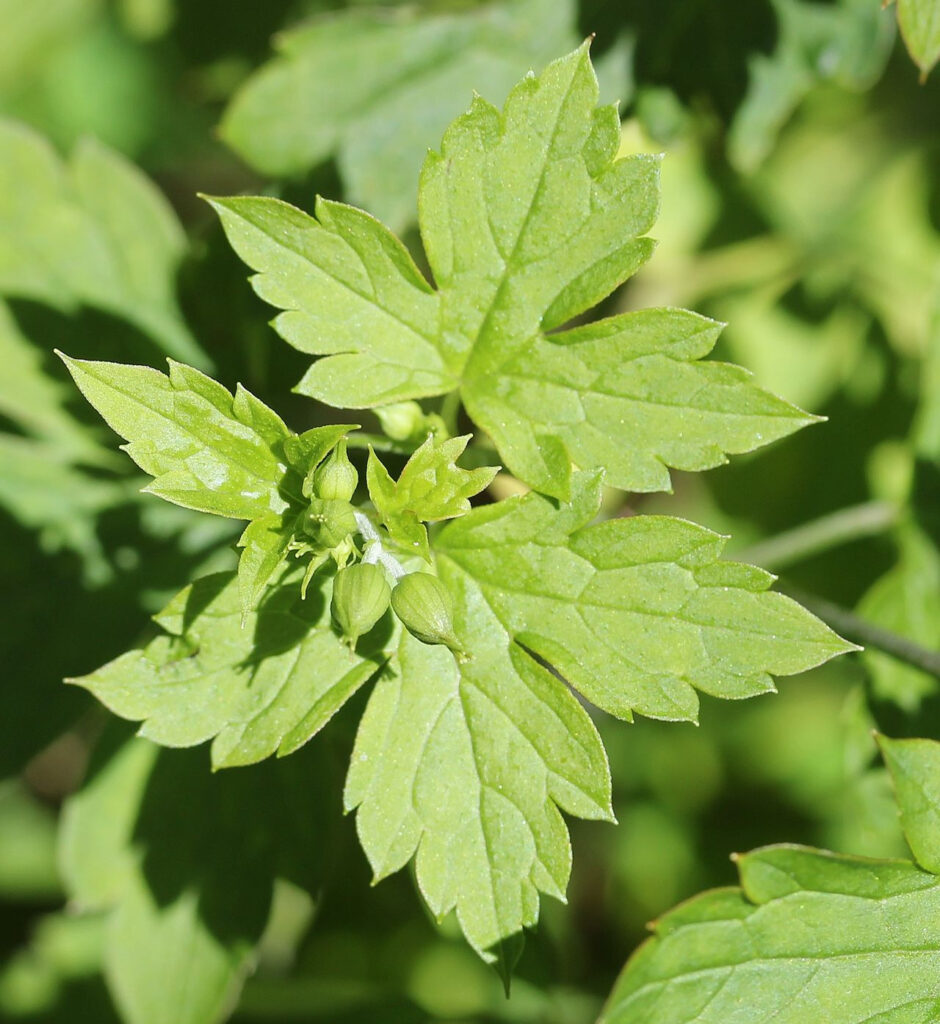
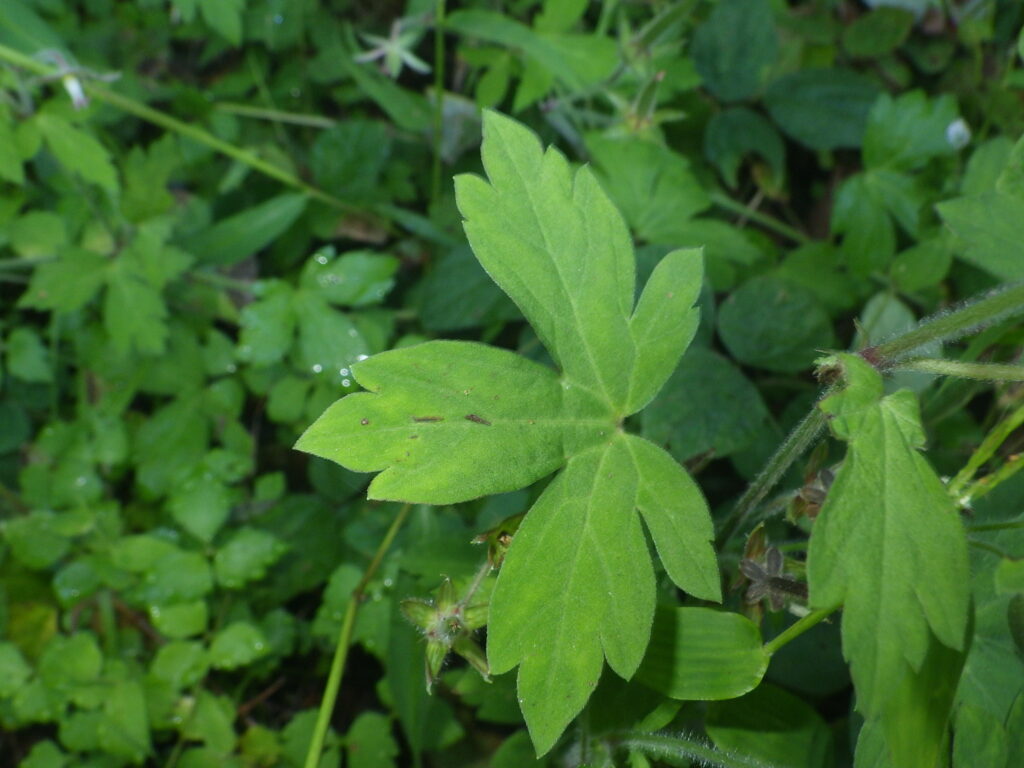
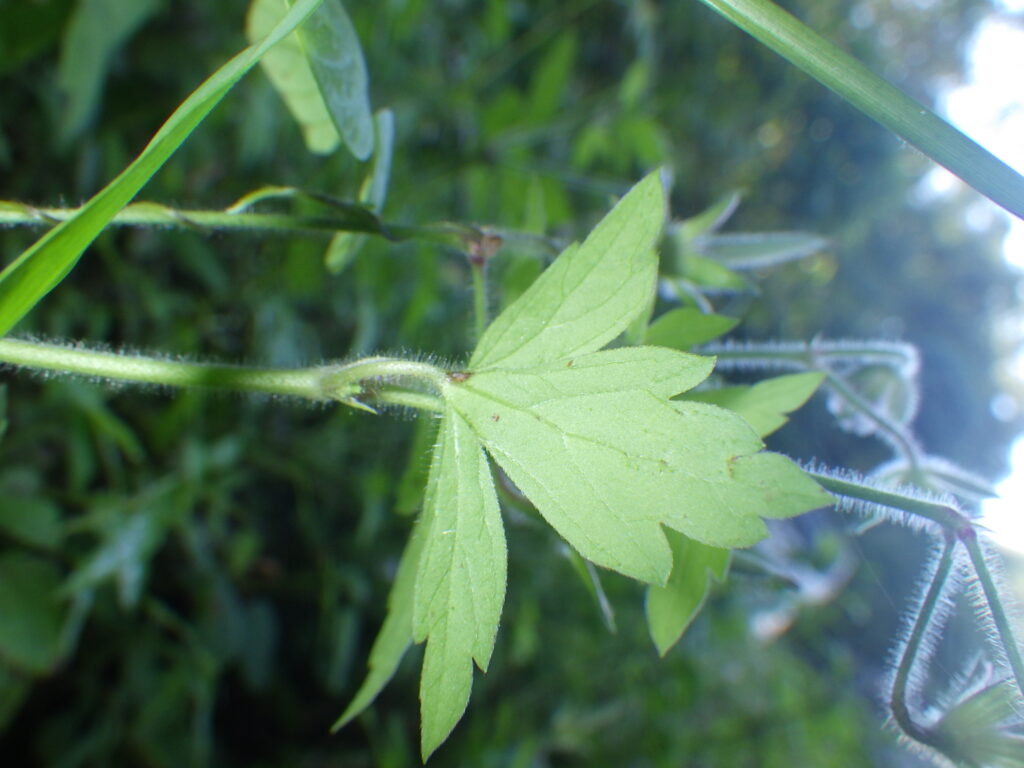
First, while Geranium thunbergii, Geranium thunbergii, and Geranium carolinianum have leaves that are 3 to 5 lobed, Geranium carolinianum has leaves that are 5 to 7 deeply lobed. In other words, Geranium carolinianum has more finely divided leaves.
Also, American cranesbill often has red edges on its leaves, but other species do not.
Regarding the remaining three species, Geranium thunbergii has glandular hairs on its sepals and pedicels, and its leaf blades are 3 to 5-lobed to deeply lobed, whereas Geranium thunbergii and Geranium erianthum lack glandular hairs on their plant bodies, and their leaf blades are 3-lobed or 3-lobed. Note that this does not mean they are completely hairless.
Regarding Geranium thunbergii and Geranium thunbergii, the difference is that Geranium thunbergii has opposite leaves that are deeply three-lobed, while Geranium thunbergii has alternate leaves that are completely three-lobed. In other words, the leaves of Geranium thunbergii are completely divided.
The above should help you distinguish them. Also, as will be explained later, their flowering periods differ; American cranesbill blooms in spring, while the other species bloom from summer to autumn.
In addition, Geranium dissectum resembles Geranium carolinianum, but its fruit has only short hairs and its flowers are dark red (Geranium carolinianum has long bristles and short hairs on its fruit, and its flowers are pale pink to white). Another difference is that its leaves are more deeply lobed, and the lobes, especially on the upper leaves, become thread-like.
In Geranium pusillum, only five stamens have anthers, while the remaining five lack anthers (unlike other species where all stamens have anthers).
What is the variety of Geranium thunbergii?
Several varieties of Geranium thunbergii are known.
Geranium thunbergii f. thunbergii is a variety with red flowers (the standard variety).
Geranium thunbergii f. pallidum is a variety with white flowers.
Yaezaki Gennoshoko f. plenum is a variety with double-flowered blossoms.
What is the structure of a flower?
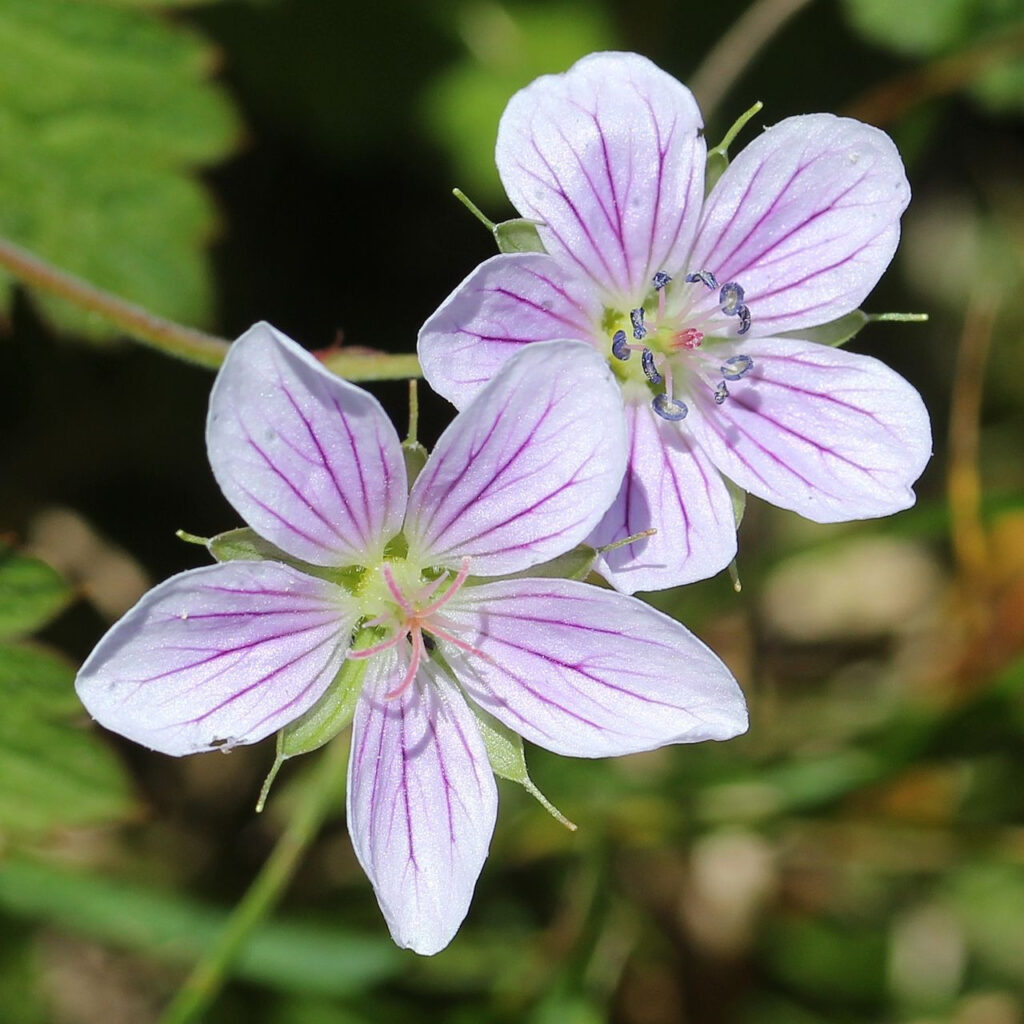
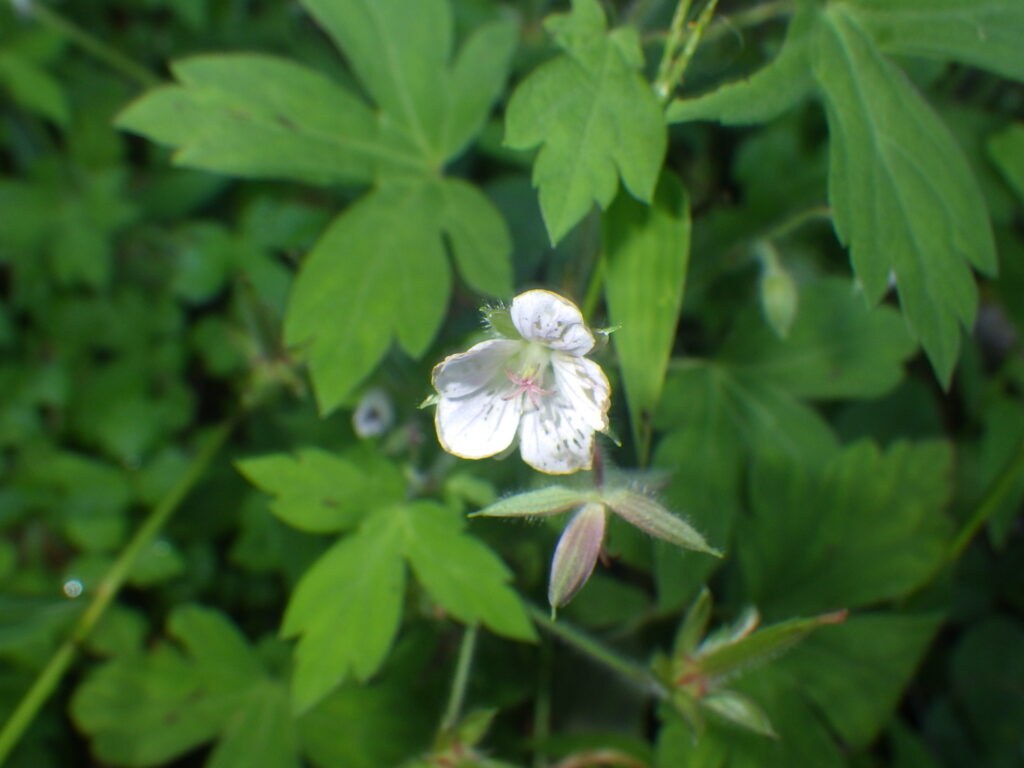
The flower structure is common to all members of the Geraniaceae family. There are generally five petals and five sepals, five stamens arranged in one to three layers, one pistil with a five-lobed style, and a superior ovary that is usually divided into five chambers.
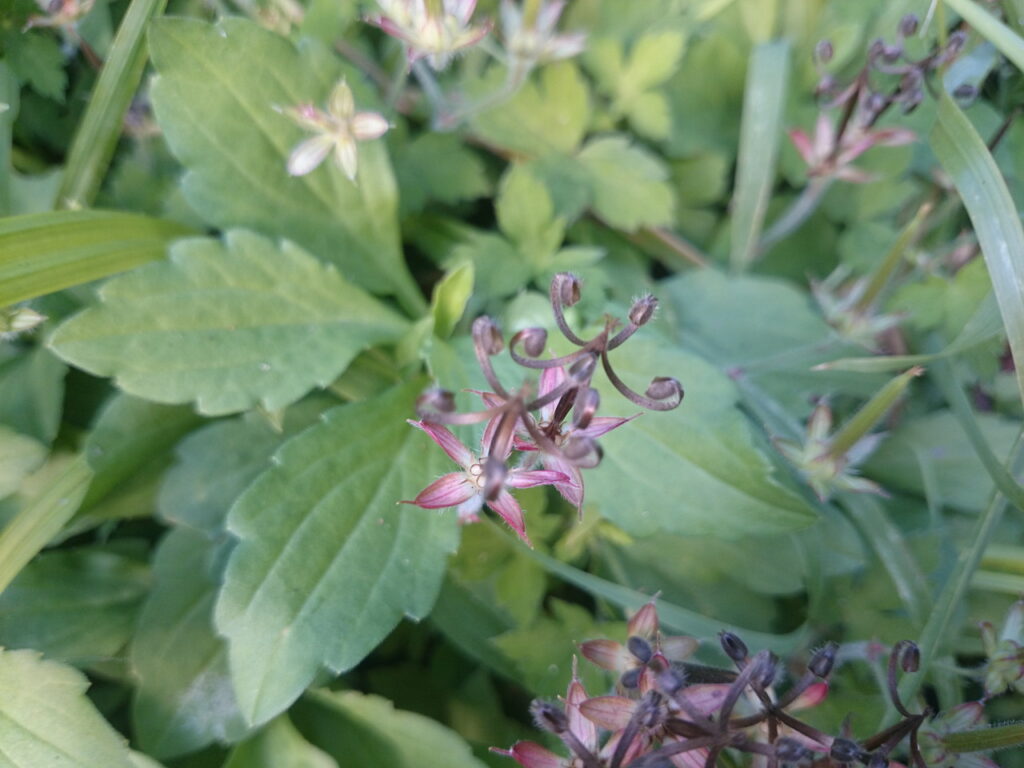
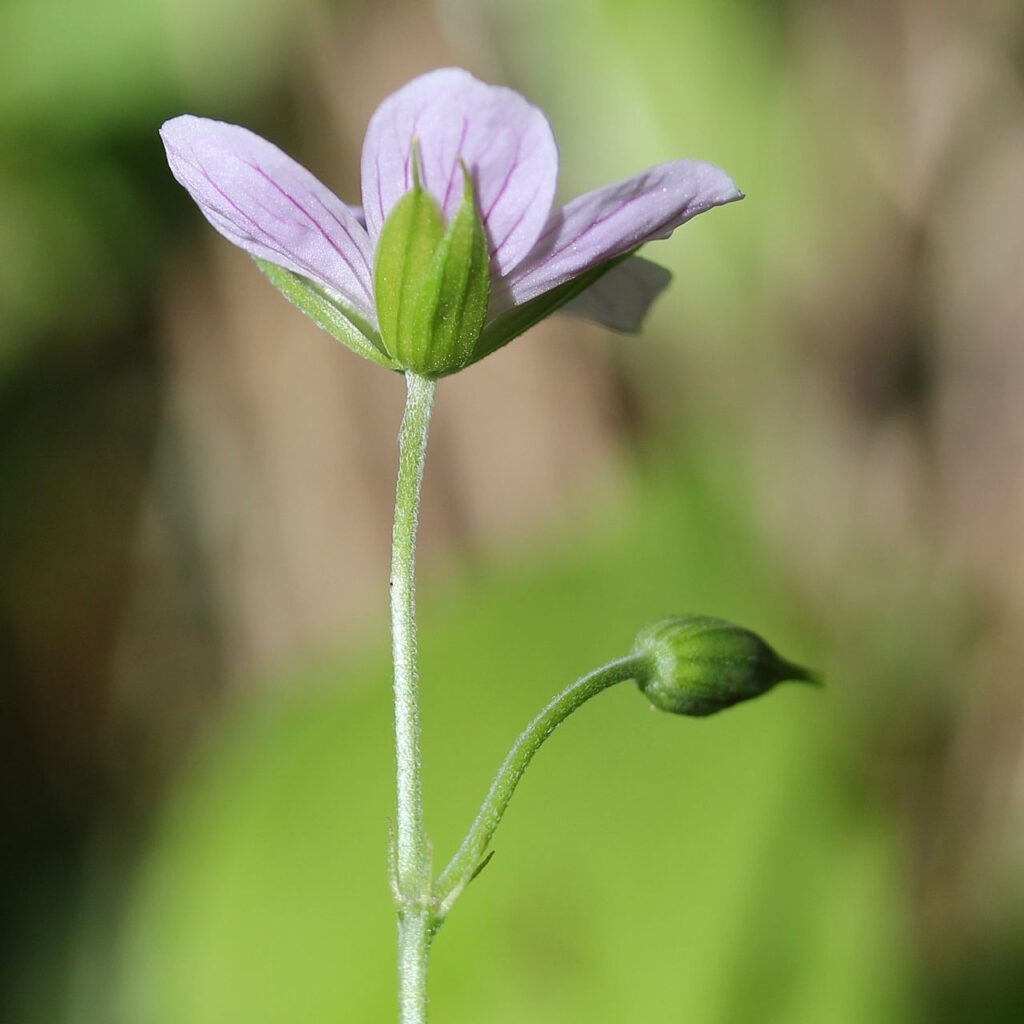
Geranium thunbergii flowers from July to October (Hayashi et al., 2013). The flowers grow in pairs at the end of long pedicels, and are reddish-purple, pale pink, or white, with a diameter of 1-1.5 cm. White flowers are more common in eastern Japan, while reddish-purple flowers are more common in western Japan. The petals and sepals are 5 in number, and the style is 5-lobed.
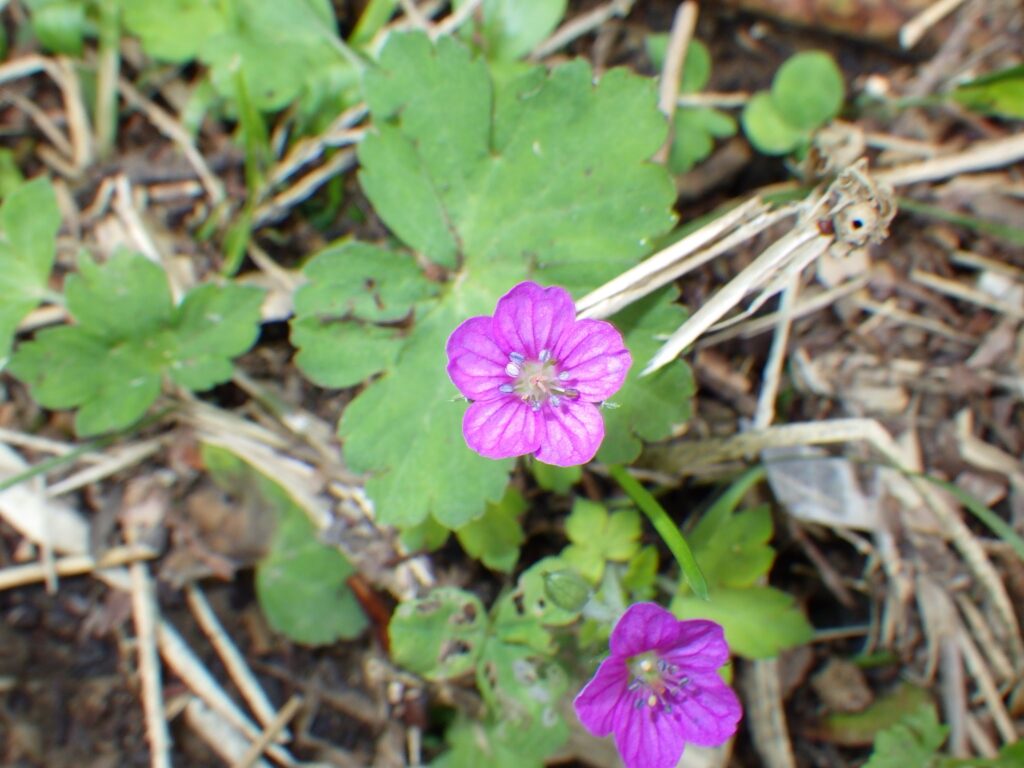
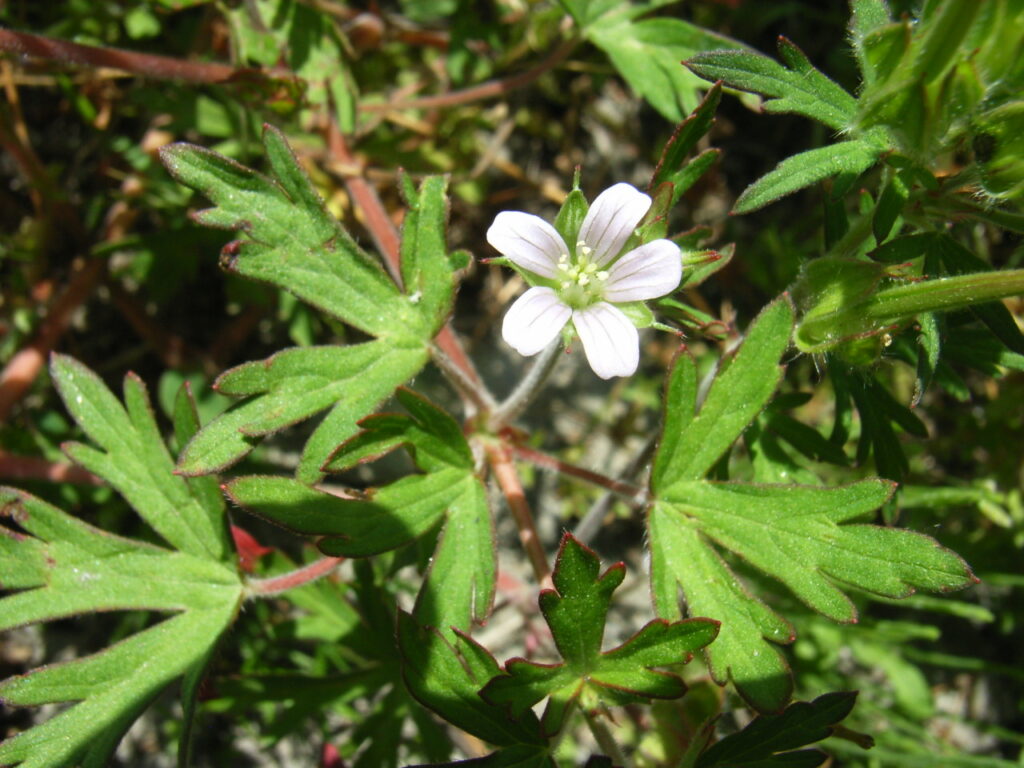
American cranesbill flowers from May to June (Shimizu et al., 2001). During this period, several pale pink, five-petaled flowers, about 5 mm in diameter, emerge from the leaf axils on pedicels.
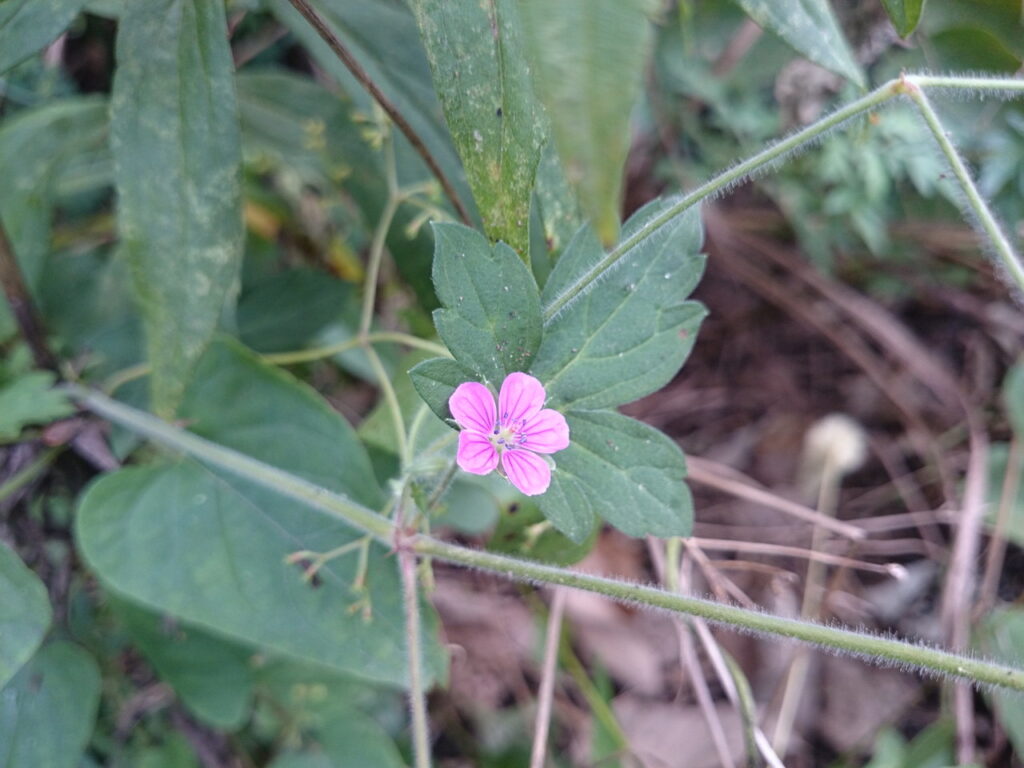
Geranium thunbergii blooms from July to October (Satake et al., 1999). It bears one or two pale purple flowers, 1-1.5 cm in diameter, facing upwards at the end of long pedicels. The pedicels and pedicels are densely covered with downward-pointing bent and pressed hairs. There are five petals and five sepals. The stamens are 10 in number, approximately 6 mm long.
Geranium thunbergii blooms from August to September. The flowers grow in pairs at the top of the stems and branches, and are about 1 cm in diameter, ranging in color from white to pale purplish-red. The outside of the calyx is densely covered with long, spreading hairs, rather than glandular hairs.
What is the structure of the fruit?
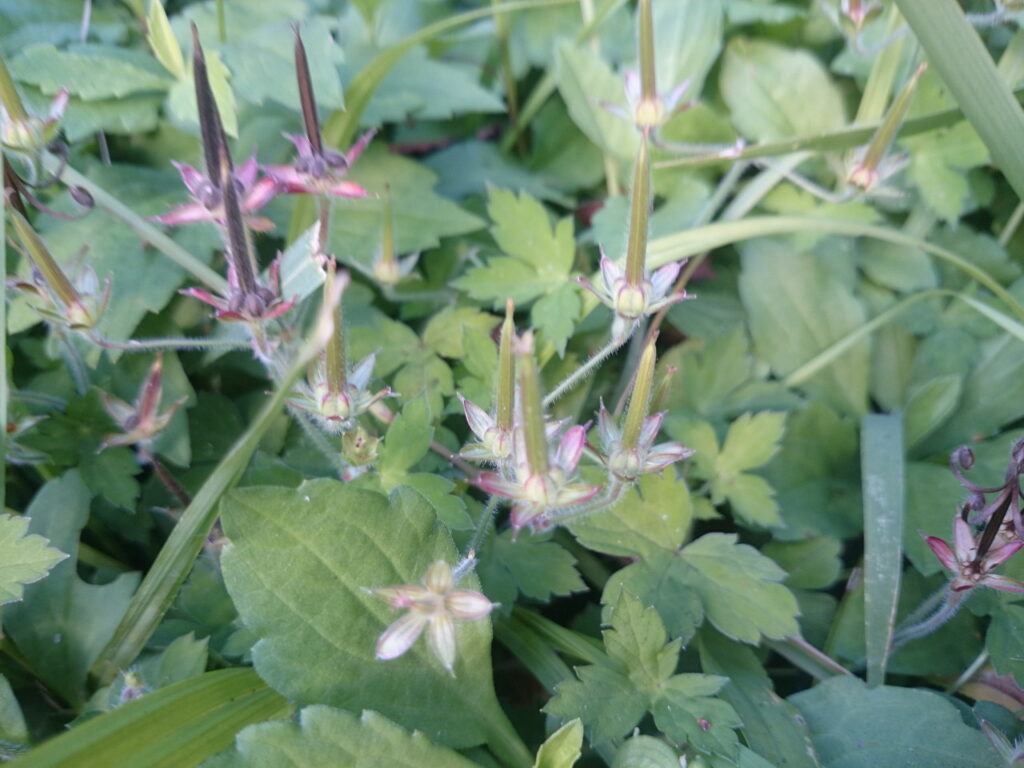
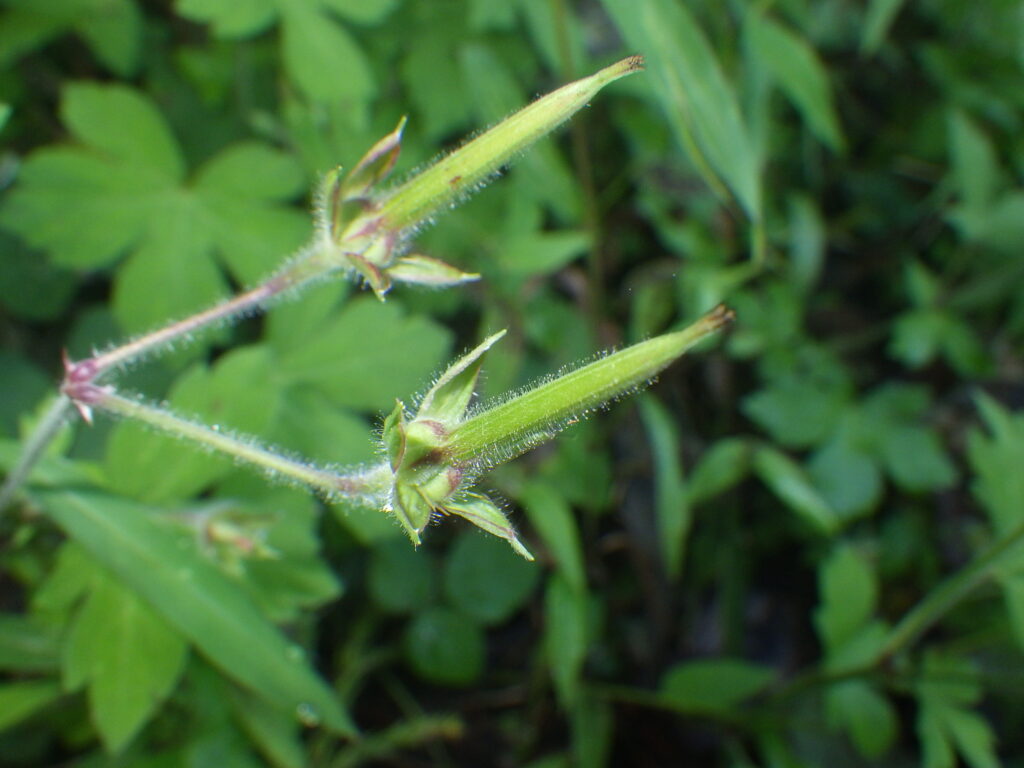
The fruit is a capsule, common to all plants in the Geraniaceae family. It divides into five segments, each with a long beak running along the central axis at the top. When ripe, it splits open and releases seeds. However, there are exceptions, such as Geranium thunbergii.
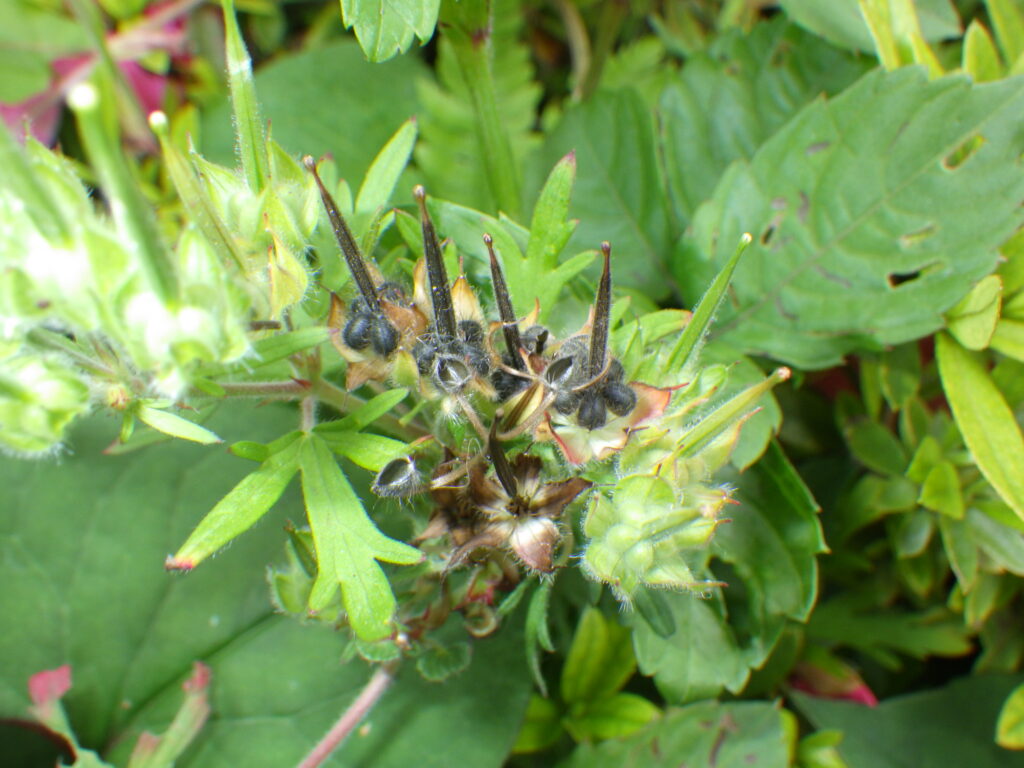
The capsule of Geranium thunbergii is about 1.5 cm long and covered with many short and glandular hairs. The upper part of the carpel extends in a beak-like shape, and the seeds are located at its lower end. When mature, it splits into five sections, and each section rolls up a single seed.
The capsule of Geranium carolinianum is a silique about 2 cm long and bursts open into five segments.
The capsule of Geranium thunbergii, along with the style branches, is about 2 cm long. The fruit body is densely covered with spreading long and fine hairs, and the beak is densely covered with fine hairs. The style branches are 4.5 to 2 mm long. When the fruit ripens, it splits open from the bottom, ejecting the seeds.
The capsule of Geranium thunbergii consists of five segments, each about 1.5 cm long. The fruit body has spreading long and short hairs, and the beak is densely covered with fine hairs.
References
Hayashi, Yasaka, Kadota, Yuichi, and Hirano, Takahisa. 2013. Yamakei Handy Illustrated Guide 1: Wildflowers (Revised and Expanded New Edition). Yama-kei Publishers, Tokyo. 664pp. ISBN: 9784635070195
Kanagawa Prefecture Flora Survey Association. 2018. Kanagawa Prefecture Flora 2018 (Electronic Edition). Kanagawa Prefecture Flora Survey Association, Odawara. 1803pp. ISBN: 9784991053726
Satake, Yoshisuke; Oi, Tsugusaburo; Kitamura, Shiro; Watari, Shunji; and Tominari, Tadao. 1999. Wild Plants of Japan (New Edition, Herbaceous Plants 2, Dicotyledonous Plants). Heibonsha, Tokyo. 318pp. ISBN: 9784582535020
Shimizu, K., Morita, H., & Hirota, S. 2001. Illustrated Guide to Naturalized Plants of Japan: 600 Species of Plant Invaders (Revised). National Rural Education Association, Tokyo. 553pp. ISBN: 9784881370858

