Angelica keiskei, Angelica pubescens, and Angelica japonica all belong to the Angelica genus of the Apiaceae family and are medium to large perennial herbs with thick stems and broad leaves. The structure of their leaves, flowers, and fruits is very similar, which is characteristic of the Apiaceae family. Furthermore, the swollen, sac-like base of the petiole and the flattened fruit are typical features of this group. However, they can be distinguished by checking the amount of hair on the leaves and the presence or absence of involucral bracts. The flowers, which are composed of umbels, are small and undergo sex change. The fruit is a schizocarp, flattened, and has a membranous, somewhat broad wing. This article will explain the classification and morphology of Angelica keiskei, Angelica pubescens, and Angelica japonica.
What are Ashitaba, Shishiudo, and Hamaudo?
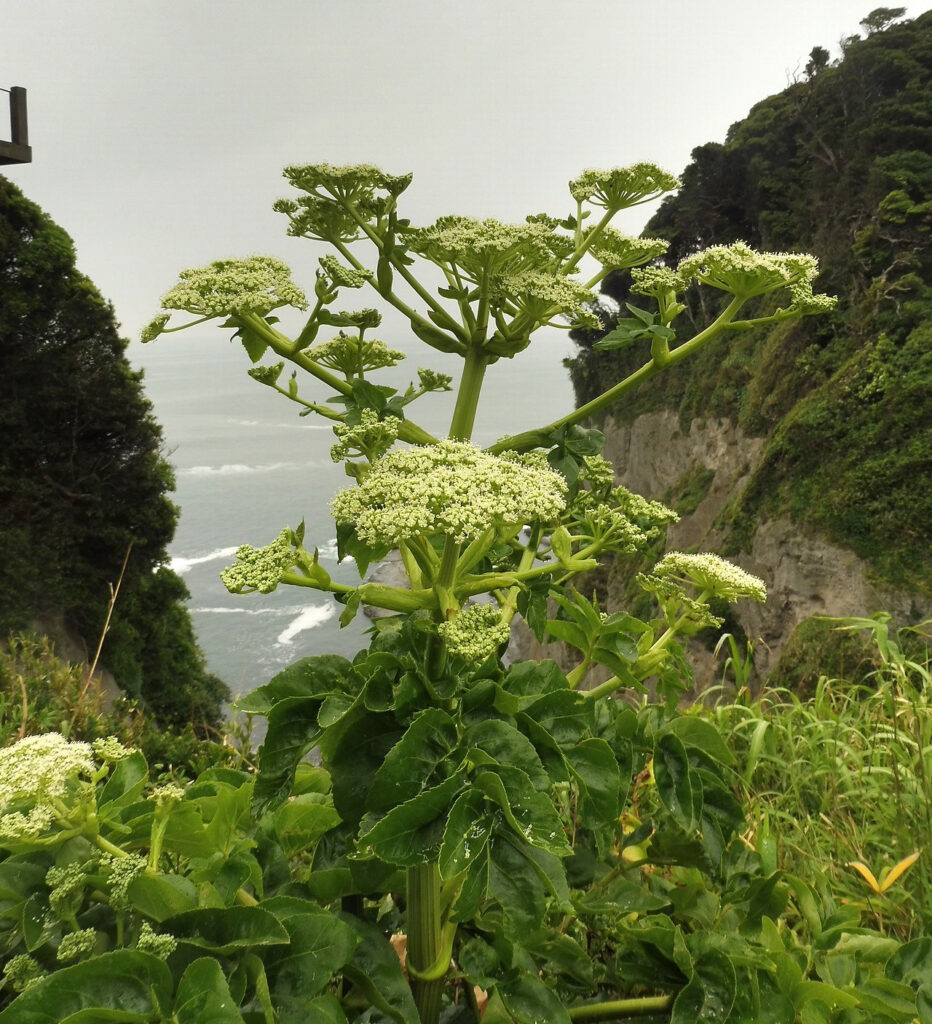
Angelica keiskei, also known as Ashitaba or Shii-gusa, is a perennial herb that grows along the coast and is distributed in Honshu (southern Kanto region, Izu Islands, Tokai region, Kii Peninsula) and the Ogasawara Islands of Japan (Kanagawa Prefecture Flora Survey Association, 2018; Ohashi et al., 2017).
Angelica pubescens var. pubescens, also known as wild angelica, is a perennial herb distributed throughout Honshu, Shikoku, and Kyushu in Japan, growing in forest edges and grasslands throughout the region except for alluvial plains.
Angelica japonica, also known as beach angelica, is a perennial herb that grows along the coast and is distributed in Honshu (west of the Kanto region), Shikoku, Kyushu, and the Ryukyu Islands in Japan, as well as in Korea (Kanagawa Prefecture Flora Survey Association, 2018; Hayashi et al., 2013).
Both are medium to large perennial herbs belonging to the Angelica genus of the Apiaceae family, characterized by thick stems and broad leaves. The leaf, flower, and fruit structures, which are typical of the Apiaceae family, are all very similar.
All species in the genus Angelica share the common trait of having flattened, hairless fruits with somewhat broad, membranous wings. Furthermore, the three species mentioned above are particularly similar in that the stalks of their large umbel inflorescences are covered with short hairs or hair-like projections, either entirely or internally, and the base of the petiole is swollen and sac-like. Therefore, identification can sometimes be difficult.
What are the differences between Ashitaba, Shishiudo, and Hamaudo?
There are 23 species of Angelica native to Japan, and it's impossible to cover all of them here, but let's consider the three species mentioned earlier.
First, Angelica pubescens lacks involucral bracts and has many curled fine hairs on the veins of the underside of the leaves, whereas Angelica keiskei and Angelica japonica have involucral bracts and the underside of the leaves is hairless.
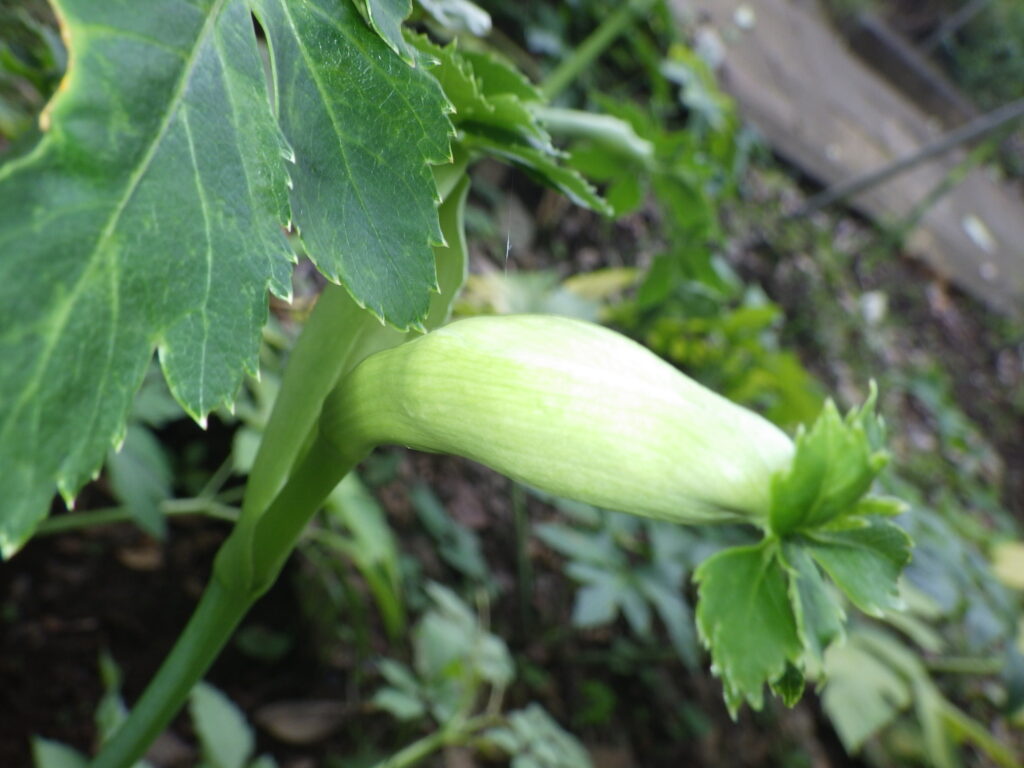
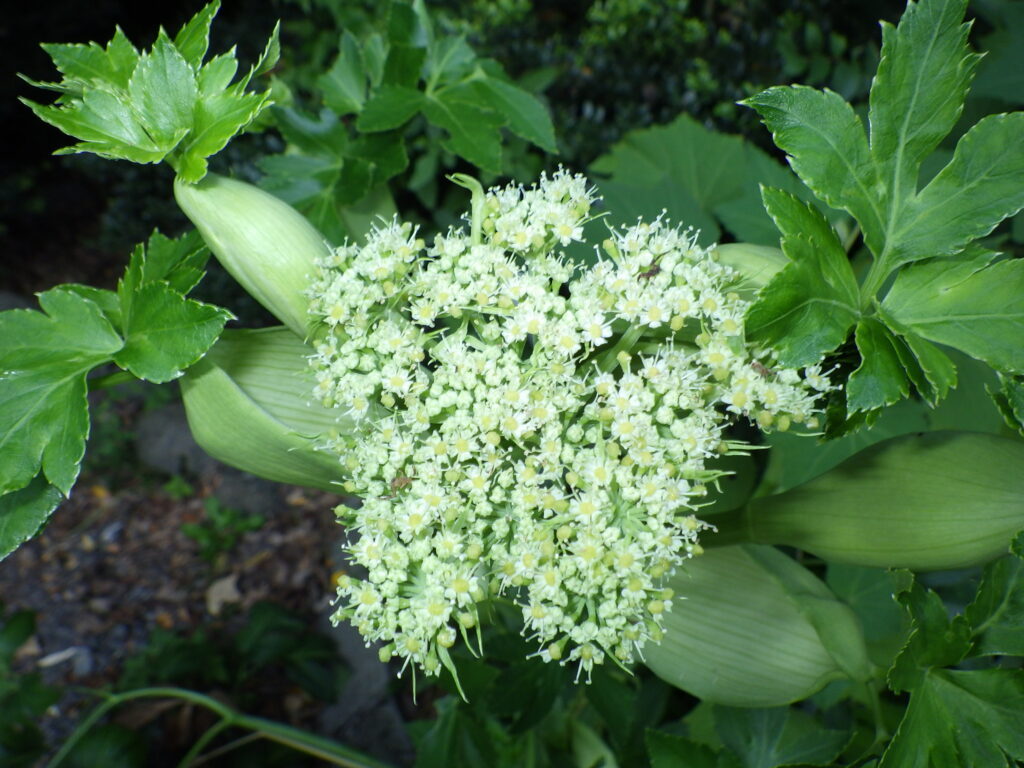
The term "involucral bracts" may be unfamiliar, but they are thin, leaf-like green structures that grow at the base of the pedicel (the slender part connecting the flower to the plant body), and they can be found in some species of the Apiaceae family. In Angelica keiskei and Angelica japonica, you can see thin, green, leaf-like structures mixed in with the flowers.
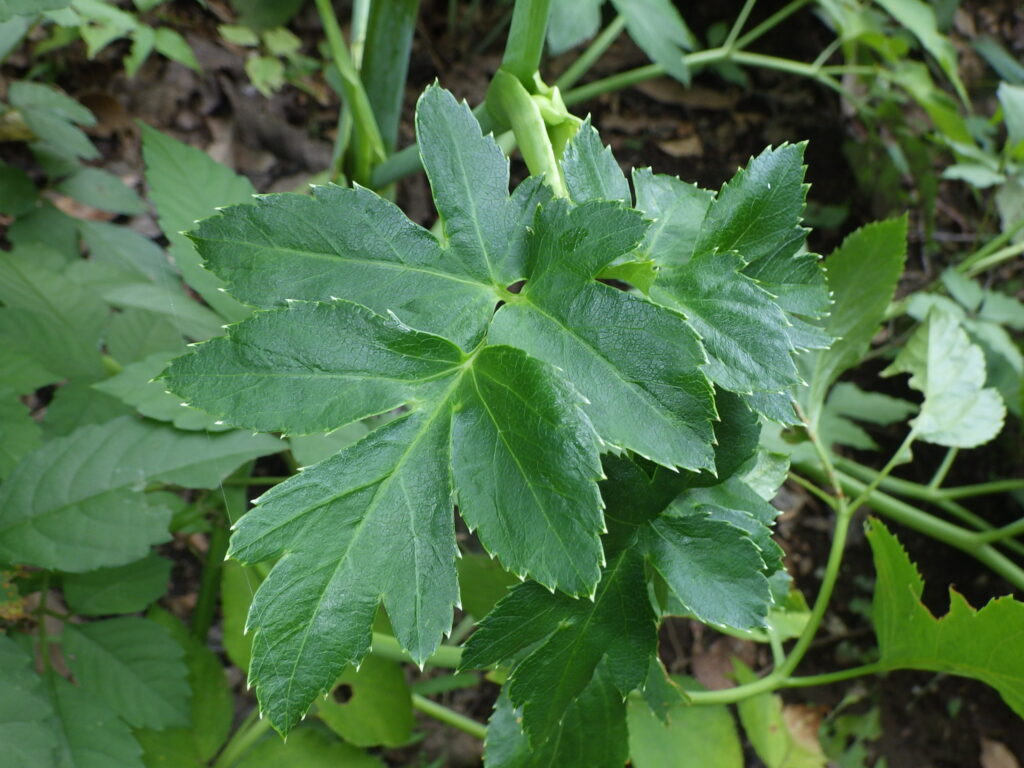
Regarding Angelica keiskei and Angelica japonica, the main difference is that Angelica keiskei has almost no hairs on the midrib on the upper surface of the leaf and on the upper surface of the leaf axis, while Angelica japonica has dense short hairs on the midrib on the upper surface of the leaf and on the upper surface of the leaf axis.
Other differences include the fact that Angelica keiskei has thick leaves, releases a yellow sap when the stem is cut, and has pale yellowish-green flowers, while Angelica japonica does not have particularly thick leaves, has white flowers, and does not release a yellow sap when the stem is cut.
Incidentally, Angelica matsumurae, a variety of Angelica shikokiana, has hairless stems.
This allows you to distinguish between the three species, but be aware that if you are judging purely by shape, you will also need to distinguish them from other species such as Angelica dahurica, Rock ginseng, Angelica shikokiana, and Angelica acutiloba. For more detailed information, please refer to the Kanagawa Prefectural Flora Survey Association (2018) or Ohashi et al. (2017).
Are there any other similar species?
As mentioned above, many species of the Angelica genus grow wild in Japan.
For information on the differences between Nodake and Shishiudo, please see our separate article.
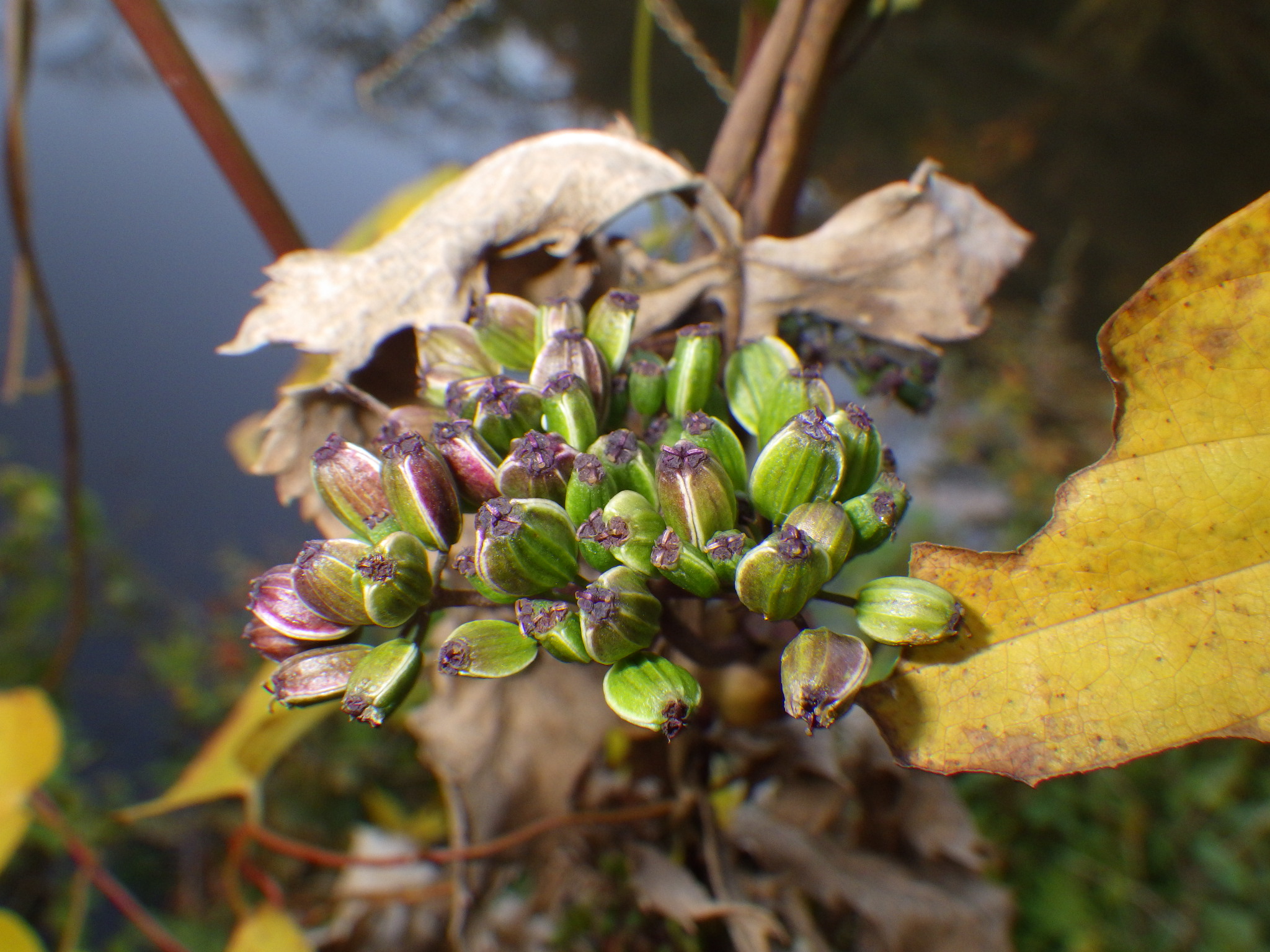
What is the structure of a flower?
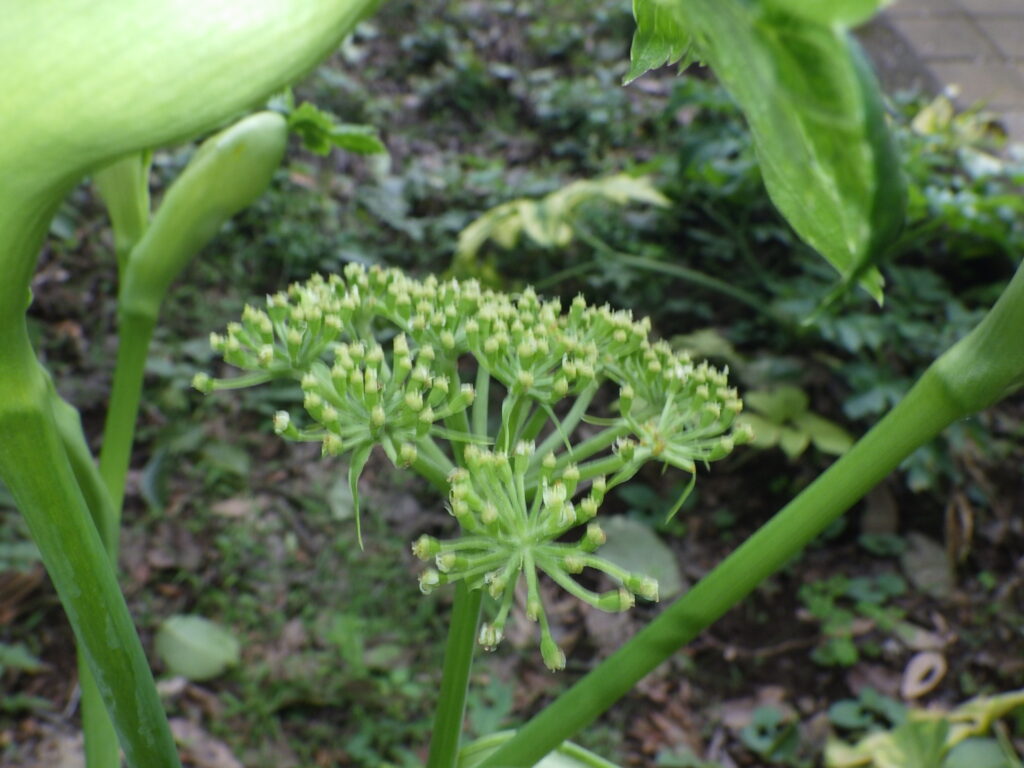
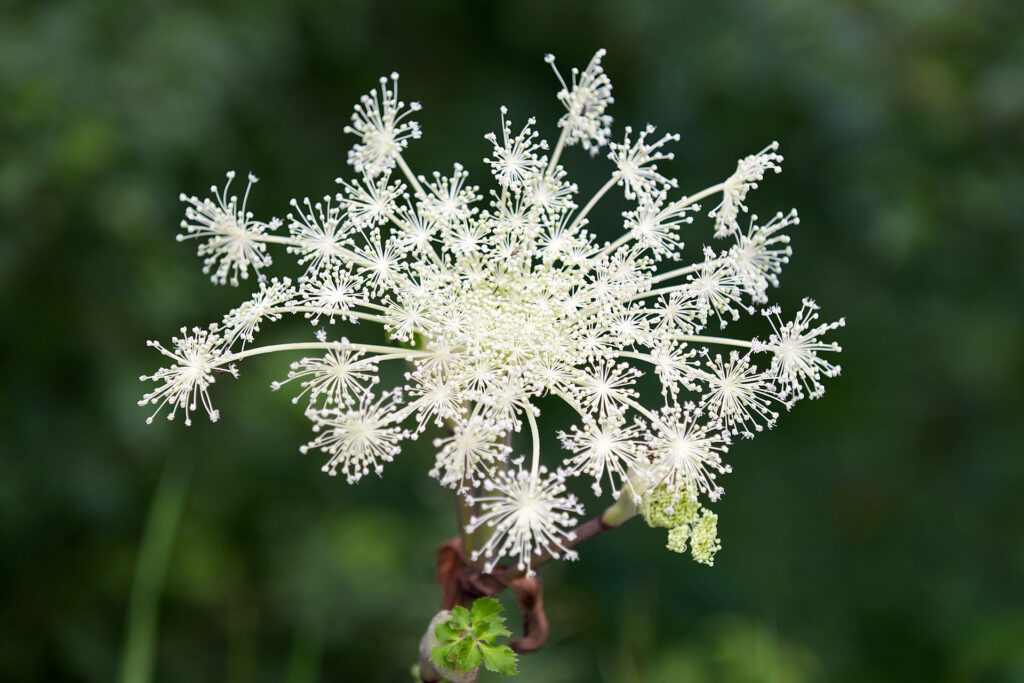
Like many other members of the Apiaceae family, the flowers form umbels.
After the stamens and petals have formed, they fall off, and the pistil develops. A structure common to the Apiaceae family (Shimizu, 2001) called the "columnar base" or "columnar base," which is a glossy structure that secretes nectar and is part of the pistil, develops. My photo shows the later stage.
This process, where the stamens appear first and then the pistils appear, is called "protandry," and it is observed in some species of the Apiaceae family, preventing self-pollination (Watanabe, 1999).
Angelica keiskei flowers from August to October. Its compound umbels lack involucral bracts, but have several involucral bracts. It bears pale yellow flowers and lacks sepals.
Angelica pubescens flowers from August to November. It bears numerous small white flowers in large umbel-shaped inflorescences. The stalks of the umbel-shaped inflorescences are irregularly shaped, ranging in length from 3 to 18 cm. There are no involucral bracts or involucral bracteoles. The petals are numbered 3 to 5, with two lobes at the tip, slightly curved inward, and sometimes tinged with yellow.
Japanese angelica tree (Hamaudo) blooms from April to June. Compound umbels emerge from the tips of its branches, bearing dense clusters of small white flowers. The involucral bracts at the base of the pedicels and the involucral bracts at the base of the pedicels are both elongated.
What is the structure of the fruit?
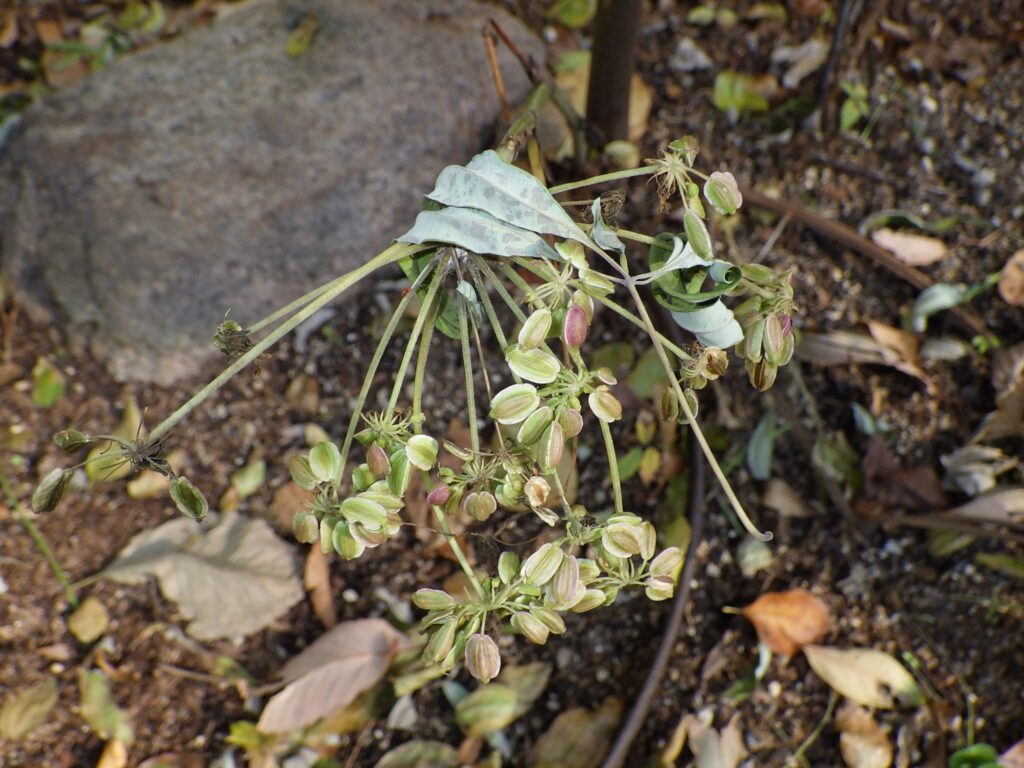
The fruit, like many species in the Apiaceae family, is a schizocarp. A schizocarp is a type of dehiscent fruit, consisting of multiple carpels. When mature, the number of schizocarps corresponds to the number of carpels, and the fruit splits open, separating from the central axis. This type of fruit is widely found in the Apiaceae family.
Common to all species in the Angelica genus, the fruit is flattened, hairless, and has a membranous, somewhat broad wing.
The fruit of Angelica keiskei is oblong, with relatively narrow wings. It consists of two flattened carpels joined together. There is one oil duct under each dorsal groove and four on the fused surface. The wing-like portion of the carpel is not as wide as that of Angelica japonica.
The fruit of Angelica pubescens is 7–9 (up to 11) mm long and 5–7 mm wide, with broad wings and consisting of two flattened segments joined together. The oil glands on the surface of the fruit are clearly visible.
The fruit of Angelica japonica is flattened and broadly oval, consisting of two flattened carpels joined together. The carpels are oblong, with broad, wing-like ridges on both sides, giving them a fan-like appearance.
References
Hayashi, Yasaka, Kadota, Yuichi, and Hirano, Takahisa. 2013. Yamakei Handy Illustrated Guide 1: Wildflowers (Revised and Expanded New Edition). Yama-kei Publishers, Tokyo. 664pp. ISBN: 9784635070195
Kanagawa Prefecture Flora Survey Association. 2018. Kanagawa Prefecture Flora 2018 (Electronic Edition). Kanagawa Prefecture Flora Survey Association, Odawara. 1803pp. ISBN: 9784991053726
Ohashi, Hiroyoshi; Kadota, Yuichi; Murata, Hitoshi; Yonekura, Koji; and Kihara, Hiroshi. 2017. Wild Plants of Japan (Revised New Edition, Vol. 5: Convolvulaceae to Caprifoliaceae). Heibonsha, Tokyo. 760pp. ISBN: 9784582535358
Shimizu, Takemi. 2001. Illustrated Dictionary of Botanical Terms. Yasaka Shobo, Tokyo. xii, 323pp. ISBN: 9784896944792
Watanabe, Osamu. 1999. Illustrated Key to Major Apiaceae Plants in Hokkaido, Part 1: Large Species - Plants Identified by Leaves 2. Shiretoko Museum Research Report 20: 15-32. ISSN: 0387-8716, https://shiretoko-museum.jpn.org/media/shuppan/kempo/sm20_02.pdf