Plumeria is a popular ornamental plant known for its vibrant, large flowers and fragrance, symbolizing the tropics. However, it is also known as Indian jasmine. The meanings of "plumeria" and "Indian jasmine" may differ. In Japan, "Indian jasmine" refers to a single, common species, while "plumeria" can have two meanings: it can be another name for Indian jasmine, or it can be a general term for the genus *Plumeria*. However, since only two species, Indian jasmine and round-leaved plumeria, are actually found in Japan, it's fair to consider it a general term for these two species. Indian jasmine and round-leaved plumeria can be distinguished by their leaves. While plumeria is often associated with Hawaii, it is actually native to the Americas. During the Age of Discovery, it spread throughout the world via the Spanish who came into contact with the Aztecs, and in Hawaii, it was adopted in the 19th century as a material for leis, a traditional cultural item. It is used not only for ornamental purposes but also for medicinal purposes. On the other hand, it is also toxic, and contact with its sap can cause skin irritation, so caution is necessary. Incidentally, the reason for its popularity lies in its large, vibrant flowers and pleasant fragrance, but research has shown that both originally evolved to deceive moths that visit the flowers. This article will explain the classification, history, culture, medicinal uses, toxicity, and pollination ecology of Plumeria and Indian Jasmine.
- What is the difference between plumeria and Indian jasmine?
- What is the difference between Indian jasmine and Malva plumeria?
- How can I use plumeria?
- How toxic is it?
- The large inflorescence and sweet fragrance are the secrets to its popularity.
- The sweet scent and showy flowers were a deception to trick insects!?
- Why hawk moths are fooled by Indian jasmine
- The fruit is a samara.
- References
What is the difference between plumeria and Indian jasmine?
While researching plumeria, a flower with vibrant, large blossoms and a fragrant scent that symbolizes the tropics, I came across the name "Indian jasmine." Is there a difference between plumeria and Indian jasmine?
Actually, plumeria and Indian jasmine may refer to different things.
When we refer to "Indian jasmine," we are usually referring to a single, common species found in Japan.
Plumeria rubra, also known as Indian jasmine, is a deciduous, semi-succulent shrub native to Mexico, Central America, and northern South America. It is cultivated in tropical regions worldwide and has even naturalized in places like India (Rojas-Sandoval, 2020). In its native habitat, it grows in dry coastal forests and rocky areas. It is popular worldwide as an ornamental plant and is also cultivated in Japan.
On the other hand, the term "plumeria" does not refer to a single species from a biological standpoint, but rather has two possible meanings.
The first case is when it's simply listed as another name for Indian jasmine in gardening or similar contexts. In this case, you can consider "Plumeria = Indian jasmine."
The second term is sometimes used as a general term for the genus Plumeria in the family Apocynaceae. This includes Plumeria obtusa (native to the Florida Keys, southeastern Caribbean, Mexico to Guatemala), P. pudica (native to Venezuela to Panama), P. alba (native to Puerto Rico to the Windward Islands), P. clusioides (native to Cuba), P. cubensis (native to Cuba), P. ekmani (native to Cuba), P. filifolia (native to Cuba), P. montana (native to Cuba), P. tuberculata (native to the Bahamas to Hispaniola), P. subsessilis (native to Hispaniola), and P. x stenopetala (native to Hispaniola) (Perez, 2019). There are about 10 species, but classification is confusing due to significant variation in leaf shape and tree form, as well as errors in specimens. Researchers have differing opinions on the exact number of species. Identifying them by appearance alone is extremely difficult.
However, the vast majority of plumerias actually cultivated outside of the Americas, including Japan, are limited to just two species: Indian jasmine and round-leaved plumeria (Plumeria obtusa). The diversity of flower colors is the result of selective breeding. Therefore, in horticulture, it could practically be considered a general term encompassing both species. In most cases, varieties of Indian jasmine are more commonly cultivated than varieties of round-leaved plumeria.
What is the difference between Indian jasmine and Malva plumeria?
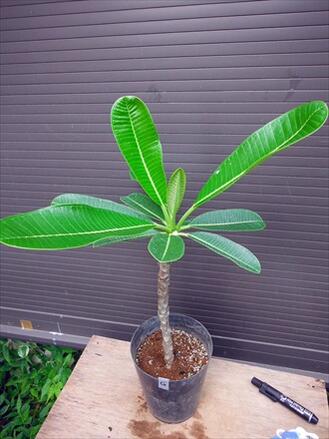
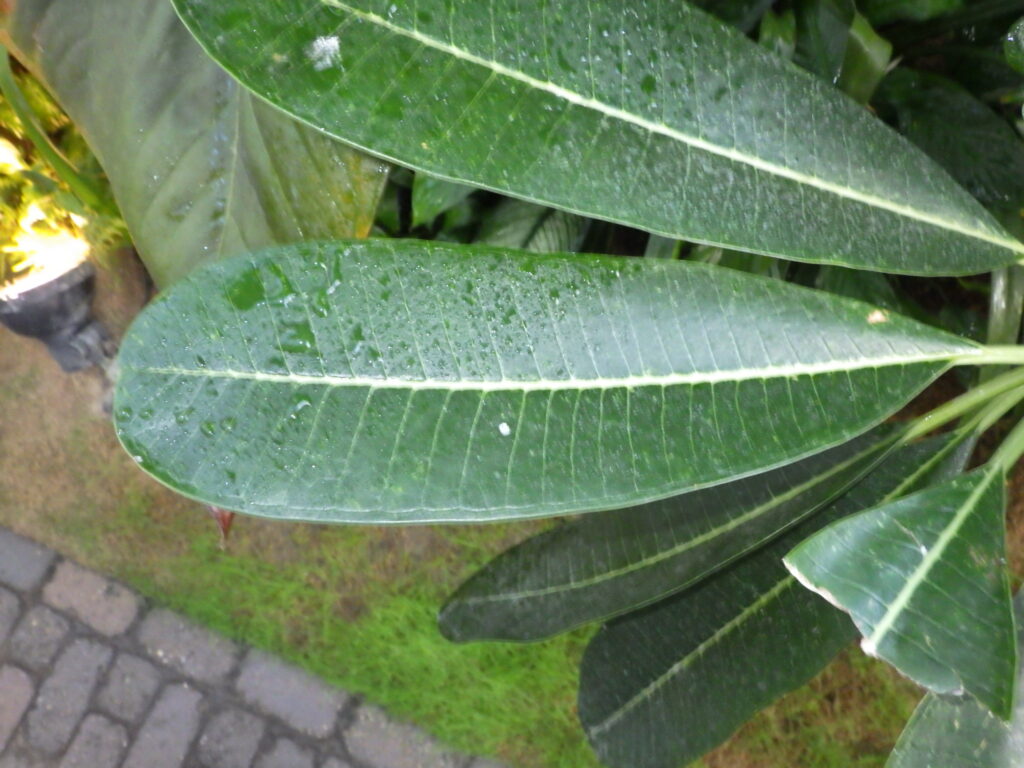
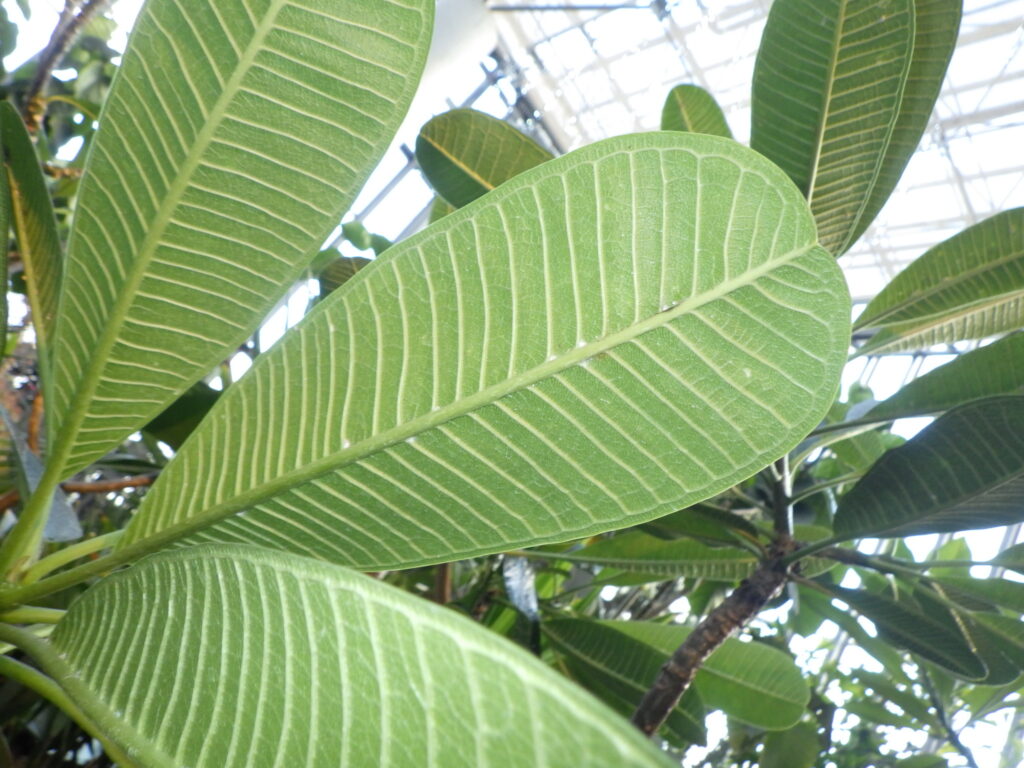
What are the differences between Indian jasmine and Malva plumeria?
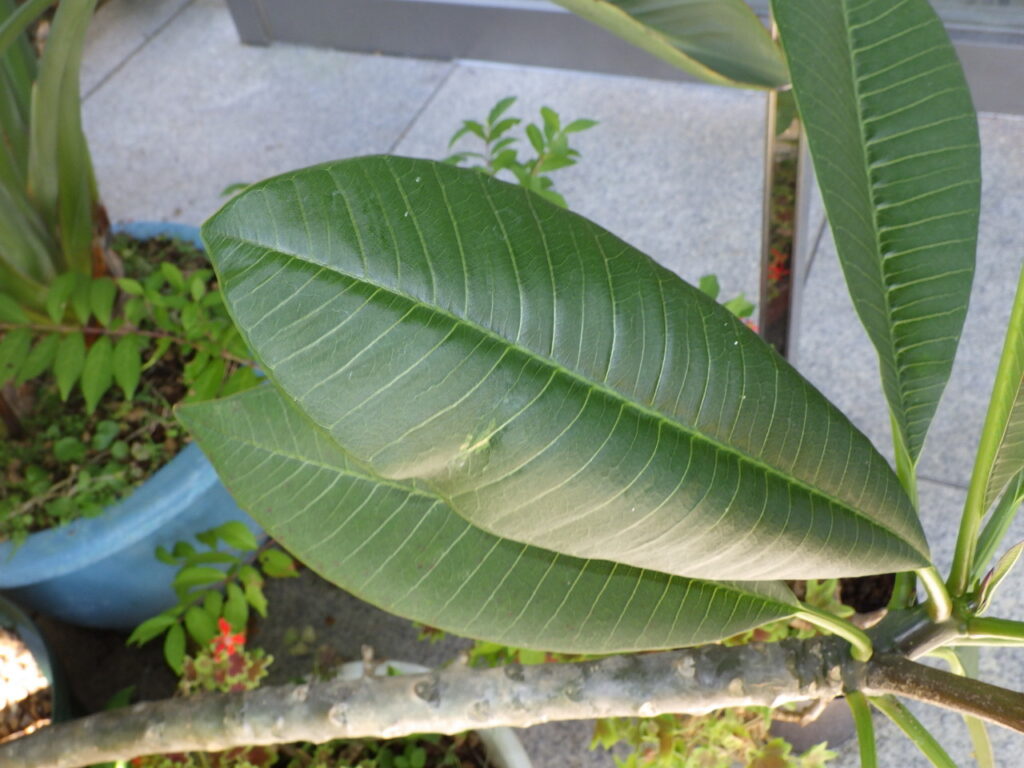
This can be distinguished by its leaves (Wu & Raven, 1995).
In Indian jasmine, the leaf blade has an acute or acuminate apex, and the upper surface is dull and green, whereas in Malva plumeria, the leaf blade has a rounded apex, and the upper surface is glossy and dark green.
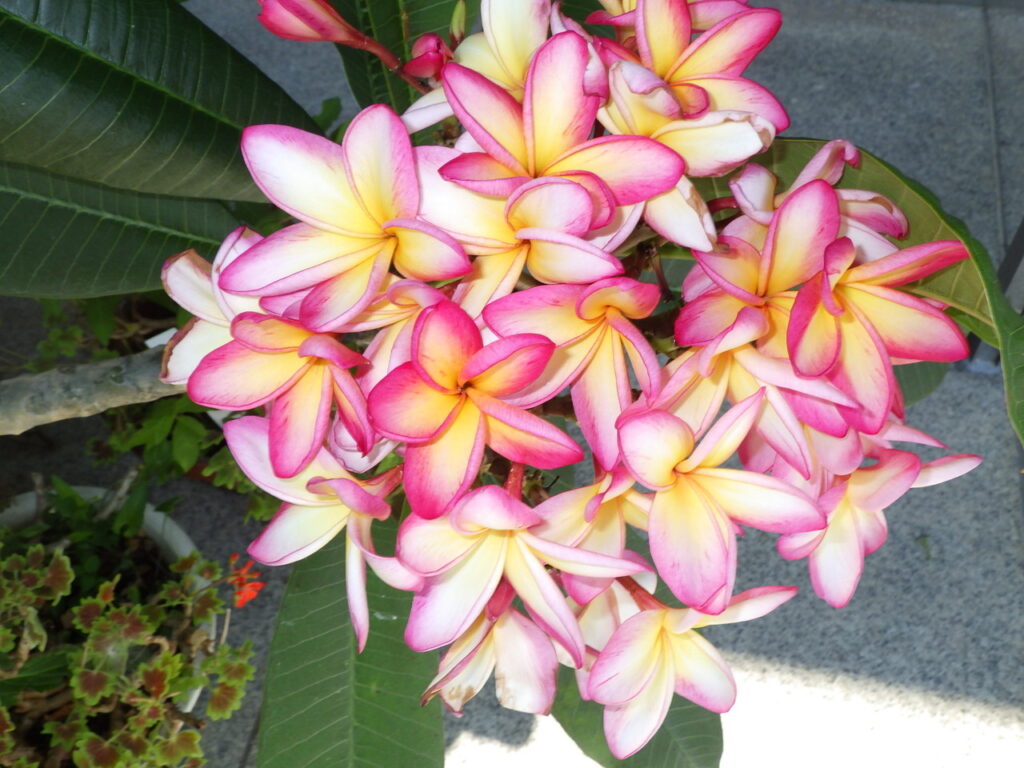
While this isn't a precise classification, generally speaking, Indian jasmine can have red or yellow flowers, while Malva plumeria's flowers are mostly white.
However, it has been suggested that the Malva plumeria populations commonly cultivated in Hawaii and along the Pacific coast may be hybrids (Perez, 2019).
Furthermore, the Ylist, the most reliable list of correspondences between Japanese names and scientific names, lists *Plumeria rubra * (red-flowered Indian jasmine) and *Plumeria rubra 'Acutifolia'* (Indian jasmine). It seems that this classification treats species with red flowers and pointed leaves as separate varieties from those with other flower colors but pointed leaves, but such a distinction is not made worldwide and is considered inappropriate.

How can I use plumeria?
Plumeria is cultivated worldwide as an ornamental plant for its color and fragrance, and its essential oil is used in perfumes. It is also cultivated for offerings and religious purposes. Furthermore, it is believed to have various medicinal properties and is sometimes used in traditional medicine (Criley, 2009; Perez, 2019; Bihani, 2021).
Many Japanese people associate plumeria with Hawaii. However, its country of origin is actually the Americas.
It was first cultivated in Mexico and parts of Central America, where it was highly valued by the colorful Aztec people and named tlâlcalôxôchitl (crow flower) (Criley, 2009).
A major turning point for plumeria can be said to have been the Age of Discovery. In 1522, the Spanish priest Francisco de Mendoza created a herbal encyclopedia describing the medicinal properties of local plants and how the Aztecs used them, which brought the plant to the attention of Europeans.
Later, they were brought to Japan by Spanish explorers and missionaries (the Columbus Exchange) and rapidly became popular as ornamental plants in tropical regions around the world.
By 1787, it had become widely cultivated in India and associated with temples and religious ceremonies. In India, it is known as a symbol of immortality because it can produce leaves and flowers even after being removed from the soil. When visiting Bali, Indonesia, it is planted in large numbers along roadsides and in residential areas for a similar purpose. It has also been the official flower of Palermo, Sicily, since its arrival there in the early 1800s.
The alternative name "frangipani" comes from the Marquis of the Frangipani family, a noble family that invented perfumes with the fragrance of this flower in 16th-century Italy.
In Hawaii, plumeria is used as cemetery flowers, for landscaping, and as potted plants, but it is best known for its use in leis.
Leis are believed to have been introduced by Polynesians who arrived around the 12th century, and have been used since ancient times as ornaments worn on the head, neck, and shoulders as a symbol of protection against evil, an offering, and a sign of social status.
Leis were used before plumeria was introduced, but later, around the 19th century, plumeria was incorporated as one of the plants brought in by travelers and settlers.
While tourists often purchase them as souvenirs, they were originally worn by funeral attendees and the bride and groom at weddings, symbolizing farewell (Koiso, 2022).
Tourists captivated by the fragrance and vibrant colors of Hawaiian plumeria flowers began taking cut flowers home. As tourism increased, so did interest in plumeria, and soon collectors began seeking out new varieties in the Hawaiian Islands. Plumeria associations were formed in warm regions of the United States and Australia, enjoying the enthusiastic support of collectors. In 2005, 14.6 million plumeria flowers were sold for $506,000, and tens of thousands of cuttings are exported from Hawaii every year.
In folk medicine, decoctions of the leaves, bark, and flowers have been used to treat skin diseases, sexually transmitted infections, and diarrhea, and have also been used as laxatives.
How toxic is it?
While it is a highly valued plant, it contains a milky sap common to the Apocynaceae family, and is also toxic due to the presence of various alkaloids or cardiac glycosides.
Regarding plumeria, various chemical components have been isolated and identified, including medicinal components such as iridoids, triterpenoids, flavonoids, glycosides, phenols, alkaloids, carbohydrates, amino acids, fatty acid esters, sphingolipids, lignin, monoglycerides, and coumarins (Bihani, 2021).
The white sap (milky sap) that oozes out when leaves or branches are cut is harmful and can cause rashes and skin irritation upon contact (Koiso, 2022). Although no specific cases have been confirmed, it is best to avoid intentional contact with it.
How about taking it orally?
The toxicity of oral ingestion of Indian jasmine has been investigated in experiments with mice and rats (Bihani, 2021).
In a 72-hour acute toxicity study, six groups of albino rats and albino mice (8 animals each) were orally administered methanol extract of jasmine leaves suspended in physiological saline at different concentrations (500, 750, 1000, 1250, 1500, and 2000 [mg/kg BW]). No typical symptoms such as death, convulsions, seizures, diarrhea, or increased dehydration were observed.
Based on this, the median lethal dose (LD50) is estimated to be over 2000 [mg/kg BW]. No toxic symptoms have been observed in other experiments.
Therefore, the effects of oral ingestion are thought to be minimal, but no case studies have been conducted in humans, and there is clearly a milky sap in the Apocynaceae family, and there are no examples of it being consumed as food anywhere in the world, so you should still not intentionally put it in your mouth.
The large inflorescence and sweet fragrance are the secrets to its popularity.
The flowers are perhaps the most popular part of this plant. The flowering period varies greatly depending on the region, but it is generally long, year-round in its native Nicaragua, from March to July in Costa Rica, and from June to October in Japan. It produces inflorescences containing many flowers, and each flower is large and conspicuous. The stamens and pistils are hidden deep inside the flower and are not visible from the outside (Haber, 1984). The corolla is five-lobed, ranging in color from pink to white, with a yellow center. It emits a fragrance in the morning and evening that has been likened to roses, citrus fruits, and cinnamon (Joulain, 2008), which is another reason why it is popular with humans.
The sweet scent and showy flowers were a deception to trick insects!?
With such a sweet fragrance and showy flowers, you might imagine that many different insects visit them.
However, it has been found that the only insects that visit flowers are hawk moths, which have long mouthparts (Haber, 1984).
First, the flowers attract hawk moths by emitting a pleasant fragrance during the twilight hours when they are most active, and then they attract the moths' attention with pink to white flowers, which are said to be their preferred color. Furthermore, the yellow parts act as nectar guides, indicating the location of nectar to the hawk moths, and pollination is completed when the hawk moths thrust their bodies deep into the flowers.
But that's not all that's surprising.
This flower doesn't produce nectar. In other words, despite being shaped in a way that is so appealing to hawk moths, it's actually deceiving them into carrying its pollen.
When you consider that the sweet scent and showy flowers of the Indian jasmine, which humans adore, are actually a deception for insects, doesn't it change your perception of it?
Why hawk moths are fooled by Indian jasmine
Even with all the clever tricks in place, why are hawk moths so easily fooled? Although they are insects, hawk moths do have the ability to learn. I feel like if they could remember the shape of the flowers and where they bloom, they would stop coming immediately.
While this mystery isn't fully understood, it's believed that hawk moths learn which flowers are tasty, not by instinct, but through learning, with each generation. This is similar to how humans do. Therefore, they must first determine if a particular flower is tasty. This is also an important opportunity for the Indian jasmine. The long flowering period is thought to increase this opportunity.
Furthermore, a longer flowering period increases the chances of various types of hawk moths, which emerge at different times of the year, visiting the plant.
Furthermore, hawk moths are busy not only searching for nectar but also for mates and places to lay their eggs, so it seems inefficient for them to remember the location of each nectar source. It might be more efficient for them to find food by scent, even if they are sometimes fooled.
However, there are many flaws in their design, such as the small amount of pollen they release at once (which should limit their chances of success), and the flowers being too clustered together (making them easy for moths to remember). Perhaps the ability to deceive moths is a relatively recent development in the grand scheme of evolution. Or perhaps there are still secrets hidden within them.
We often enjoy these plants as ornamental plants without giving them much thought, but it's fun to observe them while appreciating the wonders of their evolution.
The fruit is a samara.
The fruit is rarely seen in cultivated plants, but very occasionally it produces 20 to 60 winged fruits enclosed in a cylindrical pod about 17.5 cm long. These are thought to be dispersed by wind.
References
Bihani, T. 2021. Plumeria rubra L. –A review on its ethnopharmacological, morphological, phytochemical, pharmacological and toxicological studies. Journal of Ethnopharmacology 264: 113291. https://doi.org/10.1016/j.jep.2020.113291
Criley, RA 2009. Plumeria rubra: an old ornamental, a new crop. Acta Horticulturae 813: 183-190. https://doi.org/10.17660/ActaHortic.2009.813.23
Joulain, D. 2008. Flower scents from the Pacific. Chemistry & Biodiversity 5(6): 896-909. ISSN: 1612-1872, https://doi.org/10.1002/cbdv.200890103
Haber, WA 1984. Pollination by deceit in a mass-flowering tropical tree Plumeria rubra L.(Apocynaceae). Biotropica 16(4): 269-275. ISSN: 0006-3606, https://doi.org/10.2307/2387935
Koiso, Yoshie. 2022. The New Perfume Textbook. Mynavi Publishing, Tokyo. 223pp. ISBN: 9784839979256
Perez, BK 2019. Morphological and Molecular Approaches to Disentangling the Taxonomy of Plumeria Species (Apocynaceae) [Doctoral dissertation, University of Hawai'i at Manoa]. https://www.proquest.com/openview/0354baf8a7e554801440a3bb3d22687f/1?pq-origsite=gscholar&cbl=18750&diss=y
Rojas-Sandoval, J. 2020. Plumeria rubra (red frangipani). CABI Compendium. https://doi.org/10.1079/cabicompendium.42060
Wu, ZY, & Raven, PH (Eds.). 1995. Flora of China (Vol. 16 Gentianaceae through Boraginaceae). Science Press, Beijing, and Missouri Botanical Garden Press, St. Louis. 479pp. ISBN: 9780915279333