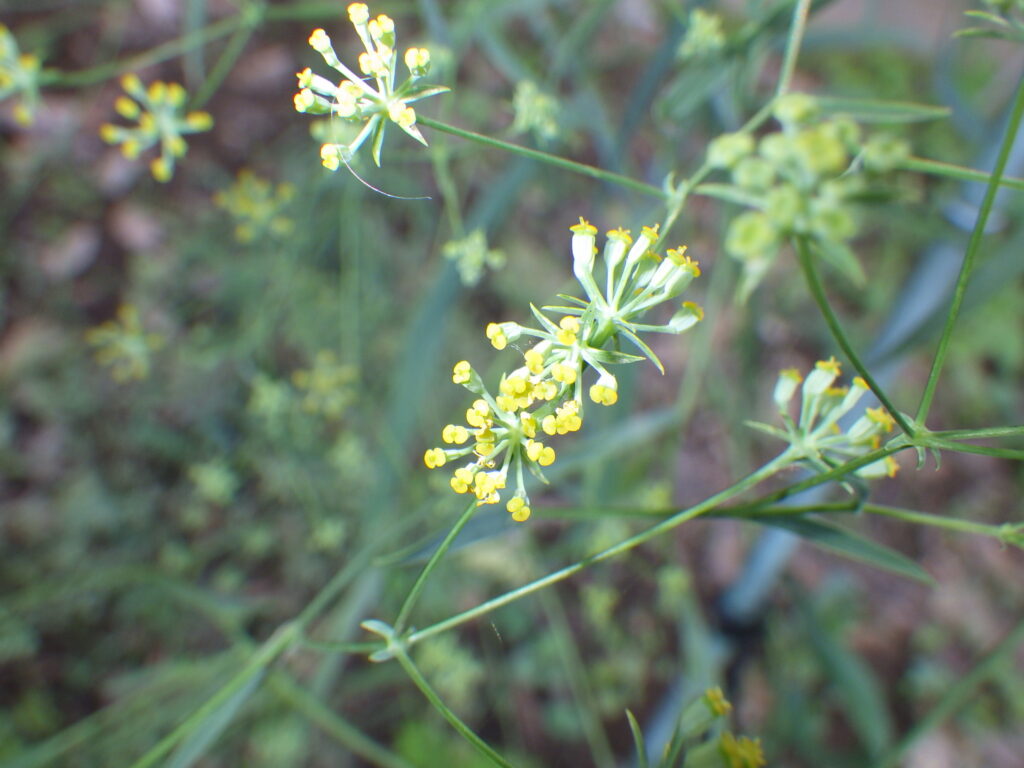
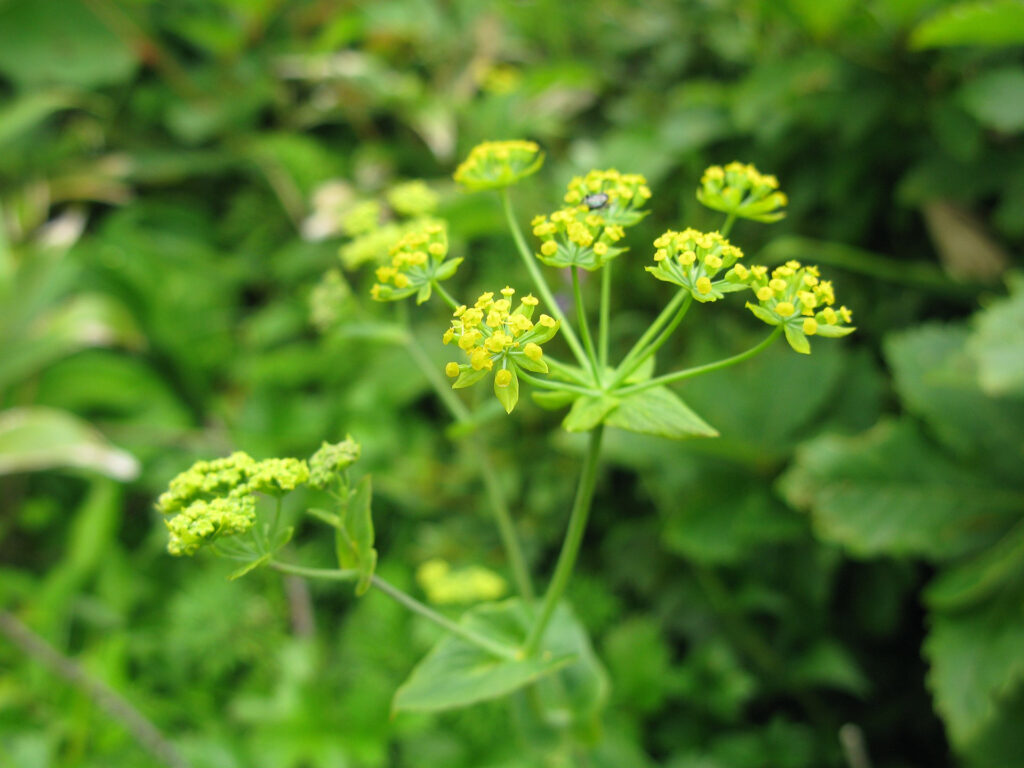
Bupleurum falcatum and Bupleurum chinense are both yellow-flowered plants belonging to the Apiaceae family that grow in sunny grasslands, so it can be difficult to distinguish between them. The difference lies in whether the base of the stem leaves clasps the stem or not. It seems that they cannot be distinguished by the morphology of the flowers, but there appears to be a difference in the shape of the involucral bracts. Bupleurum falcatum is also cultivated because its roots have medicinal properties. The roots, known as "Saiko" in traditional Chinese medicine, have been used as a psychotropic, anti-inflammatory, pus-draining, and tonic drug. However, due to its medicinal use, most of the wild plants in Japan have been overharvested, and it has gone from an endangered species to an extinct one in Japan. Currently, cultivated plants in Japan and wild individuals from Korea and China are used. Bupleurum flowers have a well-developed structure called the "columnar base" or "columnar base," which is part of the pistil, and is glossy and secretes nectar. Although there is insufficient research on this flower, it is highly likely that it is mainly visited by flies with short mouths that prefer yellow flowers. This article will explain the classification, medicinal uses, history, and pollination ecology of Bupleurum falcatum and Bupleurum chinense.
- A yellow-flowered plant belonging to the Apiaceae family that grows in sunny grasslands.
- What is the difference between Mishima Saiko and Hotaru Saiko?
- Why did the Mishima Bupleurum become an endangered species?
- What is the structure of a flower?
- Based on research into closely related species, it's highly likely that flies are attracted to these flowers.
- Are the fruits schizocarps and the seeds dispersed by gravity?
- References
- Source
A yellow-flowered plant belonging to the Apiaceae family that grows in sunny grasslands.
Bupleurum stenophyllum, also known as Mishima-saiko, is a perennial herb distributed in Honshu, Shikoku, and Kyushu in Japan; the Korean Peninsula; Siberia; Amur; Ussuri; Sakhalin; Mongolia; Northeast China; and Europe, inhabiting sunny grasslands from hills to mountains (Kyoto Prefectural Government, Department of Environment, Natural Environment Conservation Division, 2015). Its name originates from the fact that high-quality herbal medicine materials were produced in Mishima, Shizuoka Prefecture.
Bupleurum longiradiatum, also known as firefly bud lily, is a perennial herb distributed in Hokkaido, Honshu, Shikoku, and Kyushu in Japan, as well as in Sakhalin and Ussuri. It is found scattered in bright forests and grasslands on plateaus and hills. Its name is said to come from the resemblance of its yellow flowers to the light of fireflies, but this is not a characteristic unique to firefly bud lily.
Both belong to the genus Bupleurum in the family Apiaceae, and their flowers are yellow, making them very similar. Their habitats are also similar, so it may be difficult to distinguish them. The involucral bracts (leaf-like structures that emerge from the base of the inflorescence) are ovate to narrowly elliptical and hairless, which is a major characteristic of the genus Bupleurum and distinguishes it from other genera in the Apiaceae family.
What is the difference between Mishima Saiko and Hotaru Saiko?
Bupleurum falcatum and Bupleurum chinense can generally be distinguished by the base of their stems and leaves.
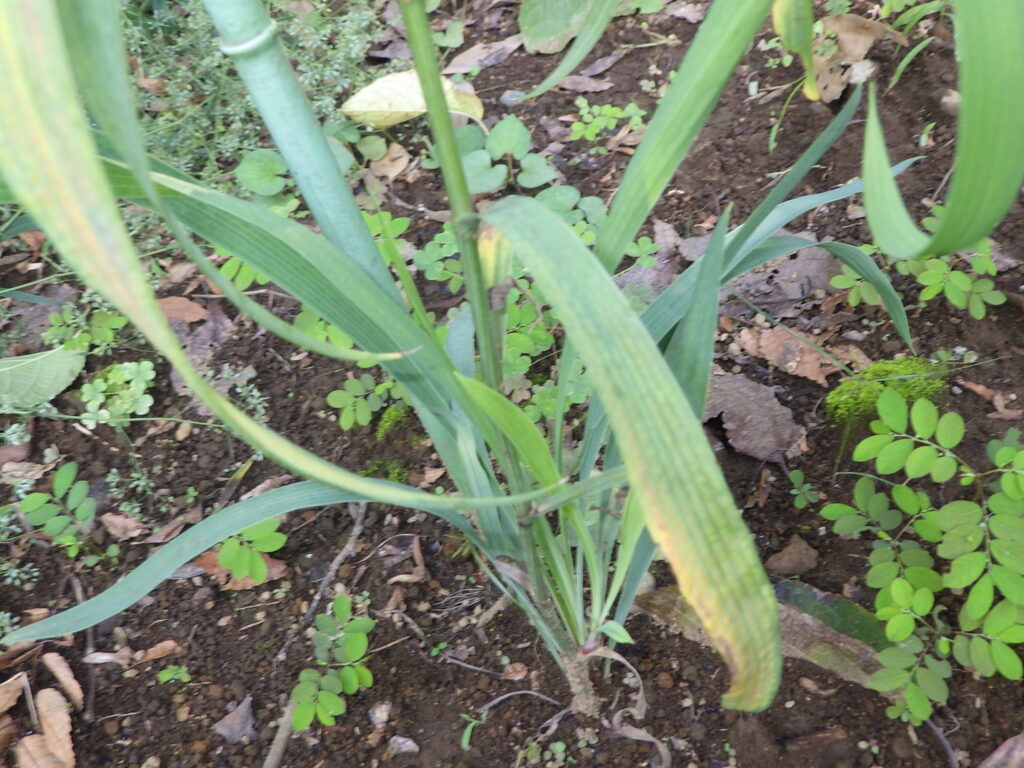
Specifically, in Bupleurum falcatum, the base of the stem leaves does not clasp the stem, and the width of the upper stem leaves is less than 2 cm, whereas in Bupleurum chinense, the base of the stem leaves clasps the stem, and the width of the upper stem leaves is 2 cm or more.
While I was unable to confirm the differences in the flowers themselves, it appears that the involucral bracts are nearly lanceolate in Bupleurum falcatum, while they are narrowly elliptical in Bupleurum chinense.
In addition, other species such as Bupleurum nipponicum and Bupleurum ajanense also exist in Japan, but they are omitted here due to their limited distribution.
Bupleurum fontanesii, a naturalized species native to the Mediterranean coast, is distinguished from two other species by the fact that its involucral bracts are longer than its inflorescences.
Furthermore, Bupleurum rotundifolium, a naturalized species native to West Asia, is distinguished from the other two species by its stems and leaves that pierce the stem and are attached in a shield-like manner.

Why did the Mishima Bupleurum become an endangered species?
Bupleurum falcatum is cultivated because its roots have medicinal properties. The roots, known as Saiko in traditional Chinese medicine, are used as a psychotropic, anti-inflammatory, pus-draining, and tonic agent (Minami, 1995). It also has antipyretic, analgesic, and detoxifying effects, and is specifically used for alternating chills and fever during the middle stages of a cold, and for chest and flank discomfort. It is also effective for malaria, liver disease, and bilateral flank pain (pain and tightness in the armpits).
The main component responsible for this effect is thought to be saikosaponin af (Sasahara, 1992).
These effects were stronger in wild individuals, and they were considered superior (Minami, 1995). As a result, most of the plants growing wild in Japan were overharvested, and consequently, even those that once grew widely in the mountains and fields west of Ibaraki Prefecture have almost disappeared.
Therefore, their numbers remain very small, and in Japan, they are designated as Endangered Species II by the Ministry of the Environment (Kyoto Prefectural Government, Department of Environment, Natural Environment Conservation Division, 2015). They are also listed on some form of Red List in 32 prefectures, and in some prefectures, they have been deemed extinct (Wildlife Survey Association/Envision Environmental Conservation Office, 2023).
Although domestic production still takes place, it is mainly cultivated. Furthermore, due to price competition with inexpensive imports from China and South Korea, the volume of imports is increasing year by year (Minami, 1995). In 2008, of the approximately 444 tons of Bupleurum used, 23 tons (5%) were produced in Japan, while 399 tons (90%) were imported from China (Kaneko et al., 2013). However, it is important to keep in mind from a sustainability perspective that even these Chinese imports are from wild plants.
What is the structure of a flower?
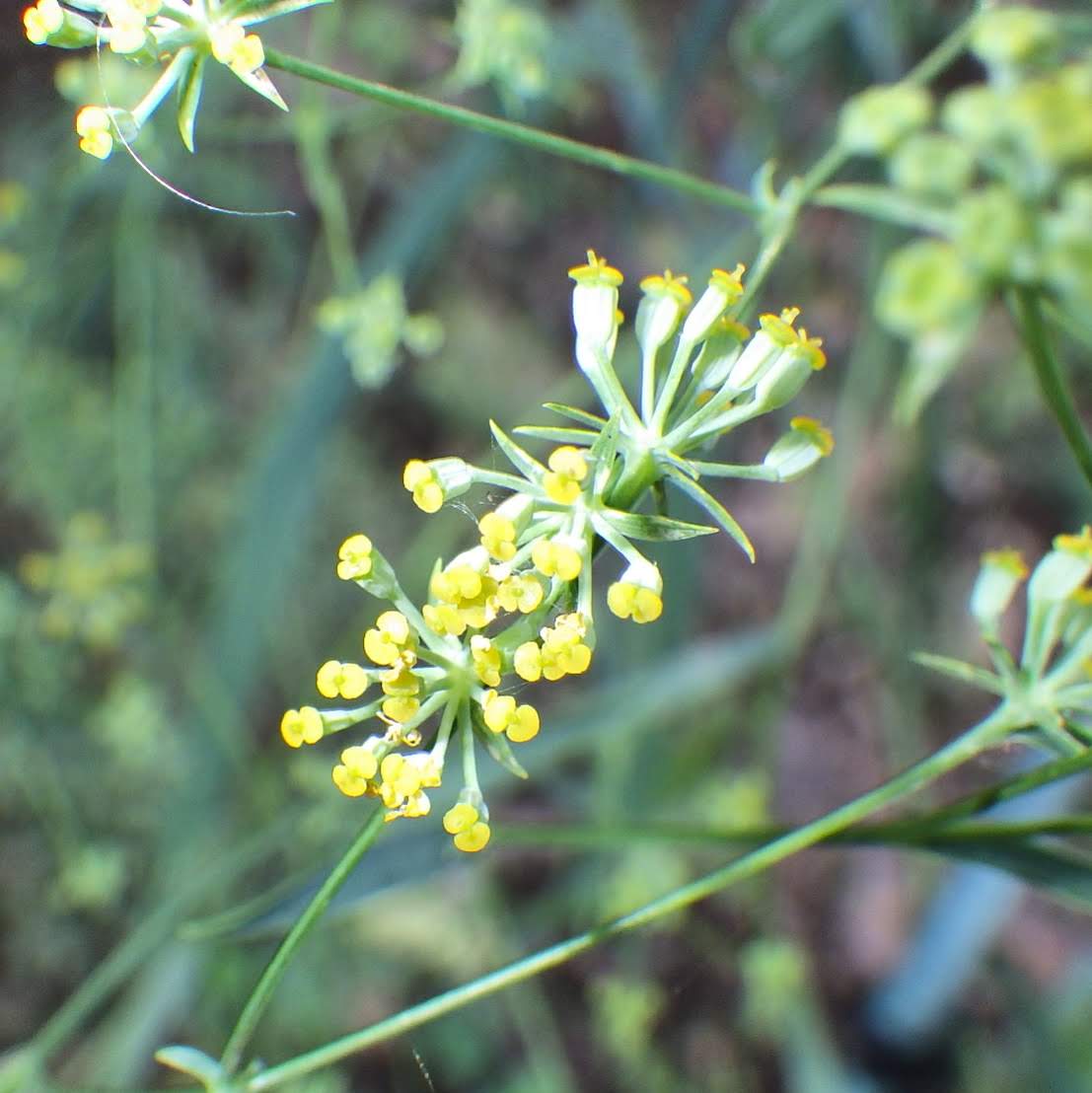
Bupleurum falcatum flowers from August to October. It bears 5 to 10 small yellow flowers in compound umbels on the stem. The petals are 5 in number, about 2 mm in diameter, and curve inward at the tip. There are 5 stamens. The ovary is inferior. There are 1 to 3 involucral bracts. The involucral bracts are 5 in number and longer than the pedicel.
The flowering period of *Ipomoea purpurea* is from July to August. The flowers are arranged in compound umbels, with multiple small yellow flowers. The petals are 5 in number and about 3 mm in diameter. The involucral bracts and involucral bracts are narrowly elliptical, and the involucral bracts are shorter than the pedicels.
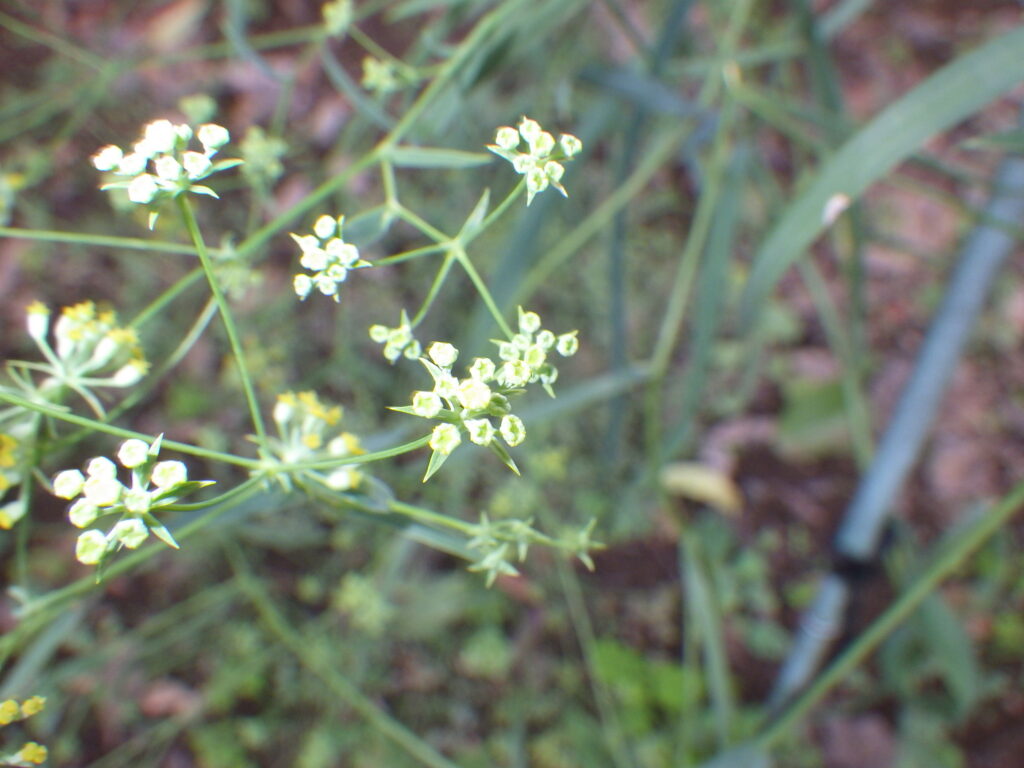
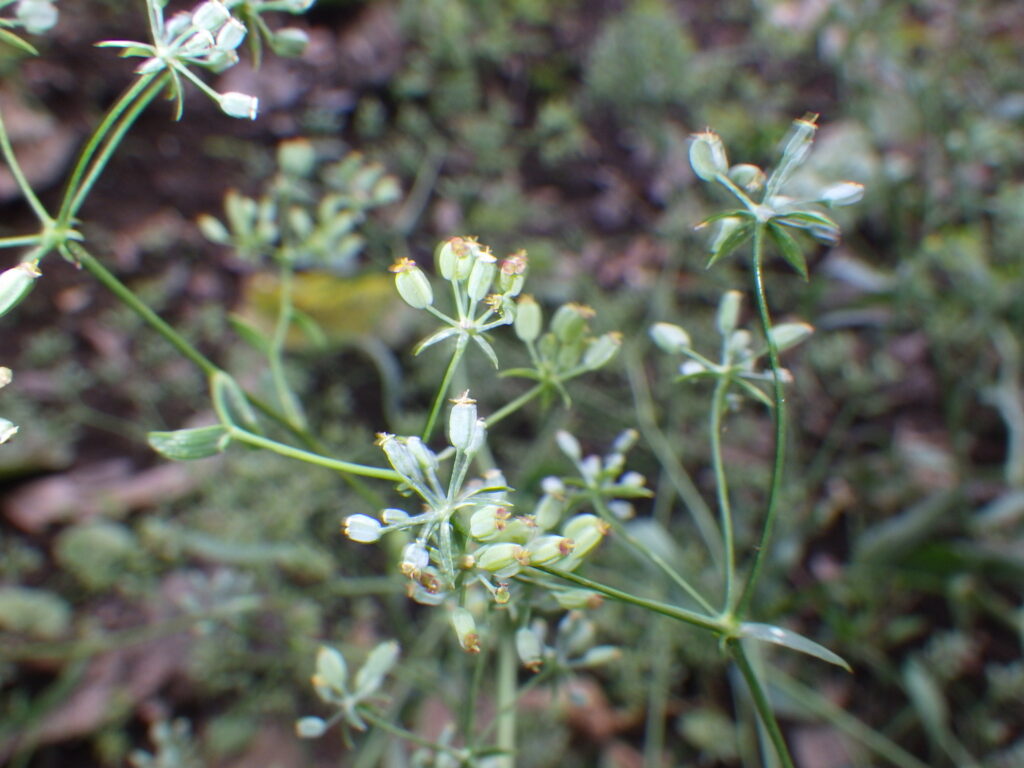
Both flowers initially have yellow stamens and petals, which then fall off, leaving the pistil. A glossy, nectar-secreting structure common to the Apiaceae family, called the "columnar base" or "columnar base" (Shimizu, 2001), develops as part of the pistil. My photos show the later stage.
This process, where the stamens appear first and then the pistils appear, is called "protandry," and it is observed in some species of the Apiaceae family, preventing self-pollination (Watanabe, 1999).
Based on research into closely related species, it's highly likely that flies are attracted to these flowers.
What kinds of insects visit these flowers?
Unfortunately, I couldn't find any research on these species in Japan, but there are some studies on Bupleurum bicaule, a member of the Bupleurum genus. Bupleurum bicaule is a perennial herb distributed in Afghanistan, South Korea, China, Mongolia, and Russia, growing on forest edges, gravel or sunny mountain slopes, and dry, stony grasslands.
A study conducted in the Mongolian steppes recorded that a species of parasitic fly , Deopalpus sp., was visiting flowers (Song, 2015).
Furthermore, studies conducted on the Mongolian steppes have shown that a species of hoverfly and a species of bee hoverfly visited the area (Yoshihara et al., 2008).
These records suggest that the nectar is coming from very shallow parts of the flower, so it's possible that flies with short mouths are the main visitors. Also, flies are thought to prefer yellow flowers.
In fact, using Google Image Search, I found two images showing a species of hoverfly visiting a Bupleurum falcatum plant.
These characteristics may not be unique to the Bupleurum genus, but could be widely observed in other members of the Apiaceae family that have yellow flowers. Therefore, there may not be any special ecological features unique to the Bupleurum genus.
However, as an endangered species, it will be necessary to properly investigate its relationship with pollinating insects in Japan.
Are the fruits schizocarps and the seeds dispersed by gravity?
The fruit is a schizocarp, a common feature in the genus Bupleurum. A schizocarp is a type of dehiscent fruit, consisting of multiple carpels. When mature, the number of schizocarps corresponds to the number of carpels, and the fruit splits open, separating from the central axis. This type of fruit is widely found in the Apiaceae family.
The fruitlets of Bupleurum falcatum are oval-shaped, brown, and about 3 mm long.
The fruitlets of Bupleurum falcatum are oblong, measuring 3.5 to 4 mm in length.
It is likely that it is dispersed by gravity, but I could not find any detailed research on this.
References
Kaneko, M., Tsukakoshi, S., Fujise, A., & Ikegami, F. 2013. Effects of nutrient solution concentration on the growth, saikosaponin concentration, and inorganic component concentration of Bupleurum falcatum L. in rockwool cultivation. Plant Environmental Engineering 25(2): 83-89. https://doi.org/10.2525/shita.25.83
Kyoto Prefectural Government, Department of Environment, Natural Environment Conservation Division. 2015. Kyoto Prefecture Red Data Book 2015 (Volume 2: Wild Plants and Fungi). Kyoto Prefectural Government, Department of Environment, Natural Environment Conservation Division, Kyoto. 611pp. https://www.pref.kyoto.jp/kankyo/rdb/index.html
Nam, Ki-tai. 1995. Developmental physiology of Bupleurum falcatum, a commonly used herbal medicine. Root Research 4(2): 52-55. ISSN: 0919-2182, https://doi.org/10.3117/rootres.4.52
Sasahara, Toshiya; Ito, Yasuyuki; and Katano, Manabu. 1992. Studies on the cultivation of Bupleurum falcatum (4): Root morphology and saikosaponin content. Bulletin of the Faculty of Agriculture, Kyushu Tokai University 11: 61-66. https://agriknowledge.affrc.go.jp/RN/2010471152
Shimizu, Takemi. 2001. Illustrated Dictionary of Botanical Terms. Yasaka Shobo, Tokyo. xii, 323pp. ISBN: 9784896944792
Song, DS 2015. Spatial and temporal variation in wild pollination service in the Mongolian steppe [Doctoral dissertation, University of Pennsylvania]. https://repository.upenn.edu/handle/20.500.14332/27924
Watanabe, Osamu. 1999. Illustrated Key to Major Apiaceae Plants in Hokkaido, Part 1: Large Species - Plants Identified by Leaves 2. Shiretoko Museum Research Report 20: 15-32. ISSN: 0387-8716, https://shiretoko-museum.jpn.org/media/shuppan/kempo/sm20_02.pdf
Wildlife Survey Association / Envision Environmental Conservation Office. January 15, 2023. Japan Red Data Search System. http://jpnrdb.com/
Yoshihara, Y., Chimeddorj, B., Buuveibaatar, B., Lhagvasuren, B., & Takatsuki, S. 2008. Effects of livestock grazing on pollination on a steppe in eastern Mongolia. Biological Conservation 141(9): 2376-2386. ISSN: 0006-3207, https://doi.org/10.1016/j.biocon.2008.07.004
Source
This article is a significantly expanded version of a piece originally published in the following book.