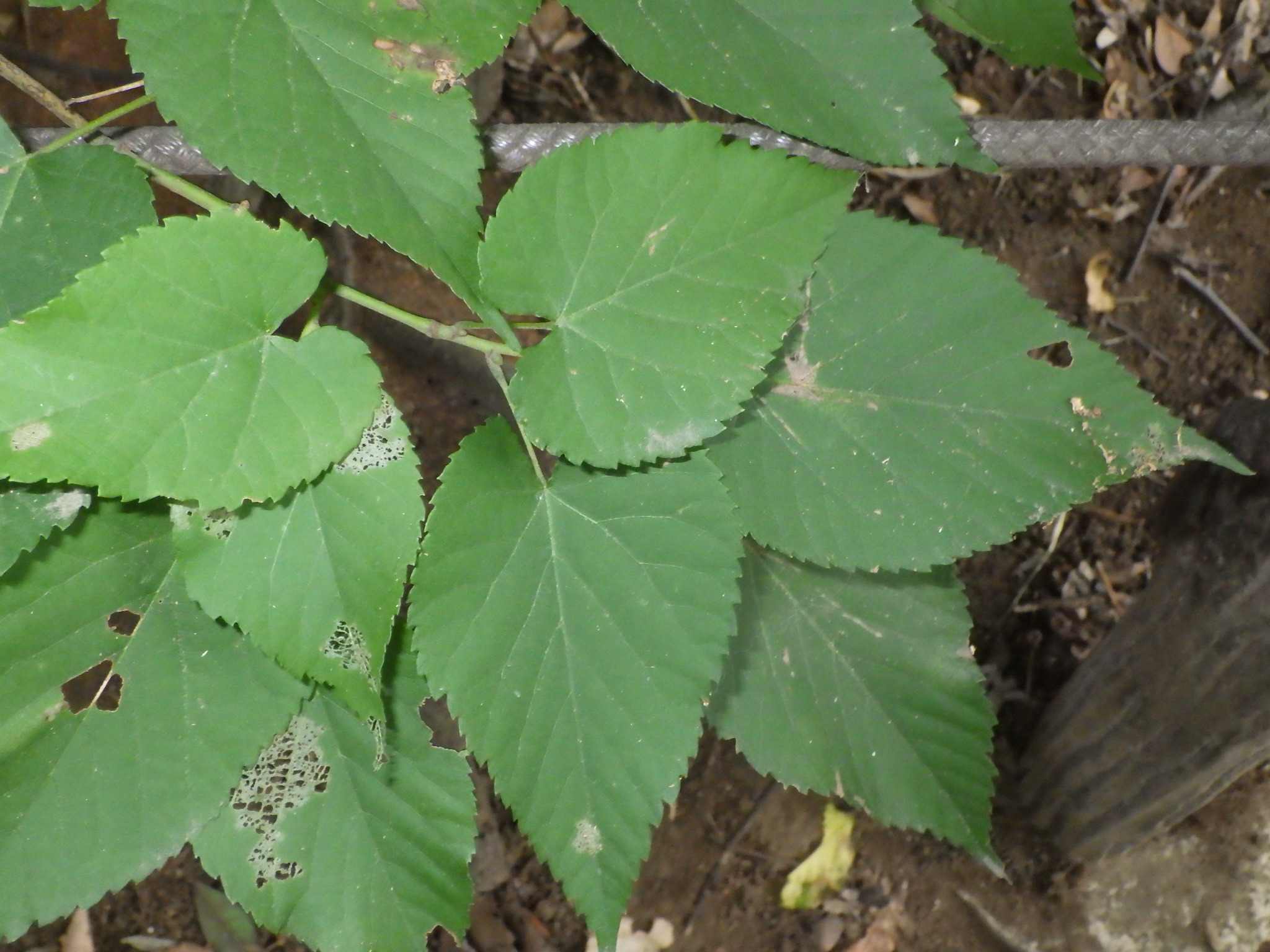
Rosemary (Rosemary vernalis) and Westringia (Australian rosemary) both belong to the mint family and have similar names. In Japan, they are commonly planted as ornamental plants, and their leaves and flowers look quite similar at first glance . However, rosemary is native to Europe and North Africa, while Australian rosemary is native to Australia. More importantly, upon closer observation, you will find that the shape of the flowers and leaves, and how the leaves are attached, are all different. The difference in scent is also significant. Rosemary has been used for medicinal and culinary purposes since ancient times, while Australian rosemary is cultivated solely for ornamental purposes. It is completely different from lavender in both appearance and scent. The flowers are labiate, with the stamens and pistils being longer in rosemary and shorter in Australian rosemary. Both are visited by bees, but the species may be slightly different. The fruit is a schizocarp, with each small nutlet being dispersed by gravity like a seed. However, in rosemary, the seeds are dispersed by ants, while it is known to release a jelly-like substance that repels ants, resulting in a seemingly contradictory ecological behavior for a certain reason. This article will explain the classification, morphology, pollination ecology, and seed dispersal of rosemary and Australian rosemary.
- What is rosemary or Australian rosemary?
- What is the difference between rosemary and Australian rosemary?
- What is the difference between rosemary and lavender?
- What are the differences in how rosemary and Australian rosemary are used?
- What is the structure of a flower?
- How is pollination carried out? Do differences in flower shape affect pollination methods?
- What is the structure of the fruit?
- How do they disperse their seeds? Ants were both allies and enemies!?
- References
What is rosemary or Australian rosemary?
Salvia rosmarinus, also known as rosemary, is an evergreen shrub native to Europe and North Africa along the Mediterranean Sea. It is cultivated worldwide, including in Japan, for ornamental, medicinal, and culinary purposes. The Japanese name "mannenrou" originates from Chinese. Rosmarinus officinalis is the old scientific name and is now considered a synonym (Drew et al., 2017).
Australian rosemary, also known as Westringia fruticosa, is an evergreen shrub native to eastern Australia, growing on coastlines and harbor foreshores, often on exposed cliffs of rocky soil (Harden, 1993). It is cultivated as an ornamental plant worldwide, including in Japan.
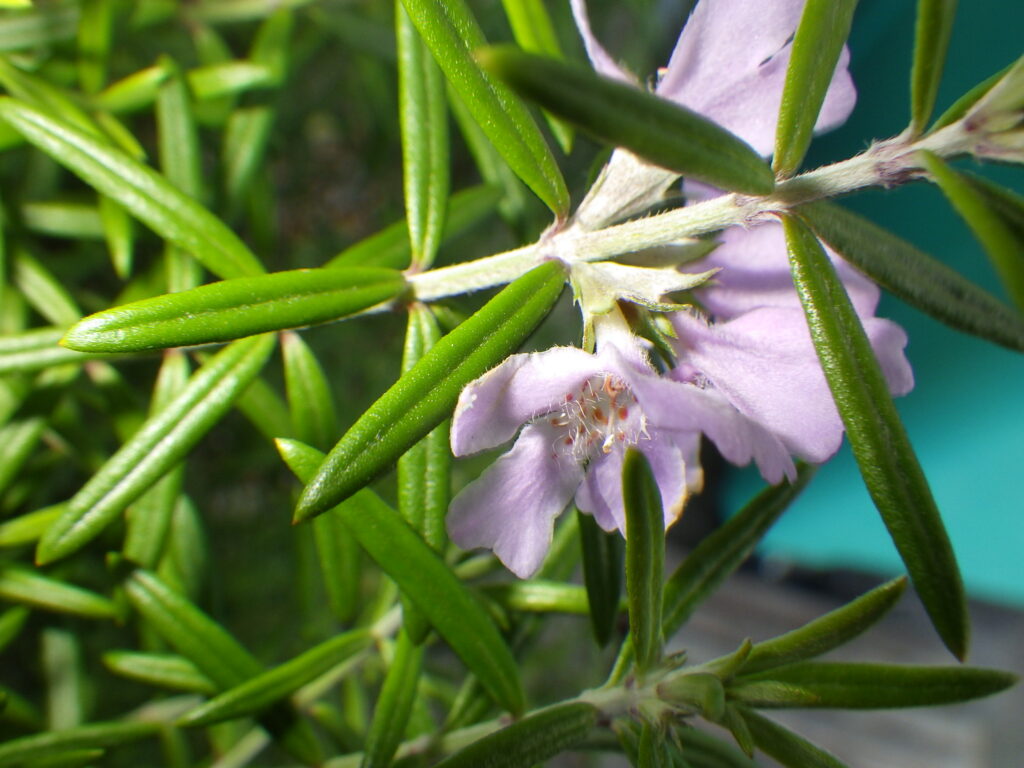
Both belong to the mint family, have similar names, and are commonly planted in Japan for ornamental purposes. Their leaves and flowers also look quite similar at first glance. The fact that their leaf margins curl back is exactly the same. Therefore, some people may have trouble distinguishing them.
What is the difference between rosemary and Australian rosemary?
These two types are very similar, but they differ in several ways (Harden, 1993; Wu & Raven, 1994).
First, as mentioned above, rosemary is native to the Mediterranean region, while Australian rosemary, as its name suggests, is native to Australia. Therefore, it can be predicted that they have different evolutionary origins.
Furthermore, there is a significant difference in classification, as rosemary belongs to the Salvia genus, while Australian rosemary belongs to the Westringia genus.
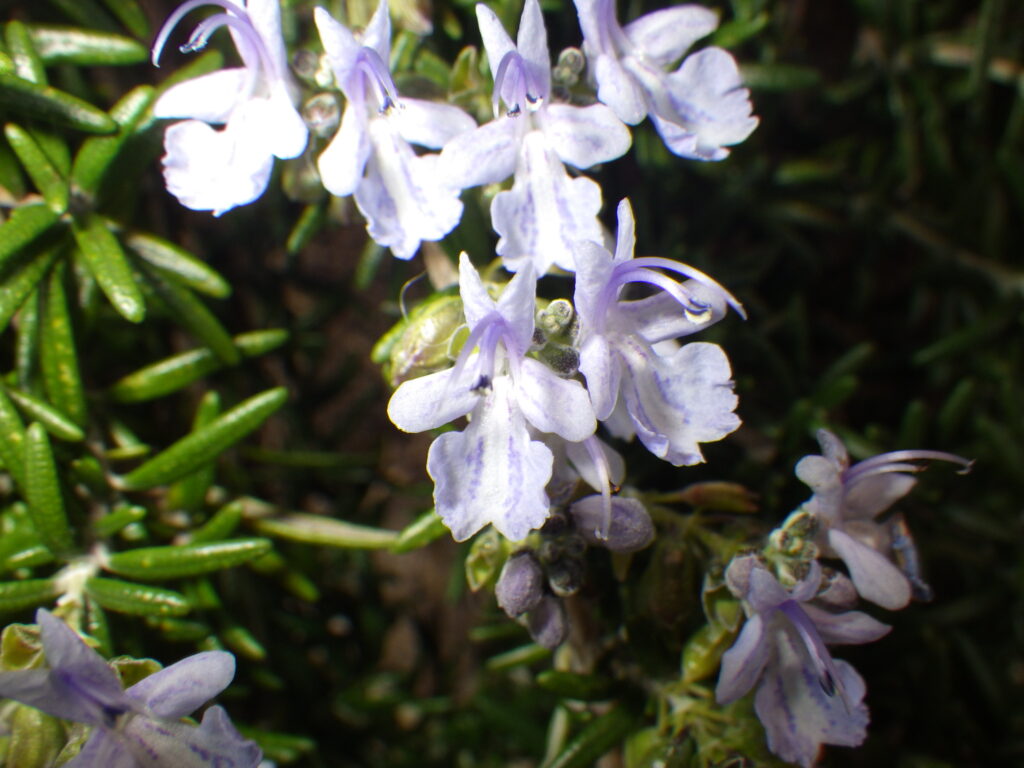
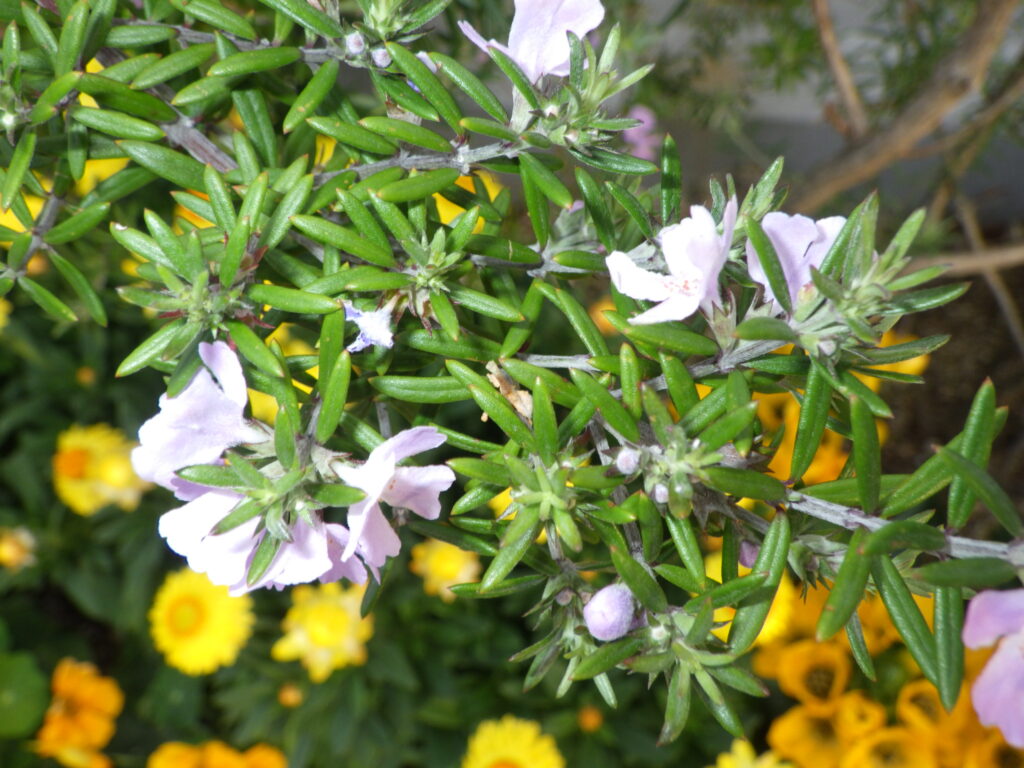
The flowers are probably the easiest to spot. In rosemary, the stamens are very long and clearly protrude from the corolla, curling inward, whereas in Australian rosemary, the stamens are considerably shorter and do not protrude from the corolla.
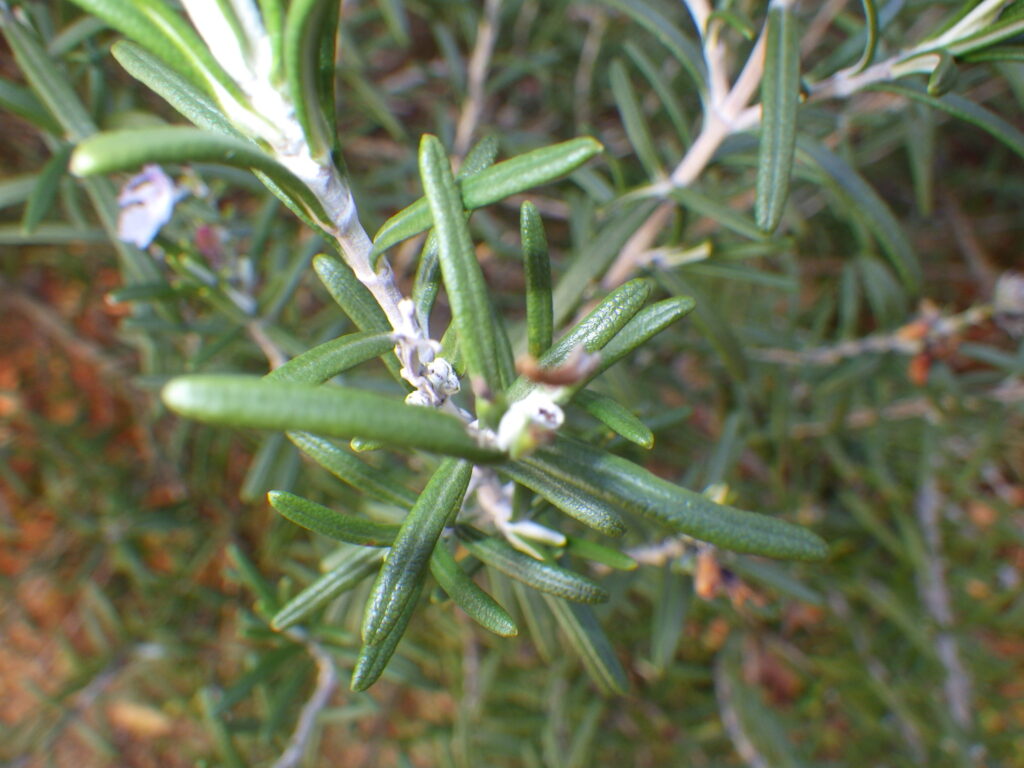
There are also differences in the leaves. Both have slender leaves with edges that curl towards the underside, but rosemary has rounded leaf tips, while Australian rosemary has pointed leaf tips.
While rosemary leaves are arranged oppositely (in whorls of two), Australian rosemary leaves are typically arranged in whorls of four. In other words, rosemary leaves only grow two per stem, while Australian rosemary leaves can grow up to four.
One distinguishing feature is that while rosemary leaves release a pleasant fragrance when rubbed, Australian rosemary does not. This is a simple way to tell them apart, even without knowledge of plant morphology, but please use common sense when verifying this.
What is the difference between rosemary and lavender?
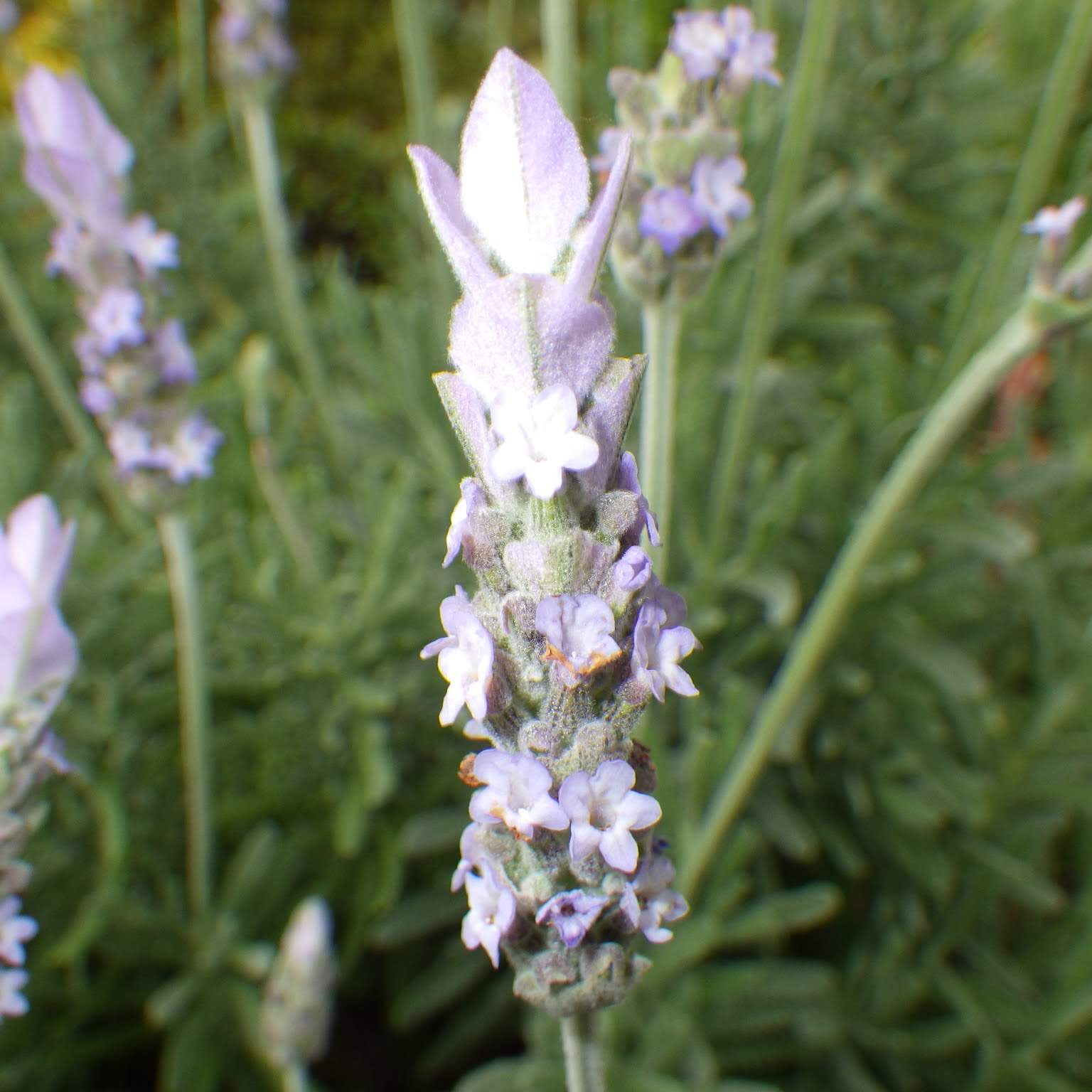
Lavender is also a plant belonging to the mint family, native to the Mediterranean region. Perhaps because of its purple flowers and herbaceous nature, the difference between rosemary and lavender is a frequently searched topic on the internet.
However, lavender is completely different from rosemary.
Lavender leaves, like rosemary leaves, are thin, but they are noticeably larger and longer, and they don't curl towards the underside.
As will be discussed later, rosemary produces small inflorescences but does not form independent flower spikes, whereas lavender varieties do form flower spikes, with the flowers clustered together.
In terms of scent, lavender has a sweet fragrance due to its main components being linalyl acetate and linalool, while rosemary has a refreshing scent due to its main component being camphor.
For more information about lavender, please see our other article.
What are the differences in how rosemary and Australian rosemary are used?
The use of rosemary has a very long history, with records of its use appearing as early as 5000 BC on clay tablets written in cuneiform by the Sumerians, who formed the Mesopotamian civilization (Ambrose et al., 2016). The ancient Egyptians also used rosemary for embalming corpses from 3500 BC. Over the centuries, it spread to Europe, China, and America, and is now used all over the world.
As in ancient times, rosemary is sometimes used medicinally in folk medicine, but its most common use is as a culinary herb. Rosemary leaves have a crisp, sweet, and refreshing aroma and are primarily used to mask the odor of meat dishes, as well as as a flavoring for foods such as stuffings and roasts of lamb, pork, chicken, and turkey.
It is also well-known as an essential oil, characterized by a refreshing, cool scent from camphor and a sweet scent from borneol, and is said to relieve mental fatigue (Aromatherapy Certification Exam Preparation Study Group, 2020).
They are popular as ornamental plants, and perhaps because they are hardy, drought-tolerant, and cold-tolerant, they seem to be found in almost every town in Japan.
On the other hand, Australian rosemary has a relatively short history in terms of its uses; it is not commonly used as a herb and is only cultivated for ornamental purposes.
What is the structure of a flower?
Like many other plants in the mint family, it has a basic structure with "lipped flowers." Lipped flowers are fused petals with a tubular corolla that is divided into two parts, an upper lip and a lower lip, at the end, resembling lips. Rosemary and Australian rosemary have their upper lip further divided into two lobes and their lower lip into three lobes.
Rosemary has a very long flowering period in Japan, from February to October. The calyx is about 4 mm long and has dense white stellate to fine downy hairs and white glandular dots on its outer surface (Wu & Raven, 1994). The corolla is two-lipped, bluish-purple, 1-1.5 cm long, and has sparse short hairs and glandular dots on its outer surface. The upper lip is nearly orbicular, 2-lobed, with ovate lobes (some appear narrower due to outward curling). The central lobe of the lower lip is nearly orbicular, about 10 mm wide, with an ovate-triangular toothed tip that narrows at the base, becoming claw-like. The lateral lobes are oblong. The corolla tube is about half the length of the corolla and slightly protrudes from the calyx. There are two stamens attached to the base of the upper lip, curving upward from the corolla. The filaments are about 10 mm long and the pollen is white. There is one pistil, which ends slightly shorter than the stamens.
Australian rosemary blooms in Japan from April to October. The sepals are 2.9–3.5 mm long, and the corolla is 10–14 mm long. The wild species is white with purple or brown punctations, while cultivated varieties can be pink (Harden, 1993). It has two stamens, two staminodes, and one pistil, which is less than half the length of the corolla lobes.
How is pollination carried out? Do differences in flower shape affect pollination methods?
What kinds of insects are attracted to the distinctive curled stamens and pistils of rosemary?
According to research in southern Spain, a diverse range of bees, including small Apidae, medium-sized Apidae, Apidae, and Bombus species, visit and contribute to pollination (Herrera, 2005).
In addition, there are records of a species of ancient bee, Hylaeus nobuyukii, being found in Japan (Tadauchi and Murao, 2014).
However, among these, the European honeybee (Apis mellifera) is considered particularly important because its distribution area overlaps considerably with other species. It is well known that European honeybees visit Japan (Sasaki, 2010), and I myself have observed them many times.
When a bee inserts its tongue into a flower in search of nectar, the anthers of the stamens and the stigma of the pistil come into contact with the bee's back, causing pollen to adhere to it or to the bee's back, thus facilitating pollination.
On the other hand, Australian rosemary does not have curls on its stamens and pistils.
While research on Australian rosemary appears to be lacking, there are records of leafcutter bees visiting it in Australia (Pauli et al., 2020), as well as Amegilla cingulata, a species of bee native to Australia that prefers blue flowers (Dollin, 2020).
Additionally, a blog from North America shows a photograph of a bumblebee species, Bombus melanopygus, visiting a flower (Garvey, 2017).
In the related but different species Westringia rubiaefolia, there is only one recorded instance of a bee visiting the plant (Hingston & Mc Quillan, 2000).
The exact pollination method of Australian rosemary is unknown, but it is reasonable to assume that pollination occurs when bees come into contact with the short stamens and pistils at their feet.
Both are visited by bees, so there doesn't seem to be much difference between them, but why is there a difference in the presence or absence of curls?
The exact reason is unclear because their natural distribution areas are so different, but I think rosemary might be selecting bees as pollinators whose bodies fit more snugly to the curls of its stamens and pistils.
In the Iberian Peninsula, rosemary flowers are known to vary in size with altitude, becoming larger at higher elevations (Herrera, 2005). One possible reason for this is the increased prevalence of larger, thermoregulatory bees, such as bumblebees, at higher altitudes.
In other words, rosemary may be a specialist at the individual level, targeting only certain bees that can efficiently pollinate at that location, while Australian rosemary may be a generalist, targeting a wide range of bees.
Although research is still insufficient, comparing these closely related species may help us understand the reasons behind their respective evolutionary paths.
What is the structure of the fruit?
Both rosemary and Australian rosemary have schizocarps, which are fruits composed of four nutlets (Wu & Raven, 1994; Western Australian Herbarium, 2023). A schizocarp is a fruit that originates from a single pistil with multiple chambers, which divides vertically into several units. Each nutlet contains only one seed. Some people might call these small nutlets "seeds," but strictly speaking, they are fruits.
Rosemary nuts are ovoid-spherical, smooth, and contain elaiosomes.
Australian rosemary nutlets are 1-2 mm in size.
How do they disperse their seeds? Ants were both allies and enemies!?
Both rosemary and Australian rosemary are dispersed by gravity, and since Australian rosemary is particularly small, wind dispersal may also be used.
However, rosemary is the only species whose seeds are dispersed by ants because its nutlets contain elaosomes (Engelbrecht & García-Fayos, 2012).
However, rosemary does more than just that; interestingly, when it absorbs moisture, its nutlets become covered in a jelly-like substance. Imagine tomato seeds, for example. Why does it produce this substance?
The reason for this is thought to be that it serves to prevent ants from eating the plant. This may seem to contradict what was said earlier, but rosemary only provides ants with ellaosomes as food, and the main part of the plant that produces the sprout after the ellaosomes have been removed cannot be eaten. Also, ants can come directly to the plant before the nuts mature and carry away the entire immature nut.
Therefore, by absorbing moisture from rainfall, or from strong morning dew or fog in the summer, they prevent the food from sticking to the ground or being carried away by ants by making it difficult for the ants to grasp it with their mandibles.
You probably won't have many opportunities to observe this kind of natural behavior in Japan, but if you're growing them from seed, be sure to take some time to observe it.
References
Ambrose, DCP, Manickavasagan, A., & Naik, R. 2016. Leafy Medicinal Herbs: Botany, Chemistry, Postharvest Technology and Uses. CABI, Wallingford. 312pp. ISBN: 9781780645599
Aromatherapy Certification Exam Preparation Study Group. 2020. AROMA Textbook: Aromatherapy Certification Exam Level 1 & 2 Passing Text & Practice Questions (3rd Edition). Shoei-sha, 288pp. ISBN: 9784798162959
Dollin, A. 2020. Blue Banded Bees. Aussie Bee Online 27: 1-6. ISSN: 1329-0231, https://www.aussiebee.com.au/aussiebeeonline027.pdf
Drew, BT, González-Gallegos, JG, Xiang, CL, Kriebel, R., Drummond, CP, Walked, JB, & Sytsma, KJ 2017. Salvia united: The greatest good for the greatest number. Taxon 66(1): 133-145. https://doi.org/10.12705/661.7
Engelbrecht, M., & García-Fayos, P. 2012. Mucilage secretion by seeds doubles the chance to escape removal by ants. Plant Ecology 213(7): 1167-1175. https://doi.org/10.1007/s11258-012-0074-9
Garvey KK, 2017, March 6. The Wonders of a Bumble Bee on Westringia. Bug Squad. https://ucanr.edu/blog/bug-squad/article/wonders-bumble-bee-westringia
Harden, GJ 1993. Flora of New South Wales (Vol. 3). UNSW Press, Randwick. 717pp. ISBN: 9780868401720, https://plantnet.rbgsyd.nsw.gov.au/cgi-bin/NSWfl.pl?page=nswfl&lvl=sp&name=Westringia~fruticosa
Herrera, J. 2005. Flower size variation in Rosmarinus officinalis: individuals, populations and habitats. Annals of Botany 95(3): 431-437. https://doi.org/10.1093/aob/mci041
Hingston, AB, & Mc Quillan, PB 2000. Are pollination syndromes useful predictors of floral visitors in Tasmania?. Austral Ecology 25(6): 600-609. https://doi.org/10.1111/j.1442-9993.2000.tb00065.x
Pauli, N., Mouat, C., Prendergast, K., Chalmer, L., Ramalho, CE, & Ligtermoet, E. 2020. The social and ecological values of native gardens along streets: A socio-ecological study in the suburbs of Perth. Clean Air and Urban Landscapes Hub (CAUL), Melbourne. 83pp. https://research-repository.uwa.edu.au/en/publications/the-social-and-ecological-values-of-native-gardens-along-streets-/
Sasaki, Masami. 2010. The World of Flowers as Seen by Bees: Nectar-Producing Plants of the Four Seasons and Gifts from Honeybees. Kaiyusha, Tokyo. 413pp. ISBN: 9784905930273
Osamu Tadauchi and Tatsuki Murao. 2014. Illustrated Guide to Japanese Bees. Bun-ichi Sogo Shuppan, Tokyo. 479pp. ISBN: 9784829988428
Wu, ZY, & Raven, PH (Eds.). 1994. Flora of China (Vol. 17 Verbenaceae through Solanaceae). Science Press, Beijing, and Missouri Botanical Garden Press, St. Louis. 342pp. ISBN: 9780915279241
Western Australian Herbarium. 2023. Florabase: the Western Australian Flora. Department of Biodiversity, Conservation and Attractions. https://florabase.dpaw.wa.gov.au/