While winged beans are not very familiar to Japanese people, they are widely cultivated in equatorial countries with high temperatures and humidity, and can also be found in Okinawa and the Ogasawara Islands. Similar species are found only in Africa, and there are basically no species in Japan that are confused with winged beans. Primarily used as food, it is a versatile plant that is rich in nutrients and can be eaten all over. Its toxicity is currently unknown. There is no consensus on the origin of winged beans, with both Asian and African theories being equally debated. Despite its conspicuous blue flowers, winged beans generally produce fruit without problems through self-pollination. However, there have been several instances where bees have been observed visiting the flowers, suggesting that at least a minimal exchange of genes is occurring. This article will explain the classification, distribution, history, pollination ecology, and seed dispersal of winged beans.
- What is a winged bean?
- Are there any species similar to the winged bean?
- Why are winged beans so amazing?: A savior of tropical regions, with its entire body edible and rich in nutrients.
- Strange distribution: Did the winged bean originate in Africa or Asia?
- What are the uses of winged beans?
- Pinged bean flowers can self-pollinate, but bees may also visit them...?
- Why do the winged bean pods (fruits) protrude in four directions?
- References
- Source
What is a winged bean?
Psophocarpus tetragonolobus, also known as the winged bean, is believed to originate in Asia or Africa, although there are various theories. It is a climbing perennial herb widely cultivated in the hot and humid equatorial countries of South Asia (India, Bangladesh, Sri Lanka), Southeast Asia (Indonesia, Malaysia, Thailand, the Philippines, Myanmar), and Africa (Lepcha et al., 2017). However, it sometimes functions as an annual in cultivation as it dies back in winter. It belongs to the legume family. Wild specimens have not been found.
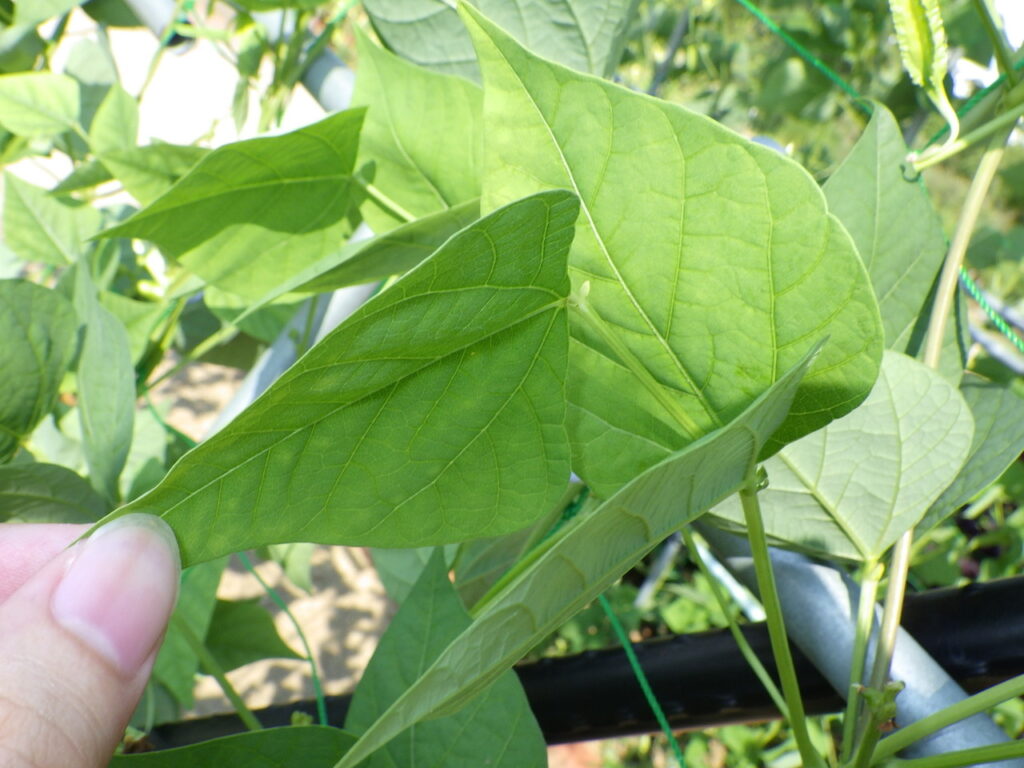
The leaves are trifoliate compound leaves, and the leaf blade is broadly rhomboid.
Although it is not very well known in Japan, it is cultivated for food in Okinawa and the Ogasawara Islands (Kito et al., 2016), and in Okinawa it is also called "urizun bean."
Around the world, it is mainly cultivated along the boundaries of rice paddies, hedges, or fences.
Are there any species similar to the winged bean?
The genus Pterocarya includes 10 known species, including the winged bean, but the remaining 9 species are distributed only in Africa and are rarely seen in Japan.
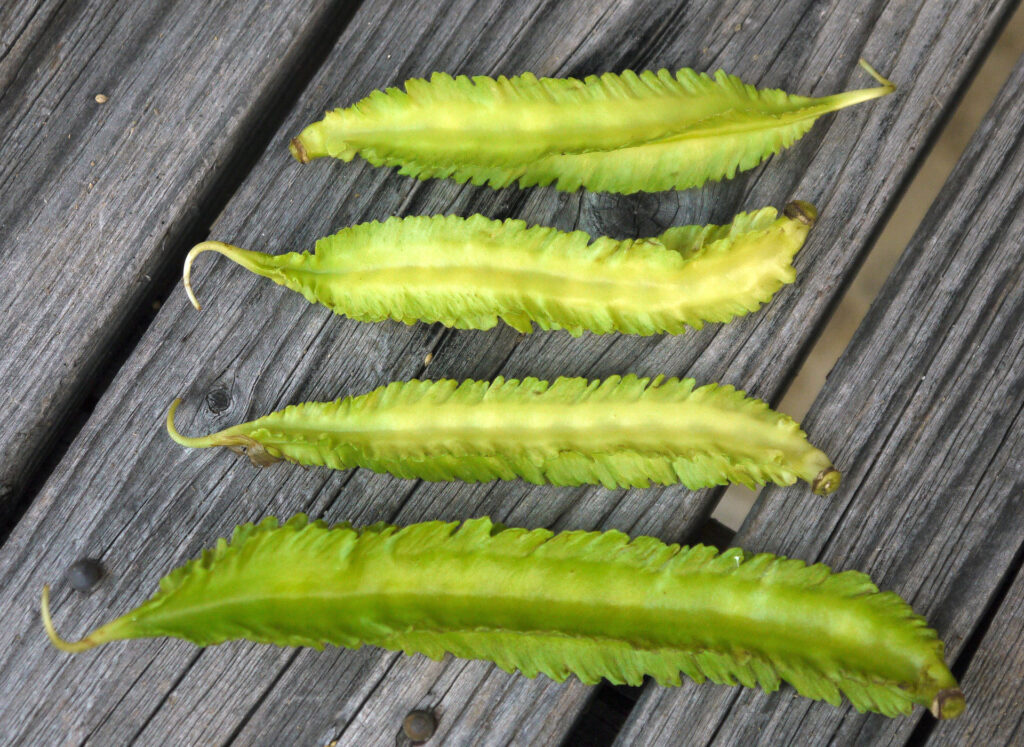
Even when considering other legumes, its blue flowers and the four prominent ridges (flat parts) on its fruit are quite unique, and it's safe to say that it's unlikely to be confused with any other common legume species.
Why are winged beans so amazing?: A savior of tropical regions, with its entire body edible and rich in nutrients.
Because it can be cultivated in tropical regions around the world where soybean cultivation is difficult, it plays an important economic and ecological role.
The leaves, flowers, roots, and bean pods can be eaten raw, and the beans can also be cooked. Because it is rich in nutrients such as amino acids, vitamin A, vitamin C, calcium, and iron, it is attracting attention as a multi-purpose food crop (Lepcha et al., 2017). Some varieties also produce underground tubers, which are also edible.
Regarding the taste of the pods, a cooking website describes them as follows: "They have a slight bitterness, but it's not overpowering, and they have a refreshing taste. The texture is crisp, and you can enjoy the crunchiness." (Every Co., Ltd., 2022).
Because it belongs to the legume family, it lives in symbiosis with nitrogen-fixing bacteria, fixing nitrogen from the air within its body. Therefore, it can grow even in fertile soil, and the beans are rich in protein, comparable to soybeans.
Because of its versatility, it's sometimes called a "one-species supermarket" or a "supermarket on a stalk" overseas. While these analogies might be a little hard for Japanese people to understand, they likely mean that winged beans are so versatile that you could open a supermarket with just one type of bean.
For these reasons, its toxicity is currently unknown.
Strange distribution: Did the winged bean originate in Africa or Asia?
Winged beans are cultivated in geographically distant regions such as Africa and Asia. Why do they have such a peculiar distribution? Where did winged beans originally grow in the wild? Until recently, there were various theories about this.
The first theory is that it originated in India and Malaysia. This theory is based on a long history of cultivation in the Assam region of eastern India.
The second theory is of Asian origin, which speculates that the winged bean was domesticated from an ancestor of the now-extinct genus Psophocarpus. Currently, there are no plants of the genus Psophocarpus in Asia other than the winged bean.
The third theory is that it originated in Papua New Guinea, based on the large genetic mutations observed there.
The fourth theory is that it originated in Africa, based on the observation that the morphology of Psophocarpus grandiflorus, a plant of the same genus found in Africa, is very similar to that of the winged bean. In addition, nine species of the same genus Psophocarpus are distributed only in Africa.
The conclusion reached in 2017 was that the fourth theory, the African origin theory, was the most likely, supported by cytological and plant pathological evidence (Lepcha et al., 2017).
Subsequently, in 2018, a study (molecular phylogenetic analysis) was published that examined the similarity of specific genes between the winged bean and the African genus Psophocarpus. If the results indicate that the winged bean and a specific species of the African genus Psophocarpus diverged, it would prove that the winged bean evolved in Africa.
However, the results were ambiguous, as they indicated that "the ancestors of the winged bean and all other African Psophocarpus species diverged first" (Yang et al., 2018). This could be interpreted as the winged bean evolving from the African Psophocarpus ancestors, or it could be interpreted as the Asian Psophocarpus ancestors, which diverged from Africa long ago and became extinct, further evolving into the winged bean.
Based on these considerations, the 2019 study maintained a neutral stance, stating that its place of origin could not be definitively determined as either Asia or Africa (Tanzi et al., 2019 ) .
While many sources on the internet definitively state that it originates from Asia, it's important to keep in mind that there's also a high possibility that it originates from Africa.
If winged beans originated in Africa, how did they spread to Asia?
There are two theories regarding this (Lepcha et al., 2017). One theory is that the ancestor of the winged bean originated on the African side of the Indian Ocean, was carried east as a wild plant, and then changed through human cultivation.
Another theory suggests that winged beans originally had a wider geographical distribution, and that domestication first began in central India or on the islands of Southeast Asia or Melanesia. The long history of cultivation in Asia supports this theory.
There are a wide variety of theories, and it's unclear which one is correct, but such discontinuous distributions are rare, mysterious, and intriguing.
What are the uses of winged beans?
Although winged beans have recently begun to attract attention, for centuries they were known as a minor food among various ethnic groups in Asia and Africa.
However, the ways in which it is used vary greatly from region to region.
In India, immature pods are eaten raw as a vegetable or pickled, immature seeds are used in soups and curries, mature seeds are roasted and eaten like peanuts, and the flowers are eaten or used to garnish dishes.
In Ghana, Burma, and Papua New Guinea, tubers are used and cooked in a variety of dishes.
In Indonesia, it is used as an ingredient in tempeh keshipi (a fermented food made from soybeans and other ingredients fermented with tempeh starter; in this case, winged beans), a traditional savory snack, and in Thailand, it is used in the preparation of snacks.
In Malaysia, the roots have been used as a poultice to treat dizziness, and the leaves have been used to treat smallpox.
In New Guinea, the pods and tubers are considered tonics, and extracts from the pods are used to treat boils and ulcers.
This versatility in uses is unique to the winged bean; it's almost as if you could open a supermarket with just this one species.
Pinged bean flowers can self-pollinate, but bees may also visit them...?
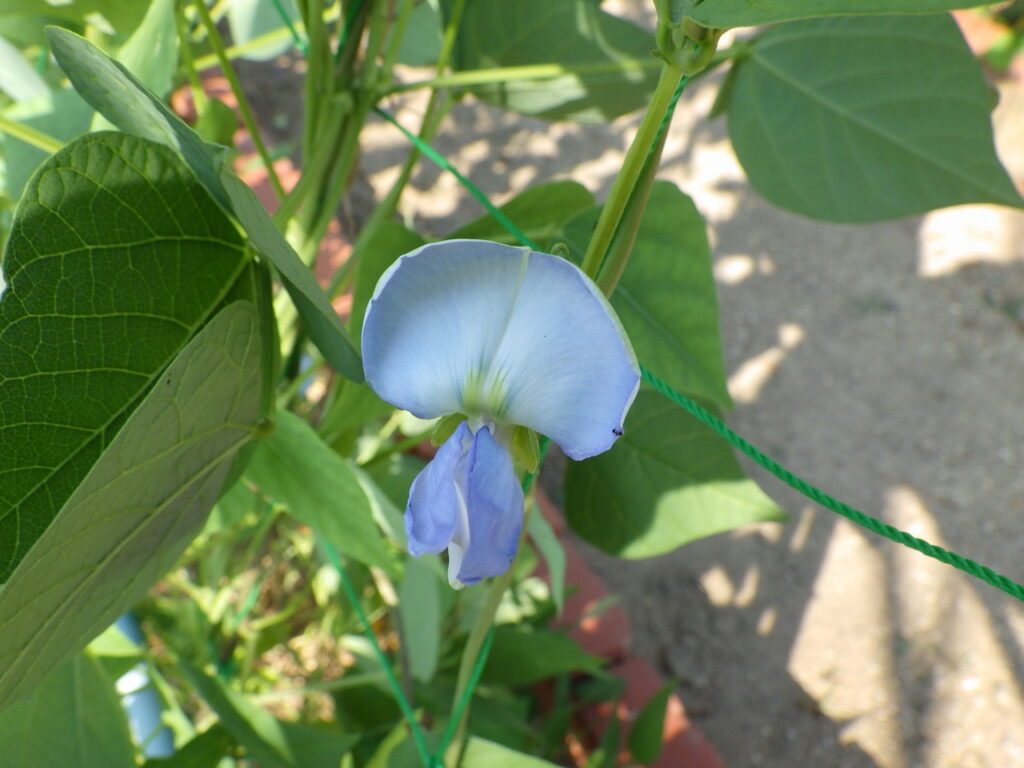
The flowers bloom in early August in Japan and have pale blue petals, which is somewhat unusual for the legume family (Lepcha et al., 2017). Their structure is the characteristic "butterfly flower" shape typical of the legume family.

The butterfly-shaped flower has a large, conspicuous "standard petal," and many leguminous species have a mark called a "nectar guide" at the base of the standard petal that indicates the location of nectar to insects; in the case of the winged bean, this mark is yellow. Protruding below the standard petal are the "wing petals" and the "keel petal (or keel petal)," with the two wing petals covering the two keel petals. The nectaries are hidden by these overlapping petals in the center.
These butterfly-shaped flowers are typically visited by bees, who pry open the central petals to collect nectar.
However, since winged beans can self-pollinate, they will basically produce fruit (pods) even if insects don't come. In that case, the flowers seem to have little purpose other than being used for human consumption.
However, although infrequently, some studies have reported that bumblebees and carpenter bees visit the flowers (Klu, 1996). Why do they do this when they can self-pollinate?
This suggests that by incorporating pollen from other individuals and performing "cross-pollination," the species incorporates a small amount of genes from other individuals, making it more resistant to environmental variations.
On the other hand, this essentially involves creating clones, which ensures stable pod production. This is very convenient for humans and is considered a rational pollination method for cultivated plants.
This is likely a characteristic acquired as a result of cultivation by humans, and conversely, it could be said that winged beans developed self-pollination in order to be eaten by humans.
It's interesting to wonder whether the blue color has any effect on the insects that visit it, but unfortunately, it seems this hasn't been studied yet.
Why do the winged bean pods (fruits) protrude in four directions?
The pods (fruits of legumes) are square in shape, measuring 6 to 30 cm or more, and have ridges (flat parts) running lengthwise. The fact that these ridges extend in four directions is the origin of the Japanese name "shikakumame" (square bean). When fully ripe, the pods turn grayish-brown, split open, and release the seeds (beans). The beans inside are mainly brown and black, with many having varying shades of brown.
The ecological role of these protruding ridges remains unclear from my research. They might serve a purpose such as dispersing pods by wind, but this requires further consideration, including related species found in Africa.
References
Every Co., Ltd. (July 20, 2022). What are winged beans (Urizun beans)? We introduce preparation methods and recipes. Delish Kitchen. https://delishkitchen.tv/articles/1196
Kito, M., Nakama, T., & Nagumo, F. (2016). Growth and phosphorus nutrition of winged bean in various soils of Okinawa. Bulletin of the Faculty of Agriculture, University of the Ryukyus, 63, 45-50. ISSN: 0370-4246, https://agriknowledge.affrc.go.jp/RN/2030911914
Klu, GYP (1996). Efforts to accelerate domestication of winged bean (Psophocarpus tetragonolobus (L.) DC.) by means of induced mutations and tissue culture [Doctoral dissertation, Wageningen University]. ISBN: 9789054856047, https://doi.org/10.18174/210524
Lepcha, P., Egan, AN, Doyle, JJ, & Sathyanarayana, N. (2017). A review on current status and future prospects of winged bean (Psophocarpus tetragonolobus) in tropical agriculture. Plant Foods for Human Nutrition, 72 (3), 225-235. ISSN: 0921-9668, https://doi.org/10.1007/s11130-017-0627-0
Tanzi, AS, Eagleton, GE, Ho, WK, Wong, QN, Mayes, S., & Massawe, F. (2019). Winged bean (Psophocarpus tetragonolobus (L.) DC.) for food and nutritional security: synthesis of past research and future directions. Planta, 250 (3), 911-931. ISSN: 0032-0935, https://doi.org/10.1007/s00425-019-03141-2
Yang, S., Grall, A., & Chapman, MA (2018). Origin and diversification of winged bean (Psophocarpus tetragonolobus (L.) DC.), a multipurpose underutilized legume. American Journal of Botany, 105 (5), 888-897. ISSN: 0002-9122, https://doi.org/10.1002/ajb2.1093
Source
This article is a significantly revised and expanded version of one included in the following book.