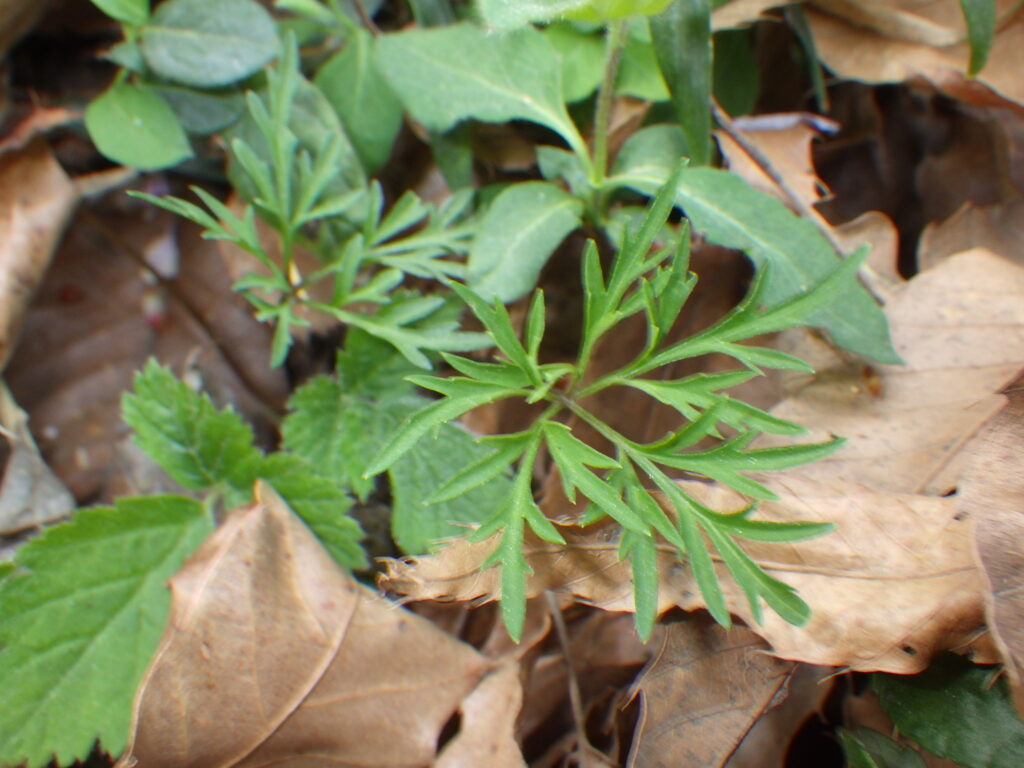
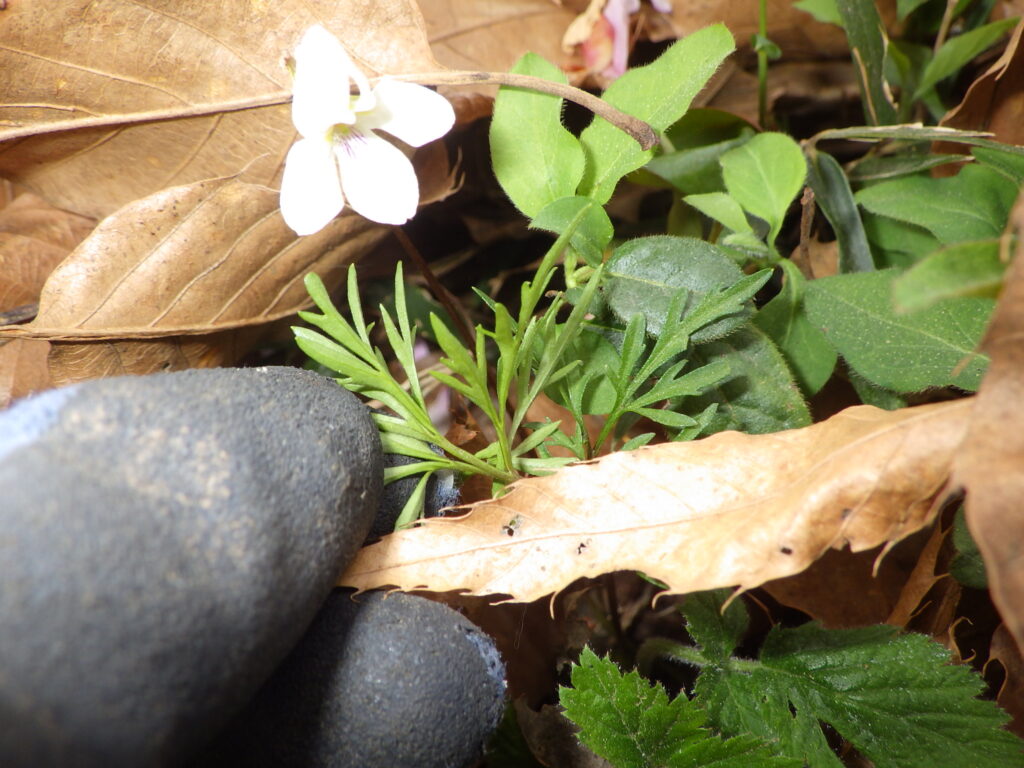
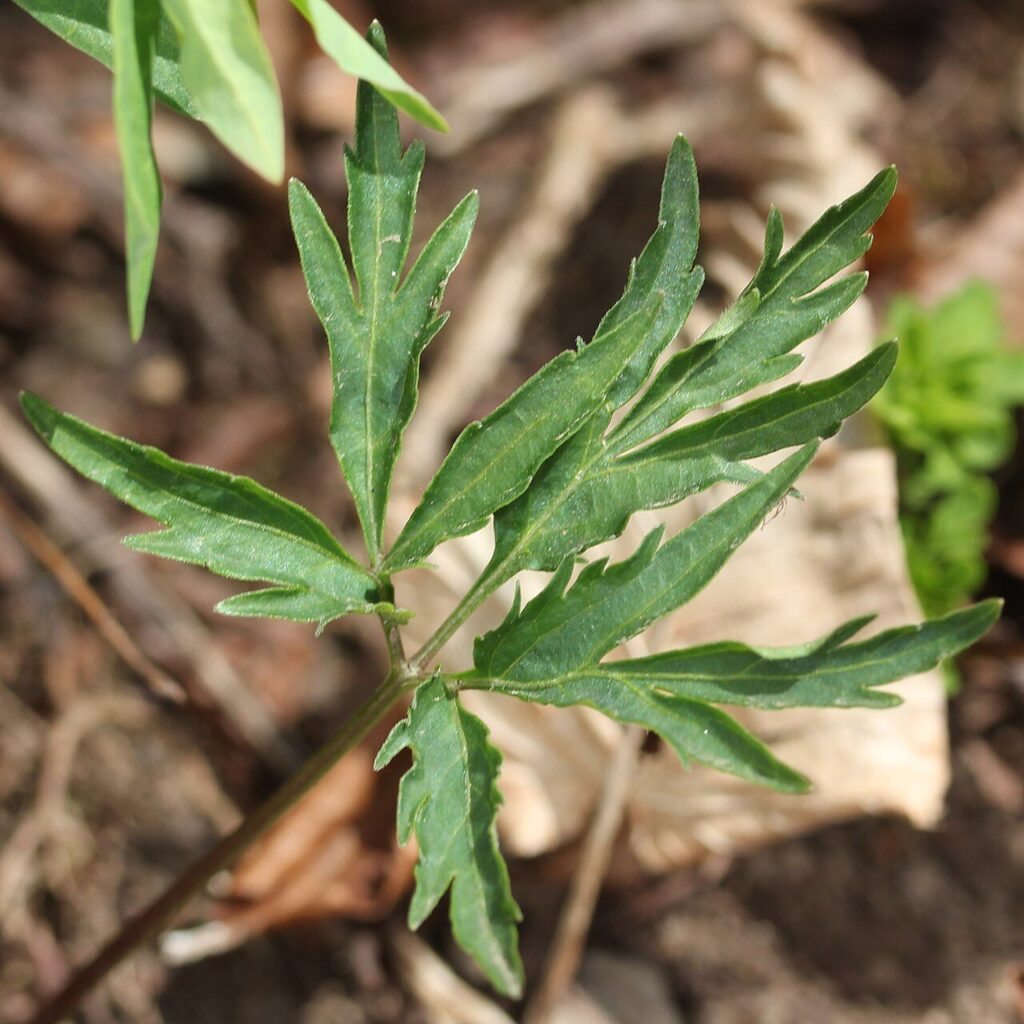
Viola eizanensis and Viola higoensis are members of the Viola genus that inhabit relatively natural areas. They are characterized by their finely divided leaves, which sets them apart from other Viola species, but their flower shapes are almost identical, making them somewhat difficult to distinguish. Morphologically, Viola higoensis has leaves divided into five lobes, while Viola eizanensis has leaves divided into three, allowing them to be distinguished. However, their habitats have also evolved in contrasting ways. Viola higoensis inhabits sunny grasslands in mountainous areas, while Viola eizanensis inhabits semi-shaded areas such as under forests in mountainous areas. This is thought to be habitat segregation, which has led to changes in their ecology. Viola higoensis, which lives in sunny areas, produces many open flowers, while Viola eizanensis, which lives in shaded areas, produces many closed flowers. There have also been changes in the insects that visit them. This is thought to be influenced by the population size of insects inhabiting those environments. The fruit is a capsule, and the seeds are dispersed automatically and by ants. This article will explain the classification, ecology, pollination ecology, and seed dispersal of Viola higoensis and Viola enzanensis.
- What are the differences between Viola higoensis and Viola enzanensis, and how do they coexist?
- What is the structure of a flower?
- Why do violets produce "cleistogamous flowers"?
- The ratio of "open flowers" to "closed flowers" differs depending on the species!?
- The fruit is a capsule, and the seeds are dispersed automatically and by ants.
- References
What are the differences between Viola higoensis and Viola enzanensis, and how do they coexist?
Viola chaerophylloides var. sieboldiana, also known as Higo violet, is a perennial herb distributed in China and Japan (from Miyagi Prefecture in Honshu southward to the inland areas of Kyushu), inhabiting sunny grasslands and forests in mountainous regions (Wu et al., 2007; Kadota et al., 2013).
Viola eizanensis, also known as Eizan violet, is a perennial herb distributed in Japan (Honshu, Shikoku, and Kyushu) and is fairly common in woodlands along streams and at forest edges (Kanagawa Prefecture Flora Survey Association, 2018).
All of them belong to the genus Viola in the family Violaceae.
While Viola higoensis and Viola eizanensis are similar, they can be distinguished by the fact that Viola higoensis has leaves divided into five lobes, while Viola eizanensis has leaves divided into three. The fine division of the leaves is a significant difference from other members of the Viola genus (Kanagawa Prefecture Flora Survey Association, 2018). In Viola eizanensis, because the leaves are divided into three lobes, the lateral lobes are 2-lobed at the top of the petiole. Therefore, they can be easily mistaken for each other if not observed carefully.
Viola higoensis and Viola eizanensis have different habitats; Viola higoensis inhabits sunny grasslands in mountainous areas, while Viola eizanensis inhabits semi-shaded areas such as under forests in mountainous regions, presenting a contrasting characteristic (Toyama & Yahara, 2009; Toyama, 2020). Viola higoensis is also less numerous than Viola eizanensis and is said to be more common in western Japan (Yamada, 2010). Cultivated specimens, thought to be from China, are sold commercially in early spring, and escaped individuals can sometimes be seen in urban areas (Kanagawa Prefecture Flora Survey Association, 2018).
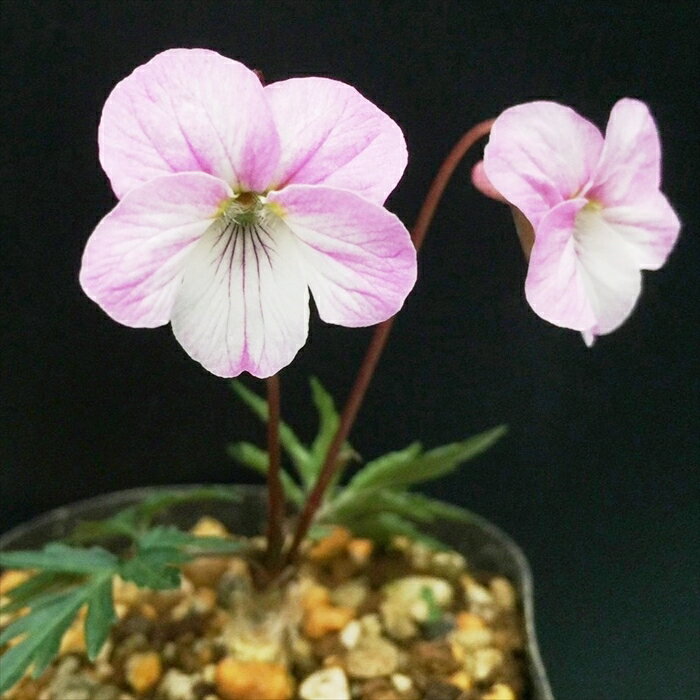
What is the structure of a flower?
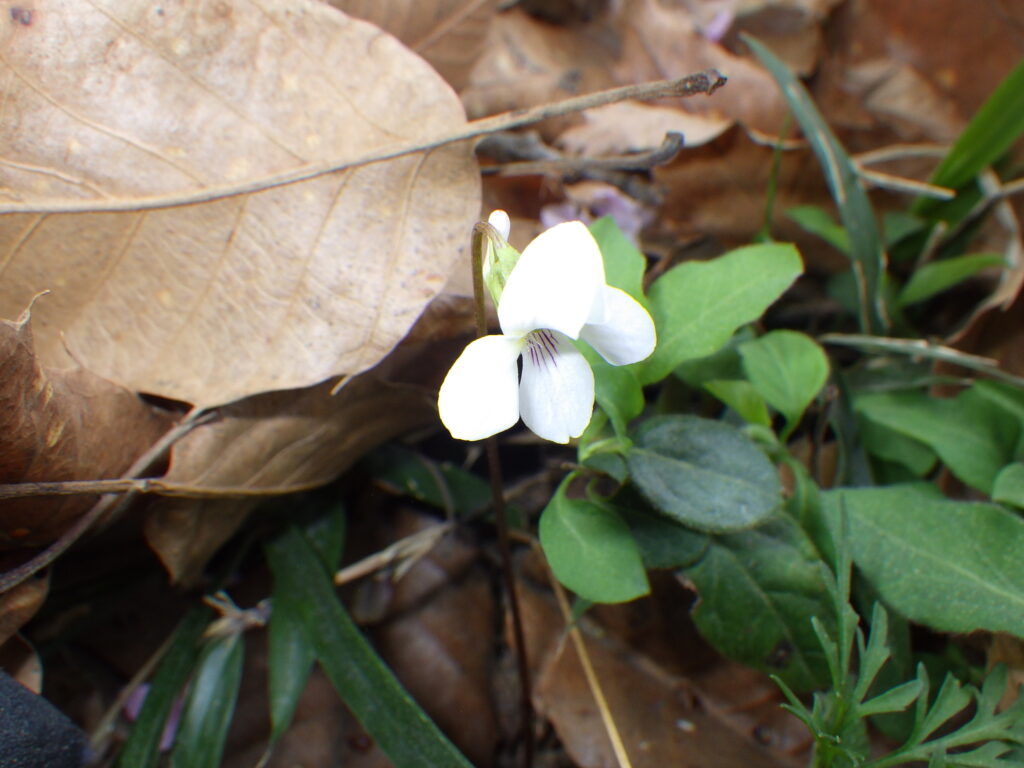
The flowers of Viola higoensis bloom in spring, from mid-April to early May, and are white, occasionally pale pink, and fragrant (Kadota et al., 2013). Viola eizanensis also blooms from mid-April to early May, and its flowers are pale reddish-purple.
Its form is not significantly different from other violets, consisting of five petals: the two upper petals are called the upper petals, the two on either side are called the lateral petals, and the single lower petal is called the labellum or lower petal (Shimizu, 2001).
The lateral petals may or may not be covered with hairs depending on the species, but they are present in Viola higoensis and Viola eizanensis (Kadota et al., 2013). The labellum is usually swollen and protrudes backward, forming a spur that contains nectar (Shimizu, 2001). The shape of this spur also varies depending on the species, but in Viola higoensis it is thinner than in Viola eizanensis (Yamada, 2010).
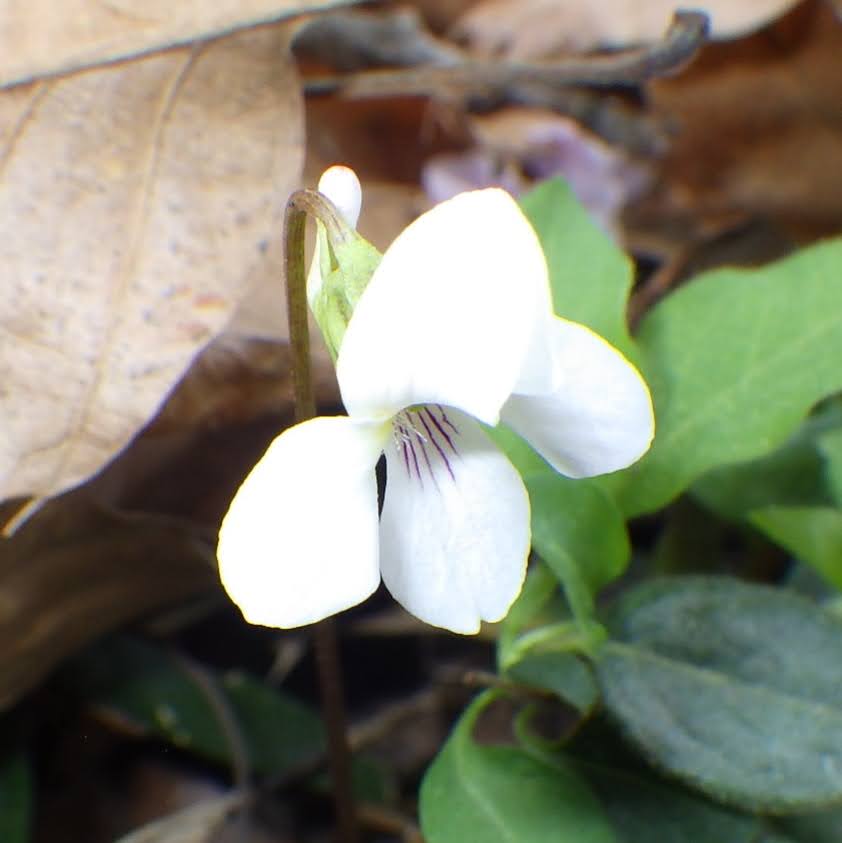
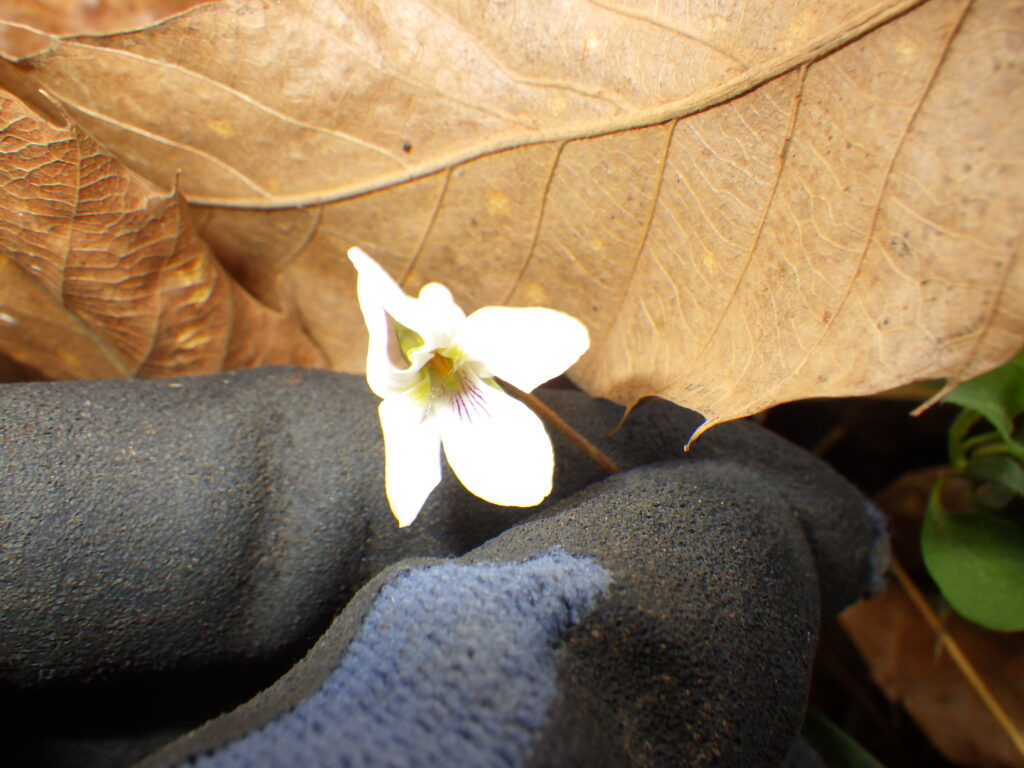
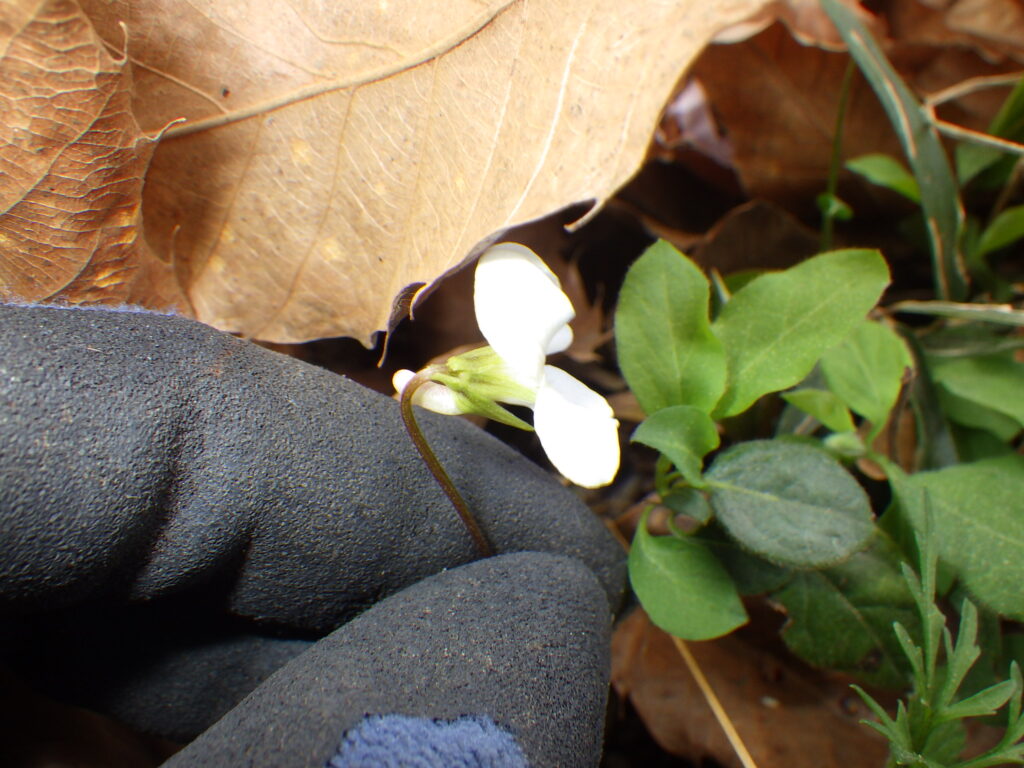
Why do violets produce "cleistogamous flowers"?
In addition to the "open flowers" that are the norm, the Viola genus also produces "cleistogamous flowers" (Tanaka, 1976; Shimizu, 2001). "Cleistogamous flower" is an unfamiliar term, isn't it?
Cleistogamous flowers are found in several taxonomic groups, including Viola, Limonium, and Lamium amplexicaule. They have a bud-like shape, just like normal flowers, but their petals are atrophied and never become visible over time.
Cleistogamous flowers self-pollinate through the fusion of stamens and pistils inside the flower, and then produce fruit. This allows them to reproduce without insect pollination. However, a disadvantage is that they cannot incorporate genes from other individuals, making them vulnerable to environmental changes. In the Viola genus, it is generally thought that cleistogamous flowers bloom from early summer onward because the amount of light decreases as trees unfurl their leaves, leading to a decrease in pollinating insects (Toyama, 2004).
The ratio of "open flowers" to "closed flowers" differs depending on the species!?
We understand the general aspects, but how does the Higo violet, which inhabits sunny grasslands in mountainous areas, manage? There is an interesting report on this, along with that of the Eizan violet (Toyama, 2004).
The Higo violet, which grows in sunny areas, produces many open flowers, while the Eizan violet, which grows in the shade, produces many closed flowers. There were also differences in the insects that visited them. The Higo violet attracted insects from many different taxonomic groups, while the Eizan violet attracted mainly bumblebees.
This difference is thought to be a result of different survival strategies between the two species depending on their habitat. The Higo violet, which lives in sunny locations, spends long periods in environments with sunlight, so it produces many open flowers to attract various insects and try to produce offspring that incorporate genes from other individuals. On the other hand, the Eizan violet, which lives in the shade, has difficulty with insect pollination after early summer, so it ensures a large number of offspring by producing many cleistogamous flowers. Furthermore, it secures opportunities to incorporate genes from other individuals by specifically attracting bumblebees, which are efficient pollinators in the spring.
Since this report hasn't been formally published as a paper yet, we don't know the specific types of insects that visit, but the Higo violet and Eizan violet have subtle differences in flower color and spur shape, so I'm curious how these differences relate to each other. Are there any differences between them and the relatively common violets and Tachitsubo violets? There are still many mysteries.
The fruit is a capsule, and the seeds are dispersed automatically and by ants.
The fruits of Viola higoensis and Viola eizanensis are capsules, which are common to the Viola genus. A capsule is a fruit in which the pericarp sac ruptures, exposing the seeds inside.
The capsules of the Viola genus are generally loculobectenate and consist of three elastic carpels. The carpels are boat-shaped, have a keel, and are thicker on the outside. When mature, the capsule splits open carpel by carpel, exposing the seeds inside, with countless seeds resting on the boat-shaped carpels. The seeds are spherical-ovate, and in Viola higoensis and Viola eizanensis, they have a caruncle (an appendage of integument origin at the tip of the seed) and are usually smooth.
Violet species disperse their seeds in a two-step process.
The carpel, which is boat-shaped and carries countless seeds on top, is made up of three layers. When it dries, the inner layer shrinks and contracts, narrowing the width of the boat shape. This constricts the seeds inside, and eventually they are ejected, resulting in "automatic dispersal" (Kobayashi, 2007).
The seeds ejected in this way have seed granules attached to them in most species of the Viola genus, and this is also true for Viola higoensis and Viola eizanensis (Toyama & Yahara, 2009). The seed granules contain ant food such as fatty acids, amino acids, and sugars, and function as "elaiosomes," allowing the seeds to be dispersed by ants through "ant dispersal."
This two-stage seed dispersal likely allows them to spread their distribution over a wide area. However, there is a lack of research on which specific ant species are responsible for carrying the seeds of Viola higoensis and Viola eizanensis.
References
Kadota, Y., Nagata, Y., & Azegami, N. 2013. Flowers Blooming in the Mountains (Revised and Expanded New Edition). Yama-kei Publishers, Tokyo. 616pp. ISBN: 9784635070218
Kanagawa Prefecture Flora Survey Association. 2018. Kanagawa Prefecture Flora 2018 (Electronic Edition). Kanagawa Prefecture Flora Survey Association, Odawara. 1803pp. ISBN: 9784991053726
Kobayashi, Masaaki. 2007. From Flower to Seed: The Science of Seed Dispersal. National Rural Education Association, Tokyo. 247pp. ISBN: 9784881371251
Shimizu, Takemi. 2001. Illustrated Dictionary of Botanical Terms. Yasaka Shobo, Tokyo. xii, 323pp. ISBN: 9784896944792
Tanaka, Hajime. 1976. Observation of insect-pollinated and wind-pollinated flowers. New Science Co., Ltd., Tokyo. 109pp. ISBN: 9784821600236
Toyama, Hirofumi. 2004. Resource allocation in response to light environment and pollinating insects in Viola eizanensis and Viola higoensis. Abstracts of the Annual Meeting of the Ecological Society of Japan 51: 230. https://doi.org/10.14848/esj.ESJ51.0.230.0
Toyama, Hirofumi. 2020. Research on plant diversity in species, interspecifics, and communities. *Journal of Plant Geography and Taxonomy* 68(1): 19-30. ISSN: 0388-6212, https://doi.org/10.18942/chiribunrui.0681-03
Toyama, H., & Yahara, T. 2009. Comparative phylogeography of two closely related Viola species occurring in contrasting habitats in the Japanese archipelago. Journal of Plant Research 122: 389-401. https://doi.org/10.1007/s10265-009-0235-7
Yamada, Takahiko. 2010. Violet Handbook. Bun-ichi Sogo Shuppan, Tokyo. 104pp. ISBN: 9784829910771
Wu, ZY, Raven, PH & Hong, DY (Eds.). 2007. Flora of China (Vol. 13 Clusiaceae through Araliaceae). Science Press, Beijing, and Missouri Botanical Garden Press, St. Louis. ISBN: 9781930723597

