Spiraea thunbergii and Prunus serrulata are native to China, and Spiraea thunbergii in particular is often cultivated in tea gardens and ordinary gardens in Japan. Although rare, Prunus serrulata is also sometimes cultivated. These two species can be reliably distinguished by the serrations on their leaves, and they can also be distinguished to some extent by their flowers. Spiraea thunbergii is written in kanji as "利休梅," which sounds like it might be related to the Sengoku period, but in reality, it was named in the Meiji era based on imagery. The flowers of these two species are characterized by a large, protruding receptacle, and a study conducted in China found that 92% of the bees that pollinate them are the Oriental honeybee, suggesting that the flowers have evolved and developed as a result of being specialized for honeybees. The fruits have the ability to retain their germination ability even after being submerged in water for more than 24 hours, and in nature they seem to live as water-dispersing plants. This article will explain the classification, origin of the names, pollination ecology, and seed dispersal of Spiraea thunbergii and Prunus serrulata.
- What are *Rikyubai* and *Yanagizakura*?
- What is the difference between Spiraea thunbergii and Prunus serrulata?
- The name is said to come from Sen no Rikyu, but in reality, there's no connection at all!?
- What is the structure of a flower?
- For some reason, only Eastern honeybees were visiting the flowers!?
- Are the fruits capsules dispersed by water?
- References
- Source
What are *Rikyubai* and *Yanagizakura*?
Exochorda racemosa, also known as Rikyubai, is native to China and has been cultivated as a garden tree in Japan since the Meiji era. In its native habitat, it is a deciduous shrub that grows on shady slopes (Wu et al., 2003).
Willow cherry (Exochorda serratifolia) is native to China and Korea and is rarely cultivated in Japan. In its native habitat, it is a deciduous shrub that grows in mixed forests, slopes, and riverbanks.
Both belong to the genus Prunus in the rose family, and in Japan they are cultivated only for ornamental purposes and do not grow wild. Although they are plants that have become known relatively recently, they can be seen occasionally, perhaps because of their interesting flowers.
Since they belong to the same group, their flower shapes are particularly similar, which can sometimes make it difficult to distinguish between them.
What is the difference between Spiraea thunbergii and Prunus serrulata?
These two species can be distinguished by their leaves or flowers, but the leaves are a more reliable indicator (Wu et al., 2003; Hayashi, 2014).
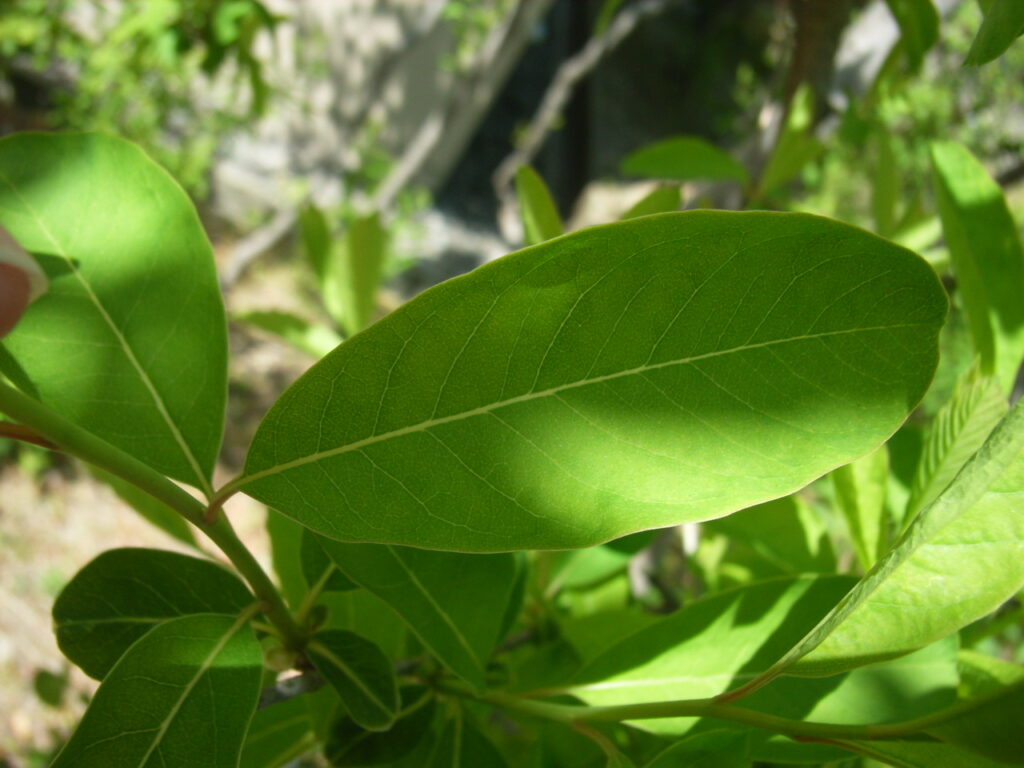
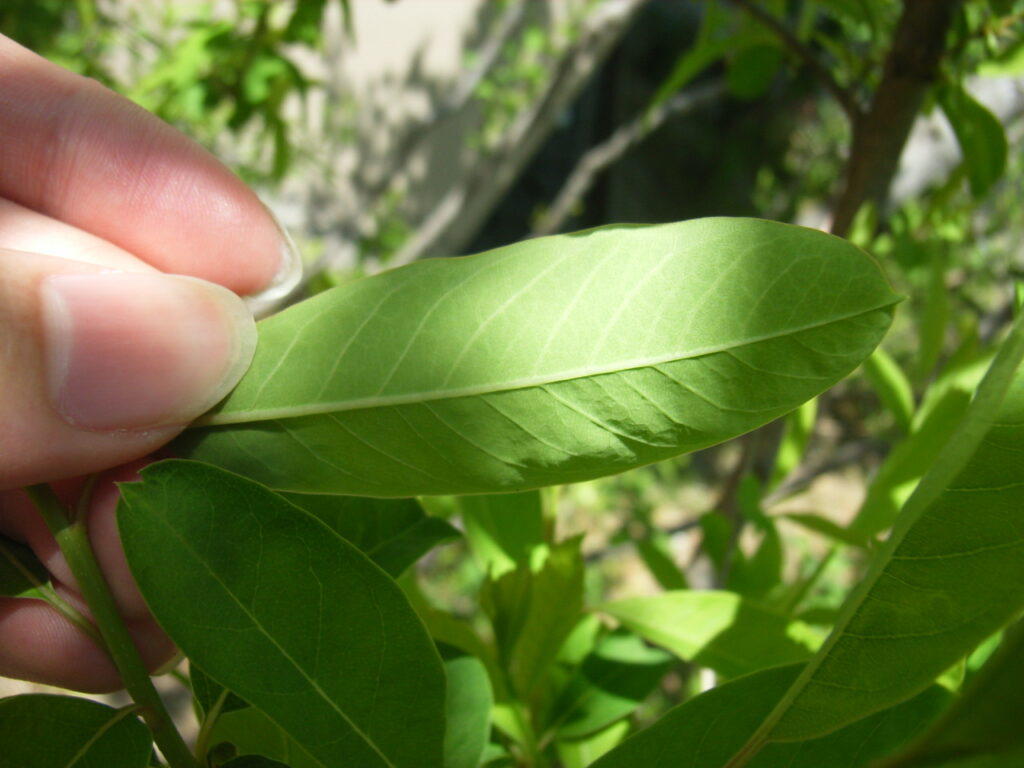
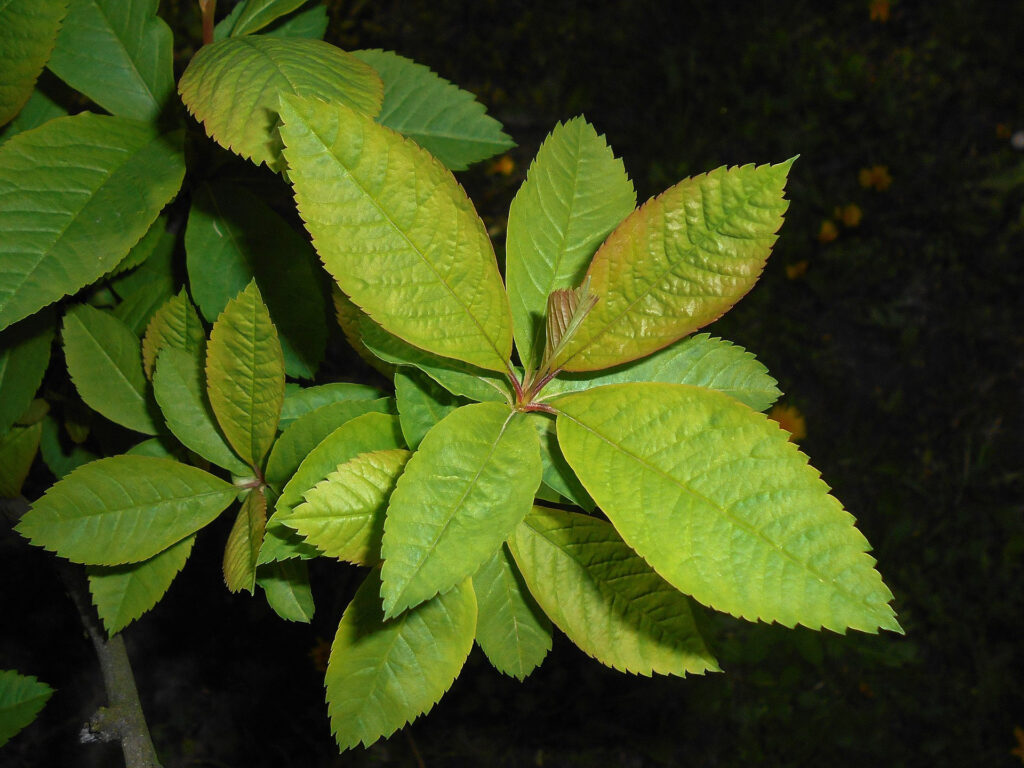
First, regarding the leaves, in Spiraea thunbergii, there is a mix of entire and serrated leaves, and when serrations are present, they are only found at the tip of the leaf. The tip is rounded, and both sides are hairless. In contrast, in Prunus serrulata, the tip of the leaf is usually serrated on the upper half, the tip is slightly pointed, and both sides are hairless, although young leaves are hairy.
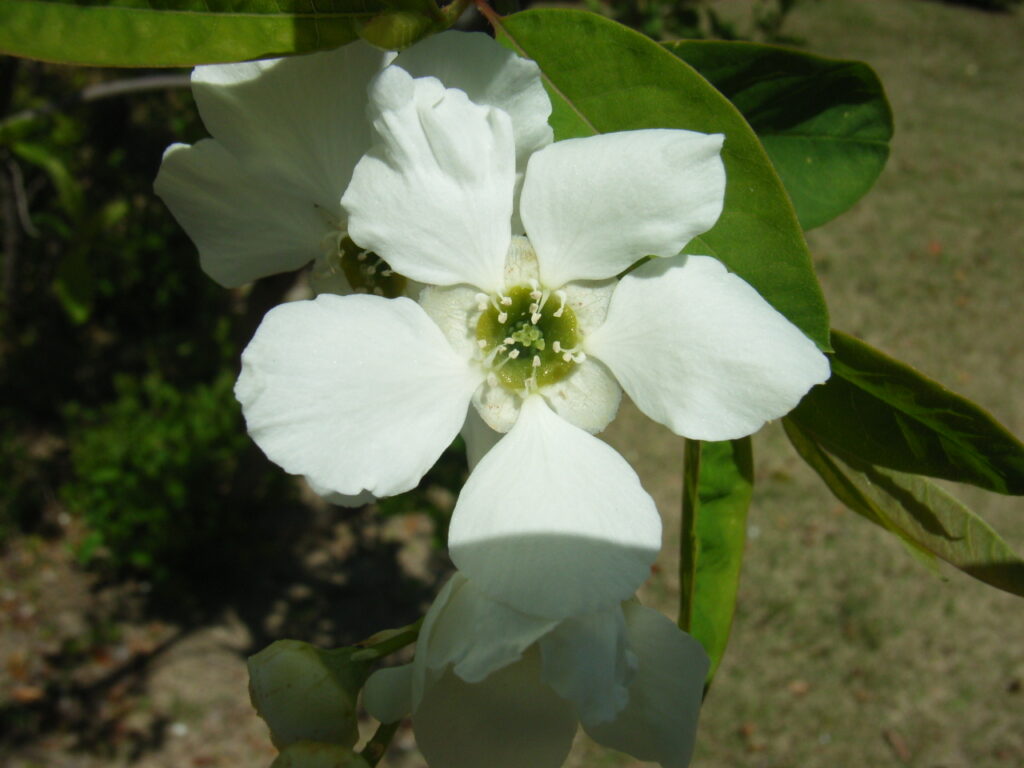
Regarding the flowers, there is a difference in that the central, protruding receptacle, known as the "floral disc," is green in Spiraea thunbergii, while it appears greenish-brown in Prunus serrulata. However, this difference is subtle and may vary depending on individual differences and lighting conditions during photography. It is probably best to compare the leaves as a general rule.
It's also worth keeping in mind that planting willow cherry trees is rare.
The name is said to come from Sen no Rikyu, but in reality, there's no connection at all!?
The Japanese name for this flower, Rikyubai, is written with the kanji characters for "Rikyubai." While it is indeed believed that the name originates from Sen no Rikyu, the reason for this is said to be either because it is a flower used to decorate tea ceremonies, or because it is cultivated in tea gardens and blooms around the anniversary of Sen no Rikyu's death. There are also several other theories, such as that it is a pure and elegant flower that Sen no Rikyu must have favored.
As you can see, there are far too many theories, and for some reason, the origins are all over the place!
In fact, as mentioned above, the Japanese laurel (Rikyubai) was introduced to Japan during the Meiji era, and naturally, Sen no Rikyu, the merchant and tea master from the Sengoku period to the Azuchi-Momoyama period, was not around at that time.
This name is said to have been given by the seed company that sold and promoted these seeds, and it is said that the name subsequently came to be used in cut flower markets and other places (Kato and Nakamura, 1971).
In other words, it's merely an image that someone from the Meiji era came up with.
This might be an unpleasant fact for those who want to feel a sense of history, but it doesn't detract from the beauty of the Spiraea thunbergii flowers, so I don't think it's something to be overly concerned about.
What is the structure of a flower?
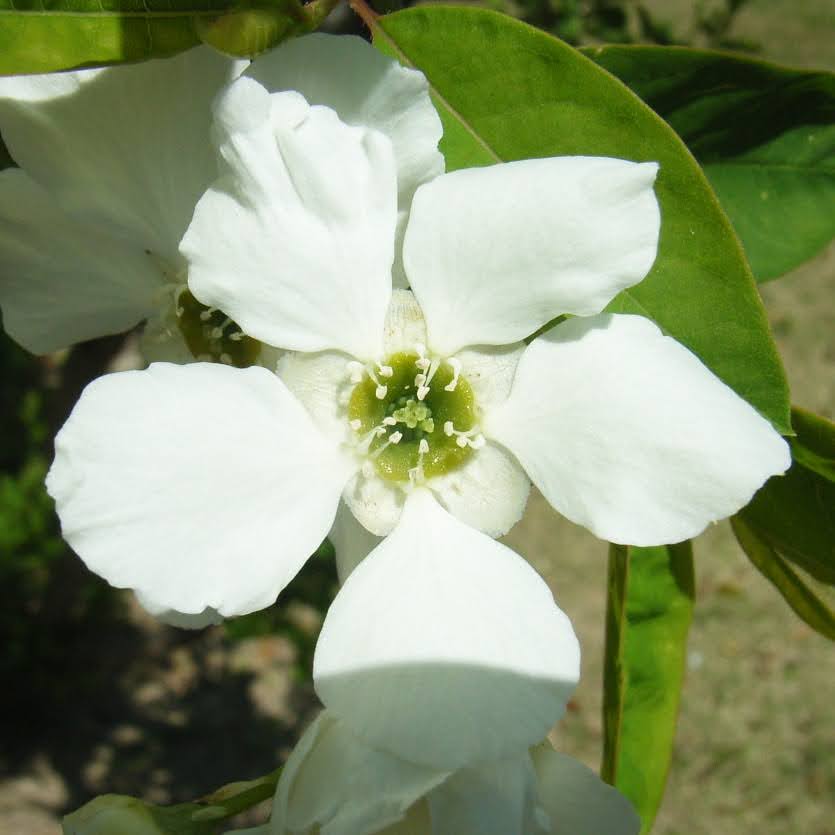
Both Spiraea thunbergii and Prunus serrulata bloom around May to June, and their flowers consist of five white petals. What is most distinctive is the large, protruding receptacle called the floral disc, which is green in Spiraea thunbergii and greenish-brown in Prunus serrulata. Numerous short stamens emerge from this disc, and the pistil can be seen in the center. Although distinctive, its flat shape suggests that it might attract many different kinds of insects.
For some reason, only Eastern honeybees were visiting the flowers!?
However, a study in China, the native habitat of the genus *Salvia japonica*, which includes *Salvia japonica* and *Salvia japonica*, found that while various insects from the orders Coleoptera, Diptera, Hymenoptera, Hemiptera, and Lepidoptera visited the plants, 92% were the oriental honeybee *Apis cerana* (Fangyou, 1998). However, more than 7% of the plants also self-pollinate, despite cross-pollination by insects.
Unfortunately, the reason why only Oriental honeybees are found remains unknown and has not been investigated.
It hasn't been confirmed how honeybees are attracted to other insects when collecting nectar and pollen, but it's likely they are drawn to the green disc and insert their mouthparts into the gap between the disc and the pistil to suck the nectar. In such cases, the length of the insect's mouthparts may limit the types of insects that can collect nectar.
The second most numerous was the blue-and-white flycatcher (Rapala caerulea), accounting for 3.31 TP and 3 T. Although its numbers are quite small, it is believed to contribute to cross-pollination because it travels longer distances than the oriental honeybee. However, I personally have some doubts about how much pollen is carried by butterflies, which often steal nectar. It seems safe to assume that these flowers are basically specialized for honeybees.
However, it should be noted that these results were obtained from studies conducted within a botanical garden in China, rather than in a completely natural environment.
Are the fruits capsules dispersed by water?
The fruit of the genus Prunus is a capsule, inverted cone-shaped with five corners, and dehisces along the sutures on both sides. It contains one or two seeds, which are flattened and winged.
Seeds of the genus Prunus are lighter than water and retain their germination ability even after being submerged in water for more than 24 hours, suggesting that they disperse their seeds by water (Fangyou, 1998). Some species may also disperse their seeds by wind or gravity. When the fruit capsule bursts open, it releases the seeds, which is an effective way for the plants to travel considerable distances and establish themselves in new locations.
On the other hand, dried capsules are not attractive to birds and are not dispersed by them. It is also possible that the plant reproduces asexually using the suckers on its roots, and researchers say they observed new branches growing from the roots during fieldwork in China in 1995.
While you might not see Japanese quince and willow cherry trees in their natural habitat if you live in Japan, it can be enjoyable to observe their fruits and understand how they live in the wild.
References
Fangyou, G. 1998. Exochorda: five species or one?: a biosystematic study of the Rosaceous genus Exochorda [Doctoral dissertation, Wageningen University]. ISBN: 9789054858256, https://doi.org/10.18174/210626
Hayashi, Masayuki. 2014. 1100 Tree Leaves Identified Through Real-Life Scans. Yama-kei Publishers, Tokyo. 759pp. ISBN: 9784635070324
Kato, Kaname & Nakamura, Tsuneo. 1971. Yamakei Color Guide: Flowering Trees 1. Yama-kei Publishers, Tokyo. 199pp.
Wu, ZY, Raven, PH & Hong, DY (Eds.). 2003. Flora of China (Vol. 9 Pittosporaceae through Connaraceae). Science Press, Beijing, and Missouri Botanical Garden Press, St. Louis. ISBN: 9781930723146
Source
This article is a significantly expanded version of a piece originally published in the following book.