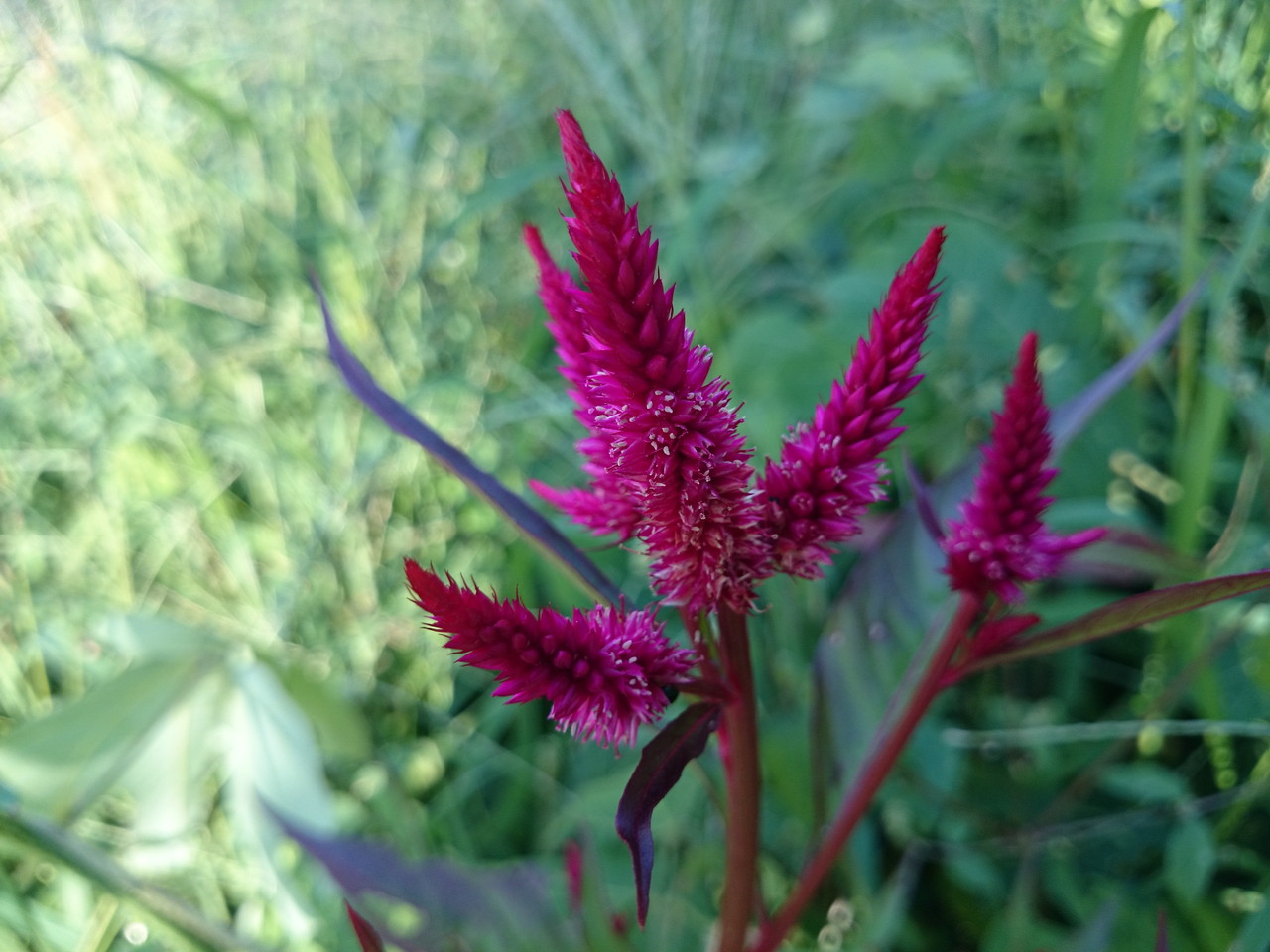
Celosia and wild celosia are both annual plants belonging to the genus Celosia in the Amaranthaceae family, cultivated for food and ornamental purposes. Their spike-like inflorescences are sometimes likened to blazing flames. The Japanese name "Keito" (鶏頭) comes from the fact that some inflorescences grow large enough to resemble a rooster's comb. However, there is a lot of inaccuracy in the descriptions of how to distinguish between celosia and wild celosia on the internet. In Japan, celosia and wild celosia are clearly distinguished by the size of the inflorescence stalk and perianth segments. Celosia has varieties that grow large enough to resemble a rooster's comb, and there are also varieties such as spear celosia and feather celosia, which can be distinguished by the shape of their inflorescences. This article will explain the classification of the genus Celosia.
What is Celosia (or Cornelianthus)?
Celosia cristata, also known as cockscomb, is an annual plant native to tropical Asia. It is cultivated and naturalized all over the world, and has been cultivated in Japan for a long time, with various varieties. Originally, the flowers and leaves were used for food, and they are still used for food in Africa and Southeast Asia, but in Japan, they are now mainly used for ornamental purposes.
Celosia argentea, also known as wild cockscomb, is an annual plant said to be native to tropical America or India. It was cultivated in tropical to temperate regions around the world and has since become widespread in Japan. It was introduced to Japan a long time ago and has become naturalized in Honshu, Shikoku, Kyushu, and the Ryukyu Islands.
All of these are annual plants belonging to the Celosia genus of the Amaranthaceae family, cultivated in horticulture for ornamental purposes. They are also called "Celosia" after their genus name. They are composed of five reddish perianth segments (petals and sepals that are indistinguishable), and their spike-like inflorescences are likened to blazing flames. Some inflorescences grow large enough to resemble a rooster's comb, hence the Japanese name "Keito" (rooster's head). These are some of the major characteristics they share.
Another difference between the Amaranthus genus and the Celosia genus is that Celosia plants contain several seeds in their fruit capsules.
However, there is little clear information on the internet regarding the distinction between these two species, and many incorrect descriptions can be found. There also seems to be confusion regarding the relationship between scientific names and common names.
In particular, the Celosia argentea var. childsii, a variety of Celosia, is easily confused with Celosia argentea because it looks similar to Celosia japonica.
What is the difference between Celosia and Cornelianthus?
In Japan, the difference between Celosia and Celosia argentea is clearly defined (Kanagawa Prefecture Flora Survey Association, 2018). The difference lies in the inflorescence and the flowers.
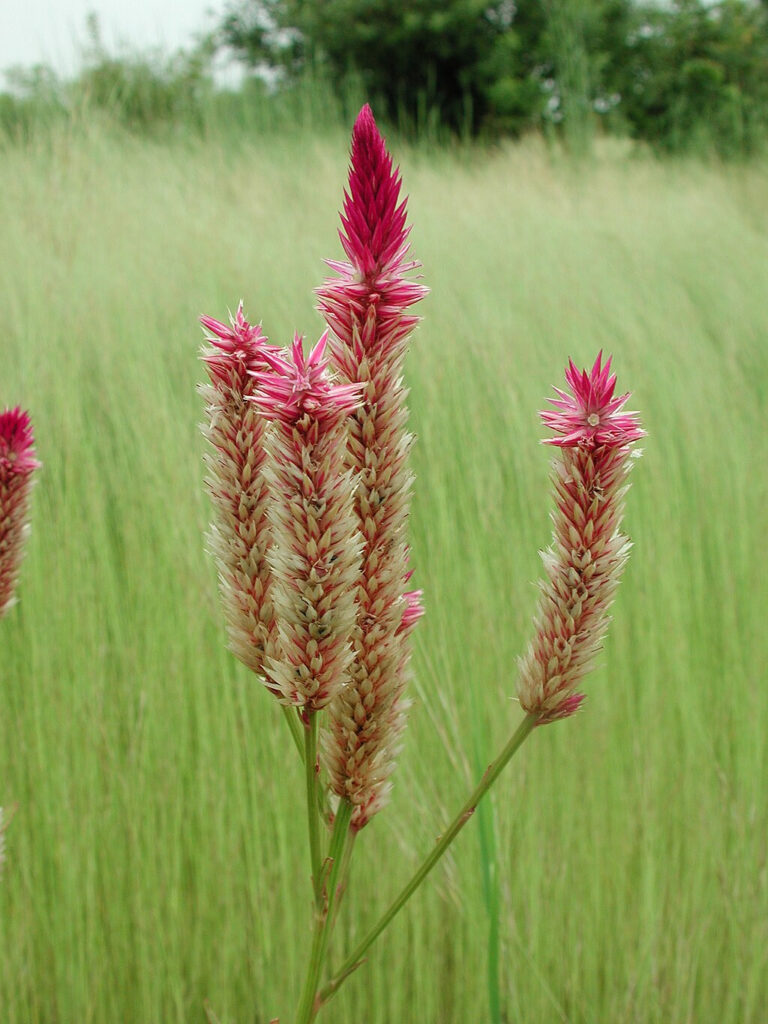
Regarding the inflorescence, there is a difference in that the stalks of the inflorescence are short in Celosia, while they are long in Celosia argentea.
While there isn't a specific length requirement, comparing the following photos reveals a significant difference in the length of the flower stalks. As a result, celosia appears to have smaller, more clustered flowers. This is the crucial difference.
Regarding the flowers, there is a difference in that Celosia has small perianth segments that are 4-6 mm long, while Celosia argentea has larger perianth segments that are 7-10 mm long.
This may seem like a minor detail, but you can tell the difference by the fact that the inflorescence of Celosia argentea appears larger.
Regarding naturalization, some sources on the internet claim that only Celosia argentea (Japanese celosia) becomes naturalized. However, this is incorrect; both species become naturalized. In fact, studies in Kanagawa Prefecture show that there are more naturalized Celosia argentea plants than wild Celosia ensata.
Based on these characteristics, in Japan, Celosia and Celosia argentea are currently treated as distinct species. However, in other countries, there is a view that they should not be distinguished (RBG Kew, 2023). In that case, the scientific name Celosia argentea takes precedence. If this is the scientific name for Celosia, it is possible that the view of not distinguishing them is adopted.
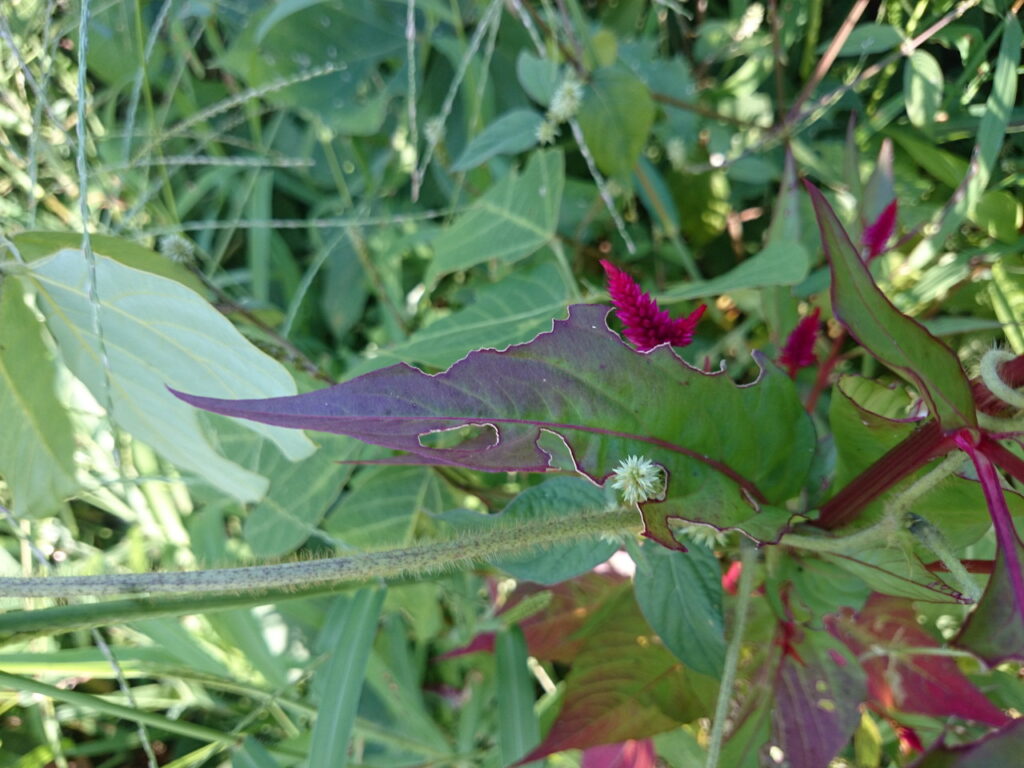
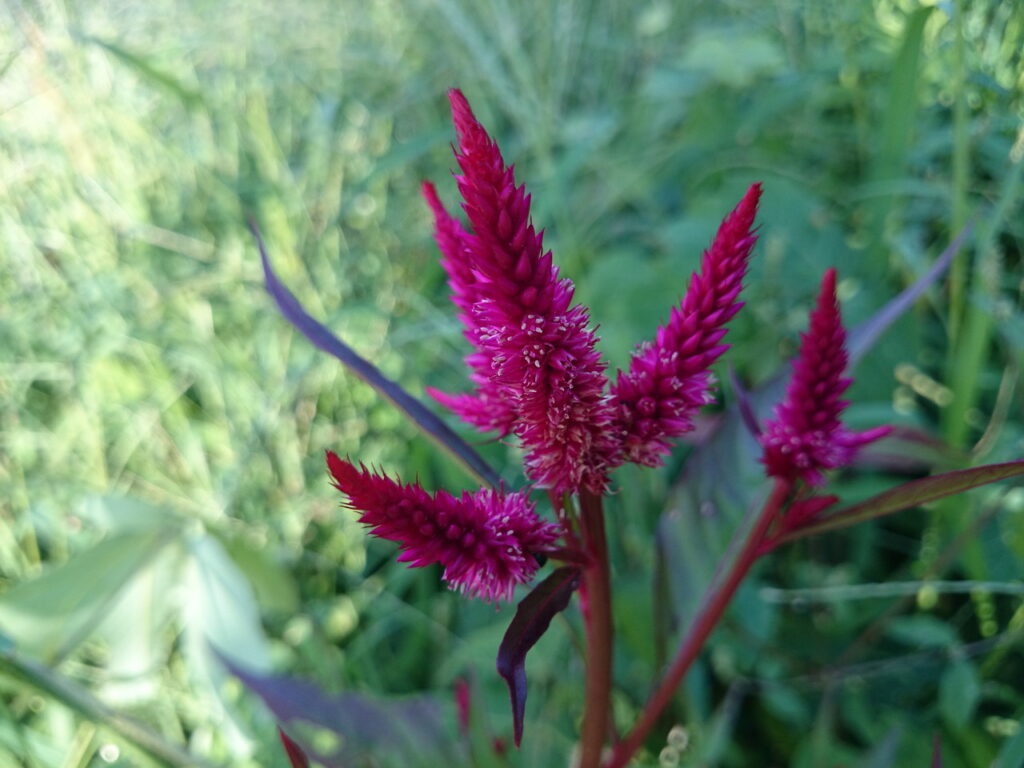
What are the varieties of celosia?
Several varieties of celosia are known.
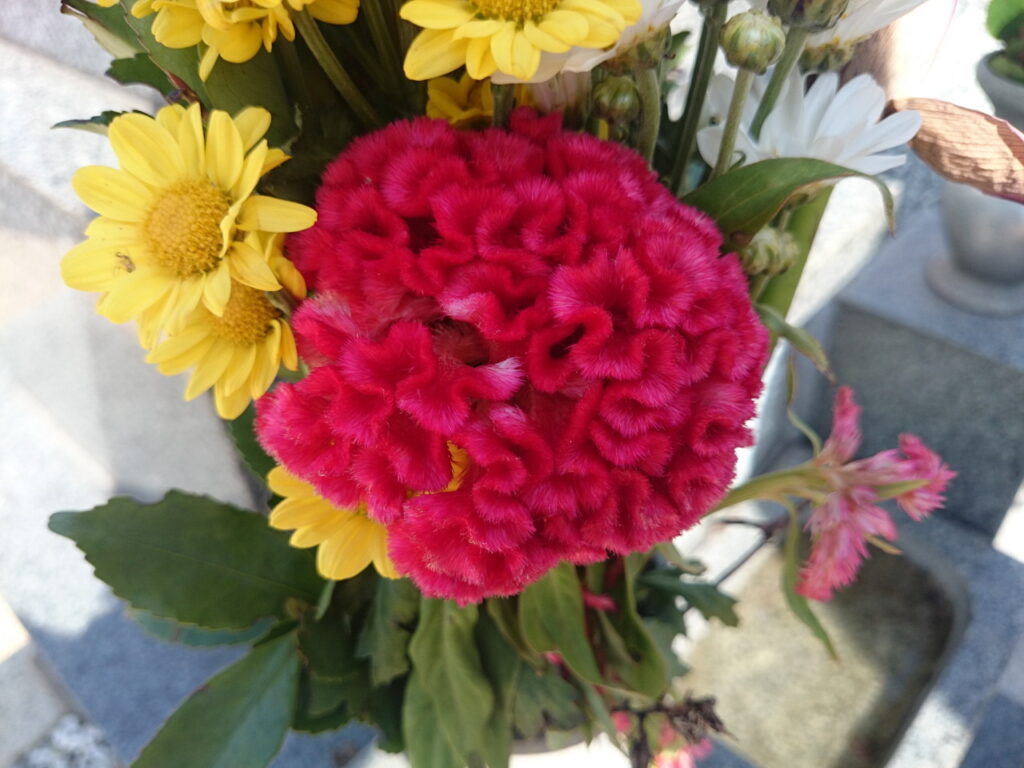
Celosia (in the narrow sense) var. cristata is also known as cockscomb celosia. This variety develops a crest-like shape as the inflorescence grows larger, and it can be said that this is the only true "cockscomb" variety.
Celosia argentea var. childsii is a variety in which the spike inflorescence does not branch and the tip of the inflorescence is pointed.
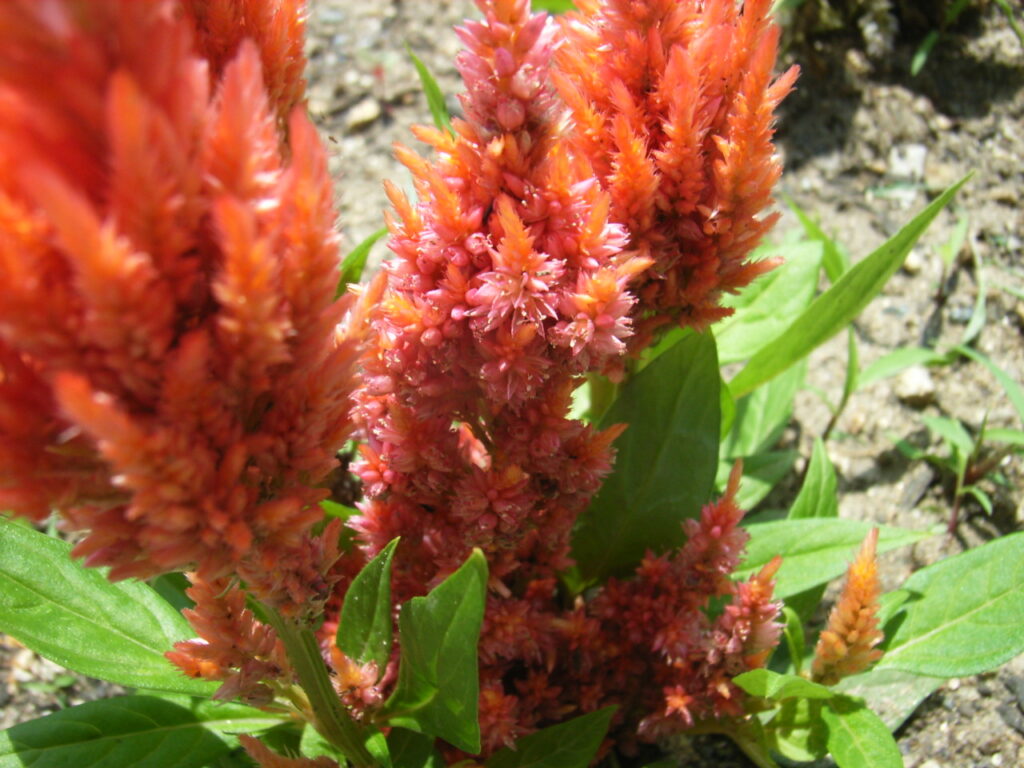
Celosia argentea var. plumosa is a variety with a narrow, pyramidal shape and a capitulum inflorescence whose buds resemble feathers. It is somewhat similar to Celosia argentea var. japonica, but its flowers are clearly more densely packed.
References
Kanagawa Prefecture Flora Survey Association. 2018. Kanagawa Prefecture Flora 2018 (Electronic Edition). Kanagawa Prefecture Flora Survey Association, Odawara. 1803pp. ISBN: 9784991053726
RBG Kew. 2023. The International Plant Names Index and World Checklist of Vascular Plants. Plants of the World Online. http://www.ipni.org and https://powo.science.kew.org/