Polygonatum odoratum, Polygonatum sibiricum, Polygonatum humile, and Disporum sessile are all species that bloom in spring and are commonly found in gardens and as wildflowers, but they can be a little difficult to distinguish as they are often sold mixed together. Therefore, we have summarized the botanical distinguishing features of the Polygonatum genus. They can be distinguished mainly by the way the flowers grow, as well as by the leaves and stems. All of these species have downward-facing flowers, but do you know what role they play in the wild? Polygonatum odoratum is the most well understood, as it is an important source of nutrition for the queen bumblebee, which becomes active in spring. Also, Polygonatum odoratum tends to produce male flowers with only stamens at the top of a single stem and hermaphroditic flowers with both stamens and pistils at the bottom. There are various theories as to why this is the case, but one theory is that it is the result of Polygonatum odoratum cleverly distributing energy due to nutrient deficiencies. The fruit is a berry and is probably dispersed by birds. This article will explain the classification, pollination ecology, and seed dispersal of Polygonatum species.
- What are Polygonatum odoratum, Polygonatum sibiricum, Polygonatum humile, and Polygonatum odoratum?
- What are the differences between Polygonatum odoratum, Polygonatum sibiricum, Polygonatum falcatum, and Polygonatum odoratum?
- What is the structure of a flower?
- The flower was specifically designed for pollination by bumblebees!?
- Why does Polygonatum odoratum produce both male and hermaphroditic flowers on a single stem?
- Are there differences in pollination methods among the various varieties of Polygonatum odoratum around the world?
- Are the fruits berries and dispersed by birds?
- References
- Source
What are Polygonatum odoratum, Polygonatum sibiricum, Polygonatum humile, and Polygonatum odoratum?
Polygonatum odoratum, also known as Amadokoro in the broad sense, is a perennial herb distributed from Hokkaido to Kyushu in Japan, as well as in Korea, China, Taiwan, Mongolia, Russia, and Europe, inhabiting sunny grasslands and forest edges (Kitamura et al., 1957). Of these, the Japanese variety var. pluriflorum is found in Japan and Korea. Its young leaves and rhizomes are sweet and used for food and medicine (Tanaka, 1995).
Polygonatum odoratum var. thunbergii, also known as mountain sweet jasmine, closely resembles Polygonatum odoratum, but its underside has fine, hair-like projections.
Polygonatum falcatum, also known as Solomon's seal, is a perennial herb distributed in Hokkaido, Honshu, Shikoku, Kyushu, and Korea, mainly growing in bright deciduous forests.
Polygonatum lasianthum, also known as Miyama Narukoyuri, is distributed in Hokkaido, Honshu, Shikoku, Kyushu, and Korea, and mainly grows in bright deciduous forests.
Polygonatum macranthum, also known as the large-flowered lily, is a perennial herb distributed in Hokkaido, Honshu, Shikoku, and Kyushu, growing in grasslands, deciduous forests, and forest edges.
Both belong to the genus Polygonatum in the Asparagaceae family (formerly Asparagaceae), and are commonly found both in gardens and as wildflowers. Their leaves and flowers are similar, and their flowering periods are close together, so you may have trouble distinguishing them.
What are the differences between Polygonatum odoratum, Polygonatum sibiricum, Polygonatum falcatum, and Polygonatum odoratum?
Although they look very similar at first glance, they can be distinguished as follows (Kanagawa Prefecture Flora Survey Association, 2018).
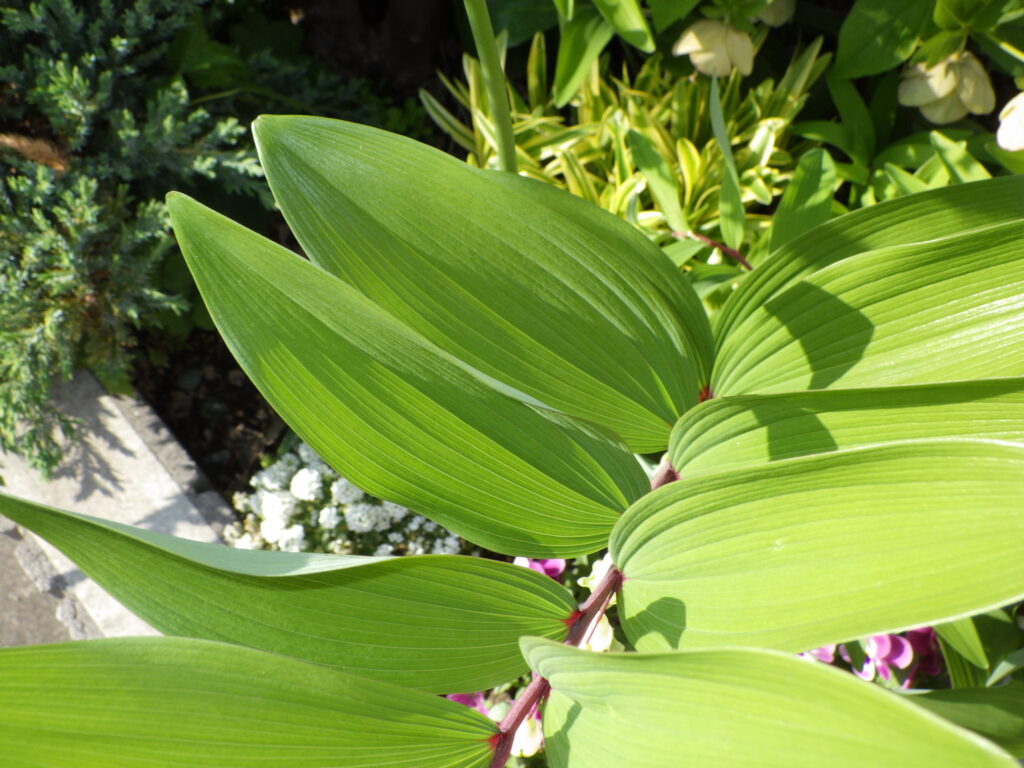
First, *Polygonatum odoratum* is completely different from other species in that its inflorescence stalk (the slender part on which the flower attaches to the plant) is long, spreads outwards, and bears 1 to 3 flowers. Also, its filaments are densely covered with long hairs. In other species, the inflorescence stalk hangs downwards, and the filaments are hairless or only have minute projections.
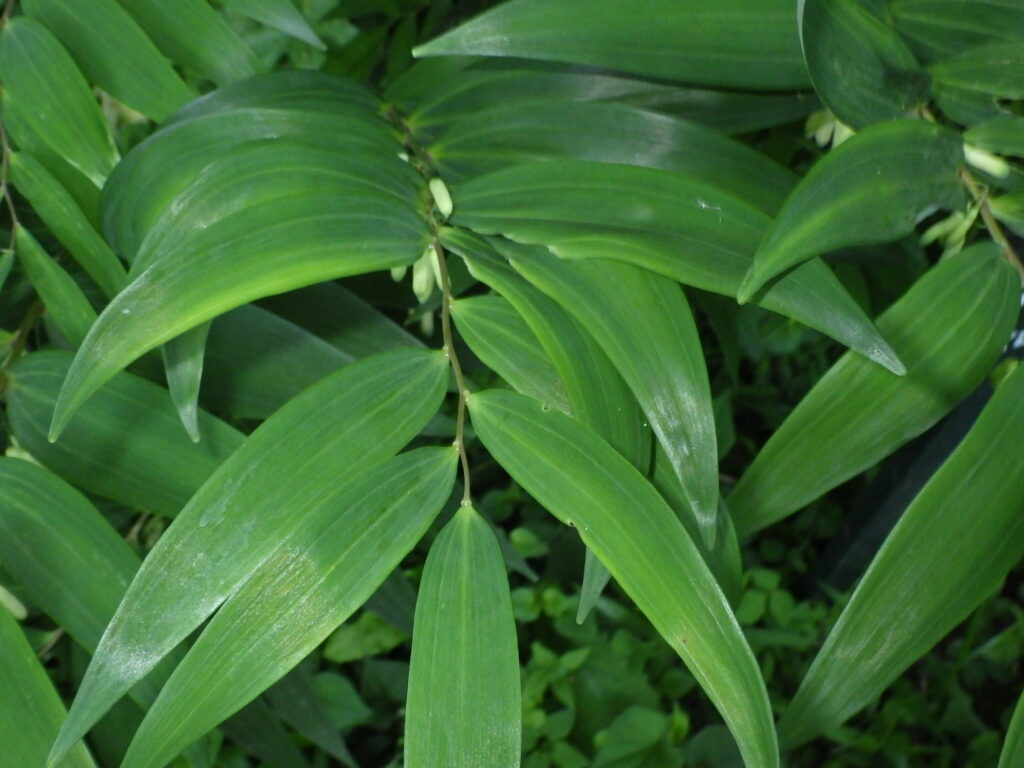
Of the remaining species, Polygonatum odoratum and Polygonatum sieboldii have ridged stems except at the base. On the other hand, Polygonatum odoratum and Polygonatum sieboldii have cylindrical stems without ridges, which is a major distinguishing feature.
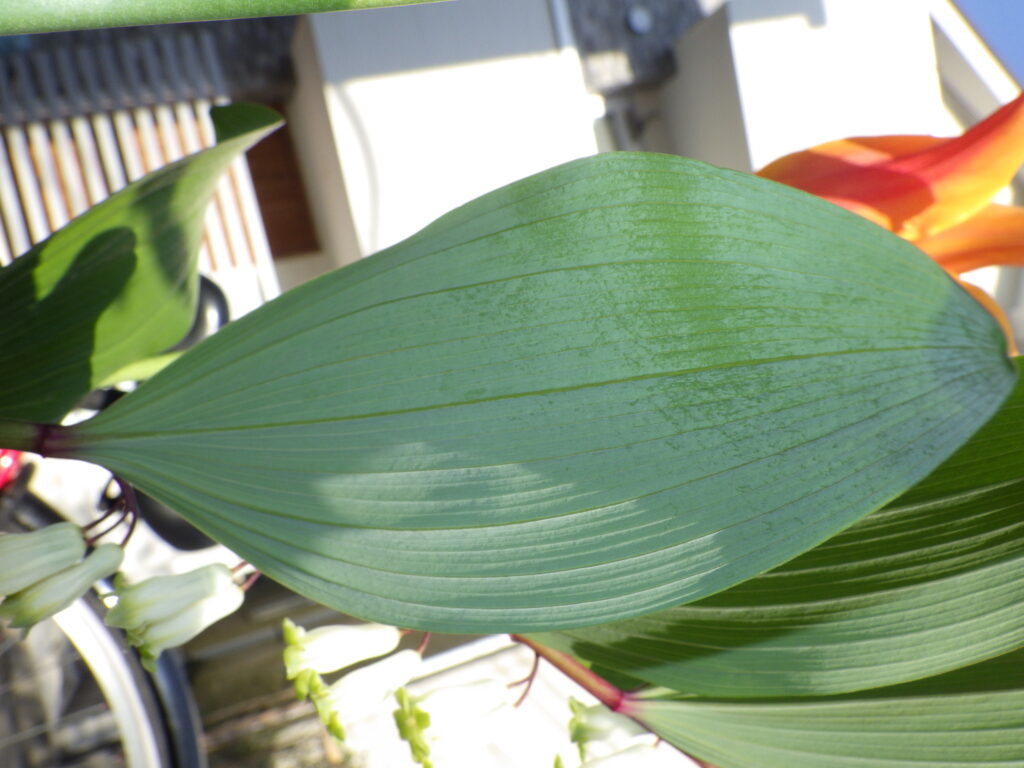
The difference between Polygonatum odoratum and Polygonatum sieboldii is that Polygonatum odoratum has a smooth underside to its leaves, while Polygonatum sieboldii has tiny protrusions on the underside of its leaves.
The difference between Polygonatum odoratum and Polygonatum sibiricum is that in Polygonatum odoratum, the underside of the leaves is covered with a powdery white substance and is smooth, and the filaments are swollen at the base and have minute projections except for the tip, whereas in Polygonatum sibiricum, there are minute projections on the veins on the underside of the leaves and the filaments are smooth.
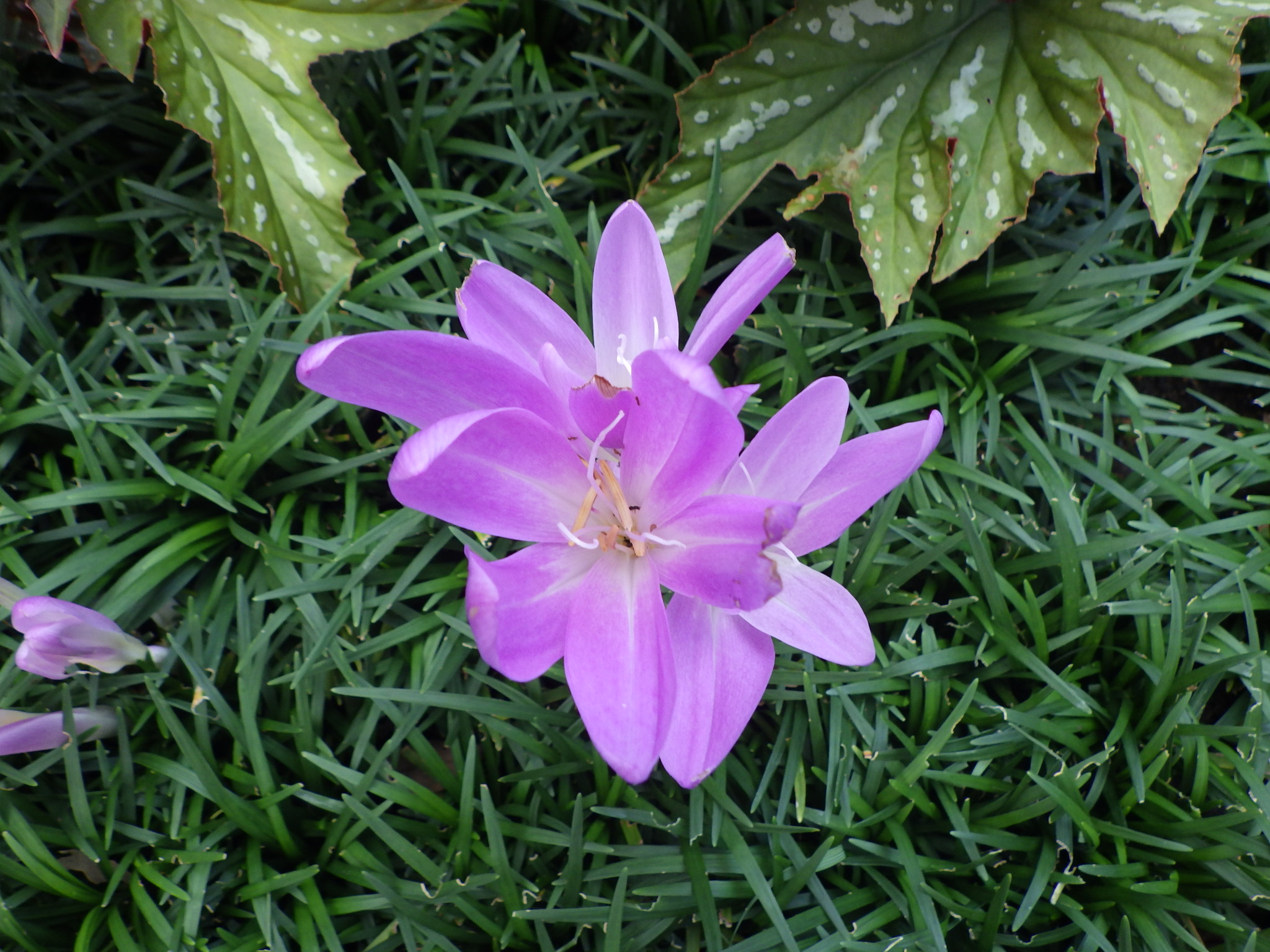
Although Disporum sessile may look similar at first glance, it is a completely different member of the Colchicaceae family. Its leaves have three distinct veins that are clearly more deeply indented than those of the Polygonatum genus, its inflorescences are attached to the stem apex, and it usually lacks a peduncle.
Other species such as *Campanula punctata* and *Polygonum thunbergii* are also present, but they will be omitted here. For more details, please refer to the Kanagawa Prefectural Flora Survey Association (2018).
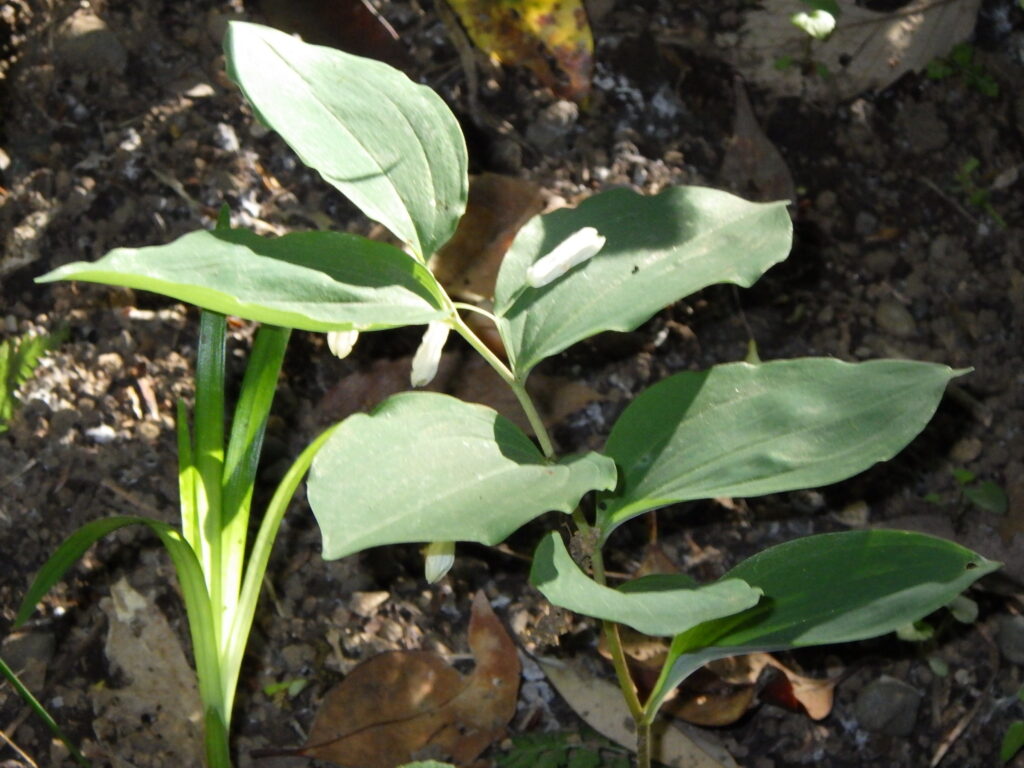
What is the structure of a flower?
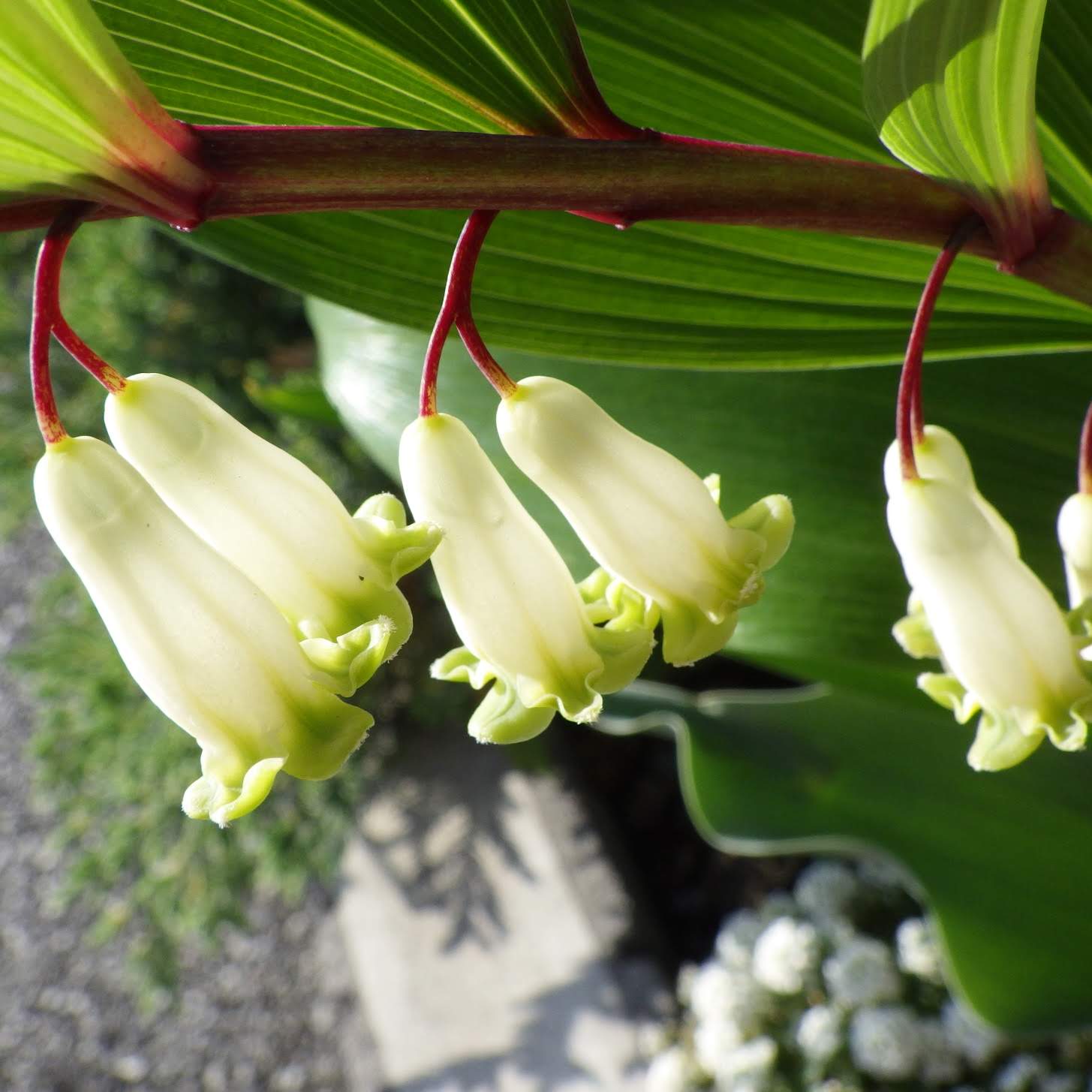
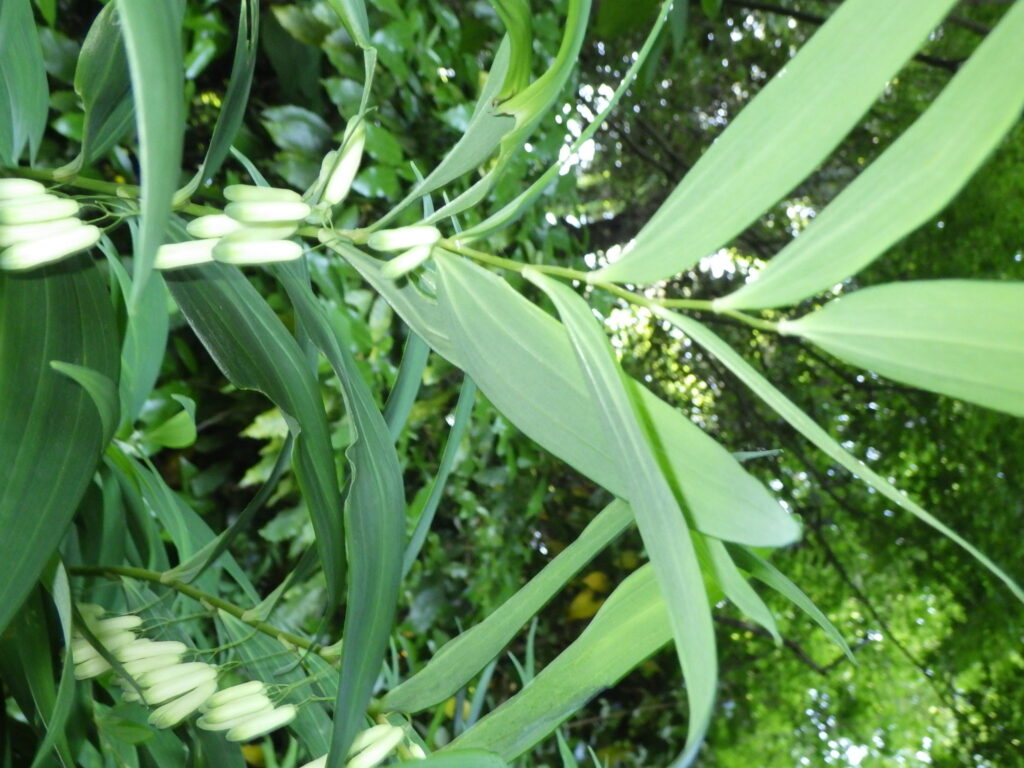
Polygonatum odoratum blooms from April to May, producing slender, bell-shaped (or oval-shaped) white flowers on single or bifurcated pedicels that emerge from the base of the leaves. The flowers droop as they open, and their tips are tinged with green. The flowers on the stem bloom from the bottom upwards.
Polygonatum odoratum blooms from May to June, with flower stalks that curve downwards from the base, bearing 3 to 8 white flowers. The flowers also droop as they open, and the tips are tinged with green, but their shape is slightly thinner than that of Polygonatum odoratum.
Polygonatum odoratum flowers from May to June. Its stalks are obliquely ascending, with a short base fused to the stem, and gently curved in an arc due to the weight of the flower. The flowers are 17-21 mm long, with a short stalk of about 0.5 mm at the base. The tip is shallowly 6-lobed, the lobes do not curve back, and there are small projections at the tips. The inner surface is covered with short hairs. There are 6 stamens, the filaments are covered with long, soft hairs and fused to the corolla up to the middle. The pistil's style is hairless, and the tip is not divided.
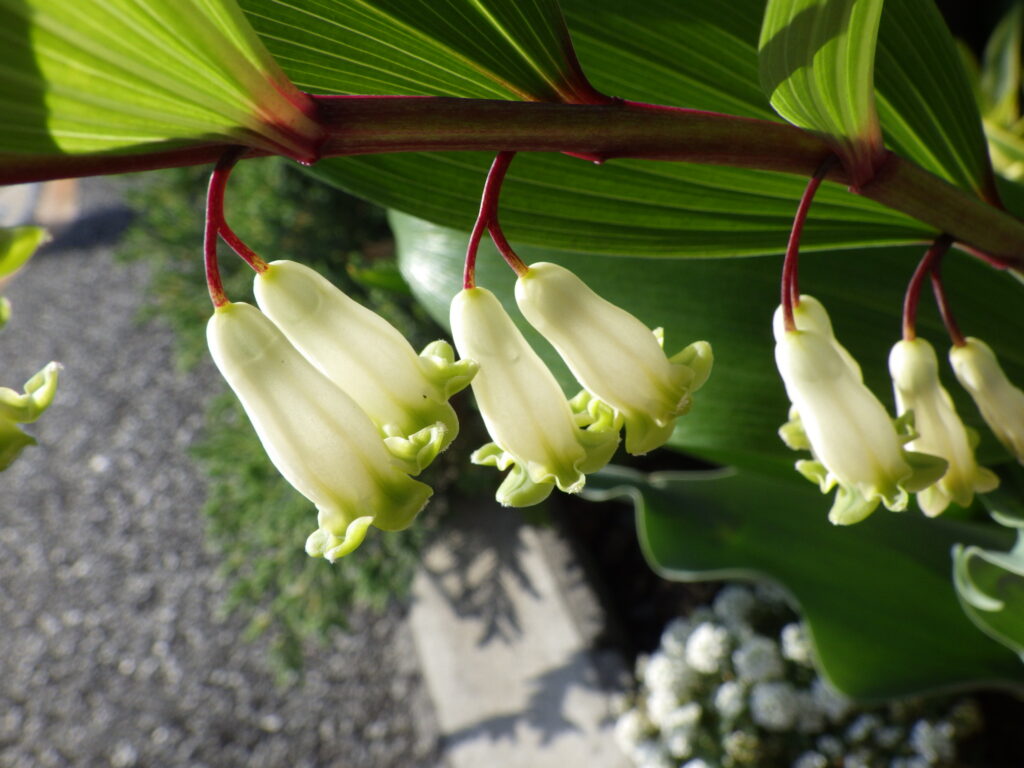
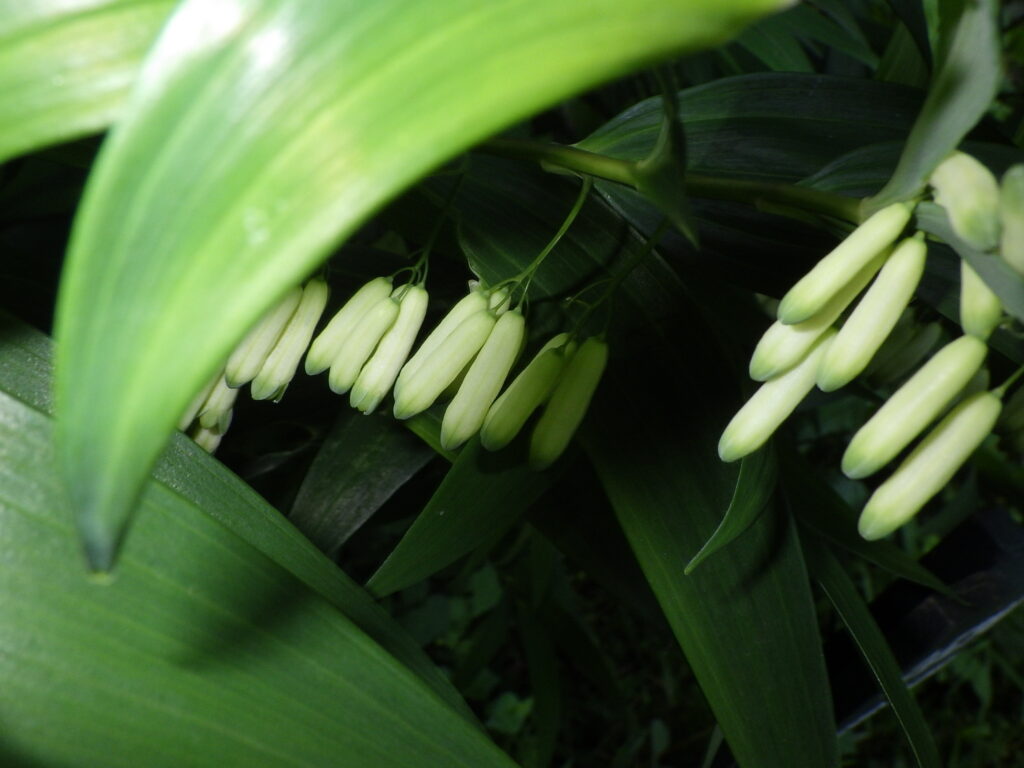
The flower was specifically designed for pollination by bumblebees!?
What kinds of insects visit these downward-facing flowers? Of these species, the ecology of the flowers of Polygonatum odoratum has been studied in detail (Tanaka and Hirano, 2000; Hirose et al., 2002; Kono et al., 2004).
Bumblebees visit this flower. This is a typical example of how downward-facing flowers are chosen by bees that can firmly cling to them (Tanaka and Hirano, 2000).
Moreover, the bumblebees that visit are often queen bees, and it is believed that this is a major food source for the bumblebee queens before they begin their activity and build their nests.
Why does Polygonatum odoratum produce both male and hermaphroditic flowers on a single stem?
Incidentally, in Polygonatum odoratum, the upper part of a single stem tends to produce male flowers with only stamens, while the lower part produces hermaphroditic flowers with both stamens and pistils. Not only that, but the size of the flowers themselves also decreases as you go higher up the stem. This change is continuous, and the fruiting rate in nature also decreases as you go higher.
Why are they doing that? It seems like they could produce more fruit if they made all of them into large, hermaphroditic flowers.
There are two main hypotheses for this (Guitián & Medrano, 2001). The first is that bumblebees visit the lower flowers first, so their own pollen gets mixed in, reducing the proportion of pollen from other individuals. Polygonatum odoratum has a characteristic called "self-incompatibility," meaning it cannot produce fruit with its own pollen. As the plant gets higher up, the probability of fruit formation decreases, so the higher up the plant simply doesn't produce pistils at all.
The second reason is that, given the limited amount of nutrients that can be absorbed, nutrients are supplied from the bottom up, leaving insufficient nutrients at the top, so only stamens are produced. If pistils were produced, the fruit would then develop, and a lot of nutrients would need to be transferred to the seeds so that they can survive on their own. However, if only stamens are produced, then pollen production is all that is required. It is thought that either or both of these reasons are the cause.
However, if that's the case, then why not just not produce flowers in the first place? This raises another question, but possible reasons for not doing so include: (1) producing more flowers makes the entire inflorescence more conspicuous and attracts bumblebees; (2) producing extra flowers so that it's okay if the flowers are pollinated but don't produce fruit properly, even if it results in a "miscarriage"; (3) producing extra flowers in advance so that a large amount of fruit can be produced in years when a lot of nutrients are stored; and (4) sometimes wanting to increase the amount of pollen itself (to increase the function of the male) for some reason.
Are there differences in pollination methods among the various varieties of Polygonatum odoratum around the world?
Although they belong to the same species, Polygonatum odoratum var. odoratum, which is widely distributed from Europe to Asia (Guitián & Medrano, 2001), and Polygonatum odoratum var. maximowiczii, which is distributed in northern Eurasia including Hokkaido and northern Honshu in Japan, have also been studied in detail (Harada et al., 2007), and it is thought that similar phenomena are occurring.
The types of bumblebees that visit Polygonatum odoratum differ from those that visit Polygonatum odoratum (Hirose et al., 2002; Harada et al., 2007), and this may be related to the fact that the flowers are larger than those of Polygonatum odoratum.
Are the fruits berries and dispersed by birds?
The fruit, common to all species in the Polygonatum genus, is a berry. A berry is a fruit in which at least part of the pericarp is fleshy or juicy.
The berries of Polygonatum odoratum are spherical, 1 cm in diameter, and black in color. The seeds are ovate, 3.5 mm long.
The berries of Polygonatum odoratum are spherical, 7-10 mm in diameter, and bluish-black in color. The seeds are ovoid, 3 mm long.
The berries of Polygonatum odoratum are spherical, bluish-black, and 8-12 mm in diameter.
The fruit contains many small seeds. Herbaceous berries with such small seeds may rely on being eaten by omnivorous carnivores such as raccoons, bears, and martens for seed dispersal, and there are records of raccoons actually using them (Takatsuki, 2018).
However, given its coloration, it is unlikely that seed dispersal relies solely on mammals with underdeveloped color vision, suggesting that birds are the primary source of seed dispersal (Ueda & Noma, 1999). Studies in the United States have confirmed that Polygonatum species are eaten by birds (Johnson et al., 1985). In the future, understanding which birds consume Polygonatum species in Japan will help determine its distribution.
References
Guitián, J., Guitián, P., & Medrano, M. 2001. Causes of fruit set variation in Polygonatum odoratum (Liliaceae). Plant Biology 3(6): 637-641. ISSN: 1435-8603, https://doi.org/10.1055/s-2001-19369
Harada, J., Sato, M., & Konno, Y. 2007. Fruiting rate of the forest perennial herb Polygonatum odoratum in residual agricultural forests and their surrounding areas. Bulletin of Obihiro University of Agriculture and Veterinary Medicine 28: 41-46. ISSN: 1348-5261, http://id.nii.ac.jp/1588/00001812/
Hirose, Tomoyuki; Hiei, Kayako; and Ohara, Masaru. 2002. Quantitative evaluation of population isolation on the genetic composition of herbaceous plant populations growing in the headwaters of the Tama River: Reproductive ecology of Polygonatum odoratum. Tokyu Environmental Purification Foundation Research Grant, Academic Research 30(215): 8-37. https://foundation.tokyu.co.jp/history/academic/project/215/
Johnson, RA, Willson, MF, Thompson, JN, & Bertin, RI 1985. Nutritional values of wild fruits and consumption by migrant frugivorous birds. Ecology 66(3): 819-827. https://doi.org/10.2307/1940543
Kanagawa Prefecture Flora Survey Association. 2018. Kanagawa Prefecture Flora 2018 (Electronic Edition). Kanagawa Prefecture Flora Survey Association, Odawara. 1803pp. ISBN: 9784991053726
Kitamura, Shiro, Murata, Gen, and Hori, Masaru. 1957. Illustrated Flora of Japan in Color: Herbaceous Plants, Vol. 1, Revised Edition. Hoikusha, Osaka. 297pp. ISBN: 9784586300150
Kohno, S., Ohara, M., Tamura, M., & Hirose, T. 2004. Polygonatum odoratum. pp. 57-64. In: Kohno, S. (ed.). Illustrated Guide to Plant Life History II: Spring Plants, No. 2. Hokkaido University Press, Sapporo. 109pp. ISBN: 9784832913813
Takatsuki, Shigeki. 2018. Characteristics of fruits used by raccoons—a review. Mammalian Science 58(2): 237-246. https://doi.org/10.11238/mammalianscience.58.237
Tanaka, Hajime & Hirano, Takahisa. 2000. The Face of Flowers: Wisdom for Bearing Fruit. Yama-kei Publishers, Tokyo. 191pp. ISBN: 9784635063043
Tanaka, Koji. 1995. Herbal Health Methods: Effectiveness and Usage at a Glance. Kodansha, Tokyo. 123pp. ISBN: 9784061953727
Ueda, Keisuke & Noma, Naohiko. 1999. What carries "grass seeds" in the forest? In: Ueda, Keisuke (Ed.), Seed Dispersal: The Evolution of Mutual Aid Vol. 1 Seeds Carried by Birds (pp. 76-85). Tsukiji Shokan. ISBN: 9784806711926
Source
This article is a significantly expanded and revised version of content previously included in the following book.