Nasturtium (also known as trumpet jasmine or nasturtium 'Nocturnum') is an annual or perennial plant native to Peru that is mainly cultivated in Japan as an ornamental plant. It is popular for its distinctive flowers and unusual leaves. It has many Japanese names, but I personally do not recommend calling it "nasturtium" as it can be confusing. There are hardly any plants similar to trumpet jasmine found in Japan, but several species are known in its native habitat. In Japan, it is mainly used for ornamental purposes, but globally, it has attracted attention from Native Americans and Europeans for its culinary and medicinal uses. Medicinally, it is used for infections of the skin, urinary tract, and reproductive organs, and culinaryly, its pungent taste has led to its use in salads. From a scientific research perspective, it is valued for containing a variety of minerals and bioactive substances that are easily absorbed by the human body. Due to its antibacterial and insecticidal properties, it is used in dermatology, and its use in respiratory and digestive system diseases is anticipated. The flowers of the trumpet jasmine are red and frilly, and are characterized by their indented sepals. In Europe, bumblebees visit this flower, but in areas closer to its native habitat, a beetle called the nasturtium (Tetranychus spp.) is known to visit. This beetle comes to feed on pollen, but also has an interesting ecological habit of gathering in depressions in the flowerbed to use them as shelter, to find a partner, and to mate. The fruit is said to be schizocarpous and dispersed by birds. This article will explain the classification, history, uses, nutrition, pollination ecology, and seed dispersal of nasturtium (Tetranychus spp.).
- A cultivated variety native to the Andes region.
- Are there any plants that resemble nasturtiums?
- Are nasturtiums used for food or medicine, not just as ornamental plants?
- What are the nutritional benefits of nasturtiums? What are their health benefits?
- What is the structure of a nasturtium flower?
- A type of beetle was making full use of the inside of a flower for its life!?
- Are the fruits dispersed by birds through schizocarps?
- References
- Source
A cultivated variety native to the Andes region.
Tropaeolum majus, also known as nasturtium or golden lotus flower, is native to Peru. In its native habitat, it is a climbing annual or perennial herb that grows in dry grasslands, shrublands, wetlands, riverbanks and streams, other waterways, coastal cliffs, and the upper edges of coastlines. Originally cultivated as an ornamental plant, it has naturalized in tropical and subtropical climates in Oceania, Australia, New Zealand, the Americas, Africa, Asia, and Europe (Duenas-Lopez, 2022). In Japan, it is also cultivated as an ornamental plant, but naturalization has not been confirmed, and it is known as a horticultural variety and is often treated as an annual (Tsukamoto, 1994). It belongs to the Tropaeolaceae family.
While there are numerous Japanese names for this plant, the most reliable correspondence list between Japanese and scientific names , 'Ylist', designates *Nōzenharen* as the standard Japanese name. In this article, we will refer to it as *Nōzenharen* except in the table of contents.
The Japanese name for this plant, "Nōzenharen," is written with the kanji characters "凌霄葉蓮," which derives from the fact that its flowers resemble those of the trumpet vine (Campsis grandiflora) and its leaves resemble those of the lotus (Lotus).
The Japanese name "Kinrenka" is a Japanese reading of the Chinese name "Jinlianhua," which derives from the brightly colored flowers and lotus-like leaves.
Nasturtium is the most common Japanese name used in horticulture. However, it is not recommended to use this name. This name originally refers to the scientific name for the genus Nasturtium, and the common name for Nasturtium officinale is watercress. Because the plant, Nasturtium officinale, has a similar pungent taste when eaten, the name has been adopted and is now a common name. To someone knowledgeable about plants, it may be confused with watercress.
Are there any plants that resemble nasturtiums?
There is also a variety of the trumpet tree called Tropaeolum majus f. variegatum, which has variegated leaves.
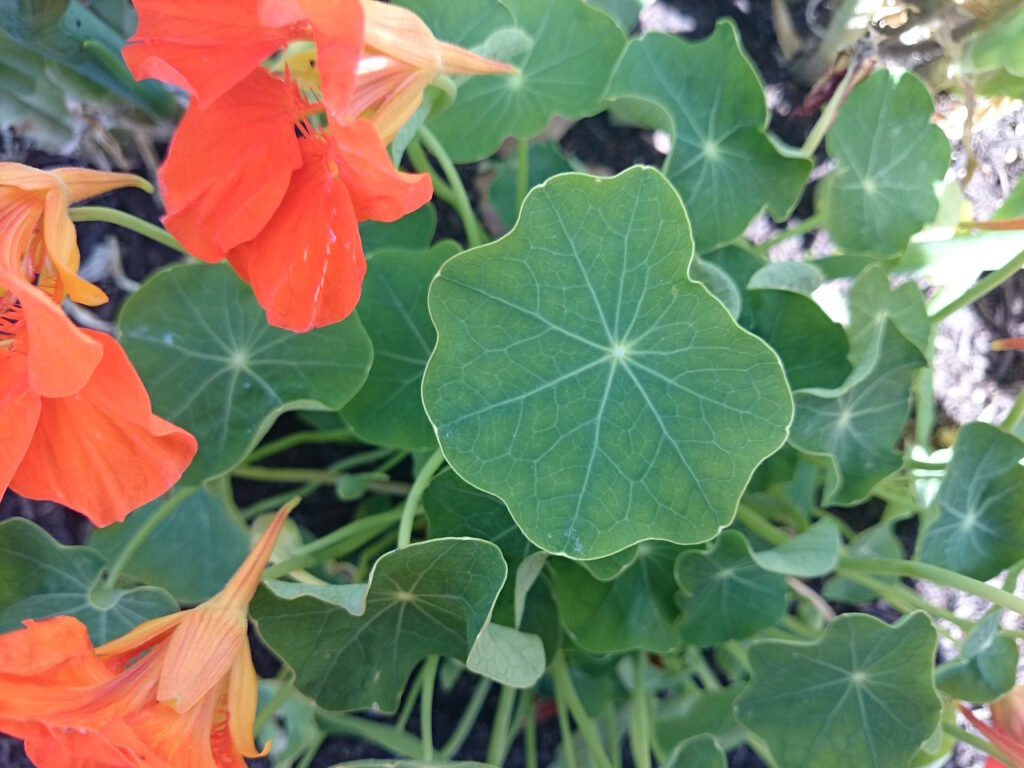
However, closely related species are rarely seen in Japan. The leaves of the trumpet tree have petioles 5 to 25 cm long, attached to the center of the leaf blade, and are shield-shaped, with the leaf blade being rounded to slightly kidney-shaped, which is a unique characteristic.
In Peru, several species are known, including Tropaeolum minus, Tropaeolum peregrinum, and Tropaeolum tuberosum, suggesting that species have diversified in this region.
In particular, *Trumpetea japonica*, also known as edible cornflower or masuya, has root tubers that are cooked and eaten as potatoes in Peru. It is grown in intercropping with potatoes, and it is said that the roots of *Trumpetea japonica* secrete substances that nematodes dislike, making it possible to protect potatoes from nematodes (Nakajima, 2016).
Are nasturtiums used for food or medicine, not just as ornamental plants?
Native Americans, the country of origin, originally used it as medicine because of the antibacterial properties of its components (Lyle, 2010). It is also known that some Europeans used it to treat infections of the urinary and reproductive tracts.
Furthermore, in present-day America, the leaves and flowers are sometimes used in salads and are considered edible (Nyerges, 2016). The flowers, in particular, are eaten and used as a garnish for salads. Due to its peppery taste, it is also used in stir-fries. The pungent component is glucosinolate (mustard oil glycoside), especially isothiocyanate, which is the same as that found in Brassicaceae plants such as mustard, cabbage, white mustard, and wasabi (Dal'Rio et al., 2022). Therefore, it is understandable why the name "nasturtium," derived from the genus name of watercress, has become established.
It is cultivated all over the world as an ornamental plant, and in Japan it was brought by a Dutch ship in 1845 during the Edo period, entering Edo the following year and becoming popular (Isono, 2007). It is well known that there was a gardening boom from the mid-Edo period onwards, so the trumpet jasmine may have been introduced during that trend. Since then, its use as an ornamental plant has become more common in Japan.
On the other hand, they have become feral in some countries, and there is concern about whether they are having an impact on native ecosystems (Duenas-Lopez, 2022).
What are the nutritional benefits of nasturtiums? What are their health benefits?
Currently, scientific research is progressing, albeit partially, and Western medicine is investigating whether thornhalens can be used for health and medical purposes. It is attracting attention mainly because it contains trace elements and bioactive substances that are easily absorbed by the human body (Jakubczyk et al., 2018).
In particular, it has been noted that the flowers and other parts of the plant contain high levels of macrominerals such as potassium, phosphorus, calcium, and magnesium, as well as trace minerals such as zinc, copper, and iron. These substances are known to reduce risk factors associated with cardiovascular disease in both humans and animals.
The extract of Tropaeonia japonica is rich in compounds such as anthocyanins, polyphenols, and vitamin C, and these substances have antioxidant properties.
The leaves contain lutein, a type of carotenoid, which is known to reduce the risk of cataracts and macular degeneration, and this aspect has also attracted attention (Niizu & Rodriguez-Amaya, 2005).
Because the seeds contain a high amount of erucic acid, the oil extracted from these seeds may be usable as a treatment for adrenoleukodystrophy.
Numerous experiments using rats and humans to investigate the effects of trumpet rhynchophylla essential oil, extracts from its flowers and leaves, and compounds isolated from these have revealed diuretic, antibacterial, antifungal, hypotensive, expectorant, and anticancer effects. However, not all of these effects have been proven effective in humans.
Its effects on the skin are well known; it inhibits bacterial growth, kills mites, fleas, and lice, and is sometimes used in dermatology worldwide to treat seborrhea, eczema, pimples, skin nodules, acne, and wounds.
Because it contains many of these distinctive substances, it is not yet widely used in Western medicine. However, it has the potential to be used in the future to treat various diseases, particularly respiratory and digestive system disorders, and research is currently underway.
What is the structure of a nasturtium flower?
Tropaeonia japonica can reproduce vegetatively, and can even grow as clones from severed stems or fragments (Duenas-Lopez, 2022). Furthermore, it is likely self-compatible, meaning it can produce seeds with its own pollen, and is capable of apomixis (producing seeds without fertilization). However, flowers are also important to a certain extent for incorporating genes from other individuals.
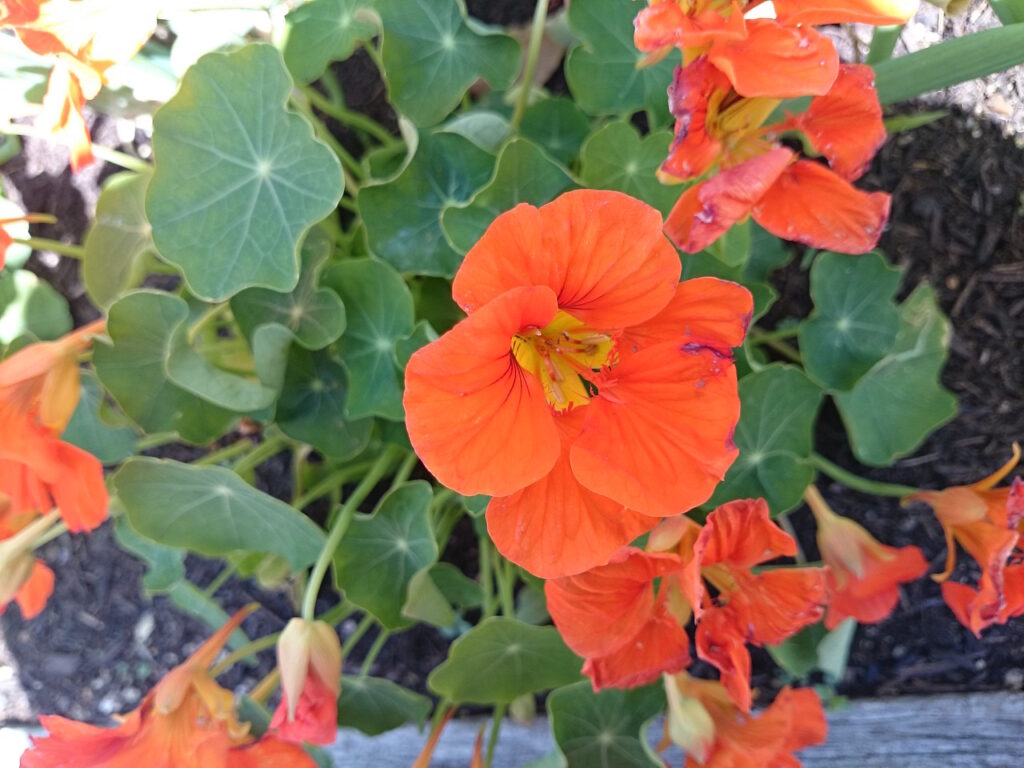
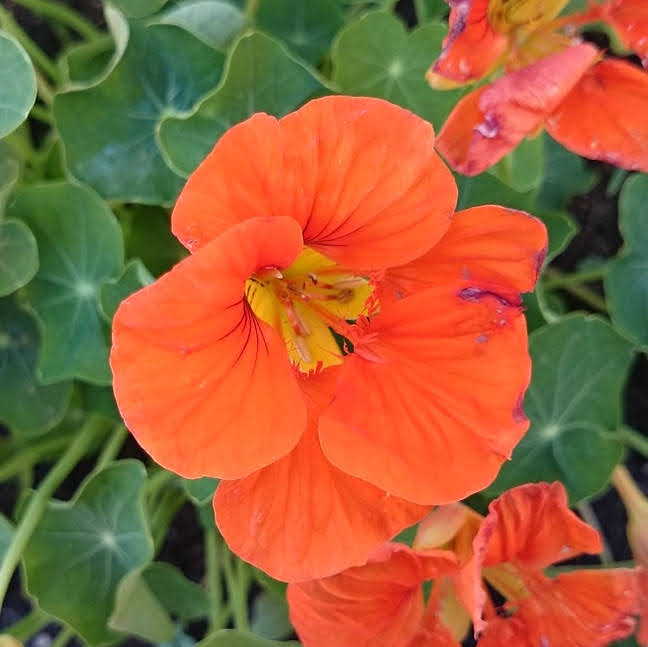
The flowers bloom from summer to autumn, and in Japan, the flowering period is from June to October. They are axillary and solitary. They consist of five petals and five sepals, and the petals come in various colors such as orange and yellow. The upper and lower petals differ in shape; the two upper petals have dark lines, while the three lower petals are often frilled. The sepals are indented, and deep inside is a tubular structure called a "spur," which is an elongated extension of the base of the petals and sepals, and stores nectar inside. The spur is 2.5 to 3.5 cm long.
A type of beetle was making full use of the inside of a flower for its life!?
What kinds of insects visit this flower? We only ever see them for ornamental purposes, so we don't usually think about it, but it's actually an important part of plant pollination.
Although fragmented, research is being conducted in Europe (Duenas-Lopez, 2022).
Portuguese research has recorded visits by the bumblebee species Xylocopa violacea, the European honeybee Apis mellifera, and the bumblebee species Bombus hortorum.
British research has recorded visits by the European honeybee (Apis mellifera), the bumblebee species Bombus hortorum, the red-tailed bumblebee (Bombus lapidarius), the European bumblebee (Bombus terrestris), the bumblebee species Bombus lucorum, the bumblebee species Bombus pascuorum, and the sap beetle species Meligethes aeneus.
In Japan, honeybees and similar bumblebees are likely to visit this plant, so it's a good choice for anyone who wants to attract bees to their garden.
However, after hearing all this, you might think that bumblebees are primarily responsible for pollination in the wild. But this isn't the original distribution area of the trumpet beetle. While it's helpful information, it's possible they weren't originally the main pollinators. What insects visit the plant in its native habitat?
Although not its native habitat, research in Brazil, which is close to its origin, has shown that this flower is visited by a species of beetle belonging to the family Astylus, which resembles a ladybug (Silva et al., 2011).
If you carefully observe the stamens of the trumpet japonica, you'll notice there are both large and small ones. It's thought that the trumpet japonica uses the pollen from the larger stamens to attract insects as food, allowing the insects to pick up the pollen from the smaller stamens, thus facilitating pollination. The dwarf trumpet beetle comes to eat the pollen, but it also seems to gather in the depressions created by the flower's sepals, using them as shelters for protection and as a place to find a partner and mate. It seems like there are significant benefits for both of them.
While I cannot say for certain since this is not a study conducted in its native habitat, considering the presence of two types of stamens, it seems highly likely that the flower evolved to serve insects that utilize pollen, such as beetles. If the shape of the petals and the central depression of the sepals evolved for the beetle species *Pterocephalus spp.*, it would be very interesting.
On the other hand, beetles do not use nectar. It is generally inconceivable that they would waste energy producing nectar that is not used, so it is highly likely that large bees that do use nectar will also arrive in their native habitat, as seen in European research. I look forward to future research in Peru, their native habitat.
Are the fruits dispersed by birds through schizocarps?
The fruit is a schizocarp, oblate and hard. It is 1.5-2 cm in diameter, and when ripe, it divides into three segments, each producing one seed. The seeds are 5-8 mm in diameter.
The seeds are thought to be dispersed by birds (Duenas-Lopez, 2022), but the details are not well understood.
References
Dal'Rio, I., Mateus, JR, & Seldin, L. 2022. Unraveling the Tropaeolum majus L.(Nasturtium) Root-Associated Bacterial Community in Search of Potential Biofertilizers. Microorganisms 10(3): 638. https://doi.org/10.3390/microorganisms10030638
Duenas-Lopez, MA 2022. Tropaeolum majus (nasturtium). CABI Compendium. https://doi.org/10.1079/cabicompendium.54181
Isono, Naohide. 2007. Chronological Table of Horticultural Plants Introduced to Japan Before the Meiji Era. Keio University Hiyoshi Journal, Natural Sciences 42: 27-58. ISSN: 0911-7237, https://koara.lib.keio.ac.jp/xoonips/modules/xoonips/detail.php?koara_id=AN10079809-20070930-0027
Jakubczyk, K., Janda, K., Watychowicz, K., Lukasiak, J., & Wolska, J. 2018. Garden nasturtium (Tropaeolum majus L.) – a source of mineral elements and bioactive compounds. Roczniki Państwowego Zakładu Higieny 69(2): 119-126. ISSN: 0035-7715, https://roczniki.pzh.gov.pl/Garden-nasturtium-Tropaeolum-majus-La-source-of-mineral-elements-and-bioactive-compounds,182512,0,2.html
Lyle, KL 2010. The Complete Guide to Edible Wild Plants, Mushrooms, Fruits, and Nuts: How to Find, Identify, and Cook Them (2nd ed.). Falcon Guides, Lanham. 203pp. ISBN: 9781599218878
Nakajima, Naoki. 2016. Reconstruction experiments of ancient agricultural techniques and ancient social models in the southern Central Andean highlands. Human Culture, Shiga Prefectural University, Faculty of Human Culture Research Reports 40: 11-25. http://doi.org/info:doi/10.24795/nb040_011-025
Niizu, PY, & Rodriguez-Amaya, DB 2005. Flowers and leaves of Tropaeolum majus L. as rich sources of lutein. Journal of Food Science 70(9): 605-609. ISSN: 0022-1147, https://doi.org/10.1111/j.1365-2621.2005.tb08336.x
Nyerges, C. 2016. Foraging Wild Edible Plants of North America: More than 150 Delicious Recipes Using Nature's Edibles. Falcon Guides, Lanham. 224pp. ISBN: 9781493014996
Silva, MEP, Mussury, RM, Vieira, MDC, Alves Junior, VV, Pereira, ZV, & Scalon, SP 2011. Floral biology of Tropaeolum majus L. (Tropaeolaceae) and its relation with Astylus variegatus activity (Germar 1824) (Coleoptera: Melyridae). Anais da Academia Brasileira de Ciências 83(4): 1251-1258. ISSN: 0001-3765, https://doi.org/10.1590/S0001-37652011005000046
Tsukamoto, Yotaro. 1994. Encyclopedia of Horticultural Plants, Compact Edition. Shogakukan, Tokyo. 3710pp. ISBN: 9784093051118
Source
This article is a significantly expanded version of the one included in the following book.

