While the names of *Lithospermum erythrorhizon* and *Lithospermum erythrorhizon* are similar and sometimes confused, there is a significant difference: *Lithospermum erythrorhizon* is a native species, while *Lithospermum erythrorhizon* is a cultivated variety. The leaf and flower shapes are also distinctly different. There are two theories about the origin of the name *Lithospermum erythrorhizon*: one is that it comes from the reddish shading at the base of the flower's spur, and the other is that the flower's color appears somewhat fluorescent and it blooms sporadically here and there. Recent research has shown that both *Lithospermum erythrorhizon* and *Lithospermum erythrorhizon* have flowers adapted to attract insects with long mouths. Surprisingly, *Lithospermum erythrorhizon* relies on bees and flies for pollination in sunny locations, but in shady areas, it relies on a completely different insect, *Eristalis japonica*, for pollination. The fruit is a nut, and based on research on closely related species, it is thought to be dispersed by birds. This article will explain the classification, history, and pollination ecology of *Lithospermum erythrorhizon* and *Lithospermum erythrorhizon*.
- Lithospermum erythrorhizon is a native species, while Lithospermum erythrorhizon is a cultivated variety.
- The name is said to come from the flower, but are there two theories?
- Long-nosed insects are attracted to the bellflower.
- The secret to pollination even in the shade?
- A similar trend is observed in the flowers of *Lithospermum erythrorhizon*.
- Are the fruits nuts and dispersed by birds?
- References
Lithospermum erythrorhizon is a native species, while Lithospermum erythrorhizon is a cultivated variety.
Lithospermum zollingeri, also known as firefly vine, is a perennial herb distributed in Korea, China, Taiwan, and Hokkaido, Honshu, Shikoku, and Kyushu in Japan, inhabiting sunny grasslands and dry woodlands (Kadota et al., 2013; Kanagawa Prefecture Flora Survey Association, 2018). Its most distinctive features are that the entire plant is covered in coarse hairs and, as its name suggests, it produces creeping stems. In my own experience, I often see it growing and blooming along the edges of forests, such as on mountain paths.
On the other hand, Glandora diffusa, also known as mountain firefly vine, is a perennial plant native to Europe (France, Portugal, Spain) and West Asia (Morocco), growing on sandy beaches along the coast, in pine forests, and near bushes. In Japan, it is cultivated for ornamental purposes.
The main difference between *Lithospermum erythrorhizon* and *Lithospermum erythrorhizon* is that *Lithospermum erythrorhizon* is a native species, while *Lithospermum erythrorhizon* is a cultivated variety. The leaves of *Lithospermum erythrorhizon* are narrowly oblong, while those of *Lithospermum erythrorhizon* are thin, small, and stiff. Also, regarding the flowers, *Lithospermum erythrorhizon* has five white ridges, but *Lithospermum erythrorhizon* does not.
Although their names are similar and they both belong to the Boraginaceae family, current classifications place them in different genera, and with careful observation, the two species are indistinguishable.

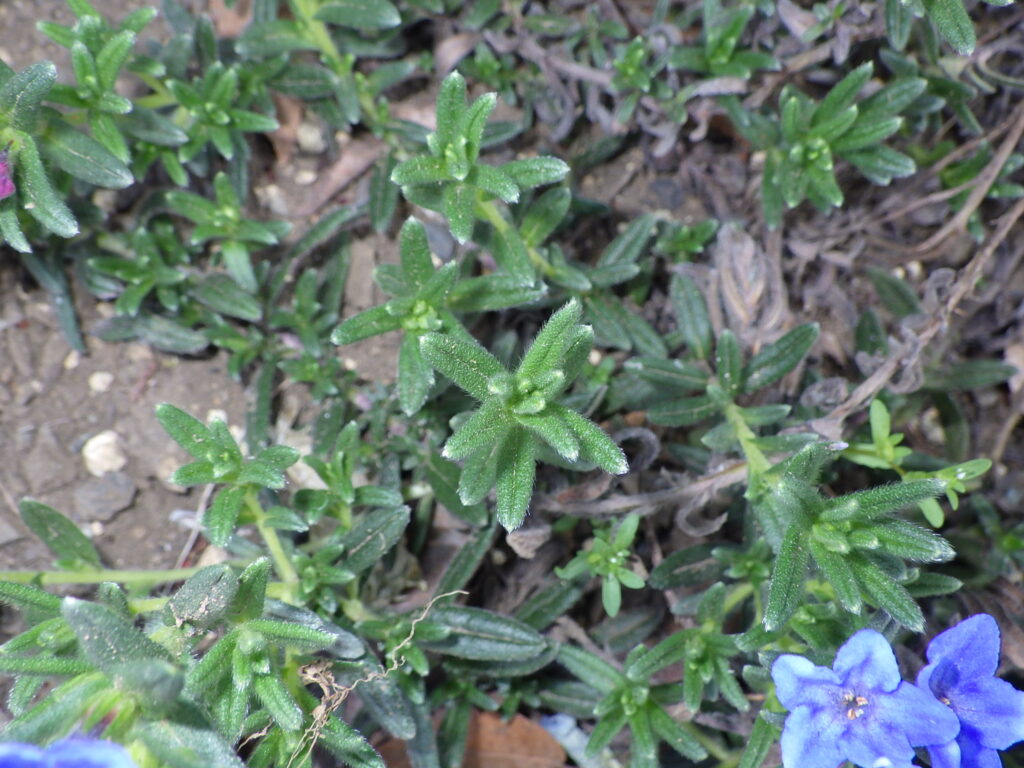
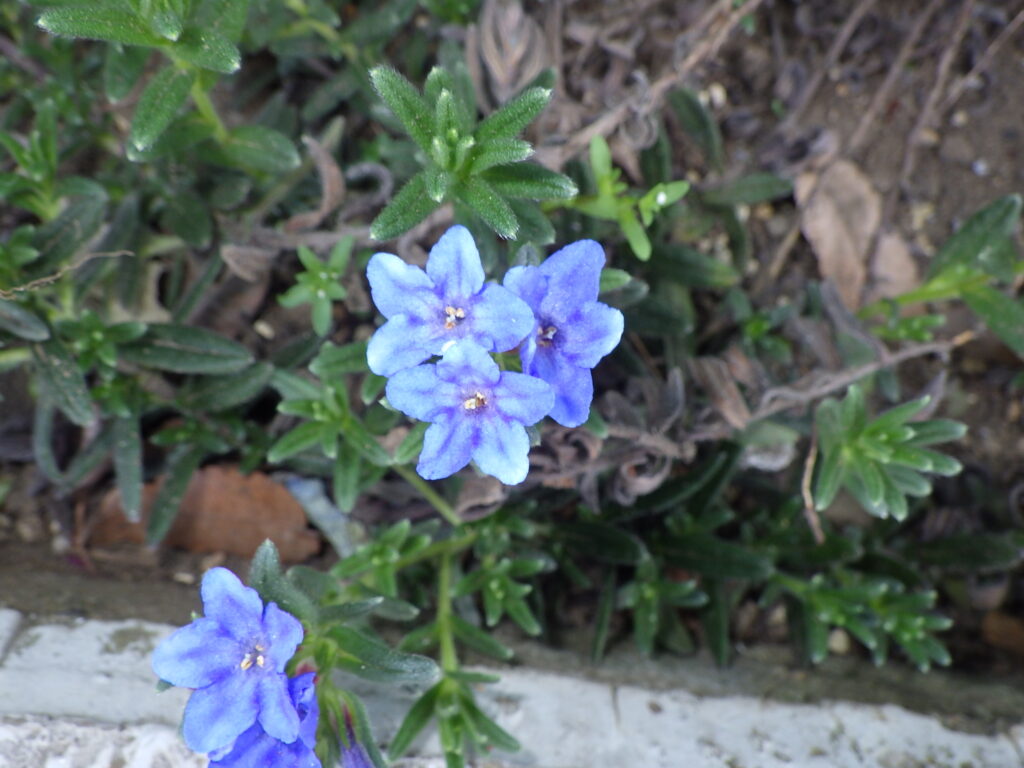
The name is said to come from the flower, but are there two theories?
Although the Japanese bellflower (Lithospermum erythrorhizon) has relatively conspicuous flowers, historically it doesn't seem to have received the same level of attention from people as its relative, the purple bellflower (Lithospermum erythrorhizon). However, it has small, blue flowers that are quite rare in the mountains, giving it a charming appearance.
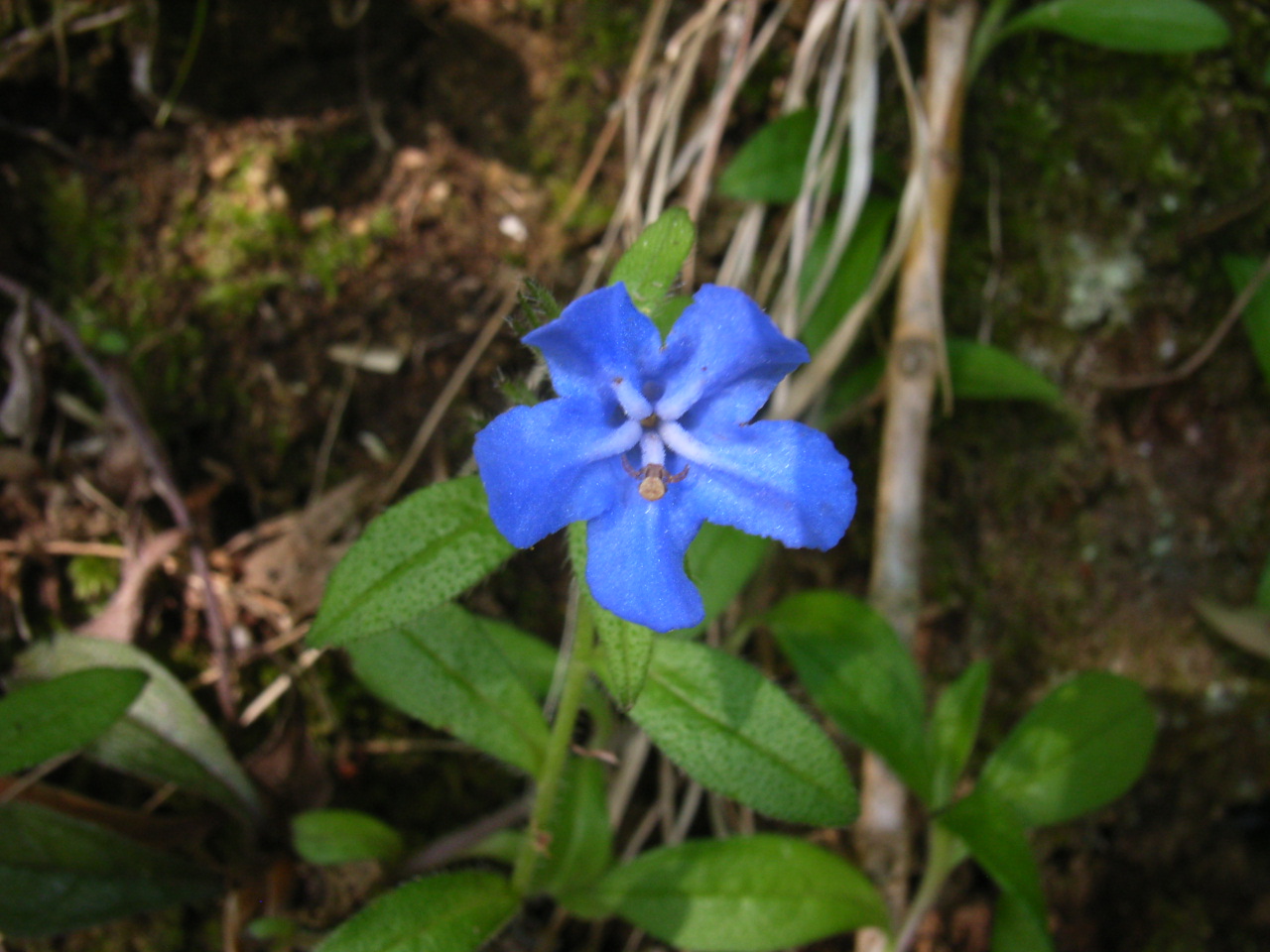
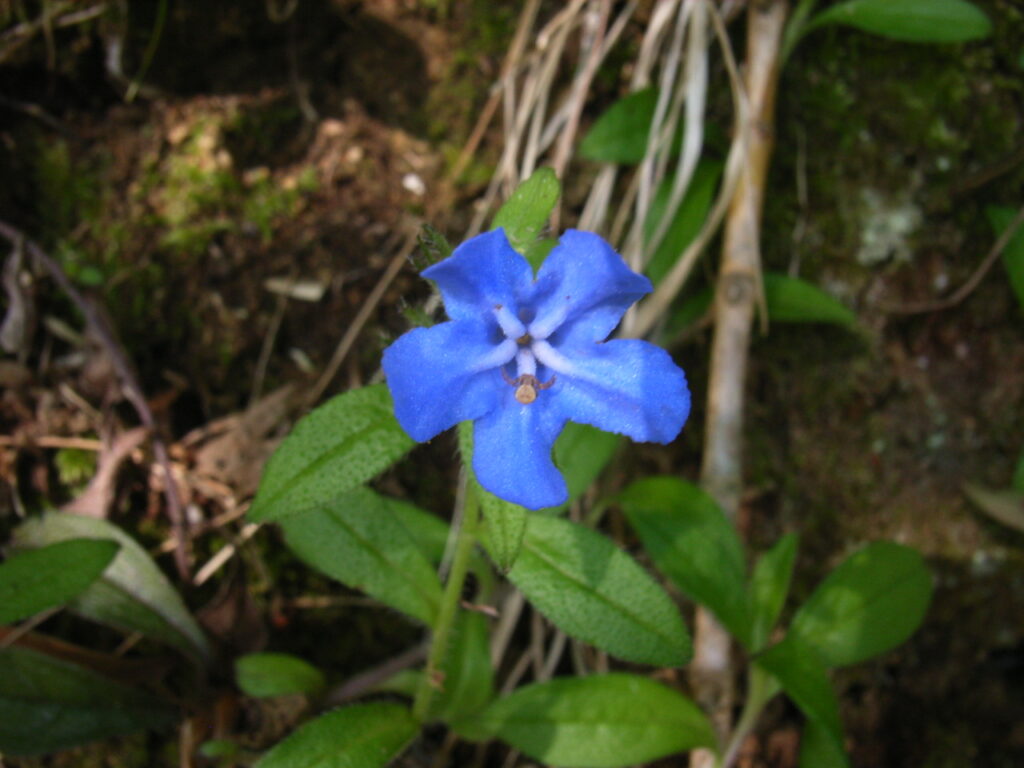
The flowers of the Japanese bellflower bloom in spring from April to June. The corolla is a vivid blue to bluish-purple, deeply divided into five lobes that spread flat, with five white ridges along the center of each lobe.
The flowers of *Lithospermum erythrorhizon* bloom in spring, from April to May. The corolla is blue, with five shallow lobes that spread flat, and there is no white ridge in the center of the lobes.
In both species, the spur (the tubular part of the petal) is long, suggesting that only insects with long mouths can access the nectar. The base of the spur has a reddish tint, and although the purpose of this red tint has not been proven, it may serve to attract insects with long mouths to the location of the nectar.
One theory about the origin of the name is that the flower's color appears somewhat fluorescent, and because it blooms sporadically here and there, it was likened to a firefly. Another theory is that the reddish hues were likened to the light of a firefly (Takahashi, 2018).
Long-nosed insects are attracted to the bellflower.
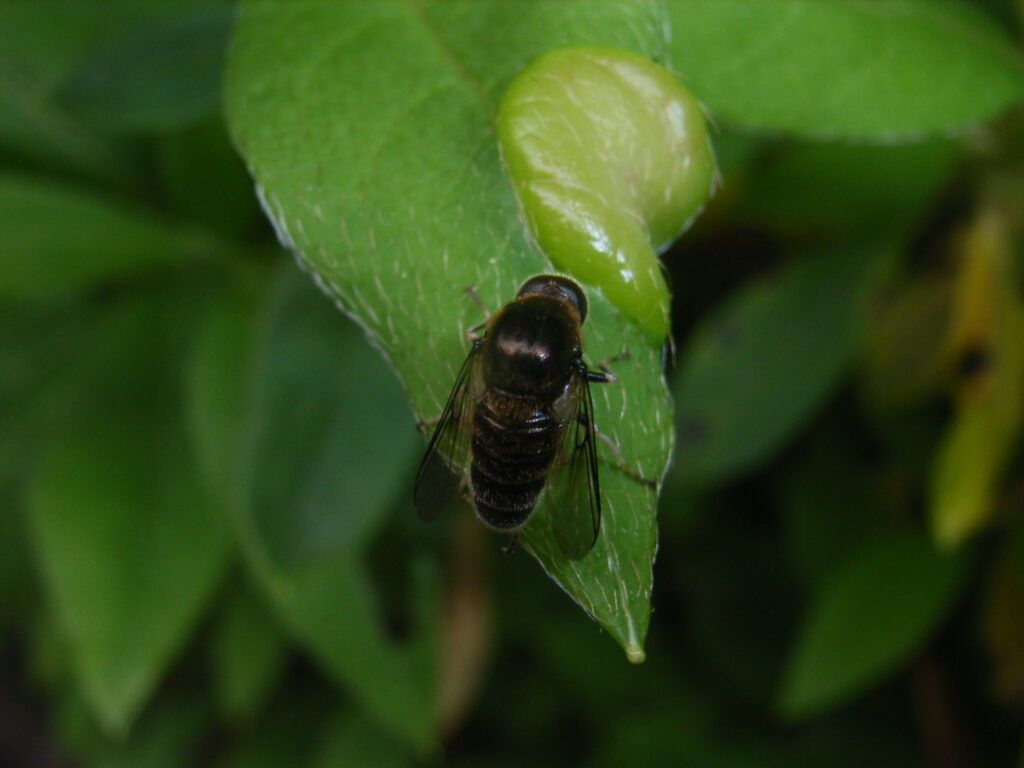
In recent years, detailed research has been conducted in Japan on the insects that visit the flowers of the Japanese bellflower (Lithospermum erythrorhizon) (Ushimaru et al., 2021). This study recorded 380 instances of insects visiting the flowers in Hyogo Prefecture. The results showed that the visiting insects were primarily the Japanese long-horned bee (54%), the velvet bee fly (27%), and the Japanese pygmy hoverfly (16%), suggesting that these three species are responsible for the majority of pollination. There were only a few records of carpenter bees and butterflies visiting the flowers. All three species are insects with long mouths, and they are numerous in Japan, busily visiting flowers in sunny spots, making them well-suited to the habitat of the Japanese bellflower.
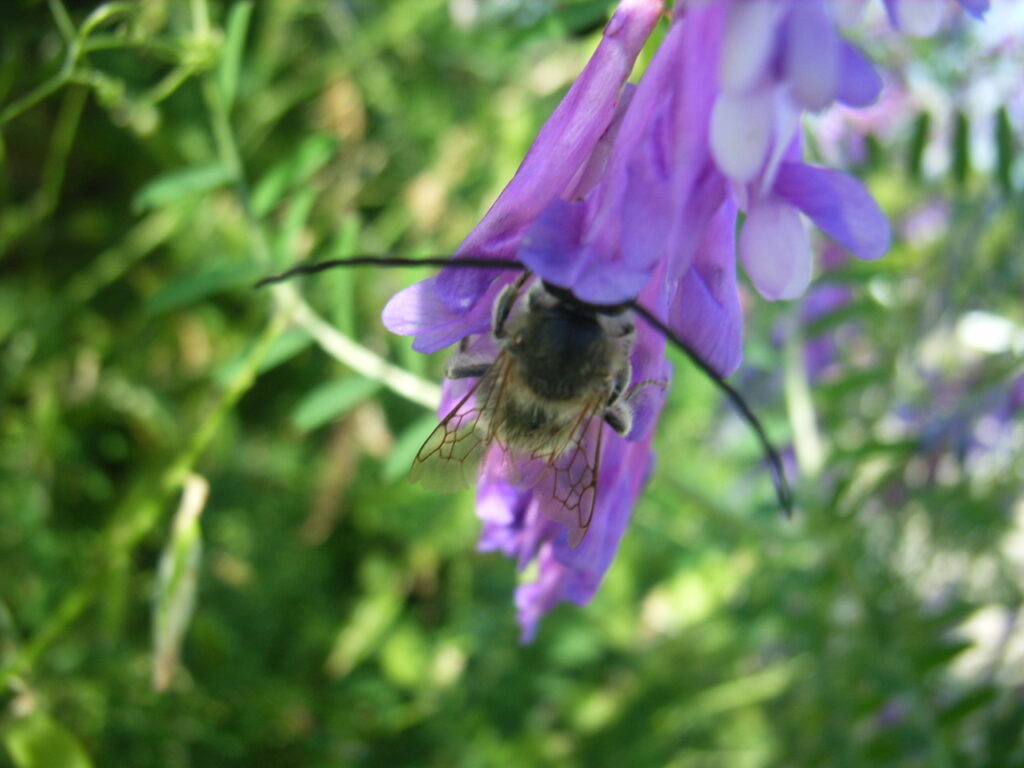
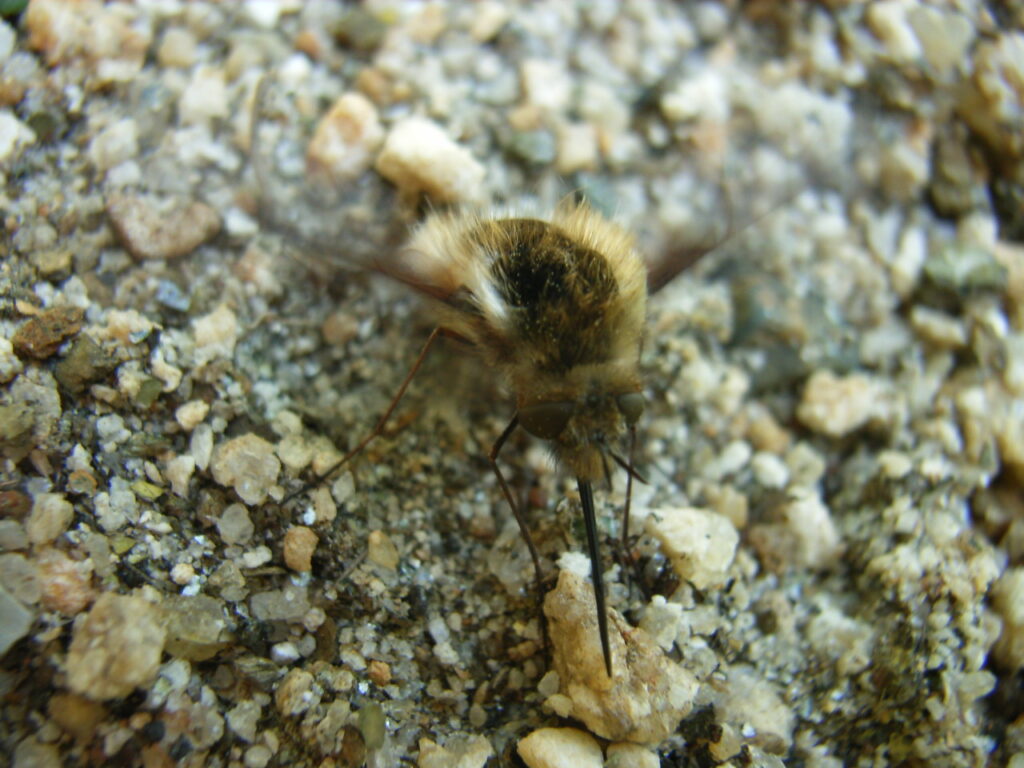
The secret to pollination even in the shade?
This study aimed not only to investigate the types of insects that visit the flowers, but also to examine whether the number of insects visiting the flowers of small herbaceous plants like Lithodora erythrorhizon decreases when they are overgrown by neighboring herbaceous plants or shrubs, or when they are shaded by tall trees. For small herbaceous plants like Lithodora erythrorhizon, if they are overgrown by other plants or shaded by other plants, insects may not be able to see the flowers, and the temperature may drop, making it too cold for insects that are active in the sun, which could hinder pollination. It is also possible that other plants may physically obstruct the way, preventing insects from getting close to the flowers.
The results of experiments conducted based on this idea also supported this hypothesis. However, it was found that the effects varied among the different types of insects. The Japanese long-horned bee and the velvet bee fly were greatly affected, but the Japanese pygmy hoverfly was relatively less affected and was the only insect found on shaded flowers. The reason for this is thought to be that the Japanese pygmy hoverfly has a black body and is better at maintaining its body temperature than other insects.
This result suggests that the Lithodora erythrorhizon, which normally blooms in full sun, may be able to reproduce even in the shade by relying on the Japanese pygmy hoverfly for pollination. This demonstrates the resilience of the Lithodora erythrorhizon, which is quite fascinating!
However, being covered by other plants would likely have a significant negative impact on small herbaceous plants like the Japanese bellflower. While it's preferable to leave them in their natural state, in forests that have been managed by humans, appropriate maintenance may sometimes be necessary.
A similar trend is observed in the flowers of *Lithospermum erythrorhizon*.
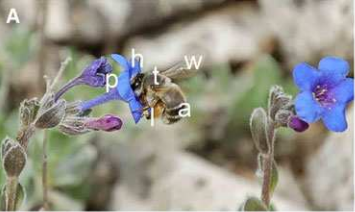
On the other hand, research in Spain has shown that the insects that visit *Lithodora flabellata* are predominantly three species: *Bombus pascuorum *, * Anthophora sp.*, and * Bombylius sp.* (Ferrero et al., 2011). It is surprising that the results are similar to those for *Lithodora flabellata* in Japan, even in far-off Spain. This is probably because the shape of the *Lithodora flabellata* flower resembles that of *Lithodora flabellata*.
On the other hand, insects that frequent shaded areas, such as the Japanese pygmy hoverfly (Lymantria dispar), were not found in this study. It is unclear whether this is due to biases in the study's observations, or because of subtle differences in the habitat or the shape of the flowers compared to Lithodora rhododendron, but it is an intriguing phenomenon.
Are the fruits nuts and dispersed by birds?
The nuts of *Lithospermum erythrorhizon* are divided into four segments, each white to pale yellowish-brown, oblate in shape, 2.5–3–3.5 mm long, smooth, glossy, with a concave ventral surface and a longitudinal groove down the center.
The nuts of *Lithospermum erythrorhizon* are schizocarps, measuring 2.5–3 mm in length and 1.5–2.5 mm in width, ovate to obtuse, smooth (with fine warts), white or whitish-gray, and glossy.
It appears that the method of seed dispersal has not been investigated. However, the fruit is clearly white and conspicuous to animals, and furthermore, in Sweden, an experiment (Åberg, 2015) showed that the germination rate increased when seeds of Lithospermum officinale, which has fruit of a nearly identical color, were subjected to chemical treatment (soaking in acid) and mechanical damage (scratching the seeds with sandpaper). Therefore, it is certain that these species are also dispersed by birds. Further investigation into specific bird species is needed.
References
Åberg, A. 2015. Could Lithospermum officinale be bird dispersed?: A greenhouse experiment [Master’s thesis, Uppsala University]. https://urn.kb.se/resolve?urn=urn%3Anbn%3Ase%3Auu%3Adiva-264350
Ferrero, V., Castro, S., Sánchez, JM, & Navarro, L. 2011. Stigma–anther reciprocity, pollinators, and pollen transfer efficiency in populations of heterostylus species of Lithodora and Glandora (Boraginaceae). Plant Systematics and Evolution 291(3): 267-276. https://doi.org/10.1007/s00606-010-0387-x
Kadota, Y., Nagata, Y., & Azegami, N. 2013. Flowers Blooming in the Mountains (Revised and Expanded New Edition). Yama-kei Publishers, Tokyo. 616pp. ISBN: 9784635070218
Kanagawa Prefecture Flora Survey Association. 2018. Kanagawa Prefecture Flora 2018 (Electronic Edition). Kanagawa Prefecture Flora Survey Association, Odawara. 1803pp. ISBN: 9784991053726
Takahashi, Katsuo. 2018. Names of Wildflowers in Spring: Origins of Japanese Names and How to Identify Them. Yama-kei Publishers, Tokyo. 240pp. ISBN: 9784635048347
Ushimaru, A., Rin, I., & Katsuhara, KR 2021. Covering and shading by neighboring plants diminish pollinator visits to and reproductive success of a forest edge specialist dwarf species. Plant Biology 23(5): 711-718. ISSN: 1435-8603, https://doi.org/10.1111/plb.13267