Malpighi and Kadsun-kadsura are two of the most popular species in Japan belonging to the Malpighiaceae family, and are often cultivated as ornamental plants in gardens, but they are also frequently confused. The biggest difference between them is that Malpighi is an evergreen shrub, while Kadsun-kadsura is a woody vine, but they can also be distinguished to some extent by their pedicels and leaves. These two very similar species have followed completely different paths in the New World and Old World to reach their current forms. Originally, the ancestors of the Malpighiaceae family relied on a special type of bee that liked oil for pollination, but as they spread to various regions, they reverted to having more conventional flowers. This article will explain the classification, pollination ecology, and seed dispersal of Malpighi and Kadsun-kadsura.
- What are Kintora-no-o and Koushunkazura?
- What is the difference between Kintora-no-o and Koshun-kazura?
- Did the common ancestor of the Malpighiaceae family secrete oil?
- Flowers that have reverted to their ancestral form.
- Despite following completely different paths, the flowers of *Kinpuranoo* and *Koushunkazura* are similar.
- The fruit is a schizocarp, and the seeds are dispersed by wind or water currents.
- References
- Source
What are Kintora-no-o and Koushunkazura?
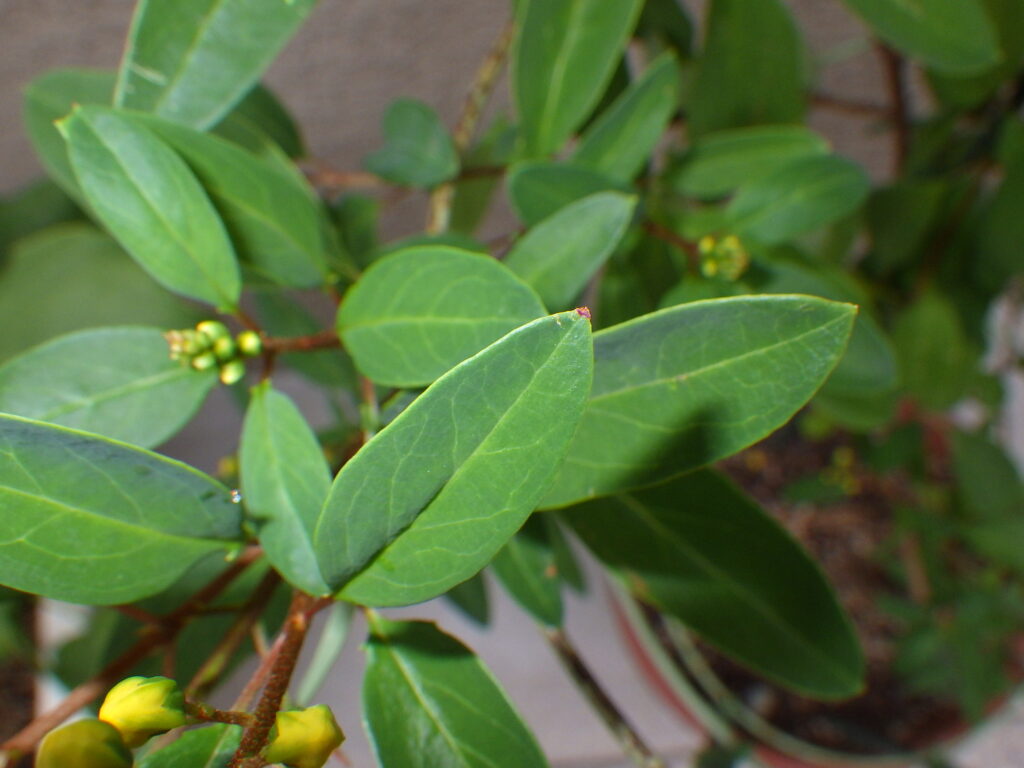
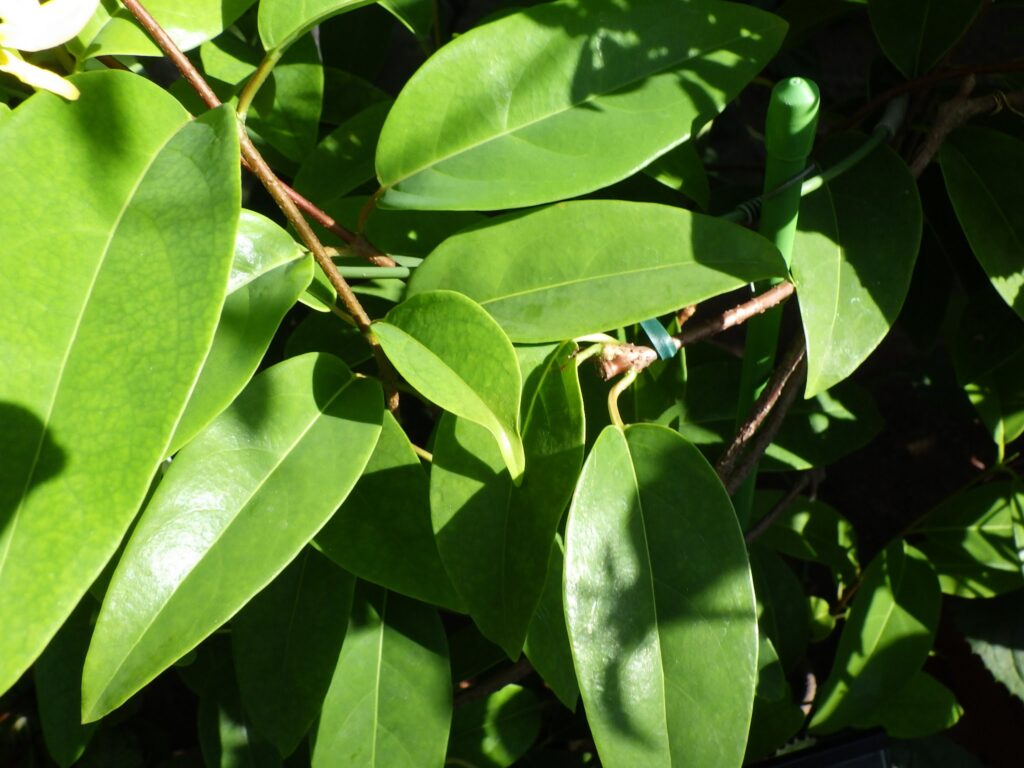
Galphimia glauca, also known as "golden tiger's tail" in Japanese, is an evergreen shrub native to Mexico and Central America, and naturalized in the United States (Florida), Cuba, St. Croix, and Peru. In Japan, it is cultivated as an ornamental plant. It grows in forests, dry areas, and along roadsides.
Tristellateia australasiae, also known as Koshunkazura, is a woody vine distributed in Malaysia, Thailand, southern Vietnam, tropical Australia, the Pacific Islands, Taiwan, and in Japan south of Okinawa Prefecture (Wu et al., 2008; Okawa & Hayashi, 2016). It is also commonly cultivated as an ornamental plant.
In Japan, these two species are well-known for their use in horticulture, belonging to the Malpighiaceae family. However, they are often confused, and there seems to be a lot of confusion on the internet, with few people able to correctly distinguish between them.
What is the difference between Kintora-no-o and Koshun-kazura?
The most distinctive difference between *Kintoranoo* (a type of evergreen shrub) and *Koushunkazura* (another type of evergreen vine) is that *Kintoranoo* is an evergreen shrub that grows independently, while *Koushunkazura* is a woody vine that twines around other plants or objects. Therefore, they can be distinguished to some extent by their appearance.
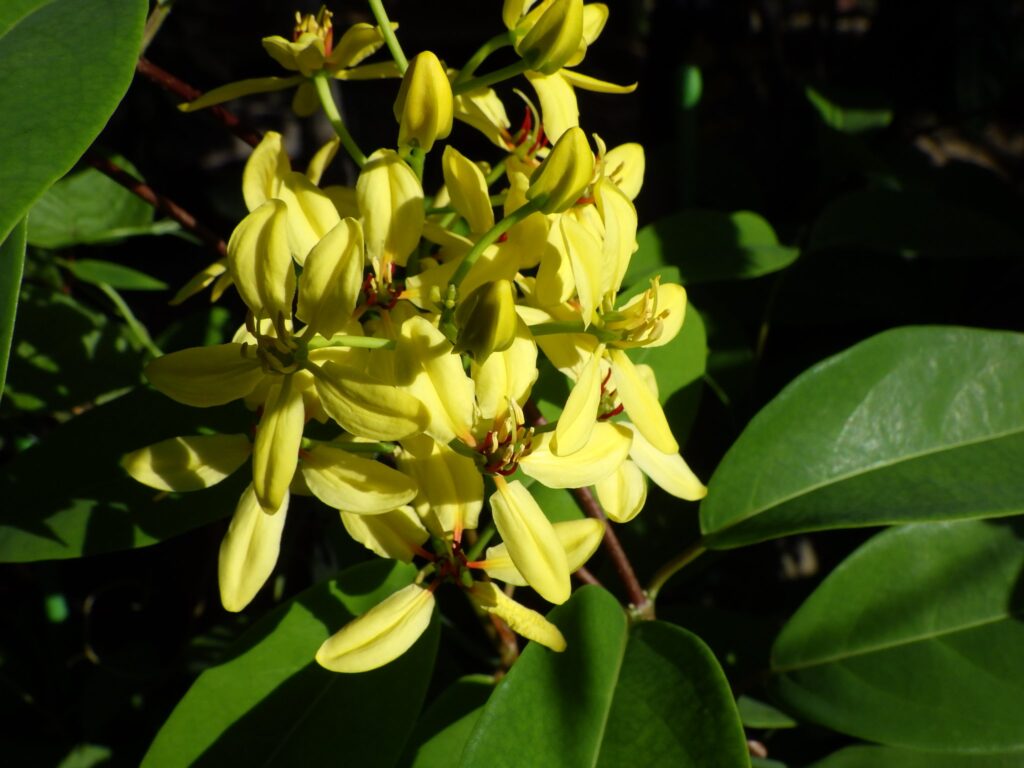
The difference becomes even clearer when the plants are in bloom. The pedicels (the thin parts to which the flowers are attached to the plant body) are only 8-12 mm long in *Pteris crassirhizoma* (Rojas-Sandoval, 2017), while they are considerably longer in *Pteris crassirhizoma*, measuring 15-30 mm (Wu et al., 2008).
The leaves are a little difficult to distinguish, but the leaves of *Koushunkazura* seem to have a slightly stronger sheen. If you check these points, you should be able to distinguish them for sure.
In North America, the species Galphimia gracilis is sometimes confused with Malpighi when used in horticulture.
According to the identification key (Anderson, 2007), *Galphimia gracilis* has petals that spread below the fruit and remain even after the fruit falls off, with lateral petal margins 7.5–15.5 mm long, no calyx glands, and a glossy ovary and fruit. In contrast, *Galphimia gracilis * has petals that fall off, with lateral petal margins 4.5–8.5 mm long, with or without calyx glands, and a hairy or glossy ovary and fruit. As far as I can confirm, the Japanese species appears to be *Galphimia gracilis*, but there is a possibility of interbreeding, so caution is advised.
Did the common ancestor of the Malpighiaceae family secrete oil?
The common ancestor of the Malpighiaceae family, which includes Malpighi japonica and Kadshunkasura, diversified in the New World (the Americas). However, many of its flowers do not produce nectar but secrete oil, specializing in attracting certain types of bees that prefer it, resulting in a very unique relationship that is unlikely to be seen in Japan (Zhang et al., 2012). These bees mix the oil with pollen and use it as food for their larvae (Anderson, 1979).
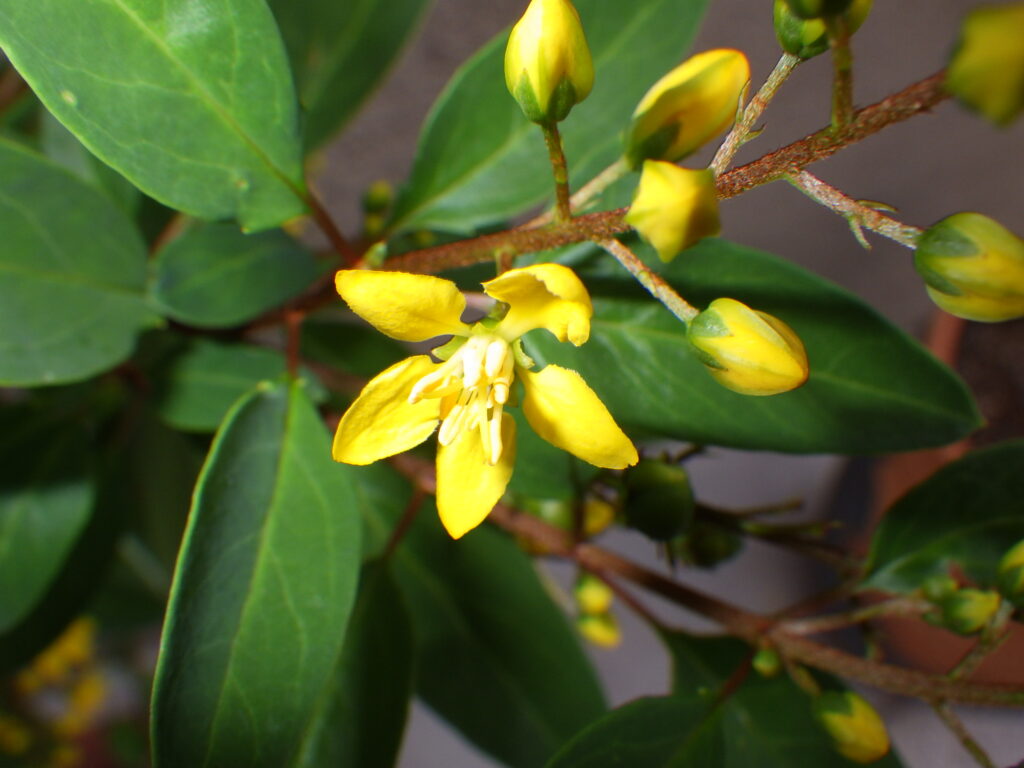
The flower's shape is generally characterized by five lobes, often composed of frilly petals that narrow at the base. When viewed from the front, there are many gaps, making it a rather unusual shape.
Flowers that have reverted to their ancestral form.
However, after some of these species migrated from the New World to the Old World (Eurasia and Africa), evolution occurred and the appearance of their flowers changed dramatically (Zhang et al., 2012). These species have undergone a "reversion" to their ancestral form, developing the common radially symmetrical flowers familiar in Japan, such as cherry blossoms, and secreting nectar as usual.
In particular, members of the genus Tristellateia, which includes *Koushunkazura*, have undergone dramatic changes. They look just like ordinary flowers and even secrete nectar. The anthers, which are the pollen-producing parts of the stamens, have also become larger, which likely increases their role as food for insects. This kind of "atavism" evolution has occurred seven times in different locations in the Old World.
So what about *Pteris crassirhizoma*, which is distributed in the New World?
In the genus to which *Pteris crassirhizoma* belongs, for some reason—perhaps because there are no bees that seek its oil in the New World—it evolved independently of the Old World species, becoming more like a normal flower. Its anthers have grown larger and it no longer produces oil.
It turns out that *Koushunkazura* and *Kintranoo* evolved into similar forms in completely different locations!
Despite following completely different paths, the flowers of *Kinpuranoo* and *Koushunkazura* are similar.
Golden lance (Primula japonica) produces racemes of yellow flowers from June to November. The flowers have five lobes and are arrowhead-shaped or ovate.
Kadsura japonica produces racemes in August (April to December in warmer regions), bearing somewhat pale yellow flowers with five-lobed, arrowhead-shaped ovate petals (Wu et al., 2008).
They are quite similar, but as mentioned above, they are similar because they have completely different origins.
No specific records of flower visitors were found for *Pteris crassirhizoma*.
In *Carex kobus*, there is one record each of unidentified bee species in New Caledonia and Singapore (Donovan et al, 2013; Soh et al., 2013), and one record of a dwarf honeybee in India (Shivalingaswamy et al., 2020).
While we cannot say for certain due to the limited information, it is natural to assume that the bees have adapted to bees that rely heavily on nectar and pollen, similar to the common honeybees found in the Old World, given the near absence of oil-loving bees found in the New World.
It's a flower that's unusual precisely because it's an "ordinary flower." Perhaps that's a little philosophical!
The fruit is a schizocarp, and the seeds are dispersed by wind or water currents.
Malpighi has schizocarps (coccus) that are dispersed by wind and water (Rojas-Sandoval, 2017).
Since the fruit of *Koushunkazura* is a samara (winged fruit) and mericarps (segmented fruit), it is likely that dispersal occurs by wind.
References
Anderson, WR 1979. Floral conservatism in neotropical Malpighiaceae. Biotropica 11(3): 219-223. ISSN: 0006-3606, https://doi.org/10.2307/2388042
Donovan, BJ, Munzinger, J., Pauly, A., & McPherson, G. 2013. Flower-Visiting Records of the Native Bees of New Caledonia. Annals of the Missouri Botanical Garden 99(1): 19-43. ISSN: 0026-6493, https://doi.org/10.3417/2010076
Rojas-Sandoval, J. 2017. Galphimia glauca (goldshower). CABI Compendium. https://doi.org/10.1079/cabicompendium.119814
Okawa, Satoshi & Hayashi, Masayuki. 2016. Trees of the Ryukyu Islands: An Illustrated Guide to Subtropical Plants of Amami, Okinawa, and Yaeyama. Bun-ichi Sogo Shuppan, Tokyo. 487pp. ISBN: 9784829984024
Shivalingaswamy, TM, Udayakumar, A., Gupta, A., & Anjanappa, R. 2020. Non-Apis bee diversity in an experimental pollinator garden in Bengaluru–a Silicon Valley of India. Sociobiology 67(4): 593-598. ISSN: 2447-8067, https://doi.org/10.13102/sociobiology.v67i4.5023
Soh, ZWW, & Ngiam, RWJ 2013. Flower-visiting bees and wasps in Singapore parks (Insecta: Hymenoptera). Nature in Singapore 6: 153-172. ISSN: 2010-0515, https://lkcnhm.nus.edu.sg/wp-content/uploads/sites/11/app/uploads/2017/06/2013nis153-172.pdf
Wu, ZY, Raven, PH, & Hong, DY (Eds.). 2008. Flora of China (Vol. 11 Oxalidaceae through Aceraceae). Science Press, Beijing, and Missouri Botanical Garden Press, St. Louis. 622pp. ISBN: 9781930723733
Zhang, W., Kramer, EM, & Davis, CC 2012. Similar genetic mechanisms underlie the parallel evolution of floral phenotypes. PloS One 7(4): e36033. ISSN: 1932-6203, https://doi.org/10.1371/journal.pone.0036033
Source
This article is a significantly expanded version of a piece included in the following book.