Common chickweed (Stellaria media), green chickweed (Stellaria media var. japonica), and large chickweed (Stellaria media var. japonica) all belong to the genus Stellaria in the family Caryophyllaceae, and are representative Japanese weeds that can almost certainly be found along roadsides. In Japan, they are one of the seven spring herbs and are familiar to many as part of the seven-herb rice porridge. However, these three species are usually simply referred to as "chickweed," and few people may correctly identify them beyond that. The most accurate way to distinguish these three species is to check the number of stamens and the number of styles on the pistil. However, since they are very small, the size of the leaves and the color of the calyx can also be helpful. Common chickweed and green chickweed are very similar, but they differ not only in shape but also in ecology. It is known that common chickweed has evolved to prioritize "quantity over quality," while green chickweed has evolved to prioritize "quality over quantity." This article will explain the classification, morphology, and ecology of the genus Stellaria.
What are common chickweed, green chickweed, and cow chickweed?
Stellaria media, also known as chickweed, is native to Eurasia and North Africa and has naturalized in Japan, specifically in Hokkaido, Honshu, Shikoku, Kyushu, the Ryukyu Islands, and the Ogasawara Islands. It is a biennial plant that grows in fields and near urban areas.
Stellaria neglecta, also known as green chickweed, is a biennial plant found in fields and urban areas, distributed throughout Japan (Hokkaido, Honshu, Shikoku, Kyushu, and Ryukyu Islands), Europe, Asia, and Africa.
Stellaria aquatica, also known as cow chickweed, is distributed in Hokkaido, Honshu, Shikoku, and Kyushu in Japan; Eurasia and North Africa; and has naturalized in North America. It is a biennial, sometimes perennial, herb that grows in relatively damp places such as roadsides, fields, and riverbanks.
Both belong to the genus Stellaria in the family Caryophyllaceae, and are representative Japanese weeds that can almost certainly be found if you observe the roadside.
Although it is often called "hakobe," there is currently no biological or taxonomic species called "hakobe," and it is common to use the term collectively to refer to both common chickweed (Stellaria media) and green chickweed (Stellaria media var. japonica). However, what was called "hakobe," "hakobera," or "asashirage" before the Meiji era is highly likely to be the native green chickweed.
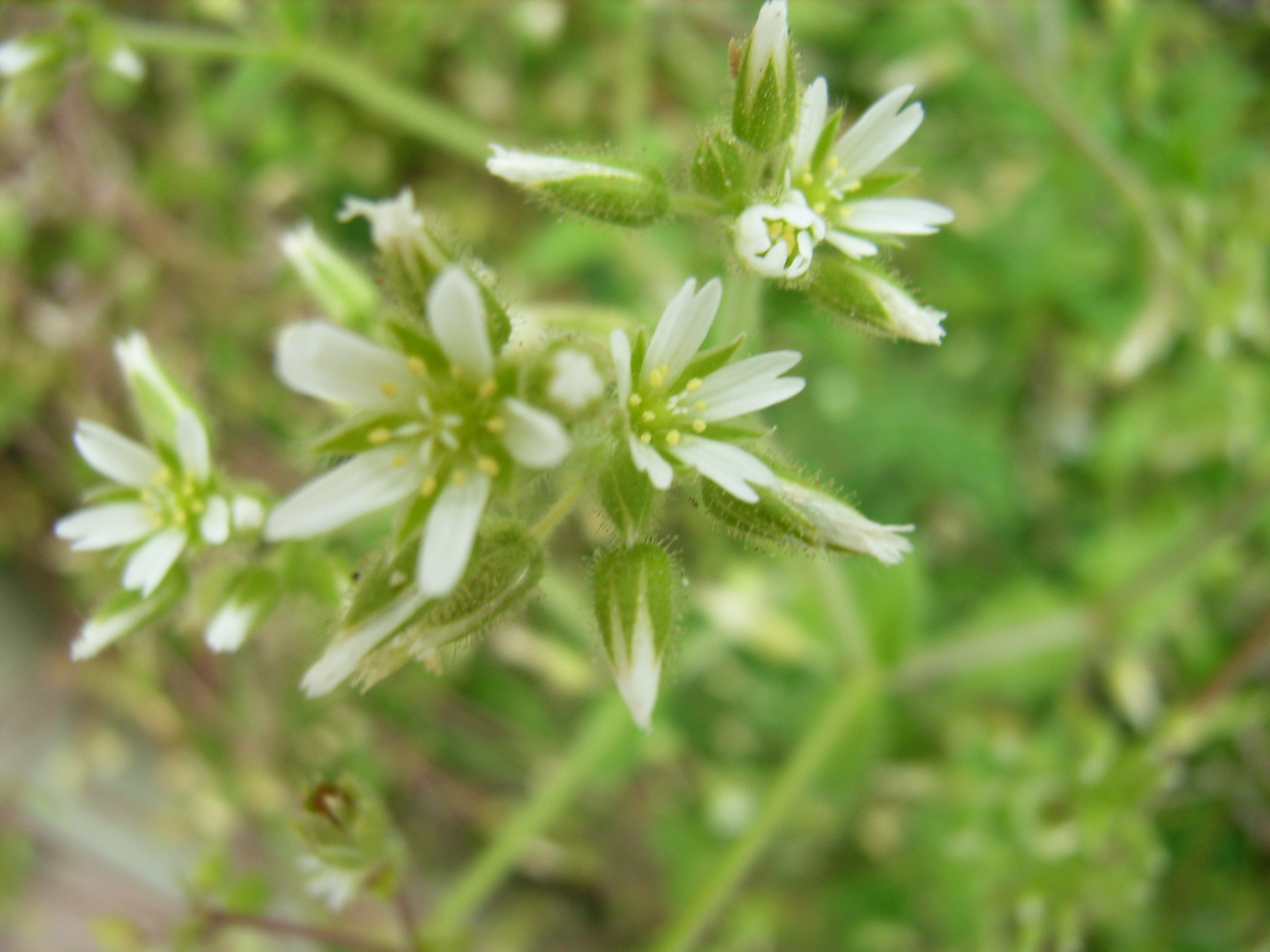
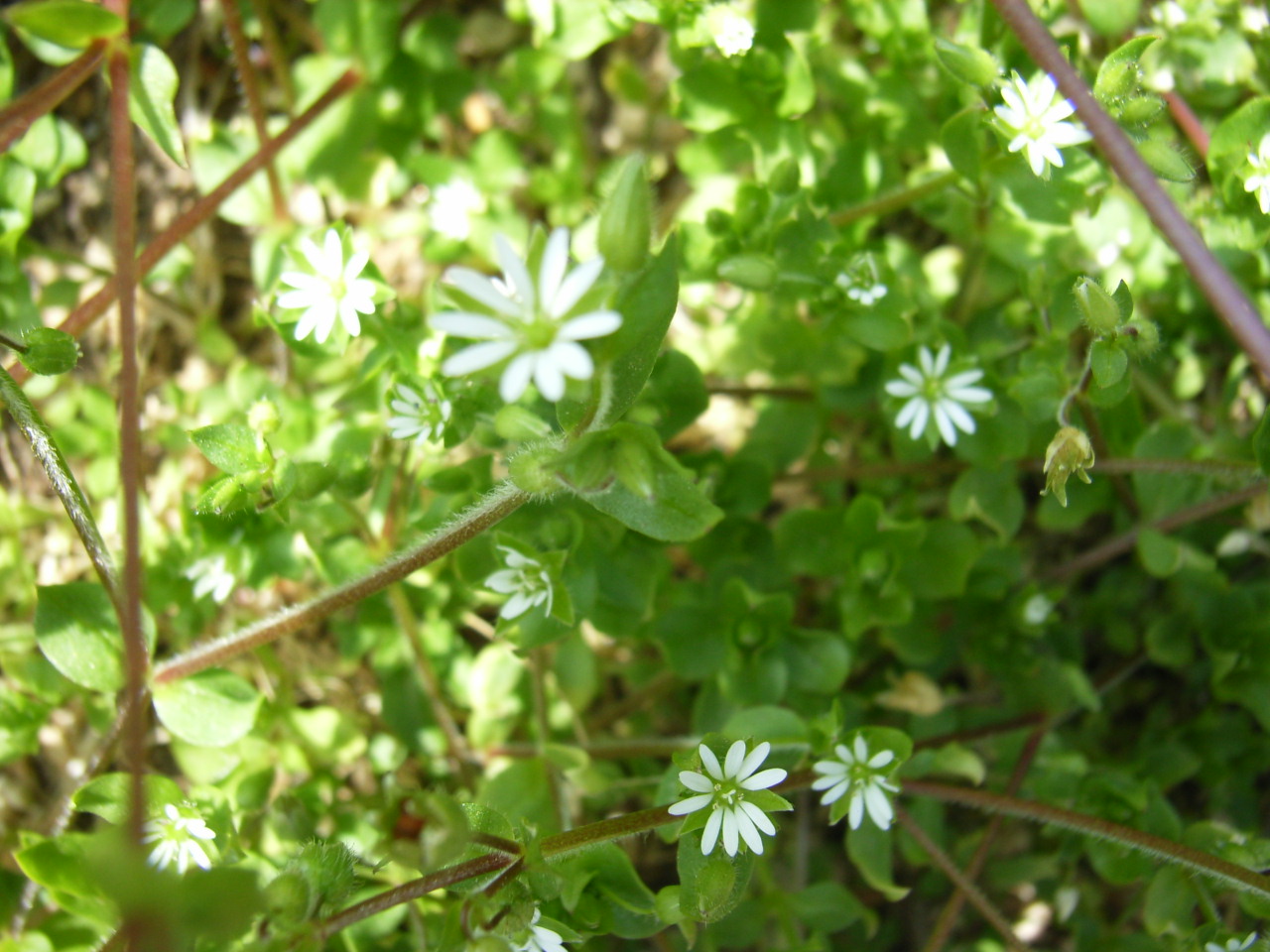
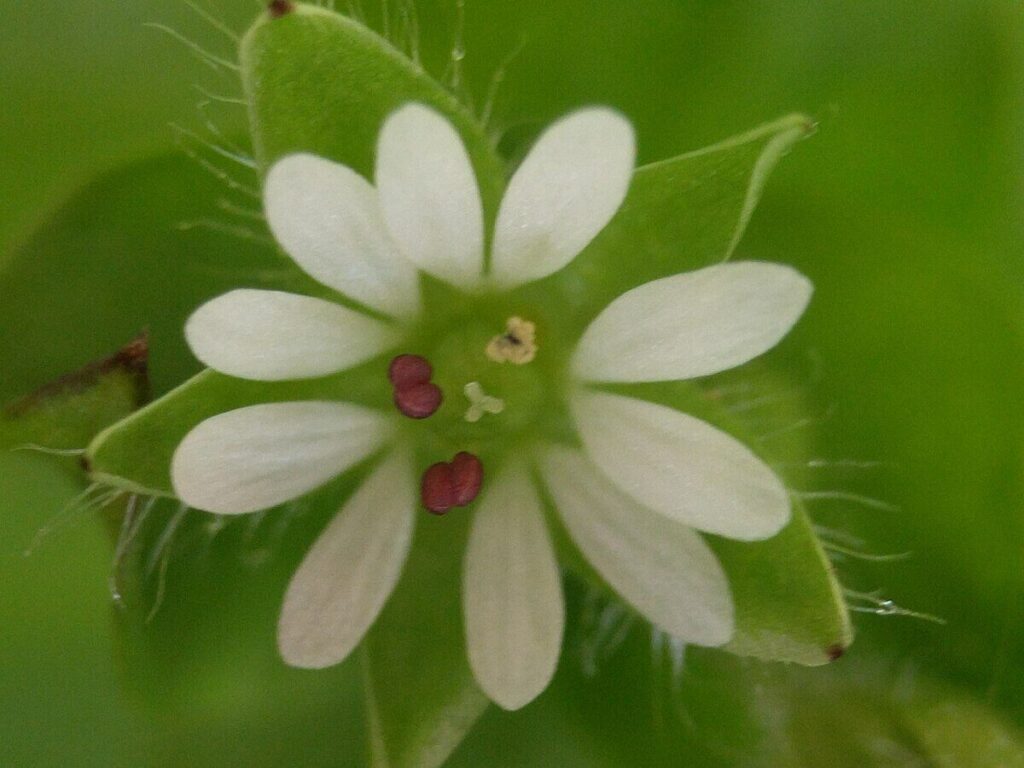
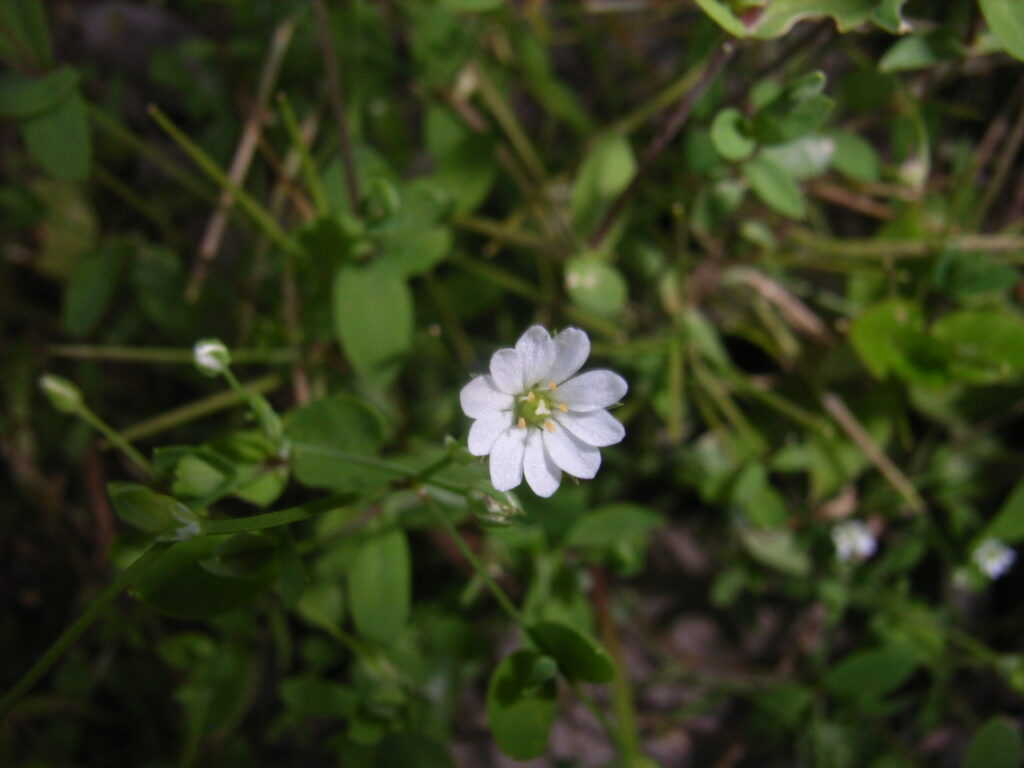
Both common chickweed and large chickweed bloom year-round from January to December, but they bloom particularly profusely in spring. Their most distinctive feature is their white petals, which are deeply lobed from five petals to appear as ten.
In Japan, it is one of the seven spring herbs and is famous for being eaten as "nanakusa-gayu" (seven-herb rice porridge ) on the Jinjitsu Festival (January 7th every year) as a divination ritual to ward off evil spirits and prevent all kinds of illnesses. There is a description of it being eaten as early as 1362 (Muromachi period/Nanboku-cho period) in the Kakaisho (a commentary on The Tale of Genji by Yotsutsuji Yoshinari).
As you can see, these are very familiar weeds in Japan, but as mentioned above, common chickweed and green chickweed are quite similar and are rarely distinguished, and cow chickweed is also a little less common.
Since all of them are edible, not being able to distinguish between them may not cause many problems, but if you want to become more knowledgeable about plants, it's good to know how to tell them apart.
What are the differences between common chickweed, green chickweed, and cow chickweed?
First, it is relatively easy to distinguish between Stellaria media and Stellaria media (Kobayashi, 1991; Kanagawa Prefecture Flora Survey Association, 2018).
The most important difference is that while common chickweed and green chickweed have three styles in their pistils, common chickweed has five styles.
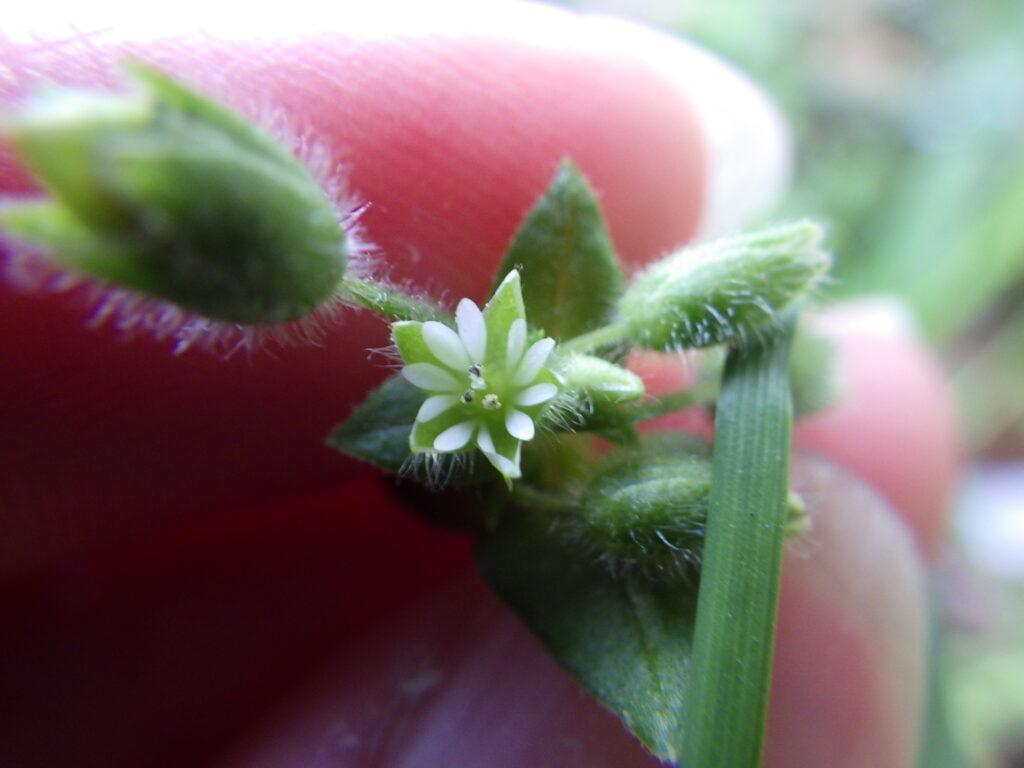
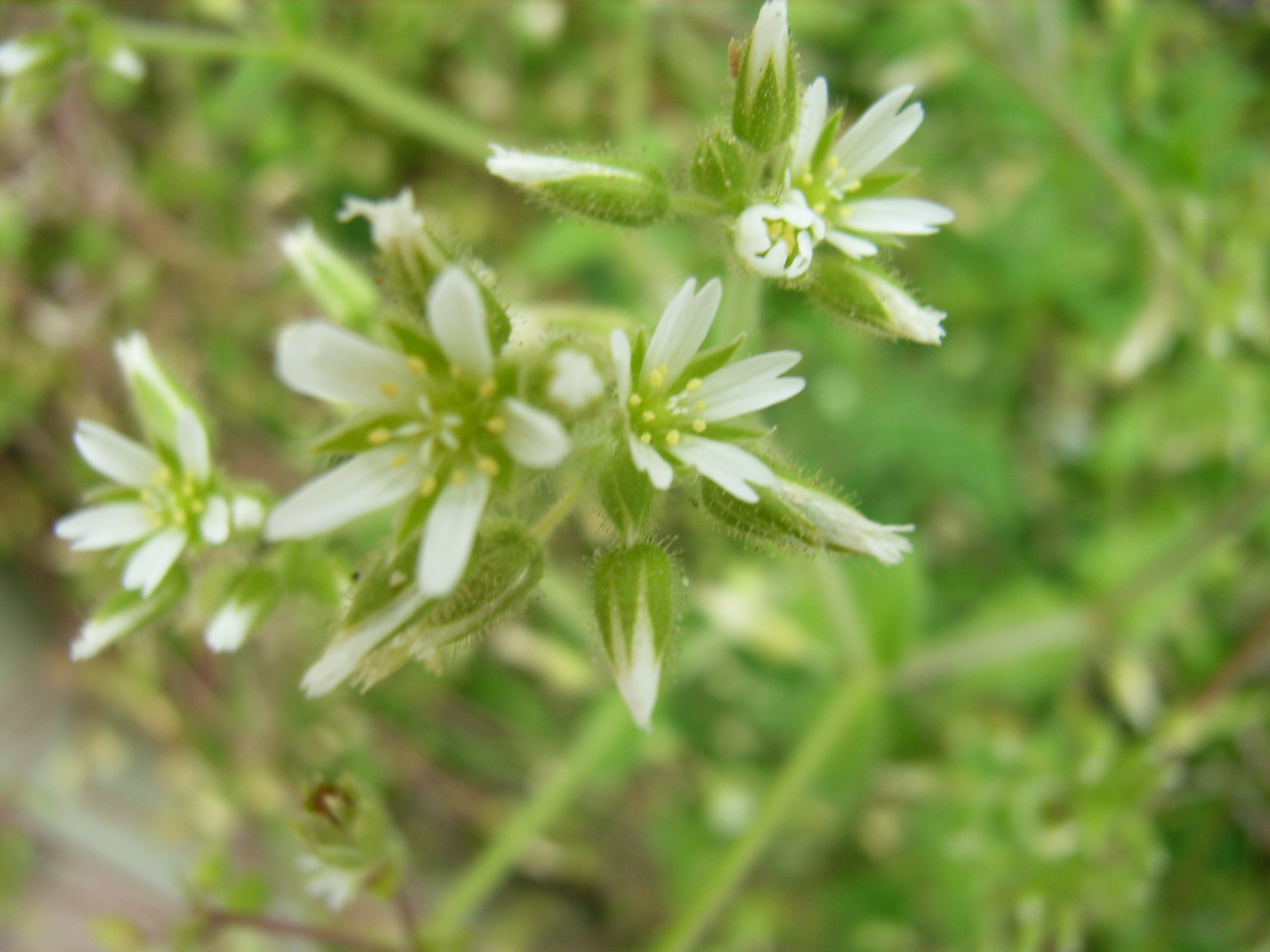
Since the flowers are small, you need to observe them quite closely, but if you look at the center of the flower, you will see white, fluffy structures extending in various directions, resembling a cat's tail or a mop. This mop-like structure is the pistil's style, which increases the surface area and receives pollen from the stamens. The number of these styles varies.
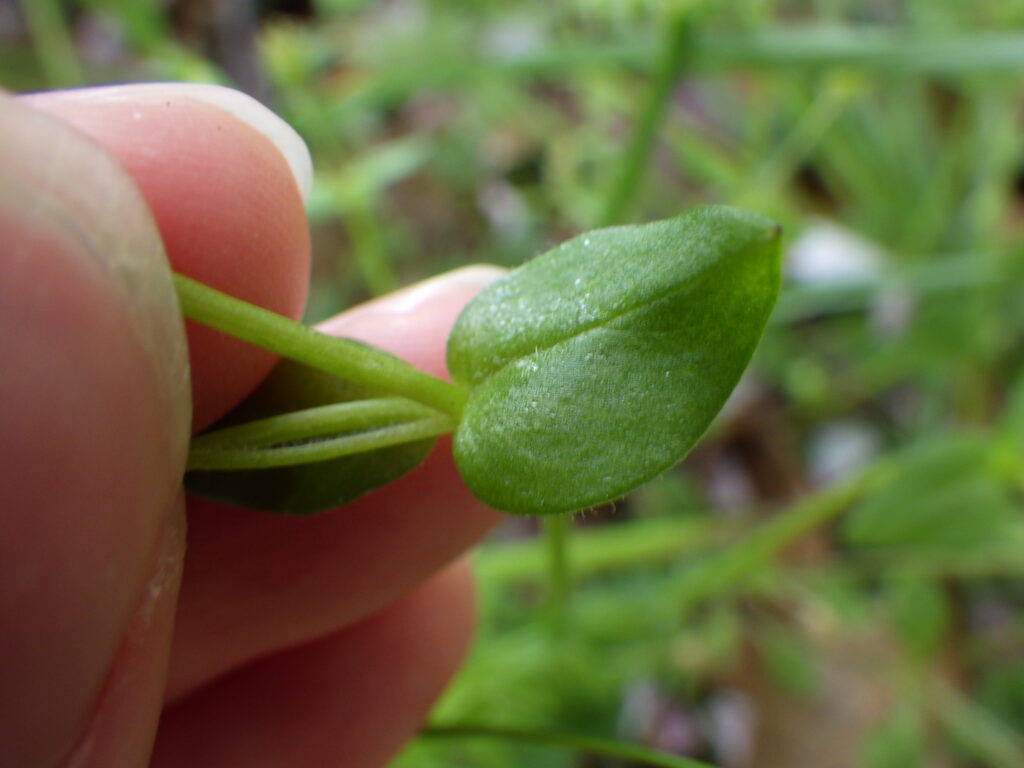
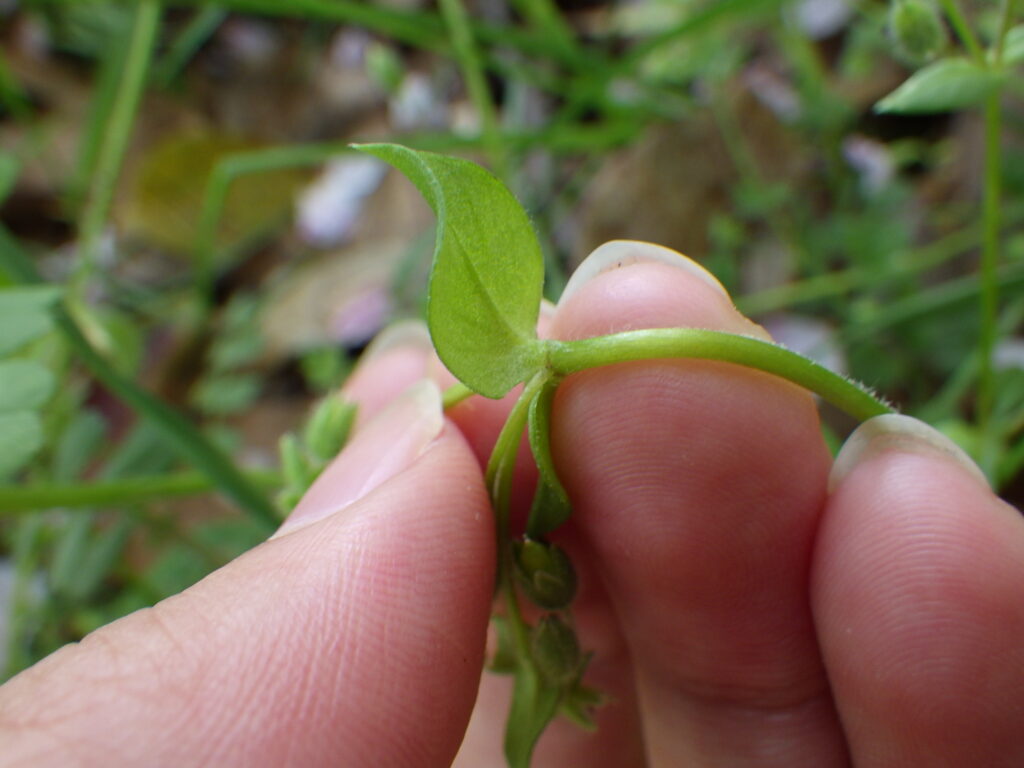
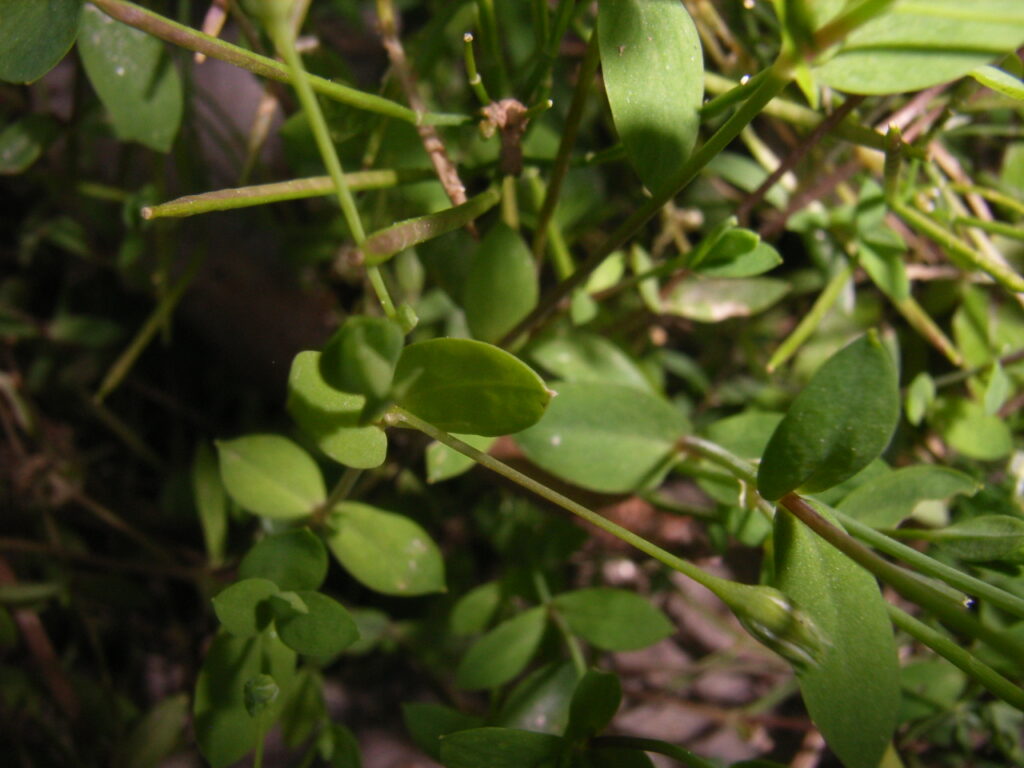
Even if it's difficult to see the pistil, you can distinguish between them by size alone: the leaves of common chickweed and green chickweed do not exceed 2.5 cm in length, while those of common chickweed grow to be quite large, between 2.5 and 8 cm.
The difficult part is distinguishing between common chickweed and green chickweed. It's hard to tell them apart just by looking at the leaves.
Another important difference is that common chickweed has 1 to 7 stamens, while green chickweed usually has 8 to 10 stamens, and at least 5.
Since the flowers are small, careful observation is necessary. You can find them by counting the number of plants growing around the pistil. The stamens contain pollen, so look for those with a yellowish sphere at the tip. Those that have lost their pollen may turn pink.
Another difference that doesn't rely on stamens is that in common chickweed, the tips of the sepals (the green triangular parts that support the petals) are blackish-purple, whereas in green chickweed, the tips of the sepals are green and have no special color.
Another difference is that while common chickweed has low, circular projections on the surface of its seeds, green chickweed has somewhat more prominent conical projections. This is also considered important from a taxonomic perspective, but it may be difficult for the average person to observe this level of detail in the field.
Furthermore, while common chickweed (Stellaria media) is generally smaller with small, dark green leaves, green chickweed (Stellaria media) is generally larger with larger, lighter green leaves. However, this difference can be difficult to discern due to individual variation and photographic conditions. While it becomes apparent with experience after observing many specimens, it's honestly not very practical.
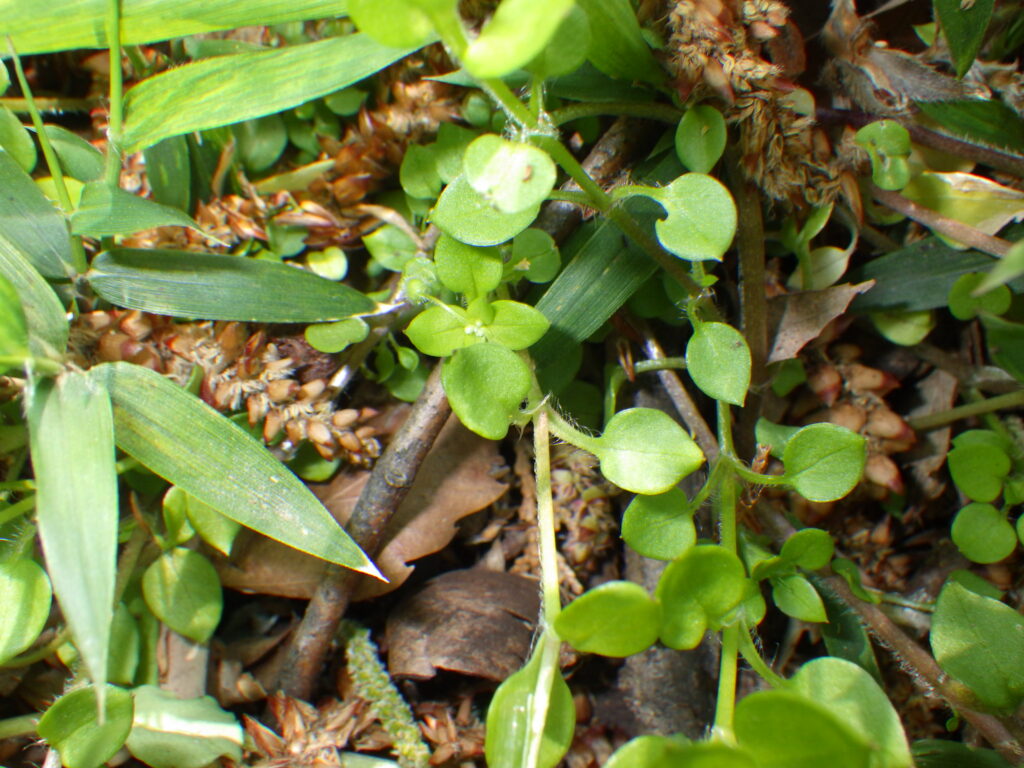
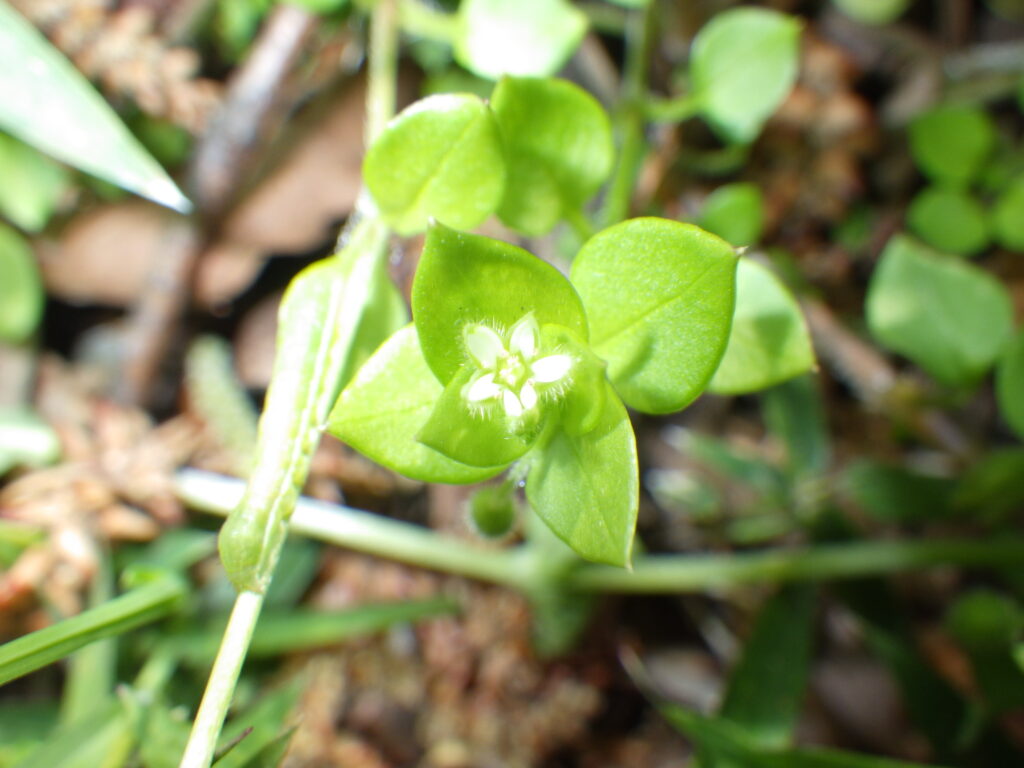
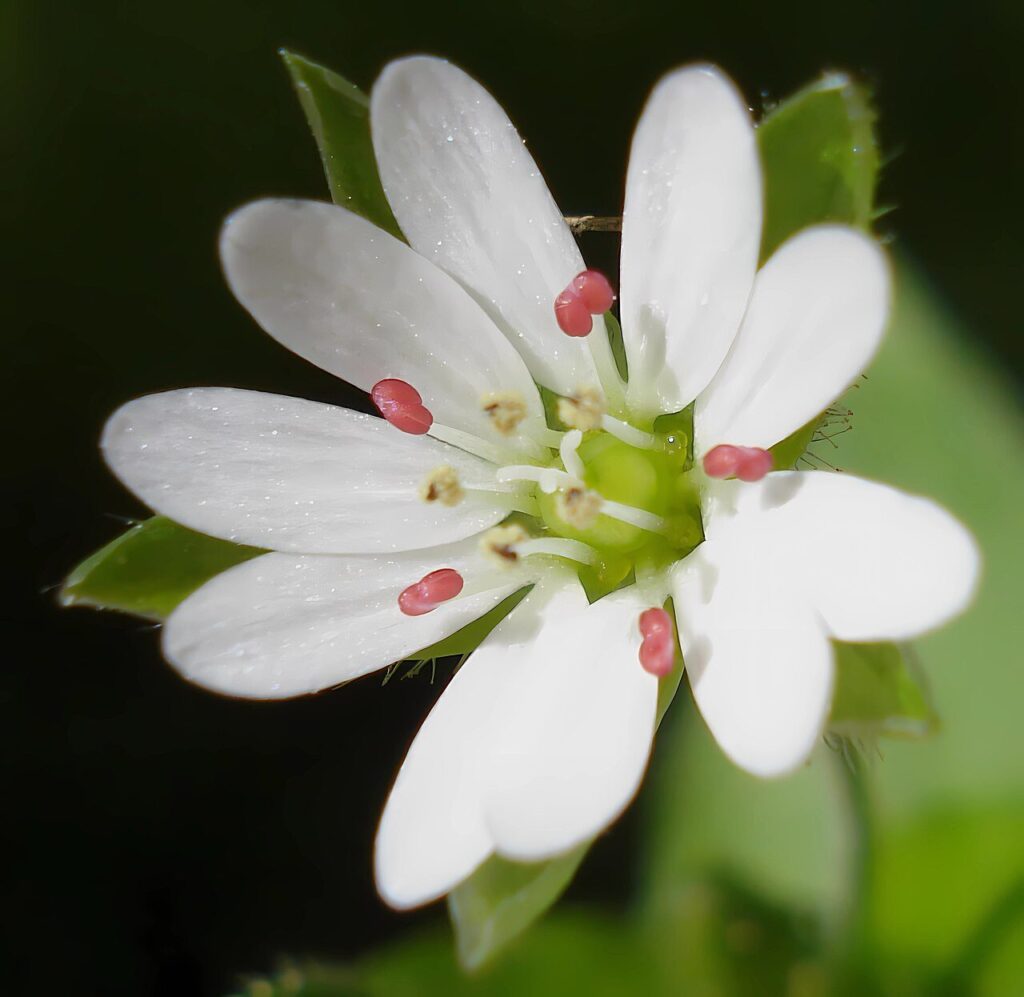
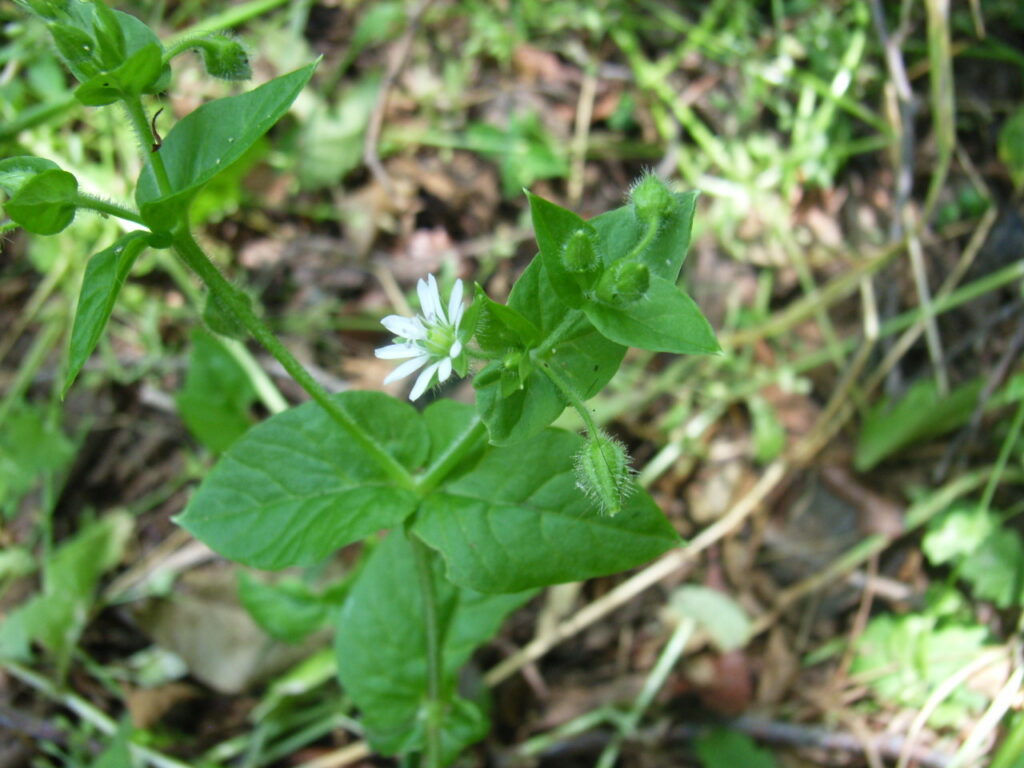
There are differences in the ecology of common chickweed and green chickweed!?
While the above lists the morphological differences between Stellaria media and Stellaria media, it has actually been found that there are also ecological differences (Miura et al., 1995; 1996; Miura, 2001).
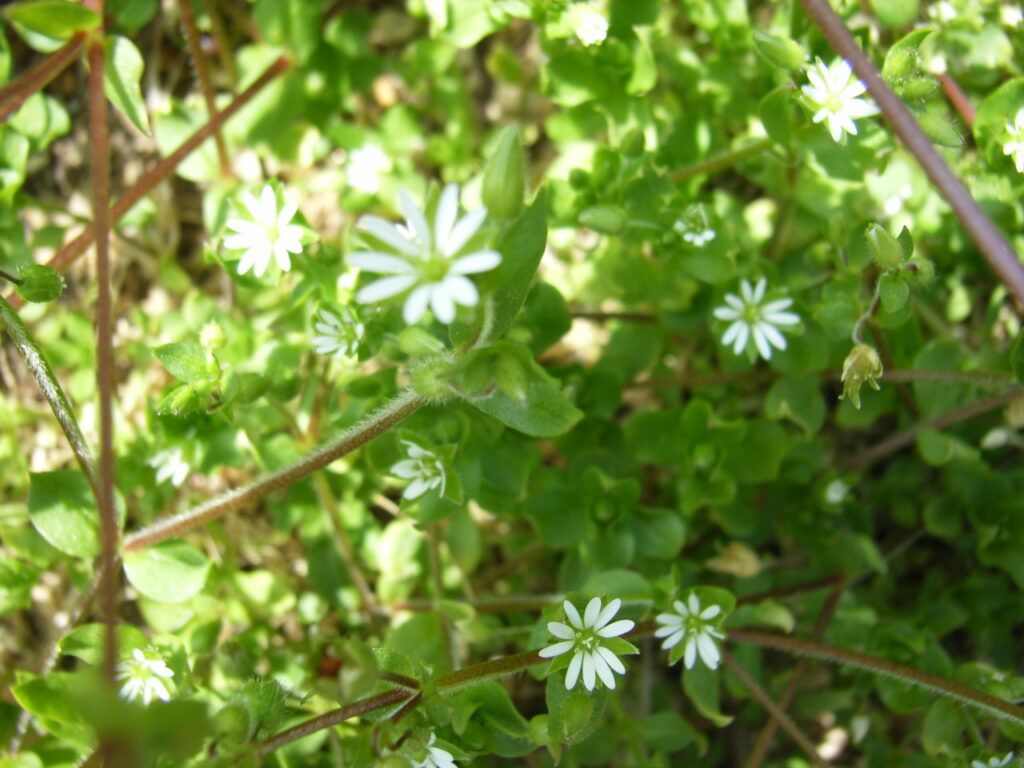
Seedlings of chickweed (Stellaria media) emerge intermittently from spring to autumn, and each emerging plant begins to flower 1-2 months later. Therefore, individual plants are small, but there are many of them.
On the other hand, seedlings of Stellaria media (green chickweed) appear almost exclusively in the autumn. The resulting plants continue vegetative growth throughout the winter, flowering and fruiting the following spring before dying. Therefore, individual plants are large, but the number of plants is small.
As a result, the flowering period for common chickweed (Stellaria media) is from January to December, meaning it blooms all year round, while that of green chickweed (Stellaria media) is from April to May.
To put this simply, common chickweed (Stellaria media) increases the number of offspring at the expense of smaller individual plants (leaning towards an "r-strategy" that prioritizes quantity over quality), while green chickweed (Stellaria media) increases the size of individual plants and decreases the number of offspring (leaning towards a "K-strategy" that prioritizes quality over quantity).
Therefore, common chickweed (Stellaria media) tends to survive in areas with high mortality rates due to natural disturbances and human disturbances such as cultivation and weeding, while green chickweed (Stellaria media) tends to survive in areas with high mortality rates due to competition with other species or within the same species.
The very lifestyle of herbaceous plants is a more strategic approach compared to woody plants (trees), but among them, chickweed (Stellaria media) seems to prioritize quantity over quality, which is why you often encounter chickweed throughout the year.
Common chickweed and green chickweed look very similar, and it seems that niche partitioning (habitat division) is occurring.
Are there any other similar species?
Several other species are known to belong to the genus Stellaria.
Stellaria sessiliflora, also known as mountain chickweed, can be distinguished from the three species mentioned above by its acutely pointed sepals and petals that are longer than the sepals. It grows in shady, damp areas in the mountains, so you probably won't see it often.
Stellaria diversiflora, also known as marsh chickweed, can be distinguished from the four species mentioned above by its nearly hairless flower stalks and stems. It grows in relatively dry woodlands in mountainous areas, so it is also rarely seen.
Stellaria alsine var. undulata, also known as flea screen, is the most likely to be confused with this plant, but its leaves are all sessile, its petals are large, and it grows in damp places such as rice paddies and fallow fields.
For the differences between the Stellaria and Cerastium genera, please see our separate article.
References
Kanagawa Prefecture Flora Survey Association. 2018. Kanagawa Prefecture Flora 2018 (Electronic Edition). Kanagawa Prefecture Flora Survey Association, Odawara. 1803pp. ISBN: 9784991053726
Kobayashi, Koji. 1991. Comparison of closely related plants: Stellaria media and Stellaria media. Niigata Prefecture Plant Protection 9: 6-7. http://hdl.handle.net/10191/10301
Miura, Reiichi. 2001. A comparative ecological study of Stellaria media and Stellaria media. [Doctoral dissertation, Kyoto University]. https://doi.org/10.11501/3183592
Miura, Reiichi, Kobayashi, Hiroyuki, and Kusanagi, Tokuichi. 1995. Effects of differences in emergence timing on survival rate and individual size in populations of Stellaria media and Stellaria verna. Weed Research 40(3): 179-186. https://doi.org/10.3719/weed.40.179
Miura, Reiichi, Kobayashi, Hiroyuki, and Kusanagi, Tokuichi. 1996. Comparison of seed dormancy and germination characteristics of the field weed Stellaria media and the habitat plant Stellaria media. Weed Research 40(4): 271-278. https://doi.org/10.3719/weed.40.271