Hops (Humulus hummus) and Humulus japonicus are both perennial herbs belonging to the genus Humulus in the family Cannabaceae, and as their scientific names suggest, they are varieties of each other. Hops are well-known as an ingredient in beer. Both varieties are almost identical in that they have leaves that do not divide or are divided into 3 (to 5) lobes, they are dioecious, and they both form fruit clusters. However, they can be distinguished by the amount of hair covering their entire body and the number of yellow glands called "lupulin glands," which are responsible for the bitter component in the "fruit cluster" that resembles a "pine cone." Considering this difference in lupurine glands, it seems unlikely that Humulus japonicus could be used to make beer. The actual fruit is located inside the fruit cluster, but it is not present in cultivated hops because pollination does not usually occur. This article will explain the classification of hops and Humulus japonicus.
What is Hops (Humulus hummus)?
Humulus lupulus var. lupulus, commonly known as hops, is a perennial plant distributed in China, Russia, Kazakhstan, the Caucasus, West Asia, North Africa (Morocco), and Europe. Hereafter, we will refer to it simply as hops.
Hops are said to have been cultivated in Europe starting around the 8th century. Initially used for medicinal purposes, they were used in beer making from 1079 onwards for bitterness, aroma, foam generation, and antibacterial properties. It wasn't until 1516, when Wilhelm IV, the monarch of Bavaria (present-day Germany), issued the "Beer Purity Law," that their use in beer became standard practice (Murakami, 2010).
Humulus lupulus var. cordifolius, also known as Karahanasou (Chinese flower grass), is a perennial herb that grows in mountainous areas and is distributed in Hokkaido and Honshu (central and northern parts) in Japan, as well as in China (Kanagawa Prefecture Flora Survey Association, 2018). It flowers from September to October.
Both are perennial herbs belonging to the genus Humulus in the family Cannabaceae, and as their scientific names suggest, they are varieties. Therefore, their basic structure is almost identical, including having leaves that are either undivided or 3- to 5-lobed, being dioecious, and forming fruit spikes. For this reason, some people may be curious about the differences.
Some people might even expect to see beer made from lilyturf. (Note that if you actually want to make alcohol with an alcohol content exceeding 1% from scratch, you will need a license under the Liquor Tax Act.)
What is the difference between hop leaves and hummus leaves?
First and foremost, these two varieties are distributed in different regions.
Hops are widely distributed across the Eurasian continent, but hummus is found only in Japan and China.
Therefore, in Japan, cultivated plants are hops, while wild plants are Humulus lupulus, and this is usually the case, except in extremely rare instances. Commercially, hops are cultivated in Hokkaido and the Tohoku region of Japan, but they are also cultivated horticulturally in other regions.
There are also morphological differences (Small, 1978).
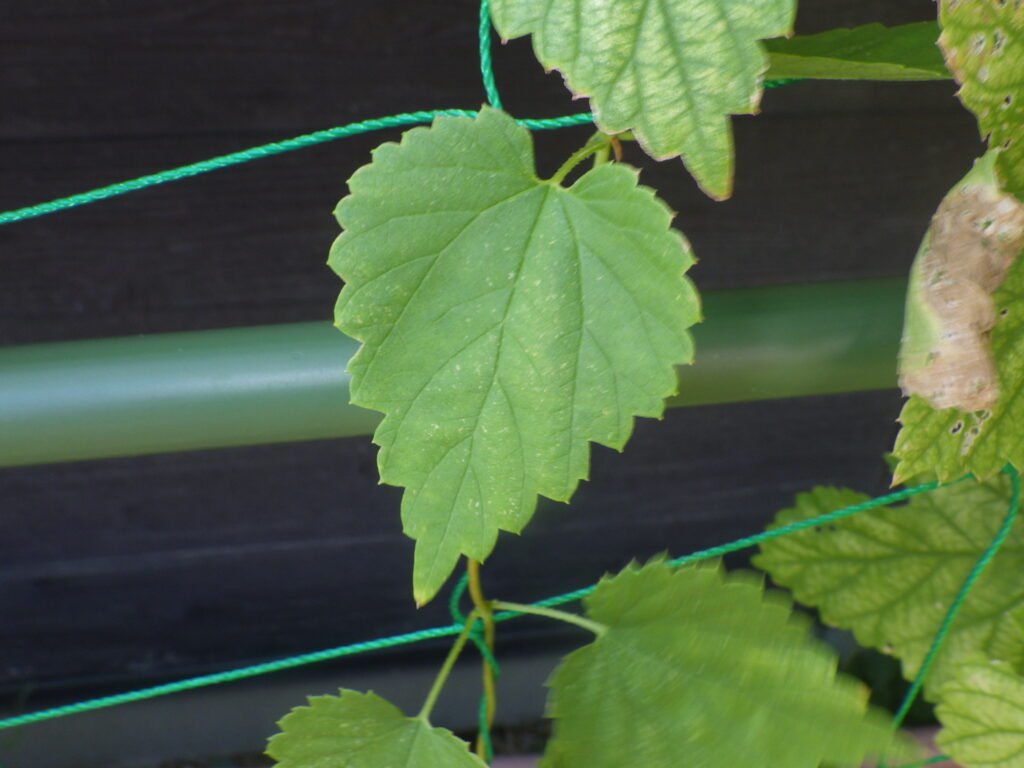
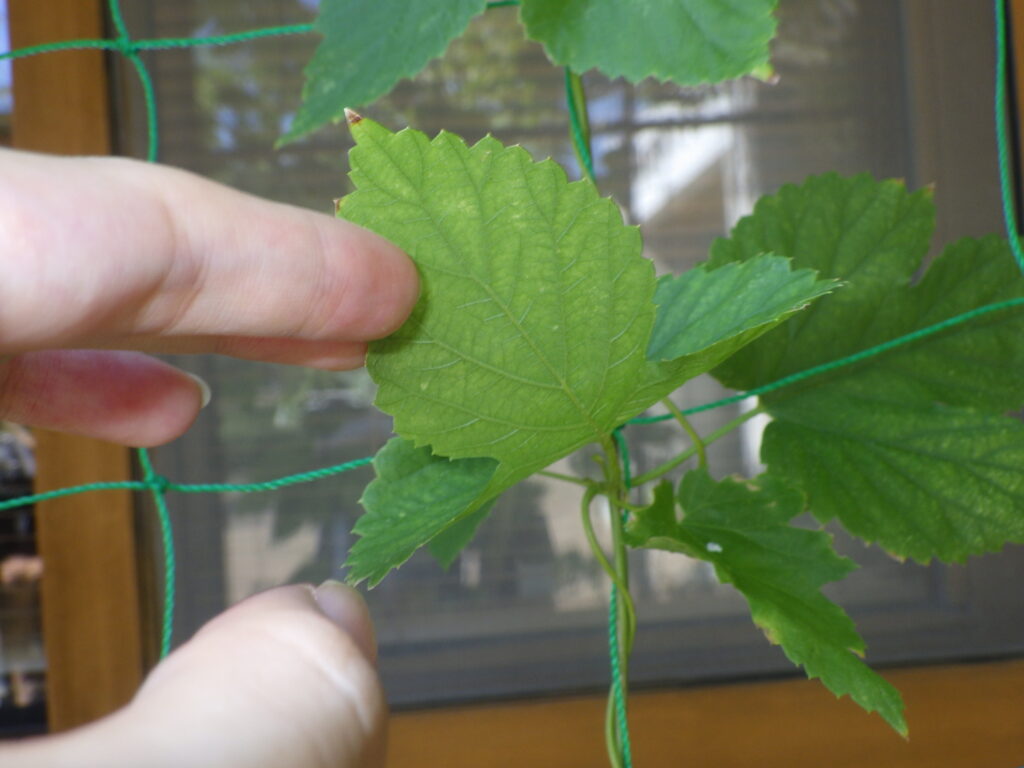
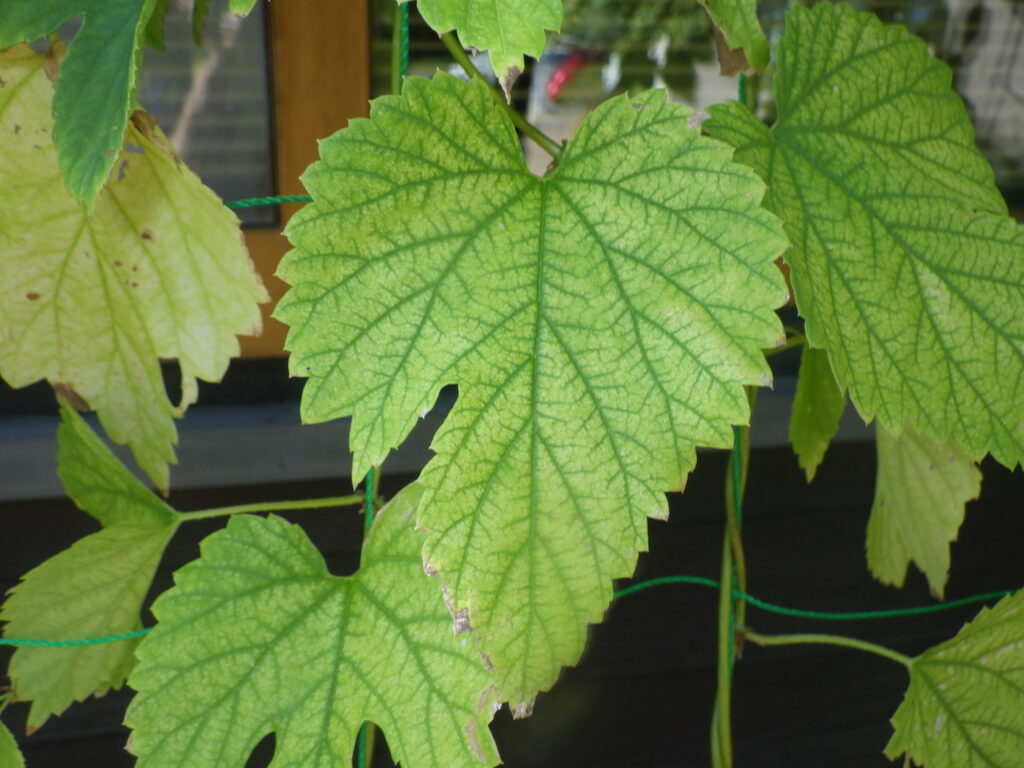
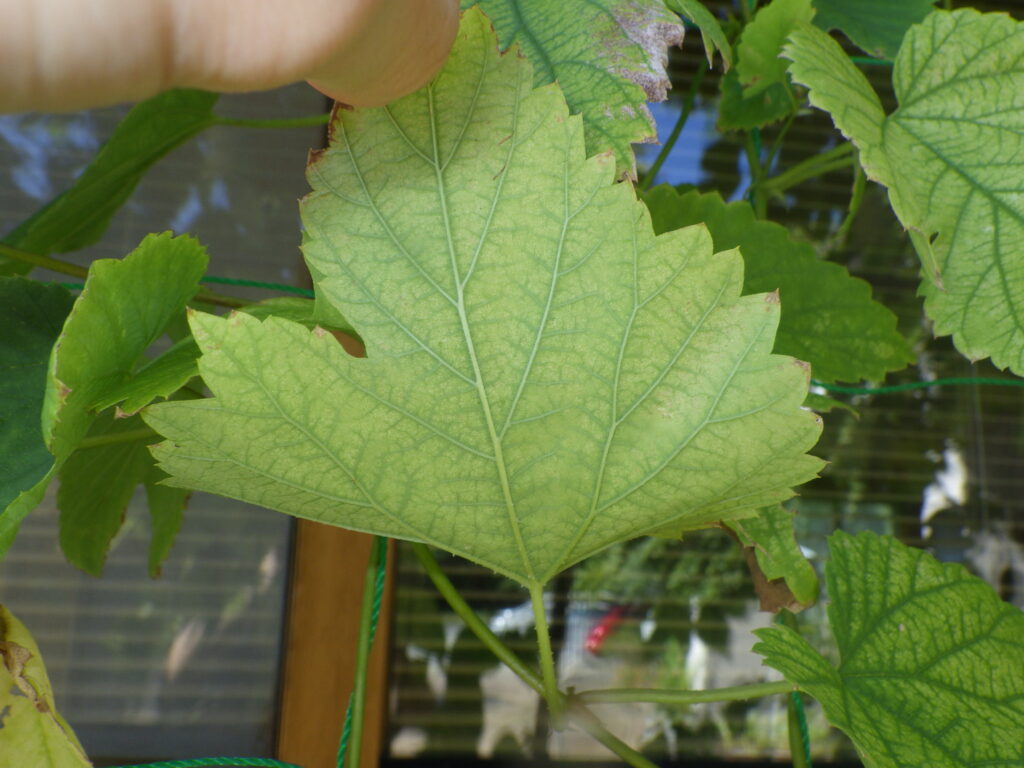
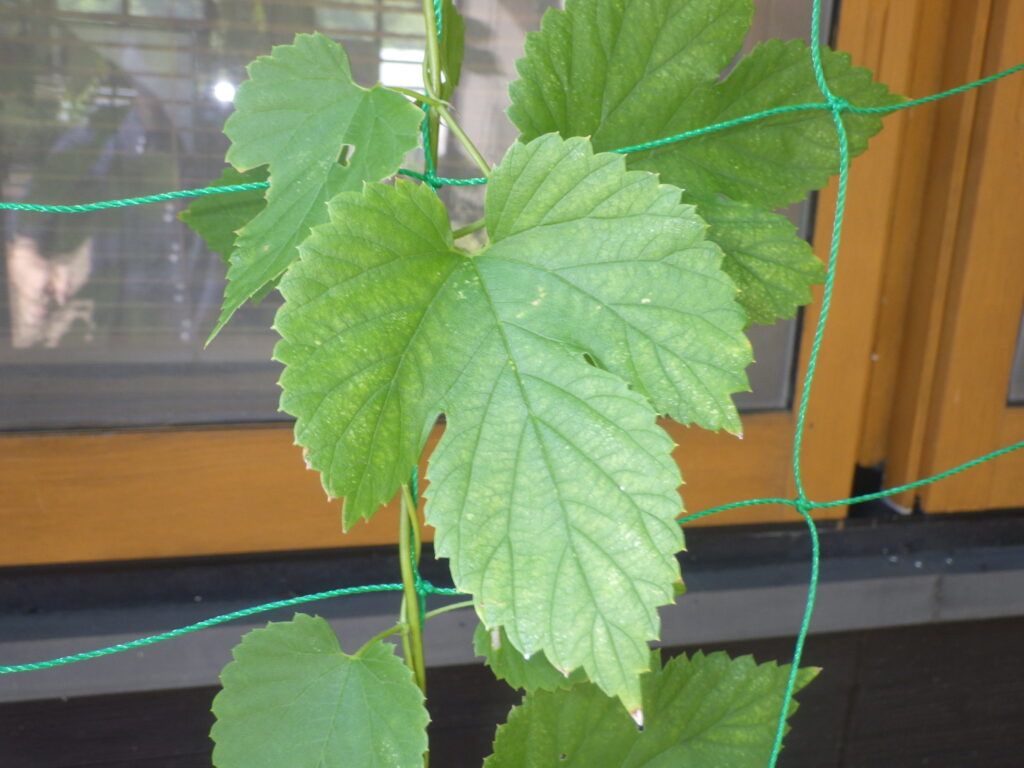
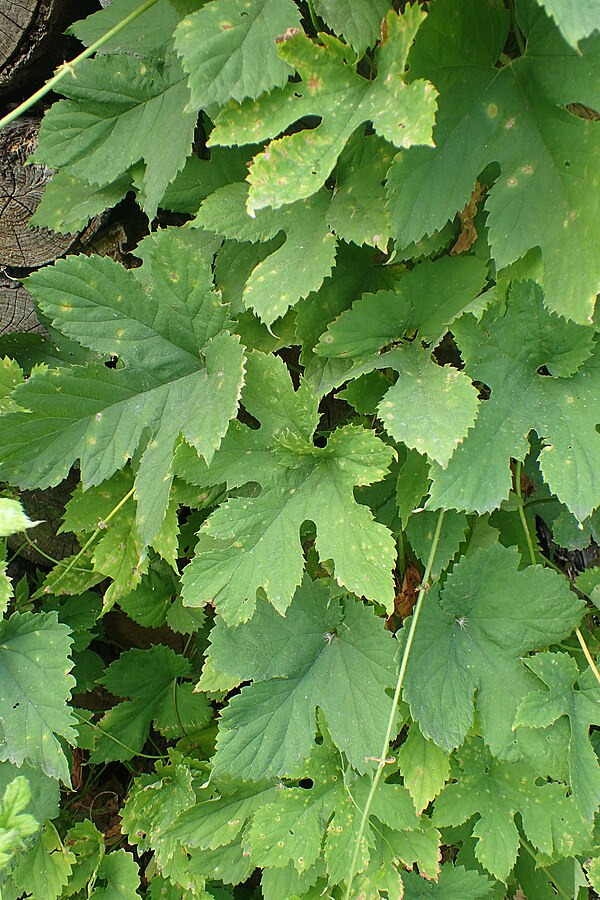
In hops, the leaves typically have 20 or fewer hairs per centimeter of midrib, 25 or fewer glands per 10 mm² between veins, relatively few soft hairs at the nodes, and in the parts with the most soft hairs (excluding petioles and stem corners), there are usually 15 or fewer hairs per 0.1 mm².
In contrast, in Humulus lupulus, the leaves typically have more than 20 hairs per centimeter of midrib, more than 25 glands per 10 mm² between veins, relatively many soft hairs at the nodes, and more than 15 hairs per 0.1 mm² in the areas with the most soft hairs (excluding the angle between the petiole and stem).
To put it more precisely, you can think of it this way: hops have less hair all over their bodies, while hummus has a lot of hair all over its body.

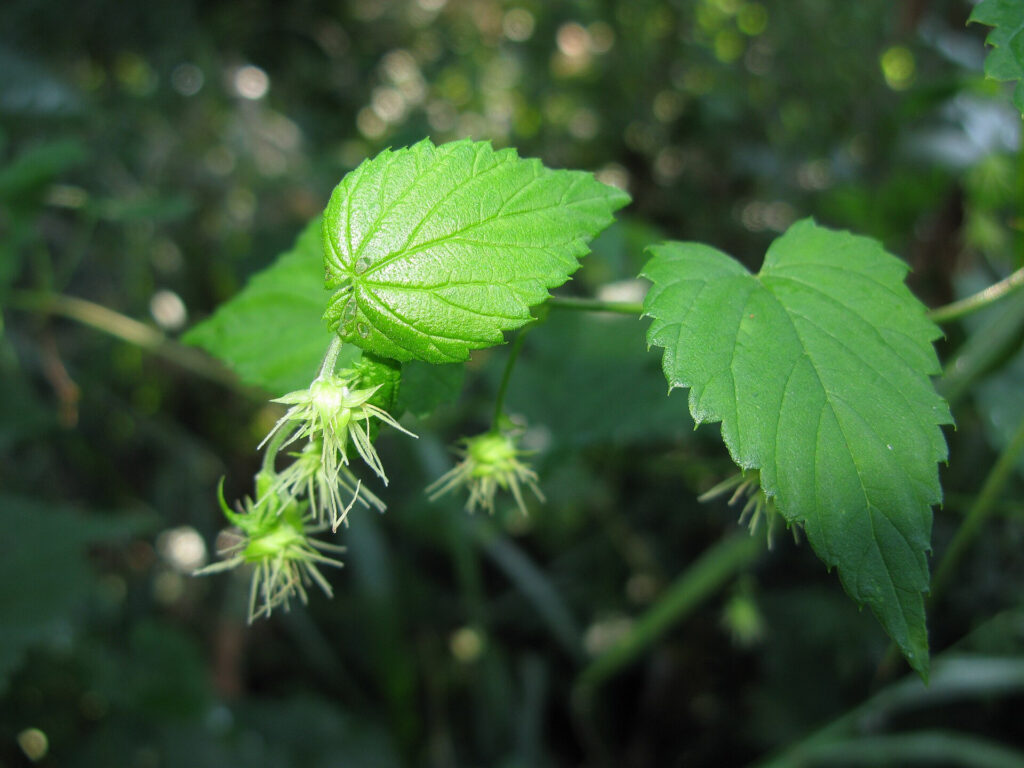

What is the difference between the fruiting heads of hops and hummus?
There are other differences that explain why hops are suitable for beer making, while hummus is not.
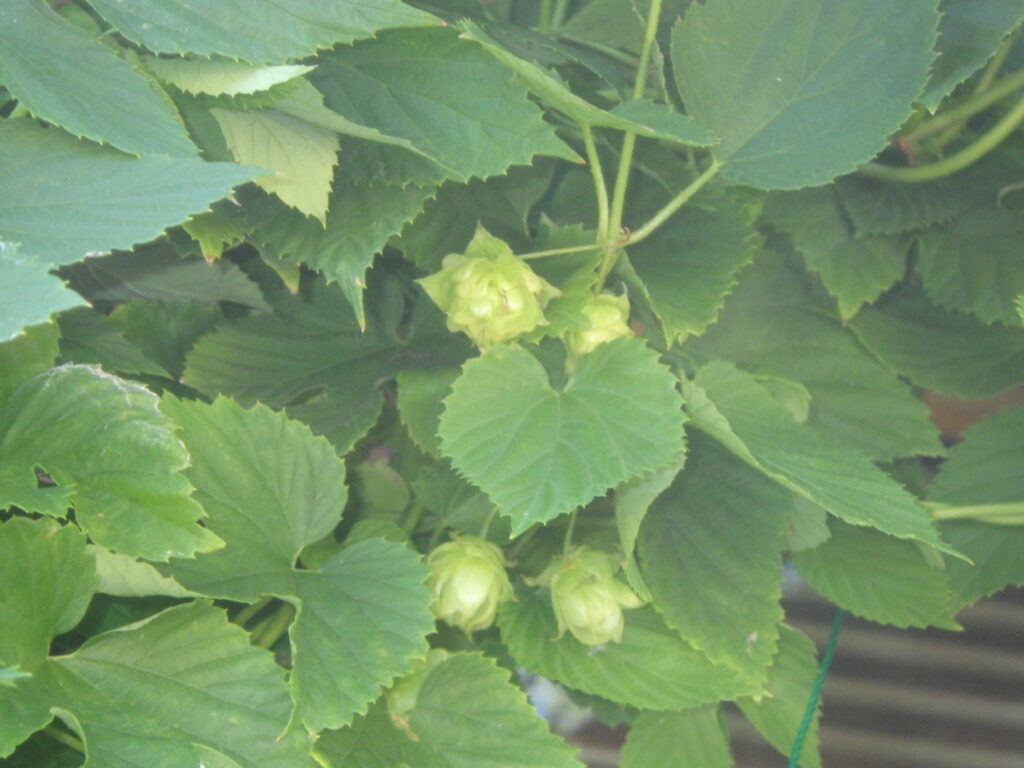
The genus Humulus is dioecious, meaning it has separate male and female plants. However, the female flowers are covered with bracts and bracteoles, giving the plant an overall shape resembling a pine cone (Hirono, 2018). When the female flower develops into a fruit, this pine cone-like structure is called a "fruit cluster." It is often mistaken for the actual fruit, but this is not the fruit itself. The true fruit (if any) is very small.
In hops, the inside of the bracts and bracteoles that make up the fruit cluster are densely covered with yellow glands, whereas in hummus, there are fewer yellow glands.
These yellow glands are called lupulin glands, and they play various roles in beer, such as adding bitterness and aroma, creating foam, and providing antibacterial properties.
Therefore, you can see that hop pods are more bitter and more suitable for beer making. It might be possible to use hummus as well, but it would likely be less efficient.

Another significant difference is that hops (cultivated populations) do not have fruits or seeds within their inflorescence, while hummus does.
The reason for this is that male hop plants are not cultivated so that the female flowers of the female plants do not get pollinated and bear fruit. Indeed, when using hops as an ingredient in beer, the fruit and seeds are not needed. Incidentally, when propagating hops, division of the plants is usually done.
The fact that hops maintain fruit cluster formation even without pollination may be a result of selective breeding and artificial selection.
References
Hirono, Ikuo. 2018. Observation of hop flowers and fruit clusters. Continued: A Walk Through the Trees 272. Tree Notebook. https://kinomemocho.com/sanpo_hop.html
Kanagawa Prefecture Flora Survey Association. 2018. Kanagawa Prefecture Flora 2018 (Electronic Edition). Kanagawa Prefecture Flora Survey Association, Odawara. 1803pp. ISBN: 9784991053726
Murakami, Atsushi. 2010. The Exploration of Hops. Journal of the Brewing Society of Japan 105(12): 783-789. https://doi.org/10.6013/jbrewsocjapan.105.783
Small, E. 1978. A numerical and nomenclatural analysis of morpho-geographic taxa of Humulus. Systematic Botany 3(1): 37-76. https://doi.org/10.2307/2418532