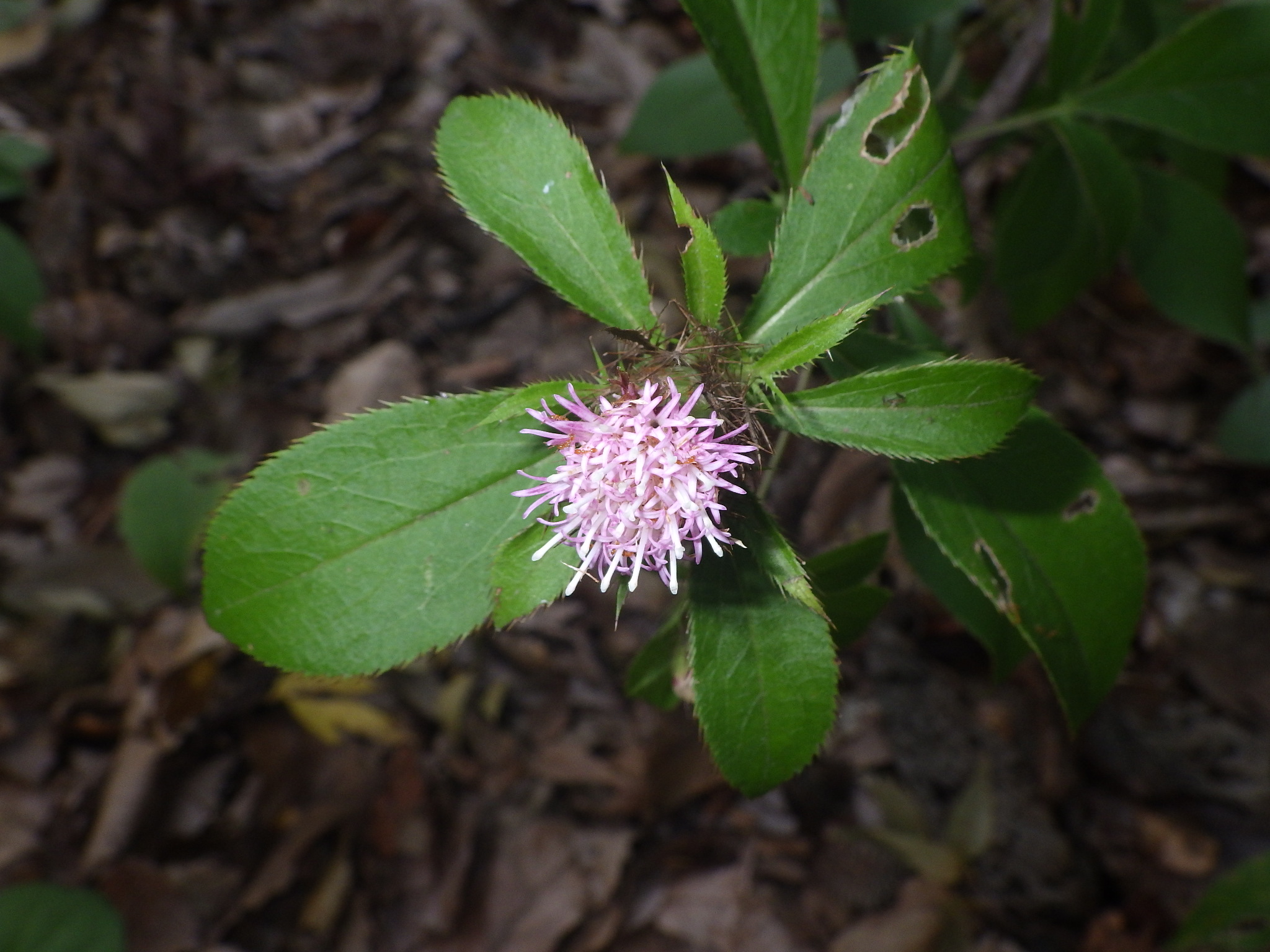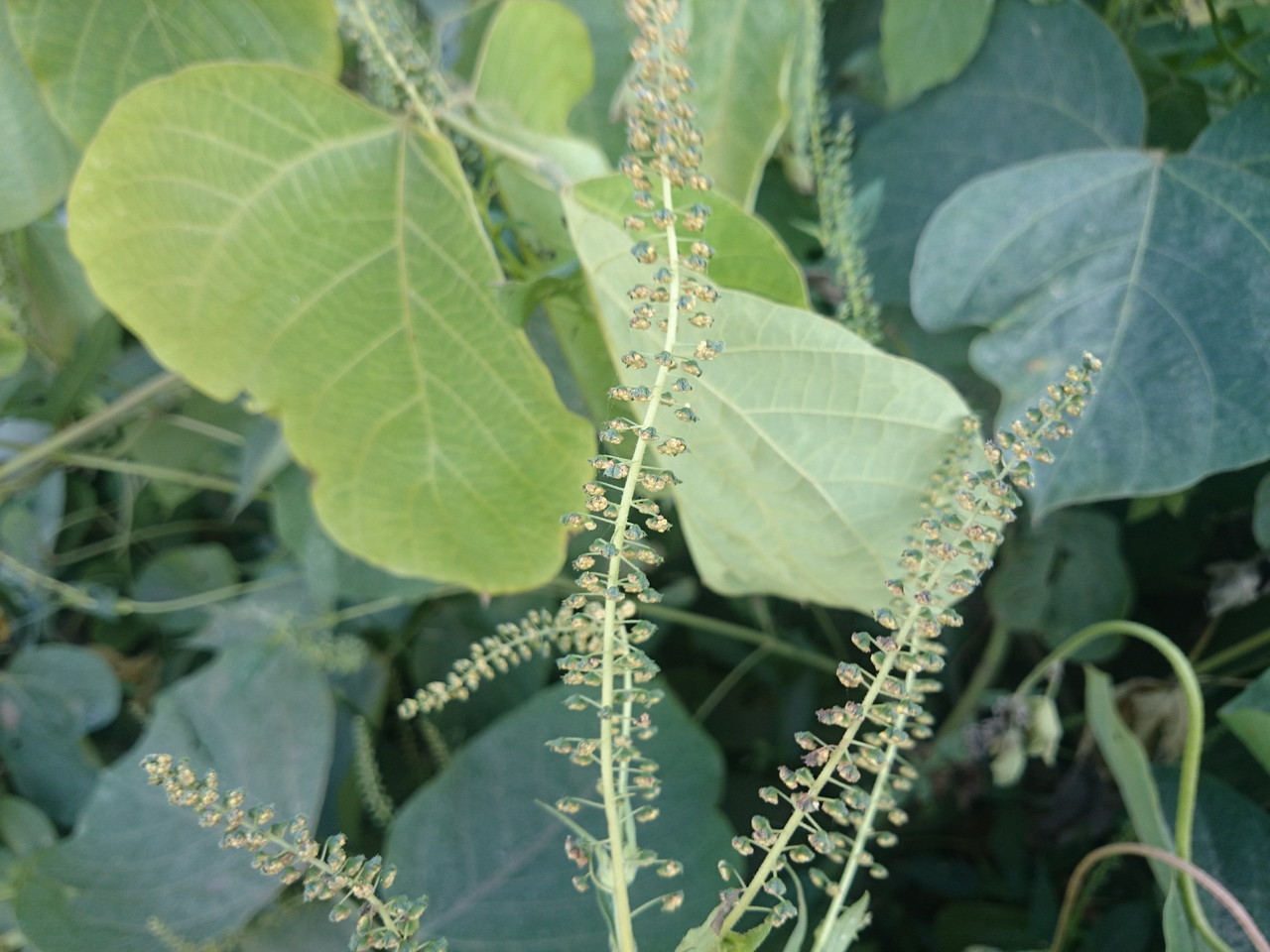
Ragweed and giant ragweed are both annual weeds belonging to the genus Ragweed in the Asteraceae family, and are best known for causing "ragweed hay fever." This is because the flowers of the genus Ragweed are wind-pollinated, and to achieve this, the female and male flower heads are arranged in slender racemes, with the male flower heads hanging downwards towards the ground—a distinctive feature. However, this feature is common to both species, and the differences may not be well known. Ragweed and giant ragweed can be easily distinguished by the shape of their leaves. Tall goldenrod is also often confused with ragweed, but tall goldenrod is insect-pollinated and has a completely different shape. Sedum and hawkweed are also sometimes confused, but their appearances are so different that it is difficult to find any commonalities. This article will explain the classification of the genus Ragweed.
What are ragweed and giant ragweed?
Ragweed (Ambrosia artemisiifolia) is native to North America and has naturalized in Asia, Europe, Africa, and South America. It is an annual plant that grows in fertile, somewhat dry areas such as fields and roadsides (Kanagawa Prefecture Flora Survey Association, 2018; RBG Kew, 2023).
Ambrosia trifida, also known as giant ragweed, is an annual plant native to North America that has naturalized in East Asia and Europe, growing in dense clusters in fertile riverbeds and other similar areas.
Both are annual weeds belonging to the genus Ragweed in the Asteraceae family, and are best known for causing "ragweed pollen allergy" (Okubo, 2014). They are well-known because they were the first to be identified as one of the causes of hay fever in Japan. However, the 70% that causes modern hay fever is cedar pollen.
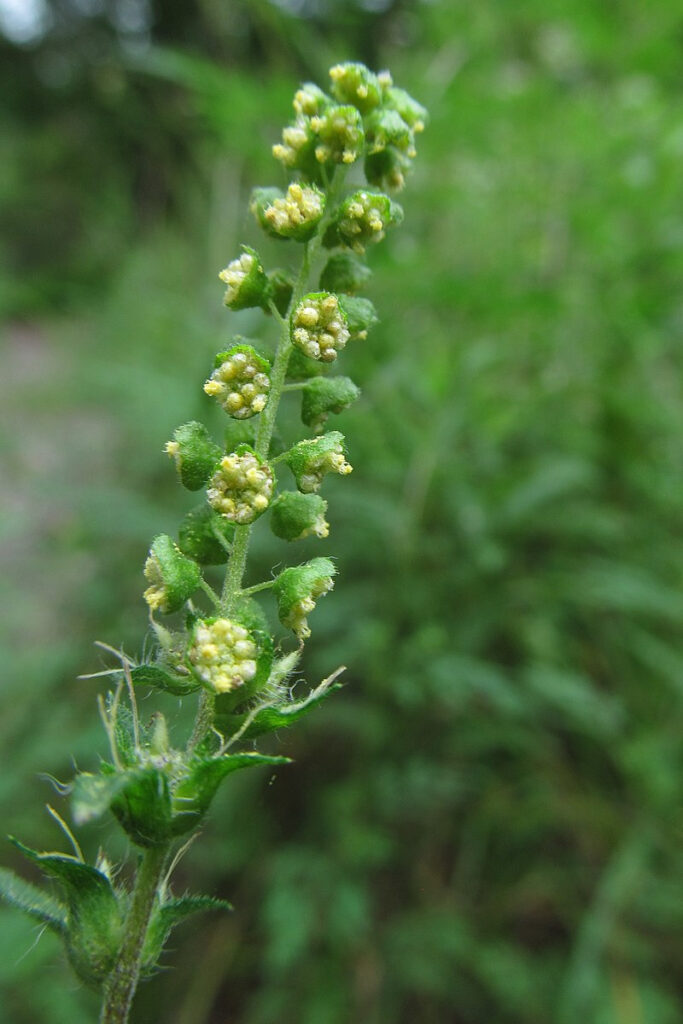
Like many plants in the Asteraceae family, the genus Ragweed produces "flower heads" (capitulum inflorescences). Flower heads are commonly found in the Asteraceae family and are inflorescences (arrangements of flowers) that are clusters of flowers. As evidence of this, each flower has the structure of stamens and pistils, and is sometimes specifically called a "flora." Most people refer to flower heads as "flowers," but they are actually different.
The florets of the Asteraceae family consist of two types: "ray florets," which have a corolla that extends widely to one side, and "disc florets," which have a tubular corolla. The combination of these two types varies depending on the species of the Asteraceae family, but in the ragweed genus, the corolla is reduced, making it impossible to distinguish between them.
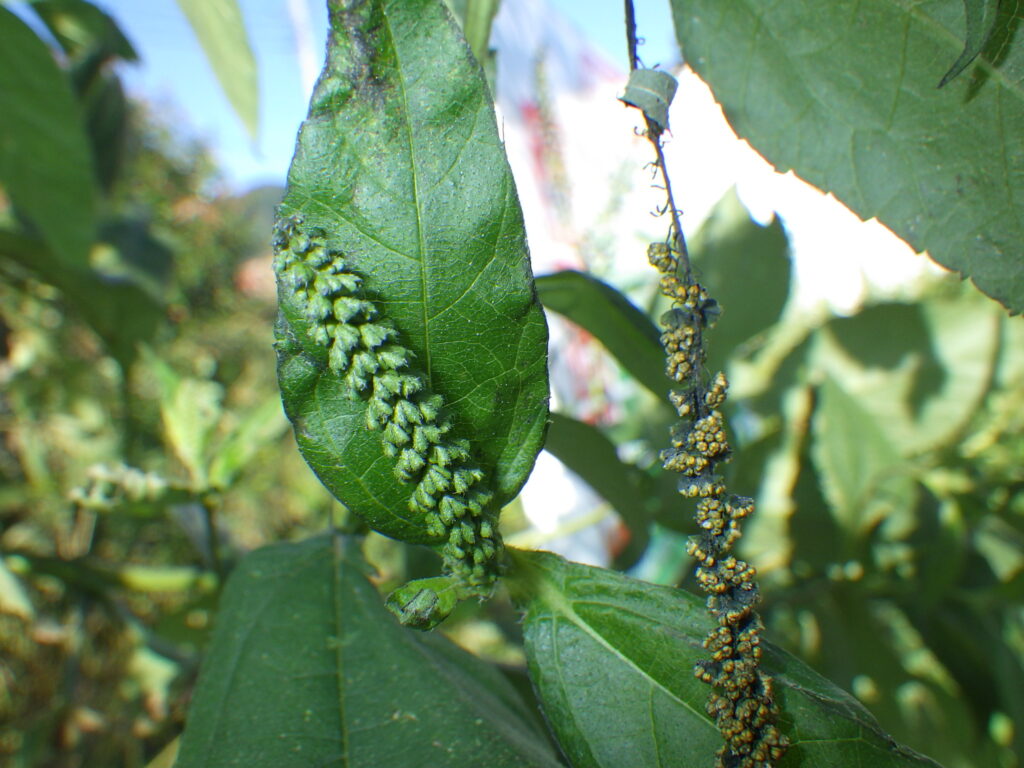
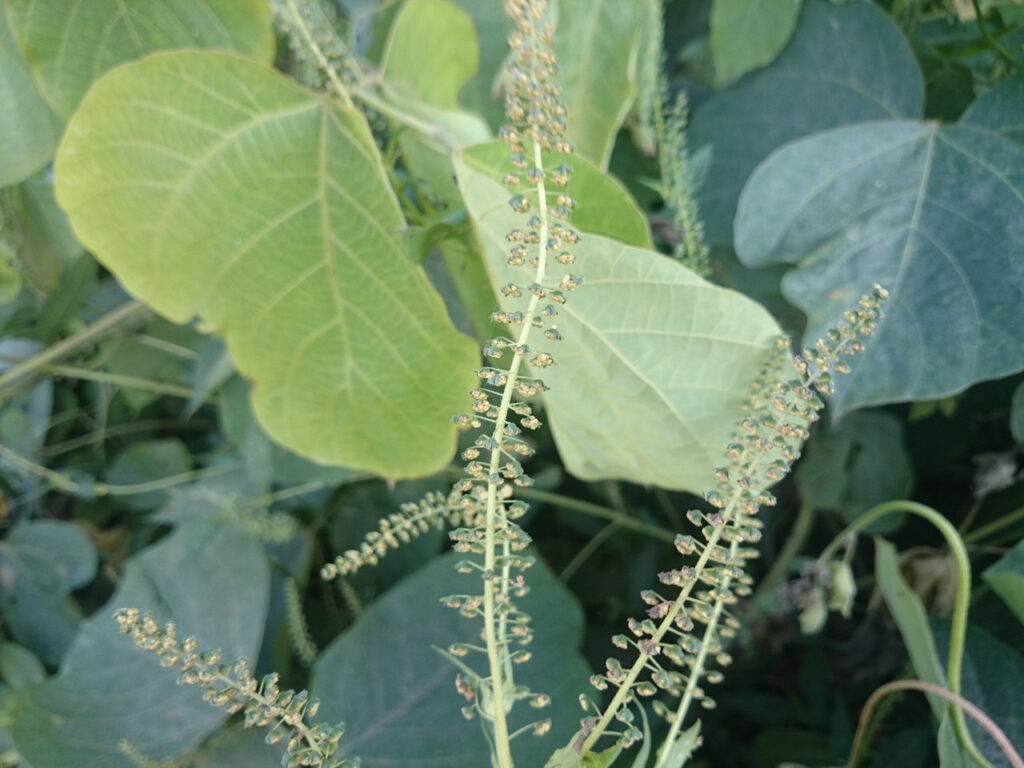
Furthermore, all the florets in the flower heads are unisexual (having only either pistils or stamens), and the fact that male and female flowers are attached to separate flower heads is also a characteristic of the genus Ragweed.
These female and male flower heads are then arranged in even more slender racemes, with the male flower heads hanging downwards towards the ground.
This is a characteristic of wind-pollinated flowers, and it is thought to be advantageous for pollination as the flowers are swayed by the wind, allowing their pollen to be dispersed. This is related to hay fever.
Among wind-pollinated flowers, it is classified as a "pendulous type," and because the flower stalks extend downwards, the flowers appear to droop and are easily swayed by the wind (Utsumi, 2002).
Although they possess many unique structural features, ragweed and giant ragweed share many characteristics, making them easily confused. Similarly, goldenrod, sedum, and hawkweed seem to be often mistaken for each other due to various misunderstandings.
What is the difference between ragweed and giant ragweed?
First, let's look at the differences between ragweed and giant ragweed, which are closely related species biologically.
The way to distinguish them is simple.
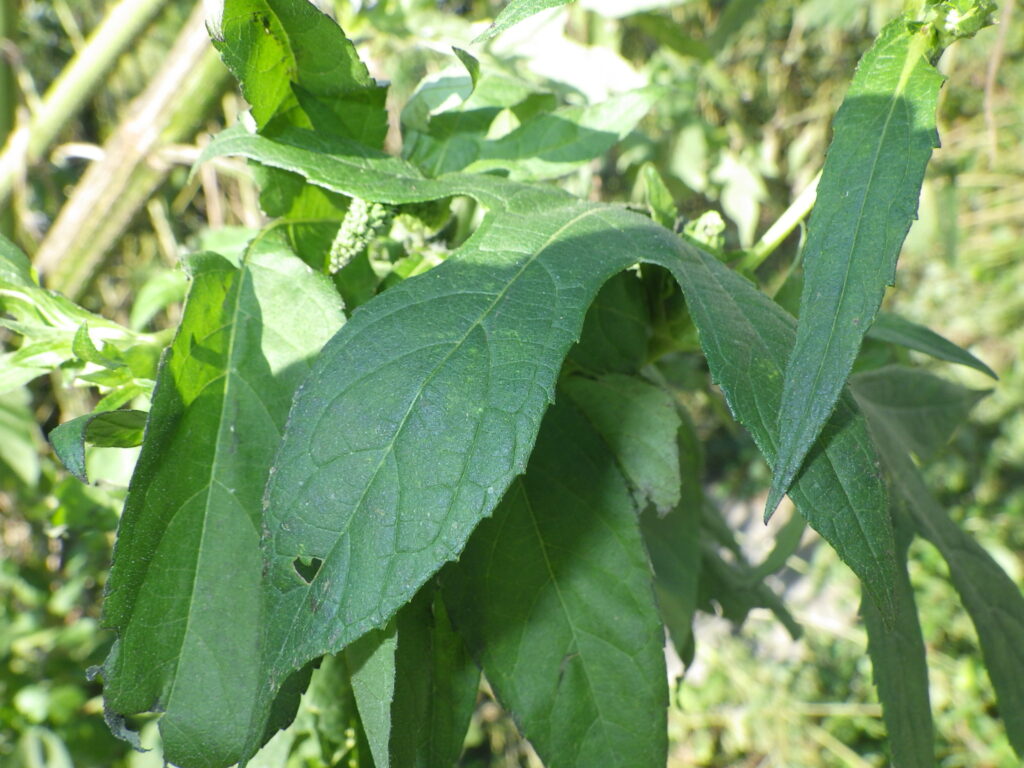
In ragweed, the leaves are opposite or alternate and pinnately lobed, whereas in giant ragweed, the leaves are opposite and palmately lobed to shallowly 3-lobed to entire.
The terminology might be confusing, but essentially, ragweed leaves are finely divided like feathers, while giant ragweed leaves are not divided as finely. You can easily tell the difference by looking at them.
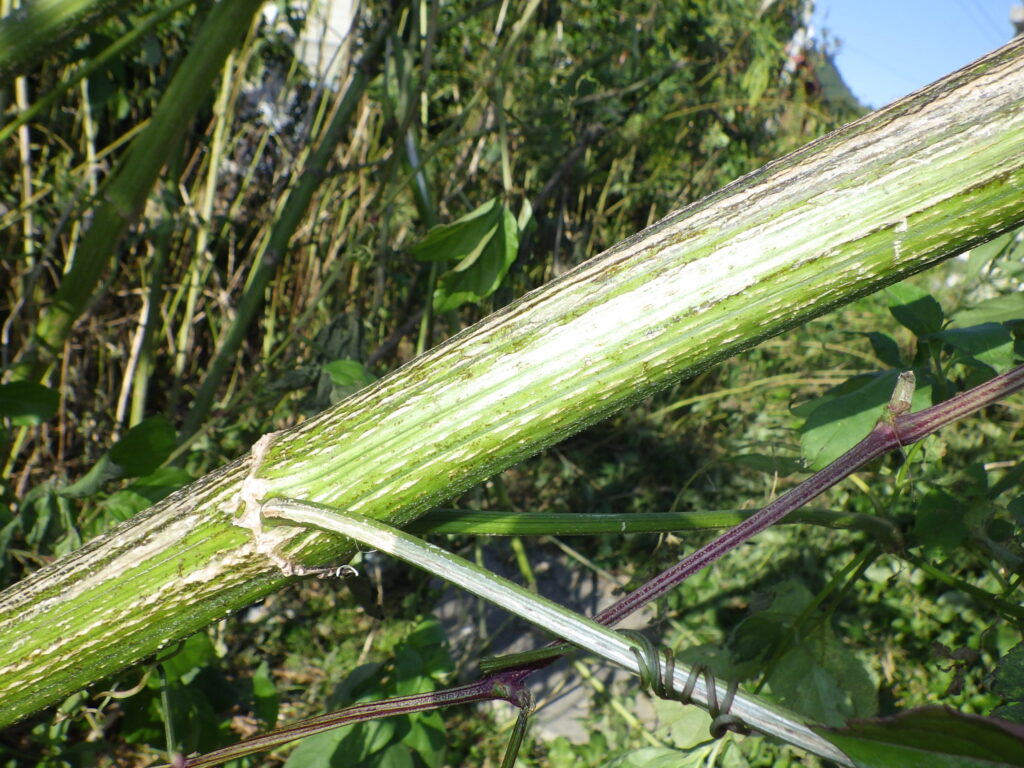
Furthermore, while the stems of ragweed (Ambrosia gracilis) are typically 20-90 cm tall, those of giant ragweed (Ambrosia trifoliata) can reach 1-3 m in height, reflecting the difference in their names. However, it's possible that the plant is still growing, so you should carefully examine the leaves.
Incidentally, the giant ragweed with all leaves having entire margins (leaves that are not lobed at all) is given the rather confusing name of *Ragweed f. integrifolia *. I really wish they would change the name.
Another species that resembles ragweed, Ambrosia psilostachya, is also rarely seen, but it differs in that its leaves are once pinnately lobed, it is a perennial herb, the outer surface of the male flower heads is covered with many soft hairs, and the female flower heads are borne singly (in contrast to ragweed, which has leaves twice pinnately lobed, is an annual herb, the outer surface of the male flower heads is scattered with stiff, short hairs or is hairless, and the female flower heads are borne in pairs or groups of three).

What is the difference between ragweed and goldenrod?
The difference between ragweed and goldenrod seems to be a frequently searched topic on the internet.
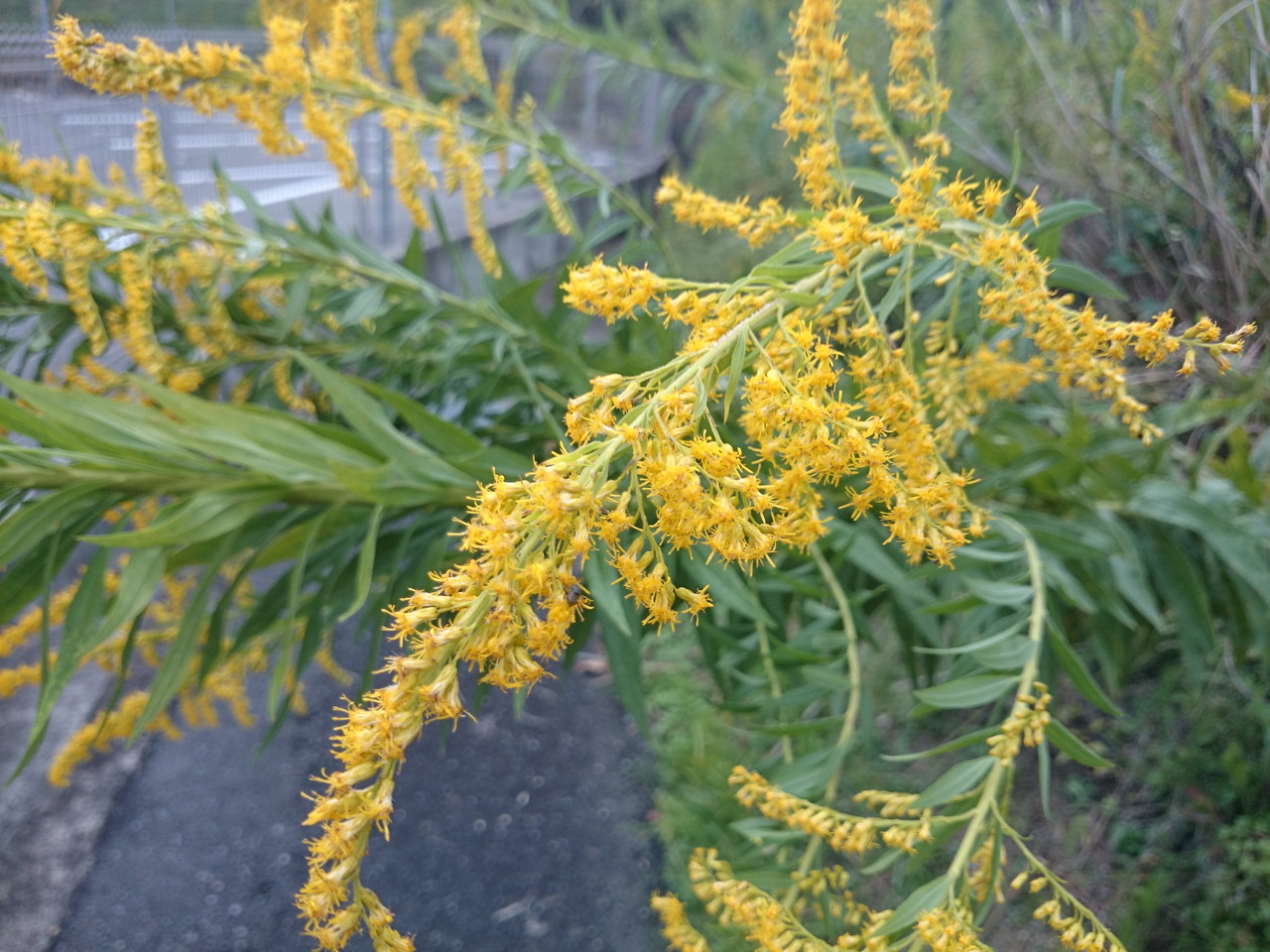
This seems to stem from the fact that Solidago altissima (tall goldenrod) was once mistaken for ragweed.
It's true that goldenrod, like ragweed, belongs to the daisy family and blooms in autumn, and you might get the impression that yellow flowers produce a lot of yellow pollen. However, this is a big mistake.
First, taxonomically speaking, ragweed and goldenrod both belong to the Asteraceae family, but they belong to quite distant groups within that family.
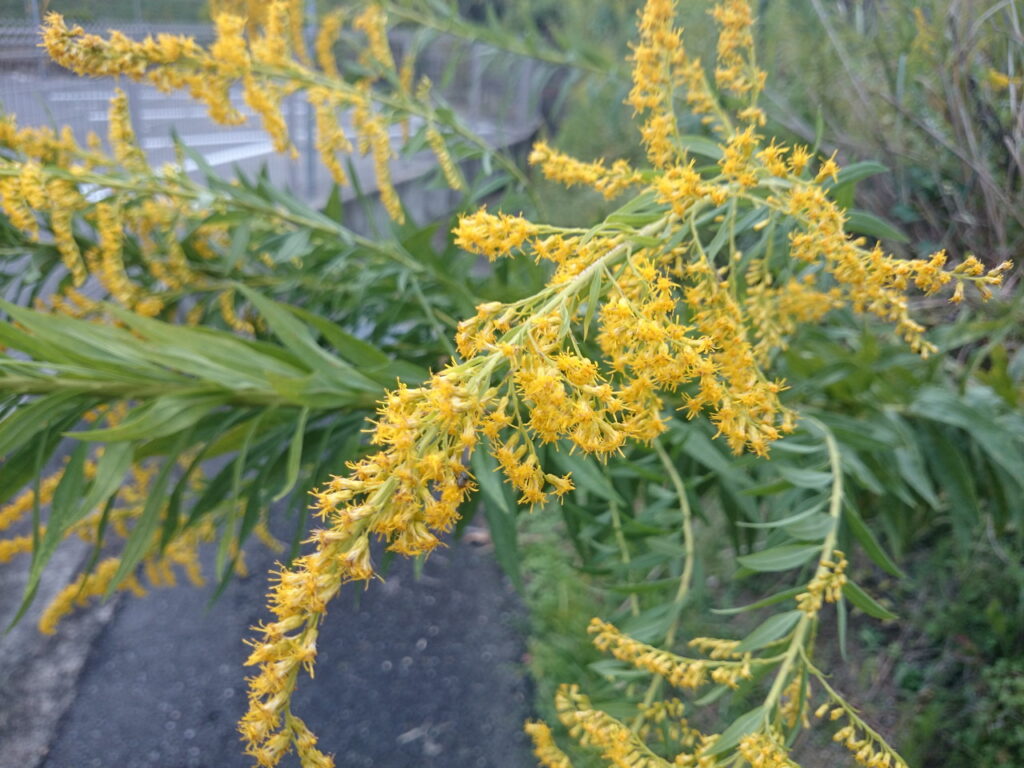
In terms of shape, as mentioned above, ragweed flower heads are green, lack a corolla, and hang downwards, while goldenrod flower heads have a prominent yellow corolla and bloom upwards, making them completely different.
The crucial difference is that ragweed is wind-pollinated, while goldenrod is insect-pollinated. Goldenrod is yellow to attract insects, and its pollen grains are large to provide nutrients for insects, making it unsuitable for wind pollination. Therefore, goldenrod does not cause hay fever in humans.
What is the difference between ragweed and sedum?
For some reason, the difference between ragweed and sedum seems to be a frequently searched topic on the internet.
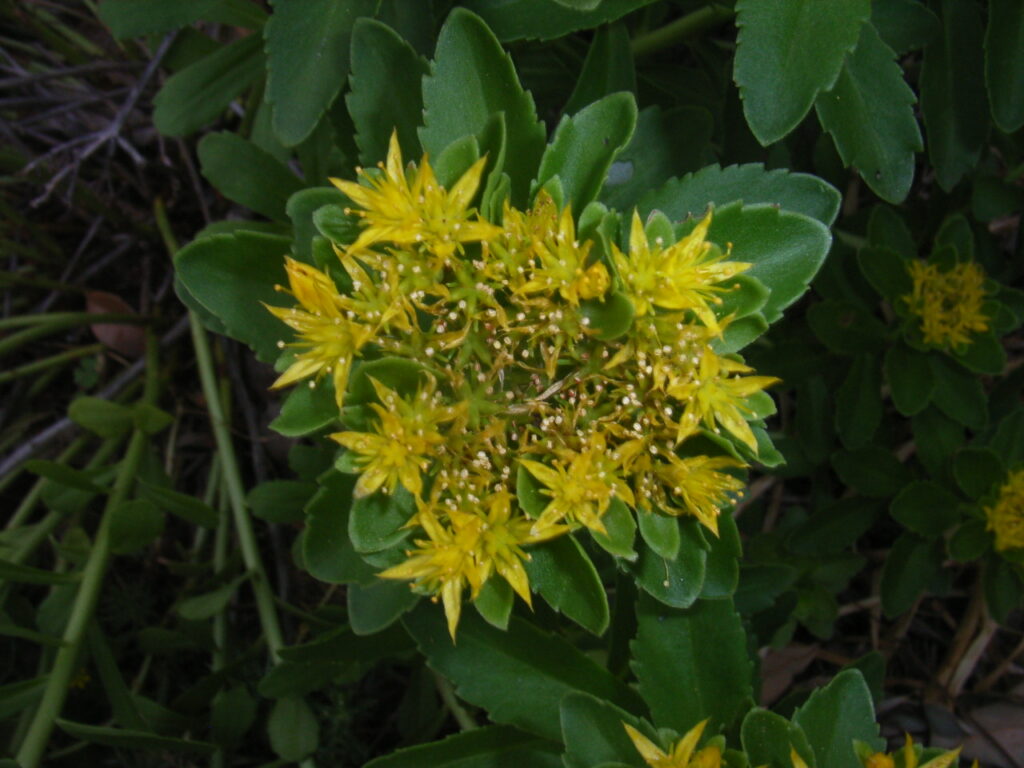
However, the true ragweed, Phedimus aizoon var. floribundus, belongs to the Crassulaceae family and is a completely different species from ragweed, which is characterized by its fleshy leaves and star-shaped yellow flowers.
This might be the result of mistaking goldenrod for sedum.
While it's true that tall goldenrod (Solidago virgaurea) belongs to the genus Solidago, and its alternative name is tall goldenrod (Solidago aurantiacus), suggesting a connection, as mentioned above, the genus Solidago belongs to the Asteraceae family, and goldenrod (Solidago virgaurea subsp. asiatica) is a different species from tall goldenrod.
In other words, they might be mistaking ragweed for goldenrod, then goldenrod for goldenrod, and then goldenrod for sedum.
This is completely wrong, so please be careful.
If you want to know the difference between goldenrod and autumn virgaurea, please see our other article.
What is the difference between ragweed and hawkweed?
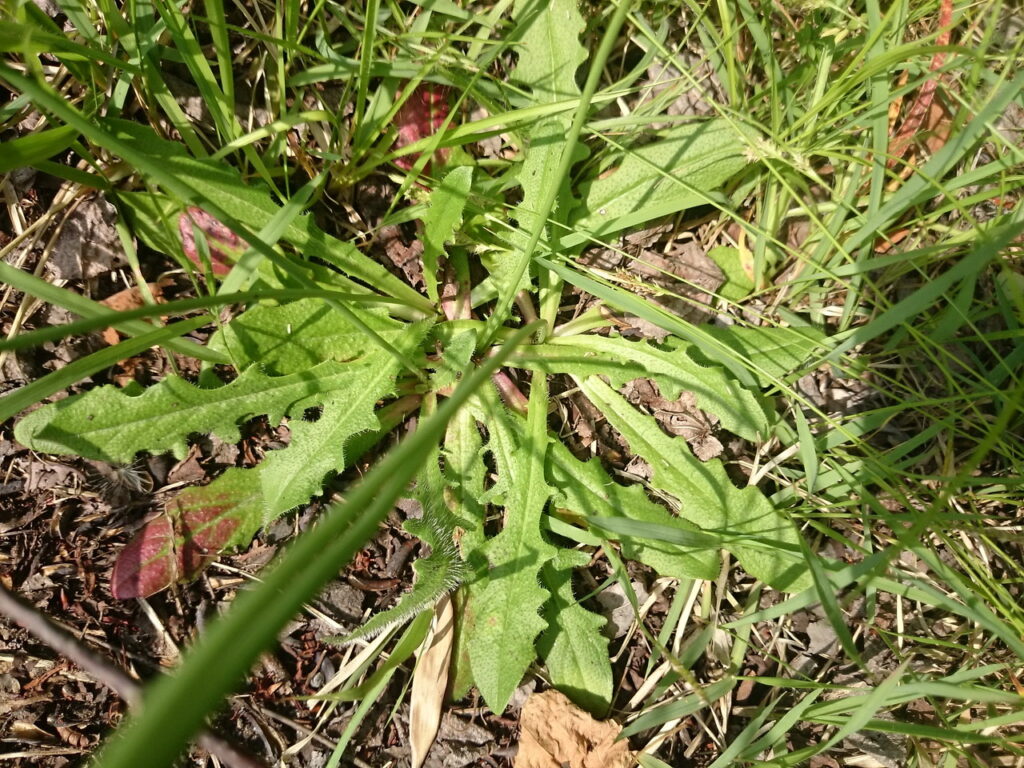
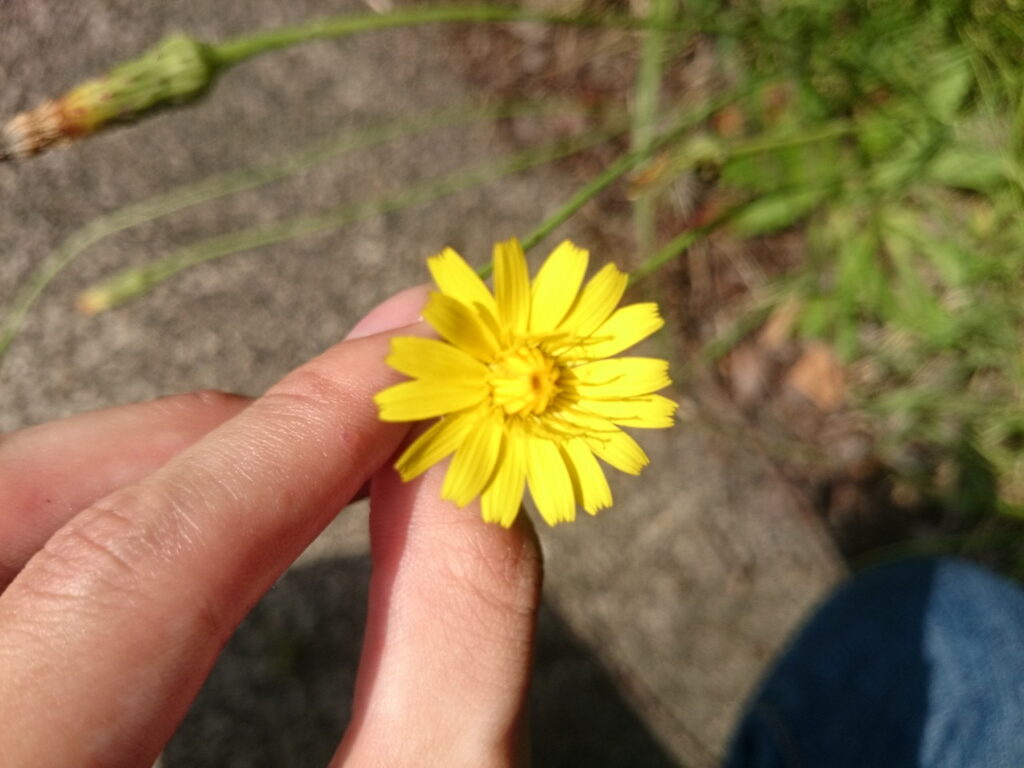
The difference between ragweed and hawkweed (Hypochaeris radicata) also seems to be a frequently searched topic.
These two plants are somewhat similar in name, and Hypochaeris radicata (pig's greens) also belongs to the Asteraceae family, which may be why they are sometimes confused.
However, the hawkweed produces large, yellow flower heads, giving the impression that it is more similar to a dandelion.
In fact, it's more difficult to find common ground with ragweed because they are so different.
The Japanese name for ragweed (Butakusa) is derived from a translation of its common English name, "hogweed" (pig's grass), while the Japanese name for ragweed (Butana) is derived from a translation of its common French name, "Salade de porc" (pig's salad).
References
Kanagawa Prefecture Flora Survey Association. 2018. Kanagawa Prefecture Flora 2018 (Electronic Edition). Kanagawa Prefecture Flora Survey Association, Odawara. 1803pp. ISBN: 9784991053726
Okubo, Kimihiro. 2014. Hay fever: its causative substances and mechanisms. Modern Media 60(12): 1-5. ISSN: 0026-8054, https://www.eiken.co.jp/uploads/modern_media/literature/MM1412_01.pdf
RBG Kew. 2023. The International Plant Names Index and World Checklist of Vascular Plants. Plants of the World Online. http://www.ipni.org and https://powo.science.kew.org/
Utsumi, Shunsaku. 2002. Why are flowers beautiful? 1. Insects and pollination. Chiba University Faculty of Education Research Bulletin 50: 441-448. ISSN: 1348-2084, https://opac.ll.chiba-u.jp/da/curator/900026751/