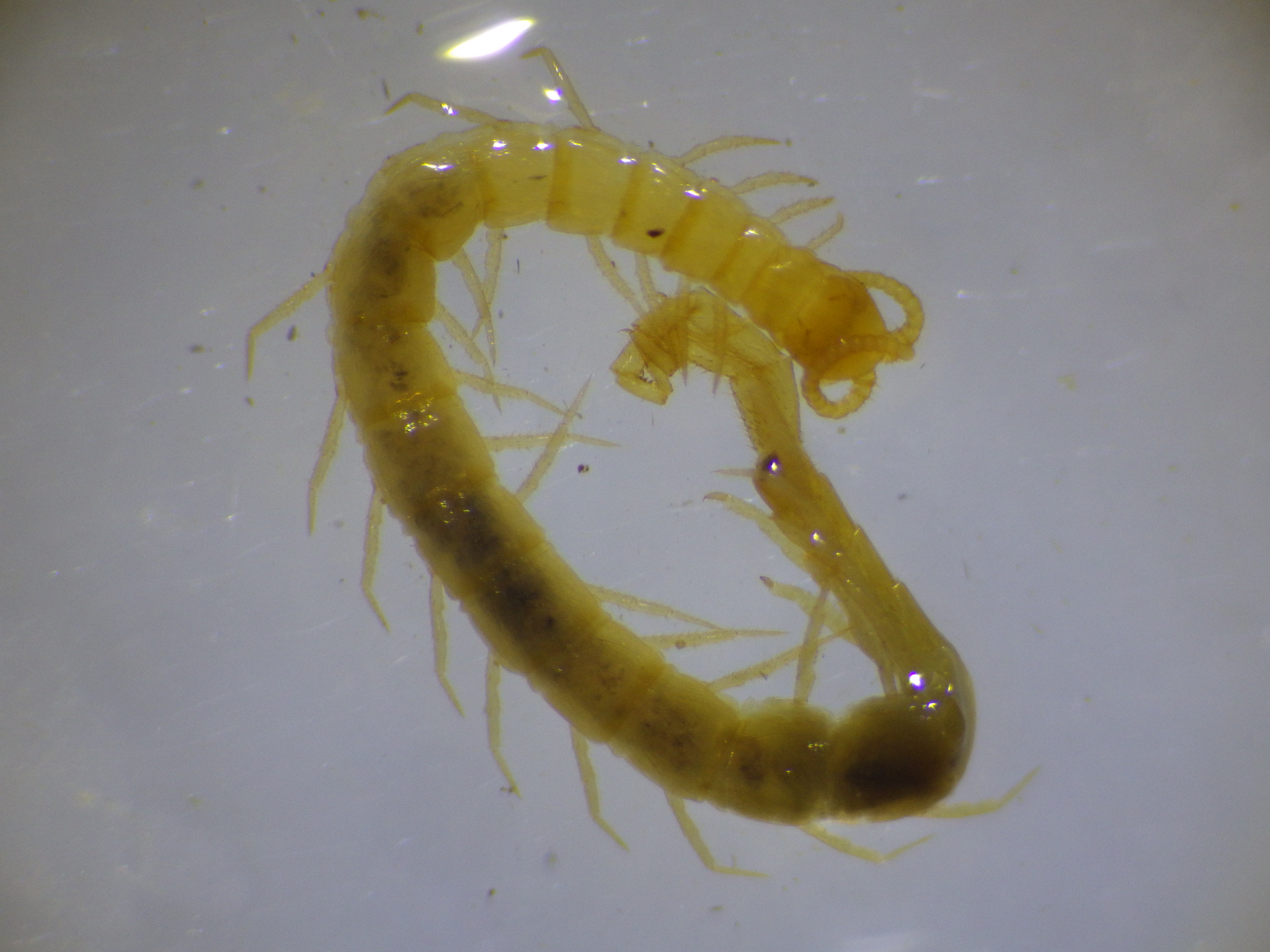
The term "mena centipede" refers to a group of centipedes belonging to the genus *Centipede* in the family Scolopendridae, order Scolopendromorpha. These centipedes are burrowing and rarely seen by the average person, but their most striking feature is their strangely enlarged final legs. While there have been various theories regarding the function of these final legs, recent research suggests they are likely used as a means of defense against predators. However, there is currently very little research on the ecology of *Centipede* species in Japan. This article will explain the ecology of *Centipede*.
What is a Menashi centipede?
Cryptops are a general term for species belonging to the genus Cryptops in the family Cryptodoridae, order Scolopendromorpha.
In Japan, only three species of Cryptops are known: Cryptops japonicus, Cryptops striatus, and Cryptops nigropictus. The distinctions between these species are described in Aoki (2015).
This group of centipedes is relatively subterranean and rarely wanders above ground, making them quite uncommon and difficult to find. However, those of us who regularly study soil animals, like myself, occasionally come across them.
Although it is not listed in Japan's Ministry of the Environment's Red Data Book, it is treated as an endangered species in some prefectures, such as Chiba and Saitama.
The most distinctive feature of this group of centipedes is that their last pair of legs, or the final pair of legs, are exceptionally large compared to other centipedes and are covered in spines called "serrations."
As its name "eyeless centipede" suggests, one of its distinguishing features is the absence of eyes (compound eyes). However, the absence of compound eyes is also common to the Scolopendromorpha order and the Scolopendridae family, which includes species like the geometrid centipede and the red centipede. These are thought to be adaptations to life underground in the absence of light (Aoki, 2010).
Like many centipedes, the flat-nosed centipedes are carnivorous.
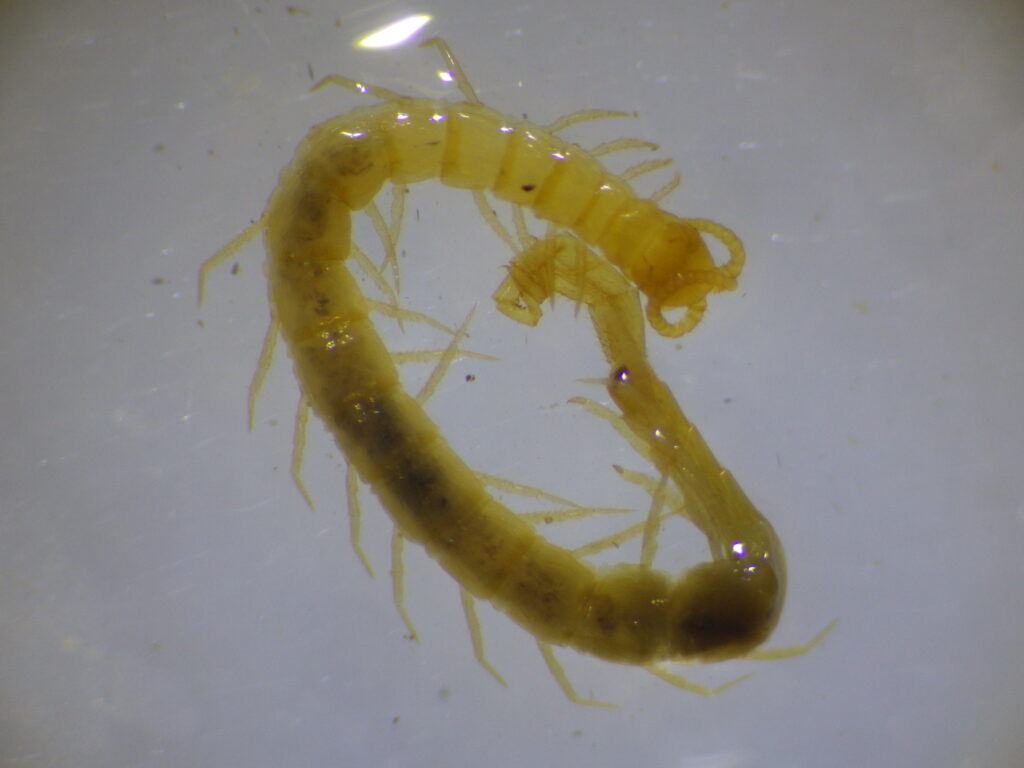
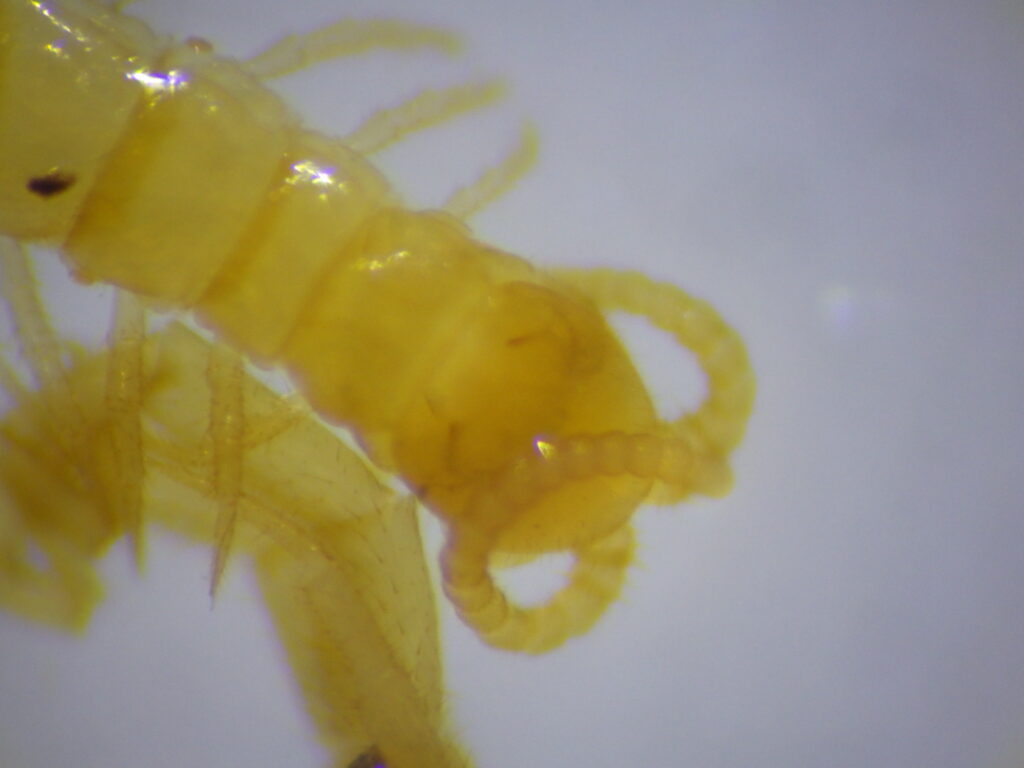
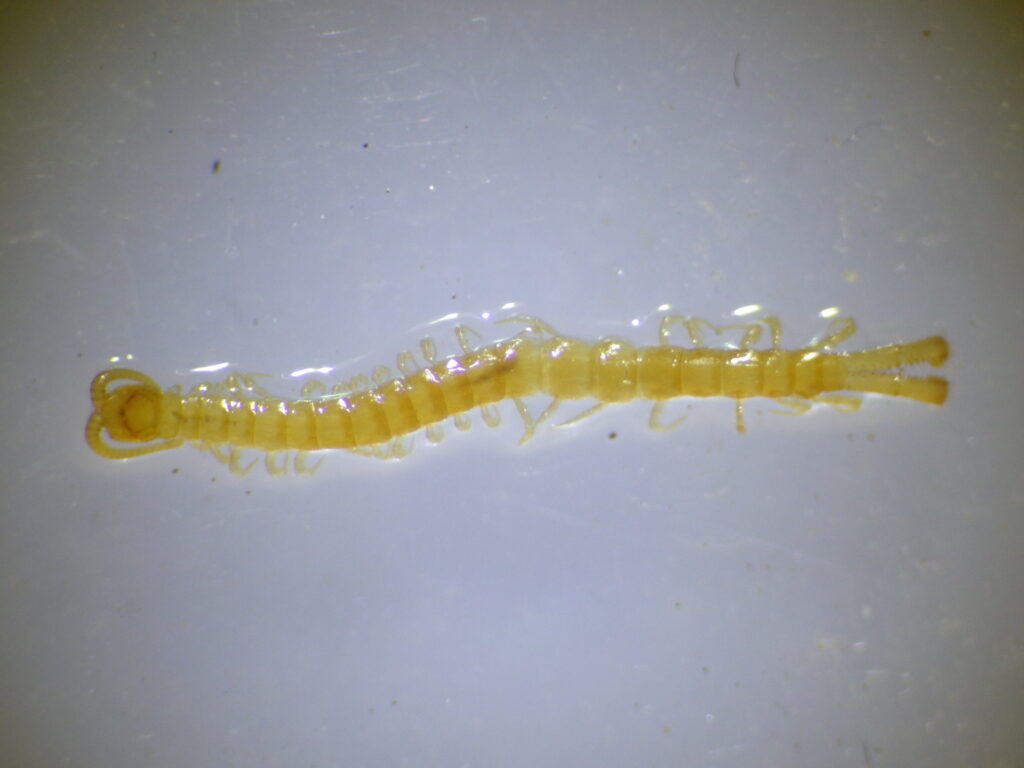
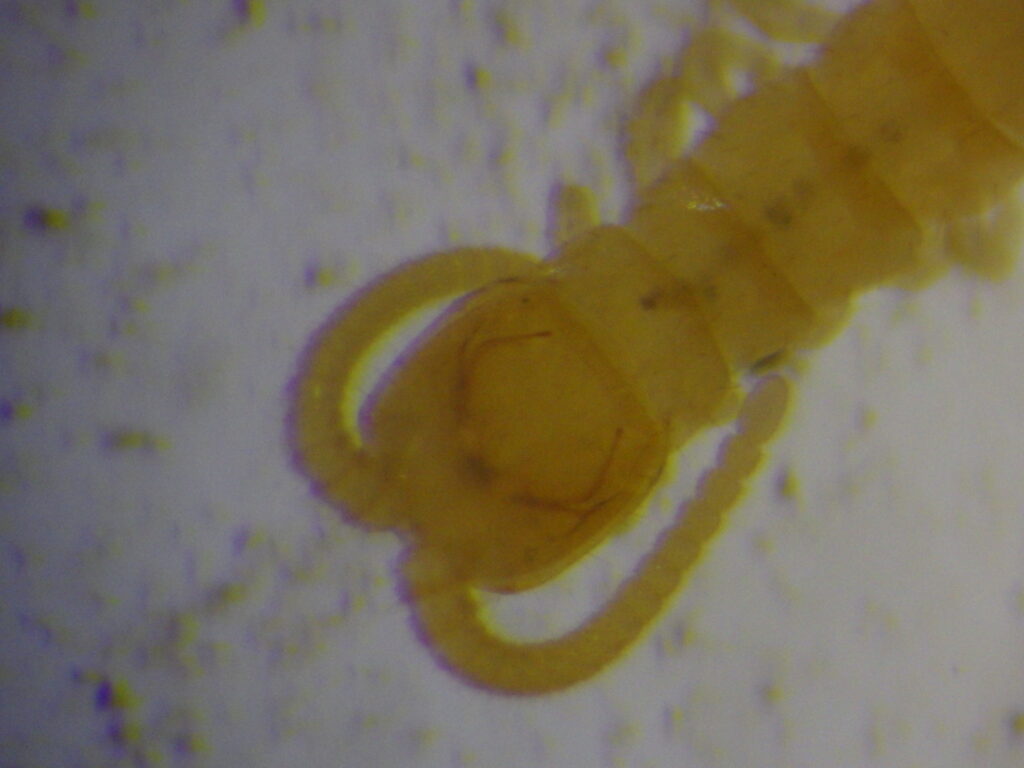
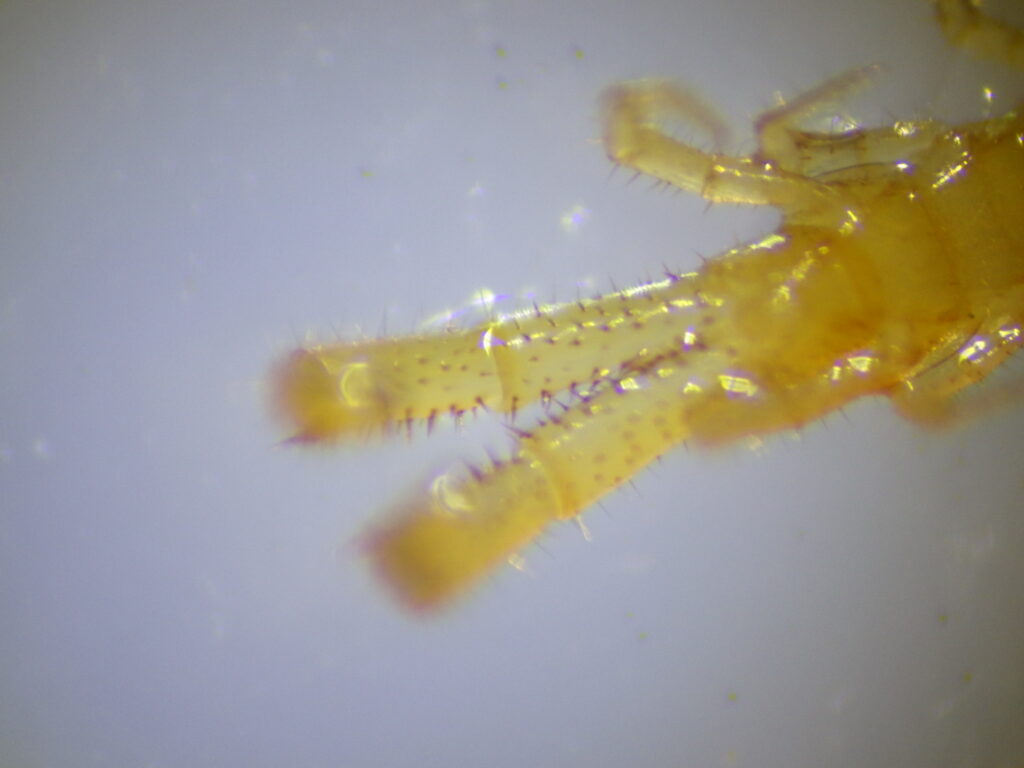
What is the role of the last pair of legs in the flat-legged centipede? Is it for predation or defense?
Every time I saw this legless centipede, I wondered, "Why are its legs shaped like that?"
Centipede research is lagging behind in Japan, and ecological research is even further behind; there is virtually no research on the Japanese species *Centipede japonica*.
However, various studies have been conducted on members of the genus *Centipede* from other countries, so I will share them here (Lewis, 2010; Kenning at al., 2017).
It was initially thought that the last pair of legs of the flat-legged centipede were used for predation.
From its appearance, it seems that this centipede has serrations on the inside of its legs, which suggests it can grip firmly. Closely related species, such as those in the genera * Theatops *, * Plutonium*, and *Centipede*, have strong muscles and pincers, and have been observed actually catching prey.
However, while there is one recorded instance of such observation in the flat-legged centipede, the centipede ultimately failed to capture and kill its prey with its last pair of legs, and other studies only record that the centipede does not use its last pair of legs, but instead grabs its prey with the mandibles on its head and eats it.
Therefore, recent research suggests that the use of the flat-nosed centipede may be different from this.
It's for defense. Specifically, the idea is that when attacked by a predator, the animal reflexively grabs with its last pair of legs, and the serrations on the inside of those legs create frictional resistance, allowing it to stick to the predator's body.
This phenomenon has been directly observed in one instance, in which a species of centipede (Phidippus genus) attacked a species of centipede (Phidippus genus), and the centipede (Phidippus genus) retaliated with its last set of legs, leaving the legs attached to the body of the centipede.
Furthermore, when specimens of the genus *Centipede* are prepared, the last pair of legs tend to detach easily due to the impact, and the detached legs are severely bent. I have actually seen a specimen of *Centipede* from Japan that was missing its last pair of legs. This fact also supports the idea that the legs developed for defensive purposes, as it would be problematic if *Centipede* used them for predation, as the legs not easily detaching would be a problem.
However, determining specifically which types of predators this last-stepped leg is advantageous against remains a subject for future research.
The final stepping leg had other roles too!?
However, the serrations on the inner side of the last step remain a mystery.
In large males of the New Zealand species C. polyodontus and C. lamprethus, the serrations on the teeth are arranged in 2 to 4 rows, while females have only one row of serrations, and these serrations are larger than those of the males.
This fact indicates sexual dimorphism in the serrations on the inner side of the last step, and sexual dimorphism usually arises through the evolutionary process of sexual selection. Therefore, it suggests that the use of these serrations differs between males and females for some reason.
However, the specific differences in their uses are still not well understood. One researcher suggests that they may be used for sex identification in species recognition. Mating behavior in the genus *Centipedes* has not yet been observed, but some other centipede species perform a courtship ritual called "tapping," where they tap or stroke the last legs of the opposite sex with their antennae. If *Centipedes* also do this, it would be a way to gather information about the distribution of their partner's serrations.
While no similar cases have been observed in Japanese centipedes, it's possible that the final set of legs changes in various ways during the evolutionary process, such as for attack, defense, and mating.
References
Aoki, Jun-ichi. 2010. Soil Zoology: Focusing on Classification, Ecology, and Relationship with the Environment. Hokuryukan, Tokyo. 797pp. ISBN: 9784832608375
Aoki, Jun-ichi. 2015. Illustrated Key to the Classification of Soil Animals of Japan (2nd edition). Tokai University Press, Hadano. 1969pp. ISBN: 9784486019459
Lewis, J. 2010. On the function of the ultimate legs of Cryptops and Theatops (Chilopoda, Scolopendromorpha). International Journal of Myriapodology 3(2): 145-151. https://doi.org/10.1163/187525410X12578602960542, https://brill.com/view/journals/ijm/3/2/article-p145.xml
Kenning, M., Müller, CH, & Sombke, A. 2017. The ultimate legs of Chilopoda (Myriapoda): a review on their morphological disparity and functional variability. PeerJ 5: e4023. https://doi.org/10.7717/peerj.4023