This article contains a draft of the report titled "Records of the Japanese land planarian in Hyogo Prefecture," which was published in the following journal.
Citation method: Ikeda, Kenichi & Ikeda, Atsuya. 2022. Records of the land planarian in Hyogo Prefecture. Nature Study 68(5): 6. ISSN: 0466-6089.
Purchase here
This article was written assuming the first recorded instance of the Japanese land planarian (Bipalium nipponense) in Hyogo Prefecture.
There may be minor changes in wording, but the cited references remain the same. For more accurate information, please refer to the journal.
Distribution status of the land planarian (Bipalium) in Japan
Bipalium kewense Moseley, 1878, a land planarian, is native to Southeast Asia and is a species of planarian that is distributed globally and is still expanding its range (Katsukawa et al., 2007; Justine et al., 2018). In Japan, it is an invasive species (Katsukawa, 2007), and in the United States and other countries, it is known to pseudoparasitize domestic dogs, domestic cats, and humans through accidental contact (Hayasaki, 2012). By prefecture, Katsukawa et al. (2007) have recorded its presence in the area around Tokyo, Chichijima in the Ogasawara Islands, Nagasaki Prefecture, and Okinawa Prefecture (main island only). In addition, as far as the author has been able to confirm, records have been found in Wakayama Prefecture (Kubota et al., 2001) and Osaka Prefecture (Ishida, 2014; Kaizuka City Nature Museum, 2016; Yamada et al., 2017; 2018), but no records were found in Hyogo Prefecture. Note that, according to Hagino (2016), the records for Chiba Prefecture have been changed to those of the large striped land planarian.
Author's distribution record
One of the authors photographed this species at approximately 10:00 AM on September 18, 2021, in ■■■■-cho, Nishi-ku, Kobe City, Hyogo Prefecture (as published in this magazine), where it was motionless in a fish tank in the garden of a private house, and reports this observation here.
1 ex., ■■■■-cho, Nishi-ku, Kobe City, Hyogo Prefecture, September 18, 2021. Photographed by Atsuya Ikeda.
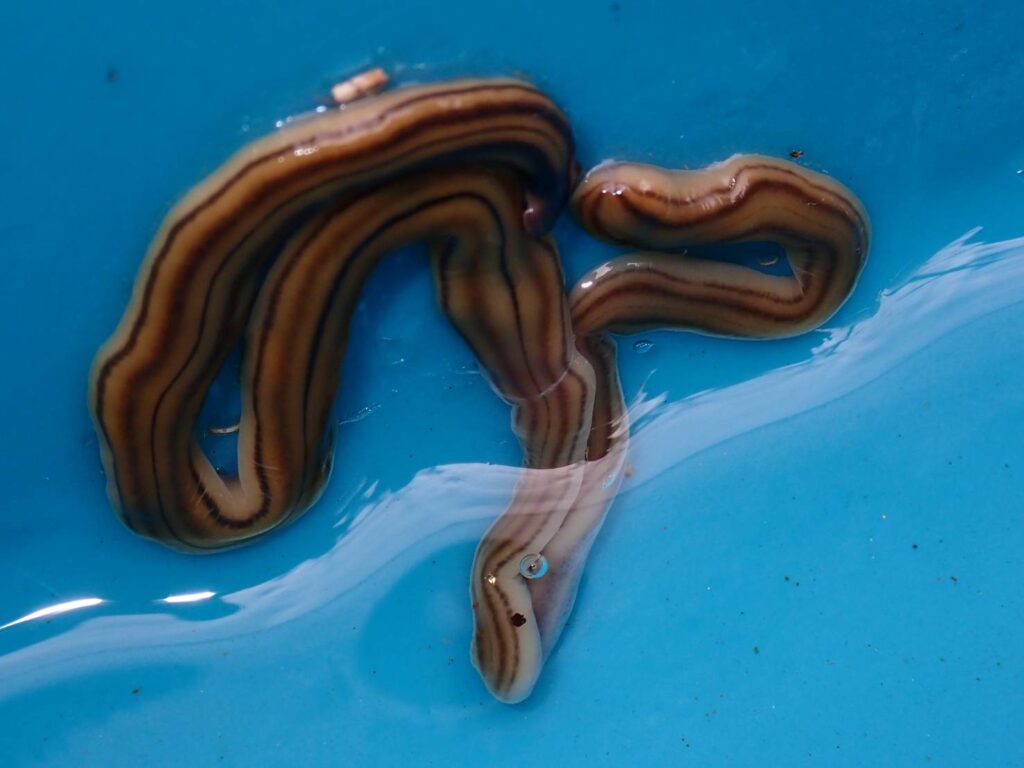
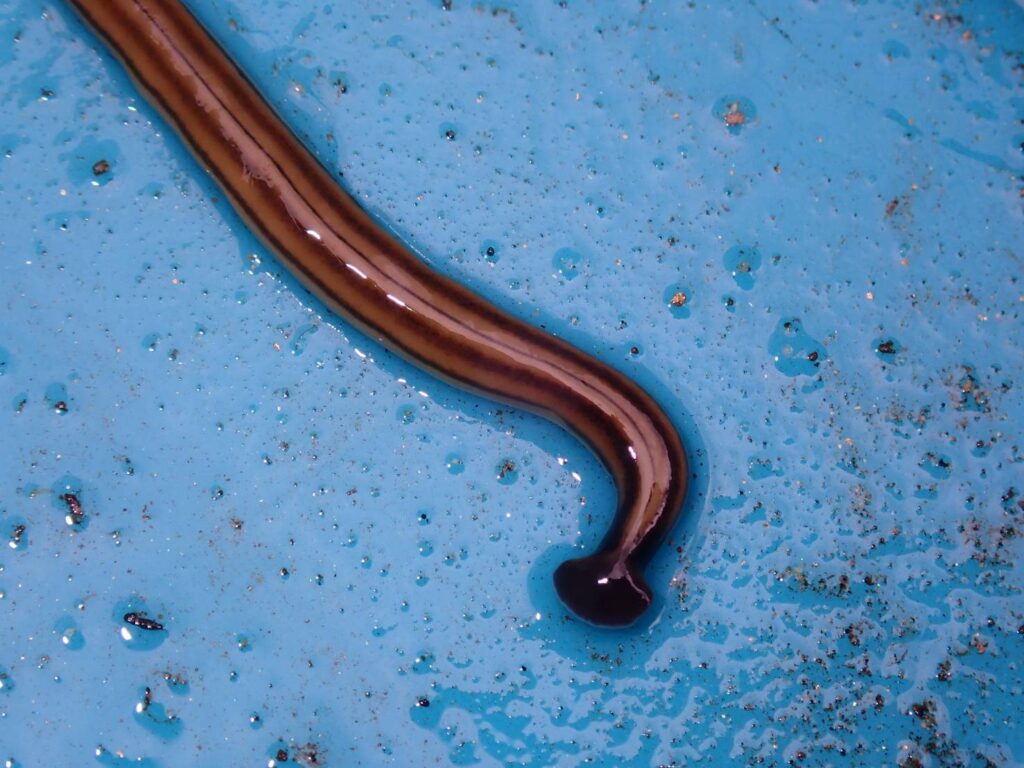
In Kubota et al. (2001), who described the distinguishing features of large land planarians in Japan, *Bipalium spp.* is described as having "five linear patterns on the dorsal surface, black markings on both sides of the neck, and a linear pattern on the midline of the dorsal surface that does not reach the head plate and is thicker in the pharynx-genital area." This individual fits this description well, so it was identified as this species. The tank was in the shade, and rainwater from the previous day had accumulated in it. Its presence in the tank was accidental, and it is thought to have been wandering around due to the increased humidity. Generally, land planarians are known to prey on snails, slugs, earthworms, and small insects (Hayasaki, 2012), and there are known cases of this species preying on earthworms (Ogren, 1995; Justine et al., 2018). Earthworms and brown slugs were present in the lawn, and it is possible that these were being used as a food source.
In the case of the land planarian (Bipalium fuscipes), fragments regenerate and reproduce asexually (Katsukawa et al., 2007), and because alien land planarians may affect the soil fauna due to their diet, some consider them to be invasive alien species (Justine et al., 2018), so they require close monitoring in Japan as well.
References
Hagino, Yasunori (2016). List of soil animals from Chiba Prefecture I: Fauna excluding winged insects. Research Reports of the Natural History of Chiba Central Museum 13(2): 83-141. http://www.chiba-muse.or.jp/NATURAL/publication/journal_13-2_3hagino.pdf
Hayasaki, Mineo (2012). Pseudoparasite: Land planarian. Journal of the Japan Veterinary Medical Association 65(10): 731-740. http://nichiju.lin.gr.jp/mag/06510/a4.pdf
Justine, JL, Winsor, L., Gey, D., Gros, P., & Thévenot, J. (2018) Giant worms chez moi! Hammerhead flatworms (Platyhelminthes, Geoplanidae, Bipalium spp., Diversibipalium spp.) in metropolitan France and overseas French territories. PeerJ 6: e4672. https://doi.org/10.7717/peerj.4672
Specimens donated by Kaizuka City Nature and Learning Center (2016). Nature and Learning Center Newsletter 81: 19-25. ISSN: 2185-9817, https://www.city.kaizuka.lg.jp/material/files/group/4/yugakukan-tayori-81n.pdf
Kawakatsu, Masaharu; Nishino, Machiko; and Otaka, Akifumi (2007). Invasive species of planarians. Journal of Limnology 68(3): 461-469. https://doi.org/10.3739/rikusui.68.461
Kubota, S., Yamamoto, K., & Kawakatsu, M. (2001) Three species of land planarians (Platyhelminthes, Turbellaria, Tricladida) appear for the first time in Wakayama Prefecture. Nanki Seibutsu 43(1): 6-10. http://hdl.handle.net/2433/188283
Ogren RE (1995) Predation behavior of land planarians. Hydrobiologia 305: 105-111. https://doi.org/10.1007/BF00036370
Koji Yamada, Taku Iwasaki, Mari Ohata, Itaru Kojima, Takuma Terada, and Taichi Wada (2017). Progress observation of the Kinokigawa tidal flat restoration site (FY2014). Kaizuka no Shizen 18: 1-34. https://www.city.kaizuka.lg.jp/material/files/group/4/kisuiwandokeikakansatu2014.pdf
Yamada, Koji; Iwasaki, Taku; Ohata, Mari; Kojima, Itaru; Terada, Takuma; and Wada, Taichi (2018). Progress observation of the Kogigawa tidal flat restoration site (FY2015). Kaizuka no Shizen 19: 1-34. https://www.city.kaizuka.lg.jp/material/files/group/4/kogigawa-kisuiwando-2015.pdf
Ishida, So (2014). Land planarians and their distribution. Nature Study 60(2): 15-16. http://www.omnh.net/pdf/NS201402_Ishida.pdf