Hello everyone, are you aware that there is an app called " Yamakawa One-Question-One-Answer World History" that contains all the questions from the book " Yamakawa One-Question-One-Answer World History" ?



I recently purchased and started playing this app, so I'll share my current impressions.
In conclusion, although there are some drawbacks, I find it very convenient and continue to use it.
This article is intended to be helpful for those wondering whether a world history Q&A app is actually useful.
This review is written from a working professional's perspective, so it may not be suitable for students. Also, the author uses the Android version and this review is based solely on that version.
- History is a discipline closely related to biology.
- My history of studying world history
- Learn all the items from YouTube videos
- Output is necessary for true memorization.
- Reasons why I found the Q&A format in books difficult to use
- I downloaded the app version of Yamakawa's Q&A World History book.
- How to Use Yamakawa's Q&A World History
- Advantages of the app version of "Yamakawa One-Question-One-Answer World History"
- Disadvantages of the app version of "Yamakawa One-Question-One-Answer World History"
- summary
History is a discipline closely related to biology.
History, depending on how you interpret it, can be considered "the ecology of humankind."
For example, in the field of "evolutionary psychology," there is a discipline that considers the natural environment of Africa where humans evolved and examines the genetic basis of human behavior and psychology.
Furthermore, Jared Diamond's famous book , "Guns, Germs, and Steel," examines the differences in the development of civilizations due to differences in resources in human habitats. This can be said to be an examination of environmentally-influenced human behavior and psychology.
In that sense, as someone who has studied biology for a long time, I find it very interesting to read.
My history of studying world history
That's why I've recently started studying world history in earnest, trying to memorize it.
I've always liked history, but in high school I was in the science stream and didn't have the opportunity to study it systematically...
During my university days, I had the freedom to study as I pleased, and I remember neglecting biology and devouring books on ancient and modern history.
I studied prehistory quite obsessively. I can recite all of them from memory: Homo habilis, Homo ergaster, Homo heidelbergensis, Homo ergaster, Homo erectus, Homo neanderthalensis, Denisovans, Homo floresiensis (laughs). This area is mostly biology, though.
Learn all the items from YouTube videos
It was during my graduate school days that I came across the YouTube channel "Historia Mundi," and I was blown away. You could watch lectures on all topics in world history and Japanese history for free.
Historia Mundi channel is here
Geography has now been added to the curriculum. When I was a student, I was engrossed in it, and I went through Japanese history once and world history twice.
This channel is truly great and provides learning opportunities for everyone.
Output is necessary for true memorization.
However, no matter how interesting a story you hear and how much information you absorb, output is essential for truly remembering it.
There are several ways to output information. Initially, I used a question-and-answer format in a book, but I felt that there were several aspects that didn't suit me.
Reasons why I found the Q&A format in books difficult to use
The book I purchased was "Yamakawa's Q&A World History."
I never took World History B in high school, but I have the impression that the book "Yamakawa One Question and Answer World History" is a standard textbook in the world of entrance exams. After all, it's a problem set from the publisher that produces the most famous textbooks.
The well-known website in the exam preparation industry , "Takeda Juku's Reversal of Fortune Passing.com," describes it as follows:
"Yamakawa World History Q&A" is a problem set for those who want to score well on entrance exams ranging from national universities to Waseda and Keio Universities, or for those who will be taking national or public university entrance exams that include essay questions.
"Yamakawa World History Q&A" is based on textbook content but is relatively voluminous. The explanations for the answers are thorough, making it suitable for preparing for the second-stage entrance exams of national and public universities, which often include descriptive and essay questions.
『Gyakuten Gokaku.com』
As a counterpoint, Toshin's "World History B: Question and Answer" seems to be quite well-known. I haven't used this one myself, but Yamakawa's version has a very simple layout and uses a lot of formal language, so Toshin's version might be a bit softer and easier to approach.
However, due to my own personality, I found these paper-based question-and-answer formats difficult to use. These can be broadly categorized into the following three points.
- Easy to give up
- Moving my eyes is difficult.
- Difficult to access immediately when out and about
Easy to give up
With a paper-based question-and-answer format, it's obvious, but there's a long list of questions. For me, this tends to make me feel overwhelmed.
I often found myself feeling overwhelmed, thinking, "Even after putting in a little effort, there are still so many problems..." I would just flip through the pages and skim through them, thinking I had done something, but in reality, I hadn't really grasped the material.
If I were a student, I might have tackled it even if it meant clinging to a rock (laughs).
I have a habit of making it difficult to concentrate because when I see a single word, it triggers all sorts of associations.
Moving my eyes is difficult.
This is obvious, but with books, you need to open the pages from left to right and move your eyes from top to bottom. However, it's difficult to follow small print for extended periods...
Furthermore, the question-and-answer format sometimes assumed that the reader would refer to the previous question, which often led to confusion about where I had left off and a loss of concentration.
Difficult to access immediately when out and about
Question-and-answer style materials are definitely something you'd want to use while traveling on trains or other public transport. However, taking a book out and putting it back in during transfers can be a hassle...
It would be great if I had a handbag, but there are times when I don't have one. I found this quite annoying.
I downloaded the app version of Yamakawa's Q&A World History book.
I've always been good at studying using computers and smartphones, so I was looking for an app to study with... and I found the app version of "Yamakawa One Question, One Answer World History" ! It was perfect.
[Number of questions included]
Approximately 4,700 questions (16 chapters in total)
⇒This covers important historical terms related to people, politics, economics, religion, art, literature, and more.
[Convenient Features]
1) It features two modes: a "multiple-choice mode" where you select an answer from four options, and a "single-question, single-answer mode" that tests your memory.
2) Your grades will be recorded automatically.
3) Even if you interrupt the game midway, you can continue playing from where you left off.
4) You can select questions from "All," "Unanswered," "Incorrect," "Correct," and "★Checked (Questions individually checked by the user)." This allows you to focus on studying areas you struggle with.
5) The problems are set to three difficulty levels, and you can choose according to the difficulty level.
Google Play
The price is 600 yen, which is cheaper than a book.
While there isn't a detailed explanation of the content, it appears that this app is a port of the book version, released in almost the same format.
How to Use Yamakawa's Q&A World History
It's extremely easy to use. After downloading, you can start working on your problems immediately after making a few settings, such as turning the sound on or off.

The problems can be solved at any level, including chapters, sections, and sub-items.
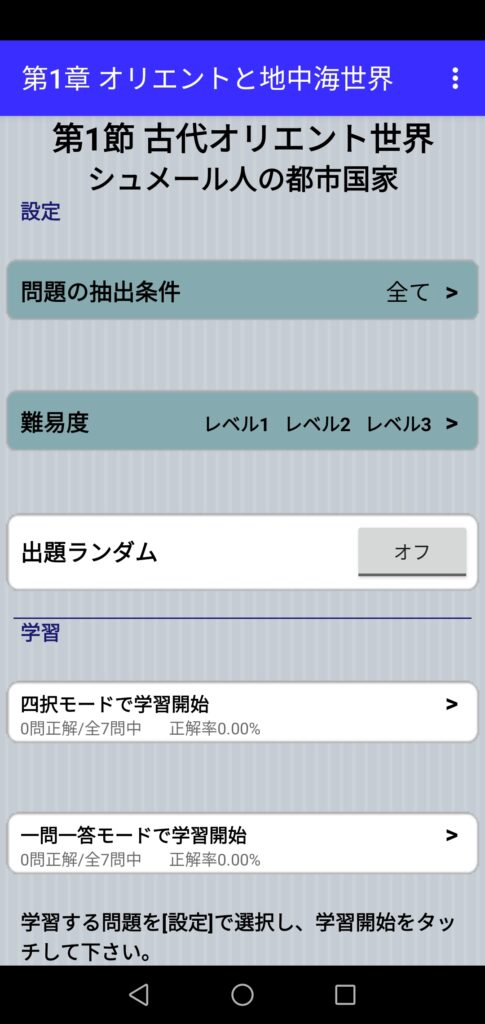
Tapping an item in any unit will display "Settings" and "Learning".
setting
In "Settings," you can select "Problem extraction criteria," "Difficulty level," and "Random question presentation on/off."
The "Problem Extraction Criteria" allows you to extract problems based on your past correct answer history. I don't use this much for review because I forget even the problems I answered correctly very quickly.
The "difficulty level" can be freely selected from levels 1-3, which are pre-set for each question. I don't set it because I want to understand everything, but I think there may be situations where it's useful depending on the difficulty level of the exam.
The "Random Question Presentation On/Off" feature allows you to randomize the order in which questions are presented within a unit. This is something that cannot be done in books, making it a very convenient and highly recommended feature.
study
In "Learning," you can actually work on problems. There are two modes.
In "4-choice mode," a question is presented, and the user selects from four options set by the app. The order of the four options is randomly changed, preventing the problem of memorizing the order by location.

In "Question and Answer Mode," only the question is displayed, and you answer it verbally yourself. If your answer is correct, it is marked as correct. This aspect is a little ambiguous, but if it were an input-only format, it would be impossible to handle variations in notation, so this is probably unavoidable. Also, inputting kanji would be difficult in Asian history.
Select your preferred mode and the game will begin. While the basic gameplay involves simply solving problems, you can also save favorites, view explanations, and go back or skip questions.
After completing the test, your accuracy rate is displayed, which helps with motivation. I repeat the process until I reach 100%.
When it reaches 100%, a crown icon will appear to the left of the unit on the home screen.
Advantages of the app version of "Yamakawa One-Question-One-Answer World History"
The advantages of this app are the inverse of the disadvantages of the book version.
- Because you can focus on the problem in front of you, you are less likely to get discouraged.
- Less eye movement is required.
- Can be taken out and solved instantly while out and about.
Less likely to give up
Unlike books, I feel less likely to give up because I can concentrate on the problem in front of me. This might be due to my personality, though.
Less eye movement is required.
Having to move your eyes less is very helpful because it means you don't have to expend energy on anything other than memorizing the problems.
Can be taken out and solved instantly while out and about.
This aspect is really convenient. You can easily get started even if you have to make many transfers on the train, or during short breaks like waiting at traffic lights.
The problem can be solved randomly.
This wasn't a drawback of the book, but I noticed it when I tried the app version. The question-and-answer format is designed with flow in mind, so memorizing the questions in order is important, but the option to use randomness to train yourself to answer quickly was a new feature.
Disadvantages of the app version of "Yamakawa One-Question-One-Answer World History"
While it doesn't have many critical bugs, it's a fairly simple app, so there are a few things I'm not entirely happy with.
The 4-choice mode includes an obvious correct answer.
Sometimes, the correct answer is obvious because the multiple-choice questions include terms like "treaty" and "conference," which should have been omitted. While this isn't the case for most questions, I wish this had been corrected.
You cannot stop the response midway.
Since you can't stop midway through answering, if you stop the app or leave it for too long, the app will reset due to Android's specifications, and you'll have to start all over again. Although the accuracy rate up to a certain point is saved, there are cases where there are many questions even when divided into sub-sections, so it's stressful to have to solve it all in one go.
Google Play says, "Even if you interrupt your gameplay, you can continue playing from where you left off." But how do I do that...?
It is not possible to display questions randomly from all available questions.
One of the advantages of this app is the ability to randomly display and solve problems, but it's not possible to solve problems from the entire range of material. While it would be interesting to test your skills by having problems randomly displayed from the entire range, such a mode doesn't exist. However, it is possible at the chapter level.
Is the explanation too brief?
The explanations are very brief, and many questions don't have explanations at all. In the multiple-choice mode, various terms appear together, and it would be nice to hear explanations for those as well, but you can only hear explanations for the correct answer. This is a bit disappointing.
How will the data be transferred?
I haven't tried it myself yet, but it seems like there's a possibility that data might be lost if you change your smartphone device. There's no export function or anything like that, so it seems like there's nothing the app can do about it. However, I've had data transferred successfully with other apps, so it might be possible on Android in some cases (unverified).
[Updated 2023-12-13] I recently tested this and downloaded the app on a different device, and the progress was saved. However, I haven't yet verified whether synchronization is possible.
summary
In summary, while there are several drawbacks, the ability to solve problems via a smartphone app is undeniably convenient. I plan to continue using it repeatedly to assess how well I'm retaining the terminology.
Similarly, apps based on books are available for subjects like Japanese history and English, but there are fewer of them for geography and science.
While there are many app-based problem sets available, the reality is that many of them lack guaranteed quality because the problems are original.
Even after becoming a working adult, there are times when I feel like I want to study again, so I would be happy if similar workbooks based on books were sold!