When you think of spiders, how do you imagine them producing silk? A common misconception is that they produce silk from their mouths. In reality, spiders have organs called "spinnerets" on their abdomen from which they produce silk. Spiders don't usually produce silk from their mouths.
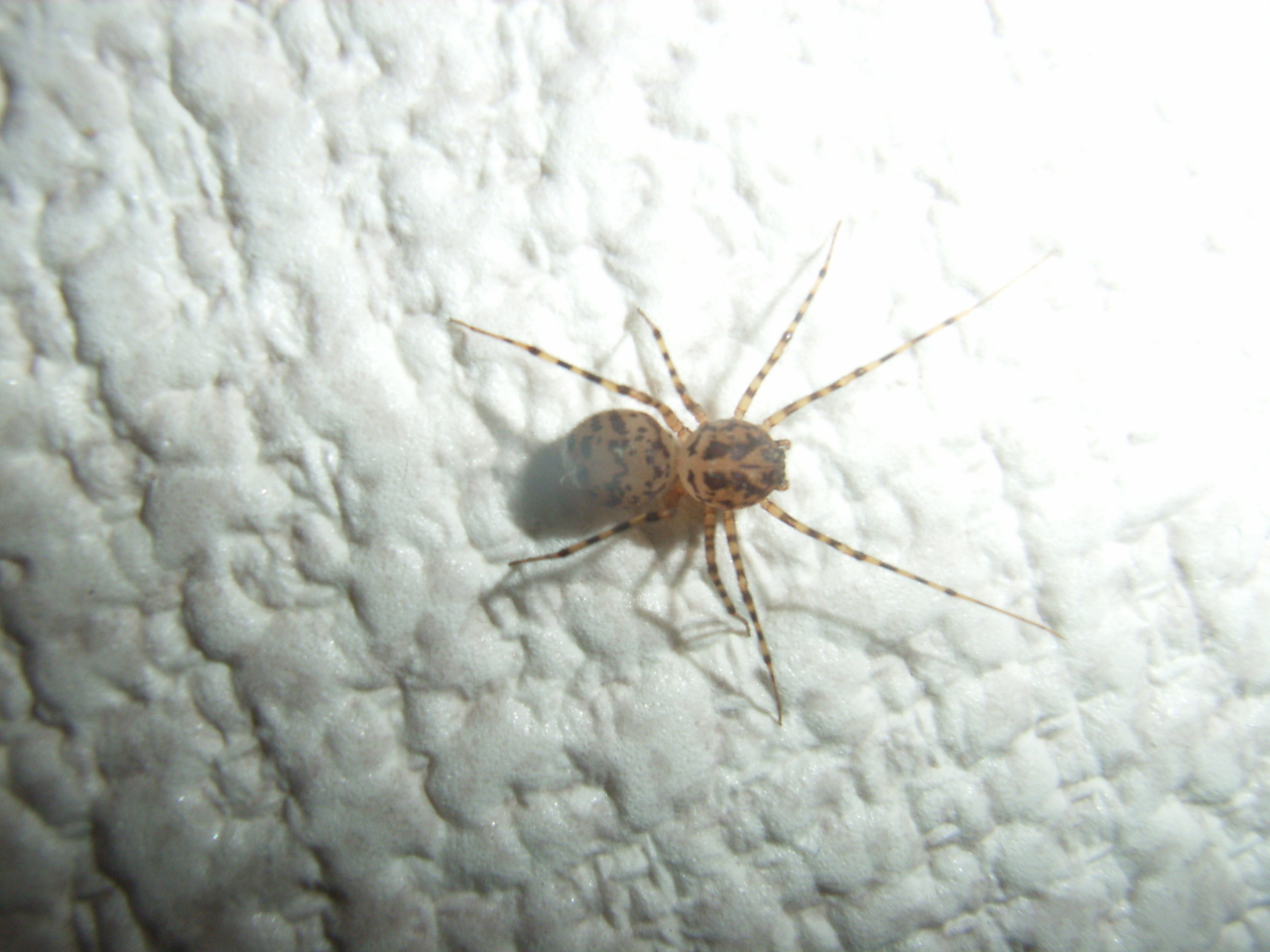
However, there are a very small number of spider species that do indeed spin silk from their mouths, just as this misconception suggests! One such species, the Yukatayama Shirogumo, appears indoors and preys on other spiders. This time, we will explain the ecology of the Yukatayama Shirogumo.
The misconception that spiders spin silk from their mouths.
When you think of spiders, how do you imagine them producing silk? A common misconception is that they produce silk from their mouths. In reality, spiders have organs on their abdomen called "spinnerets" or "spinner projections," from which they produce silk. Spiders do not normally produce silk from their mouths.
Some species can spit out threads from their mouths.
However, a very small number of species are known to actually spit silk from their mouths, as this misconception suggests. Specifically, this behavior has been confirmed in some species of the families Lycoperdonidae and Lynidae. This type of behavior is called spitting performance in English (Suter & Stratton, 2009).
Both the families Dictisidae and Scytodesidae are commonly found in Japan, and at least three species of Dictisidae, Dictis striatipes, Scytodes fusca, and Scytodes thoracica, have been observed spinning silk from their mouths in Japan (Ikeda, 2020).
The Japanese white spider is inside the house!
Of these, *Yukatayamashirogumo* is the most commonly seen species in Japan. It is widely distributed from Eurasia to North America, and in Japan, it is found in Hokkaido, Honshu, Shikoku, and Kyushu (Ono, 2009). Since it is found in buildings such as houses and warehouses, you may have the opportunity to see it inside your home. When I lived in Kansai, I was able to observe it in my own apartment. The carapace (the dorsal side of the cephalothorax) has symmetrical mottled black spots on a yellowish-brown background, and the dorsal side of the abdomen has distinctive dark brown markings on a yellowish-brown or gray background, which resembles a "yukata" (summer kimono), hence its name!
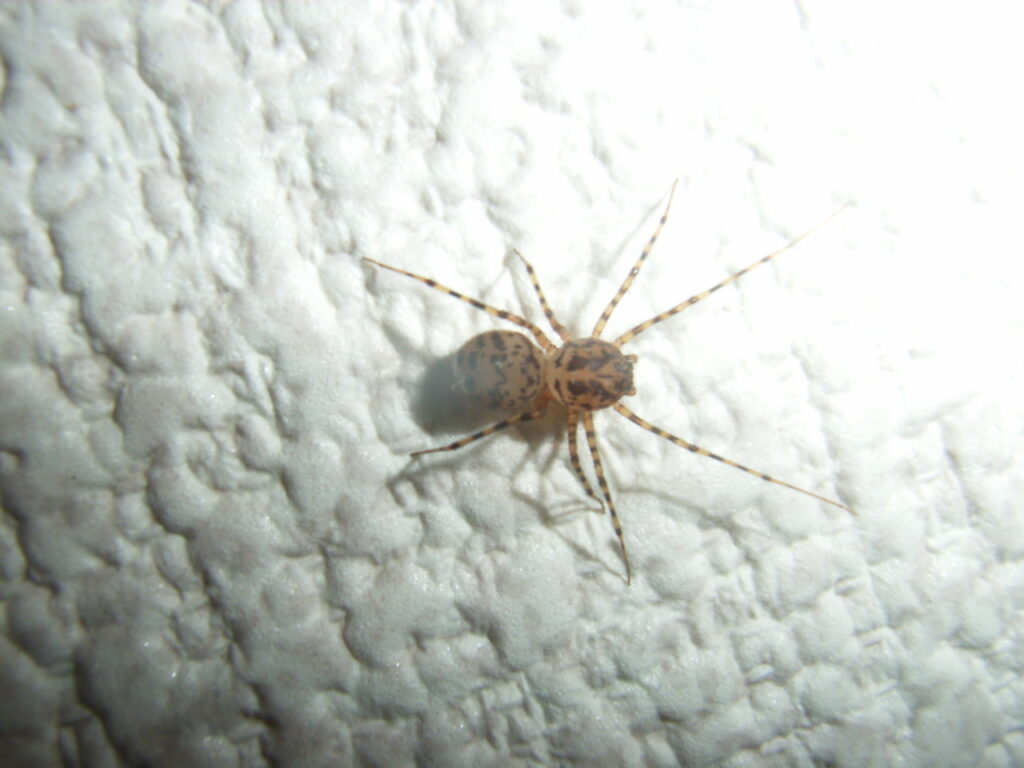
In terms of reproduction, the spawning season is from July to August, and it is known that the egg mass is thinly wrapped in silk and carried by attaching it to the mouthparts (Ikeda, 2020).
Why does the Japanese white spider spin silk from its mouth?
The reason why the Japanese white spider (Latrodectus fuscescens) spins silk from its mouth is thought to be related to its diet. In Japan, the Japanese white spider has only been observed feeding on spiders such as the large house spider (Latrodectus ventricosus) and the house spider (Latrodectus sedentary). When the Japanese white spider finds a spider to feed on, it spins silk in a zigzag pattern from both of its fangs to immobilize the spider (Suter & Stratton, 2009; 2013; Ikeda, 2014).
You can see what it looks like in the video below.
It is said that the white-spotted spiders can spin silk up to 30 cm long at a speed of 28 m/s, and the force is so great that they cannot control it themselves. The zigzag shape of the silk appears to be a result of "letting the force of the ejection take over." This is thought to be the same principle as when the tip of a fire truck hose swings from side to side due to strong water pressure.
In most spiders, the pores of the fangs are located at the tips, but in the Japanese white spider (Elaphe climacophora), they are located at the base of the fangs, and the secretion is released from there along a groove on the edge of the fang, outwards from the tip. This is thought to have evolved to release silk forward.
While I couldn't find any papers that clearly explain why spiders need to shoot silk forward to catch their prey, it's possible that a special structure is required to quickly and forcefully shoot silk forward. Also, the method of restraining an opponent by shooting a somewhat haphazard zigzag silk seems well-suited for catching spiders with long legs in general.
Conversely, even if you capture a Yukatayama white spider and place an insect nearby, it doesn't spin silk easily. Instead, it uses its long, slender legs to search ahead, and the moment the insect touches its leg tips, the insect flies away (Ikeda, 2014). It seems that this spider is indeed completely specialized in preying on other spiders.
It should be noted that some members of the Ophioglossidae family, mentioned earlier, spray liquid from their fangs for self-defense or to protect their eggs, which seems to be a slightly different reason from that of the White Spiders (Suter & Stratton, 2009).
The secret to why the other spider can't escape the zigzag web.
However, just hearing this, you might think that if you shoot a zigzag thread randomly, the spider could easily escape if it tried hard enough, right?
However, there are several reasons why that cannot be done.
Firstly, the zigzag thread contracts after it is released. Three milliseconds after the squirt is released, the thread contracts to 60% of its original length, and the tension of the thread pins down the host spider (Suter & Stratton, 2013). This makes it physically impossible for the host spider to move.
Furthermore, the Japanese white spider (Elaphe climacophora) is venomous. While the zigzag thread itself does not contain venom, the spider bites the legs or other parts of its host spider's body once the spider is immobilized by the thread. At this time, it secretes venom from its salivary glands. Recent research has revealed that this venom contains substances similar to various other substances, such as enzymes like astacin metalloproteinase, venomous allergens, longistatin (a substance that inhibits blood coagulation), and venomous proteins like translation-regulating oncoprotein (TCTP) (Zobel-Thropp et al., 2014). Being injected with such venom would be fatal.
summary
The Japanese white spider (Yukatayamashirogumo) is specialized in preying on other spiders by spinning silk from its mouth. Furthermore, it employs various techniques to catch a variety of spiders, not just simply producing silk. We encourage you to look around your home to see if this species is living there!
References
Ikeda, Hiroaki. 2014. The silk-spinning hypothesis of *Yukatayamashirogumo*. *Yushi* 35: 10-12. http://www.arachnology.jp/yushi/y35.pdf
Ikeda, Hiroaki. 2020, March 15. Encyclopedia of Spider Physiology and Ecology 2019 (in editing). http://spider.art.coocan.jp/studycenter/Dic11.html
Ono, Hirotsugu. 2009. Japanese spiders. Tokai University Press, Hadano. xvi, 738pp. ISBN: 9784486017912
Suter, RB, & Stratton, GE 2009. Spitting performance parameters and their biomechanical implications in the spitting spider, Scytodes thoracica. Journal of Insect Science 9(1): 62. ISSN: 1744-7917, https://doi.org/10.1673/031.009.6201
Suter, RB, & Stratton, GE 2013. Predation by spitting spiders: elaborate venom gland, intricate delivery system. In: W. Nentwig (Ed.), Spider ecophysiology (pp. 241-251). Springer. ISBN: 9783642339882, https://doi.org/10.1007/978-3-642-33989-9_18
Zobel-Thropp, P. A., Correa, S. M., Garb, J. E., & Binford, G. J. 2014. Spit and venom from scytodes spiders: a diverse and distinct cocktail. Journal of Proteome Research 13(2): 817-835. ISSN: 1535-3893, https://doi.org/10.1021%2Fpr400875s