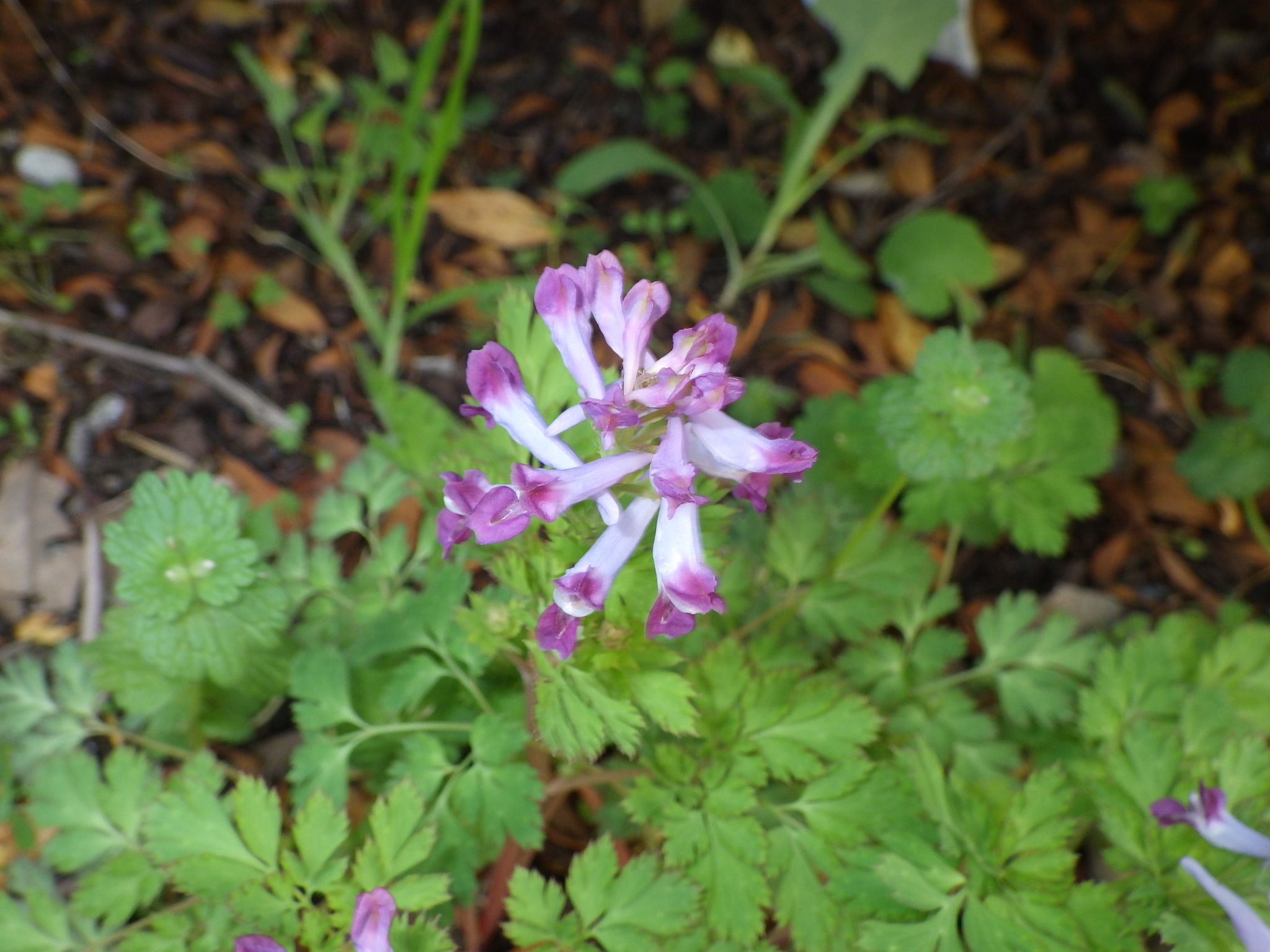
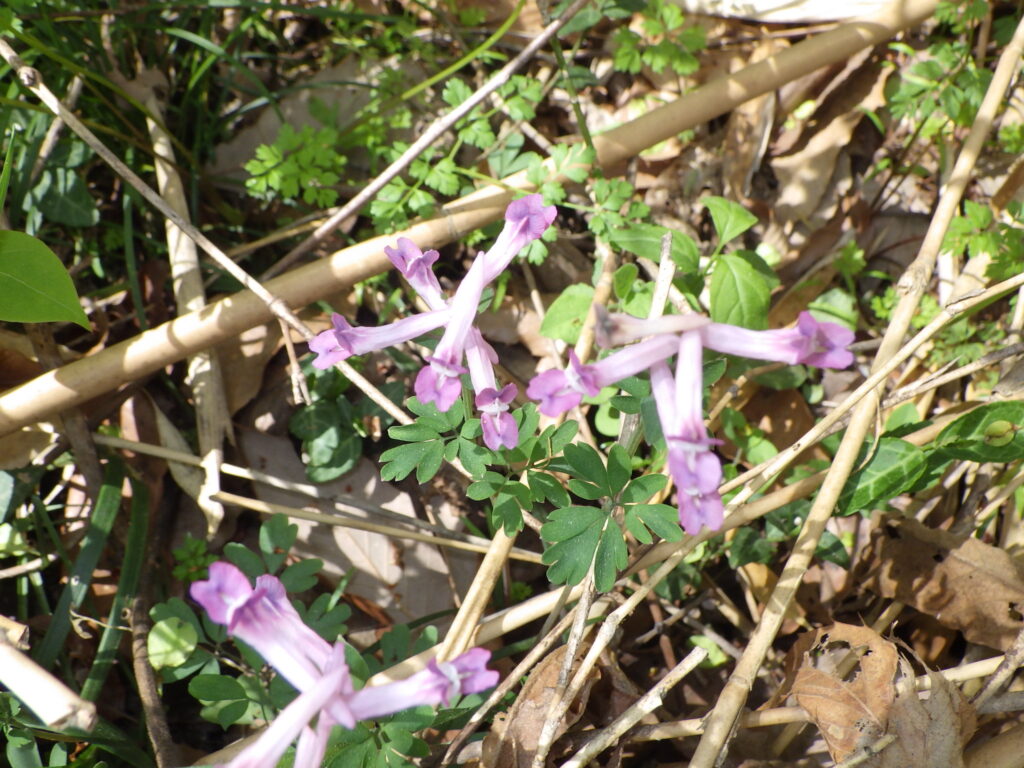
Corydalis ambigua, Corydalis fumariifolia, and Corydalis ambigua all belong to the Corydalis genus of the poppy family. What's interesting about them is that in the spring (April to June) when they bloom in the forest, their purple to bluish-purple flowers bloom in a spiral pattern facing in all directions. However, their flower shapes and habitats are similar, so they can sometimes be confused. These three species have various differences, but you can accurately distinguish them by first checking the shape of their leaves. If you forget to check the leaves, it's a good idea to check the color of the flowers, the shape of the bracts below the flowers, and the shape of the fruits. This article will explain the classification and morphology of the Corydalis genus.
What are Corydalis ambigua, Corydalis fumariifolia, and Corydalis ambigua?
Corydalis incisa, also known as purple corydalis, is a perennial herb distributed in Hokkaido, Honshu, Shikoku, Kyushu, and the Ryukyu Islands in Japan, as well as in China, growing in forests, on the edges of fields, and along roadsides (Kanagawa Prefecture Flora Survey Association, 2018).
Corydalis decumbens, also known as Jirobo Engosaku, is a perennial herb distributed in Honshu (west of the Kanto and Chubu regions), Shikoku, and Kyushu in Japan; as well as in China and Taiwan, growing in grasslands, forest edges, and between stone walls.
Corydalis lineariloba var. lineariloba, also known as mountain sedge, is a perennial herb distributed in Honshu and Kyushu in Japan, as well as in Korea, China, Amur, and Ussuri, growing in mixed forests and forest edges.
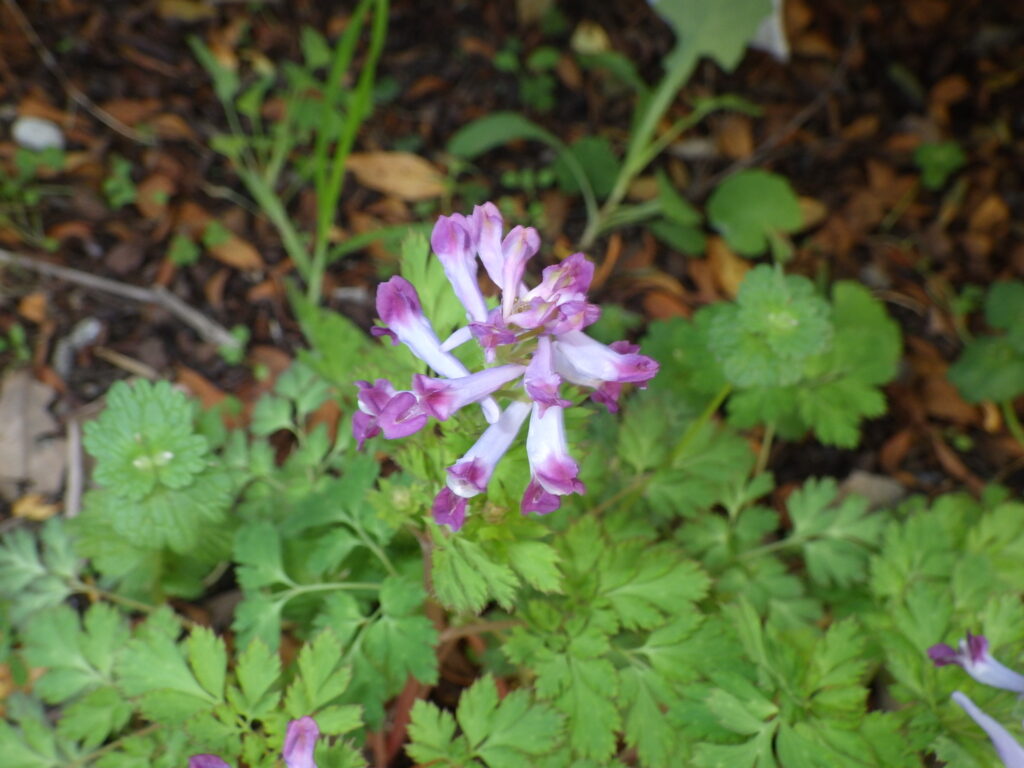
Both belong to the genus Corydalis in the poppy family, and what's interesting is that when they bloom in the spring (April to June) in the forest, their purple to bluish-purple flowers bloom in a spiral pattern facing in all directions. The Japanese name Murasaki-keman is said to come from the fact that the flowers face diagonally upwards or downwards, resembling the Buddhist ornament Keman (a decorative ornament hung in transoms, etc., in temples). However, the flowers of the Corydalis genus themselves do not resemble Keman very much, so it might be better to think that the name is derived from Lamprocapnos spectabilis, a close relative in the same poppy family. In this case, the flowers actually hang down.
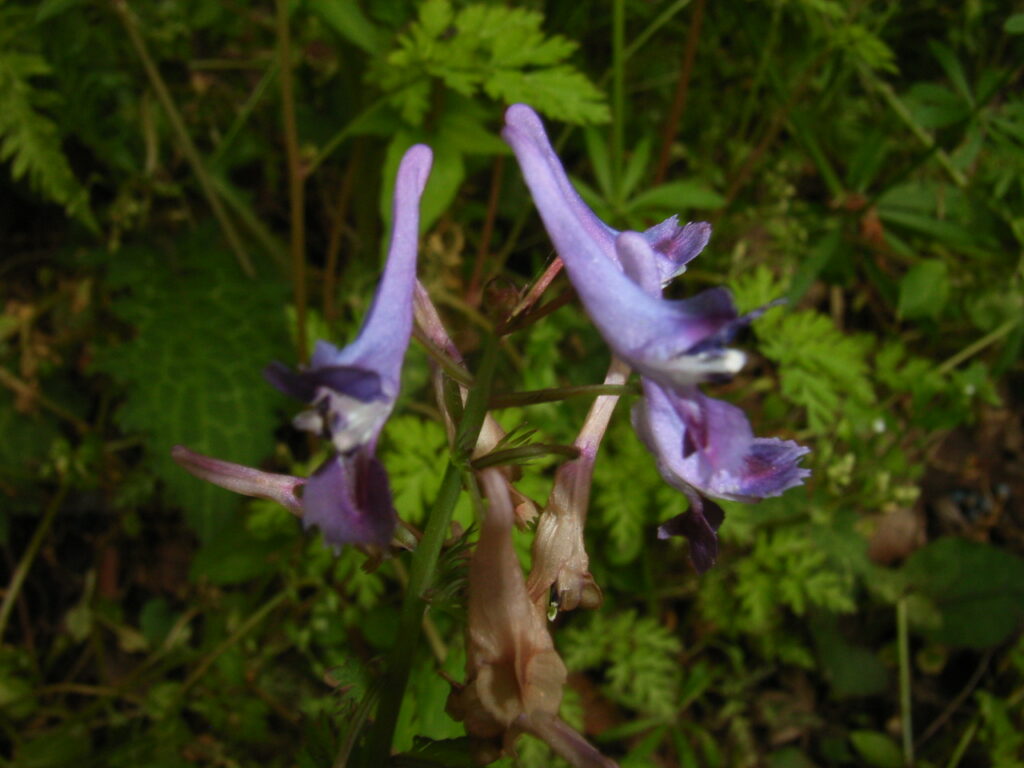
The flower has four petals, but the two outer petals and the two inner petals have different shapes. The upper of the outer petals has a unique structure in which the back is pouch-shaped and protrudes, which gives it a very different appearance from other poppy flowers (Hayashi et al., 2013). The two inner petals are fused at the tips. This flower structure is the same in all three species and they are quite similar.
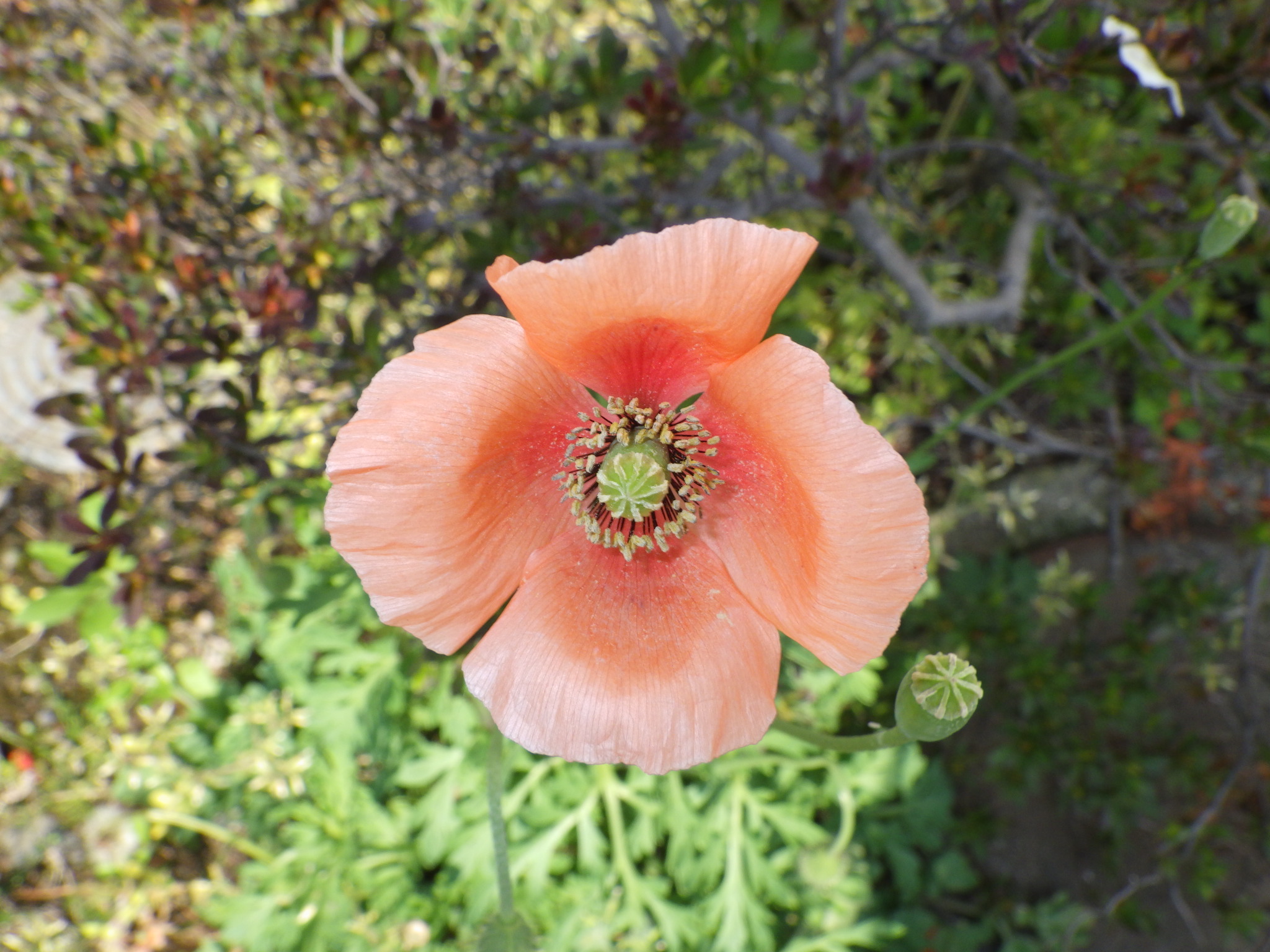
They also share the characteristic of having leaves that are twice-ternately compound.
They have similar habitats and can sometimes coexist.
Therefore, some people may not be able to tell the difference.
What are the differences between Corydalis ambigua, Corydalis fumariifolia, and Corydalis ambigua?
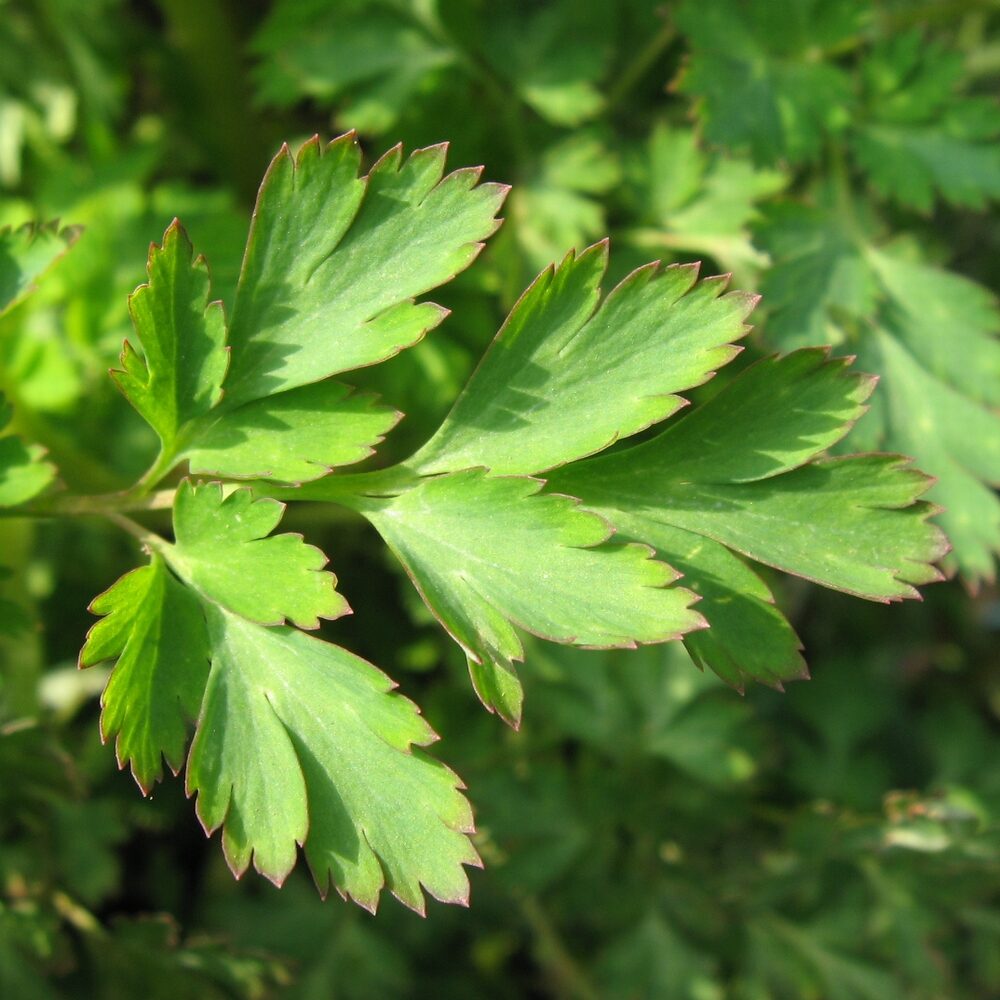
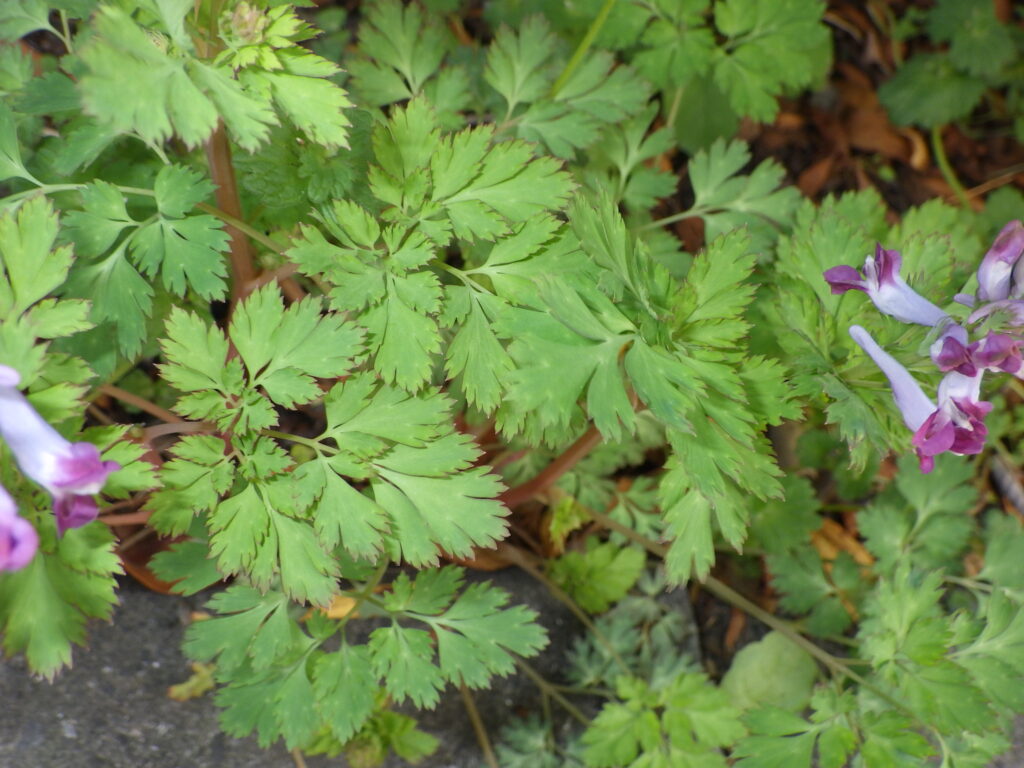
Several methods have been proposed to distinguish these three species, but I think it's best to identify them by their leaves (Kanagawa Prefecture Flora Survey Association, 2018).
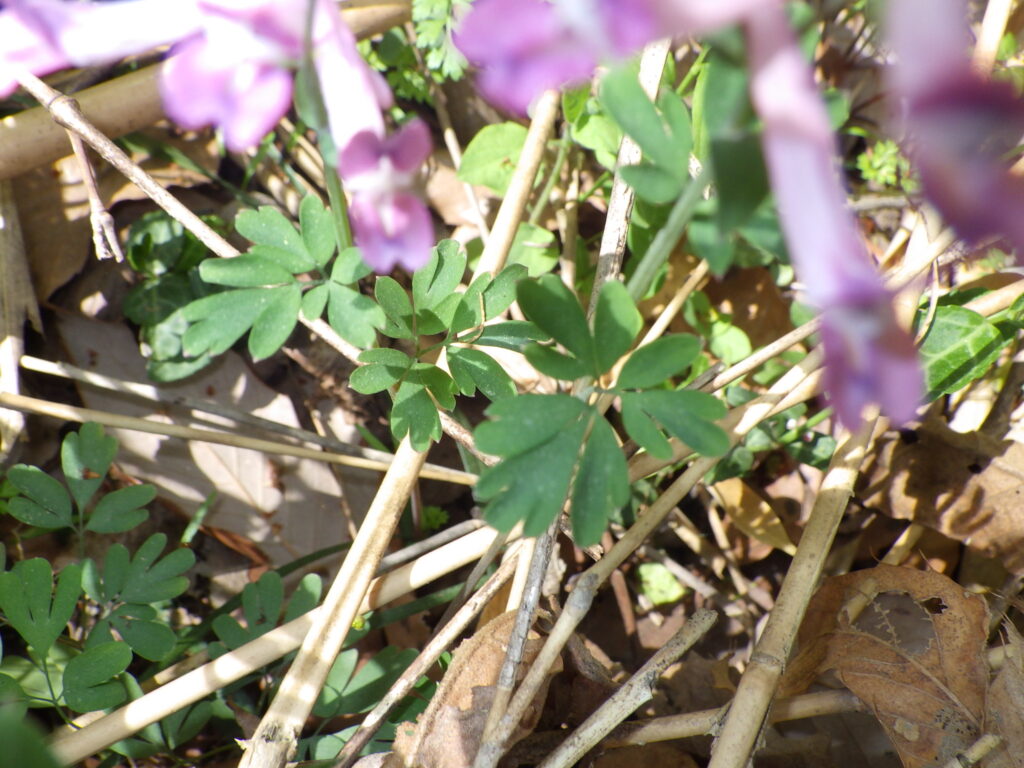
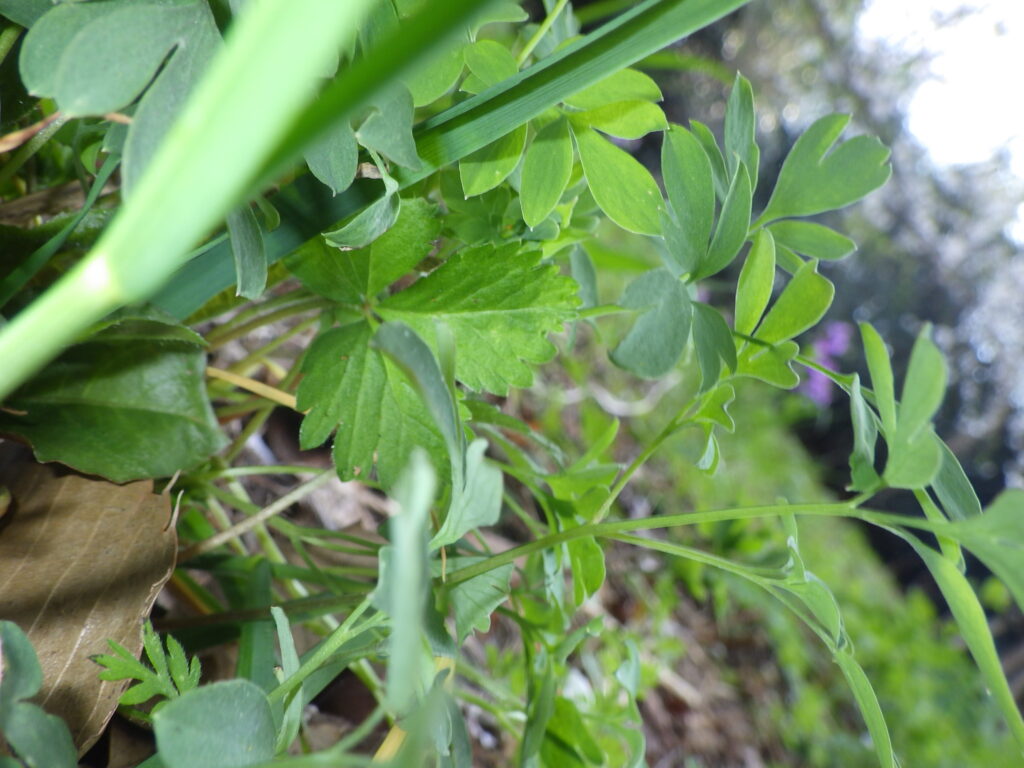
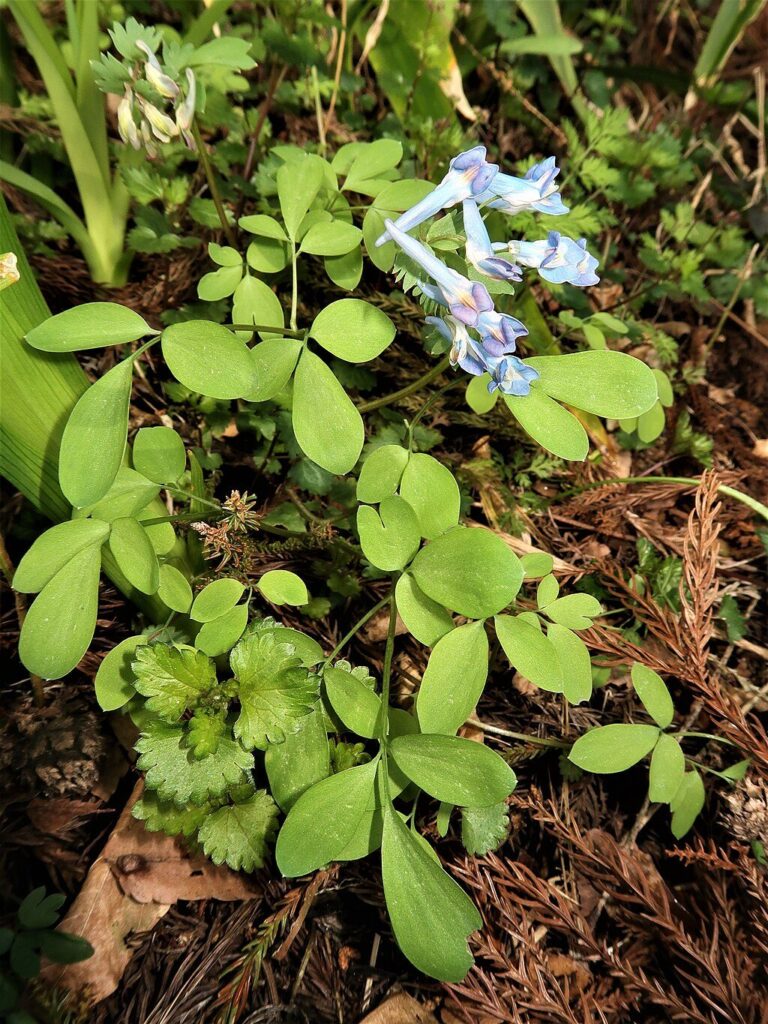
All three species have compound leaves, but the difference is that Corydalis ambigua has serrated edges on its leaves, while Corydalis fumariifolia and Corydalis hyemalis do not.
Regarding Corydalis ambigua and Corydalis fumariifolia, the difference is that Corydalis ambigua has leaflets that are deeply divided into 2-3 lobes, while Corydalis fumariifolia has leaflets that are not divided and are linear to broadly ovate.
For the record, Corydalis incisa does not have tubers, while Corydalis ambigua and Corydalis fumariifolia do have tubers.
This results in a difference between Corydalis ambigua, which keeps its leaves up all year except in winter, and Corydalis fumariifolia and Corydalis radiata, which have their above-ground parts die back in summer and spend a long time underground until the following spring using their tubers as nutrients, becoming "spring plants."
This is a significant ecological difference, but it won't be helpful when trying to distinguish them in the wild during spring.
In addition, the flower colors are usually purple for Corydalis ambigua, pale reddish-purple for Corydalis fumariifolia, and pale purple for Corydalis ambigua, but there are many exceptions as will be discussed later.
The fruits are narrowly oblong in Corydalis ambigua, linear in Corydalis fumariifolia, and broadly lanceolate or ovate-oblong in Corydalis radiata.
While there are bracts at the base of the flower, in Corydalis ambigua and Corydalis fumariifolia, the bracts are tooth-shaped, whereas in Corydalis fumariifolia, the bracts are entire.

Are there any other similar species? Are there any varieties or cultivars?
Among the Corydalis ambigua species, there are varieties such as Corydalis fumariifolia f. pallescens, which has slightly smaller flowers with reddish-purple tips on the petals and is nearly white overall, and Corydalis fumariifolia f. candida, which has entirely white petals.
Among the Corydalis ambigua species, there is a known variety called Corydalis ambigua f. albescens, in which all of the petals are white.
Corydalis ambigua is known to have a variety called Corydalis fumariifolia var. capillaris, which is smaller overall and has fewer flowers (2-4) than Corydalis ambigua.
References
Hayashi, Yasaka, Kadota, Yuichi, and Hirano, Takahisa. 2013. Yamakei Handy Illustrated Guide 1: Wildflowers (Revised and Expanded New Edition). Yama-kei Publishers, Tokyo. 664pp. ISBN: 9784635070195
Kanagawa Prefecture Flora Survey Association. 2018. Kanagawa Prefecture Flora 2018 (Electronic Edition). Kanagawa Prefecture Flora Survey Association, Odawara. 1803pp. ISBN: 9784991053726