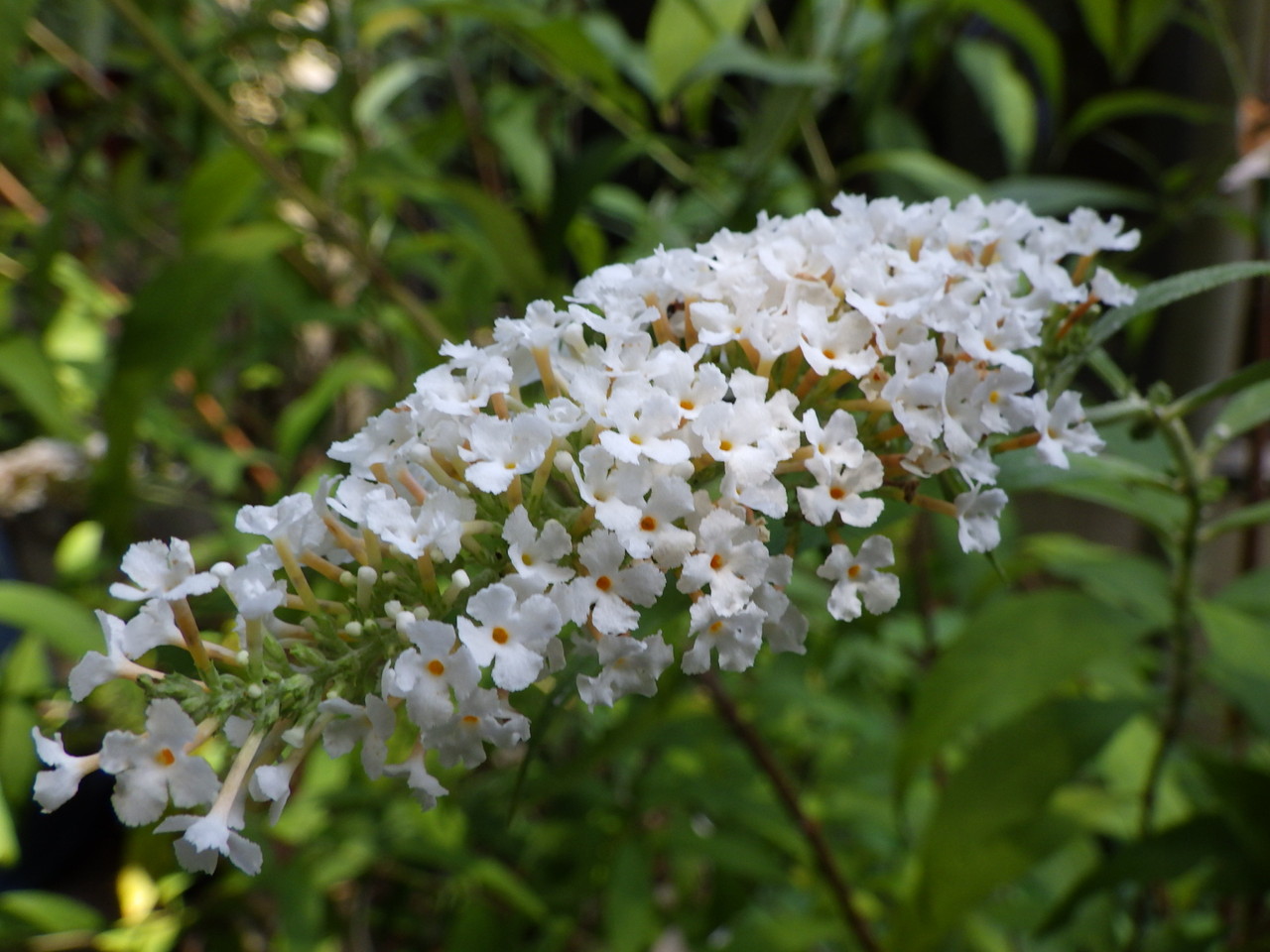
Aralia cordata, Kalopanax septemlobus, Kalopanax septemlobus, and Aralia elata all belong to the Araliaceae family and are deciduous trees. Their inflorescences, flowers, and fruits are very similar, and their young leaves are edible. Therefore, they can sometimes be confused. However, they can be distinguished by whether the leaves are compound or simple, and by checking the thorns on the branches. All of them bear umbel-shaped inflorescences, and their flowers are green to yellow. The fruits are berries that are spherical to broadly oval and turn blackish-purple when ripe. This article will explain the classification, morphology, and uses of Aralia cordata, Kalopanax septemlobus, Kalopanax septemlobus, and Aralia elata.
- What are Aralia cordata, Kalopanax septemlobus, Kalopanax septemlobus, and Aralia elata?
- What are the differences between Aralia elata, Aralia cordata, Kalopanax septemlobus, and Aralia elata?
- What are the uses of Aralia cordata, Kalopanax septemlobus, Kalopanax septemlobus, and Aralia elata?
- What is the structure of a flower?
- What is the structure of the fruit?
- References
What are Aralia cordata, Kalopanax septemlobus, Kalopanax septemlobus, and Aralia elata?
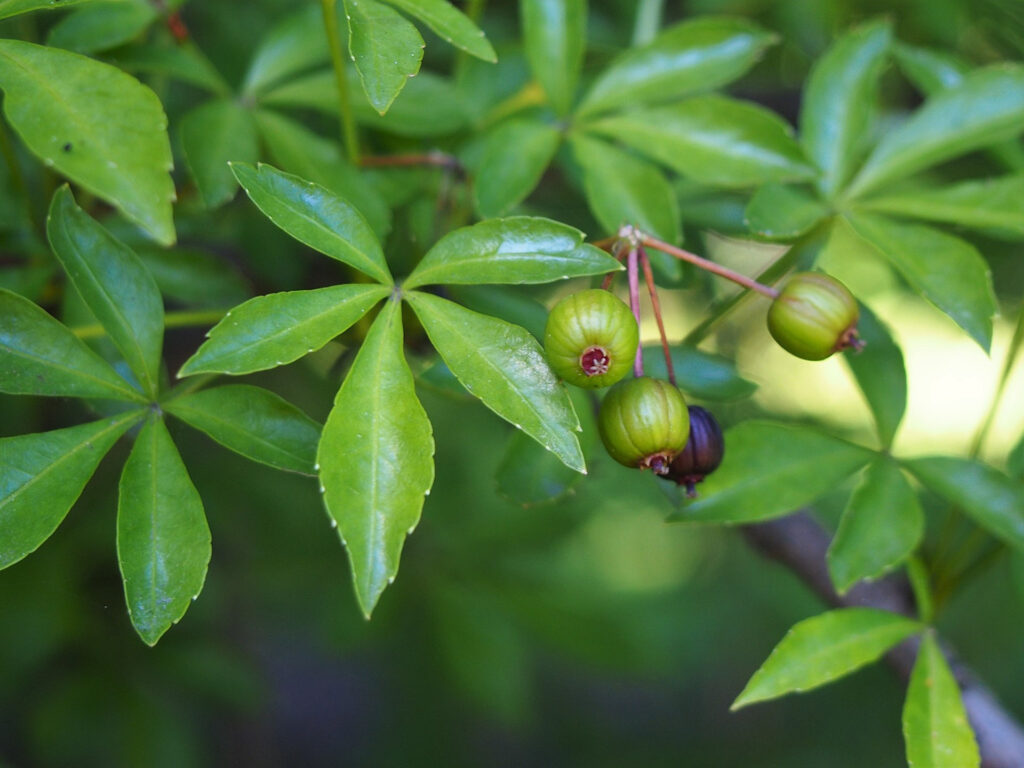
Ukogi (五加木) is not the Japanese name for a specific species but is a general term for the genus Eleutherococcus, although it generally refers to Himeukogi (姫五加木). Himeukogi , Eleutherococcus sieboldianus, is a deciduous shrub native to China. In Japan, it was introduced from China in ancient times for medicinal purposes and was planted as a famine relief plant in hedges and gardens of private homes. However, in recent years it has not been planted as a garden tree as much, and wild specimens can be found in thickets, wastelands, and at the foot of mountains.
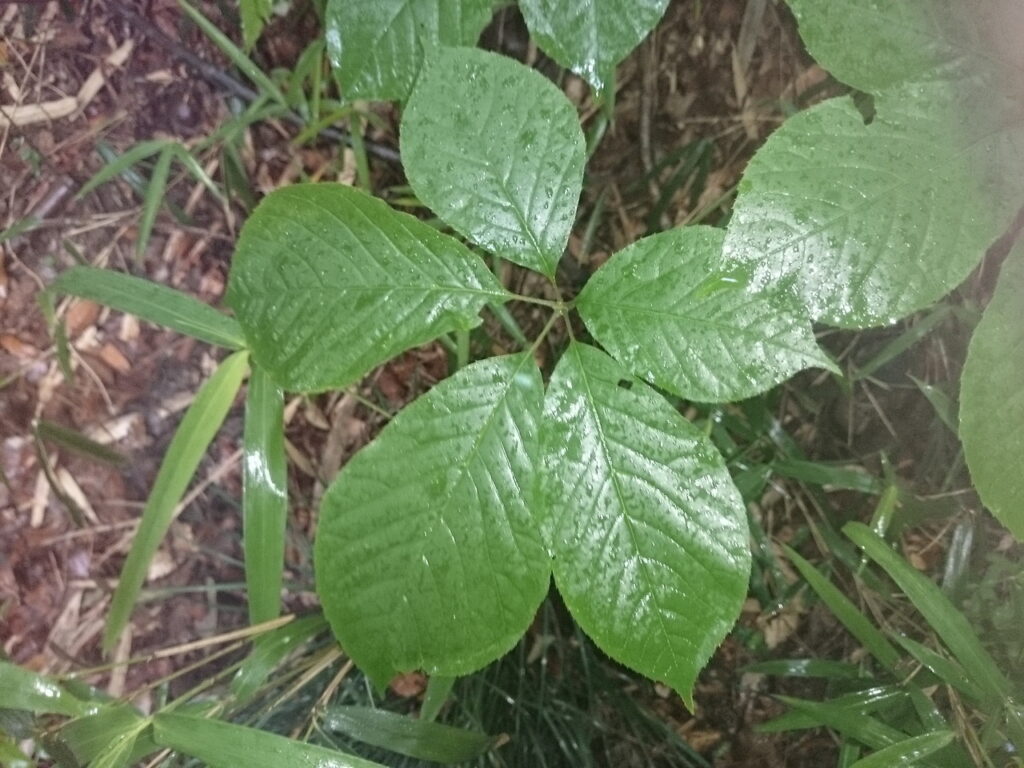
Chengiopanax sciadophylloides, also known as koshiabura (or koshiabura), is a deciduous tree that grows in mountain forests and is distributed throughout Hokkaido, Honshu, Shikoku, and Kyushu in Japan (Mogi et al., 2000).
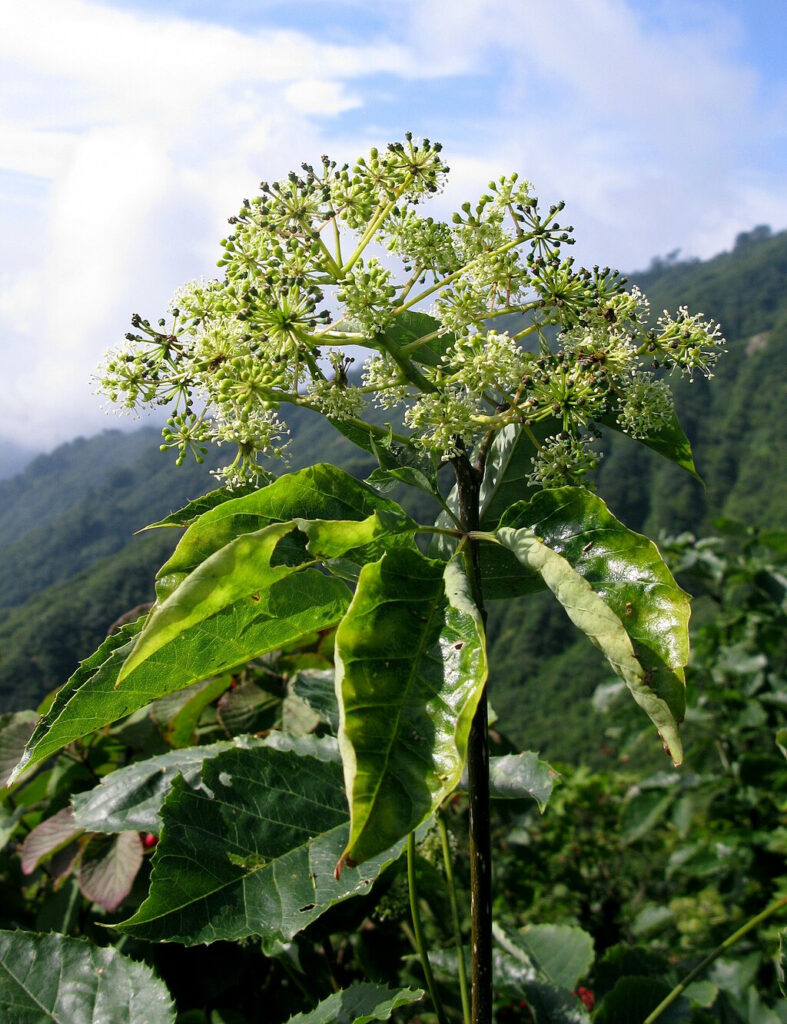
Evodiopanax innovans, also known as the hawk's claw tree, is distributed in Hokkaido, Honshu, Shikoku, and Kyushu in Japan. It is a deciduous small tree or tall tree that grows on mountain ridges, in forests, and at forest edges.
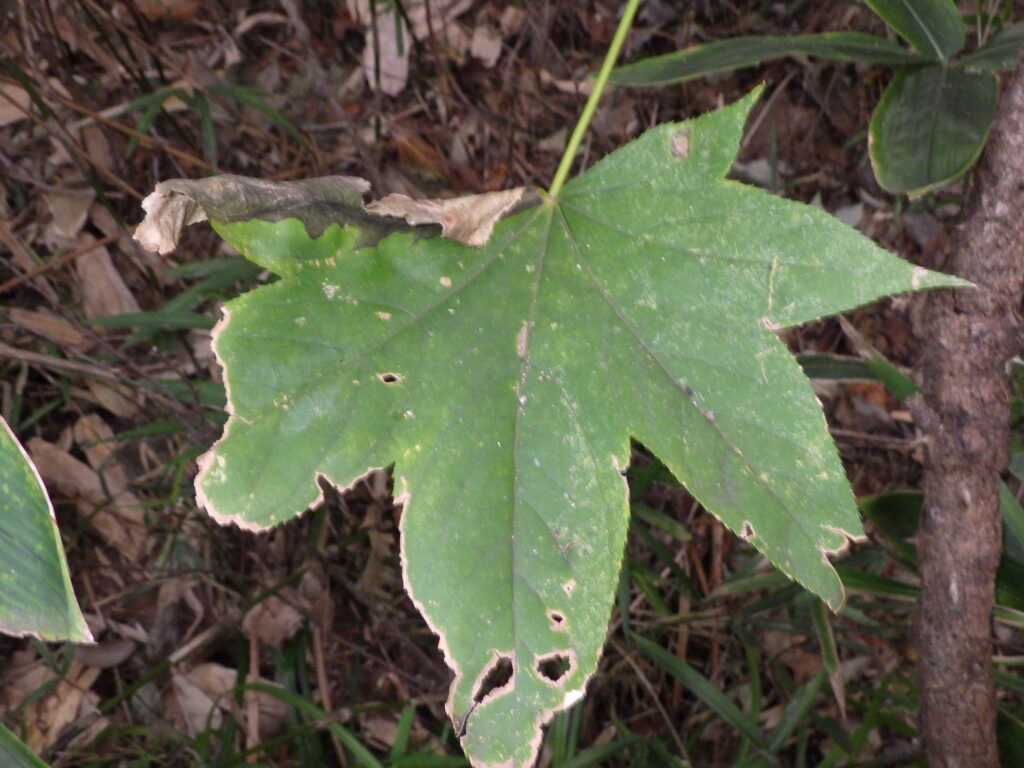
Kalopanax septemlobus var. septemlobus, also known as Japanese angelica tree (Kalopanax septemlobus), is a deciduous tree distributed in the southern Kuril Islands, Hokkaido, Honshu, Shikoku, and Kyushu in Japan; as well as Sakhalin, Korea, and China, growing in evergreen broad-leaved forests and beech forests.
They all share the common characteristics of being deciduous trees belonging to the Araliaceae family, and their umbel-shaped inflorescences and yellow to green flowers are very similar. A subtle but common feature is that their petals resemble paving stones when in bud. All of them produce berries. Therefore, they may sometimes be confused with each other.
What are the differences between Aralia elata, Aralia cordata, Kalopanax septemlobus, and Aralia elata?
However, although they all belong to the Araliaceae family, they all belong to different genera and have quite different characteristics as plants (Kanagawa Prefecture Flora Survey Association, 2018).
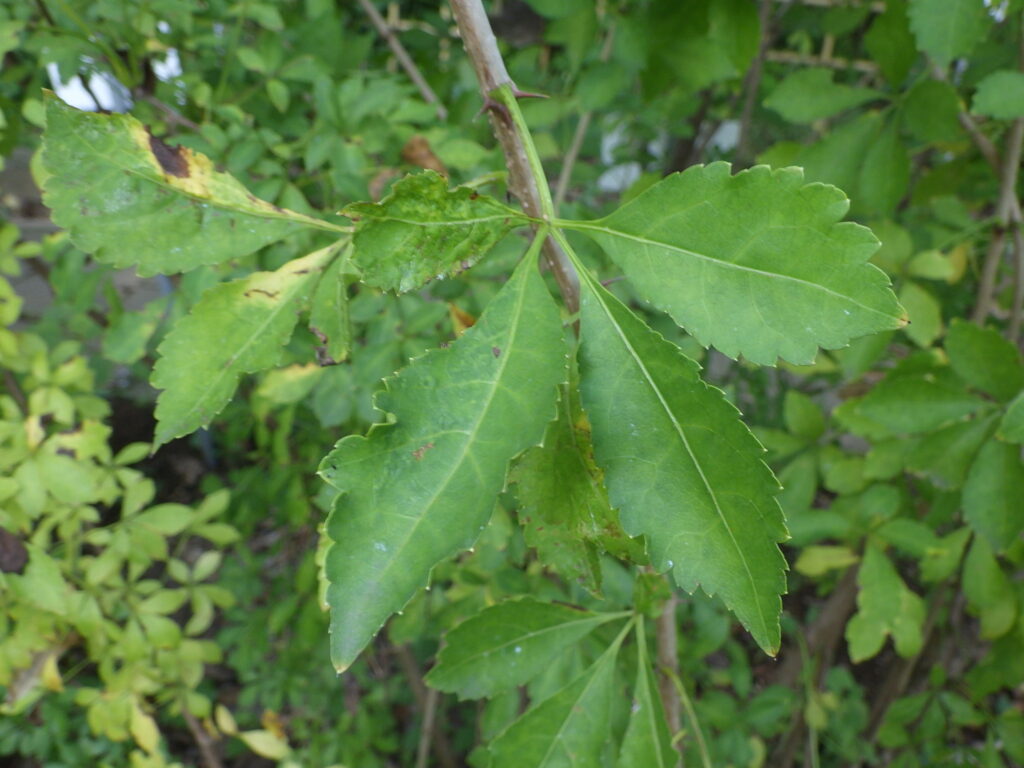
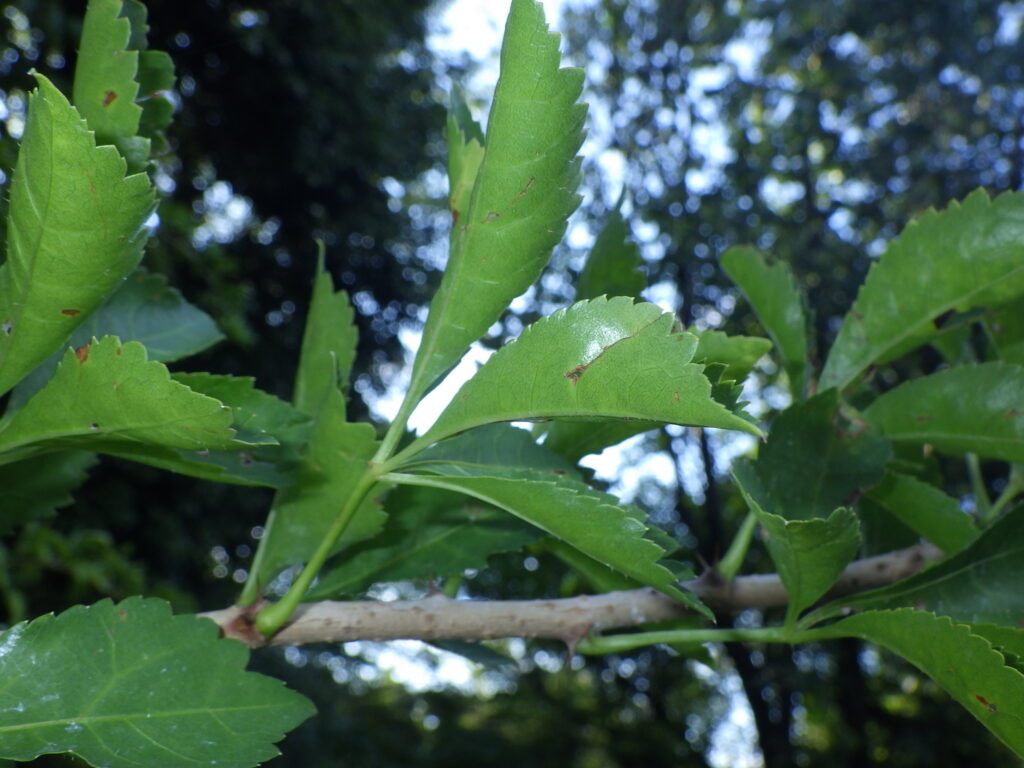
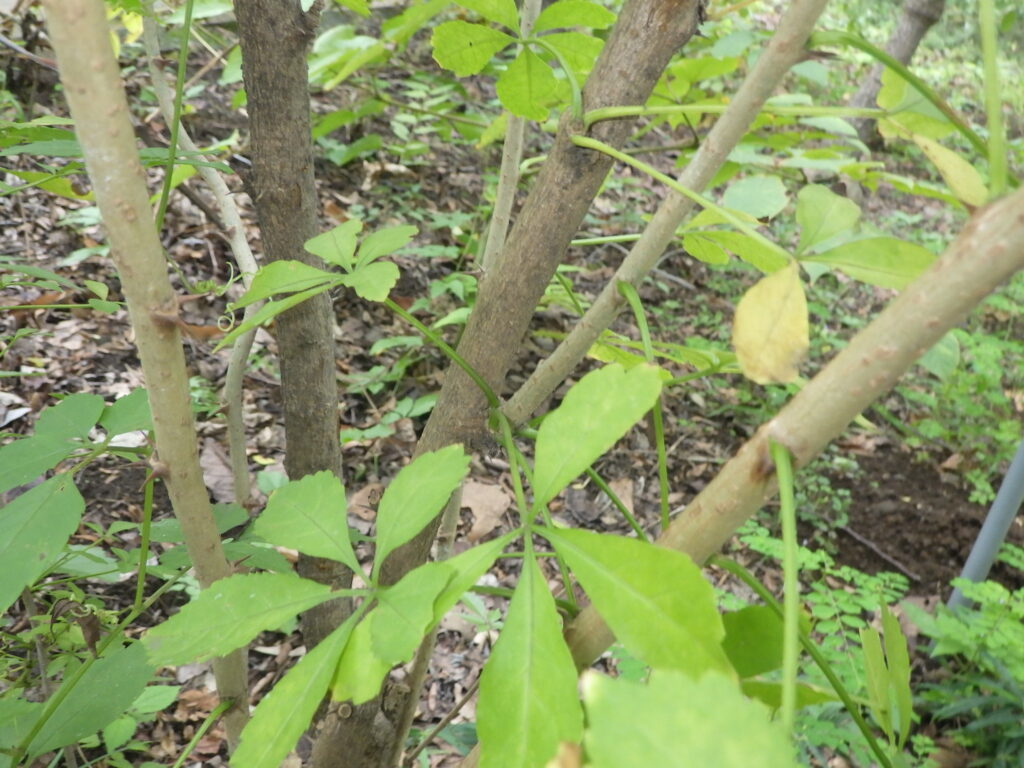
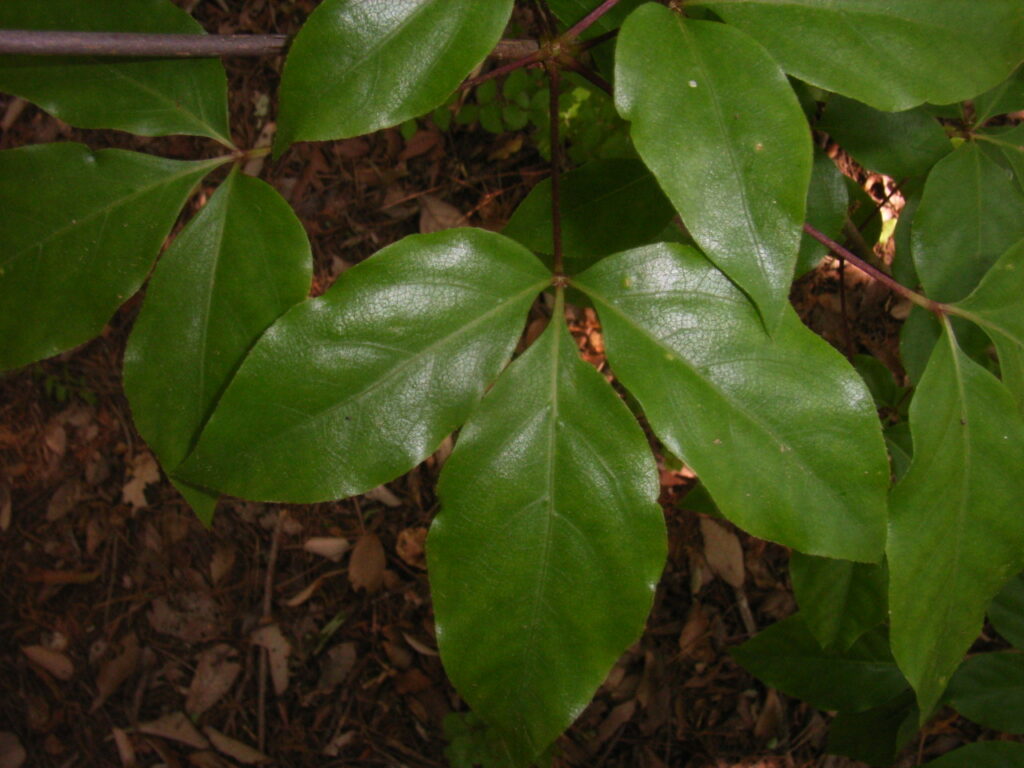
First, there is a difference in that the leaves of Acanthopanax septemlobus, Acanthopanax sciadophylloides, and Acanthopanax edulis are palmately compound, while the leaves of Acanthopanax septemlobus are simple.
A palmate compound leaf refers to a leaf in which several leaflets are arranged radially at the tip of the petiole, forming a palmate shape, while a simple leaf is a typical leaf that is not divided into leaflets like a compound leaf. This is self-explanatory.
Of the three species of palmate compound leaves—Eleutherococcus senticosus, Acanthopanax sciadophylloides, and Aralia elata—Eleutherococcus senticosus and Acanthopanax sciadophylloides have quinate compound leaves, while Aralia elata has trifoliate compound leaves.
The difference lies in whether the compound leaf is divided into five leaflets or three. This should also be obvious at a glance.
The main difference between *Eleutherococcus senticosus* and *Eleutherococcus sciadophylloides* is that *Eleutherococcus senticosus* is a shrub with thorns on its trunk and branches, while *Eleutherococcus sciadophylloides* is a small tree without thorns on its trunk and branches.
The four species listed above can be distinguished. However, while there is no confusion with Kalopanax septemlobus, Aralia elata, and Kalopanax pictus as they are the only species in their genus in Japan, the Araliaceae genus, which includes Aralia cordata, contains eight species. Therefore, when researching the Araliaceae genus, a more detailed examination is necessary, but we will omit that here.
The underside of the leaves of Kalopanax septemlobus has dense, curly hairs, and a variety called Kalopanax septemlobus var. magnificus, which grows at high altitudes, is also known.
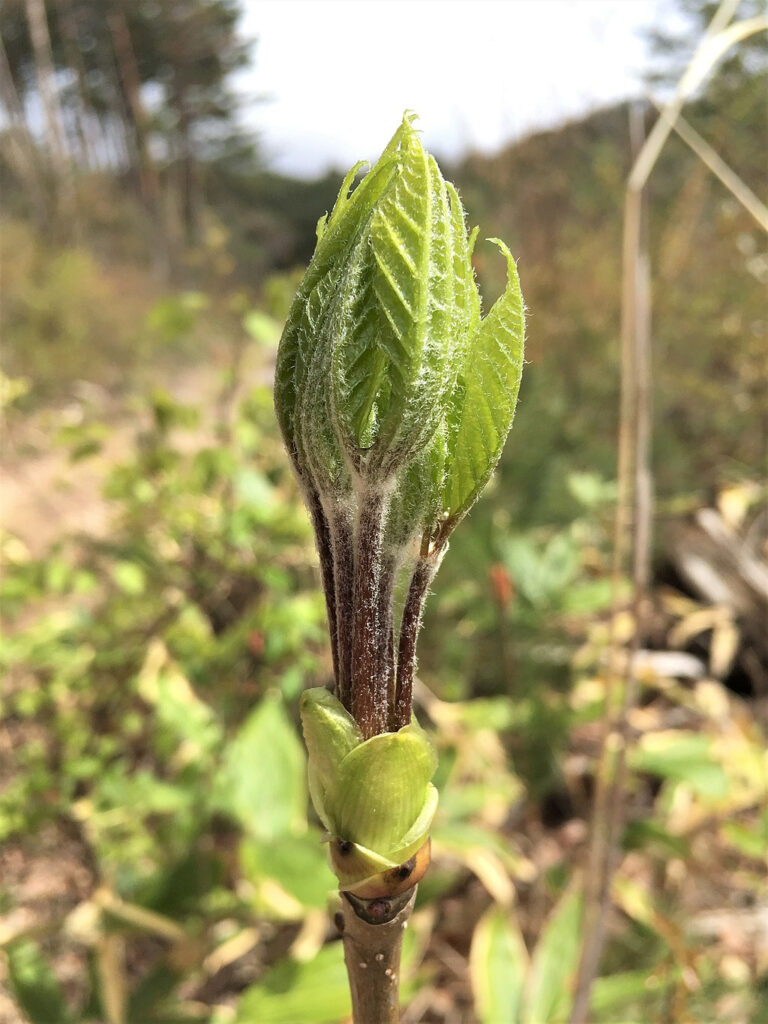
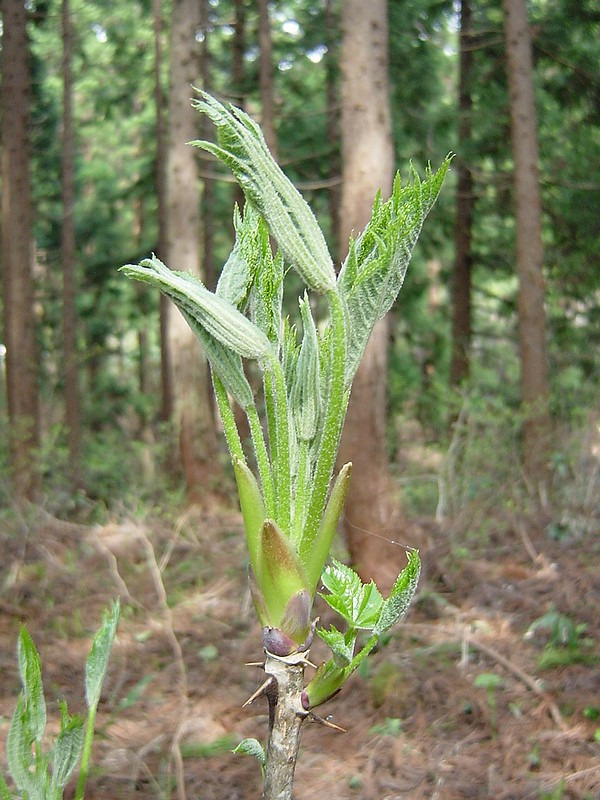
The new shoots may not show their distinctive features clearly and may be difficult to distinguish, but if you carefully examine them along with the thorns on the branches, you should be able to tell them apart.
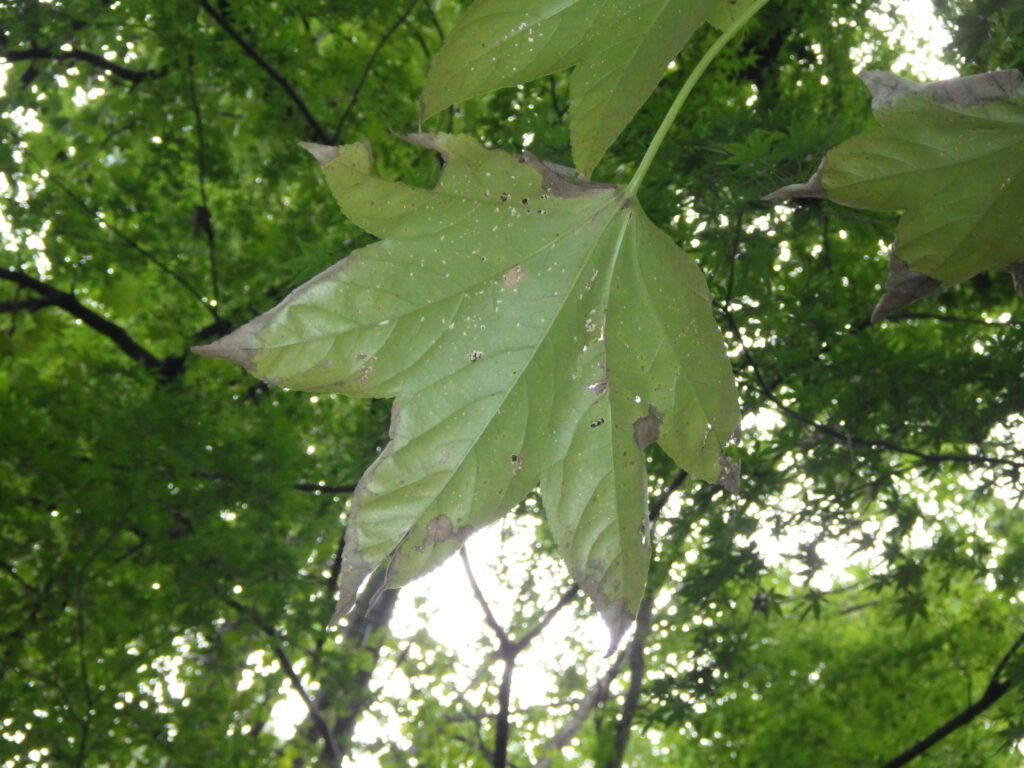
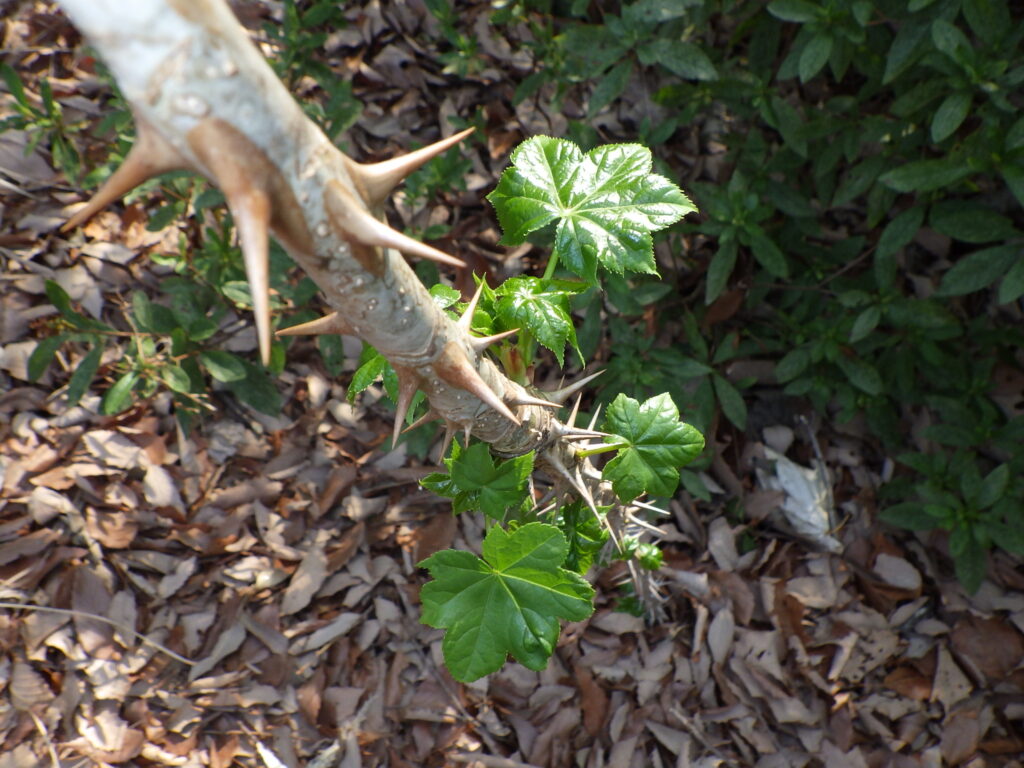
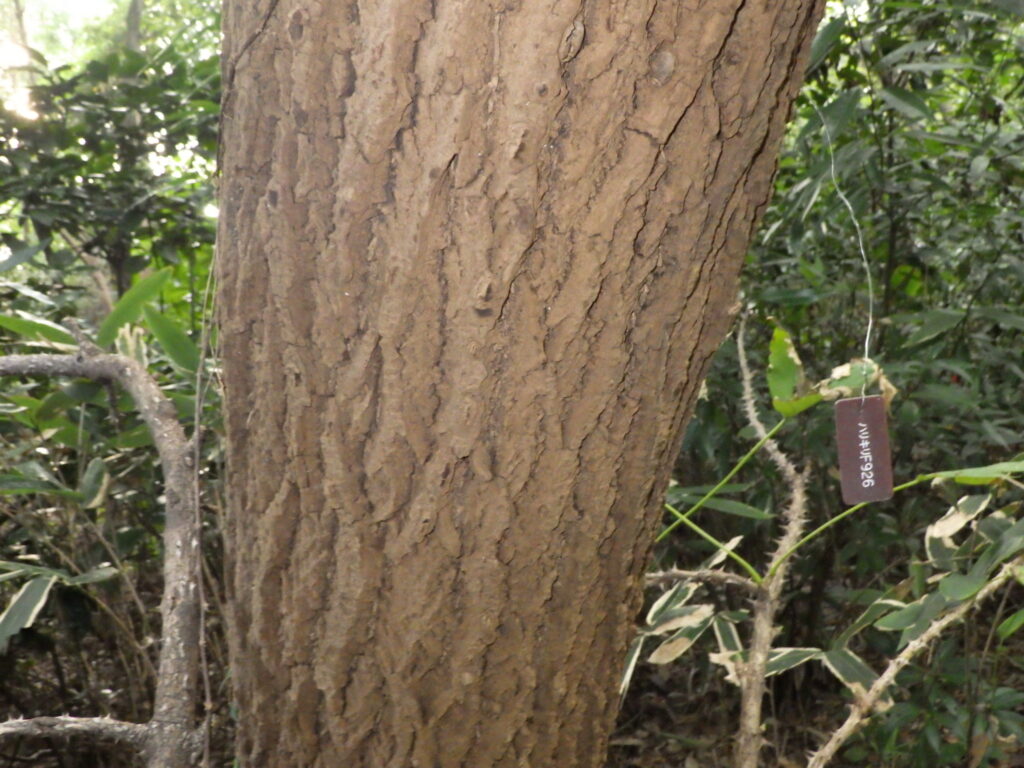
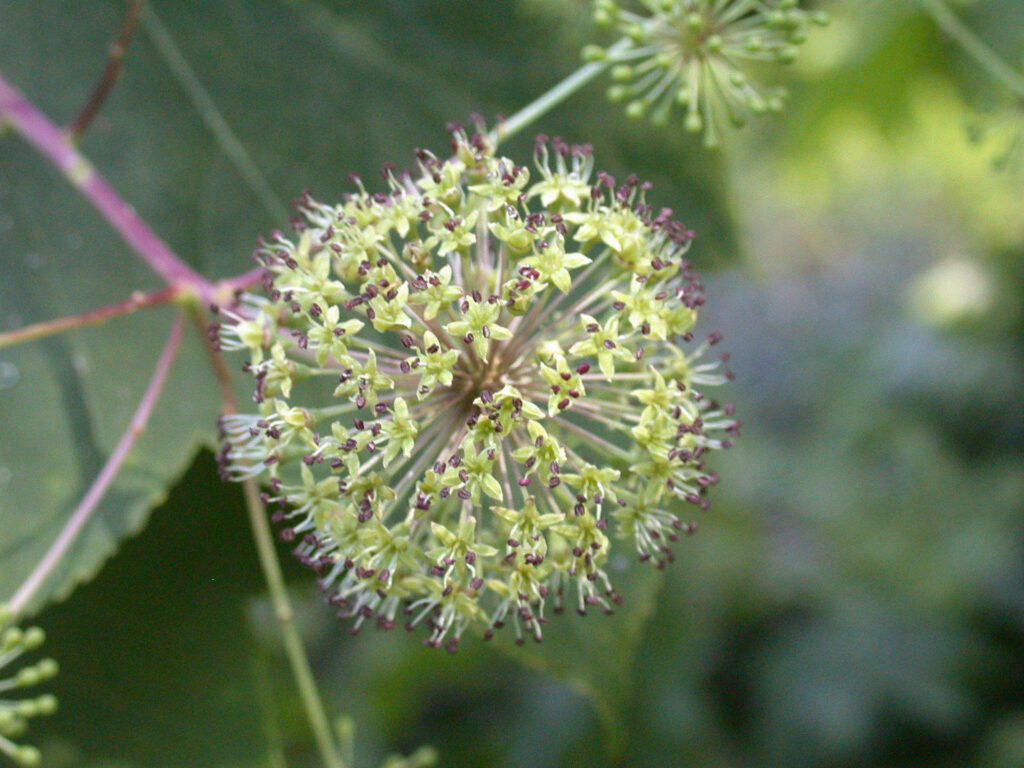
What are the uses of Aralia cordata, Kalopanax septemlobus, Kalopanax septemlobus, and Aralia elata?
Interestingly, in Japan, the new shoots and young leaves of all four of these species are used as wild vegetables in the spring. The same is true for the Japanese angelica tree (Aralia elata), which belongs to the same Araliaceae family. I don't think people in the past knew that they all belonged to the Araliaceae family, but perhaps they shared some common aptitude as plants.
Himeukogi is particularly famous for "ukogi-meshi," a mixed rice dish made by boiling the young leaves in salt water, finely chopping them, and mixing them with freshly cooked rice. It has a unique aroma.
The young shoots of the Japanese angelica tree (Koshiabura) are known to be rich in fat and protein. They have a strong, rich flavor and aroma.
In addition, the following species are known to be used as timber: Kalopanax septemlobus, Kalopanax septemlobus, and Aralia elata.
What is the structure of a flower?
All four species of Araliaceae listed here bear umbels. Umbels are inflorescences in which flowers with stalks are arranged radially at the end of a flower axis, giving them a spherical appearance. The flowers all share the common characteristic of being green to yellow.
Acanthopanax septemlobus flowers from May to June. Although it is dioecious (having separate male and female plants), the plants introduced to Japan from China are considered to be female. Short flower stalks emerge from between the leaves of short branches, bearing small, greenish-white, spherical umbel-shaped inflorescences.
Koshiabura flowers from August to September. It produces umbel-shaped inflorescences with long stalks at the tips of the current year's branches, bearing numerous small yellowish-green flowers. The petals are five in number, narrowly ovate, about 1.5 mm long, and curved backward. There are five stamens. The style is short and shallowly two-lobed. The calyx is bell-shaped. The pedicels are 4-7 mm long.
Kalopanax septemlobus flowers from July to August. It produces numerous spherical umbels at the tips of its branches, each bearing small flowers. The petals are 5 in number, oval-shaped, and about 2 mm long. There are 5 stamens with reddish-purple anthers. The pistil is 2-lobed.
Takanotsume flowers from May to June. It is dioecious (having separate male and female plants). It produces umbel-shaped inflorescences at the ends of short branches, bearing numerous small yellowish-green flowers. The pedicels are 2-5 cm long, and the pedicels are 7-10 mm long. There are four petals, narrowly ovate and about 2 mm long. Male flowers have four stamens and one small pistil. Female flowers have no stamens, and the pistil is two-lobed.
What is the structure of the fruit?
Like many species in the Araliaceae family, the fruits of these four species are berries. A berry is a fruit in which at least part of the pericarp is fleshy or juicy.
The berries of Acanthopanax septemlobus are flattened and spherical, 6-8 mm in diameter, and ripen from reddish-purple to blackish-purple. However, the plants introduced to Japan from China are female, so they rarely bear fruit.
The berries of the Japanese angelica tree (Koshiabura) are slightly flattened spheres, 4-5 mm in diameter, and ripen to a dark purple color in October and November. The style remains at the tip. Each fruit contains two seeds, which are flattened hemispherical in shape.
The berries of the Kalopanax septemlobus are spherical, 4-5 mm in diameter, initially reddish-brown, and later ripening to black. The seeds are 3-4 mm long.
The berries of the Japanese angelica tree (Aralia elata) are broadly oval, 5-6 mm long, and ripen to a dark purple color in September and October. Each berry contains 2-3 seeds. The seeds are oblong, 4-5 mm long, with a reddish-brown surface and short, pointed ends.
References
Kanagawa Prefecture Flora Survey Association. 2018. Kanagawa Prefecture Flora 2018 (Electronic Edition). Kanagawa Prefecture Flora Survey Association, Odawara. 1803pp. ISBN: 9784991053726
Mogi, T., Ota, K., Katsuyama, T., Takahashi, H., Shirokawa, S., Yoshiyama, K., Ishii, E., Sakio, H., and Nakagawa, S. 2000. Flowers Blooming on Trees: Polypetalous Flowers (Vol. 2, 2nd edition). Yama-kei Publishers, Tokyo. 719pp. ISBN: 9784635070041