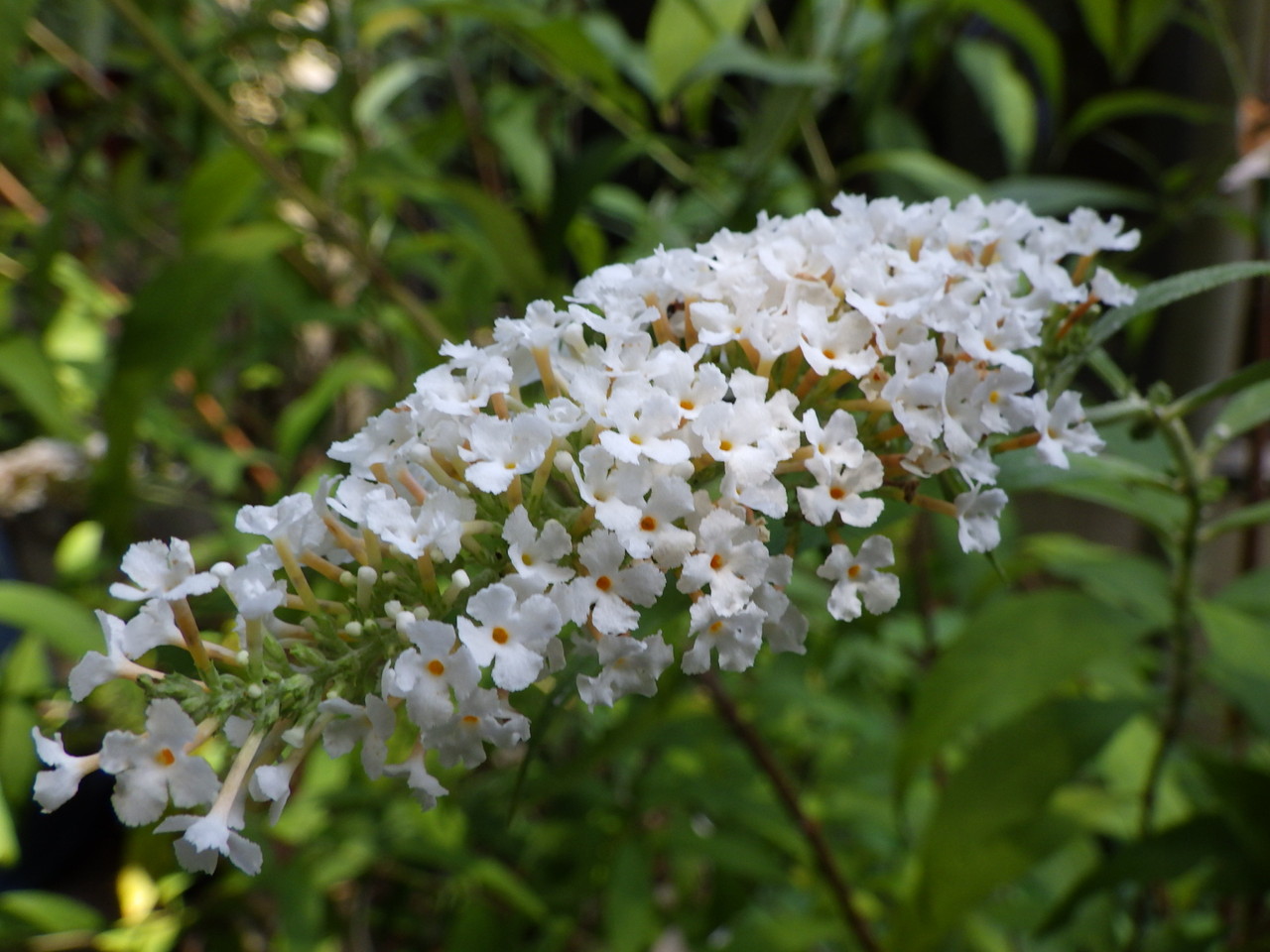
Buddleja japonica, Buddleja stolonifera, Buddleja gracilis, and Buddleja davidii all belong to the Buddleja genus of the Scrophulariaceae family. Their most distinctive feature is that they produce inflorescences at the top of their stems, and each flower has a long corolla tube. Buddleja stolonifera is particularly popular in gardening due to its strong fragrance. However, Buddleja japonica and Buddleja stolonifera, especially those that are more common, are often confused on the internet. While distinguishing between these four species can be difficult, their differences have been clearly confirmed. To differentiate them, the ridges on the stem, the appendages between the leaves, and the shape of the leaves are very important, so be sure to record them carefully. However, Buddleja stolonifera has quite different characteristics from the other species, making it easily recognizable. Because of their showy flowers, long corollas, and strong fragrance, it was thought that butterflies were the main visitors, but research has shown that in some species, only bees visit. However, Buddleja stolonifera seems to attract many butterflies. The fruit is a capsule that opens when ripe, releasing winged seeds that are dispersed by the wind. This article explains the classification, pollination ecology, and seed dispersal of the Buddleja genus.
- What are Buddleja japonica, Buddleja stolonifera, Buddleja gracilis, and Buddleja buergeriana?
- What are the differences between Buddleja japonica, Buddleja davidii, Buddleja stolonifera, and Buddleja davidii?
- What are other species in the genus Buddleja?
- What is the structure of a flower?
- How is pollination done?
- What is the structure of the fruit?
- What are the seed dispersal methods?
- References
What are Buddleja japonica, Buddleja stolonifera, Buddleja gracilis, and Buddleja buergeriana?
Buddleja japonica, also known as Fujiutsugi, is a deciduous shrub distributed in Honshu (the Pacific coast from the Tohoku region to the Kinki region) and Shikoku in Japan. It grows in sunny areas in mountainous fields, riverbanks, and at the foot of cliffs in somewhat rocky, watery areas. It is also cultivated for ornamental purposes.
Buddleja davidii, also known as the bush-leaved budweed, is a deciduous shrub distributed in China, growing in thickets on mountain slopes and on the sides of mountain slopes (Wu & Raven, 1996). In Japan, it is cultivated for ornamental purposes, and while some believe that wild specimens are escaped cultivated plants, others consider it a native plant that grows naturally in the limestone areas of central Honshu.
Buddleja curviflora, also known as Kofujiutsugi, is a deciduous shrub that grows somewhat rarely in forest edges and wastelands in southern Shikoku, southern Kyushu, and Amami Oshima in Japan.
Buddleja lindleyana, also known as Chinese Buddleja, is a deciduous shrub native to China, growing along mountain paths, streams, and forest edges. In Japan, it is cultivated for ornamental purposes.
"Buddleja" is a general term for the genus Buddleja, but in horticulture, it commonly refers to Buddleja japonica.
Both belong to the genus Buddleja in the family Scrophulariaceae, and their most distinctive feature is that they produce inflorescences at the top of their stems, and each flower has a long corolla tube. However, the common Buddleja japonica and Buddleja davidii are often confused on the internet, and there seem to be few websites that clearly explain the differences between them. Some websites even list Buddleja davidii as Buddleja japonica.
What are the differences between Buddleja japonica, Buddleja davidii, Buddleja stolonifera, and Buddleja davidii?
While it is certainly difficult to distinguish between these four species, the differences have been clearly confirmed (Kanagawa Prefecture Flora Survey Association, 2018; Hayashi, 2019).
First, the main difference between Buddleja japonica and Buddleja davidii is that their stems and branches have ridges, while Buddleja davidii and Buddleja stolonifera do not. However, Buddleja davidii may sometimes have weak ridges.
The term "ridge" (ryō) might be a little difficult to understand, but it refers to the corner or pointed part of a stem.
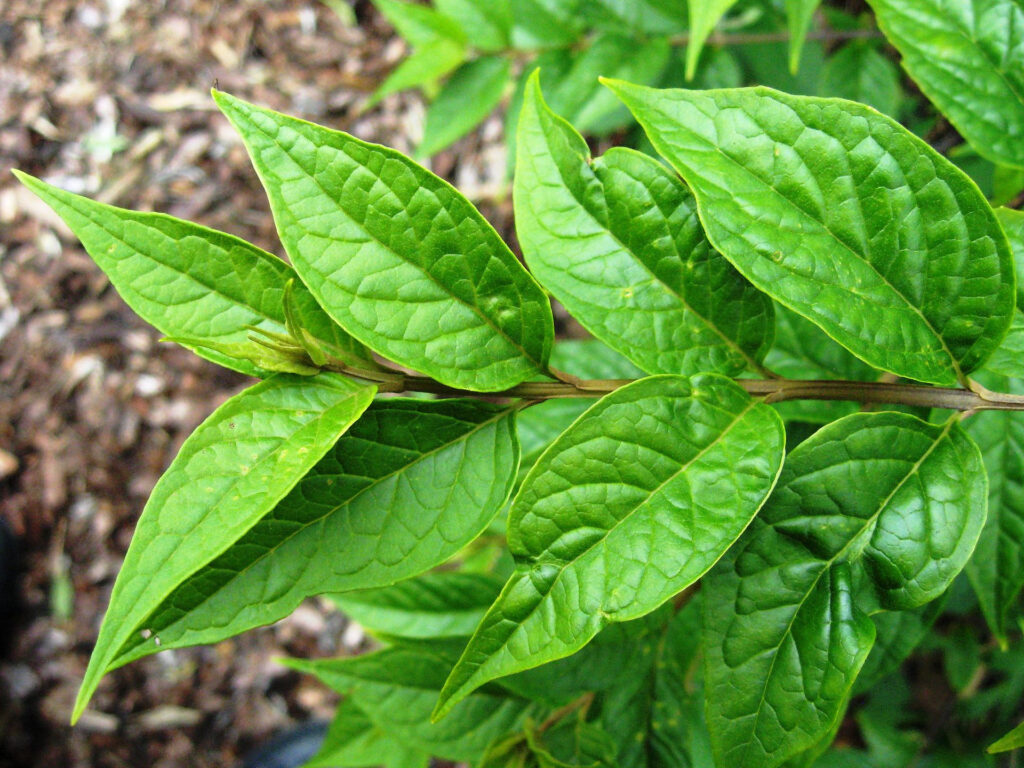
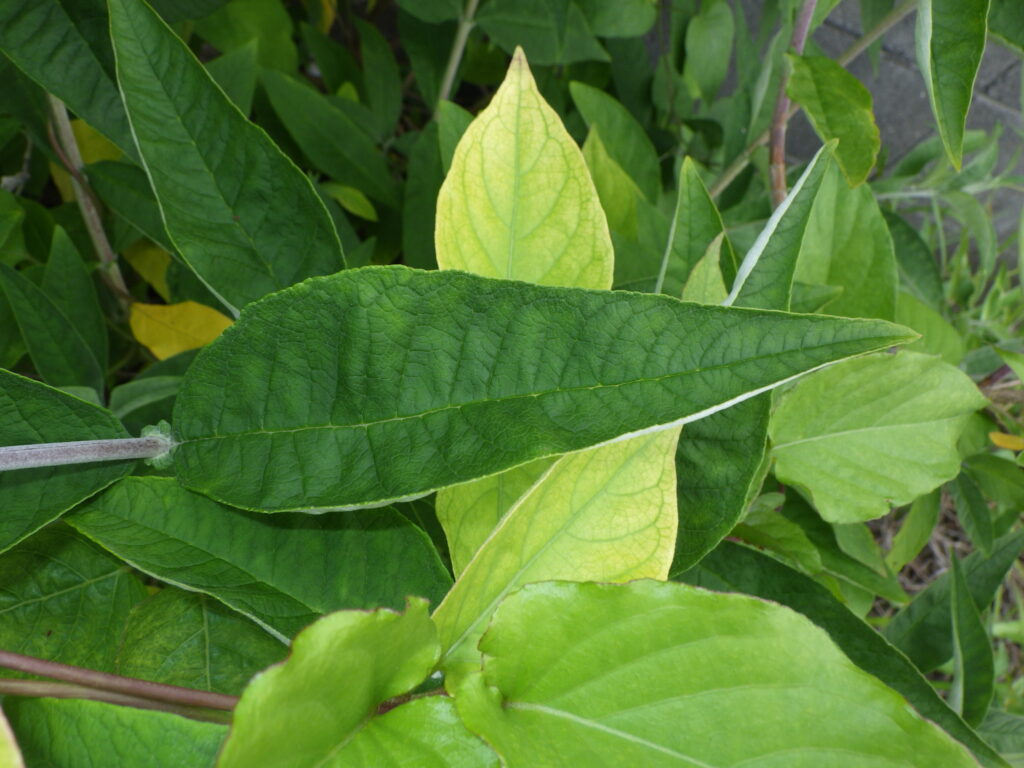
The difference between Buddleja japonica and Buddleja davidii lies in the fact that Buddleja japonica has semicircular green appendages between its opposite leaves, and while some leaves are almost entire, many have irregular, coarse serrations. In contrast, Buddleja davidii does not have appendages between its opposite leaves, and most of its leaves are nearly entire.
Regarding Buddleja davidii and Buddleja japonica, Buddleja davidii has many fine serrations on its leaves and a straight flower tube, while Buddleja japonica has leaves that are usually entire but only have blunt serrations, and a curved flower tube.
The above should allow you to distinguish them for sure. In particular, the fact that the flower tube of Buddleja davidii is straight is unique among the four species, so if you see the flowers, you shouldn't confuse them.
It's also worth noting that only Buddleja japonica and Buddleja davidii are native species; all other species in the Buddleja genus are cultivated varieties. However, Buddleja japonica is sometimes cultivated. Buddleja davidii is arguably the most commonly used species in horticulture.
Among the Buddleja japonica species, there is a well-known variety called Buddleja japonica f. albiflora, which is commonly found in Kagoshima and Yakushima and has a strong whitish tint on the underside of its leaves.

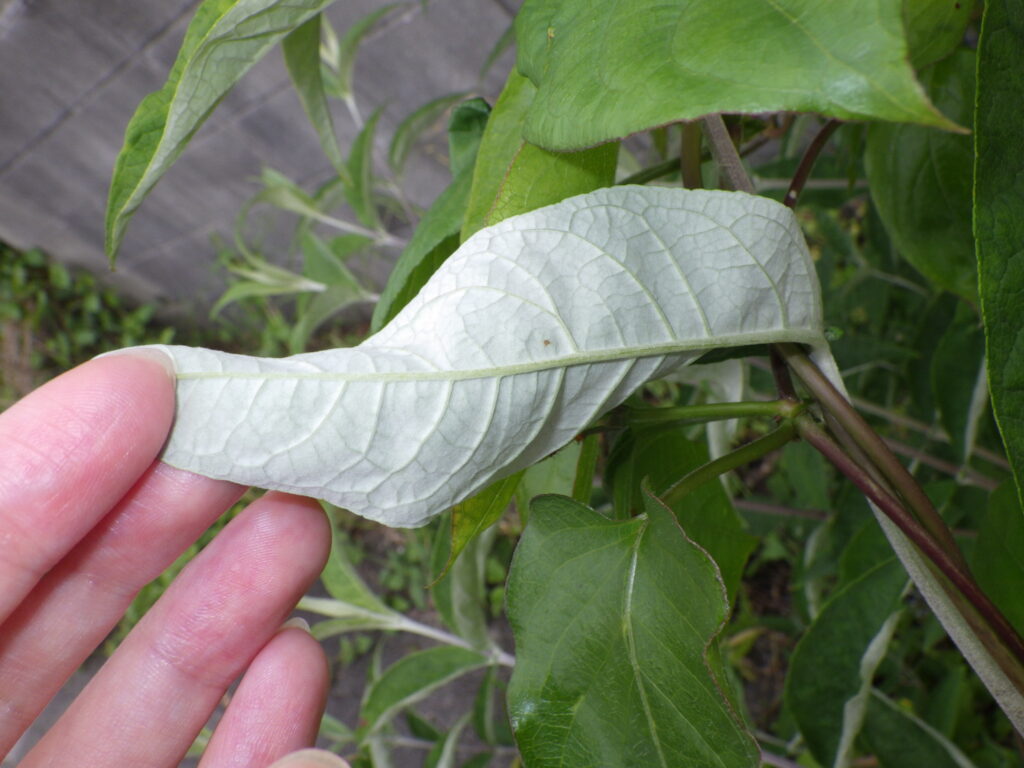
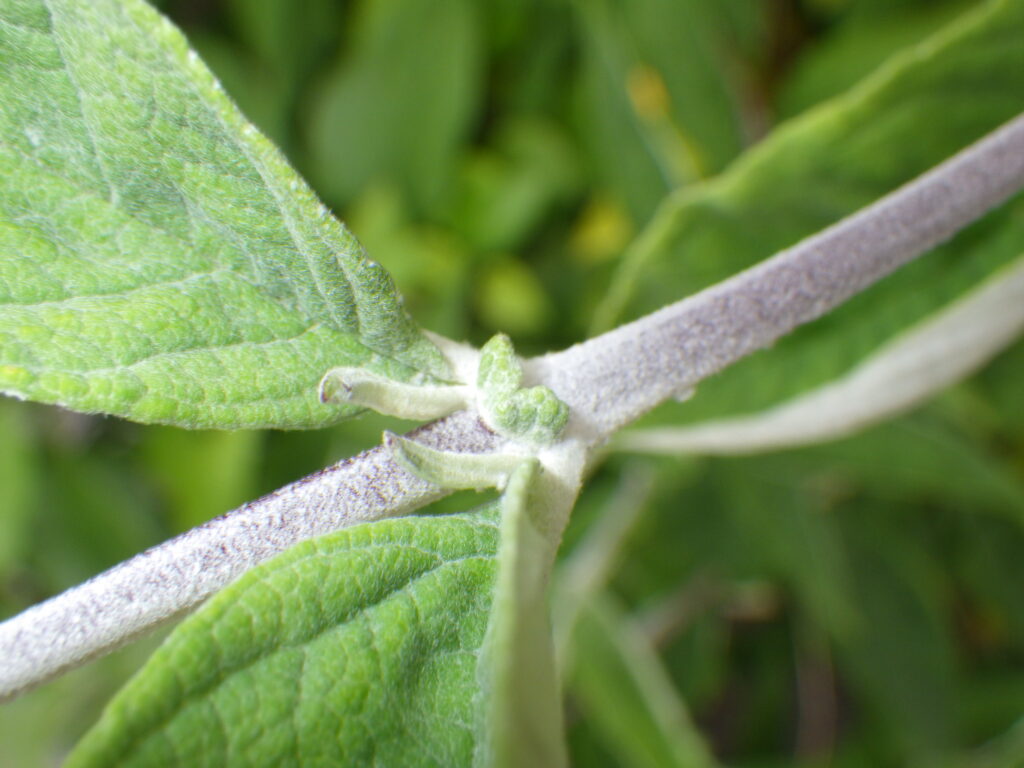
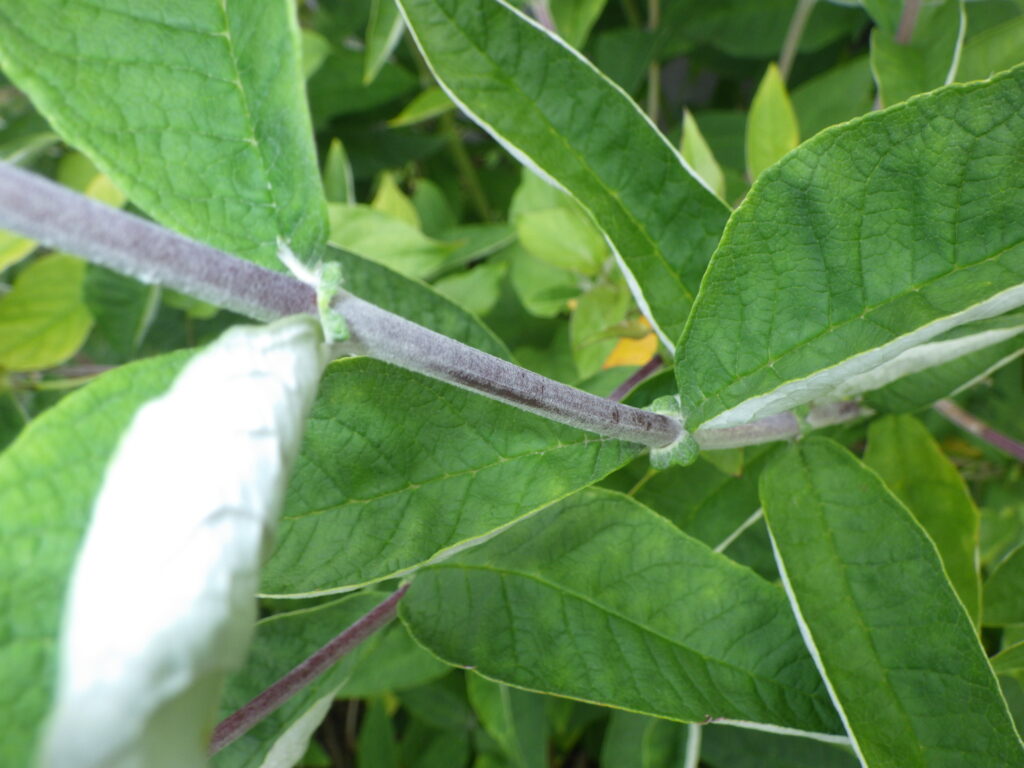
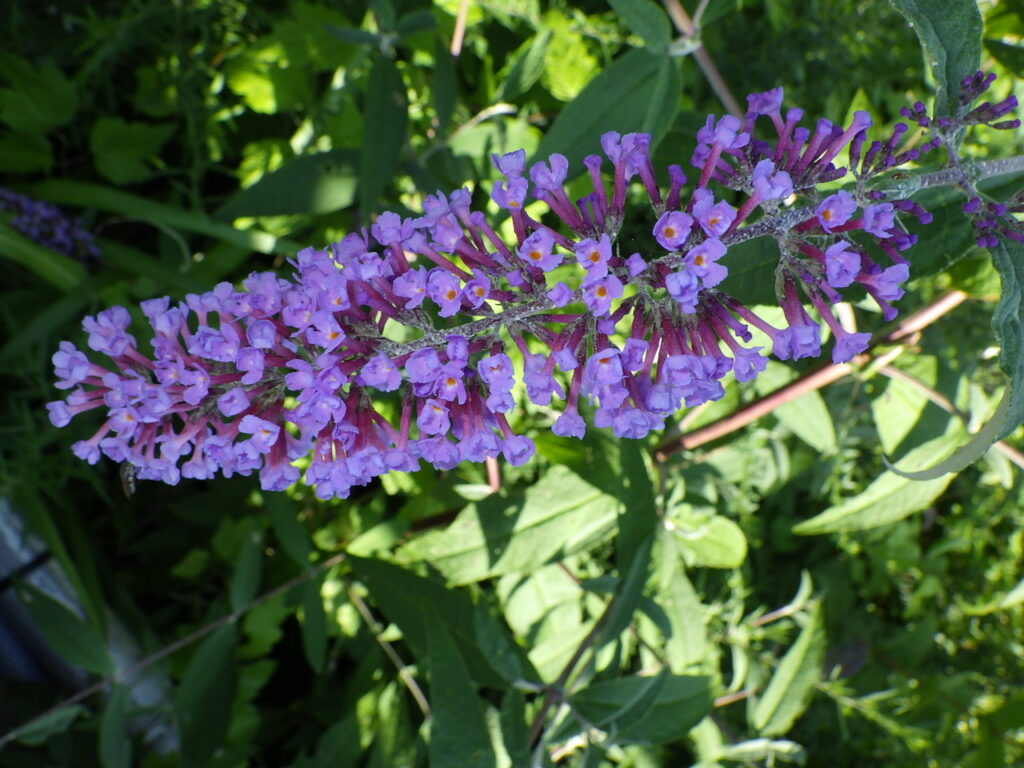
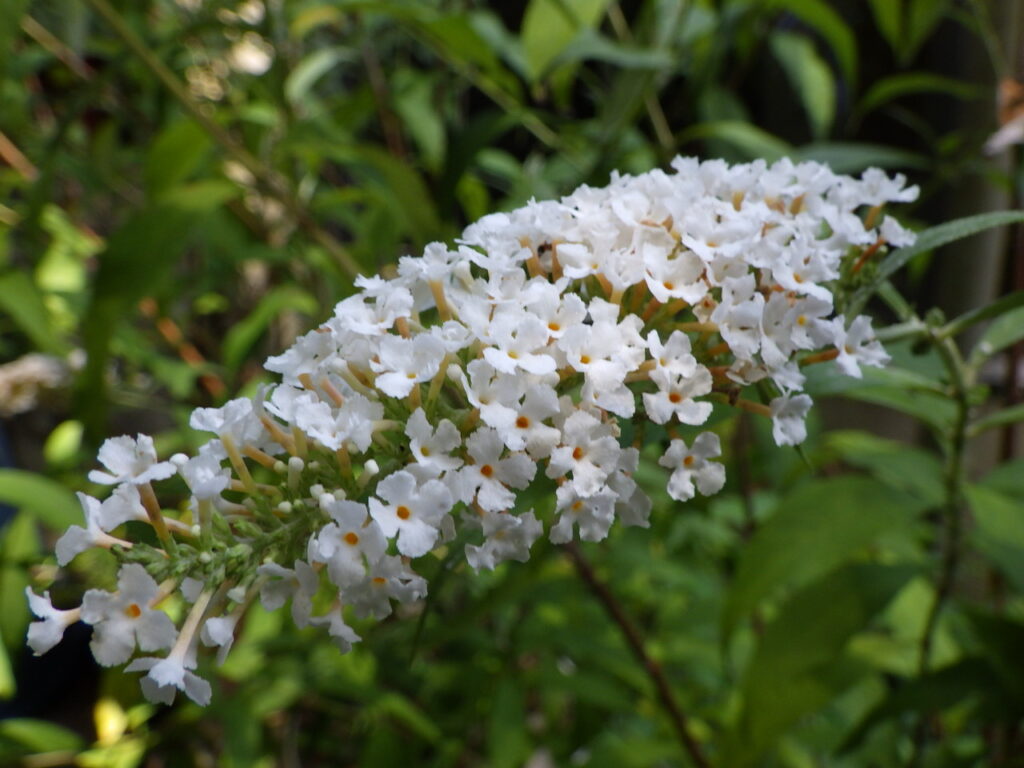
What are other species in the genus Buddleja?
In addition, although rarely seen in Japan, several cultivated varieties are known.
Buddleja asiatica has stems without ridges and produces white to yellow flowers.
African Buddleja (Buddleja madagascariensis) has ridged stems and produces orange flowers.
Buddleja colvilei has ridged stems and produces large, crimson flowers.
What is the structure of a flower?
The most distinctive feature of the Buddleja genus is that they all produce large inflorescences, and their corollas have long corolla tubes.
Buddleja japonica has terminal, conical inflorescences, less than 20 cm long, with numerous flowers densely packed together. The flowers are a pale lilac color.
Buddleja davidii flowers from May to October. The inflorescence is terminal, resembling a raceme or dense spike, 4-30 cm long and 2-5 cm wide. The lower bracts are leaf-like, while the other bracts are small and linear. The calyx is bell-shaped, 2-3.5 mm long, and glabrous on the outside with stellate hairs. The sepals are narrowly triangular, 0.5-2 mm long. The corolla is purple to dark pink, sometimes white, with an orange-yellow throat, 0.8-1.4 cm long, glabrous or stellate-hairy and glandular on the outside. The corolla tube is narrowly tubular or nearly tubular, 6-11.5 mm long and 1-1.5 mm wide, and covered with soft hairs on the inside except at the base. The corolla lobes are nearly orbicular, 1.5-3 mm long and 1.5-3 mm wide, and glabrous on the outside. The stamens are attached to the middle to near the base of the corolla tube. The anthers are oblong. The ovary is ovate, glabrous to short and soft, sometimes glandular. The stigma is club-shaped.
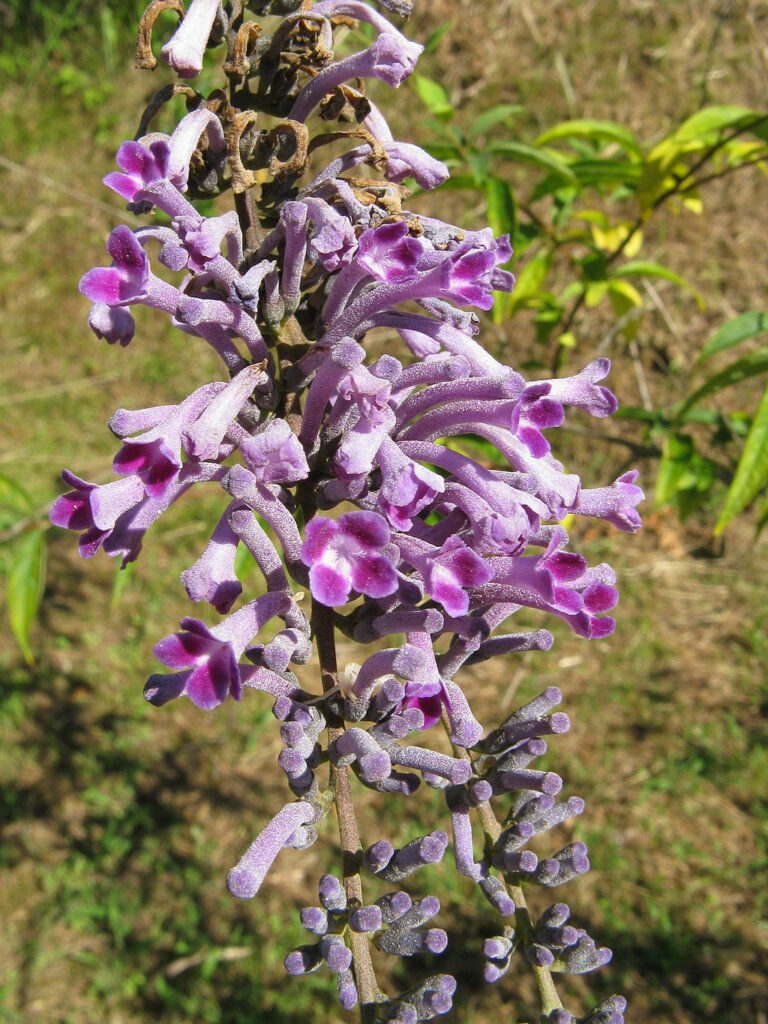
Buddleja japonica has terminal, spike-like or dense conical cymes, 5–20 cm long and 2–4 cm wide. The calyx is bell-shaped, 2–3.5 mm long, with stellate hairs and small glandular hairs on the outside. The sepals are ovate to triangular, 0.5–1 mm long, and glabrous on the inside. The corolla is purple, 1.1–2 cm long, with a swollen, curved corolla tube, 1.4–2.5 mm in diameter at the apex and 1.2–1.5 mm at the base. The corolla lobes are nearly orbicular, 1.5–2.5 mm long and 1.5–2.5 mm wide, with stellate hairs and short hairs on the outside, mixed with small glandular hairs. The stamens are attached to the middle or near the middle of the corolla tube. The anthers are oblong. The pistil is glabrous.
Buddleja japonica flowers from April to October. The inflorescence is terminal, a spike-like cyme, 4-20 cm long and 2-4 cm wide. The lower bracts are leaf-like, often linear, 1-10 mm long. The calyx is campanulate to urn-shaped, 2-4 mm long. The sepals are broadly triangular, 0.2-1 mm long and 0.5-1 mm wide, with short hairs and glandular hairs on the outside, often stellate hairs. The corolla is purple, 1.3-2 cm long, with a tube 1.1-1.7 cm long, curved from the middle downwards, with a apex 2.5-4 mm in diameter and a base 1-1.5 mm wide, with short hairs and glandular hairs on the outside. The corolla lobes are nearly orbicular, 2-3.5 mm long and 2-3 mm wide. The stamens are attached to or near the base of the corolla tube. The anthers are oblong to ovate. The pistil is glabrous.
How is pollination done?
The genus Buddleja is commonly known as "Butterfly Bush" in English, and it has been thought that they primarily attract butterflies and use them for pollination.
They all share a long flower tube, which is thought to be an adaptation to accommodate the length of the butterfly's proboscis (Chen et al., 2012). Their vibrant colors are also attributed to the butterfly's well-developed color vision. Furthermore, their strong scent has also been considered an adaptation for butterflies.
Field surveys have also recorded that the Common Leopard butterfly and the Common Skipper butterfly visit the flowers of Buddleja japonica (Fukuda et al., 2016).
In the case of Buddleja davidii, there are records of 17 different groups of butterflies visiting the plant, although this is a record from Japan (Mizota et al., 2008).
However, recent studies have shown that five wild species of Buddleja davidii, including Buddleja davidii, are rarely visited by butterflies, and are mostly visited by large bees with long tongues, with butterflies almost never seen (Gong et al., 2015).
This contradicts previous assumptions and seems like a strange result considering that its shape is not significantly different from that of Buddleja davidii. However, it is believed that the reason lies in the difference in the components of its scent.
It is unclear whether Buddleja japonica and Buddleja buergeriana are pollinated by butterflies or bees, but given that there are records of bees visiting these species (Ikutome, 1992; 2005; Ikutome and Murao, 2021), it is likely that these species also rely at least partially on bees with long tongues for pollination.
However, as for the common ornamental variety, Buddleja japonica, planting it in your garden is likely to attract many butterflies.
What is the structure of the fruit?
With a few exceptions, the fruits of the Buddleja genus are capsules.
The capsules of Buddleja japonica are oval, 4-6 mm long and 1.5-2 mm wide, covered with glandular hairs or occasionally glabrous. The seeds are pale brown, obliquely tetrahedron-shaped, with wings at the corners.
The capsules of Buddleja japonica are oval-shaped, 5-7 mm long and 2-3 mm wide, and glabrous. The seeds are obliquely oval-shaped, 1.2-1.5 mm long, and have wings at both ends.
The capsules of Buddleja davidii are brown, narrowly elliptic to narrowly ovate, 5–9 mm long and 1.5–2 mm wide, glabrous or sparsely covered with stellate hairs. The seeds are elliptic, 2–4 mm long and about 0.5 mm wide, with long wings at both ends.
What are the seed dispersal methods?
As can be inferred from the fact that the seeds have wings, it is generally believed that the genus Buddleja is dispersed by wind, with a few exceptions (Lindstrom et al., 2004).
When the capsule ripens, it exposes its interior, releasing the seeds which are then carried away by the wind.
References
Chen, G., Gong, WC, Ge, J., Dunn, BL, & Sun, WB 2012. Floral scents of typical Buddleja species with different pollination syndromes. Biochemical Systematics and Ecology 44: 173-178. https://doi.org/10.1016/j.bse.2012.05.010
Fukuda, Haruo; Moriyama, Taiji; and Kanai, Kenichi. 2016. Butterflies of Iwojima and Takeshima Islands in Mishima Village, Kagoshima Prefecture: Results of the 2015 survey and an examination of the history of butterfly fauna formation. Research Bulletin of the Kagoshima Prefectural Museum 35: 1-14. https://dl.ndl.go.jp/pid/10365819
Gong, WC, Chen, G., Vereecken, NJ, Dunn, BL, Ma, YP, & Sun, WB 2015. Floral scent composition predicts bee pollination system in five butterfly bush (B. uddleja, Scrophulariaceae) species. Plant Biology 17(1): 245-255. https://doi.org/10.1111/plb.12176
Hayashi, Masayuki. 2019. Tree Leaves: Expanded and Revised Edition - Identifying 1300 Species Through Real-Life Scans. Yama-kei Publishers, Tokyo. 824pp. ISBN: 9784635070447
Ikutome, Shuichi. 1992. Environment and bee fauna of urban nature parks: Survey results in Shiroyama Park, Kagoshima City. Appendix: Revised Catalogue of bees in mainland Kagoshima Prefecture. Bulletin of Kagoshima Women's Junior College 27: 99-135. http://id.nii.ac.jp/1121/00000877/
Ikuru, Shuichi. 2005. Ecological study of wild bee fauna in populated areas of Yakushima Island. Bulletin of Kagoshima Women's Junior College 40: 1-20. http://id.nii.ac.jp/1121/00000469/
Ikuru, Shuichi & Murao, Tatsuki. 2021. Lasioglossum, a genus of bees (Hymenoptera: Halictidae) from Yakushima Island. Nature of Kagoshima 47: 349-354. https://journal.kagoshima-nature.org/047-060/
Kanagawa Prefecture Flora Survey Association. 2018. Kanagawa Prefecture Flora 2018 (Electronic Edition). Kanagawa Prefecture Flora Survey Association, Odawara. 1803pp. ISBN: 9784991053726
Lindstrom, JT, Bujarski, GT, & Burkett, BM 2004. A novel intersectional Buddleja hybrid. HortScience 39(3): 642-643. https://doi.org/10.21273/HORTSCI.39.3.642
Koji Mizota, Yojiro Endo, and Ayumi Miyagawa. 2008. Butterflies in the Butterfly Garden of Miyagi University of Education. Journal of Environmental Education Research, Miyagi University of Education 10: 33-42. http://id.nii.ac.jp/1138/00001005/
Wu, ZY, & Raven, PH 1996. Flora of China (Vol. 15 Myrsinaceae through Loganiaceae). Science Press, Beijing, and Missouri Botanical Garden Press, St. Louis. 387pp. ISBN: 9780915279371

