Spiraea thunbergii, Spiraea cantoniensis, and Spiraea japonica are representative species of the Spiraea genus in Japan, known for their white flowers that bloom in spring. They are also used in horticulture for ornamental purposes. Distinguishing between them is relatively easy; you can quickly tell them apart by examining the shape of the inflorescence and flowers. Their leaf shapes are also distinctive, so you can distinguish them even when they are not in bloom if you look closely. Surprisingly, research has shown that Spiraea thunbergii attracts many flies and hoverflies. On the other hand, research on Spiraea cantoniensis is insufficient, but it is possible that it has evolved to attract more beetles than Spiraea thunbergii. This article will explain the classification, pollination ecology, and seed dispersal of Spiraea thunbergii, Spiraea cantoniensis, and Spiraea japonica.
- What are Spiraea thunbergii, Spiraea cantoniensis, and Lycaena phlaeas?
- What are the differences between Spiraea thunbergii, Spiraea cantoniensis, and Lycaena phlaeas?
- What is the structure of the flowers of Spiraea thunbergii, Spiraea cantoniensis, and Lycaena phlaeas?
- Although I haven't researched the flowers enough, there were a lot of flies!
- The fruit is a follicle, and seeds are dispersed by gravity.
- References
- Source
What are Spiraea thunbergii, Spiraea cantoniensis, and Lycaena phlaeas?
Spiraea thunbergii, also known as snow willow, is distributed in eastern China and south of the southern part of Northeast China, and is commonly cultivated in Japan. Although not often recognized, it is naturally distributed in Japan. It is a deciduous shrub that inhabits crevices in cliffs along riverbanks and rocky areas (Mogi et al., 2000).
Spiraea cantoniensis, also known as Japanese snowball bush, is distributed in central China and is commonly cultivated in Japan. In China, it is a deciduous shrub that grows on slopes.
Spiraea prunifolia, also known as the clam flower, is distributed in southeastern China and Taiwan and is commonly cultivated in Japan. In China, it is a deciduous shrub that grows in thickets, slopes, rocks, and steep, dry cliffs.
The Spiraea genus, belonging to the rose family, includes several species with white flowers, and the three mentioned above are representative. Since they are frequently used as ornamental plants in horticulture, it's important to be able to distinguish between them.
What are the differences between Spiraea thunbergii, Spiraea cantoniensis, and Lycaena phlaeas?
They can be easily distinguished when they are in bloom (Hayashi, 2014).
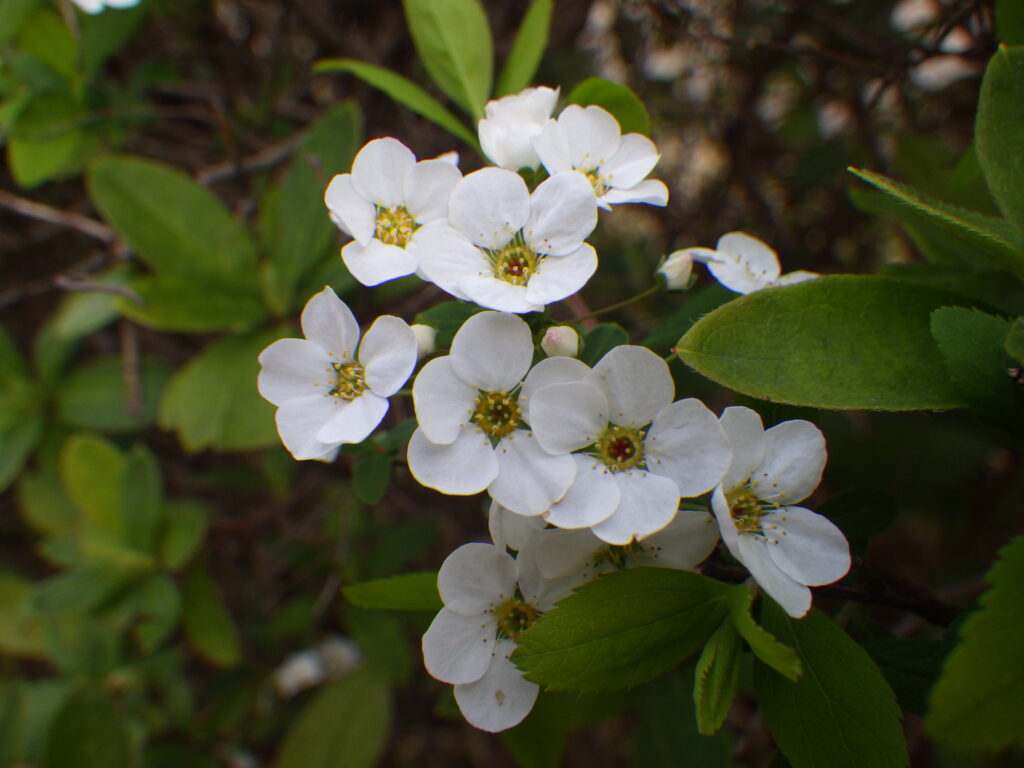
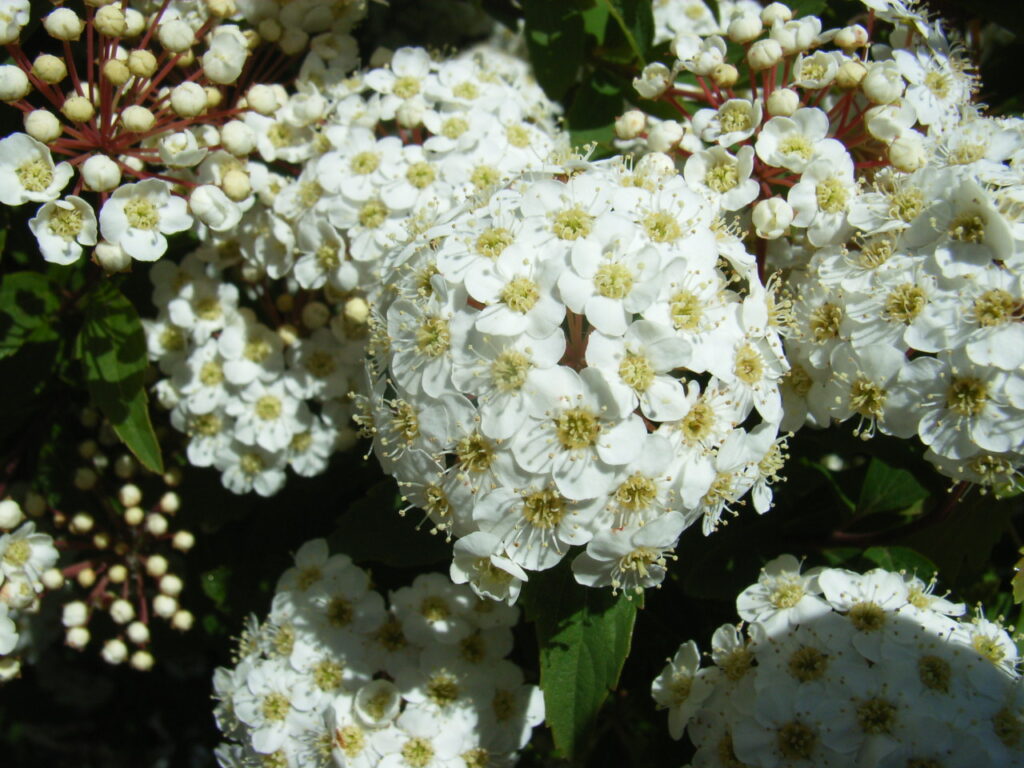
In Spiraea thunbergii, the inflorescence consists of several flowers clustered together, whereas in Spiraea thunbergii and Lycaena phlaeas, the inflorescence is corymbose.
The difference between Spiraea thunbergii and Lycaena phlaeas is that Spiraea thunbergii, as its name suggests (written with the kanji characters for "small ball"), has flowers arranged in a hemispherical shape resembling a temari (traditional Japanese handball), while Lycaena phlaeas does not.
In terms of flower morphology, Spiraea thunbergii and Spiraea cantoniensis have single flowers (although there is a double-flowered variety of Spiraea cantoniensis called Yaekodemari), while cultivated specimens of Spiraea thunbergii have double flowers.
You might not often confuse Spiraea thunbergii and Lycaena phlaeas, but even if Lycaena phlaeas is not double-flowered, you can distinguish them by the fact that Spiraea thunbergii has hairless flower stalks that are 6-12 mm long, while Lycaena phlaeas has long, hairy flower stalks that are 10-24 mm long.

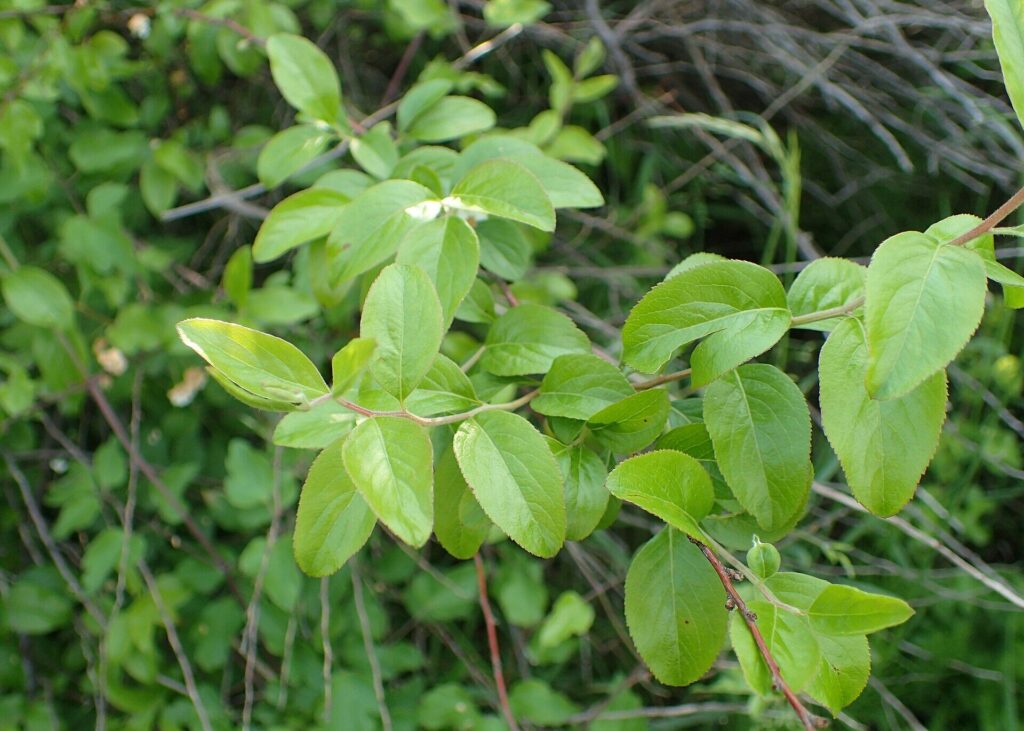
They can be distinguished even by their leaves alone.
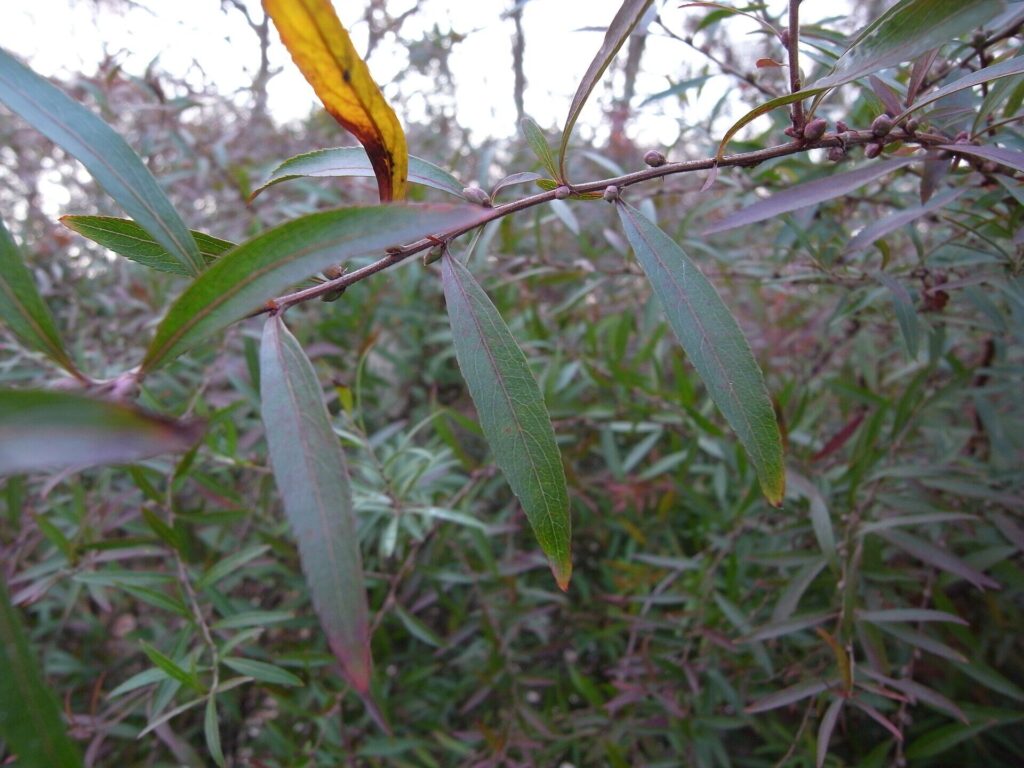
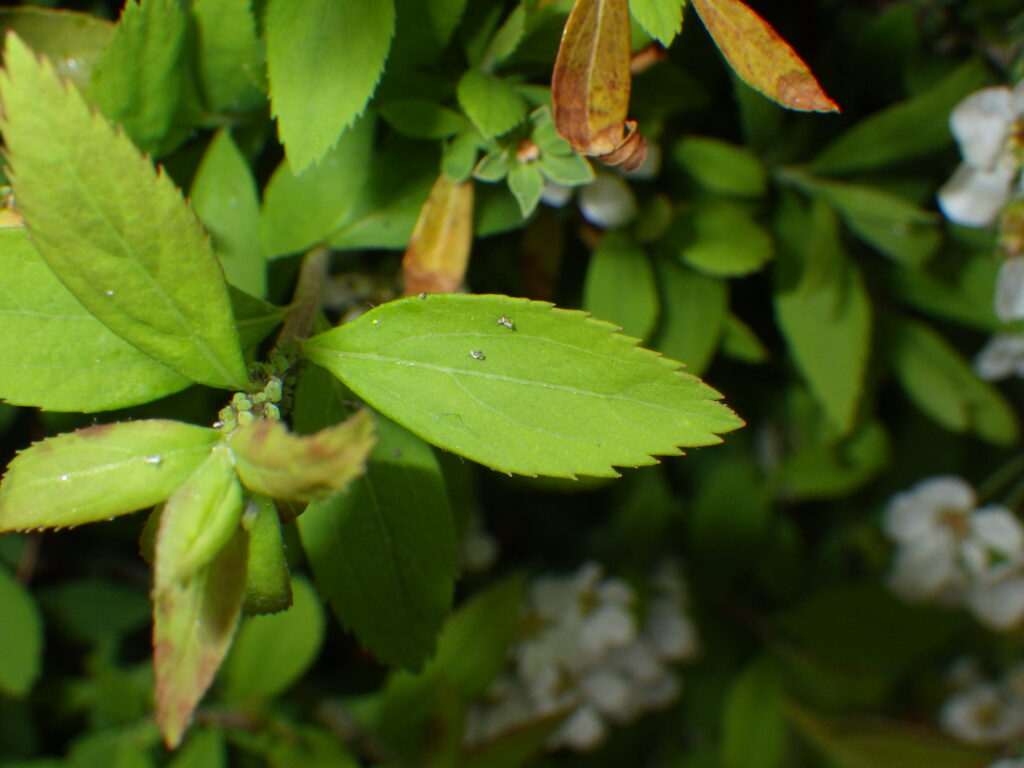
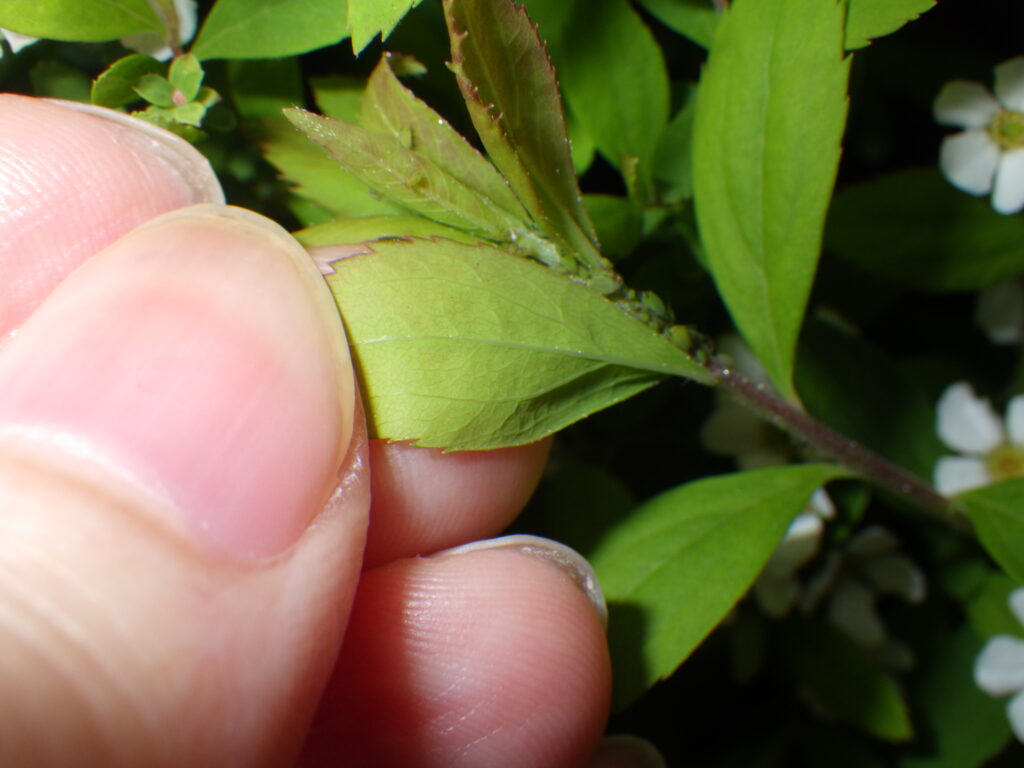
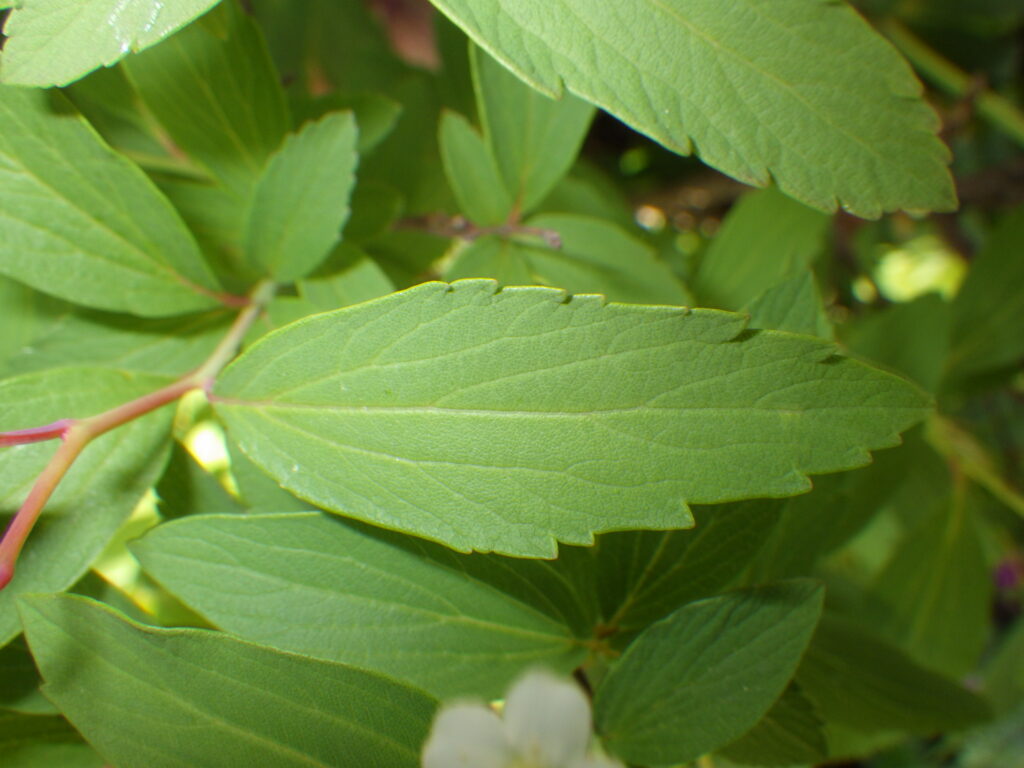
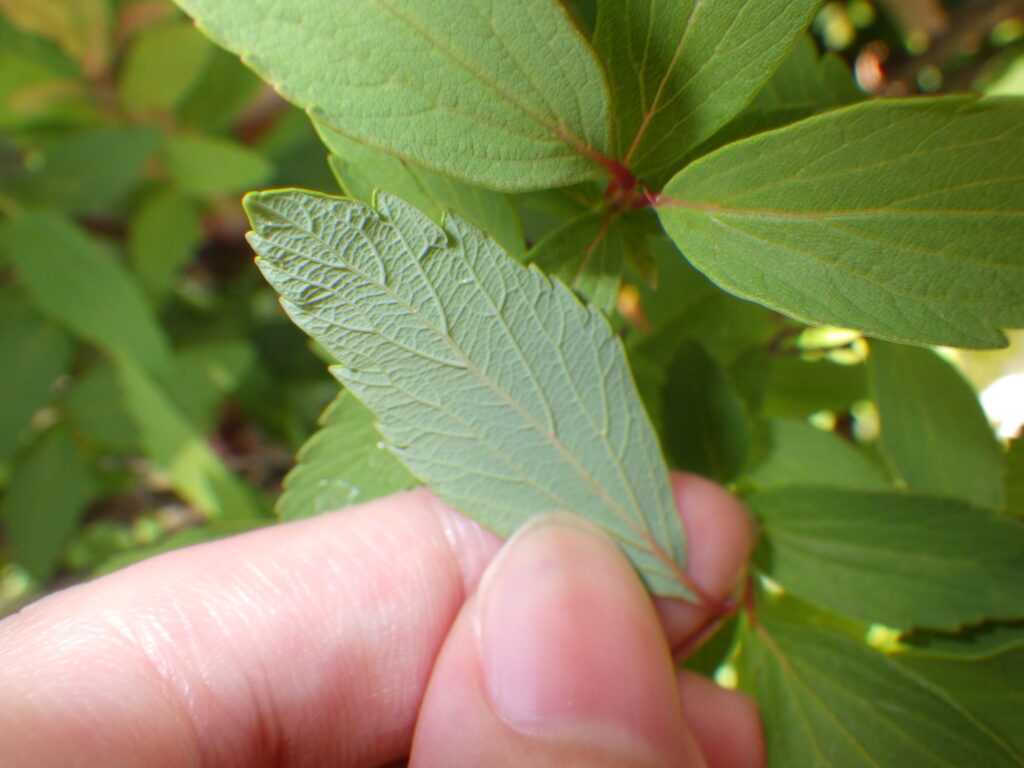
In Spiraea thunbergii, the leaves are rounded oval-shaped and glossy, whereas in Spiraea thunbergii and Spiraea cantoniensis, the leaves are narrow and not glossy.
The difference between Spiraea thunbergii and Spiraea cantoniensis is that Spiraea thunbergii has longer, narrower leaves with fine, single serrations, while Spiraea cantoniensis usually has rhomboid-shaped leaves with coarse, double serrations, and the upper surface is often slightly bluish-white, while the underside is whitish.
What is the structure of the flowers of Spiraea thunbergii, Spiraea cantoniensis, and Lycaena phlaeas?
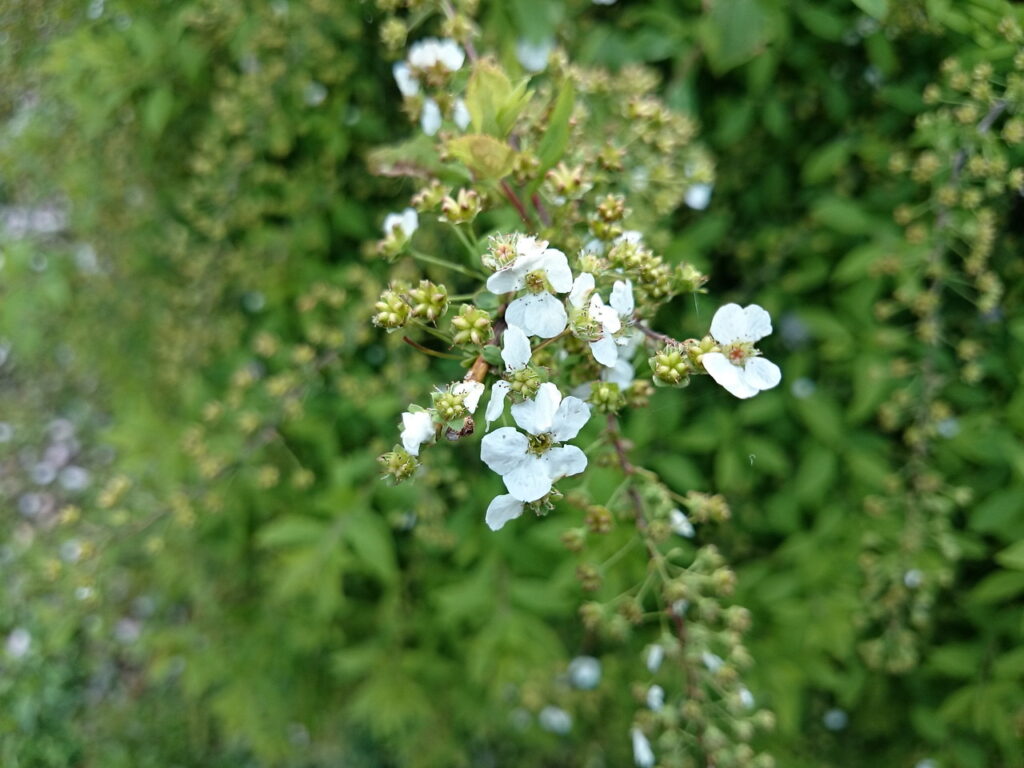
Spiraea thunbergii blooms in April, producing numerous inflorescences on the previous year's branches (older branches), with each inflorescence containing 2 to 7 white flowers. I initially thought the flowers were all white, but upon closer inspection, I found that they are arranged with orange pistils, yellow ring-shaped nectaries, and white stamens from the inside out, making for a rather vibrant display.
Spiraea thunbergii produces numerous flowers in round, umbel-shaped inflorescences from April to May, and they are mostly white.
Lycaena phlaeas produces double-petaled white flowers from March to May.
They may seem very similar, but as mentioned above, they can be clearly distinguished.
Although I haven't researched the flowers enough, there were a lot of flies!
Many insects visit the flowers of Spiraea thunbergii, perhaps due to the flat shape of the flower. Records show that a variety of insects visit, including a species of sawfly (Uemori, 2017), a silver-flowered bee (Negoro, 1999), and a mason bee (Tsugawa, 1973). However , a Japanese study that examined the proportion of these insects found that flies and hoverflies accounted for 901 TP3T (Yokoi et al., 2008). The reason is unknown, but it may be related to the fact that it originally blooms on riverbanks.
On the other hand, while no records of pollinating insects for Spiraea thunbergii were found in literature, a Google image search revealed that bees, carpet beetles, flower beetles, longhorn beetles, and hoverflies do visit the flowers. Although the proportions are unknown, the hemispherical shape of the flowers allows for a wider foothold, which may have evolved to make it easier for beetles to visit the flowers compared to Spiraea thunbergii.
Because the Lycaena phlaeas has double flowers, there are probably few instances of people visiting its blossoms.
These may be subtle morphological differences, but they will likely have different effects on the insects that visit them. Research on the pollination ecology of the Spiraea genus is lacking, but we can hope for more in the future.
The fruit is a follicle, and seeds are dispersed by gravity.
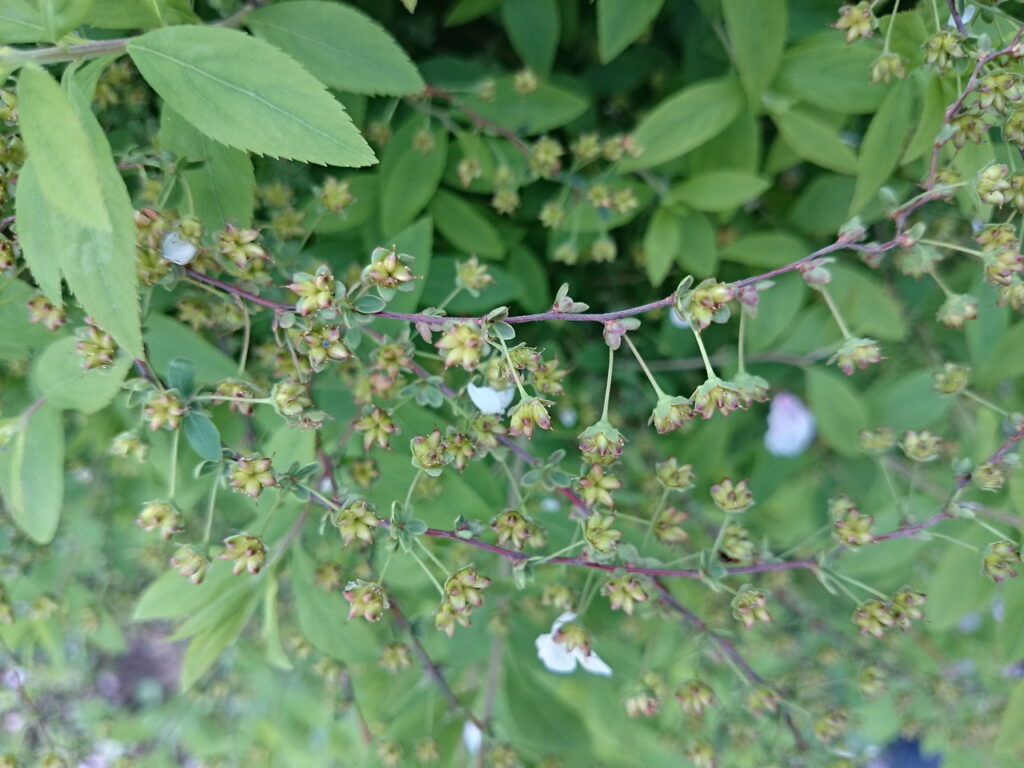
All three species produce follicles, and the mature pericarp usually dries out and splits open along a single line, releasing the seeds. While their detailed ecology is unknown, it has been noted that gravity dispersal is the primary method for Spiraea thunbergii, with wind and animal dispersal being rare (Poliakova, 2022). It is likely that the same is true for the other two species, but how do they manage to reproduce on cliffs and slopes? Spiraea thunbergii exhibits a tendency towards inbreeding, making clonal reproduction easy, which may also contribute to its easy reproduction. These three species are common, yet their wild life remains largely unknown.
References
Hayashi, Masayuki. 2014. 1100 Tree Leaves Identified Through Real-Life Scans. Yama-kei Publishers, Tokyo. 759pp. ISBN: 9784635070324
Negoro, Takashi. 1999. Flower-visiting behavior of bees at Kanazawa Castle Ruins (former Kanazawa University campus). Research Report of Toyama City Science and Culture Center 22: 55-79. ISSN: 0387-9089, http://repo.tsm.toyama.toyama.jp/?action=pages_view_main&active_action=repository_view_main_item_detail&item_id=731&item_no=1&page_id=13&block_id=82
Mogi, T., Ishii, H., Sakio, H., Katsuyama, T., Ota, K., Takahashi, H., Shirokawa, S., and Nakagawa, Shigetoshi. 2000. Flowers Blooming on Trees: Polypetalous Flowers (Vol. 1, Revised 3rd Edition). Yama-kei Publishers, Tokyo. 719pp. ISBN: 9784635070034
Poliakova, TA 2022. Adaptive Strategies and Genetic Stability of Species from the Spiraea Genus (Rosaceae) in Natural Population Systems. Biology Bulletin Reviews 12(1): 96-107. https://doi.org/10.1134/S207908642207009X
Tsugawa, R. 1973. Conservation and utilization of pollinating insects of fruit trees. Tohoku Agricultural Research 14: 30-35. ISSN: 0388-6727, https://agriknowledge.affrc.go.jp/RN/2010072713
Kamimori, Kyoji. 2017. Bee fauna in urban parks in Amagasaki City, Hyogo Prefecture. Kiberihamushi 40(1): 4-8. ISSN: 1884-9377, https://www.konchukan.net/pdf/kiberihamushi/Vol40_1/kiberihamushi_40_1_4-8.pdf
Yokoi, Tomoyuki; Habe, Akifumi; Katori, Ikuo; and Sakuraya, Yasuyuki. 2008. Diversity of pollinating insect communities at Kinki University Nara Campus. Kinki University Faculty of Agriculture Bulletin 41: 77-94. ISSN: 0453-8889, http://id.nii.ac.jp/1391/00005214/
Source
This article is a significantly expanded version of content found in the following book.