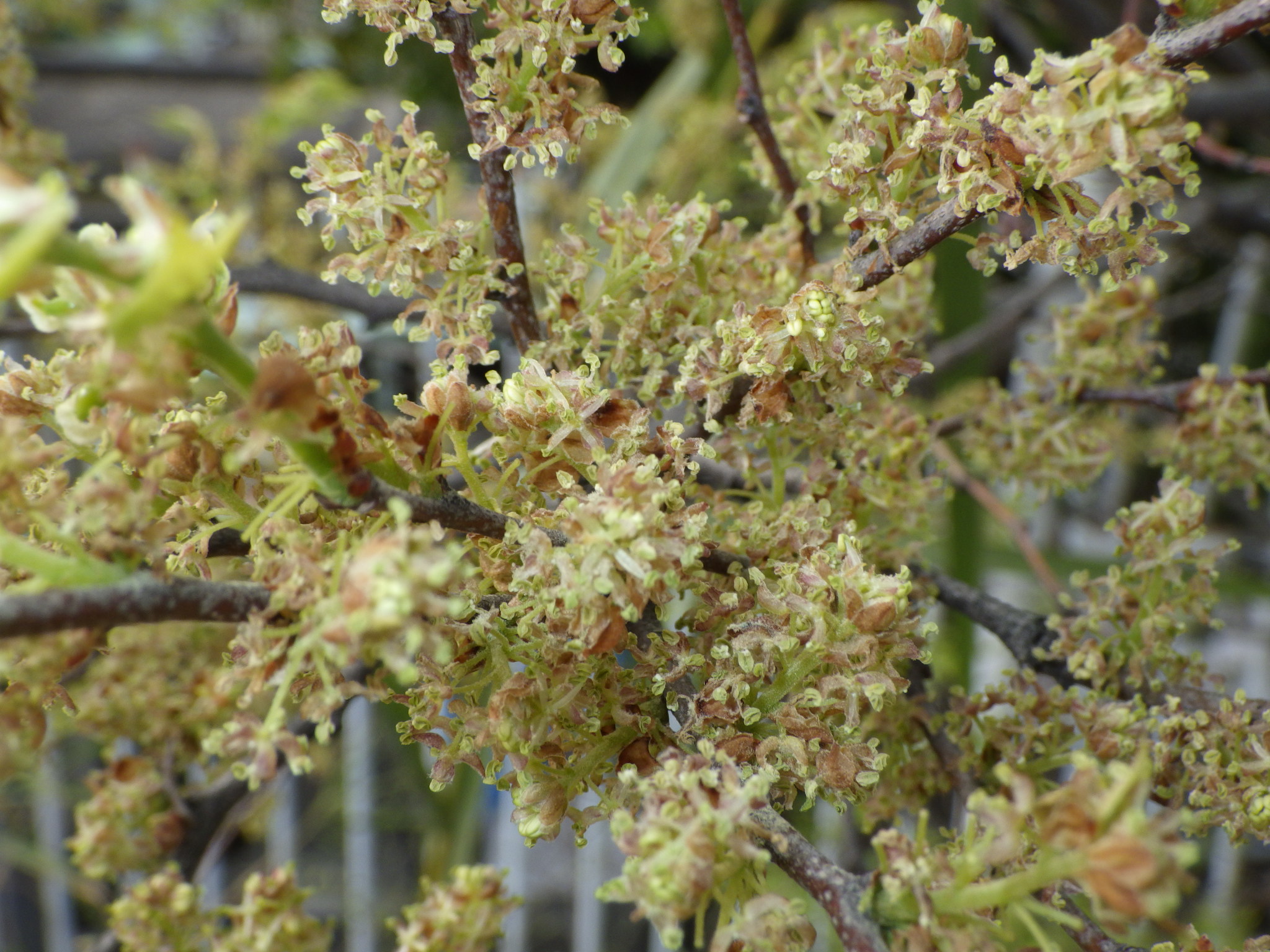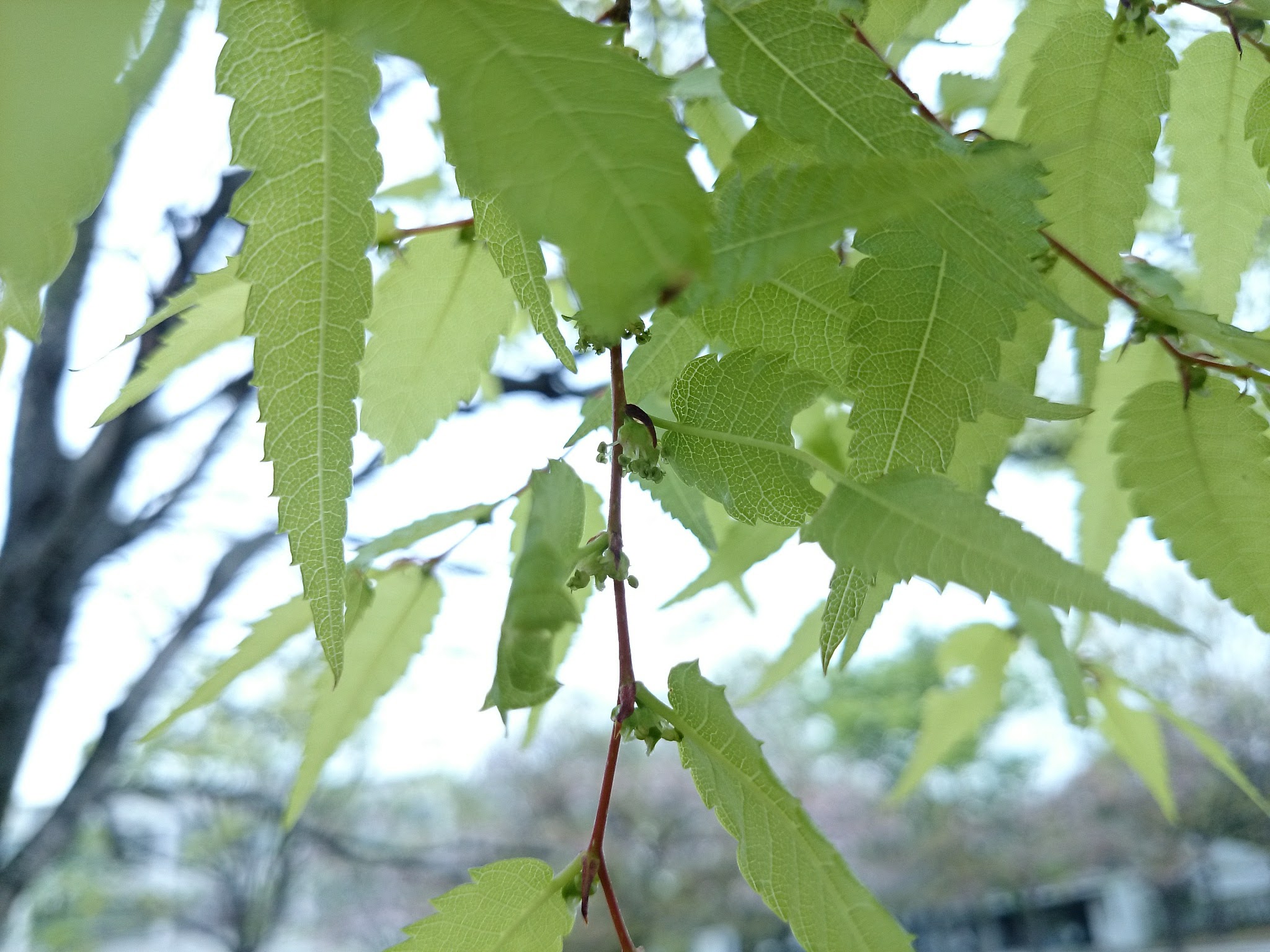
Zelkova serrata, Japanese elm, and Japanese elm all belong to the elm family and are deciduous trees commonly found growing wild in forests in Japan, as well as being cultivated as street trees. All three have beautiful autumn foliage, which can sometimes lead to confusion. Of the three species, Zelkova serrata belongs to the genus Zelkova, while Japanese elm and Japanese elm belong to the genus Ulmus. There are significant differences in the shape of their fruits and differences in their ecology, but in practical terms, distinguishing them by the shape of their leaves is the most reliable method. This article will explain the classification and morphology of the Zelkova and Ulmus genera.
What are Zelkova, Japanese elm, and Japanese elm?
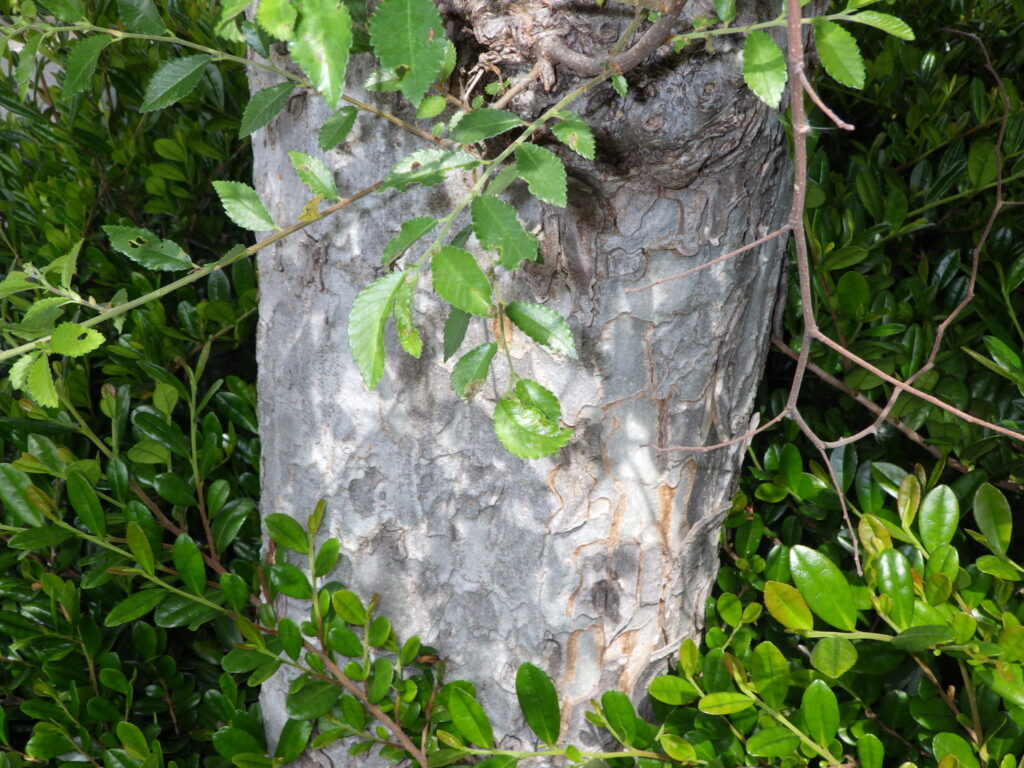
Zelkova serrata, also known as zelkova, is a deciduous tree that grows along valleys in the oak and chestnut zones to the lower beech zones of Honshu, Shikoku, and Kyushu in Japan, and in eastern China. In Japan, it is commonly cultivated as a street tree and park tree. Zelkova f. stipulacea is a variety with dense hairs on both sides of the leaves and on the petioles.
The Japanese elm (Ulmus parvifolia), also known as the elm zelkova, is a deciduous tree distributed from the oak and chestnut zones to the subtropical regions of Honshu (central and western parts), Shikoku, Kyushu, and the Ryukyu Islands in Japan; as well as Korea, China, and Taiwan. It grows in barren areas, riverbanks, and riverbeds. In Japan, it is commonly cultivated as a park tree and street tree.
Japanese elm (Ulmus davidiana var. japonica) is a deciduous tree distributed in Hokkaido, Honshu, Shikoku, and Kyushu in Japan; as well as in Korea and China (northeast and northeast). It grows in moist, fertile plains and floodplains. In northern Japan, it is cultivated as a park tree.
Both belong to the elm family and are commonly seen growing wild in forests in Japan. They are also very commonly cultivated deciduous trees used as street trees. The Keyakizaka Street in Roppongi, Minato Ward, Tokyo, is a famous example. This is likely due to their ease of cultivation and the beautiful orange to yellow autumn foliage they produce.
Zelkova blossoms, as well as the flowers of Japanese elm and Japanese elm, share the characteristic of being inconspicuous because they are wind-pollinated (Saku & Hashizume, 1995; Caudullo & De Rigo, 2016).
However, many people may confuse the three types due to these characteristics.
What are the differences between Zelkova, Japanese elm, and Japanese elm?
These three species are first divided into two taxonomic groups: Zelkova serrata belongs to the genus Zelkova, while Ulmus parvifolia and Ulmus davidiana belong to the genus Ulmus (Kanagawa Prefecture Flora Survey Association, 2018; Hayashi, 2019).
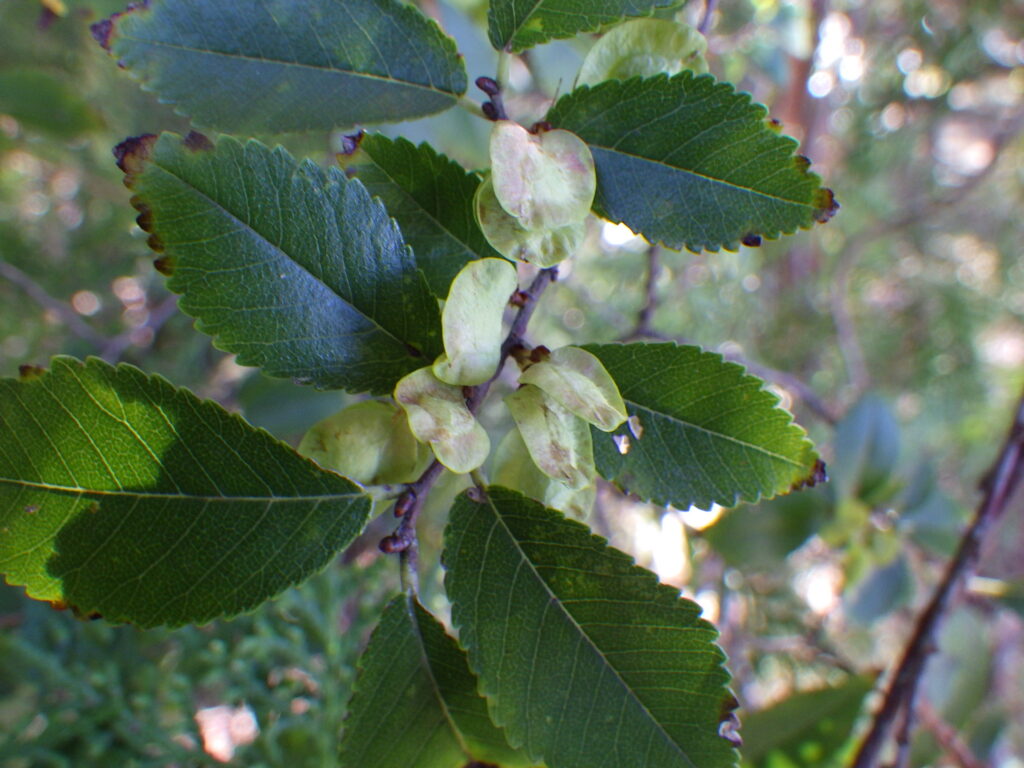
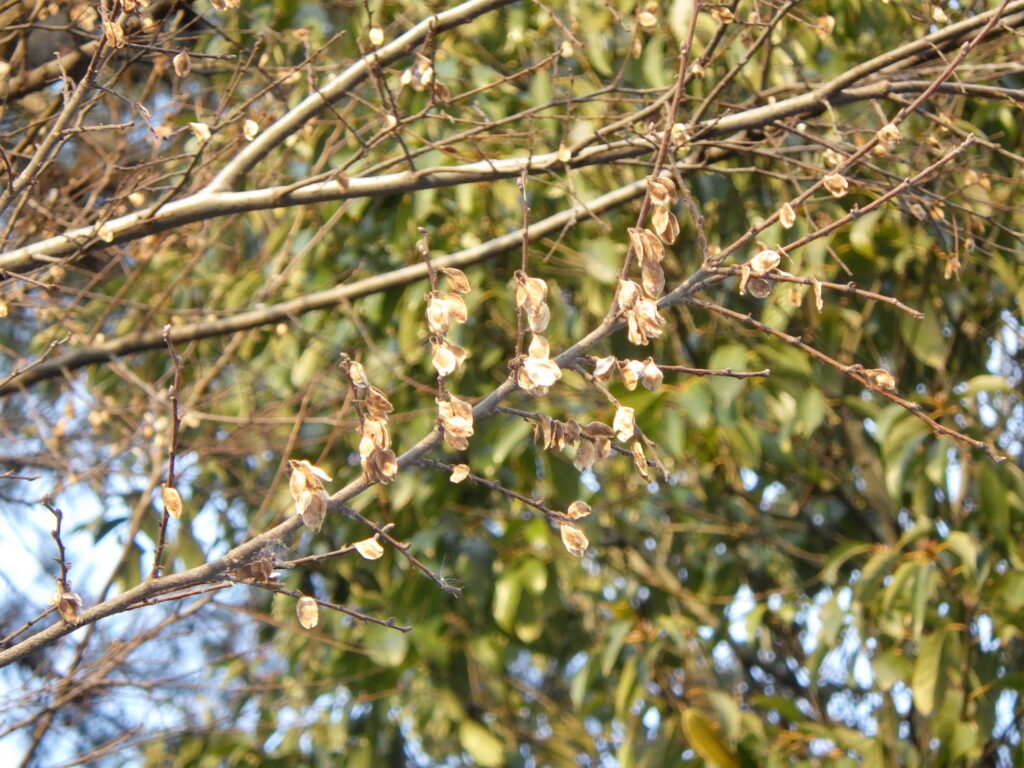
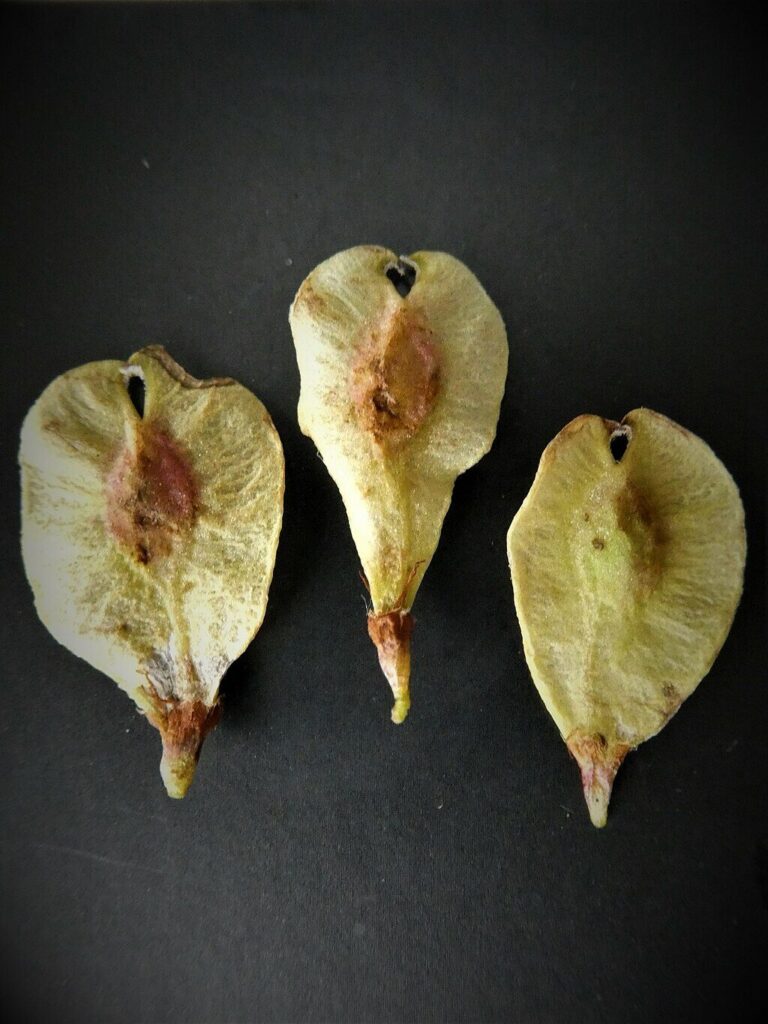
Specifically, the difference lies in the fact that zelkova trees produce achenes, while Japanese elm and Japanese elm trees produce samaras (fruits that are flat and have a wind-receiving part).
This is related to differences in seed dispersal methods.
Japanese elm and Japanese elm use the "wings" on their samaras to catch the wind, allowing them to spread their habitat over long distances. This process is called wind dispersal.
On the other hand, the zelkova tree's fruit is an achene, and the fruit itself has very little seed dispersal capacity. However, it has been found that the seeds are also dispersed by wind when branches with leaves and fruits still attached fall (Hoshino, 1990).
This is thought to have developed because zelkova seeds prefer exposed areas with little humus, and young trees grown from germinated seeds are vulnerable to shade.
While these ecological differences are quite interesting, it may be difficult to use them for differentiation because the fruits cannot be seen outside of the fruiting season. Furthermore, this makes it difficult to distinguish between Japanese elm (Ulmus parvifolia) and Japanese elm (Ulmus davidiana).
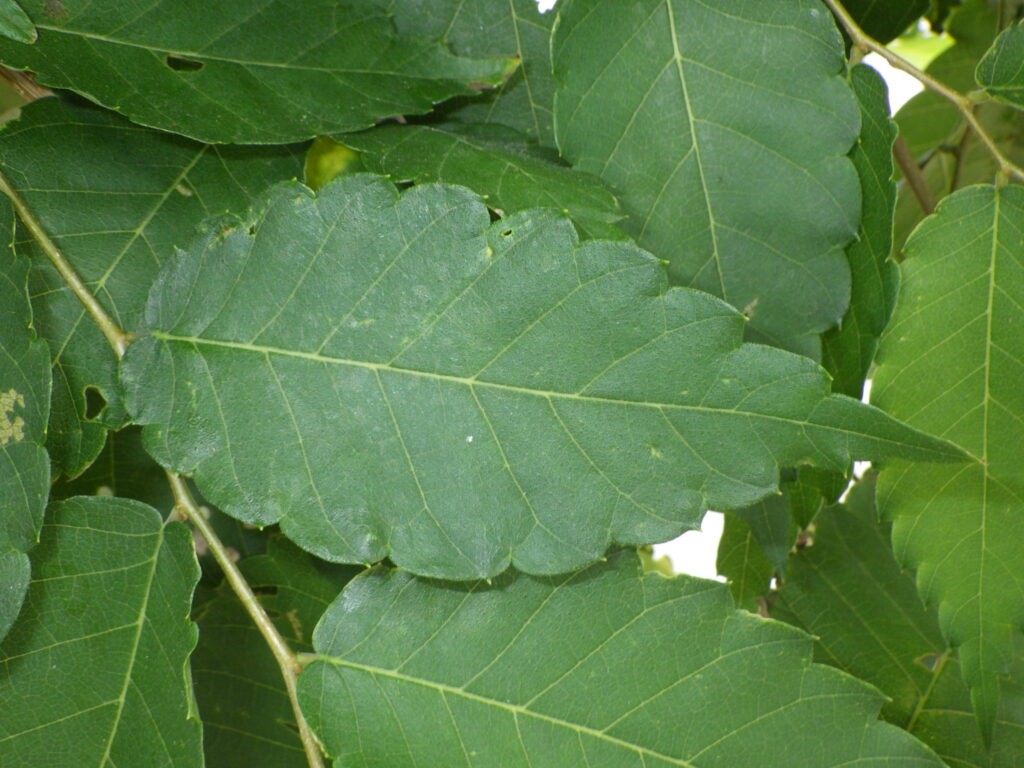
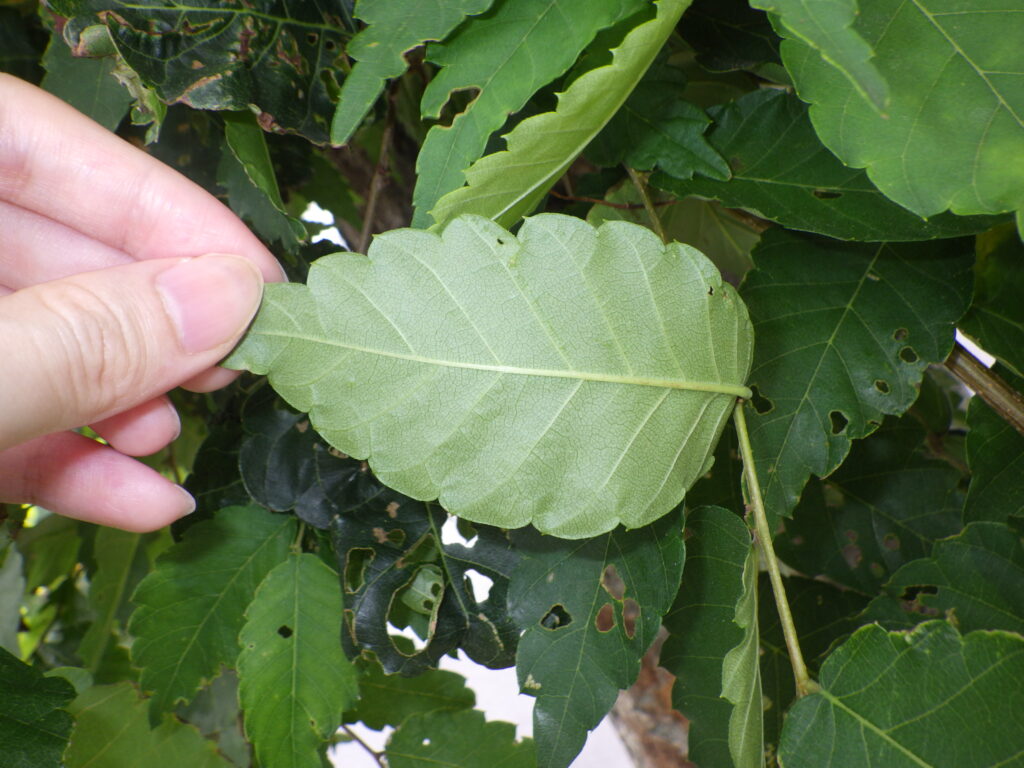
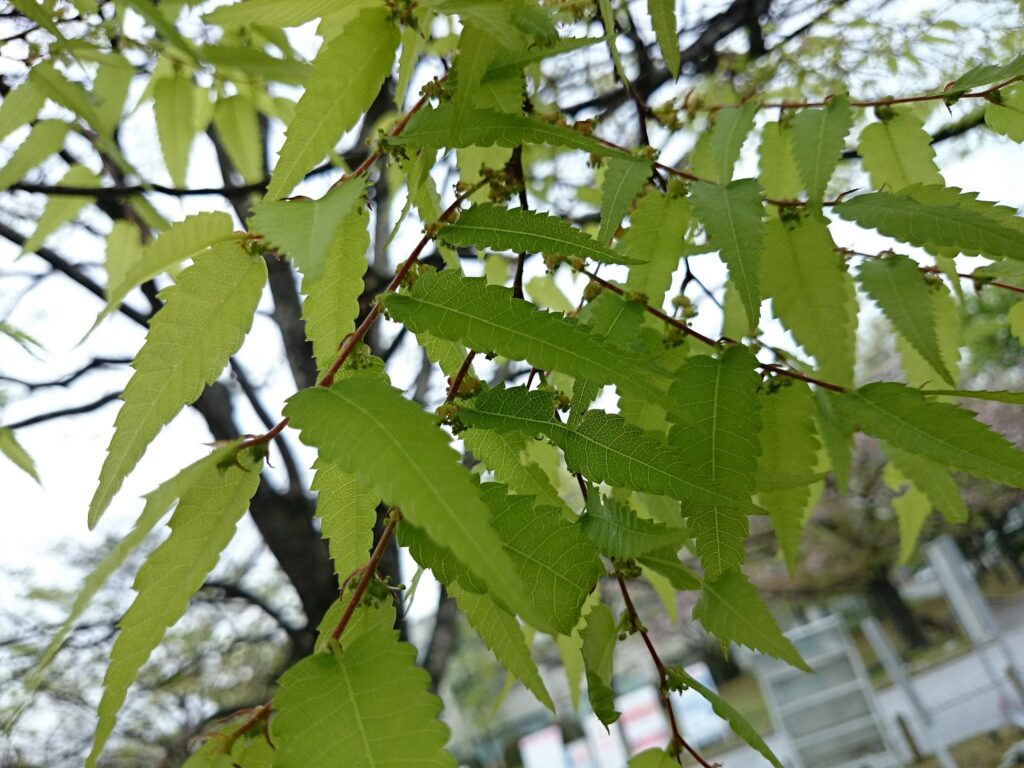
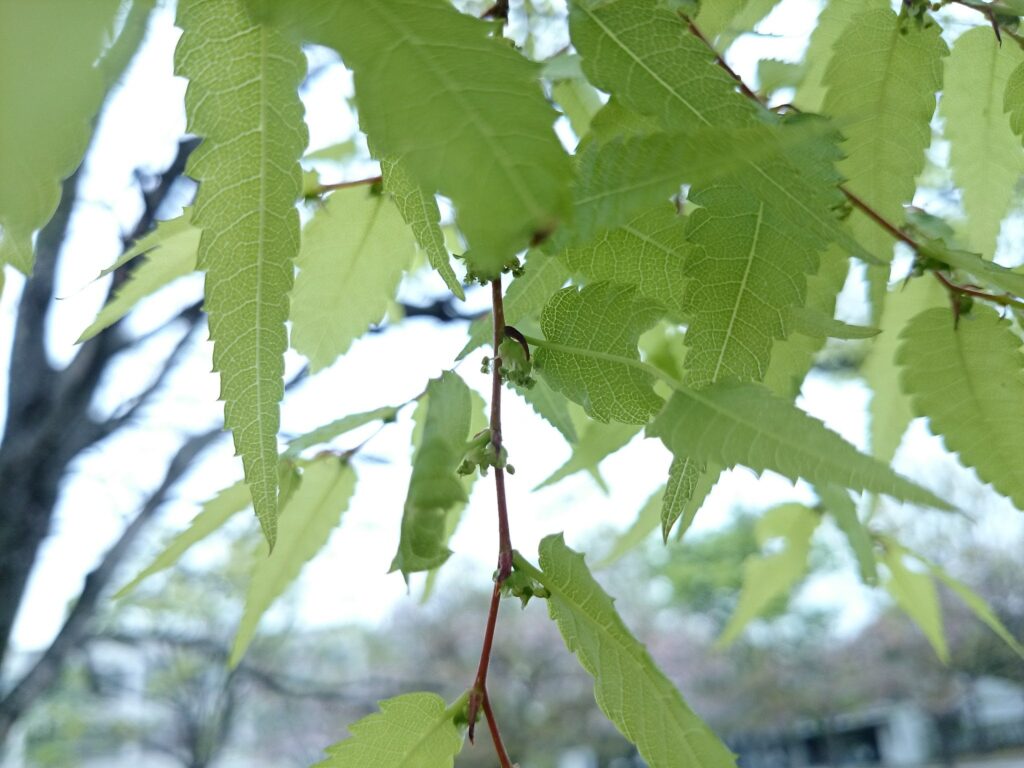
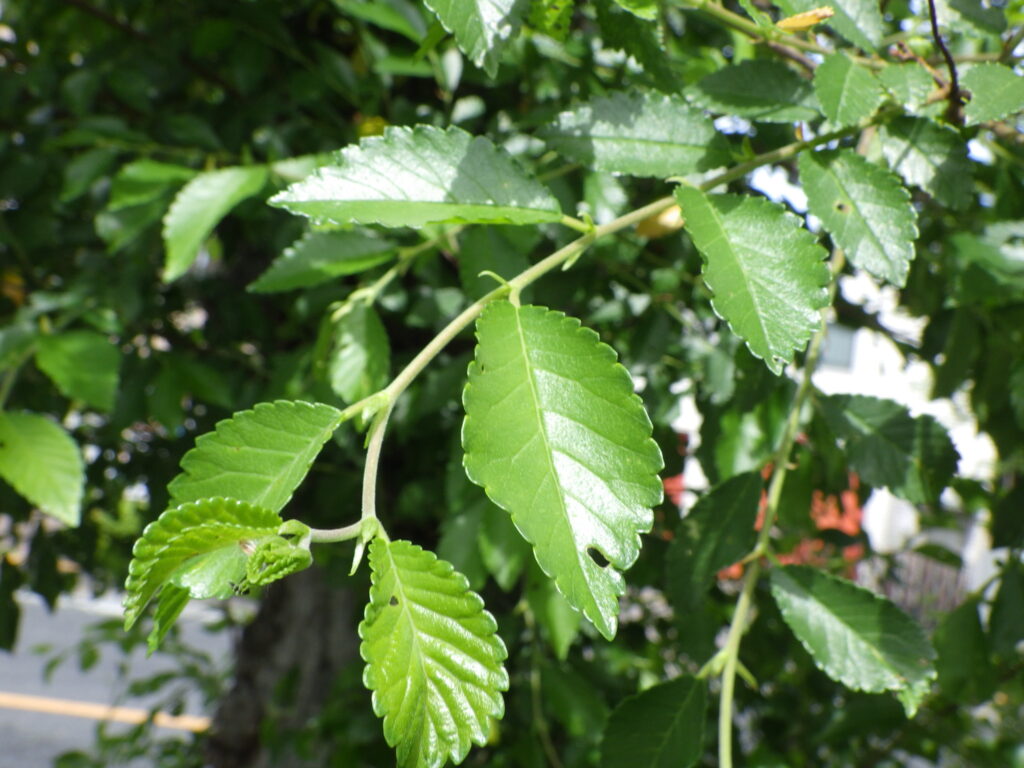
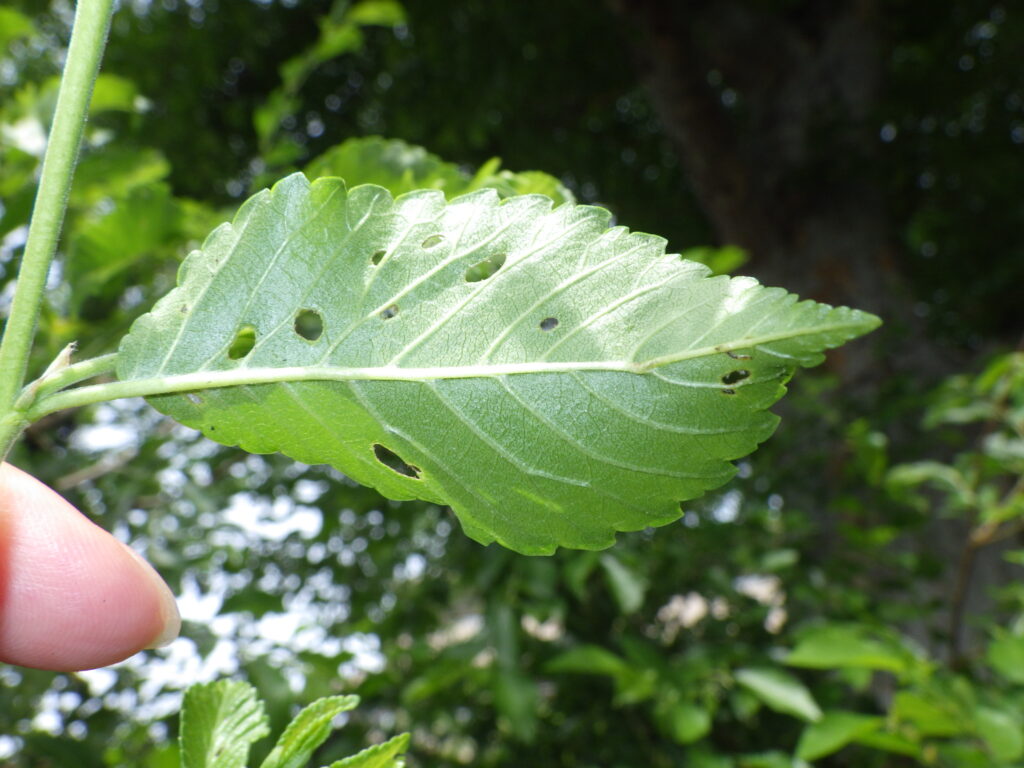
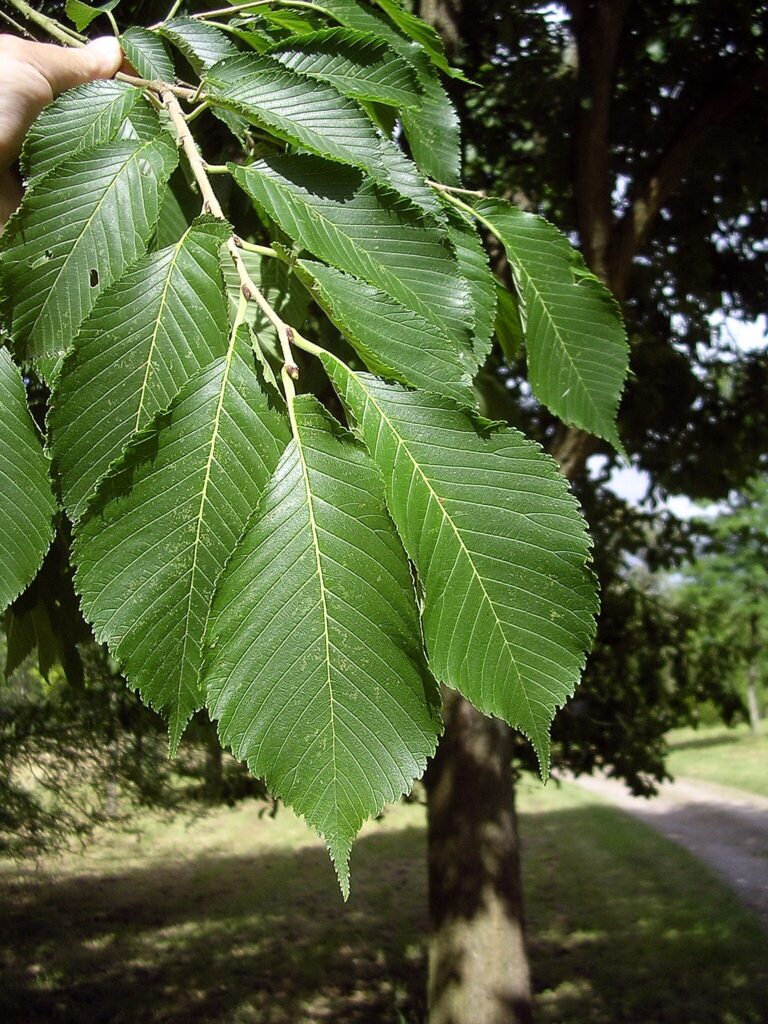
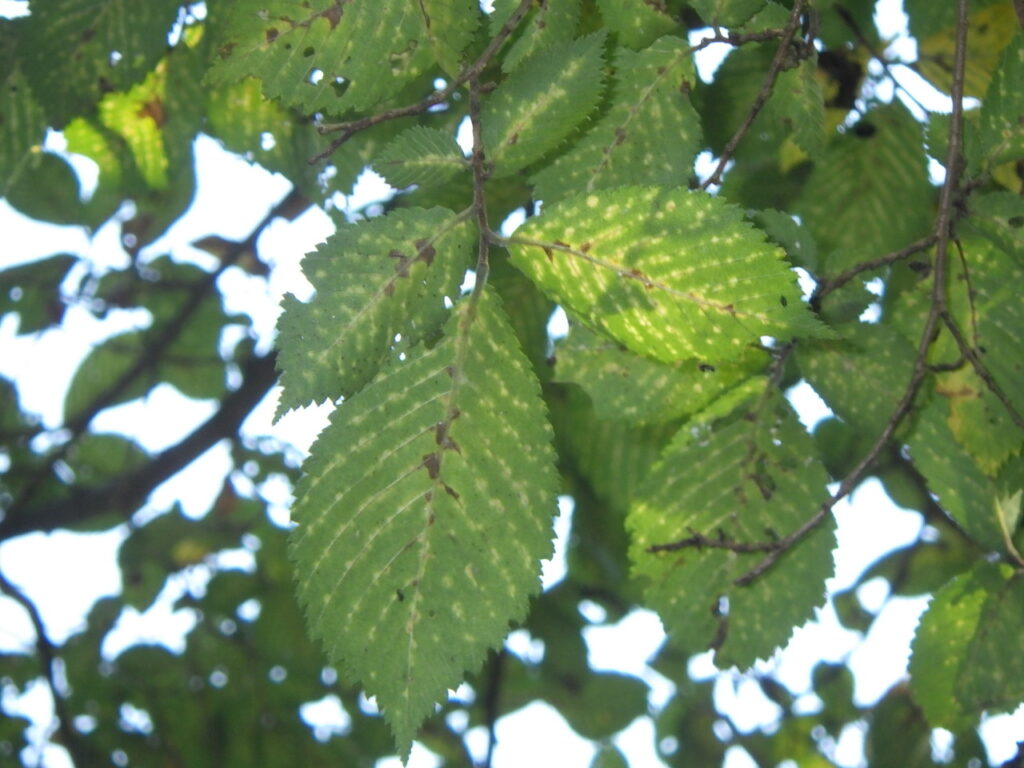
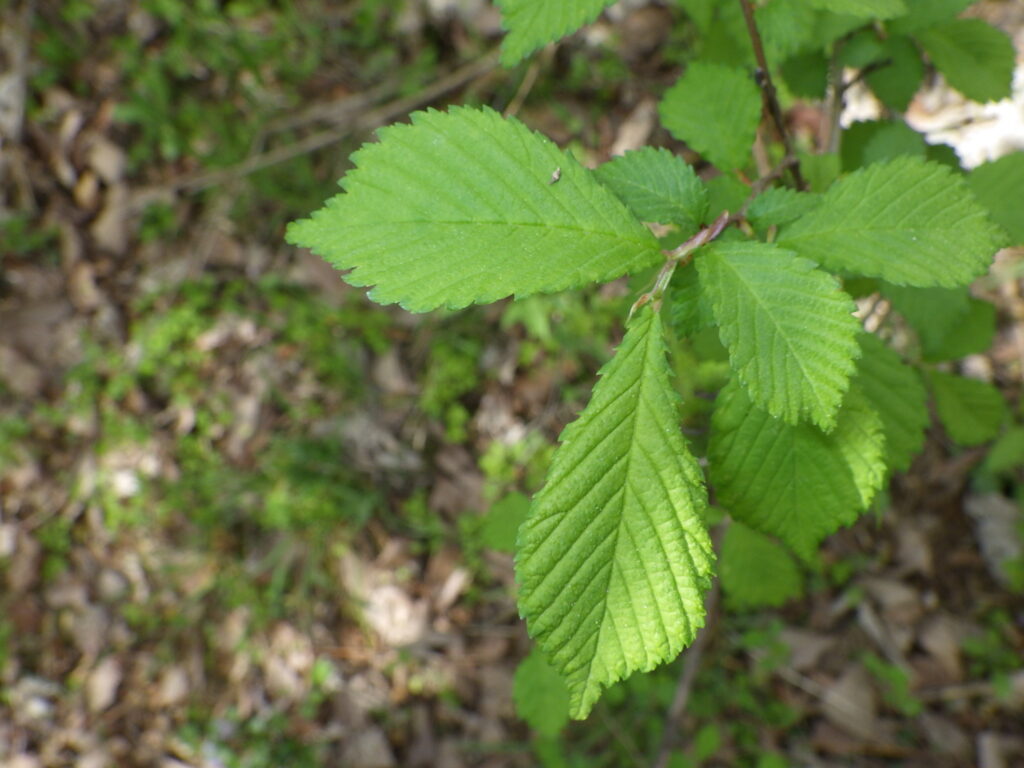
For practical purposes, it's best to judge by the shape of the serrations on the leaves.
Specifically, the differences lie in the type of saw blades: zelkova has single, sharp saw teeth, Japanese elm has single, blunt saw teeth, and Japanese elm has double saw teeth.
The terminology might be a little confusing, but essentially, the edges of zelkova leaves are pointed, Japanese elm leaves are rounded, and Japanese elm leaves have a complex pattern of serrations within serrations. You'll understand immediately if you look at a photograph.
As their names suggest, the Japanese elm (Ulmus parvifolia) and the Japanese elm (Ulmus davidiana) differ in that the Japanese elm blooms from August to September, while the Japanese elm blooms from March to May.
It's a minor detail, but there's also a difference in the perianth segments: Japanese elm has four segments, while Japanese elm has four lobes that are joined together to form a single segment.
References
Caudullo, G., & De Rigo, D. 2016. Ulmus -elms in Europe: distribution, habitat, usage and threats. In: J. San-Miguel-Ayanz, D. De Rigo, G. Caudullo, TH Durrant, & A. Mauri (Eds.), European Atlas of Forest Tree Species (pp. 186-188). Publications Office of the European Union. ISBN: 9789279367403, https://doi.org/10.2788/4251
Hayashi, Masayuki. 2019. Tree Leaves: Expanded and Revised Edition - Identifying 1300 Species Through Real-Life Scans. Yama-kei Publishers, Tokyo. 824pp. ISBN: 9784635070447
Hoshino, Yoshinobu. 1990. Fruiting branches as wind dispersers in the fruit dispersal of Zelkova serrata. Journal of the Ecological Society of Japan 40(1): 35-41. ISSN: 0021-5007, https://doi.org/10.18960/seitai.40.1_35
Kanagawa Prefecture Flora Survey Association. 2018. Kanagawa Prefecture Flora 2018 (Electronic Edition). Kanagawa Prefecture Flora Survey Association, Odawara. 1803pp. ISBN: 9784991053726
Sakushi Tatsuya & Hashizume Hayato. 1995. On the flowering habits, flowering, pollination, pollen production, and pollen dispersal of Zelkova serrata. Journal of the Japanese Forestry Society 77(4): 332-339. ISSN: 0021-485X, https://doi.org/10.11519/jjfs1953.77.4_332