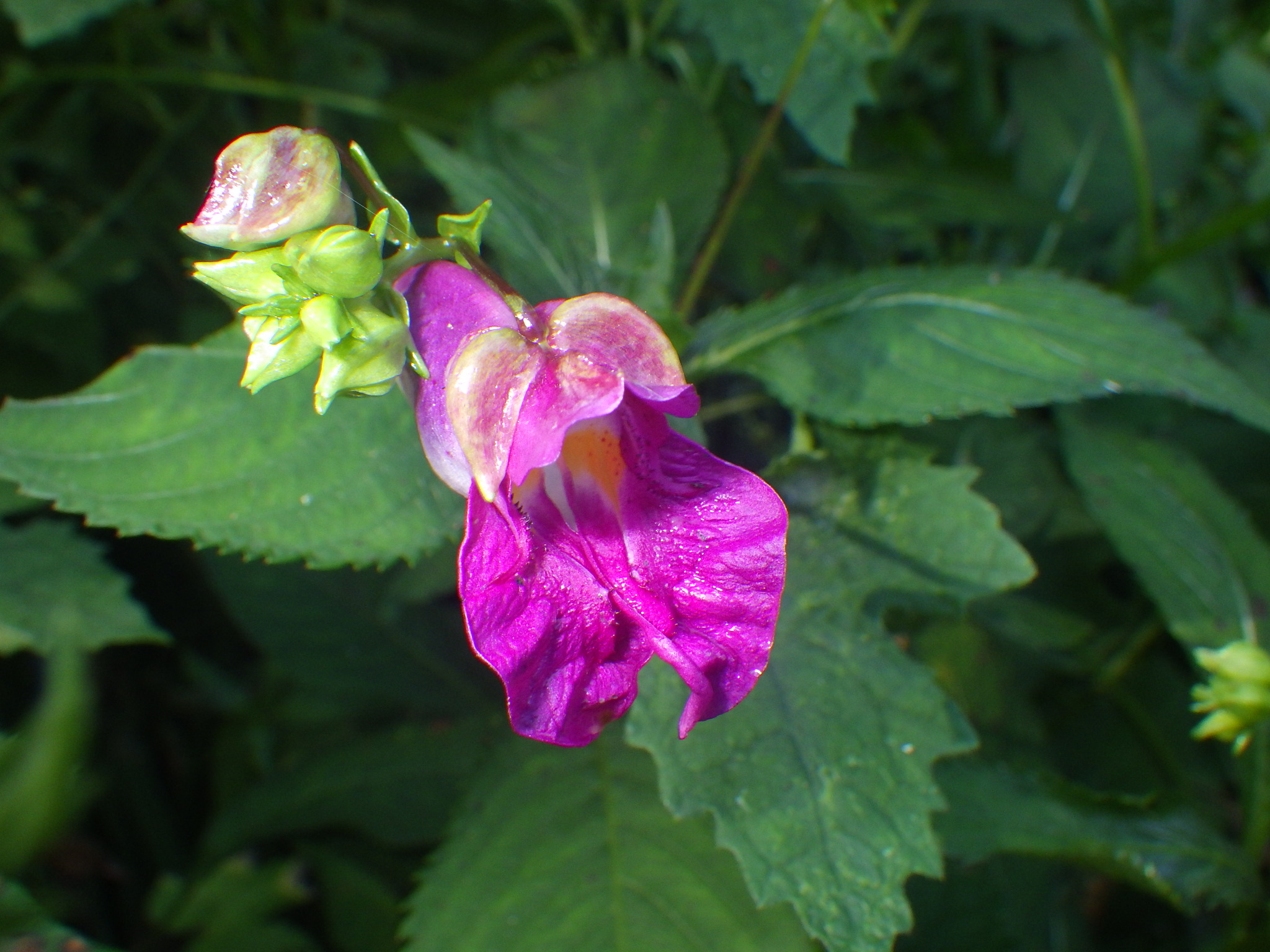
Impatiens textorii, Impatiens balsamina, and Balsam are three species of plants with boat-shaped flowers. At first glance, all three flowers look similar, and Impatiens textorii and Impatiens balsamina, in particular, are similar as they sometimes inhabit the same wetlands . However, they can be distinguished by carefully observing the overall hairs and the color and shape of the flowers. There are also differences in the leaves alone. Flowers of the Impatiens genus are composed of a complex combination of petals and sepals . Various studies have shown that bumblebees (specifically the tiger bumblebee) specialize in visiting these distinctive boat -shaped flowers. However, Impatiens textorii seems to struggle as this symbiotic relationship doesn't always work out, with other insects visiting or bumblebees not visiting at all. Impatiens balsamina also has differences, such as sex change and the formation of cleistogamous flowers, but it is still primarily visited by bumblebees. However, considering this, it is thought that Impatiens textorii and Impatiens balsamina are competing for the same pollinating insects. Indeed, there is competition between Impatiens textori and Impatiens noli-tangere, and not only that, but there is also an impact on seed production known as reproductive interference. Seeds are dispersed by being ejected from a capsule. This article will explain the classification, pollination ecology, and seed dispersal of Impatiens textori.
- Three species with boat-shaped flowers
- What are the differences between Impatiens textorii, Impatiens noli-tangere, and Balsam?
- What other species belong to the genus Impatiens?
- A "ship" formed by the intricate combination of petals and sepals.
- Are bumblebees the only ones "boarding" the ship?
- Are there insects that illegally exploit the "boat" structure of the Impatiens plant?
- Is an evolutionary process underway to eliminate the curled-up spur?
- Are there any differences in the insects that visit Impatiens textorii compared to Impatiens balsamina?
- Did the Impatiens textorii undergo sex change and form cleistogamous flowers?!
- A fierce competition was taking place between Impatiens textori and Impatiens noli-tangere for bumblebees!?
- Why can Impatiens textorii and Impatiens noli-tangere coexist?
- The seeds are contained in capsules and are dispersed automatically.
- References
Three species with boat-shaped flowers
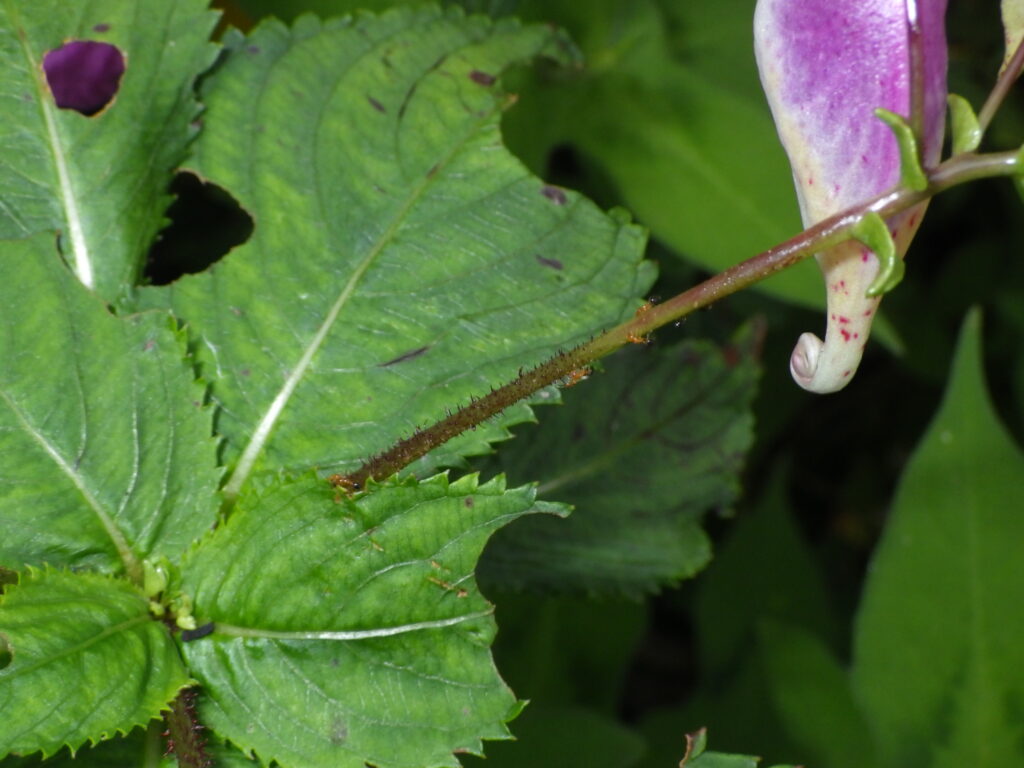
Impatiens textori, also known as "hanging boat grass," is an annual plant distributed in Hokkaido, Honshu, Shikoku, and Kyushu in Japan; the Korean Peninsula; China; and southeastern Russia, growing in slightly damp places such as wetlands and waterways (Hayashi et al., 2013). It is characterized by its slightly reddish stem with swollen nodes and alternate leaves. The leaves are rhombic-elliptic with fine serrations. Its Japanese name comes from its shape resembling a hanging sailboat or a hanging boat-shaped flower vase. Although it is not included in the Ministry of the Environment's Red List in Japan, it is designated as endangered or near threatened in some prefectures due to its limited habitat.
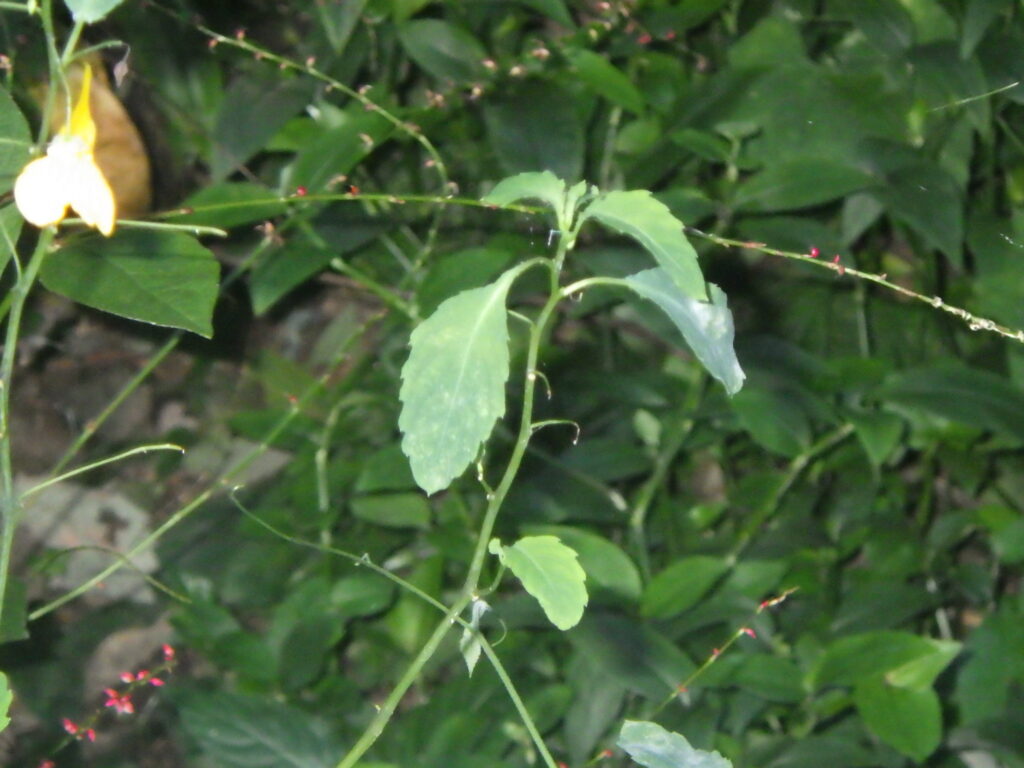
Impatiens noli-tangere, also known as yellow balsam, is an annual plant that grows in damp woodlands and is distributed across Hokkaido, Honshu, Shikoku, Kyushu, East Asia, North America, and Europe.
Impatiens balsamina, also known as balsam flower, is an annual plant believed to be native to India and Myanmar (Rojas-Sandoval, 2018). It has been widely introduced as an ornamental plant to parts of Europe, Asia, the Americas, Oceania, and tropical Africa, and has naturalized in wastelands and semi-natural habitats such as secondary forests and forest edges. It is said to have been introduced to Japan during the Heian period, and although it sometimes escapes into areas around human settlements, its numbers are now considered to be decreasing. The Japanese name comes from the Chinese name "Fengxianhua," which is a phonetic reading of the flower's shape, which is likened to a phoenix in flight.
Both belong to the genus Impatiens in the family Balsaminaceae, and their boat-shaped flowers are similar, which can sometimes make it difficult to distinguish between them.
What are the differences between Impatiens textorii, Impatiens noli-tangere, and Balsam?
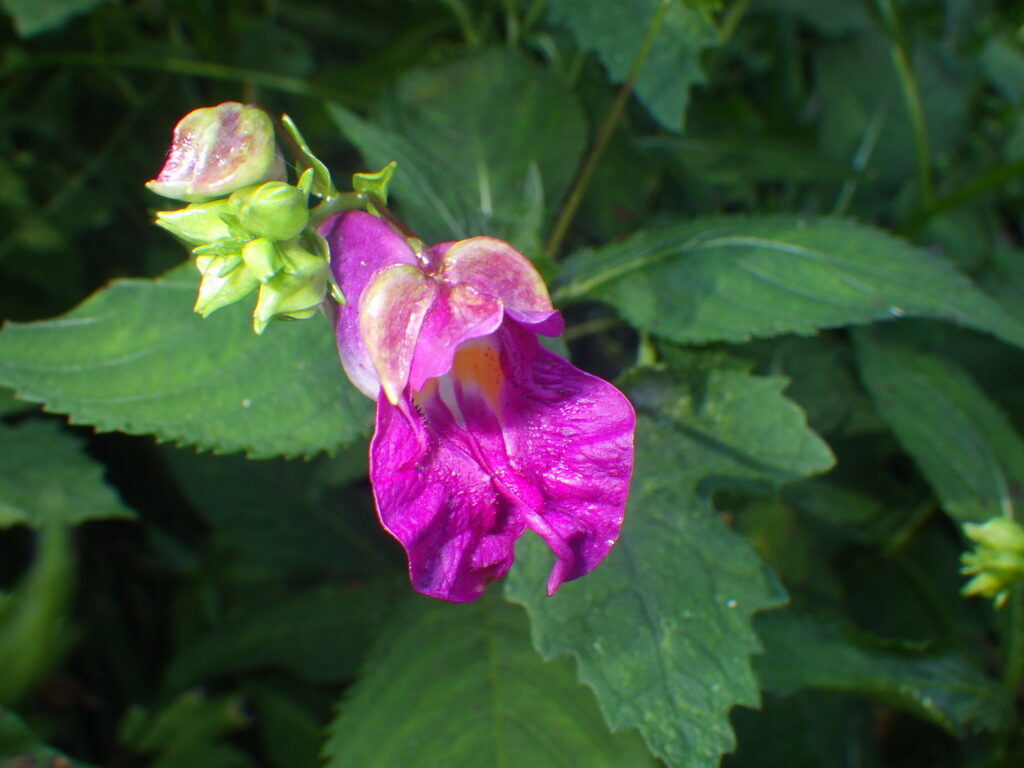
However, Impatiens textorii, Impatiens noli-tangere, and Balsam differ in their overall hair structure and the color and shape of their flowers.
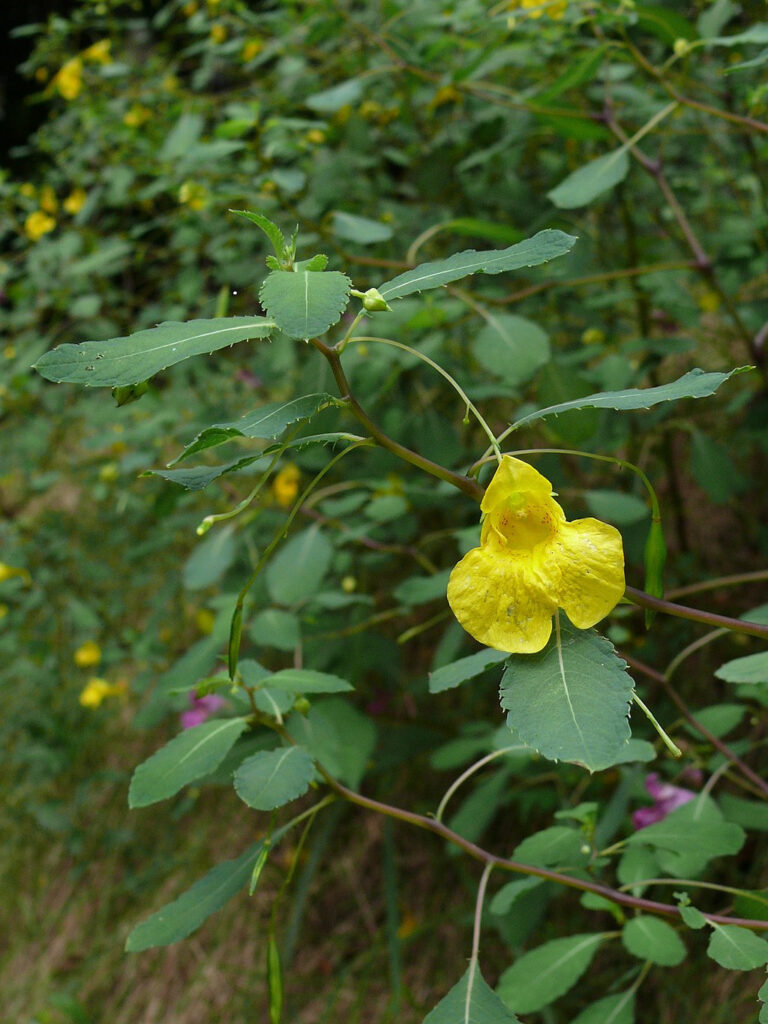
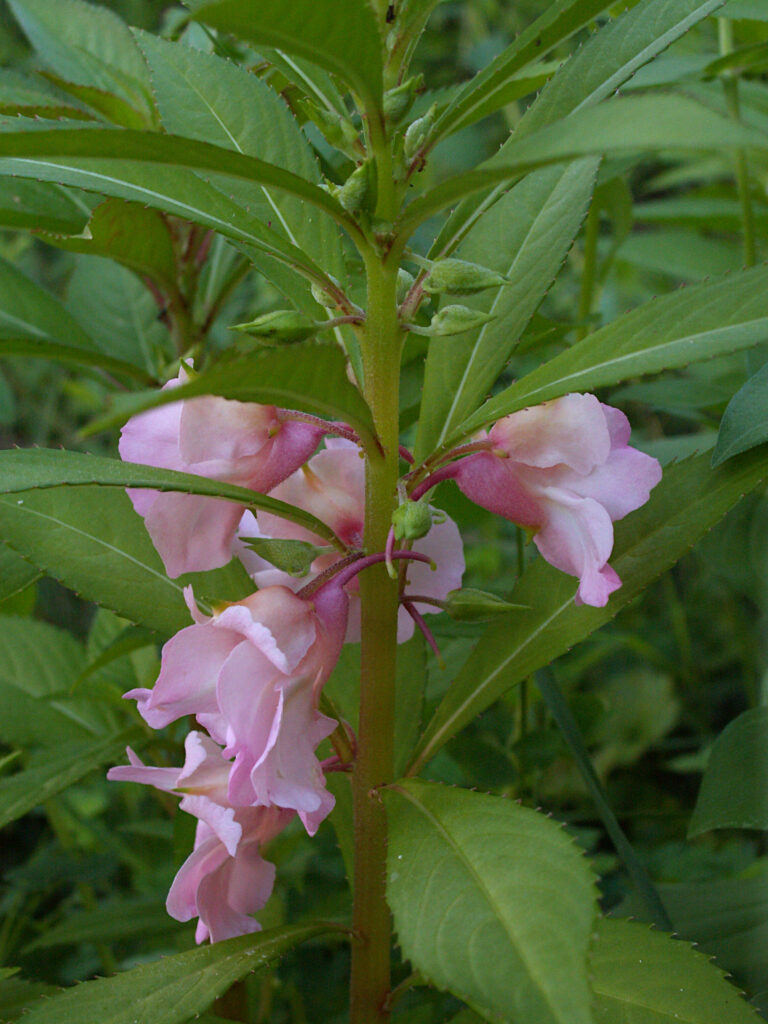
While Impatiens textorii and Balsam typically have hairs on parts of their bodies and their flowers are red, white, or reddish-purple, Impatiens textorii is completely hairless and its flowers are yellow.
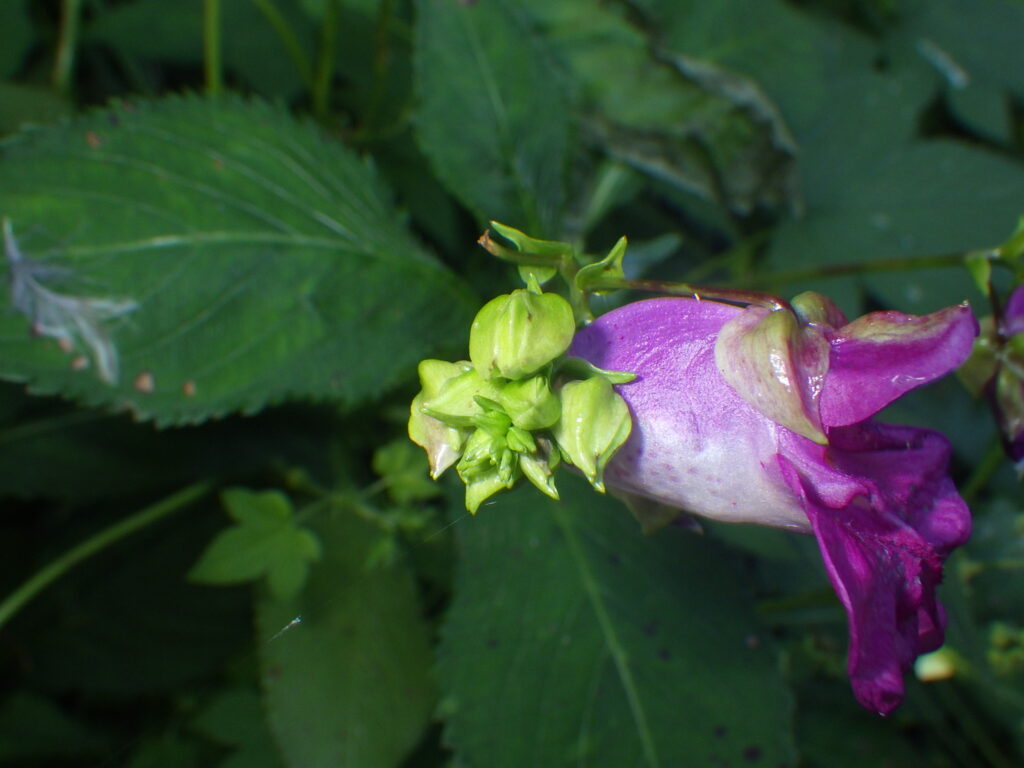
Regarding Impatiens textorii and Balsam, Impatiens textorii typically has a spiral-shaped spur and reddish-purple flowers, while Balsam's spur only curves downwards, and its flowers come in a variety of colors including red, white, and purple.
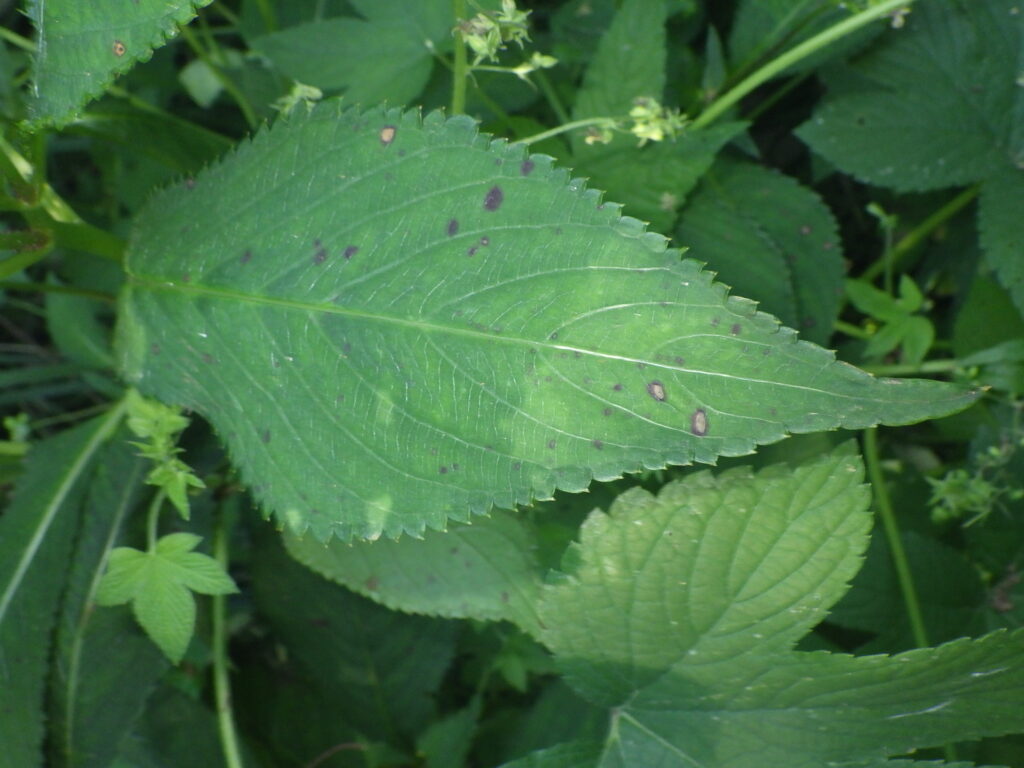
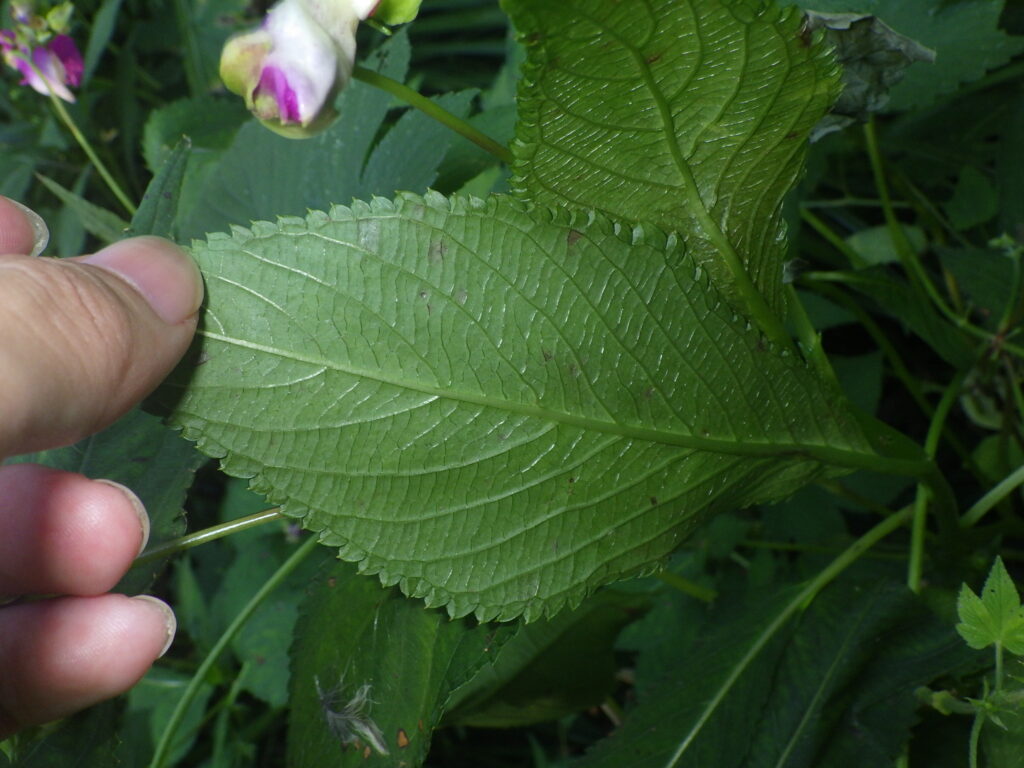
However, it may not be the flowering season, and you might only be able to see the leaves. Even the leaves can differ.
The difference between Impatiens textorii and Balsam is that Impatiens textorii has finely serrated, sharp, and slightly protruding edges on its leaves, while Impatiens textorii has low, rounded, and somewhat large serrations on its leaf edges.
Regarding Impatiens textorii and Balsam, Impatiens textorii has clearly defined petioles less than 5 cm long, whereas Balsam has a leaf blade base that flows into the petiole, forming a wing, and hardly any independent petiole.

What other species belong to the genus Impatiens?
There are several varieties of Impatiens textori.
Impatiens textori f. nudipedicellata lacks hair-like projections on its inflorescence stalks. Impatiens textori f. pallescens has white flowers.
Several other species are also known to belong to the same genus.
Impatiens ohwadae resembles Impatiens balsamina, but it is distributed in Honshu (Tochigi, Gunma, Saitama, Ibaraki, and Chiba prefectures), and differs in that the tips of its petals are not pointed (unlike Impatiens balsamina), they darken over time, the surface of the seeds is brown and not reticulated, and the inflorescence is hairless. The flowers also vary greatly, with the center being white or yellow, and sometimes having spots and sometimes not.
Impatiens hypophylla var. hypophylla is distributed in Honshu (Kii Mountains, Shikoku Mountains, and Kyushu Mountains), and its flowers bloom hidden beneath the leaves. The flowers are reddish-purple to pale reddish-purple or white.
Other species in the same genus include Impatiens balfourii, Impatiens walleriana, and Impatiens hawkeri, but these will be omitted from this article.
A "ship" formed by the intricate combination of petals and sepals.
Impatiens textori blooms from July to October, with inflorescences emerging obliquely from the leaf axils and bearing several reddish-purple flowers. The flowers are 3-4 cm long.
Impatiens textorii blooms from June to September, with inflorescences that hang down from the leaf axils, bearing yellow flowers at the end of slender pedicels.
Balsam flowers bloom from July to September, with flowers growing in the leaf axils. They come in a variety of colors, including pale pink, red, white, and purple. The flowers are 2.5 to 5 cm long.
The flower structure is common to both species, consisting of three petals and three sepals. However, this configuration is somewhat complex. Some of the sepals are the same color as the petals—reddish-purple in Impatiens textori and yellow in Impatiens noli-tangere—making it difficult to see at a glance how they are combined.
Two of the three sepals support the entire flower at the top, while the remaining sepal is positioned below, forming a large, sac-like structure with a slender spur at its tip, which in the case of Impatiens textorii curls up. Nectar is stored in this spur. The lower sepal has small, dark purple spots.
The three petals are attached to the tips of the three sepals; the two lower petals are large and each has a large yellow spot (except in Impatiens textori), while the upper petal is small and positioned to enclose the other two.
The flower has five stamens, with short filaments and fused anthers that enclose the pistil.
As mentioned above, it was named "Tsurifune-sou" (hanging boat grass) because its overall shape resembles a sailing ship hanging down, and it also resembles a hanging boat used as a flower vase (Takahashi, 2003).
Are bumblebees the only ones "boarding" the ship?
What kinds of insects visit the distinctive flowers of this Impatiens plant?
In a study conducted at Kyoto University, of the 55 insects collected and identified on Impatiens textori, 48 individuals (81% total) were identified as Bombus diversus, a bumblebee known for its long tongue (Kakutani, 1994). Other independent studies have also shown that Bombus diversus is the main flower visitor (Kato, 1988; Tanaka, 2001).
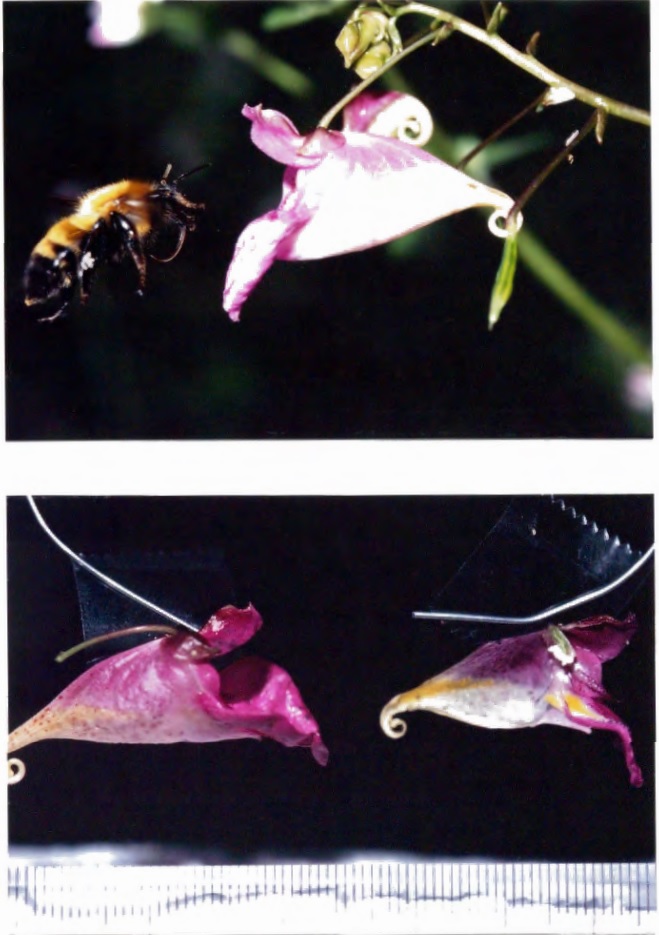
It is thought that Impatiens textorii avoids smaller insects with short mouthparts and limited ranges, such as bumblebees, by limiting the insects that visit it to bumblebees (Tanaka, 2001). Since Impatiens textorii often grows in clusters, this may be important to prevent hybridization with genetically closely related species.
However, a small number of hoverflies and stink bugs also visit in search of pollen (Kakutani, 1994).
Bumblebees are attracted to flowers by the yellow spots on the two large lower petals. They enter the flower in search of nectar in the curled spur, extending their long tongues to feed on it. The size of the flower tube of Impatiens is just right for the thickness of the bumblebee's body, so as the bumblebee enters and exits the flower, its back inevitably rubs against the stamens and pistils at the top of the tube, allowing it to get pollen on its back (Tanaka, 2001).
Because it is completely specialized for the bumblebee species *Campanula punctata*, it does not exhibit the diurnal behavior seen in other plants, such as *Cayratia japonica*, where the amount of nectar secreted changes depending on the time of day (Kakutani, 1994). This is because even though it monotonously secretes nectar, it is almost entirely utilized by the bumblebee, which is an effective pollinator.
While bumblebees are used to feed on Impatiens textori, it seems they also employ strategies to avoid missing out on nectar. Bumblebees are known to prefer visiting flowers that haven't been visited for more than 30 minutes rather than those they've recently visited (Kato, 1988). This suggests they employ some form of chemical marking. Since Impatiens textori often grows in clusters, such strategies are essential for efficiently collecting nectar from flowers whose condition is not visible from the outside.
Are there insects that illegally exploit the "boat" structure of the Impatiens plant?
While it seems that Impatiens have a strong symbiotic relationship with bumblebees, there are many other insects that illegally utilize boats (Tanaka, 2001)!
First, the yellow-necked bumblebee (Xylocopa appendiculata) straddles the flower, inserts its sharp black proboscis into the curled spur, drills a hole, and steals the nectar from the outside (primary nectar robbing). This prevents the Impatiens from being pollinated, and the flower gains nothing from it. This must be quite unpleasant for the flower. The large bumblebee (Bombus hypocrita) also clings to the underside of the flower and drills holes in the same way.
To make matters worse, some honeybees and moth species steal the nectar from the holes made by the yellow-breasted bumblebee. These species don't even bother to make holes themselves; they just suck the nectar. This is called secondary nectar robbing.
This isn't the only way they steal nectar. Hawk moths, such as Macroglossum pyrrhosticta, also visit (Tanaka, 2001). Hawk moths hover in the air in front of the flowers and insert their long proboscises, which are over 3 cm long, deep into the flower to suck the nectar. The tube is shallower than the proboscis, so the moth's body does not touch the stamens or pistils, which is also a problem for the Impatiens. However, since Impatiens secretes nectar even at night, there remains the possibility that nocturnal hawk moths contribute to pollination (Kato, 1988; Kakutani, 1994).
Is an evolutionary process underway to eliminate the curled-up spur?
The distinctive curled spur of the Impatiens textorii is a defining characteristic, but some specimens in urban botanical gardens lack this spur. Why does this happen?
In urban areas, there is no suitable habitat for the bumblebee species *Bombus ignitus*, so they do not visit. Instead, honeybees and other bees may visit in search of pollen.
Unlike bumblebees, honeybees sometimes contribute to pollination by burrowing in from above. In this case, the spurs they had built for bumblebees become useless. In fact, creating complex structures and synthesizing nectar is nothing but a waste of energy. Therefore, it seems that microevolution has occurred in which they no longer build spurs. It is unclear how frequently this will occur, but it is interesting.
Are there any differences in the insects that visit Impatiens textorii compared to Impatiens balsamina?
On the other hand, what kinds of insects visit the Impatiens textorii? Does the difference in color have any effect on the insects that visit?
Emotionally, you might think that if the colors are different, there must be some difference.
However, several studies have shown that the insect that visits flowers and primarily contributes to pollination is the bumblebee (Bombus ignitus) (Kato, 1988; Tokuda et al., 2015; Hattori et al., 2016).
Why don't color differences affect pollinating insects?
The reason is unclear, but it has been reported that bumblebees generally visit flowers regardless of their color, and bumblebees do not perceive red. Possible factors include the fact that in Epimedium, which exhibits similar color changes, the red flowers contain the same pigment as the yellow flowers (Suzuki, 1983).
This is purely speculation, but it's possible that the ancestors of the yellow balsam plant had some variation, and that a population happened to have many individuals with yellow flowers. Over a long period of time, geographical isolation may have resulted in all of them having yellow flowers. This phenomenon is called the founder effect and is known to be a common occurrence in evolution. However, as will be discussed later, there are other possibilities.
It has been found that not only Impatiens balsamina and Impatiens chinensis tend to utilize bumblebees, but also Impatiens hypophylla, which is distributed from Wakayama to Shikoku and Kyushu.
While Impatiens textorii blooms for two days and completes pollination in a short period, Impatiens textorii, which grows in the valleys of southern Japan where rainfall is high, has adapted to bloom for a longer period and to bloom under its leaves to increase the chances of pollination.
Did the Impatiens textorii undergo sex change and form cleistogamous flowers?!
However, Impatiens textorii has some differences from Impatiens balsamina.
These are sex changes and the formation of cleistogamous flowers (Tanaka and Hirano, 2000).
On its first day of blooming, the Impatiens textori exhibits male behavior, with its white stamens releasing pollen. However, the following day, the caps surrounding the stamens detach, revealing the pistil, and the flower behaves as a female. This represents a temporal sex change, which is thought to be a mechanism to avoid self-pollination.
On the other hand, they also engage in intentional self-pollination. In Impatiens textorii, in addition to "open flowers," which are normal flowers that allow insects to visit, they also form "cleistogamous flowers," which remain as buds. Cleistogamous flowers do not require pollen from other individuals; they are pollinated by their own pollen and produce seeds. This can be considered a means of ensuring the survival of at least a minimum number of offspring, even if there are few insects, separate from "open flowers."
However, the formation of cleistogamous flowers may also be related to competition with Impatiens textori, as will be discussed later.
A fierce competition was taking place between Impatiens textori and Impatiens noli-tangere for bumblebees!?
The aforementioned study concluded that Impatiens textorii and Impatiens balsamina are pollinated by the same insect. If that's the case, have you noticed that this presents a very significant problem?
This means that there is competition between Impatiens textori and Impatiens noli-tangere for the bumblebee, a pollinating insect.
Impatiens textorii and Impatiens noli-tangere share the same habitat and can grow in the same locations, and their flowering periods also overlap. Therefore, it is expected that fierce competition for bumblebees occurs in such areas.
This effect is not limited to mere interspecies competition. It is known that a significant amount of energy is wasted because pollen does not reach other individuals of the same species that should be pollinated, and seed production is suppressed. This phenomenon is called "reproductive interference."
Therefore, a study conducted in Nagano Prefecture confirmed whether this phenomenon actually occurs (Tokuda et al., 2015).
As a result, it was confirmed that pollen from each species was actually found on the pistils of the other species in the wild. Furthermore, when artificial pollination was attempted, if even 10% of the pollen grains were from a different species, the fruit set was reduced by more than half.
Why can Impatiens textorii and Impatiens noli-tangere coexist?
Given these results, it's rather puzzling why Impatiens textori and Impatiens noli-tangere are able to coexist.
The reason is not yet fully understood, but two hypotheses have been proposed.
The first reason is that one or both species have the ability to mitigate the effects of reproductive interference.
Impatiens textorii is known to self-pollinate through open flowers, while Impatiens noli-tangere forms cleistogamous flowers as described above. These abilities may mitigate the effects of competition between the two species.
The second reason is that other causes of death are stronger than competition between plants mediated by bumblebees, and limit the distribution of both species (for example, predation of seeds by insects).
However, it remains unclear whether the significant negative impacts on seed production can be eliminated solely for the reasons mentioned above.
While differences in flower color and the resulting differences in visiting insects have not been proven for Impatiens textorii and Impatiens noli-tangere, they have been proven for other plants. Similar to the hawk moths mentioned above, nighttime surveys of Impatiens textorii and Impatiens noli-tangere are insufficient, so there might be some differences.
The seeds are contained in capsules and are dispersed automatically.
The fruit is a fleshy capsule, common to all plants in the Impatiens genus. When the fruit ripens, it automatically disperses its seeds by ejecting them.
The scientific name Impatiens comes from the Latin word "impatient," meaning "unable to bear," because the mature capsules of the Impatiens genus burst open when touched, describing this as "unbearable."
In Impatiens textorii, the capsule is spindle-cylindrical, 1-1.8 cm long, and the seeds are brown, numerous, oval, about 4 mm long, and warty.
In Impatiens, the capsule is broadly spindle-shaped, 1-2 cm long, densely covered with downy hairs, and narrows at both ends. The seeds are numerous, dark brown, spherical, 1.5-3 mm in diameter, and warty.
The mechanism by which seeds are ejected is as follows (Kobayashi, 2007).
First, as the fruit ripens, the water content of the carpel cells that make up the fruit increases, and the turgor pressure of the cells rises.
At this time, the outer cells of the ovary, in particular, contain a lot of water and have high turgor pressure, while the inner cells are dry and have low turgor pressure. As a result, a force acts to curl inward.
When this happens, even a slight touch will cause it to burst open into five segments, corresponding to the number of segments in the pericarp, curling up and ejecting the seeds inside. The impact is strong enough to produce a popping sound.
We often see Impatiens textori growing in clusters, which may be due to their seed dispersal method. Since there are few suitable habitats like wetlands, they probably don't need to travel long distances.
However, I'm a little puzzled as to how they can expand their habitat to other wetlands. Ultimately, even their seed dispersal might be a somewhat mysterious method.
References
Hattori, M., Nagano, Y., Shinohara, Y., & Itino, T. 2016. Pattern of flower size variation along an altitudinal gradient differs between Impatiens textori and Impatiens noli-tangere. Journal of Plant Interactions 11(1): 152-157. https://doi.org/10.1080/17429145.2016.1226437
Hayashi, Yasaka, Kadota, Yuichi, and Hirano, Takahisa. 2013. Yamakei Handy Illustrated Guide 1: Wildflowers (Revised and Expanded New Edition). Yama-kei Publishers, Tokyo. 664pp. ISBN: 9784635070195
Kato, M. 1988. Bumblebee visits to Impatiens spp.: pattern and efficiency. Oecologia 76(3): 364-370. ISSN: 0029-8549, https://doi.org/10.1007/BF00377030
Kakutani, Takehiko. 1994. Pollination ecological studies on pollinating insect communities: Community composition viewed from nectar secretion patterns and interinsect competition. [Doctoral dissertation, Kyoto University]. https://doi.org/10.11501/3096539
Kobayashi, Masaaki. 2007. From Flower to Seed: The Science of Seed Dispersal. National Rural Education Association, Tokyo. 247pp. ISBN: 9784881371251
Rojas-Sandoval, J. 2018. Impatiens balsamina (garden balsam). CABI Compendium. https://doi.org/10.1079/cabicompendium.28765
Suzuki, Kazuo. 1983. Pollination patterns of the genus Epimedium. *Journal of Species Biology* 7: 72-81. ISSN: 0913-5561, https://dl.ndl.go.jp/info:ndljp/pid/10467757
Takahashi, Katsuo. 2003. Names of Wildflowers in Autumn and Winter: Origins of Japanese Names and How to Identify Them. Yama-kei Publishers, Tokyo. 351pp. ISBN: 9784635070164
Tanaka, Hajime. 2001. Flowers and Insects: A Collection of Discoveries of Mysterious Deception. Kodansha, Tokyo. 262pp. ISBN: 9784062691437
Tanaka, Hajime & Hirano, Takahisa. 2000. The Face of Flowers: Wisdom for Bearing Fruit. Yama-kei Publishers, Tokyo. 191pp. ISBN: 9784635063043
Tokuda, N., Hattori, M., Abe, K., Shinohara, Y., Nagano, Y., & Itino, T. 2015. Demonstration of pollinator-mediated competition between two native Impatiens species, Impatiens noli-tangere and I. textori (Balsaminaceae). Ecology and Evolution 5(6): 1271-1277. https://doi.org/10.1002/ece3.1431