Are you familiar with the insect known as the spiny grasshopper? It's a relatively common creature in Honshu, especially in rice paddies. Surprisingly, this species has been found to protect itself from predation by frogs through a combination of two mechanisms: spines on its body and a behavior called feigning death. This article will explain the spiny grasshopper's defense mechanisms.
- Spiny grasshoppers that live in wetlands
- The mysterious pose of the spiny grasshopper?
- "Feigning death" is essentially an action to make a predator lose sight of itself.
- The unique reason why the spiny grasshopper feigns death
- Did the feigned death behavior develop because of the presence of frogs in the wetlands?
- References
Spiny grasshoppers that live in wetlands
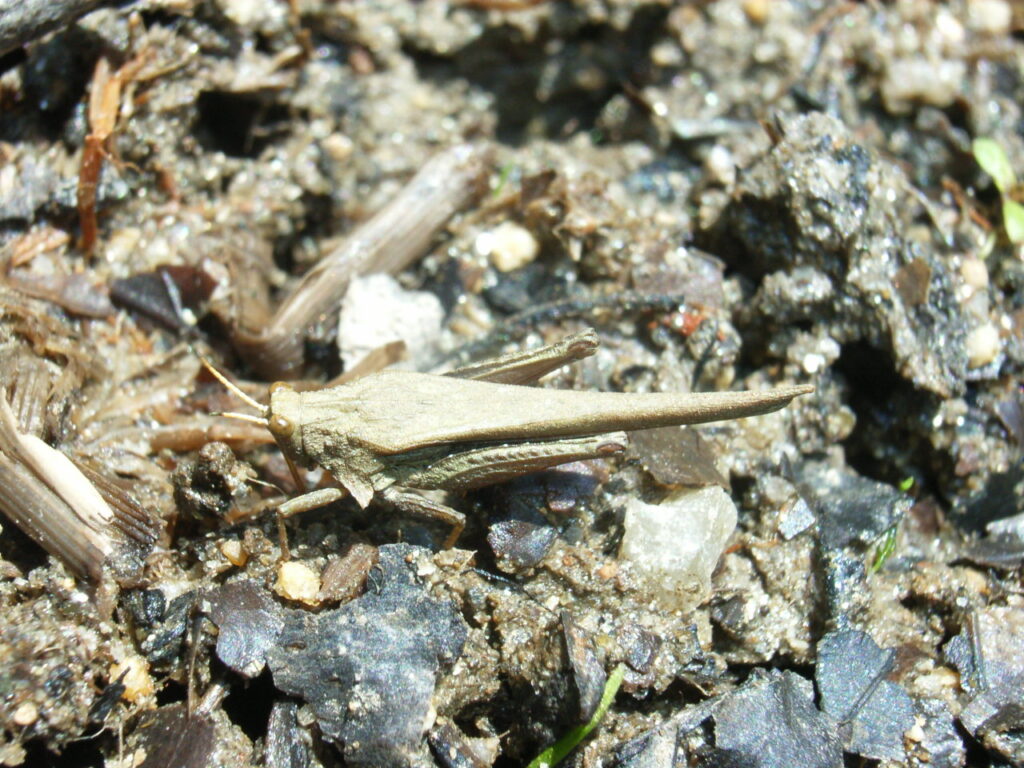
Criotettix japonicus, a grasshopper belonging to the family Acrididae in the order Orthoptera, is distributed in Hokkaido (south of the Ishikari Plain), Honshu, Shikoku, Kyushu, Tanegashima, and Tsushima, and is an endemic Japanese species unknown outside of Japan (Kano et al., 2016). It inhabits wetlands such as riverbanks and fallow rice fields. Adults are seen from autumn to spring, and at least in the Kanto region, adults overwinter.
In terms of diet, it is known to feed on detritus and algae on the soil surface (Honma et al., 2006).
While their body color is generally brown, there appears to be color variation, with some individuals exhibiting green or grayish-white backs (Kano et al., 2016). This clearly seems to function as camouflage in their wetland habitat.
What distinguishes it most is the spine at the tip of the lateral lobes on its pronotum. Such spines are found in several genera of the family Acrididae, including the genus Criotettix, to which the spiny grasshopper belongs.
The mysterious pose of the spiny grasshopper?
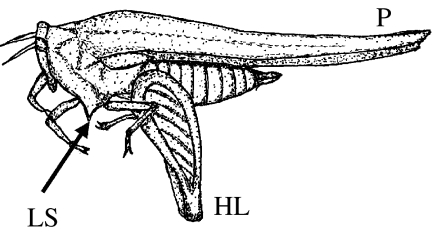
It has been observed that when attacked by certain predators, the spiny grasshopper (Honma et al., 2006) firmly bends the femurs of its hind legs downwards, making its entire body form a T-shape. This is thought to be a type of feigned death behavior that certain animals exhibit when attacked by predators, but why does it feign death in such an incomplete way?
"Feigning death" is essentially an action to make a predator lose sight of itself.
Before considering the death-feeding behavior of the spiny grasshopper, we need to consider why animals generally engage in this behavior. It seems like there might be some vague reason why they feign death, doesn't it?
However, if you think about it, it's strange. If you were a predator searching for prey and saw an animal playing dead right in front of you, what would you think? Since it wouldn't run away, you might even consider it lucky and catch or eat it. Playing dead isn't always an advantageous behavior.
However, feigning death has been observed in many animals, from vertebrates to arthropods. Considering this, it must have some advantage under certain conditions.
While we don't fully understand it, the accumulation of numerous studies is gradually revealing some of the reasons. The reasons aren't all the same; it seems there are different reasons depending on the taxonomic group (Honma et al., 2006; Ecological Society of Japan, 2012; Humphreys & Ruxton, 2018).
Firstly, certain predators, which specialize in catching live prey, will lose track of or lose their appetite if their prey stops moving. It's well known that frogs and praying mantises won't bite at things that don't move. This method takes advantage of this predator instinct.
Next, it increases the chances of escaping from predators who treat their prey gently or briefly release it after killing it to eat it. By playing dead, you can escape from predators who momentarily loosen their grip.
Finally, when a predator is catching multiple prey, playing dead after being attacked can prevent the prey from actually dying. After a predator kills its prey, it may look for another prey or temporarily store it, creating an opportunity for the prey to play dead and escape.
This is a somewhat frightening analogy, but haven't you heard stories of people pretending to be dead to survive during hostage situations and shootings? It's because it's extremely costly for the attacking side to check on the survival status of each individual target.
Several other special cases and exceptions have also been proposed. The act of feigning death is indeed a complex and intriguing phenomenon!
The unique reason why the spiny grasshopper feigns death
So why do spiny grasshoppers feign death? A study conducted at Kyoto University revealed that the reason is quite different from the one mentioned above (Honma et al., 2006; Ecological Society of Japan, 2012).
The researchers first investigated which predators would trigger the feigned death behavior in the spiny pygmy grasshopper. Representing birds, amphibians, insects, and spiders, they had quail (Coturnix japonica), the Japanese pond frog (Pelophylax nigromaculatus), the praying mantis (Tenodera angustipennis), and the wolf spider (Pardosa pseudoannulata) attack the spiny pygmy grasshopper after making them hungry. Only the Japanese pond frog caused the spiny pygmy grasshopper to feign death.
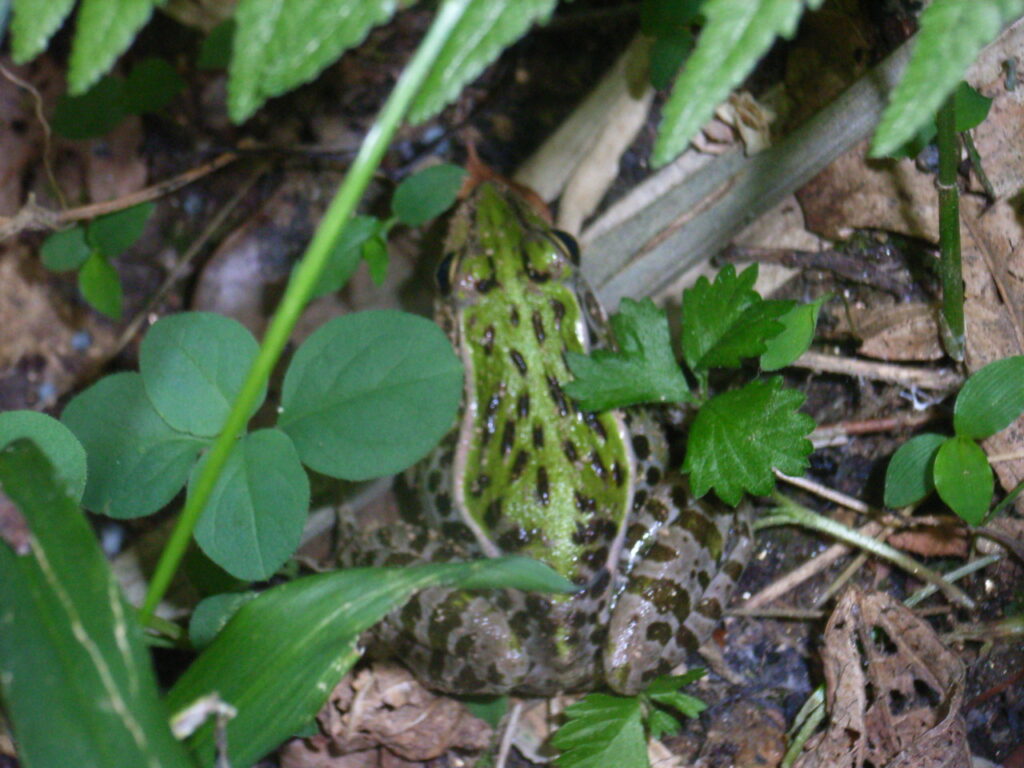
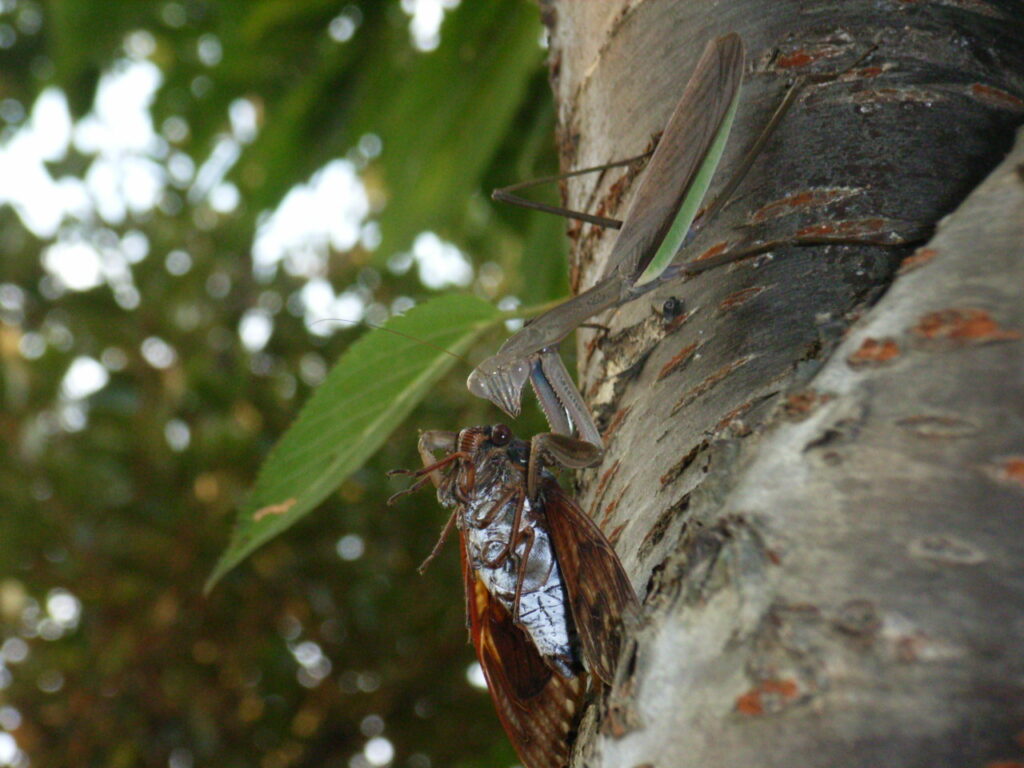
This suggests that the spiny grasshopper only exhibits this behavior when frogs, such as the Japanese pond frog, are its prey, and it may be a uniquely evolved behavior.
When a spiny grasshopper is attacked and caught, it contracts its body and stiffens, extending only the femurs of its hind legs. The frog tries to swallow the grasshopper, but the femurs get in the way, so it has no choice but to turn the grasshopper sideways. The frog's mouth is not big enough to swallow it whole. However, when it does so, the spines on the grasshopper extend sideways, and these spines pierce the frog's tongue.
The spiny grasshopper combined feigning death with the spines at the tips of the lateral lobes on its pronotum to prevent itself from being swallowed by frogs.
To verify whether this process was truly important, in another experiment, we tied the hind legs of the grasshoppers to prevent them from feigning death and then fed them to frogs. This time, the grasshoppers remained upright and were preyed upon. In other words, feigning death and the spines were both part of the tactic that worked together.
You can see the frog's desperate attempts to thwart its prey in the video below. It's a frog that struggles to swallow its prey, unable to do so...
This tactic differs significantly from previously known examples. Normally, feigning death is an action performed to prevent detection or identification by the opponent, as described above, but in the case of the spiny grasshopper, feigning death was performed as a "defense" after detection and identification had occurred.
Did the feigned death behavior develop because of the presence of frogs in the wetlands?
These behaviors, such as feigning death and the presence of spines, likely evolved because the environment was a wetland where frogs lived. Even within the same family, the grasshopper Tetrix japonica, which lacks spines, inhabits grasslands and bare ground, and other spineless species, at least among those found in Japan, tend to follow a similar pattern (Kano et al., 2016).
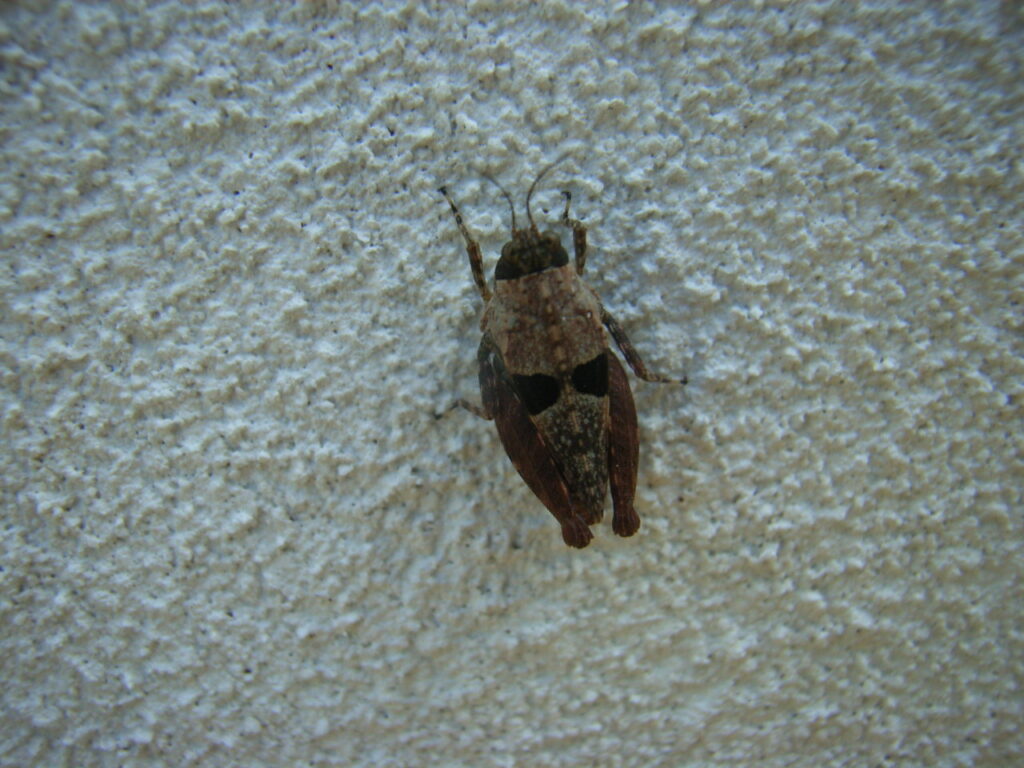
In Japan, other spiny grasshopper species include the spiny grasshopper *Trichoptera japonica*, *Trichoptera okinawaensis*, *Trichoptera nanata*, and *Trichoptera japonica*. All of these species inhabit wetlands, and it is highly likely that they also feign death, but this has not yet been confirmed.
Frogs eat different sizes of prey depending on the size of their mouths; they don't eat prey that is too big, and they also don't eat prey that is too small because the effort required to catch it is not worthwhile (Honma et al., 2006). Are there any differences in how the spiny grasshoppers adapt to the frogs that coexist with them, as mentioned above? At the very least, the shape of the spines differs for each species. This is a very intriguing point, but research is still in its early stages. It would be interesting if this were clarified in the future.
As we begin to understand the relationship between insect shapes and their habitats, as seen in these examples, we may begin to understand why insects have such diverse forms!
References
Honma, A., Oku, S., & Nishida, T. 2006. Adaptive significance of death feigning posture as a specialized inducible defence against gape-limited predators. Proceedings of the Royal Society B: Biological Sciences 273(1594): 1631-1636. ISSN: 0962-8452, https://doi.org/10.1098%2Frspb.2006.3501
Humphreys, RK, & Ruxton, GD 2018. A review of thanatosis (death feigning) as an anti-predator behavior. Behavioral Ecology and Sociobiology 72(2): 1-16. ISSN: 0340-5443, https://doi.org/10.1007/s00265-017-2436-8
Kano, K., Kawai, M., Ichikawa, A., Tominaga, O., & Murai, T. 2016. Orthoptera. In: The Orthopterological Society of Japan (Eds.), Standard Illustrated Guide to Japanese Orthoptera (pp. 242-371). Tokyo. ISBN: 9784054064478
Ecological Society of Japan. 2012. Behavioral Ecology. Kyoritsu Shuppan, Tokyo. 292pp. ISBN: 9784320057388