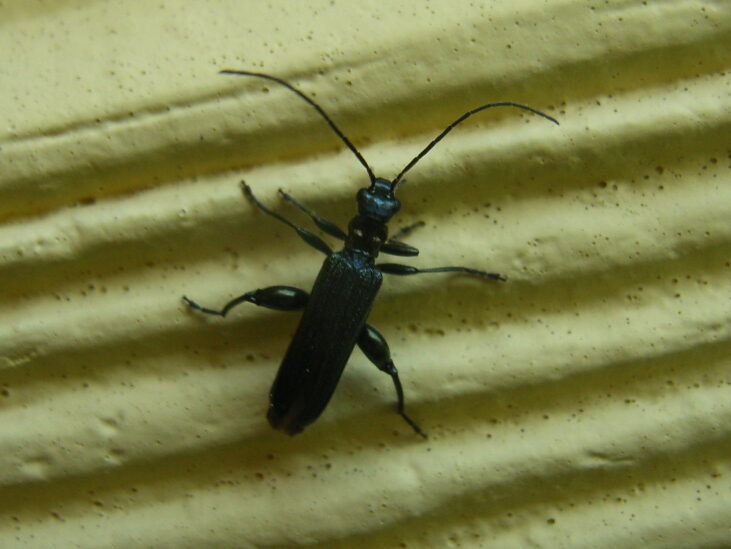
Are you familiar with the insect known as the Momobutokamikirimodo (thick-legged longhorn beetle)? It gathers on flowers from spring to early summer and is one of the most commonly seen longhorn beetles in Honshu. The most distinctive feature of this insect is its thick hind legs. Have you ever wondered why this is the case? Based on research on its close relative, the Futairokamikirimodo (two-colored longhorn beetle), it can be inferred that this may have evolved as a way for the male to suppress the female in a biological conflict called "sexual conflict." Furthermore, in the Futairokamikirimodo, there were geographical differences in leg thickness due to environmental influences. In this article, we will explain the secret of the Momobutokamikirimodo's hind legs, as well as the world of cantharidin.
- A common species of the family Cerambycidae, often seen on flowers.
- Residents of Cantharizin World
- Sexual dimorphism: Males have thicker thighs.
- What is sexual conflict?
- The male's legs are thick so he can hold the female down...?
- Why did this evolution only occur in the false longhorn beetle (Prunus serrulata)?
- References
A common species of the family Cerambycidae, often seen on flowers.
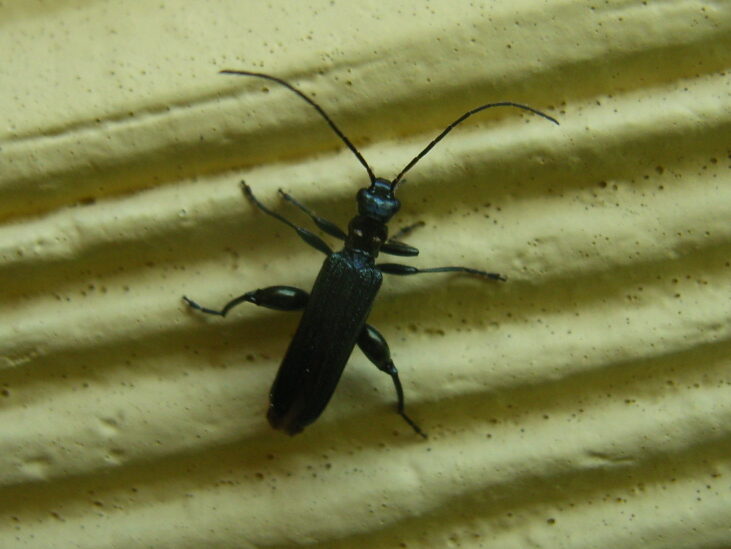
Oedemera lucidicollis is an insect belonging to the family Cerambycidae in the order Coleoptera, and is found in Hokkaido, Honshu, Shikoku, Kyushu, and the Kuril Islands (Morimoto, 2007).
The entire body is dark blue, but occasionally there are individuals with a reddish-brown stripe running vertically down the center of their upper surface.
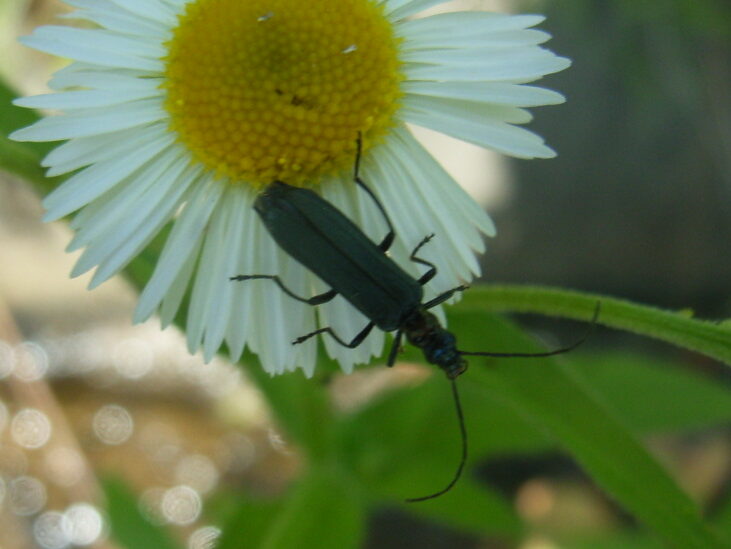
In lowland areas, they gather on flowers from spring to early summer (Morimoto, 2007). Specifically, records have been confirmed for Trillium species (Fukuda, 1961), Erigeron annuus (Kishi, 2022), Rumex philadelphicus, Anemone flaccida, and Alpine damselfly (Tanaka, 2001). The author has observed them in large numbers on the flowers of Rubus hirsutus. While Alpine damselfly is a special case, they generally seem to prefer flat flowers that provide easy access to pollen.
Females prefer pollen as a protein source for the eggs they lay, and in the case of Anemone nemorosa flowers, it has been observed that males lie in wait for females to come and feed on pollen (Tanaka, 2001).
While some sources on the internet state that the larvae "grow in decaying wood or withered Miscanthus," the author has not found any such description in literature. However, the closely related species, *Pterocephalus spp.*, is said to have larvae that bore into the stems of withered Miscanthus (Takahashi, 1992), so there is a possibility that they are similar.
Residents of Cantharizin World
Members of the families Cerambycidae and Meloidae are known to synthesize a toxic substance called cantharidin (Young, 1984), and the longhorn beetle *Melanitis leda* is no exception.
These beetles are said to have softer bodies compared to other beetles, making it easier for them to release cantharidin stored in their bodies into contact with predators when attacked (Young, 1984).
It has been confirmed that reptiles and carnivorous insects strongly dislike this substance (Young, 1984), and it can also cause blisters in humans upon contact.
Furthermore, cantharidin also possesses potent antifungal properties, protecting the eggs from fossil fungi such as Microsporum and Trichophyton (Dettner, 1997). This cantharidin in the eggs is supplied by the female parent.
Although females synthesize cantharidin themselves, they accumulate a large amount of cantharidin by receiving it as a gift from the male during mating (nuptial gift) (Hashimoto, 2018). In other words, there seems to be a flow of cantharidin from male to female to egg. That's interesting.
Even more surprisingly, blister beetles, which also synthesize cantharidin, are sometimes preyed upon by beetles of the families Anoplophora and Pterodontidae, and these beetles accumulate cantharidin in their bodies (Hashimoto, 2018). Thus, the movement of cantharidin occurs in nature, and this connection is called the "cantharidin world." There are still many unclear aspects regarding the family Pterodontidae, but it is possible that they are similarly preyed upon, and cantharidin is passed on to other organisms.
Sexual dimorphism: Males have thicker thighs.
The most distinctive physical feature of this insect is that only males have thicker femurs on their hind legs. Females do not show any significant difference. This phenomenon, where characteristics (traits) differ between sexes, is called "sexual dimorphism."
They don't seem to be particularly useful in everyday life. They don't jump like grasshoppers, for example. Why are only the males' legs so thick?
What is sexual conflict?
To understand this phenomenon, we must first understand the phenomenon of "sexual conflict."
"Sexual conflict" is a phenomenon in which males and females have conflicting interests in terms of producing many offspring (Hayashi, 2009).
Males produce a large number of tiny gametes called sperm, but the production cost per individual is very low. Therefore, mating as many times as possible is key to producing offspring. In other words, they prioritize "quantity."
On the other hand, females produce a small number of large gametes in the form of eggs, and each one requires a great deal of energy to produce. Therefore, females cherish each and every egg and carefully select a male that seems likely to give their offspring a high chance of survival before mating. In other words, they prioritize "quality."
Therefore, a conflict inevitably arises between males and females regarding whether or not to mate.
This might sound a bit mundane, but it's thought that a similar phenomenon fundamentally operates in romantic relationships between humans, so it might be easier to understand. However, it's important to note that humans don't reproduce as often as insects or typical mammals. Also, especially in developed countries, the economic and time costs per child are high for men, so a simple comparison isn't possible. Of course, there are individual differences in mating tendencies, both in insects and humans (these individual differences are also a scientifically interesting topic, but we'll omit them for now).
The male's legs are thick so he can hold the female down...?
Such "sexual conflict" can have such a significant impact on the evolutionary process that it can even cause changes in parts of the body. This phenomenon that drives evolution is called "sexual selection." While conflict between members of the same sex (males against males, females against females) can also be a cause of sexual selection, "sexual conflict" primarily refers to conflict between members of the opposite sex.
Now, to the main point: what about the case of the longhorn beetle *Phallus nigricans*?
While not the exact same species as *Oedemera rhinoceros*, an interesting observation has been made with its close relative , *Oedemera sexualis* (Satomi et al., 2019). This species has even larger hind legs than *Oedemera rhinoceros*.
When a female two-colored longhorn beetle tried to mount a male, she would use her hind legs to dash and kick, driving the male away.
Meanwhile, the male, when the female tried to chase him away, used his enlarged hind legs to hold her down and try to force her to mate with him.
This suggests that the male's hind legs evolved to hold the female down during mating.
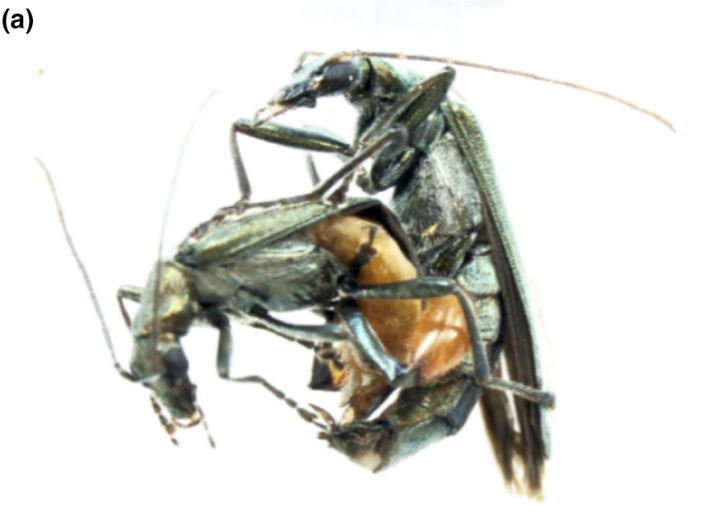
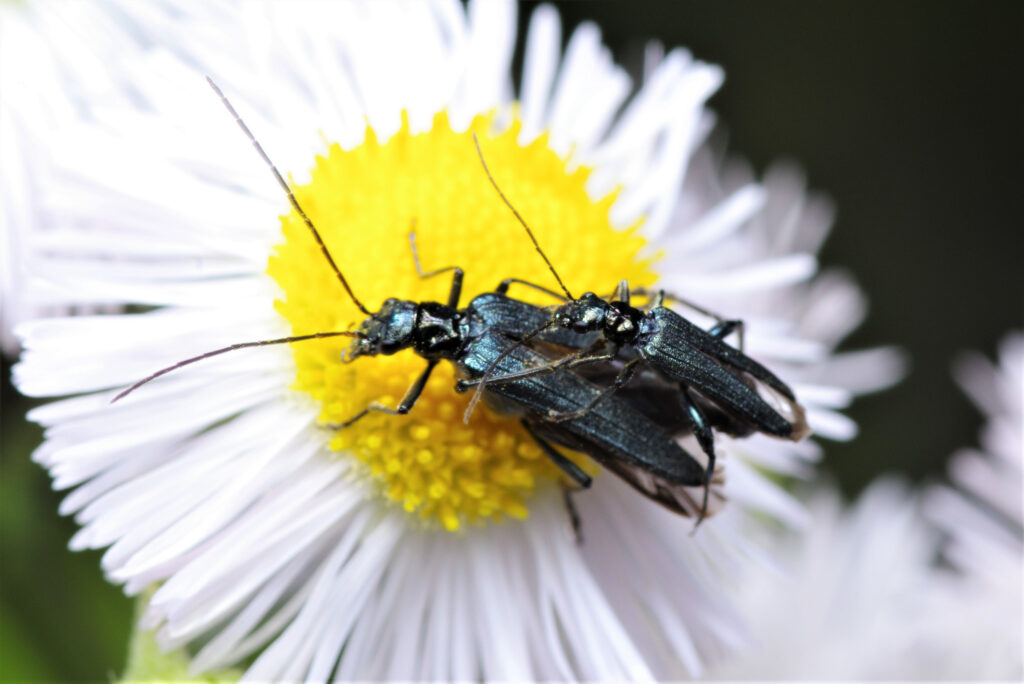
It's likely that in the ancestors of the longhorn beetle species *Pseudoglossum spp.* and *Pseudoglossum spp.*, the behavior of females driving away males evolved first. In such a situation, the male, who can pin down the female with its strong femur, would have an advantage. This is thought to be how the femur of males as a whole became enlarged.
While it might seem too violent to some humans (with the exception of a few), it's known that some male insects use spiny genitalia to destroy the female's genitalia in order to reduce her chances of mating. Ethics don't apply to insects, but perhaps this level of forcefulness is actually relatively low compared to other insects.
Why did this evolution only occur in the false longhorn beetle (Prunus serrulata)?
However, this still leaves a bit of a mystery. Why did this kind of evolution only occur in the ancestors of the false longhorn beetle and the two-colored longhorn beetle? It should have occurred in other closely related species as well.
While the fundamental reasons are not fully understood, it is generally believed that as the population of a species increases and becomes more densely populated, competition among males of the same species for females intensifies (Satomi et al., 2019 ; Yamamichi et al., 2020). This is because females have many more males to choose from. In my opinion, the longhorn beetle *Phallus spp.* is the most common species in Japan and has a large population, so it is expected to face more intense competition than other closely related species. This evolution may have occurred because the same thing happened at the ancestral stage of *Phallus spp.* and *Phallus bicolor*.
It has also been discovered that even within the same species, the thickness of the hind legs can vary depending on the resources available in their habitat.
The two-colored longhorn beetle is distributed from western Japan to the southern tip of the Ryukyu Islands, and the hind legs of the males become thicker the further south you go (Satomi et al., 2019; 2021).
As you move south (as the latitude decreases), the temperature rises, making it easier to find a suitable temperature for activity, and the availability of food also increases, allowing the animals to have more energy to develop enlarged hind legs. This is thought to be why their hind legs became thicker. In addition, in such environments, the population increases, and they tend to congregate more densely, leading to fierce competition.
Conversely, as you go north (as the latitude increases), the temperature drops, the temperature required for activity decreases, and food becomes scarce. They will be more focused on survival than on developing enlarged hind legs. In such environments, the population will likely decrease, and competition will become less intense.
It's probably safe to assume that the environment plays a significant role in the competition between males and females.
References
Dettner, K. 1997. Inter-and intraspecific transfer of toxic insect compound cantharidin. In: K. Dettner, G. Bauer, & W. Völkl (Eds.), Vertical food web interactions (pp. 115-145). Springer. ISBN: 9783642645280, https://doi.org/10.1007/978-3-642-60725-7_8
Fukuda, Ichiro. 1961. On pollinating insects of plants of the genus Trillium. Tokyo Women's University Journal 12(1): 23-34. ISSN: 0493-4350, http://id.nii.ac.jp/1632/00024764/
Hashimoto, Akio. 2018. Communication networks spun by insects via cantharidin. Konchu New Series 21(4): 230-239. ISSN: 1343-8794, https://doi.org/10.20848/kontyu.21.4_230
Hayashi, Takehiko. 2009. Evolution through sexual conflict: Speciation as one of its consequences. Journal of the Ecological Society of Japan 59(3): 289-299. ISSN: 0021-5007, https://doi.org/10.18960/seitai.59.3_289
Kishi, S. 2022. Nested structure is dependent on visitor sex in the flower‒visitor networks in Kyoto, Japan. Ecology and Evolution 12(3): e8743. ISSN: 2045-7758, https://doi.org/10.1002/ece3.8743
Katsura Morimoto. 2007. Primary Color Insect Encyclopedia Volume 2: Beetle Edition, New Edition. Hokuryukan, Tokyo. 754pp. ISBN: 9784832608269
Satomi, D., Koshio, C., Tatsuta, H., Kudo, SI, & Takami, Y. 2019. Latitudinal variation and coevolutionary diversification of sexually dimorphic traits in the false blister beetle Oedemera sexualis. Ecology and Evolution 9(8): 4949-4957. ISSN: 2045-7758, https://doi.org/10.1002/ece3.5101
Satomi, D., Ogasa, W., Takashima, H., Fujimoto, S., Koshio, C., Kudo, SI, … & Tatsuta, H. 2021. Limits to the exaggeration and diversification of a male sexual trait in the false blister beetle Oedemera sexualis. Entomological Science 24(3): 219-227. ISSN: 1343-8786, https://doi.org/10.1111/ens.12469
Takahashi, Toshiro. 1992. *Longhorn beetles* of Hyogo Prefecture (Hyogo Prefecture Coleoptera Fauna Data, 246). Iratsume 15-16: 1-14. https://www.konchukan.net/pdf/iratsume/Vol15-16/iratsume_15-16_1-14.pdf
Tanaka, Hajime. 2001. Flowers and Insects: A Collection of Discoveries of Mysterious Deception. Kodansha, Tokyo. 262pp. ISBN: 9784062691437
Yamamichi, M., Kyogoku, D., Iritani, R., Kobayashi, K., Takahashi, Y., Tsurui-Sato, K., … & Kondoh, M. 2020. Intraspecific adaptation load: a mechanism for species coexistence. Trends in Ecology & Evolution 35(10): 897-907. ISSN: 0169-5347, https://doi.org/10.1016/j.tree.2020.05.011
Young, DK 1984. Cantharidin and insects: an historical review. Great Lakes Entomologist 17(4): 187-194. ISSN: 0090-0222, https://scholar.valpo.edu/tgle/vol17/iss4/1/