This article contains a draft of the report titled "Records of the Satsuma Stream Fly in Nara Prefecture," which was published in the following journal.
Citation method: Ikeda, Kenichi. 2021. Records of *Satsumamonagareba* in Nara Prefecture. *Gekkan Mushi* (Monthly Insect Magazine) 602: 46-47. ISSN: 0388-418X
This article was written assuming the first recorded sighting of the Satsuma fly in Nara Prefecture.
There may be minor changes in wording, but the cited references remain the same. For more accurate information, please refer to the journal.
Distribution of the Japanese horsefly (Satsuma monagareba) in Japan and the Kansai region.
Suragina satsumana (Matsumura, 1916) is a species of fly belonging to the family Suragina, distributed in Japan as Hokkaido, Honshu, Shikoku, Kyushu, Tsushima, Tanegashima, and Yakushima (Nagatomi, 2018). Adults emerge from mid-June to mid-August, inhabiting river tributaries and irrigation canals, and there have been reports of adult females feeding on the blood of cattle.
Although its distribution has been confirmed in the Kinki region, including Hyogo Prefecture (Nagatomi, 2018), Osaka Prefecture (Osaka Museum of Natural History, last updated 2008), Kyoto Prefecture (Sakai et al., 2012), and Mie Prefecture (Shinogi and Yazaki, 2017), it is not listed in the Nara Prefecture Wildlife Catalog (Nara Prefecture Red Data Book Revision Committee, 2017).
Author's distribution record
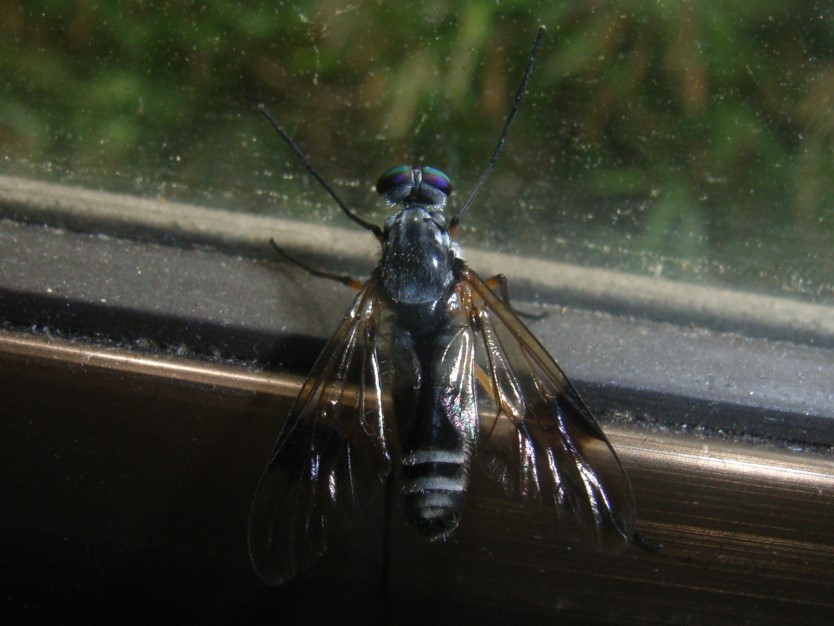
I photographed a female of this species at approximately 1:30 PM on July 2, 2013, at Kinki University Nara Campus in Nakamachi, Nara City, Nara Prefecture, and report it here.
1♀ (photo), Kinki University Nara Campus, Nakamachi, Nara City, Nara Prefecture, February 2, 2013, photographed by the author.
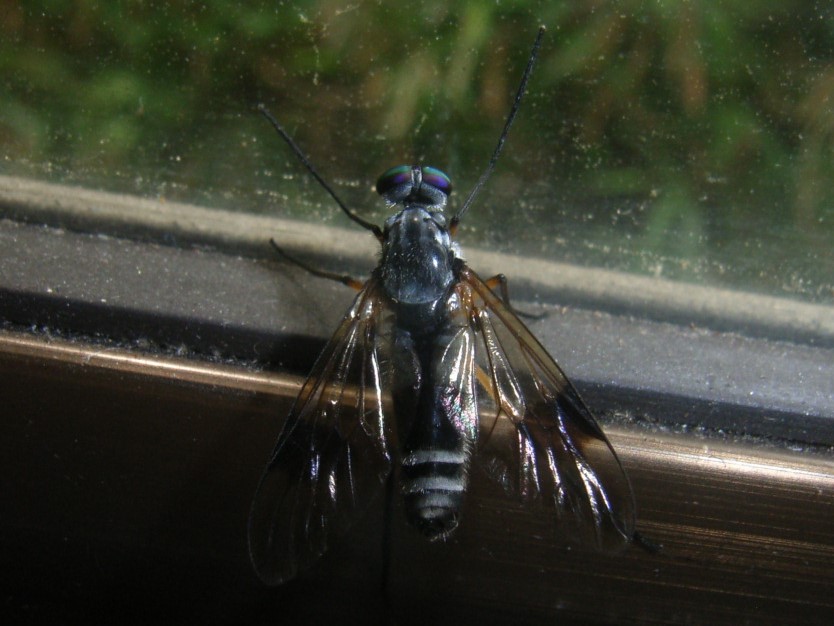
The insect was photographed at the clubhouse on campus, and it appears to have entered the building for some reason. The nearest river, the Tomio River, is about 1.5 km away from the photographed location, and although the range of this species' movement is unknown, it is thought to be quite far. There are small terraced rice paddies nearby (Ito et al., 2013), and this species has also been confirmed to occur in irrigation canals (Nagatomi, 2018), but the water source for these terraced rice paddies is spring water (Ito et al., 2013), so it is unclear where the insect originated. Regarding the adult insect's food source, no livestock, including cattle, were being raised on campus at the time of the photograph, so it is thought to be wild mammals. At least eight species of medium to large mammals have been confirmed on campus, including Japanese raccoon dogs, feral cats, raccoons, and wild boars (Fujii and Sawabata, 2016; Sawabata and Goda, 2019), and it is possible that the insect uses one of these species as a host.
References
Fujii, Taiki and Sawabata, Takuo, 2016. Japanese macaques appearing on the Nara campus of Kindai University. Kindai University Faculty of Agriculture Bulletin 49: 49-51. https://kindai.repo.nii.ac.jp/records/17912
Ito, T., Imada, A., Ishida, T., Mizude, C., & Hosoya, K., 2013. Aquatic fauna in the Kinki University terraced rice paddy biotope: A comparison of habitats in terraced rice paddies. Kinki University Faculty of Agriculture Bulletin 46: 81-89. https://kindai.repo.nii.ac.jp/records/5341
大阪市立自然史博物館,2008最終更新.大阪府産のアブ類.http://www2.mus-nh.city.osaka.jp/CGI/Guide/Guide.exe?A_G81=*&THTM=Ent%5CAbu-list
Sakai, Y., Natsuhara, Y., & Kato, M. 2012. Distribution patterns of benthic animals in streams in the Kamitani basin of the Ashiu Research Forest. Forest Research 78: 19-27. http://hdl.handle.net/2433/193448
Shinoki, Yoshishige & Yazaki, Mitsuhiko, 2017. First record of *Satsuma monagareba* in the prefecture. Hirakura 61(4): 99.
Sawabata, T. & Goda, A. 2019. The relationship between the presence or absence of understory vegetation along walking trails in rural areas, the number of wild animals using the trails, and the number of ticks present. Landscape Research 82(5): 719-724. https://doi.org/10.5632/jila.82.719
Nagatomi, A., 2018. Family: Lymantriidae. In: Kawai, T. and Tanida, K. (eds.), Key to Japanese Aquatic Insects: Family, Genus, and Species, 2nd edition: 1455-1461. Tokai University Press, Hiratsuka.
Nara Prefecture Red Data Book Revision Committee, 2017. Nara Prefecture Wildlife Catalog. Landscape and Natural Environment Division, Landscape and Environment Bureau, Department of Lifestyle Creation, Nara.