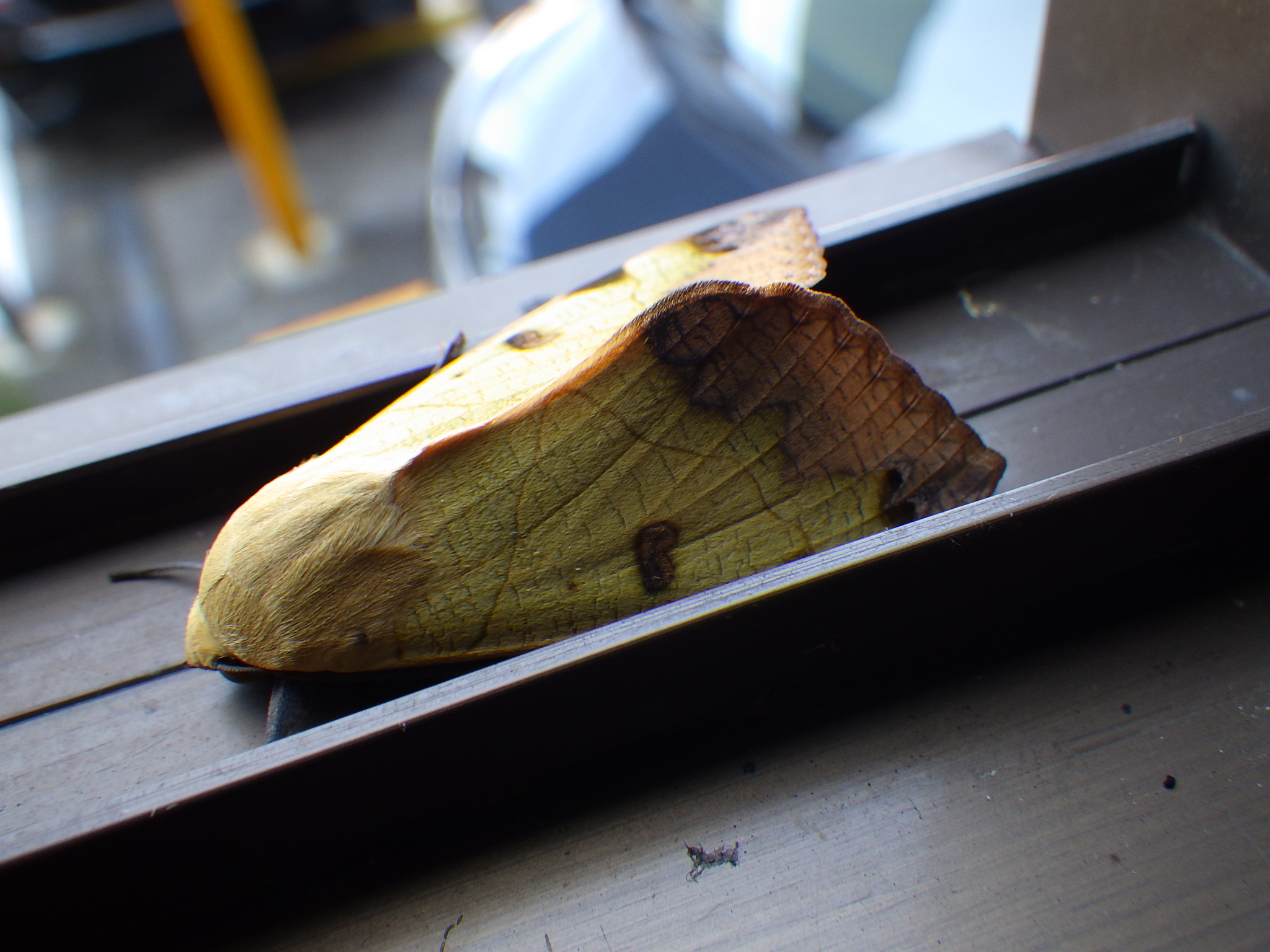
This article contains a draft of the report titled "A Record of the Black-spotted Underwing Moth in Sakai City, Osaka Prefecture," which was published in the following journal.
Purchase here

Citation method: Ikeda, K. 2019. A record of Ophiusa tirhaca (Cramer) (Nocmidae) in Sakai-city, Osaka Prefecture. Yugato 237: 92. [ISSN: 0387-5695]
This article was written with the expectation that the species *Catapultella fuscata*, which is attracting attention as it moves northward, will be recorded in Osaka Prefecture for the first time in 38 years.
There may be minor changes in wording, but the cited references remain the same. For more accurate information, please refer to the journal.
Distribution status of the black-spotted underwing moth in Japan
Ophiusa tirhaca (Cramer), also known as the black-spotted underwing moth, has been reported to be distributed in Japan on Honshu, Mikura Island in the Izu Islands, the Ogasawara Islands, Shikoku, Kyushu, the Tokara Islands, Okinawa, and Ishigaki Island. However, records on the mainland are sporadic, and it is considered an accidental occurrence (Kishida et al., 2011). It is recorded in March and August-November, with multiple generations per year. The larval food plant is unknown according to Kishida et al. (2011), but Tsubota (2016) identifies it as Psidium palmatum and Rhus javanica. In the Kansai region, there have been several recent records in Hyogo Prefecture (Matsuo, 2010; Takao, 2010; Tsubota, 2016; Matsuda, 2017), but in Osaka Prefecture, only old records in Osaka City are found (Sonoda, 1982).
The author's records in Osaka Prefecture
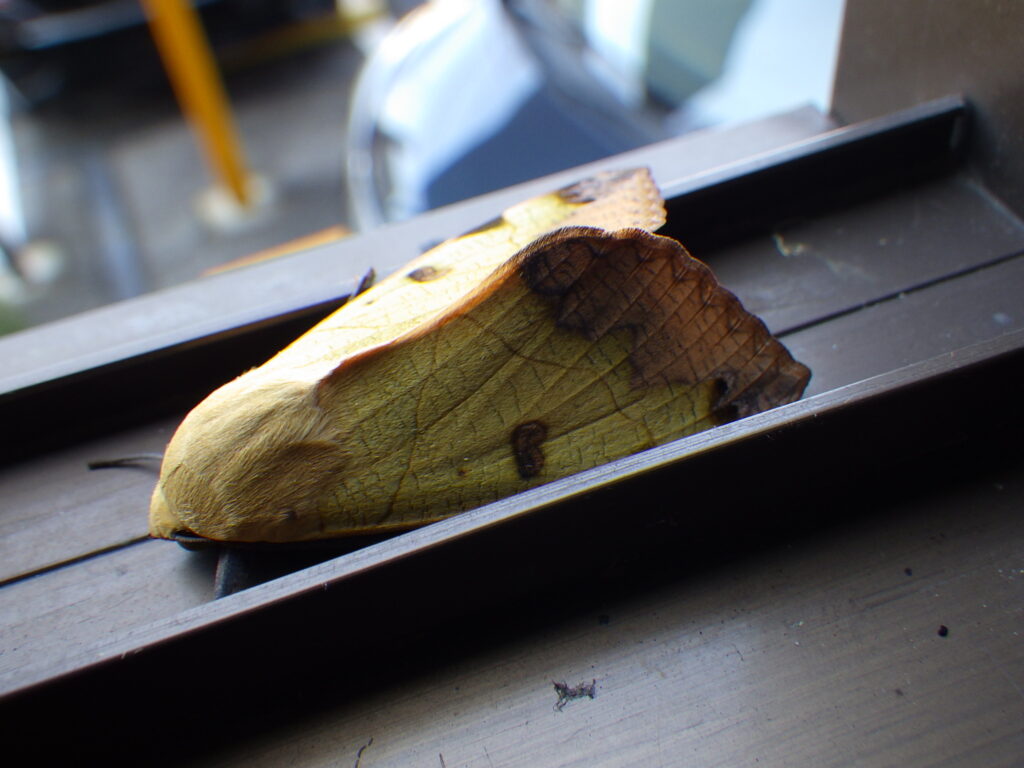
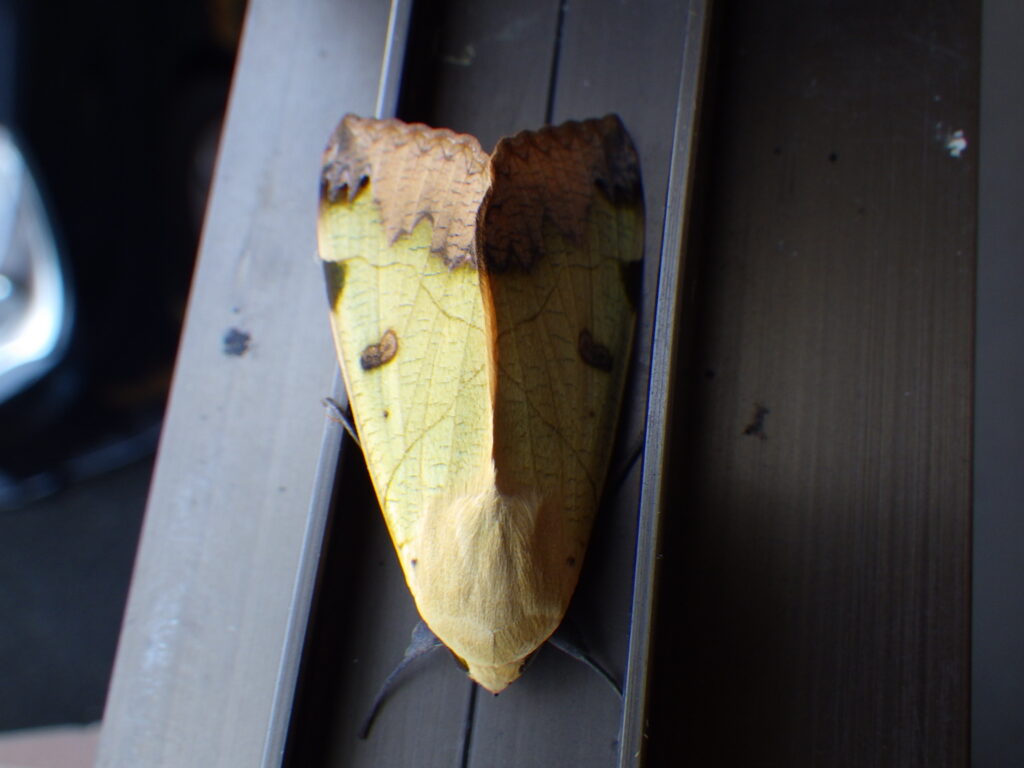
The author photographed a Black-spotted Underwing Moth (Catocala nigricans) around 10:30 AM on November 11, 2016, in the corridor of an apartment building near Shirasagi Station in Shirasagi-cho, Higashi-ku, Sakai City, Osaka Prefecture, and reports it here. The sex can be determined from the black markings on the hindwings (Sonoda, 1982; Tsubota, 2016), but it is unknown as it was not collected. The apartment building's corridor is lit at night, and it is thought that the moth was attracted to this light. The area around Shirasagi Station is a residential area, and the only green spaces are Shirasagi Park, Osaka Prefecture University Nakamozu Campus, and planted areas along the road. Tsubota (2016) investigated the presence or absence of the larval food plant in Ichikawa-cho, Kanzaki-gun, Hyogo Prefecture, and confirmed the presence of Rhus javanica. In the vicinity of Shirasagi Station, as recorded in this document, the author has not confirmed the presence of Psidium palmatum, but has confirmed young Rhus javanica individuals in the planted area along the road near Shirasagi Station, which appear to have germinated and grown after being dispersed by birds. Sato (2004) points out the possibility that this species may have been carried here by typhoons or westerly winds, but Tsubota (2016) has confirmed two beautiful male and female individuals and has inferred that this species originated near Ichikawa Town. It is difficult to determine whether these individuals were migratory or originated within Sakai City. The numerous reports in Hyogo Prefecture in recent years may be related to this report.
References
Kishida, Y., Yanagida, Y., Seino, A., and Ishizuka, K., 2011. Noctuidae, Catocalinae. In: Kishida, Y. (ed.), Standard Illustrated Guide to Japanese Moths 3: 253. Gakken Educational Publishing. Tokyo.
Matsuda, Shinpei, 2017. *Catapula nigricans* was collected in Inagawa-cho, Hyogo Prefecture. *Great Entomology Crude* 61: 18.
Matsuo, Takato, 2010. Records of two southern moth species at Dangamine. Kiberihamushi 33(1): 17. https://www.konchukan.net/pdf/kiberihamushi/Vol33_1/kiberihamushi_33_1_17.pdf
Sato, Yuka, 2004. Ophiusa tirhaca was found in Fukui City. Research Report of the Fukui City Museum of Natural History 51: 67. http://www.nature.museum.city.fukui.fukui.jp/shuppan/kenpou/51/51-67-67.pdf
Sonoda, Koichi, 1982. *Catapultella fuscata* found in Osaka. Nature Study 28 (10): 10. http://www.omnh.net/ns_online/html/v28/28-10_005.html
Tsubota, E., 2016. *Catapula nigricans* was collected in Ichikawa-cho, Kanzaki-gun, Hyogo Prefecture. *Kiberihamushi* 39 (1): 24-25. https://www.konchukan.net/pdf/kiberihamushi/Vol39_1/kiberihamushi_39_1_24-25.pdf
Takao, Kaisei, 2010. *Catapula nigricans* was collected in Kato City, Hyogo Prefecture. *Kiberihamushi* 33 (1): 18. https://www.konchukan.net/pdf/kiberihamushi/Vol33_1/kiberihamushi_33_1_18.pdf