In the "Ecological Information" section, at the request of the lead author, Mr. Daisuke Noguchi, I assisted with the introduction, discussion, and literature review on a paid basis . Through a comprehensive literature review, I demonstrated that intraguild predation between spiders and wasps occurs universally, and that "symmetrical intraguild predation" between spiders and wasps is possible. It is hoped that these results will be used to evaluate the impact of spiders and wasps on terrestrial ecosystems in the future. This research falls under the theme of biological interaction in ecology. The results of this research were published in the Egyptian peer-reviewed scientific journal " Serket " 18(3) in March 2022 as " Intraguild predation on hornets and yellowjackets of vespine wasps by spiders, and vice versa." This article provides a brief explanation of this paper in Japanese.
Background: What is "predation within the guild"?
Previous research by Dr. Noguchi has reported the phenomenon of spiders preying on wasps. This in itself may be surprising. Furthermore, the fact that this phenomenon falls under the ecological phenomenon of "intraguild predation" has been largely unrecognized in previous research.
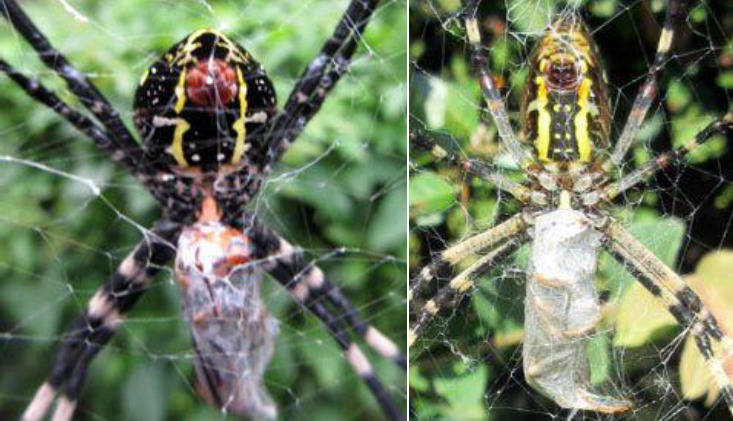
The phenomenon of wasps preying on spiders is also frequently observed, but similarly, it has not been considered from the perspective of "intraguild predation."
Guild predation refers to the phenomenon of predation occurring between species (guilds) that share the same food resources, and it frequently occurs within the food webs of arthropods.
This is thought to add redundancy (complexity) to the simple trophic levels (food chain) of the ecosystem as a whole, thereby increasing the stability of the ecosystem. Furthermore, nutritional importance is considered to exist for each individual, and there is a hypothesis that predators intentionally engage in intraguild predation in order to obtain nutrients for other predators.
Both spiders and wasps are often polyphagous, so it's likely that many cases fall under the category of "intraguild predation." Moreover, both are apex predators among arthropods.
This study revealed the globally universal nature of spider predation on wasps.
Building upon Mr. Noguchi's research, we thoroughly investigated instances of spiders being preyed upon by wasps and wasps preying on spiders through a literature review, creating foundational data to determine whether "intraguild predation" occurs between spiders and wasps.
Literature research revealed that predation of wasps by spiders was only fragmentary. However, records were found in various regions, including Japan, Europe, and Africa, suggesting that it is a global phenomenon.
While there are many records of wasps preying on spiders, the literature is often abstract, only specifying the order or family, perhaps because wasp researchers are unfamiliar with spiders.
This suggests the possibility of "symmetrical intraguild predation" between spiders and wasps.
Generally, intraguild predation is divided into "asymmetrical intraguild predation," where one party preys on the other, and "symmetrical intraguild predation," where each party preys on the other. Our research, through a cross-referencing of relevant literature, has revealed the possibility of "symmetrical intraguild predation" occurring between some spiders and wasps. This may be a rare case in terms of properly documented examples.
Furthermore, intra-guild predation is a phenomenon that occurs when creatures "live in the same place spatiotemporarily," but spiders roam and lie in ambush on the ground, while wasps are in flight. If intra-guild predation is occurring on both the ground and in the air, this too may be a rare case.
Future prospects
However, this study alone does not clarify whether spiders and wasps "really share food." Therefore, it will be important to increase the records of predation between the two species, scientifically clarify this point, and evaluate the impact of spiders and wasps on terrestrial ecosystems.
Part of the Japanese text
Here is a draft of the Japanese text. This is only a portion of the content; please see the full text for details.
background
Spiders are a richly distributed taxonomic group in terrestrial ecosystems (Wise, 1993; Nyffeler & Birkhofer, 2017) and are known to constitute a top predator group within arthropods (Schmitz & Suttle, 2001). One indicator of their influence is the estimated consumption of 400 to 800 million tons of mainly insects as food annually (Nyffeler & Birkhofer, 2017). On the other hand, wasps also prey on various types of insects and spiders in some parts of the Old World (Richards, 1971; Matsuura, 1991) and are considered a top predator group as well. While their global influence may not extend to that of spiders, their influence in their habitats is presumed to be significant due to their eusocial nature, the formation of large colonies, their predatory behavior involving powerful venomous stingers and mandibles, and the fact that they do not require aquatic environments like dragonflies (Richards, 1971; Matsuura, 1991). With a few exceptions, they are generally known as semi-specialist to polyphagous predators (Wise, 1993; Matsuura, 1991). Although predation between species of different taxonomic groups may occur in areas where their habitats overlap, records on this point are limited to higher taxonomic groups, such as Matsuura (1984), who studied the diet of Japanese wasps, referring only to "Araneae," and Miyashita & Shinkai (1995), who studied the diet of Japanese spiders, referring only to "Hymenoptera," with no records of specific species. Furthermore, Matsuura (1991), who provided a comprehensive overview of the ecology of hornets, did not include spiders as a major predator of hornets, suggesting that this possibility is not widely recognized.
If predation is occurring between spiders and wasps, this could be considered intraguild predation. Intraguild predation refers to the phenomenon of predation occurring between species (guilds) that share the same food resources (Root, 1967), and is common in arthropod food webs, occurring at a frequency of 58-87% within the trophic level (Arim & Marquet, 2004; Schowalter, 2016). Generally, intraguild predation is divided into "asymmetrical intraguild predation," where predation is unilateral, and "symmetrical intraguild predation," where species prey on each other (Polis et al., 1989).
Intraguild predation is important in ecosystems because it is thought to reduce predation pressure on herbivores, add redundancy to simple trophic cascades, and increase ecosystem stability (Polis & Holt, 1992; Holt & Polis, 1997; Finke & Denno, 2005). Furthermore, it is thought to have nutritional importance for each predatory species, and there is a hypothesis that predators intentionally engage in intraguild predation in order to obtain nutrients for other predators (Matsumura et al., 2004; Michalko et al, 2021). Even if the amount of predation between spiders or wasps is small, there may be a nutritionally important relationship between them. However, although there are studies that have captured intraguild predation among spiders and wasps (Hodge 1999; Feldhaar & Polidori, 2011), there are few studies that have captured the relationship between spiders and wasps, which are different taxonomic groups, in terms of intraguild predation. One example is Crowder & Snyder (2010), but it does not examine specific cases and only points out the possibility that wasps may prey on spiders within their guild. There seem to be very few studies that provide actual examples or examine "symmetrical predation within a guild" that occurs when spiders prey on wasps.
While there may be fragmentary accounts in the literature of specific instances of wasps preying on spiders, and one of the authors has previously confirmed and reported two instances of spiders preying on wasps (Noguchi, 2020; 2021), these remain sporadic records. On the other hand, searching the internet in Japanese and English for "spider," "wasp," and "predation" reveals several instances in which wasps appear to prey on spiders in nature, as well as multiple instances where spiders appear to prey on wasps (Google Image Search, 2022-01-19). Although this interaction may be widely observed in the Old World (and the New World where wasps have invaded), there are no scientifically conducted studies that organize known records of this interaction.
Therefore, by investigating literature that shows examples of "predation of wasps by spiders" and "predation of spiders by wasps" around the world, we aimed to create basic data for examining "mutual predation between predators," which is the opposite condition of "predation of a predator by a predator" within a guild.
Discussion
Although predation of spiders by wasps has been noted quite frequently, 18 of the studies are abstract, only mentioning the order or family, suggesting that the phenomenon is only vaguely understood, and that no quantitative relationship is known at all. It can be said that there are very few records of spiders preying on wasps.
While predation of spiders by wasps is relatively common at the species level, the records in those regions have not been comprehensively surveyed. Prior to Noguchi (2020; 2021), only five studies had been found documenting predation of wasps by spiders (Bilsing, 1920; Laing, 1973; Hendawy, 2004; Carrel & Deyrup, 2019; Ramírez et al., 2021), suggesting that the records remain fragmentary considering the actual interactions in the ecosystem.
The reason for the scarcity of records is likely that wasp researchers were not familiar with spiders or did not recognize their ecological importance when it came to wasp predation. While it is possible that wasps escape spider webs due to their size and powerful jaws, as seen in Fordhan (1961) (Sugiura et al., 2019), there may also be a lack of studies investigating spider prey resources at the species level.
On the other hand, it has become clear that "predation of a predator by a predator," one of the conditions constituting intraguild predation, occurs globally, at least qualitatively. Comparisons between the lesser hornet and spiders by Matsuura (1984) and Noguchi (2020; 2021), and between the European black hornet Vespula germanica and spiders by Bilsing (1920) and Harris (1991 etc.), suggest the possibility of mutual predation. However, it has been shown that in spiders, trophic levels differ between taxonomic groups and developmental stages based on the characteristics of δ15N (Sanders et al., 2015), so the possibility remains that it does not actually occur at the species level.
While there is a possibility of asymmetrical intraguild predation between spiders and wasps, given the relative size differences, the possibility of mutual predation has been shown between larger species, at least between the lesser hornet and spiders, and between the European black hornet and spiders, suggesting the possibility of "symmetrical intraguild predation." Although symmetrical intraguild predation is commonly observed, size and developmental stage are often important factors (Polis et al., 1989). In wasps, which undergo complete metamorphosis, size and developmental stage are not factors in "symmetrical intraguild predation," making this a rare case. However, its intensity needs further investigation.
One of the conditions for predation within a guild is that the individuals "live in the same spatiotemporal location" (Potter et al., 2018). Spiders and wasps are thought to satisfy this condition, but the fact that flying wasps and spiders that use webs to stay still or wander within the same guild is considered a distinctive case.
In the future, it will be necessary to gather information on predation relationships between spiders and wasps more generally, and to verify whether relationships such as intraguild predation exist. It is necessary to verify what kind of food "spiders" are for wasps, both quantitatively and qualitatively, and what kind of food "wasps" are for spiders, both quantitatively and qualitatively. Quantitatively, it will be important to conduct more detailed studies, such as those by Matsuura (1984) and Miyashita & Shinkai (1995), to determine the proportion of each species' food menus. From a qualitative perspective, experiments with restricted food menus and ecostoichiometric verification may be necessary, as by Matsuura (2005). Recently, DNA analysis of intestinal contents has also been performed (Aebi et al., 2011).
Although not demonstrated in this study, it is also necessary to verify whether food resources are truly shared within the same ecosystem. Assuming an ecosystem in Honshu, Japan, a comparison of the results by Matsuura (1984) and Miyashita & Shinkai (1995) shows that the captured food menus overlap considerably at the order level, but the overlap at the species level is unclear, and a more detailed investigation is needed.