Are you familiar with the bee-like hoverfly (Elaphe climacophora)? At first glance, it looks just like a bee, but hoverflies are actually a type of fly, so they won't sting you and are harmless. Their bright colors are thought to be a form of mimicry. While most hoverflies feed on flower nectar and pollen, the bee-like hoverfly surprisingly feeds on tree sap. What's more, even its larval stage depends on tree sap. This article will explain the classification and ecology of the bee-like hoverfly.
- A hoverfly that closely resembles a bee and lives in rural, woodland environments.
- The bee-like hoverfly doesn't sting; it's a form of mimicry.
- Almost the only hoverfly that survives by feeding on tree sap.
- The bee-like hoverfly is born from tree sap!?
- What do hoverflies do in areas where the carpenter moth is absent?
- References
A hoverfly that closely resembles a bee and lives in rural, woodland environments.
Monoceromyia pleuralis is a species of hoverfly distributed in the Russian Far East and Honshu and Kyushu in Japan, inhabiting rural and woodland environments (Kyoto Prefecture, 2015). Although not widely documented in Japanese literature, there are also records of it in South Korea (Deuk-Soo et al., 2018).
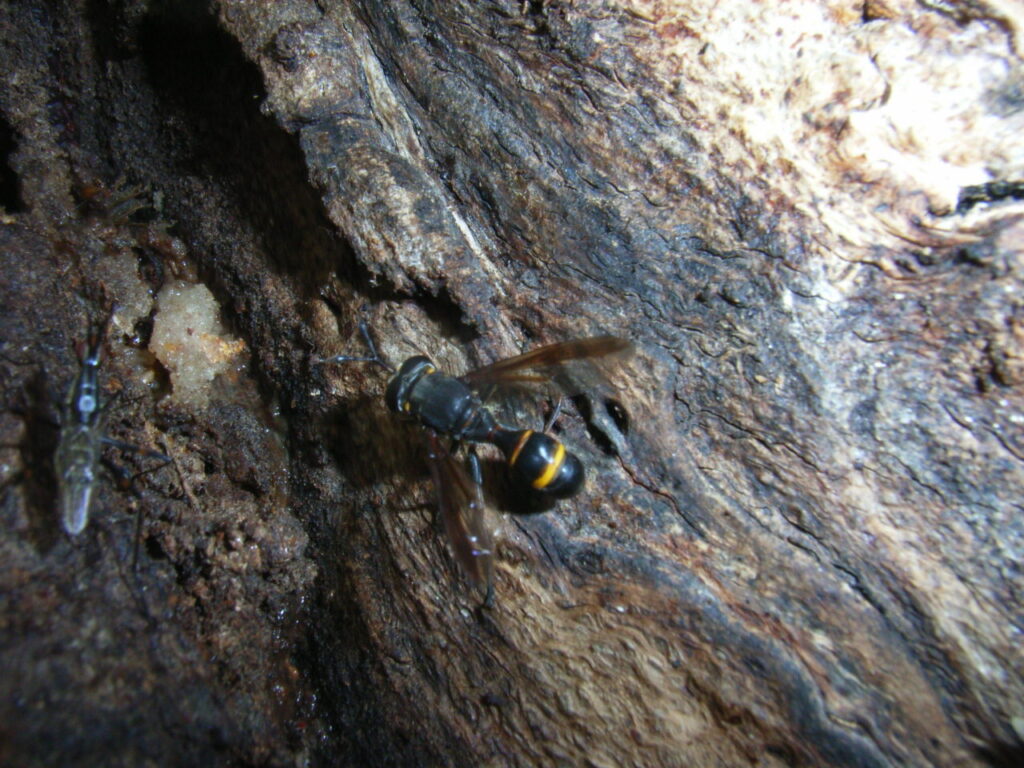
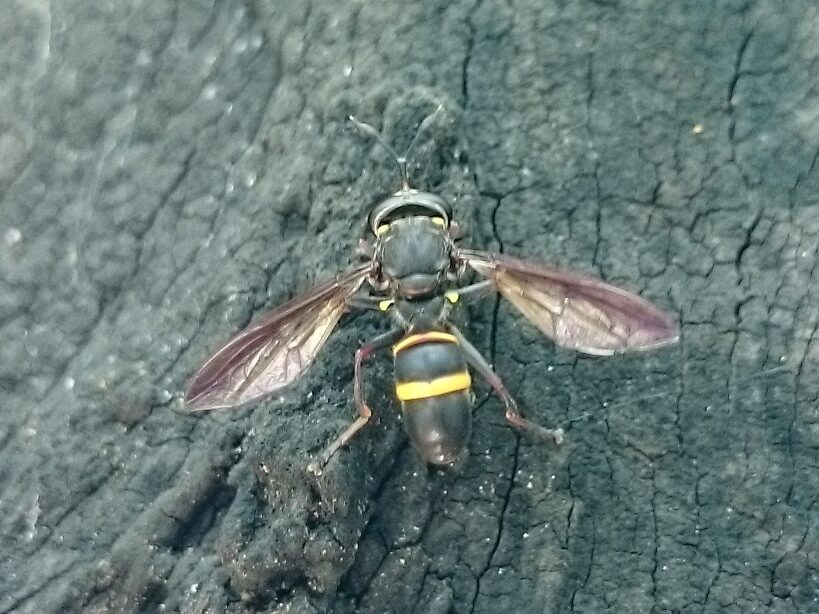
Closely related species include Primocerioides petri and Ceriana japonica, but the difference is that neither of these two species has an abdomen as constricted as that of Primocerioides petri. Aside from the constriction, Ceriana japonica closely resembles Primocerioides petri, but as its name suggests, Primocerioides petri is hairy all over and has a reddish-brown scutellum (Hirashima and Morimoto, 2008).
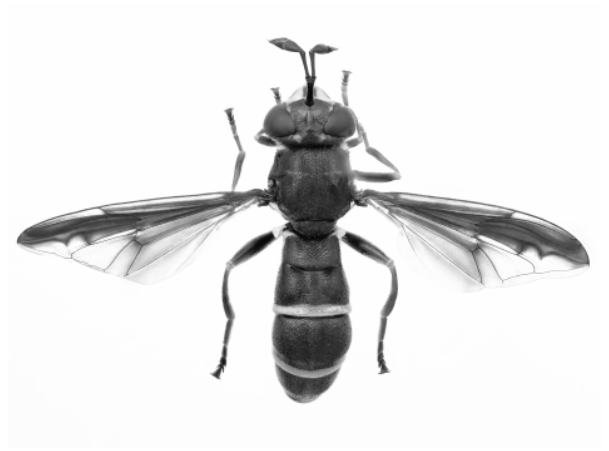
Although it is not listed on the Ministry of the Environment's Red Data List, it is designated as near threatened or endangered in seven prefectures, including Mie and Kyoto (Wildlife Research Association/Envision Environmental Conservation Office, 2021). In Hyogo Prefecture, there are only three records (Yoshida and Yagi, 2012). Because it depends on rural environments, it is said that its population may decline due to forest decline and development.
The bee-like hoverfly doesn't sting; it's a form of mimicry.
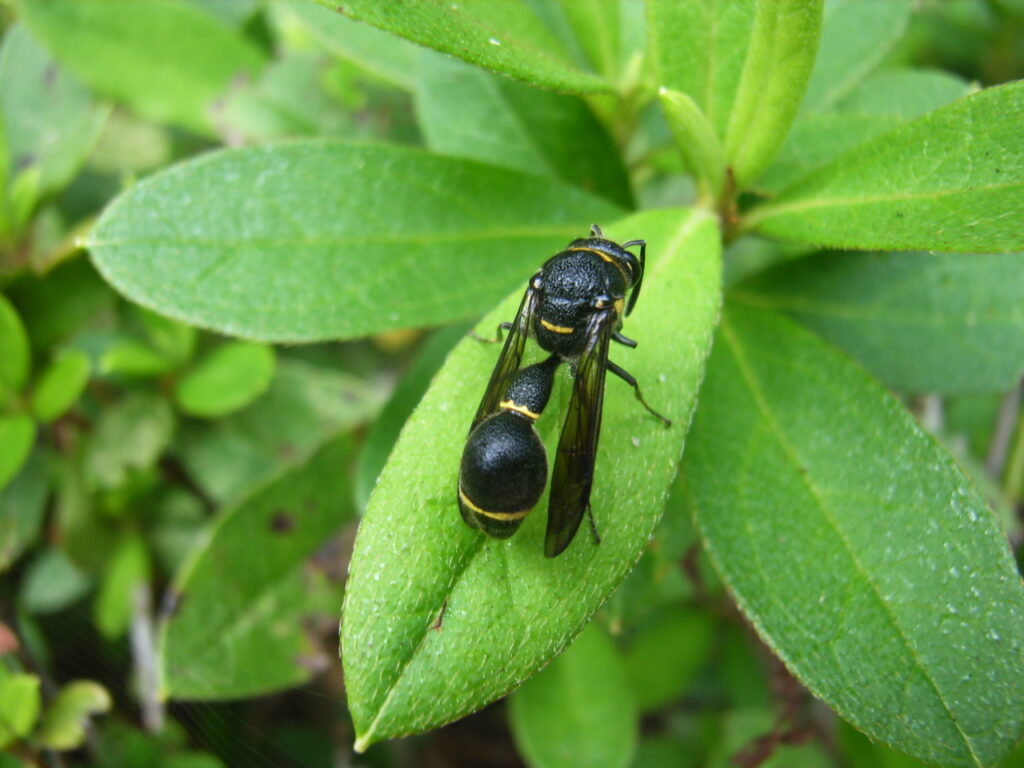
With its black, constricted body and yellow markings, it looks very much like a bee, but since the Syrphidae family is a group within the order Diptera, it does not have a stinger structure. Therefore, it cannot sting. This is considered a form of mimicry. This type of mimicry of a specific, dangerous model is called "Batesian mimicry."
Specifically, it is thought to mimic a type of mud dauber wasp called Anterhynchium flavomarginatum, which is found in the same area (Kyoto Prefecture, 2015).

From a distance, they look remarkably similar. However, the exact target of their mimicry isn't always clear, as proving it is extremely difficult.
The large two-banded mud dauber wasp does not visit tree sap but feeds on flower nectar and pollen. It is known to nest in existing cavities such as bamboo tubes, holes in wood, and old nests of other predatory wasps, and to hunt and store larvae of moths such as leafrollers (Yamane and Terayama, 2016). Therefore, it is thought that they share some of their home range with the hoverfly during the process of searching for trees, but it is unclear to what extent their ranges overlap.
It has been suggested that the closely related *Eumenes rubronotatus* hoverfly mimics another bee (Ichikawa and Ohara, 2009). *Eumenes rubronotatus* hoverfly tends to visit flowers more often than *Eumenes rubronotatus* hoverfly, and it has been confirmed that both * Eumenes rubronotatus* hoverfly and *Eumenes rubronotatus* rubronotatus were visiting the flowers of *Rhus sylvestris*.
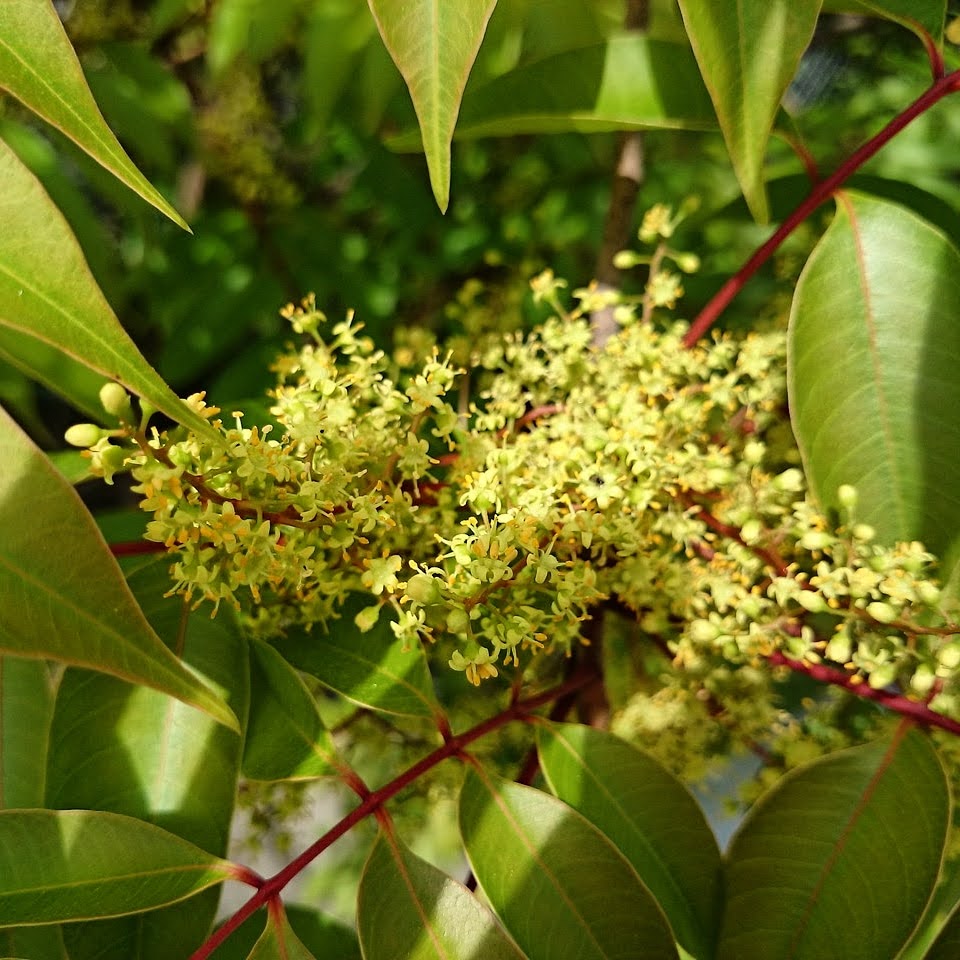
These two insects were found in the same locations and looked so similar that even researchers couldn't distinguish between them. The fact that the constriction is not very noticeable in the Hisamatsu hoverfly may be an attempt to mimic the appearance of a potter wasp.
Almost the only hoverfly that survives by feeding on tree sap.
Hoverflies, as their name suggests, are generally known to visit flowers and feed on their pollen and nectar. This is what characterizes hoverflies, but this particular hoverfly, the false bee hoverfly, specializes in feeding on the sap of oak trees (Ichikawa and Ohara, 2009).
This characteristic is thought to be almost uncommon in Japan's hoverflies, except for the false wasp hoverfly. The only other species that comes close is the black hoverfly. Closely related species, the Hisamatsu false wasp hoverfly and the hairy false wasp hoverfly, feed on tree sap, but they do not use sawtooth oak trees, instead feeding on the nutrient-poor sap of zelkova trees, as well as their pollen and nectar.
Sap is produced when the phloem tubes (tubes that transport nutrients such as sugars produced by photosynthesis throughout the tree) are damaged by various causes, causing sugar-containing liquid to leak out and be fermented by yeast and other microorganisms. In the case of sawtooth oak sap, it is known in detail that it is produced when the moth Cossus jezoensis gnaws on it (Ichikawa and Ueda, 2010). The ecology of this moth is also very interesting, but we will introduce that in another article. As for zelkova sap, it is thought to be produced as a result of longhorn beetle larvae accidentally damaging the phloem tubes.
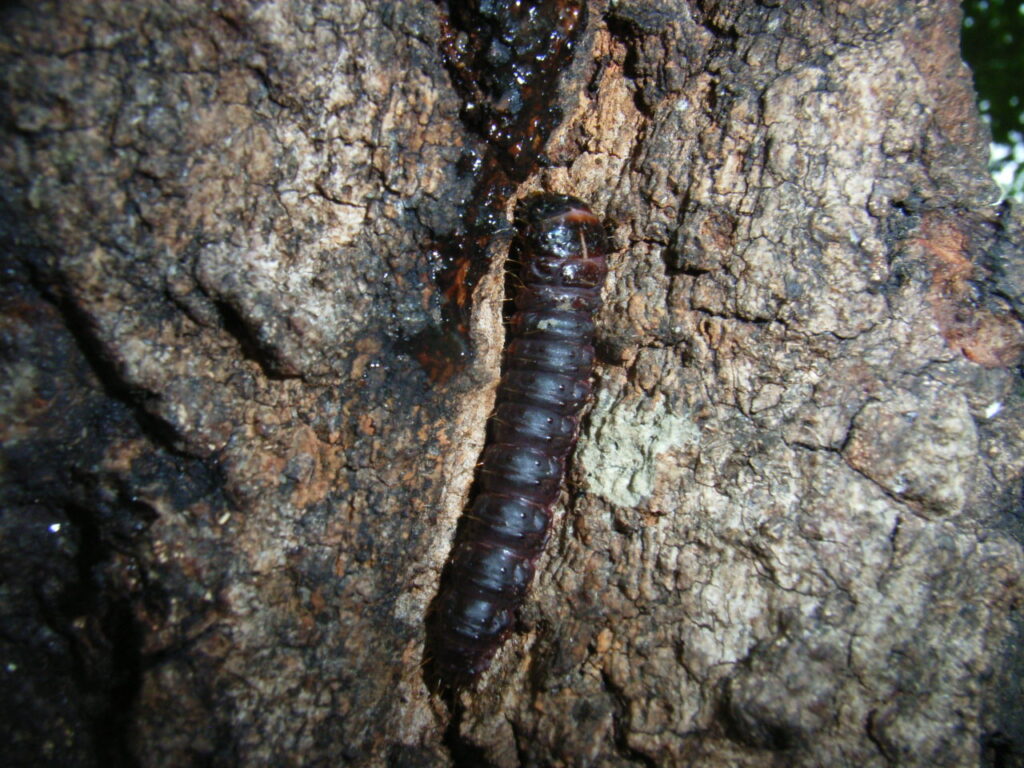
The sap of the sawtooth oak tree is intentionally produced by the carpenter moth, so it can be seen quite frequently. Also, to use an analogy, it's like the tree is shedding its own blood, so it's richer in nutrients than other tree saps.
Therefore, the bee-like hoverfly likely came to depend on the sap of oak trees for its survival.
However, it is currently unknown why only the false bee hoverfly has come to live this way. One theory is that the false bee hoverfly is the only species among its close relatives that can utilize the nutrient-rich sap of the sawtooth oak tree because its size and the aggressiveness of the males drive away other hoverflies.
While oak sap is more frequently found than zelkova sap, it only flows during the period when carpenter moth larvae are developing, and the area where it flows is not very wide. Therefore, it is a valuable resource, and insects are constantly competing for it.
According to this theory, the Hisamatsu's wasp-like hoverfly and the hairy wasp-like hoverfly are being driven out by the wasp-like hoverfly and are forced to feed on the sap, pollen, and nectar of zelkova trees.
The bee-like hoverfly is born from tree sap!?
While few hoverflies feed on tree sap, a surprisingly large number of flies visit tree sap if we consider the whole family (Yoshimoto et al., 2012).
However, what makes the false hoverfly unusual is that the adults lay their eggs in the sap (or bark) of oak trees (Ichikawa and Ohara, 2009; Kyoto Prefecture, 2015).
The bee-like hoverfly relied on tree sap even while it was in the egg and larval stages.
Males establish territories and spend long hours during the day on the trunks of oak trees, waiting for females while securing sap, which serves as a place for them to lay their eggs. By doing so, they can provide females with the limited resource of sap, giving them an advantage in competition among males for females. This behavior is also observed in rhinoceros beetles, stag beetles, and the Great Purple Emperor butterfly (a type of butterfly), which also compete for sap (Kurita, 2007; Hongo, 2012), and is an interesting commonality.
Unfortunately, not much is known about the life cycle of the larvae. They are believed to live in tree cavities that serve as waterlogging spots for rainwater. If we could learn more about this aspect, we would be able to discover some very interesting aspects of their ecology.
What do hoverflies do in areas where the carpenter moth is absent?
The oak moth, which secretes oak sap, is said to be distributed only in China and Japan. However, as mentioned above, the bee-like hoverfly does not visit flowers, but specializes in feeding on tree sap.
If that's the case, how do the bee-like hoverflies live in Russia and South Korea?
So far, I haven't been able to find anyone researching this topic.
However, in Korea, there are records of the bee-like hoverfly visiting several Asteraceae flowers, including Eupatorium fortunei and Aster tataricus (Kim et al., 2012).
It's possible that the bee-like hoverfly has become more dependent on oak sap while living in Japan.
If they originally visited flowers, then mimicking mud dauber wasps makes more sense.
We don't know anything about it at the moment, but it leaves us with a very intriguing mystery.
References
Deuk-Soo, C., Sang-Wook, S., Su-Bin, L., & Ho-Yeon, H. 2018. Insect fauna of Korea (Vol. 5, Number 2 Syrphidae II). National Institute of Biological Resources, Seo-gu. 149pp. ISBN: 9788968113208, https://www.nibr.go.kr/aiibook/catImage/128/Insect%20Fauna%20of%20Korea%205_2E.pdf
Hisasue, Yu. 2019. *Hisamatsu's False Bee-like Flower Hoverfly* collected in Onojo Ikoi-no-Mori. *Korasana* 91: 19-20. ISSN: 0919-8830, https://www.researchgate.net/publication/333417551
Hirashima, Yoshihiro & Morimoto, Kei. 2008. Illustrated Encyclopedia of Insects in Color, Vol. 3: Odonata, Stoneflies, Grasshoppers, True Bugs, Diptera, Hymenoptera, and Others (Revised Edition). Hokuryukan, Tokyo. 654pp. ISBN: 9784832608276
Hongo, Yoshito. 2012. The Latest Science on Beetles and Stag Beetles. Media Factory, Tokyo. 186pp. ISBN: 9784840146197
Ichikawa, Toshihide and Ohara, Kenji. 2009. Adult behavior of *Hyperva* and *Hyperva* (Diptera, Syrphidae). Bulletin of the Faculty of Agriculture, Kagawa University 61: 1-10. ISSN: 0368-5128, http://id.nii.ac.jp/1731/00003525/
Ichikawa, Toshihide and Kyoichiro Ueda. 2010. Predation of sap-dependent arthropods by carpenter moth larvae—Preliminary observations. Bulletin of the Faculty of Agriculture, Kagawa University 62(115): 39-58. ISSN: 0368-5128, http://id.nii.ac.jp/1731/00003542/
Kim, GT, Lyu, DP, & Kim, HJ 2012. Floral Characteristics of Asteraceae Flowers and Insect Pollinators in Korea. Korean Journal of Environment and Ecology 26(2): 200-209. ISSN: 1229-3857, https://www.koreascience.or.kr/article/JAKO201217034922409.view?orgId=anpor&hide=breadcrumb,journalinfo
Kurita, Sadao. 2007. The Great Purple Emperor Butterfly: A Life History of Japan's Satoyama and its National Butterfly. Shinano Mainichi Shimbun, Nagano. 127pp. ISBN: 9784784070510
Kyoto Prefecture Natural Environment Conservation Division. 2015. Kyoto Prefecture Red Data Book 2015, Volume 1. Kyoto Prefecture Natural Environment Conservation Division, Kyoto. https://www.pref.kyoto.jp/kankyo/rdb/bio/db/ins0240.html
Yamane, Masayoshi & Terayama, Mamoru. 2016. Subfamily Dictyophorinae. In: Terayama, Mamoru & Suda, Hirohisa (Eds.), Illustrated Guide to Japanese Argynnis Wasps (pp. 290-319). Tokai University Press. ISBN: 9784486020752
Wildlife Research Association / Envision Environmental Conservation Office. 2021. Japan Red Data Search System. UpToDate. Retrieved January 5, 2021, from http://jpnrdb.com/index.html
Yoshida, Hiroshi & Yagi, Tsuyoshi. 2012. Notable Diptera of Hyogo Prefecture. Kiberihamushi 34(2): 12-25. ISSN: 1884-9377, https://www.konchukan.net/pdf/kiberihamushi/Vol34_2/kiberihamushi_34_2_12-25.pdf
Yoshimoto, J., Kakutani, T., & Nishida, T. 2007. Do battles lead to coexistence? Role of interference competition in structuring the insect community on fermented tree sap. Ecological Entomology 32(5): 552-558. ISSN: 0307-6946, https://doi.org/10.1111/j.1365-2311.2007.00900.x
Watanabe, Kyohei; Kawashima, Itsuro; and Seki, Etsuko. 2020. Hymenoptera insects obtained from a survey at the Kawasaki Municipal Japan Open-Air Folk House Museum. Research Bulletin of the Kanagawa Prefectural Museum, Natural Science 49: 119-143. ISSN: 0453-1906, https://doi.org/10.32225/bkpmnh.2020.49_119