The Buxaceae family consists of shrubs or trees. The flowers are unisexual and monoecious. There are no petals, and the calyx has 4 to 12 lobes. There are 4 stamens opposite the calyx. The ovary has 3 superior chambers, rarely 2 or 4 chambers. The fruit is a capsule or drupe. There are 5 genera and about 100 species worldwide, and 2 genera and 3 species are distributed in Japan.
This article provides a comprehensive, illustrated guide to plants belonging to the Buxaceae family.
The basic information is based on the Kanagawa Prefecture Flora Survey Association (2018). Photos are replaced as better ones become available. While the identification is done by the author, please note that misidentifications may be corrected without notice.
No. 1328 Buxus microphylla var. microphylla
Also known as Kusatsuge (Hayashi, 2014). It is a variety of boxwood known only as a cultivated species, with long, narrow leaves, and is sometimes planted for cultivation.
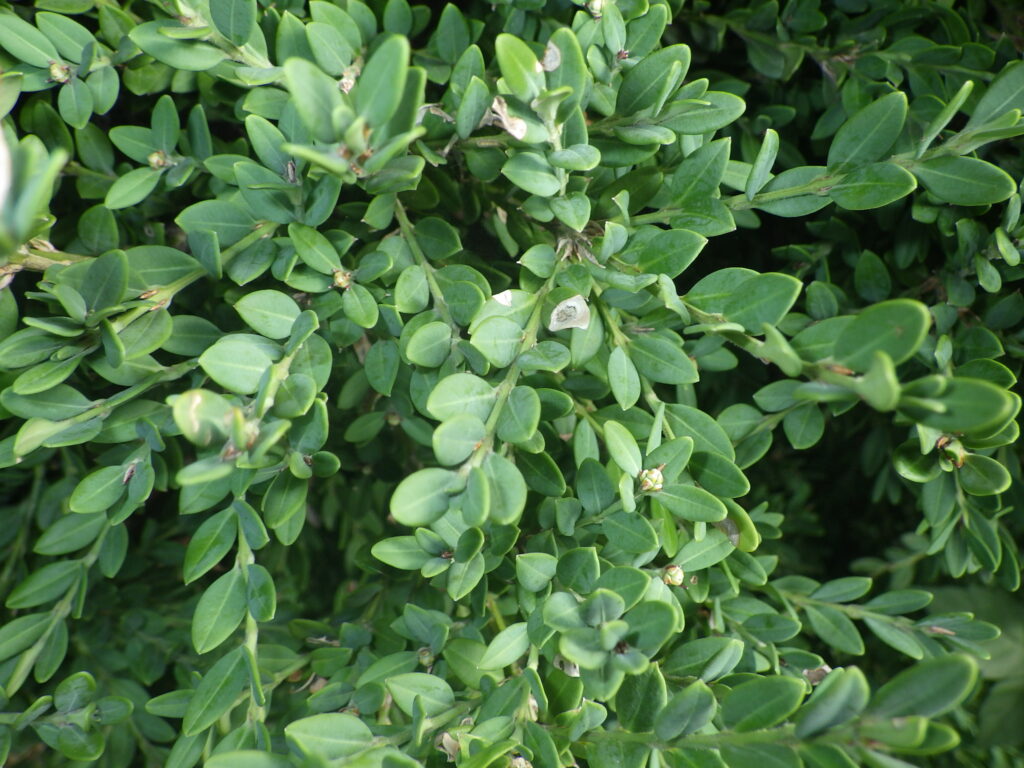
No.1328.1 Korean Boxwood (Buxus microphylla var. insularis)
A variety of boxwood with slightly smaller leaves and hairy branches and leaves (Hayashi, 2014). Native to Okayama and Hiroshima prefectures; also found in Korea and China.
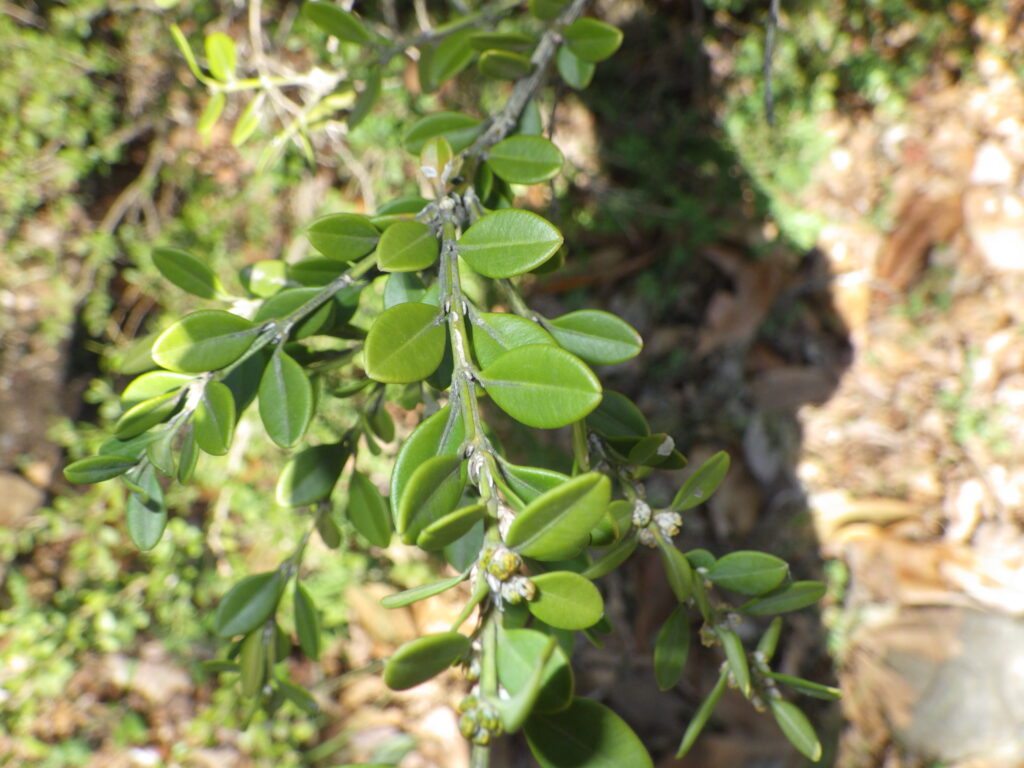
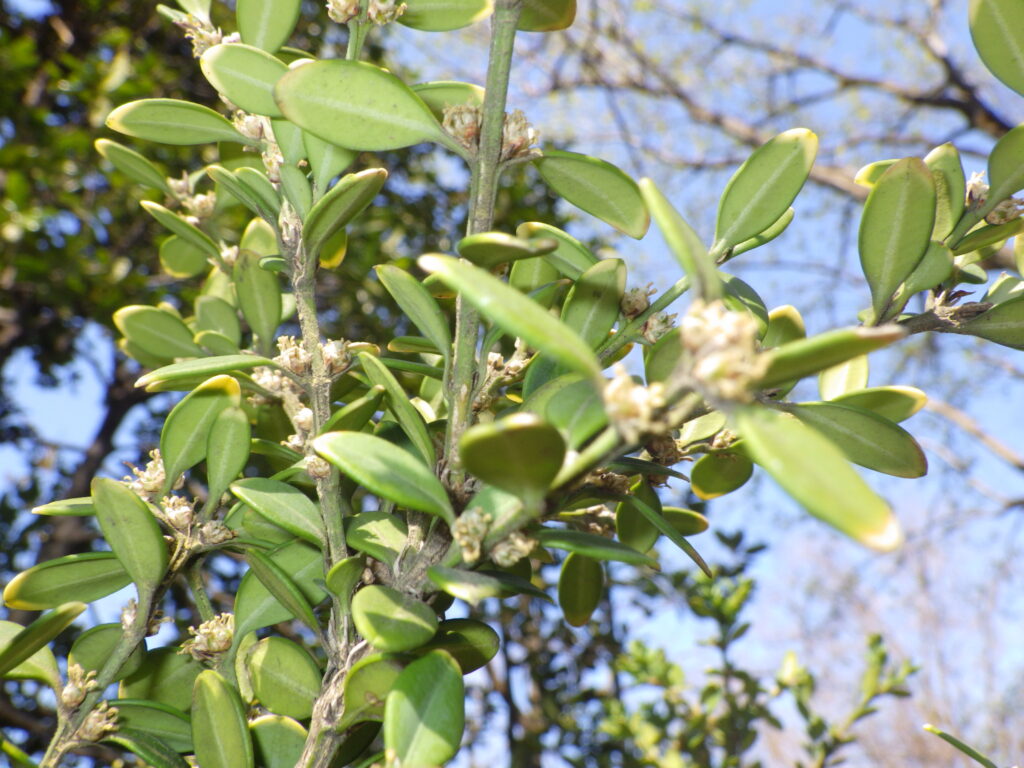
No.1329.a European boxwood (Buxus sempervirens)
Evergreen shrub or small tree (Rushforth, 1999). Reaches a height of 1-9m and a trunk diameter of up to 20cm. Leaves are oval-shaped, green to yellowish-green, 1.5-3cm long and 0.5-1.3cm wide, and arranged oppositely along the stem. The flowers are inconspicuous but strongly fragrant, greenish-yellow, without petals, and are insect-pollinated. Native to Western Europe, Southern Europe, Northwest Africa, Southwest Asia, southern England to northern Morocco, and the northern Mediterranean to Turkey. It grows in chalky or limestone-derived soil and is most commonly found as undergrowth in forests of large trees such as the European beech (Fagus sylvatica), and sometimes in open, dry mountainous areas of the Mediterranean region. This corresponds to the population cultivated in Japan and known as "boxwood," but Hayashi (2014) states that the details are unknown, and it seems there are some uncertainties as to whether the Japanese boxwood is actually European boxwood.
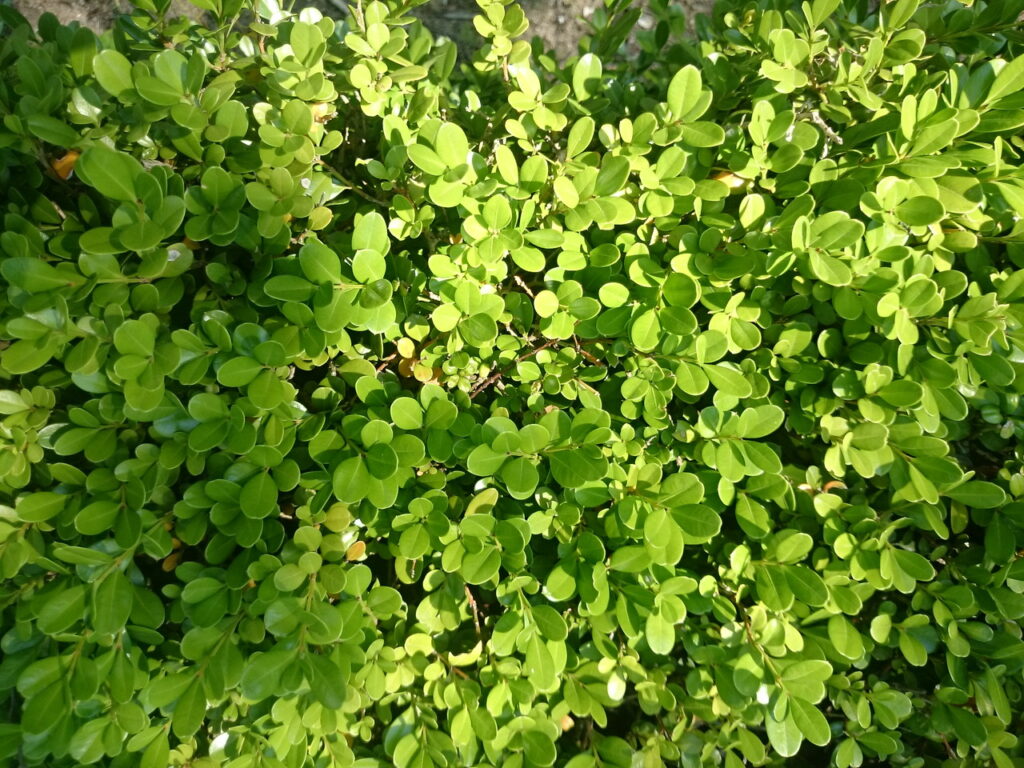
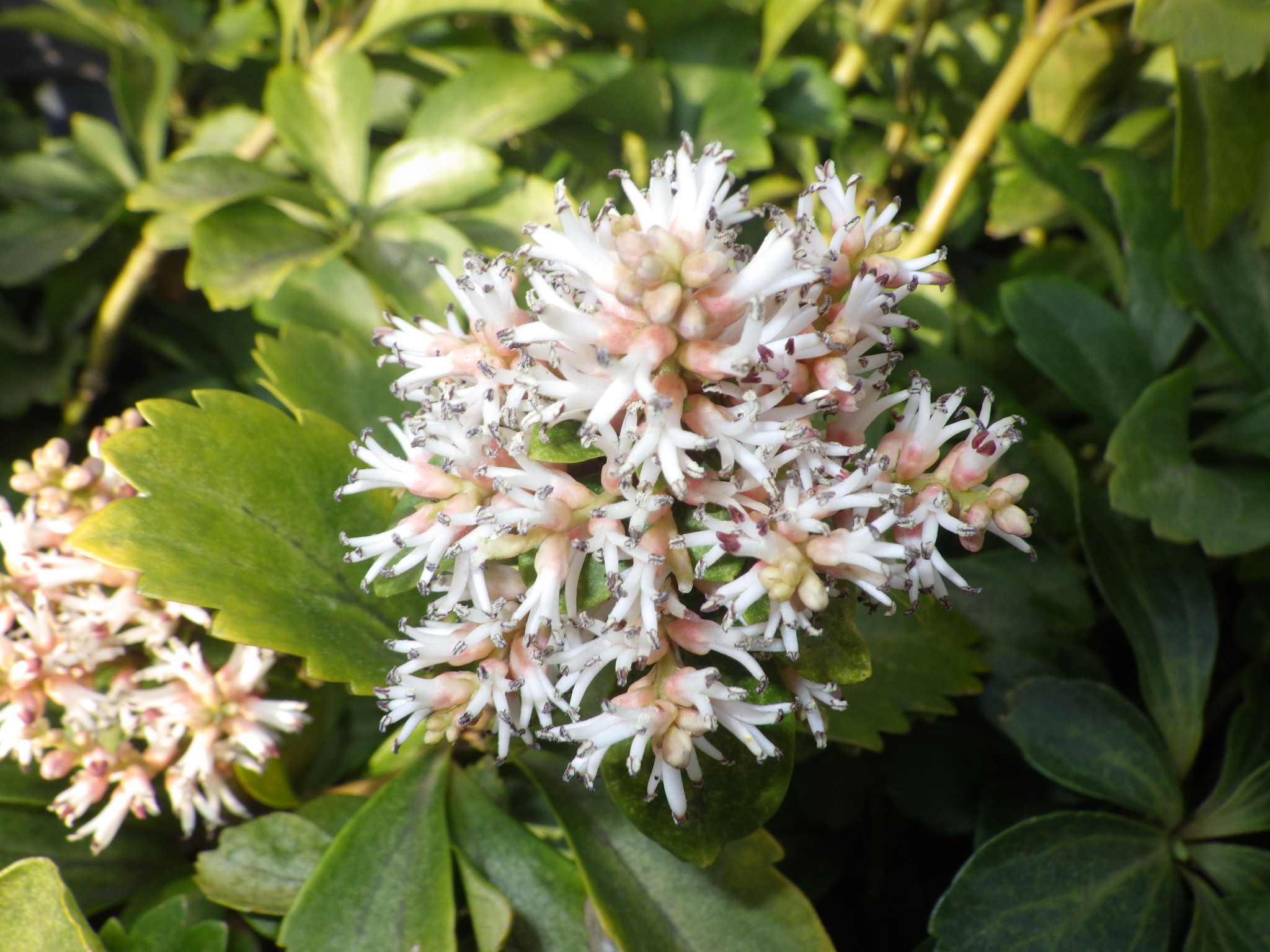
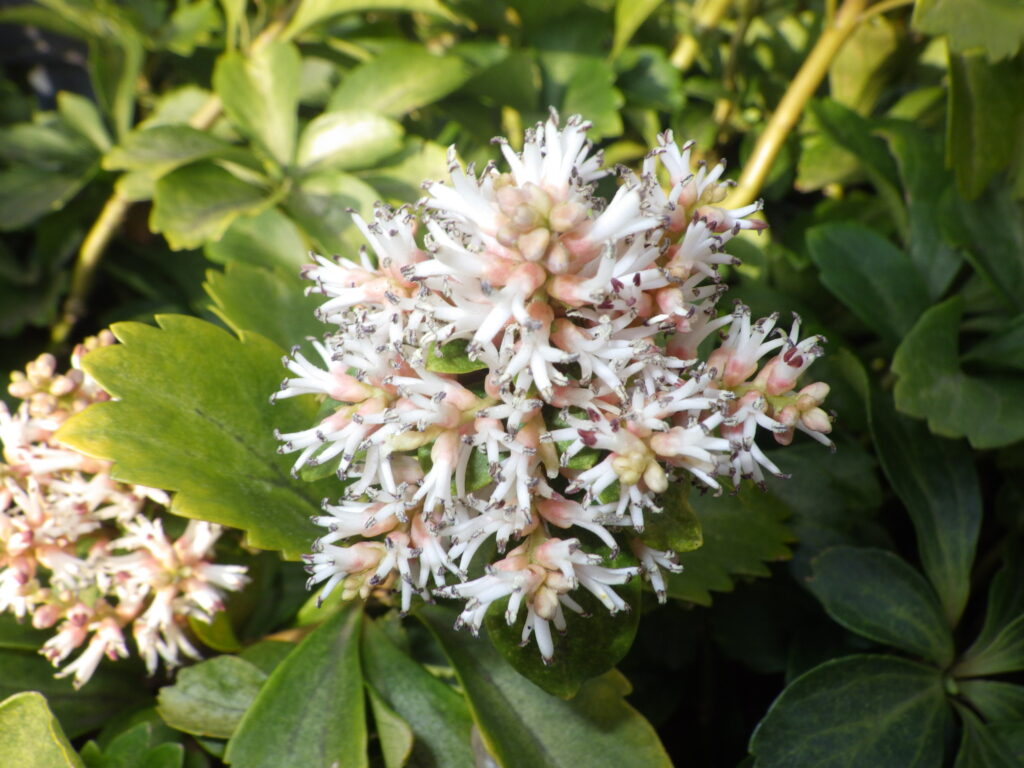
No. 1330 Pachysandra terminalis
An evergreen subshrub (a wild flower). Monoecious. The lower part of the stem creeps along the ground, while the upper part grows obliquely upwards to a height of 20-30 cm. The leaves are thick, densely arranged alternately, ovate-elliptic or rhomboid-obovate, 5-10 cm long and 2-4 cm wide. The upper half has coarse serrations. Flowering occurs from March to May. Male flowers are densely clustered at the top of the stem, with 5-7 female flowers below them. Neither male nor female flowers have petals, but have four sepals. The fruit is a drupe, ovate about 1.5 cm long, ripening to white. Distributed in Hokkaido, Honshu, Shikoku, Kyushu, and China. It grows in clusters in mountain forests. It is also cultivated for ornamental purposes.
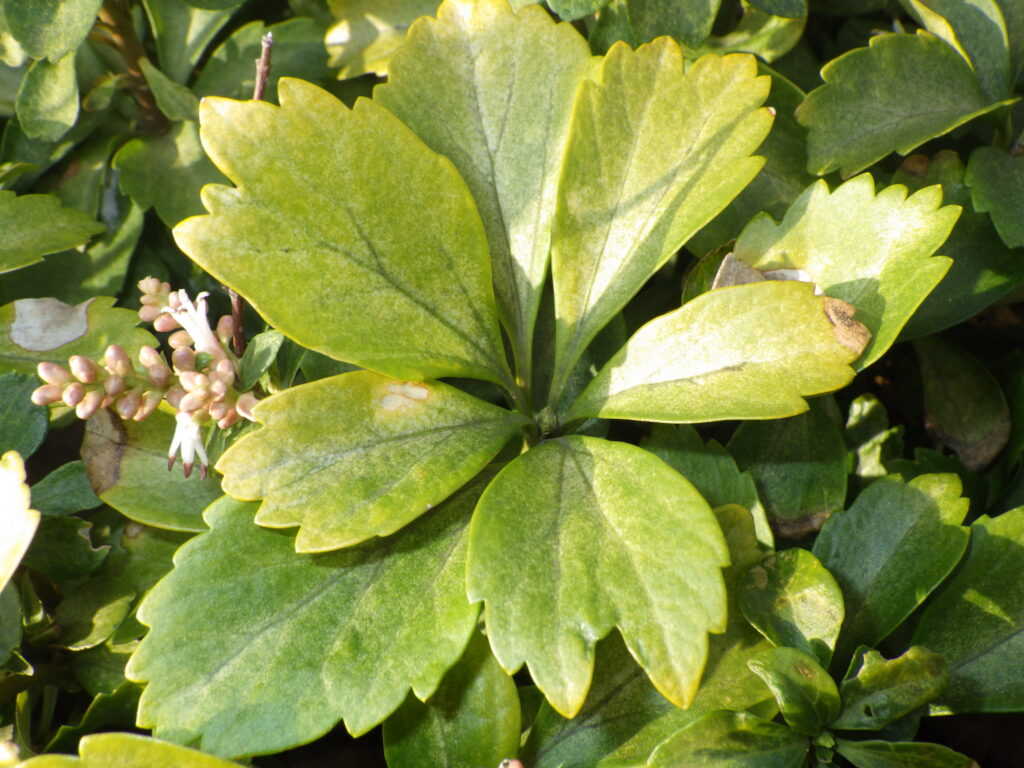
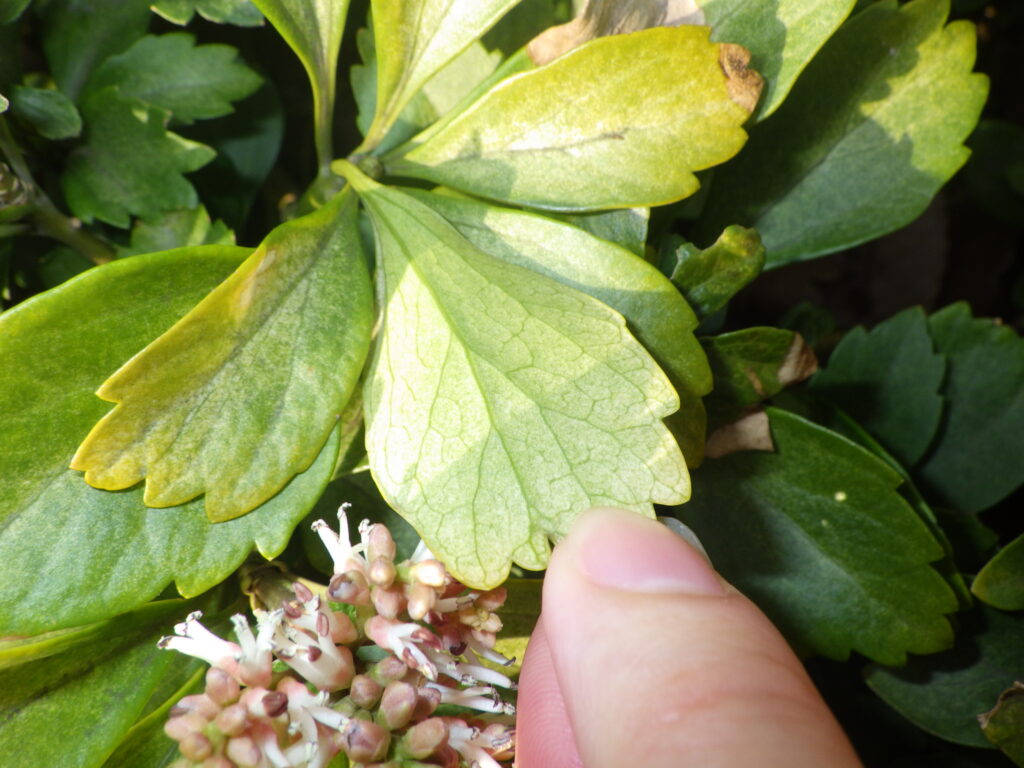
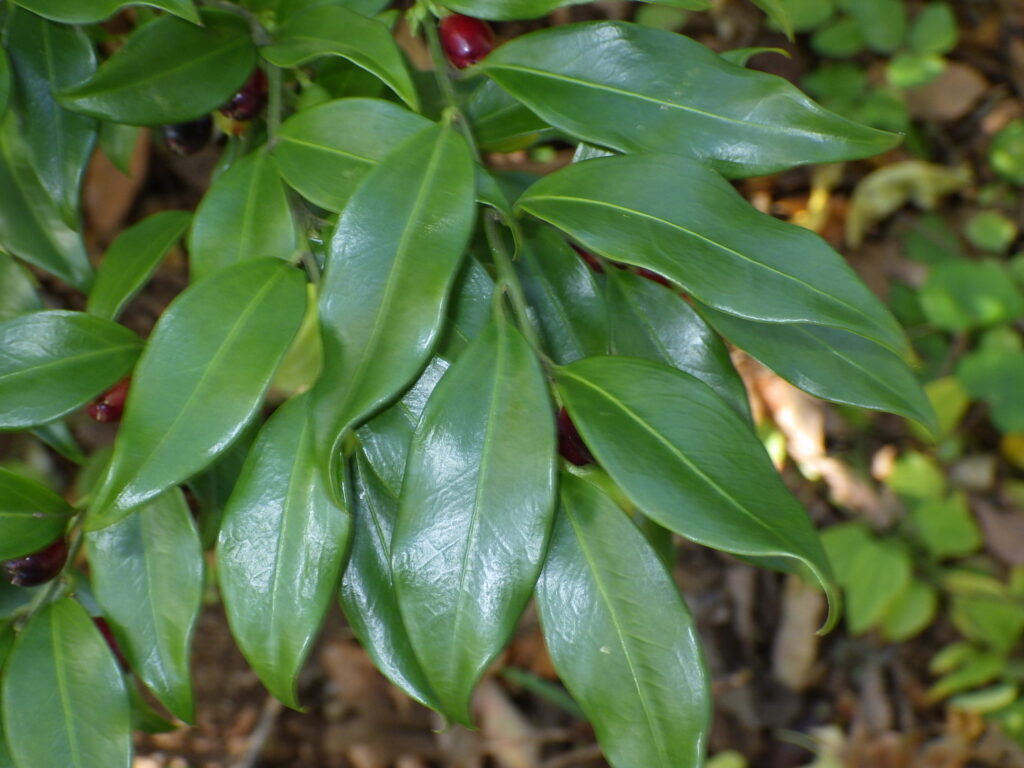
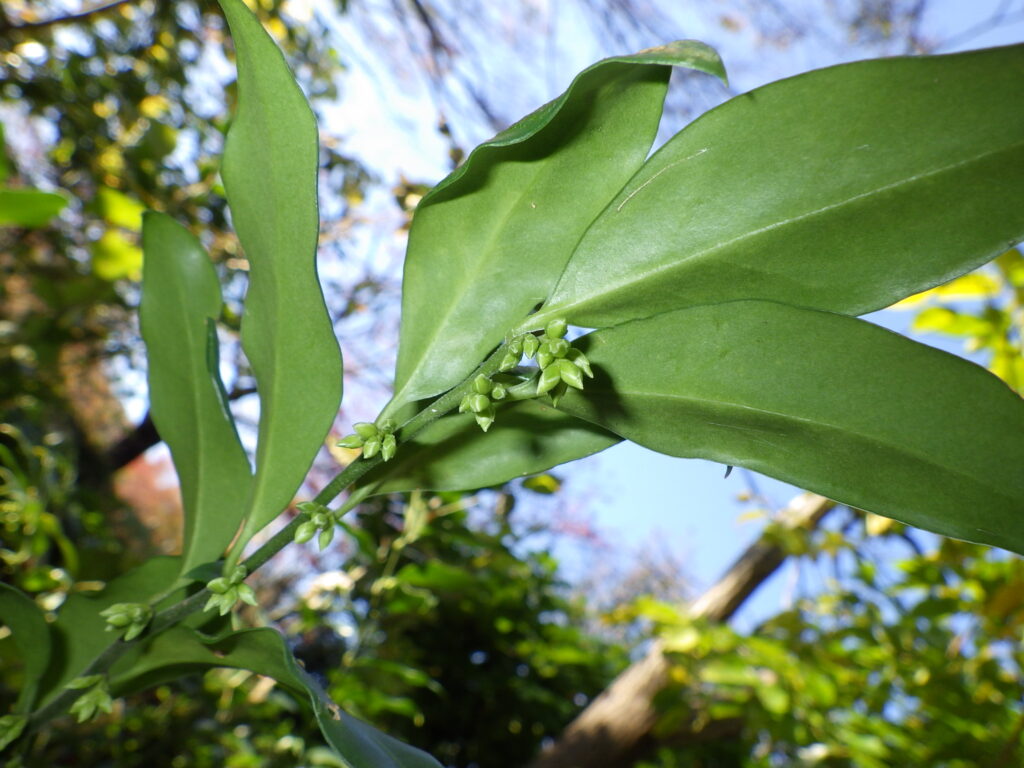
No.1330.a Digyna Himalayan Sarcococca hookeriana var. digyna
Himalayan sarcococca hookeriana is a shrub or small tree (Flora of China). The origin of its Japanese name is unknown. It grows up to 3m tall. Young branches have longitudinal ridges and are covered with soft hairs. The leaf blades are lanceolate, oblong, oblong-lanceolate, narrowly lanceolate, rarely elliptic or elliptic-elliptic, dark green, 3–8 (–11) × (0.7–)1.3–1.8 (–3) cm. The leaves are 8 (–3) cm long, dark green along the axis, with many hairs along the midrib, reduced at the base and pointed at the apex. The involucral bracts are ovate or ovate-lanceolate, subscalloped at the apex, and covered with downy hairs on the outside. Male flowers number 5-8, borne at the tip of the inflorescence, with short pedicels or no sessile flowers. The basal flowers have two bracts, and four petals; the inner petals are broadly elliptical or subglobose, 3-3.5 mm long, while the outer petals are shorter and have many hairs on the outside. Female flowers number 1-2, borne at the base of the pedicel, with flowers and pedicels 6-7 mm long, several ovate, scaly bracts, and perianth segments similar to bracts, about 2 mm long. The fruit is spherical, and the capsule is black or bluish-black. Two to three styles, about 2 mm long, are erect and recurved at the tip. var. hookeriana has alternate leaves, lanceolate or nearly oblong leaf blades 5-8 × 1.3-1.8 cm, and three styles, and is distributed in Tibet, Afghanistan, Bhutan, northern India, and Nepal. var. digyna has opposite or subopposite leaves at the tips of branches, and the leaf blade shape and size are more diverse, ranging from elliptic to lanceolate, oblong, lanceolate, narrowly lanceolate, and oblong, measuring 3–11 × 0.7–3 cm; it has two styles and is distributed in China (Chongqing, western Hubei, southern Shaanxi, Sichuan, and Yunnan provinces), growing in forests. In Japan, it is rarely cultivated for ornamental purposes.
References
Hayashi, Masayuki. 2014. 1100 Tree Leaves Identified Through Real-Life Scans. Yama-kei Publishers, Tokyo. 759pp. ISBN: 9784635070324
Rushforth, K. 1999. Trees of Britain and Europe. Harpercollins Pub Ltd, Collins. 1336pp. ISBN: 9780002200134