Most plants in the Alstroemeriaceae family are perennials. They are distributed in Central and South America. Many species have tubers or rhizomes, and many members of the Alstroemeriaceae family have beautiful flowers, leading to extensive cultivation as horticultural plants. The flowers have three inner perianth segments and three outer perianth segments (sometimes fused, sometimes not), three inner stamens and three outer stamens, and the pistil appears as one stamen due to the fusion of three carpels, with an inferior ovary.
This article provides a comprehensive, illustrated guide to plants belonging to the Liliaceae family.
The basic information is based on Tsukamoto (1994). Photos are replaced as better ones become available. Also, while the identification is done by the author, please note that it may be changed without notice if there are any misidentifications.
No.0317.a Alstroemeria pulchella (Lycoris radiata)
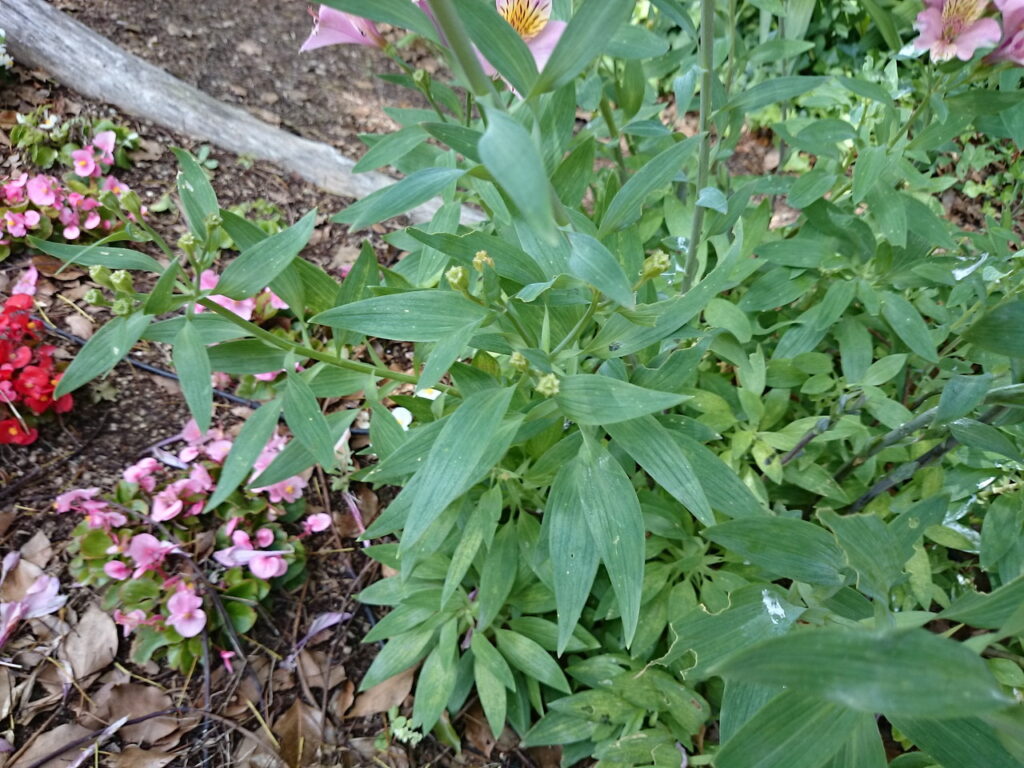
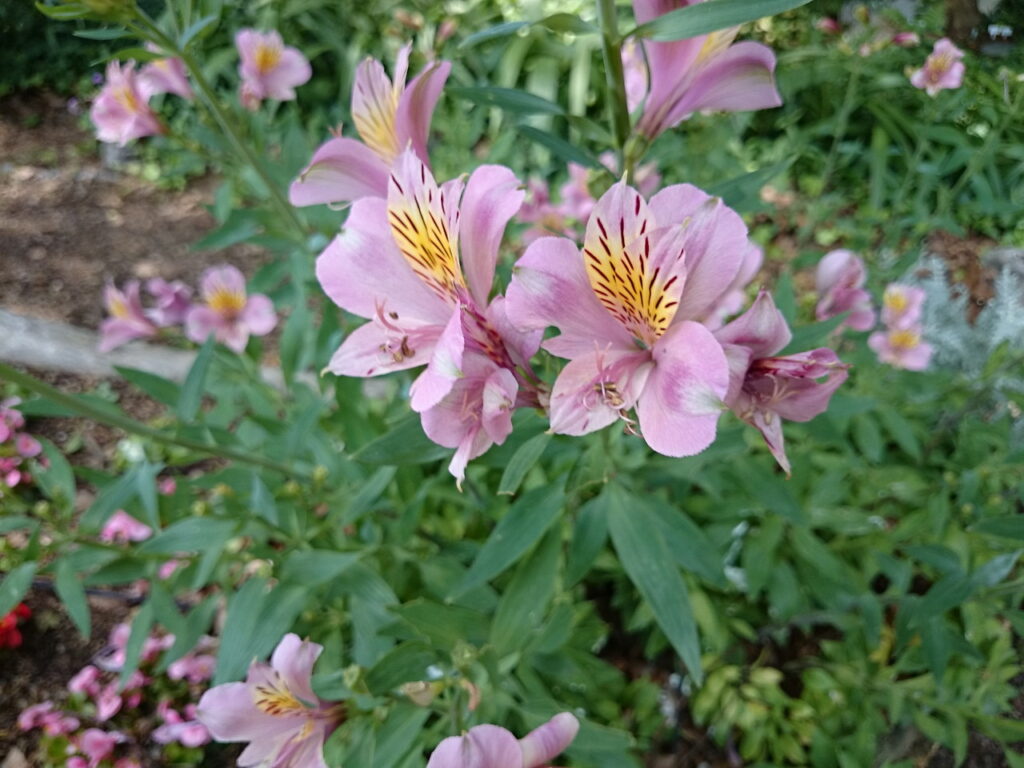
This is a perennial herb. It grows to about 1 meter tall, and its leaves are oblong or spatulate. Flowers with short pedicels are borne in an umbel-like arrangement at the top of the stem. The six perianth segments are of equal length, forming a tubular shape and semi-opening. The flowers are red, with a yellowish-green tip and many short black stripes on the inside. The tubers form shallowly from the ground and divide readily. It grows vigorously in the cooler temperatures of spring and autumn, but weakens in the high temperatures of midsummer, flowering in May-June and in autumn. There are about 50 species of Alstroemeria distributed in South America, but modern horticultural varieties are mainly bred from species native to Chile. Species from north of Chile are not cold-hardy. It produces fleshy, cylindrical tubers or rhizomes, but the depth at which the tubers are formed varies depending on the species. The petioles of the stem leaves are twisted, so the underside often faces the upper side. The flowers are borne in terminal inflorescences and have bracts. The flower has six perianth segments and six stamens. The ovary is inferior and has three chambers, with one style and a three-lobed stigma. The fruit is a capsule. It is native to northern Brazil.
References
Tsukamoto, Yotaro. 1994. Encyclopedia of Horticultural Plants, Compact Edition. Shogakukan, Tokyo. 3710pp. ISBN: 9784093051118