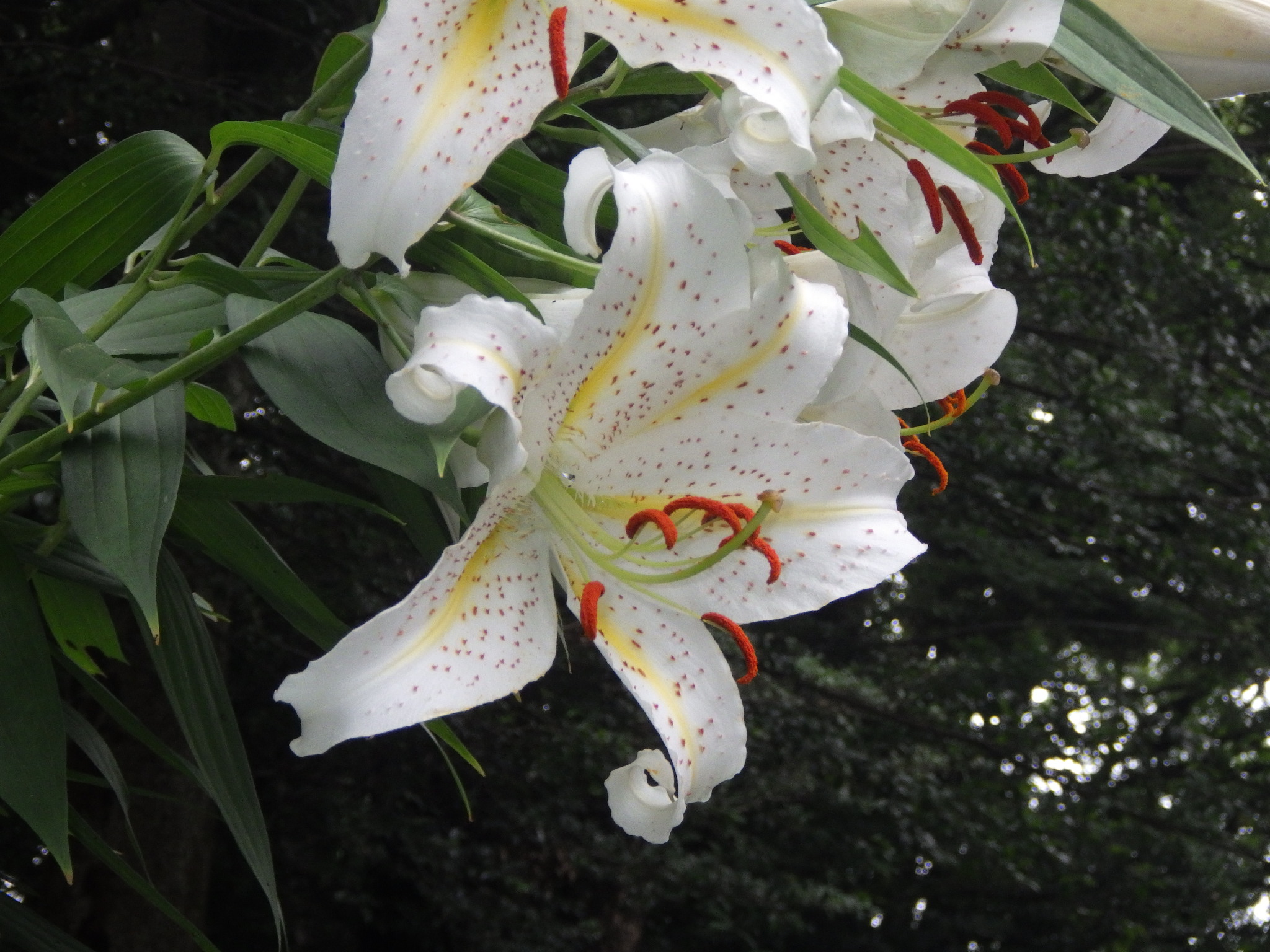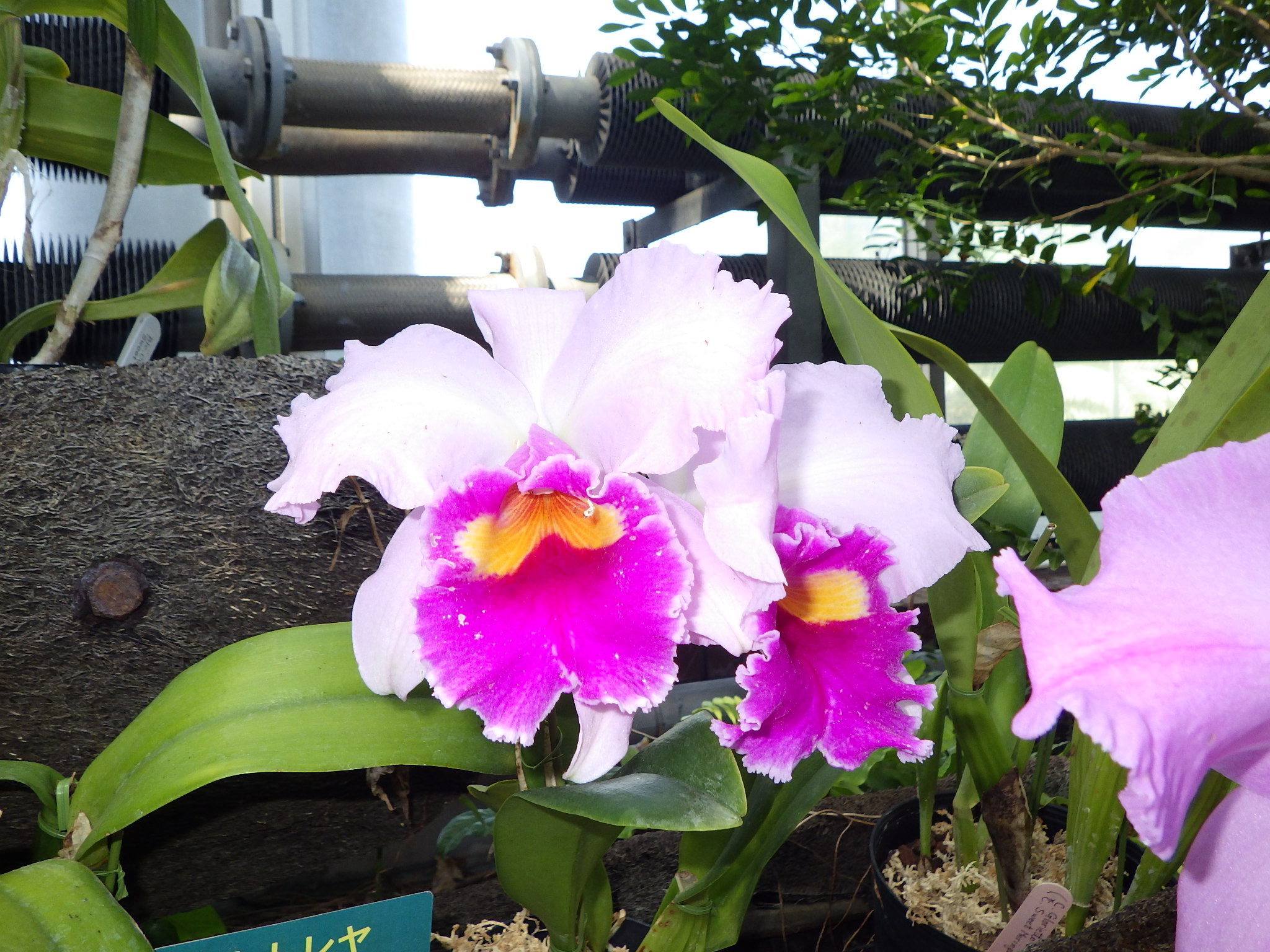
Orchids (Orchidaceae) are terrestrial, epiphytic, lithophytic, and mycoheterotrophic perennial herbs. Stems are monoaxial (monostalked) or sympodial (compound), with long stems, rhizomes, or enlarged pseudobulbs. Leaves are mostly flattened, with a tubular sheath at the base, sometimes reduced to scales. Flowers are bilaterally symmetrical, bract-bearing, and arranged in spikes or racemes, rarely solitary. There are typically three sepals and three petals, although some species have fused lateral sepals. The three sepals are almost identical. The two lateral petals are similar, but the central one, called the labellum, is distinctive in shape, size, and color, and sometimes has a spur at its base. In most cases, the stamens and pistil are fused to form a column, with the anthers on the upper surface and the stigma on the lower surface. Generally, part of the stigma is modified to form a beak. The anthers are usually two-chambered, containing 2 to 8 pollinia, which are aggregates of waxy or powdery pollen, with the base typically attached to a sticky substance. The fruit is mostly a capsule that splits into three sections, and the seeds are extremely small. They are widely distributed throughout the world, with approximately 860 genera and 26,000 species known globally, and approximately 86 genera and 320 species known in Japan.
This article provides a comprehensive, field guide-style introduction to orchid species.
The basic information is based on Tsukamoto (1994) and the Kanagawa Prefectural Flora Survey Association (2018). Photographs are replaced as better ones become available. While the identifications are made by the author, please note that they may be changed without notice if misidentifications are found.
- No. 0373 Hemipilia graminifolia var. graminifolia
- No.0374.a Okinawa Plover (Hemipilia lepida)
- No.0386 Habenaria radiata (Egret Flower)
- No. 0422 Vanilla planifolia
- No.0433 Spiranthes sinensis subsp. australis
- No.0433.a Spiranthes sinensis subsp. sinensis
- No.0439.a Goodyera hachijoensis var. yakushimensis
- No.0442 Bletilla striata
- No.0442.1 White-flowered Bletilla striata f. gebina
- No.0445 Cochran (Liparis nervosa)
- No.0456 Ebine Calanthe discolor
- No.0461.a Phaius tankervilleae
- No. 0462 Cremastra variabilis
- No.0465 Dendrobium moniliforme
- No. 0468 Hinoderan Cattleya labiata
- No.0472.a Bulbophyllum boninense (Ogasawara's shikoran)
- No. 0474 Cymbidium goeringii
- No. 0476 Cymbidium dayanum
- No.0478.a Cymbidium cv. (a cultivated variety of the genus Cymbidium).
- No.0478.b Oncidium sphacelatum
- No.0487.a Jade Orchid (Vanda coerulea)
- No. 0488 Phalaenopsis aphrodite
- References
No. 0373 Hemipilia graminifolia var. graminifolia
This is a deciduous perennial herb. The rhizome is oval-spherical with a few fibrous roots. The stem is erect or ascending depending on the growing environment, reaching a height of 5-20 cm, with 2-4 leaves clasping the stem. It flowers from July to August. 3-12 flowers bloom at the top of the stem, usually facing in one direction, and are typically reddish-purple, although there is considerable individual variation in flower color. The bracts are narrowly lanceolate. The dorsal sepal is ovate, and the lateral sepals and petals are obliquely ovate. The dorsal sepal and lateral petals meet at the tip, forming a helmet-like shape. The labellum is longer than the sepals and deeply 3-lobed, with a thick spur that does not taper at the tip and is slightly curved. The capsule is cylindrical. It is distributed in Honshu, Shikoku, Kyushu, and Korea. It grows in slightly damp, rocky areas in mountainous regions.
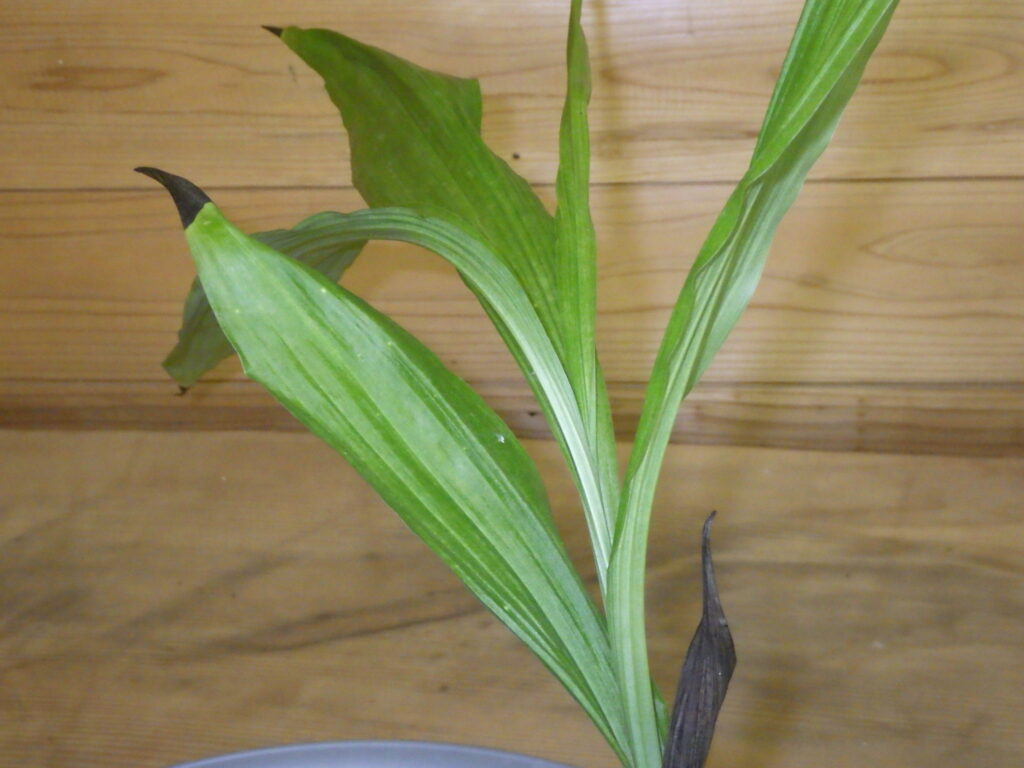
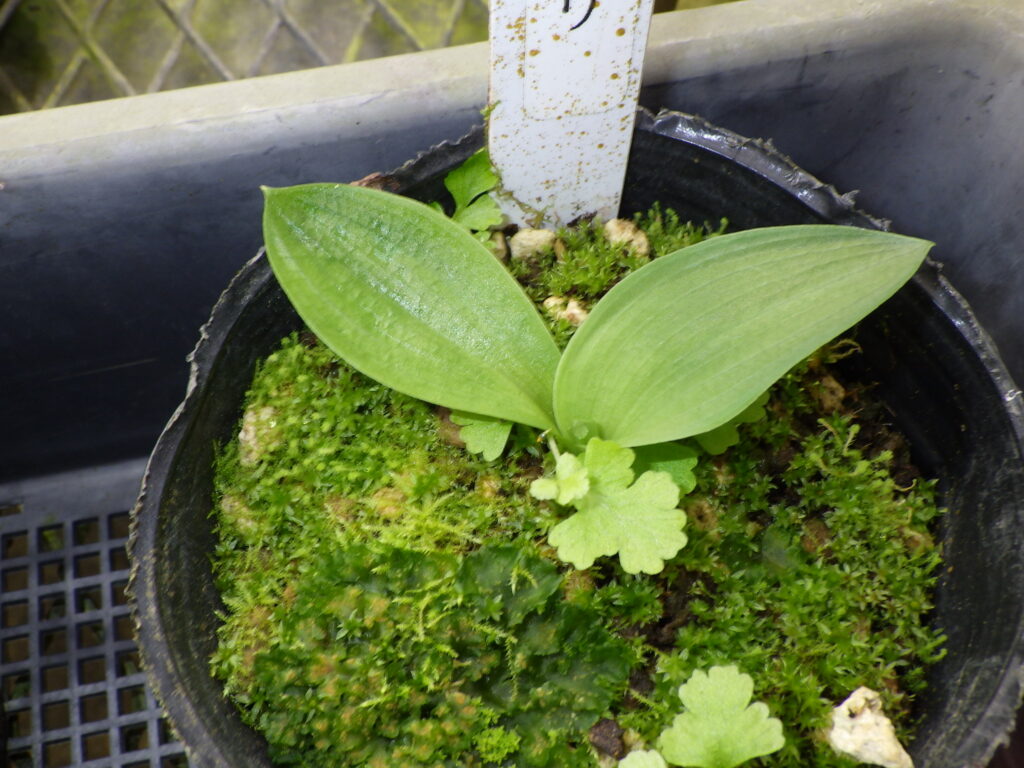
No.0374.a Okinawa Plover (Hemipilia lepida)
This is a perennial herb, growing to a height of 10-15 cm. The stem emerges from an oval-shaped tuber at the tip of a slender stolon. There are 2-4 leaves at the base, which are oblong and somewhat broad, 4-8 cm long and 1.5-2.5 cm wide. It flowers from February to April. The flowers are pale pink, with several flowers growing at the end of the stem. They are pale reddish-purple, and the labellum is 8-10 mm long, deeply 3-lobed, with the central lobe further divided into two. The calyx is oblong, 4-6 mm long, and the lateral petals are slightly shorter than the sepals. The spur is 4-5 mm long and slightly shorter than the ovary. It is endemic to Japan, distributed from Kyushu (southern part) to Okinawa, and inhabits crevices on damp rocks and grasslands along the coast.
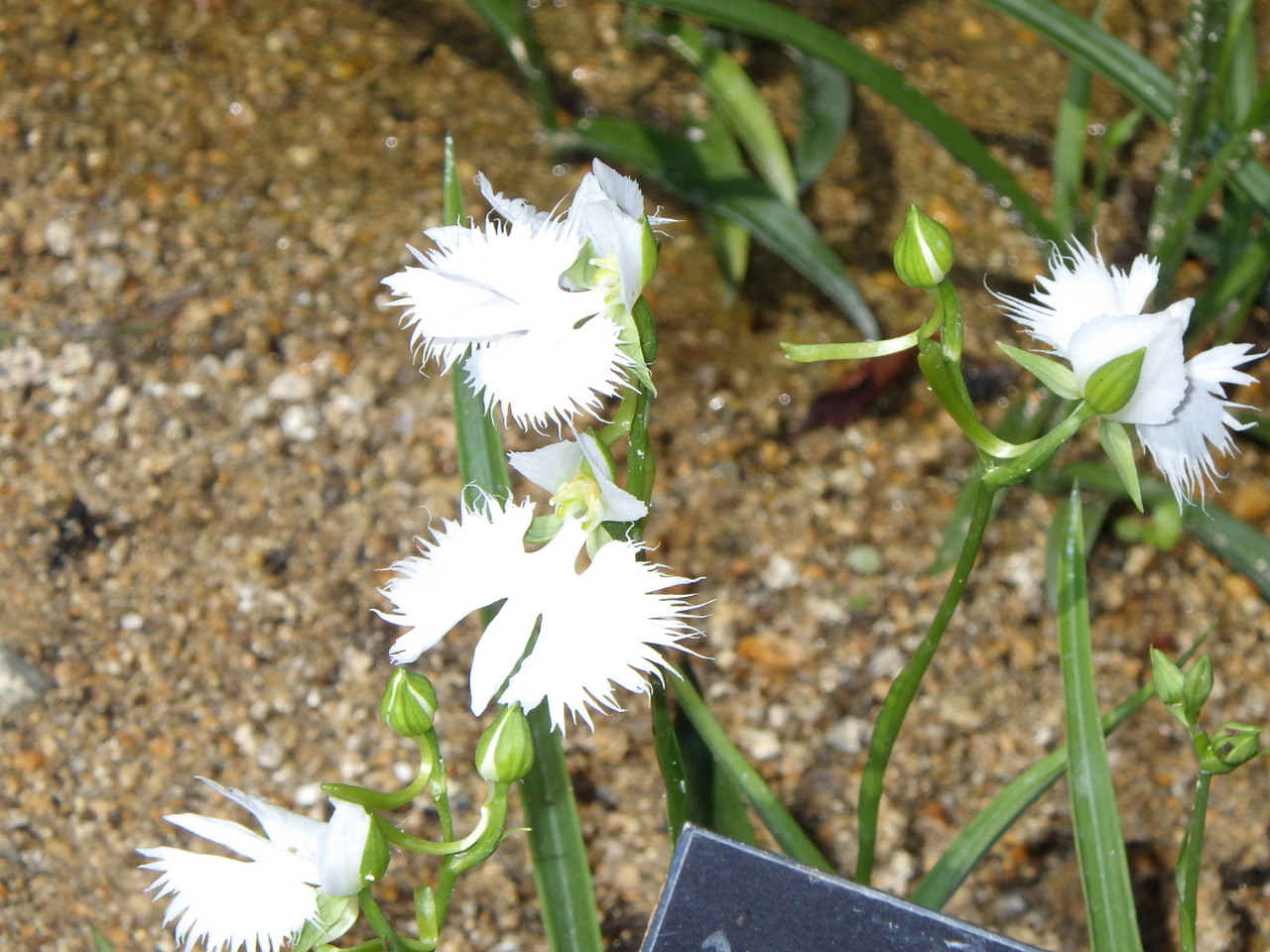
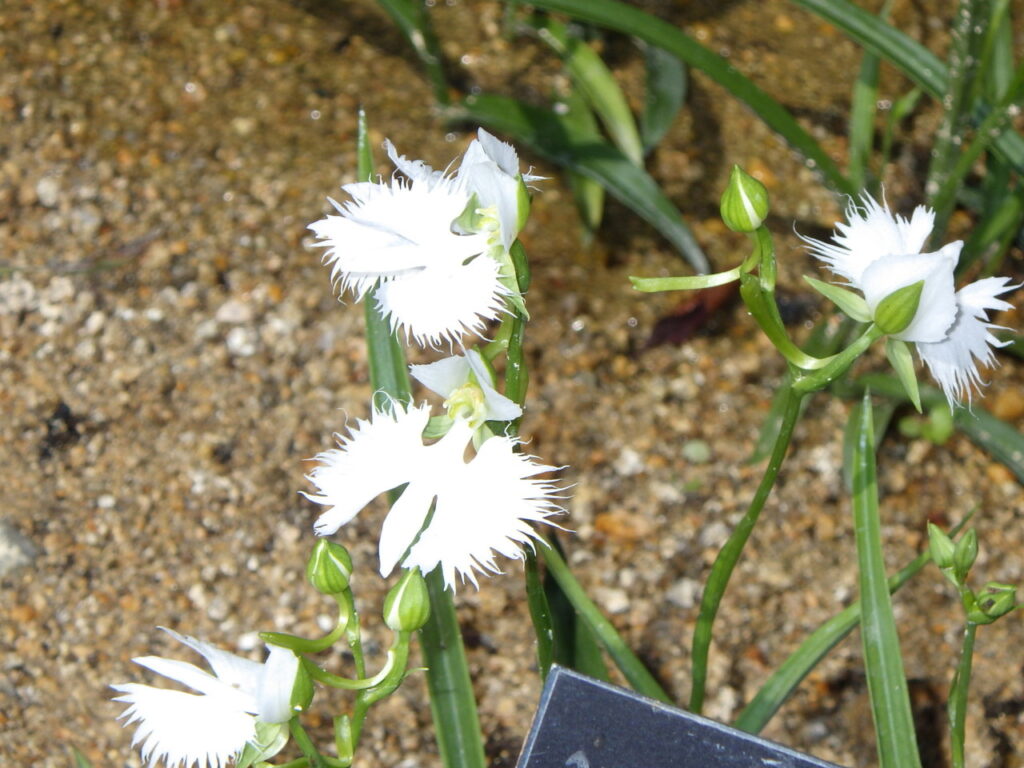
No.0386 Habenaria radiata (Egret Flower)
This is a perennial herb. The stem grows tall and solitary, reaching 15-50 cm, and bears 1-3 white flowers near the tip. It flowers from July to August. The flower is about 3 cm in diameter, with a large, deeply arranged labellum. The central lobe is lanceolate, while the lateral lobes are obliquely fan-shaped, spreading laterally with finely divided edges. The Japanese name comes from the fact that the open labellum resembles a white heron spreading its wings. The lateral petals are white and distorted ovate. The spur hangs down to a length of 3-4 cm, gradually thickening at the tip, where nectar accumulates. The flower has almost no fragrance, but occasionally some individuals exhibit a noticeable scent. The two anther locules are parallel, and each contains a yellow, ovate pollinia. The bracts are about 5 mm long and ovate-lanceolate. The three sepals are green, with the dorsal sepal being broadly ovate and the lateral sepals on either side being distorted ovate, about 8 mm long. There are a few thick roots underground. Several thick rhizomes, which closely resemble roots, also grow, and the tips of these rhizomes swell into tuberous structures, with only these parts surviving the winter. The following year, rhizomes emerge from these bulbs. There are 3-4 basal leaves at the base of the stem, and a few scale leaves above them. The leaves are alternate, with the lower leaves being larger, and are elongated linear, 5-10 cm long and 3-6 mm wide. It is distributed in the Korean Peninsula, the Russian Far East, eastern China, and Japan (Hokkaido, Honshu, Shikoku, and Kyushu), and inhabits slightly damp places.
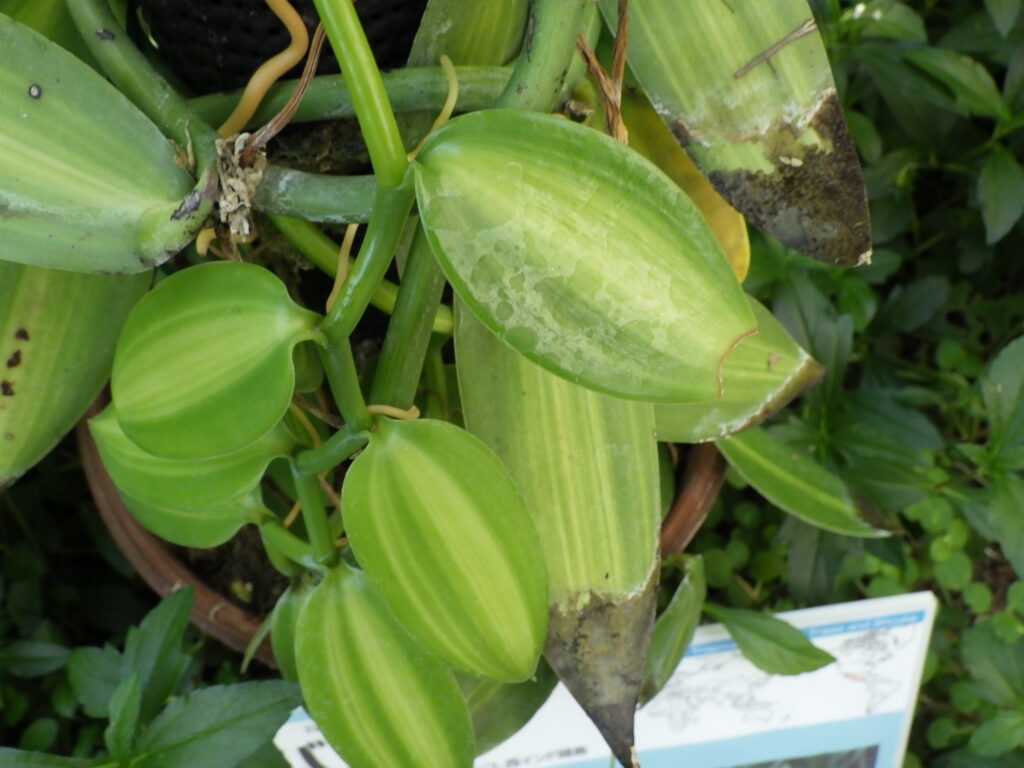
No. 0422 Vanilla planifolia
Commonly known as vanilla, it is a climbing perennial evergreen epiphytic orchid. It has adhesive roots. Its vines (stem) grow by twining around trees and other objects. They can grow to over 60m in length. Racemes of several fleshy, yellowish-green flowers, about 6cm in diameter, bloom from the leaf axils from spring to early summer. The flowers are not fragrant. The fruit that develops after flowering is a slender, cylindrical capsule. The fruit is initially green, but turns glossy purplish-brown when ripe. The pod contains countless tiny black seeds. The seeds are used as a raw material for fragrances, but the harvested seed pods have no scent. Only through repeated curing, fermentation, and drying does the pod develop its unique sweet aroma, gradually producing the sweet-smelling vanilla beans. This scent is mainly due to vanillin. By extracting the components of vanilla beans and dissolving them in a solvent, vanilla essence or vanilla oil can be produced. These are used medicinally for treating hysteria and as sedatives, and to flavor chocolate, ice cream, and confectionery. Native to Mexico and Central America, it is cultivated in hot and humid tropical climates. It is believed that cultivation began with the Totonaco people living on the eastern coast of Mexico to add it to a drink called xocolatl, which is made from cacao. In the 15th century, the Aztecs, who conquered the Totonaco, acquired vanilla, and it eventually fell into the hands of the Spanish, who conquered the Aztecs. There is also a theory that the conqueror Hernán Cortés brought it back to Europe. Originally used as a flavoring for chocolate, in the early 17th century, Hugh Morgan, the pharmacist to Queen Elizabeth I of England, used it in confectionery, and the Queen highly valued it. Even today, production takes a long time, so supply cannot keep up with demand, making it the second most expensive spice in the world, with 99% of the market being synthetic vanilla. Because stingless bees, a species endemic to Central America, visit the flowers, pollination was not possible outside of this region. However, in 1841, on the French colony island of Réunion in the Indian Ocean, a 12-year-old slave boy named Edmond Albius devised a method for artificially pollinating vanilla (Odoux & Grisoni, 2010).
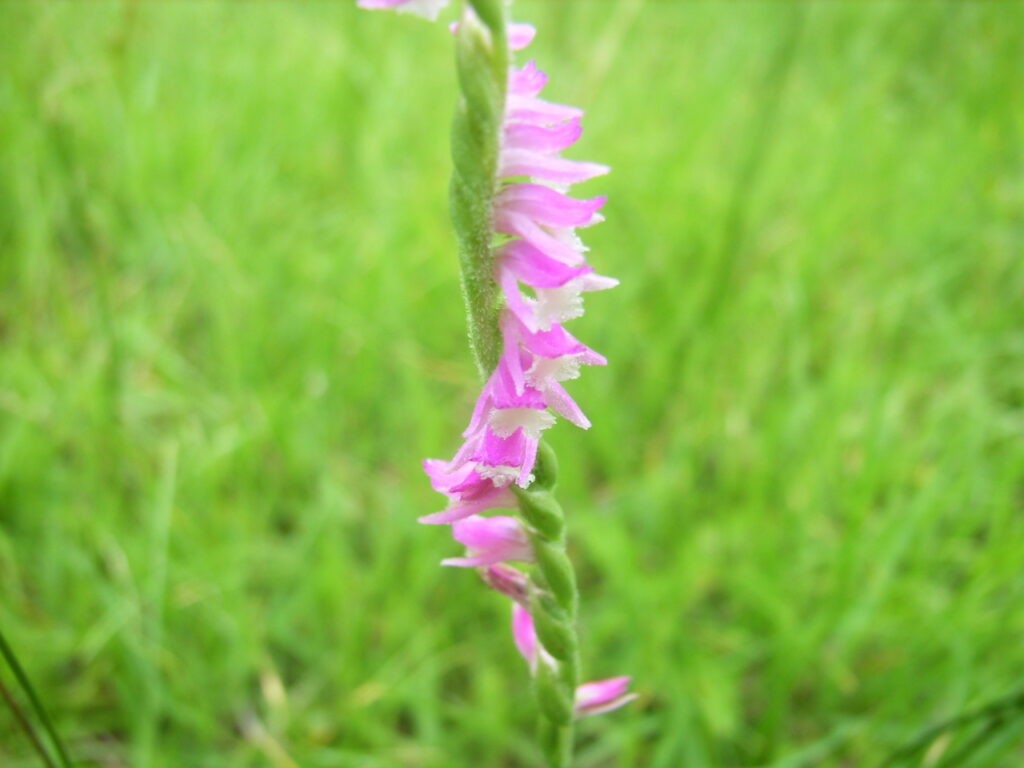
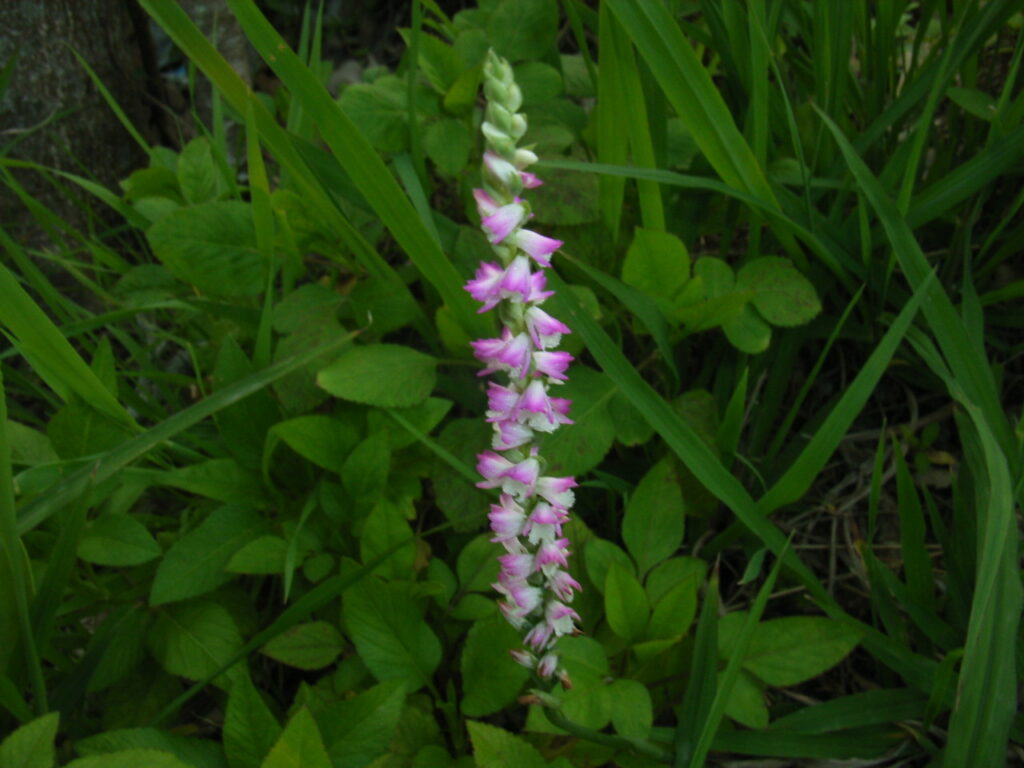
No.0433 Spiranthes sinensis subsp. australis
Also known as Mojizuri. The stems are 10-40 cm tall. The leaves are broadly linear, with 2-3 leaves arranged alternately at the base. The flowering period is from May to August. The flowers are pale pink and usually grow in many spirals at the top of the stem. The sepals and lateral petals are lanceolate. The labellum is white, obovate, with a downward-curving tip and serrated edges. The capsule is elliptical. It is distributed in Hokkaido, Honshu, Shikoku, Kyushu, the Ryukyu Islands, the Ogasawara Islands; Asia south of Sakhalin, Australia, Tasmania, and New Zealand. It prefers sunny grasslands and lawns. It grows in grasslands, lawns, and roadsides throughout the region and is the most common of the wild orchids. Known varieties include autumn-blooming f. autumnus and white-flowered f. albescens. The scientific name 'Ylist' is used. It has been found that twisting the inflorescence prevents pollination of neighboring flowers by leafcutter bees, which are pollinating insects, but at the same time reduces its appeal to bees. For this reason, the degree of twisting varies depending on the number of leafcutter bee populations present (Hayakawa and Sueji, 2017).
No.0433.a Spiranthes sinensis subsp. sinensis
This is a perennial herb, growing to a height of 20-50 cm. It has 2-3 leaves, broadly linear, 5-20 cm long and 0.3-1 cm wide. The tips are acute, and the base forms a sheath. It flowers from March to May. The flowers are pale pink and resemble those of Spiranthes sinensis, but the inflorescence is hairless. It is distributed from Hachijojima, Aogashima, the Nansei Islands (south of the Amami Islands) to tropical Asia and Australia. It grows in grasslands and lawns. The scientific name 'Ylist' is used.
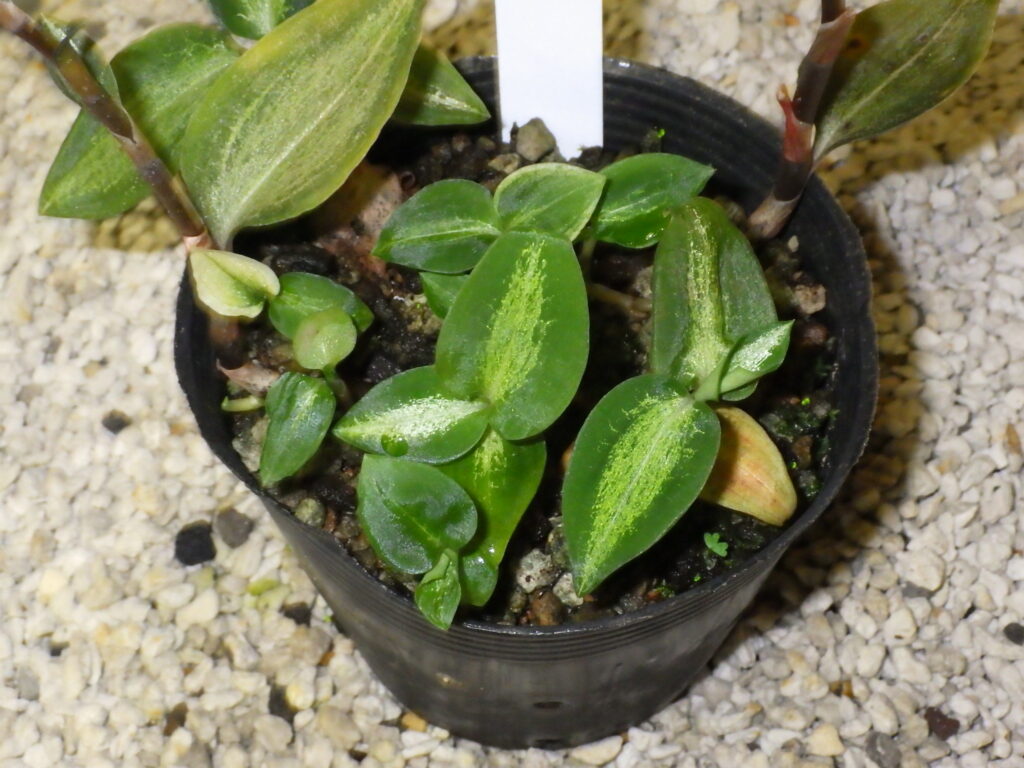
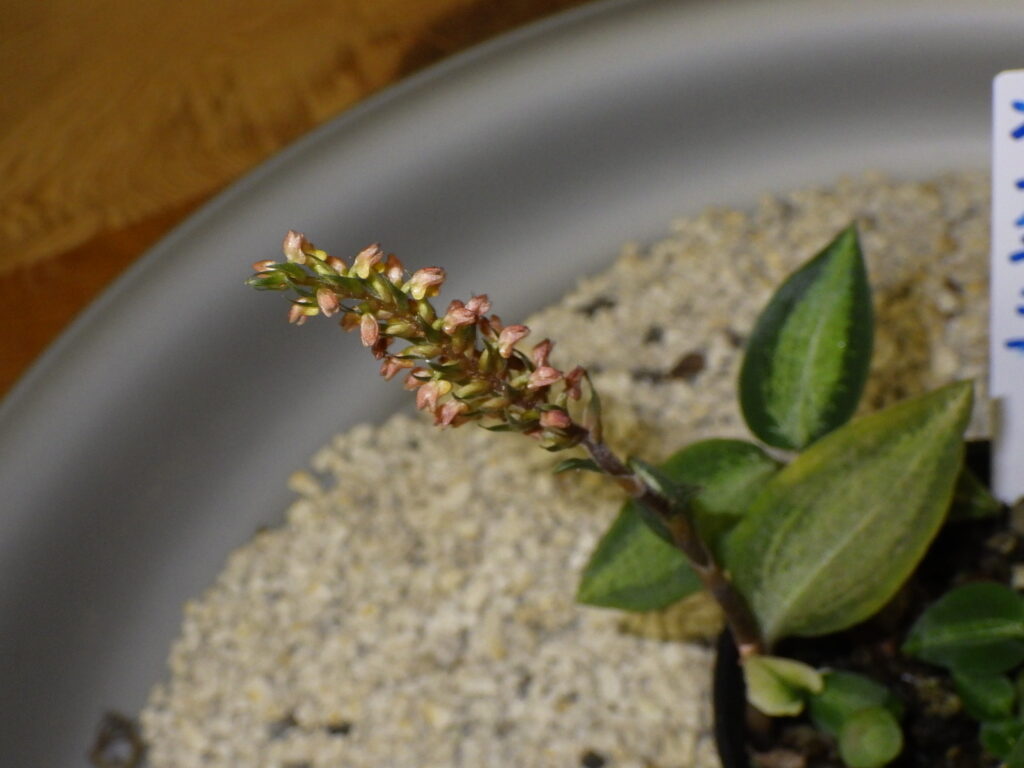
No.0439.a Goodyera hachijoensis var. yakushimensis
This is a perennial herb, growing to a height of 10-25 cm. The stem has a long, creeping base and an upright upper section. It has 3-4 leaves, with oblique-ovate-elliptic to narrowly ovate blades, 4-8 cm long. White spots run in a band along the midrib. It flowers in October. The flowers are densely packed in racemes at the top of the stem and are pale pink. The bracts are linear-lanceolate with an acute apex. The dorsal sepal is ovate, and the lateral sepals are oblong-ovate-ovate, about 4 mm long. The lateral petals are oblanceolate, almost the same length as the sepals. The labellum is broadly ovate, with a white, vesicular swollen portion at the base. It resembles *Aster tataricus*, with white spots along the midrib of the leaves, but differs in that its leaves are slightly longer (about 4-8 cm) and the swollen portion at the base of the labellum is white instead of yellow. It is distributed in Kyushu (southern Kyushu and Yakushima). It inhabits evergreen broadleaf forests.
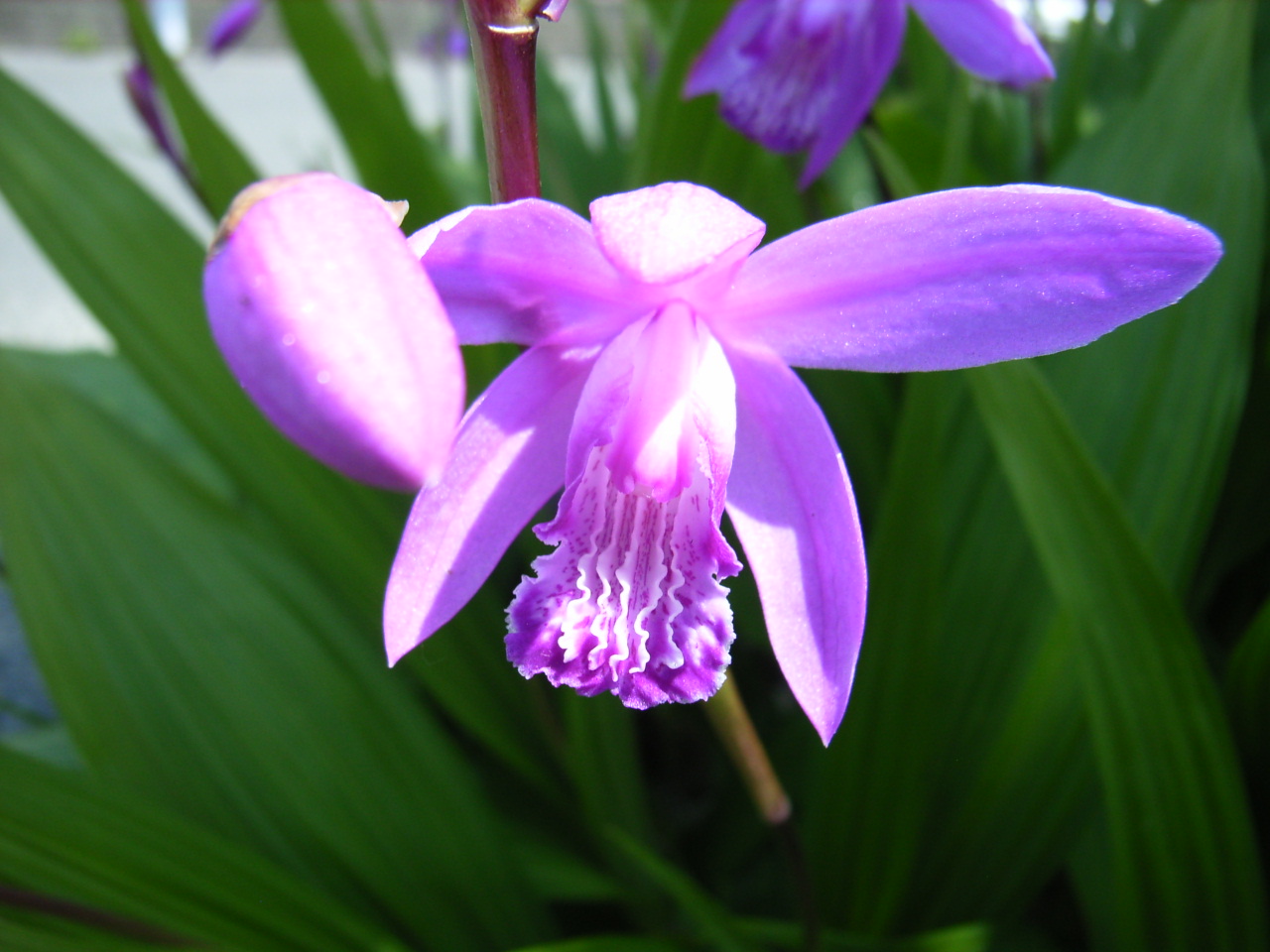
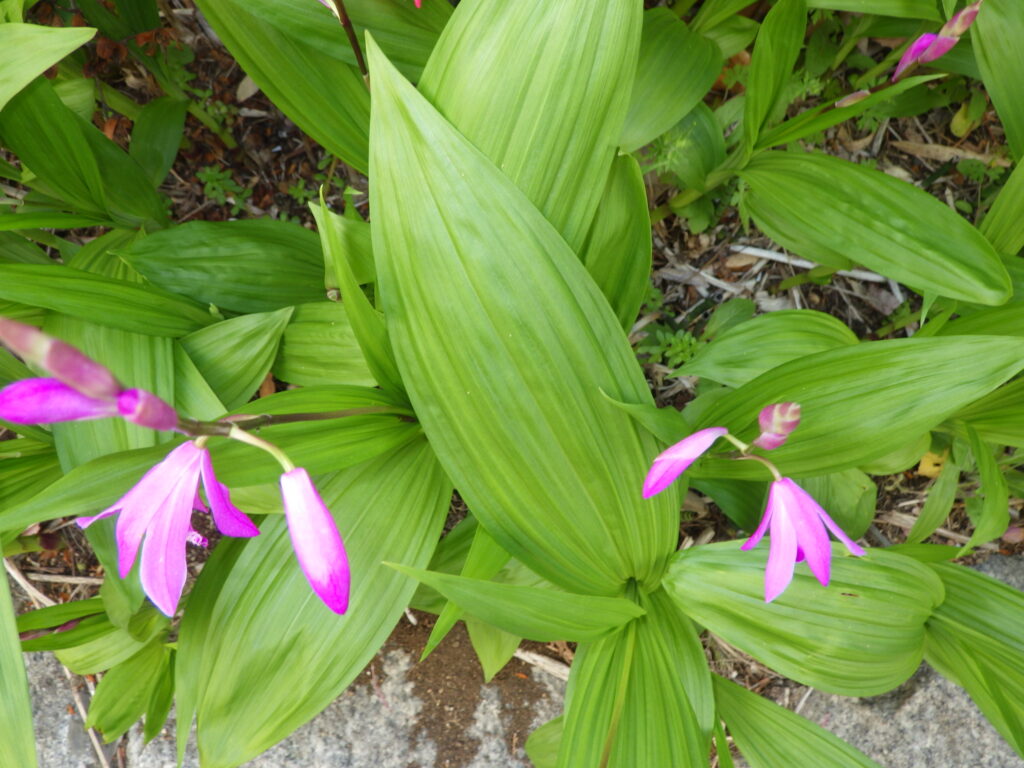
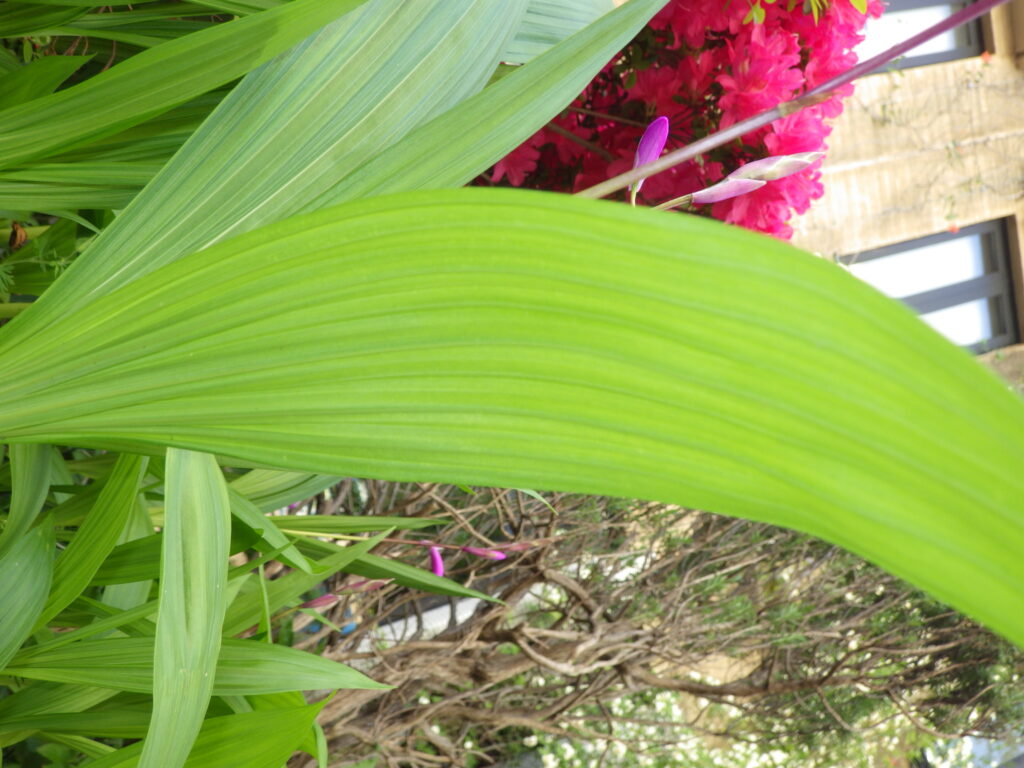
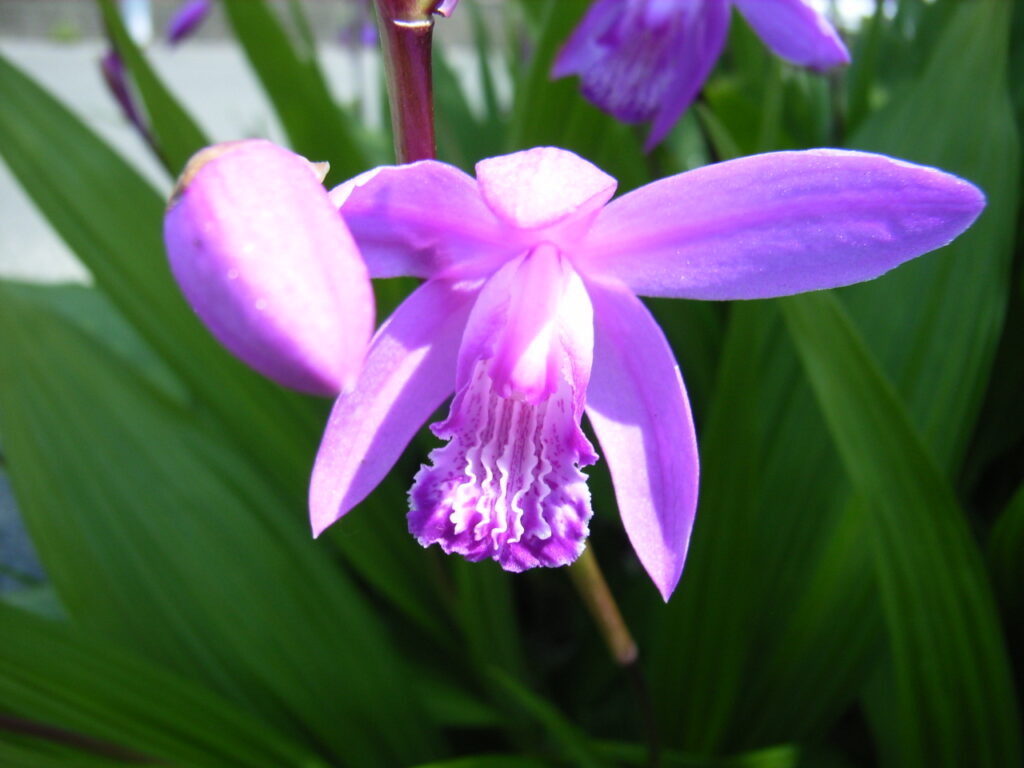
No.0442 Bletilla striata
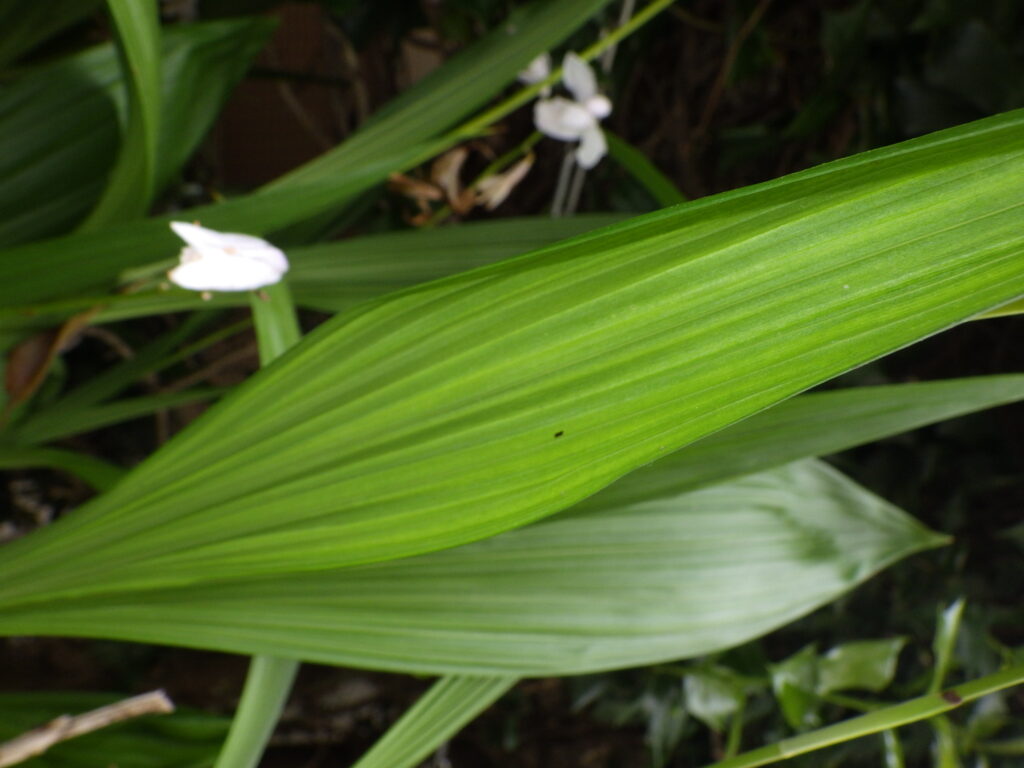
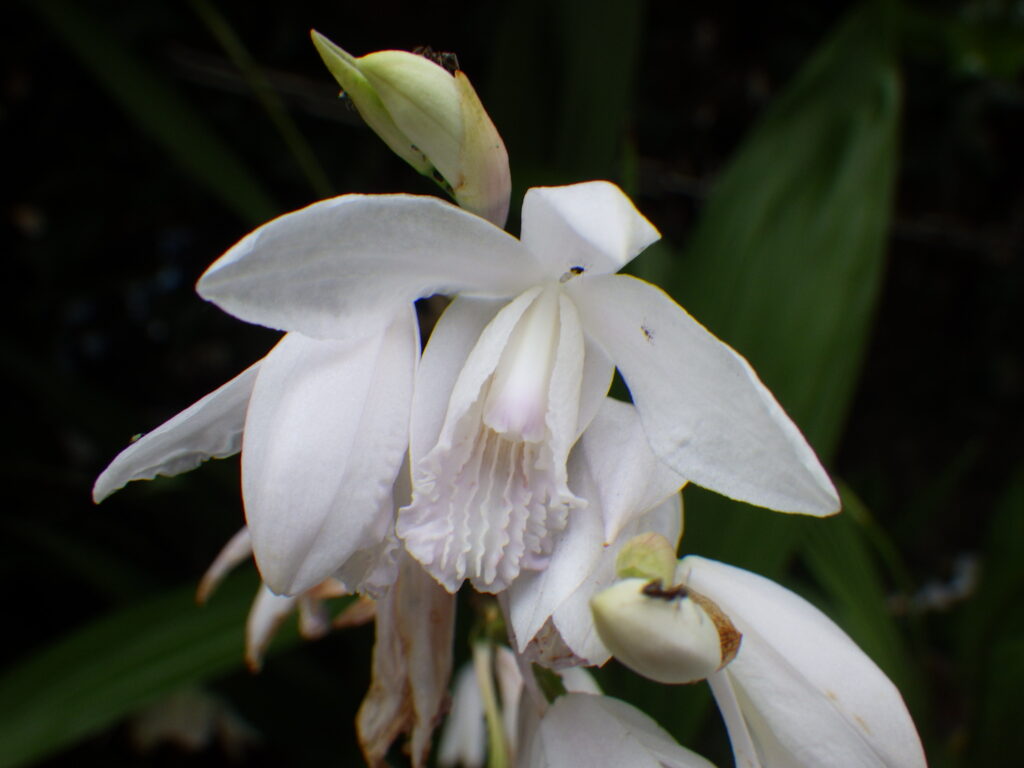
This is a deciduous perennial herb. The pseudobulbs are somewhat flattened and grow in clusters along the ground surface. The leaves are lanceolate-oblong, 20-30 cm long and 2-5 cm wide. The flower stalk emerges from a sheath-like center as the leaves unfold, reaching a length of 30-70 cm. It flowers from April to May. The flowers are reddish-purple and borne in groups of 3-7. The bracts are lanceolate-elliptic and deciduous. The labellum is wedge-shaped and obovate, with three lobes at the tip. The lateral lobes are inwardly curved, surrounding the column, while the central lobe is rounded with a curled edge and has five irregular ridges on its inner surface. The capsule is spindle-shaped. It is distributed in Honshu (west of Fukushima Prefecture), Shikoku, Kyushu, the Ryukyu Islands, southern Korea, China, and Taiwan. It grows in sunny, slightly damp grasslands and slopes. It rarely grows wild in damp sloping forests and cliffs, but it is commonly cultivated in gardens and other places, so there are many lost specimens.
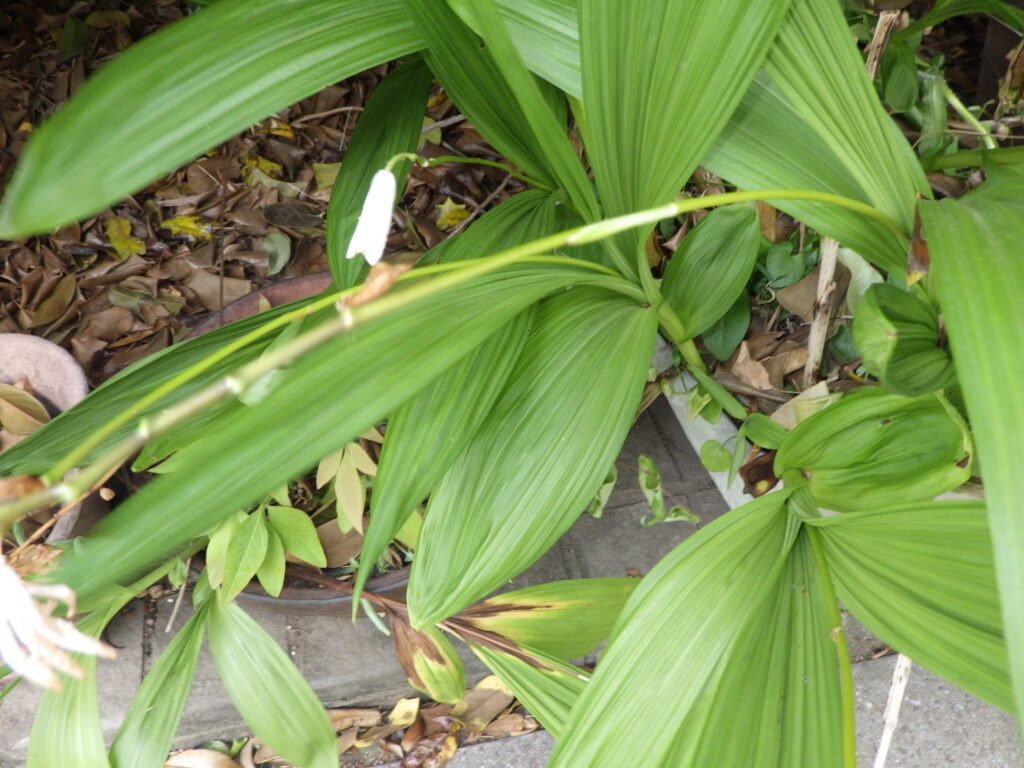
No.0442.1 White-flowered Bletilla striata f. gebina
A variety of Bletilla striata with white flowers. It can be found both in the wild and in gardens.
No.0445 Cochran (Liparis nervosa)
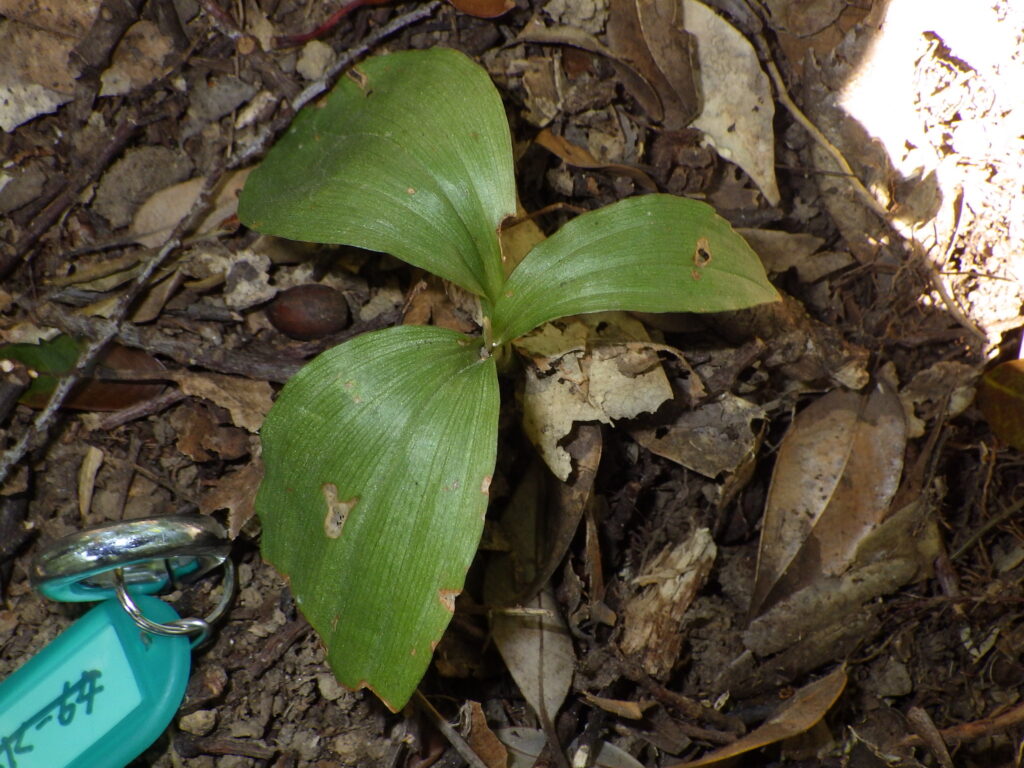
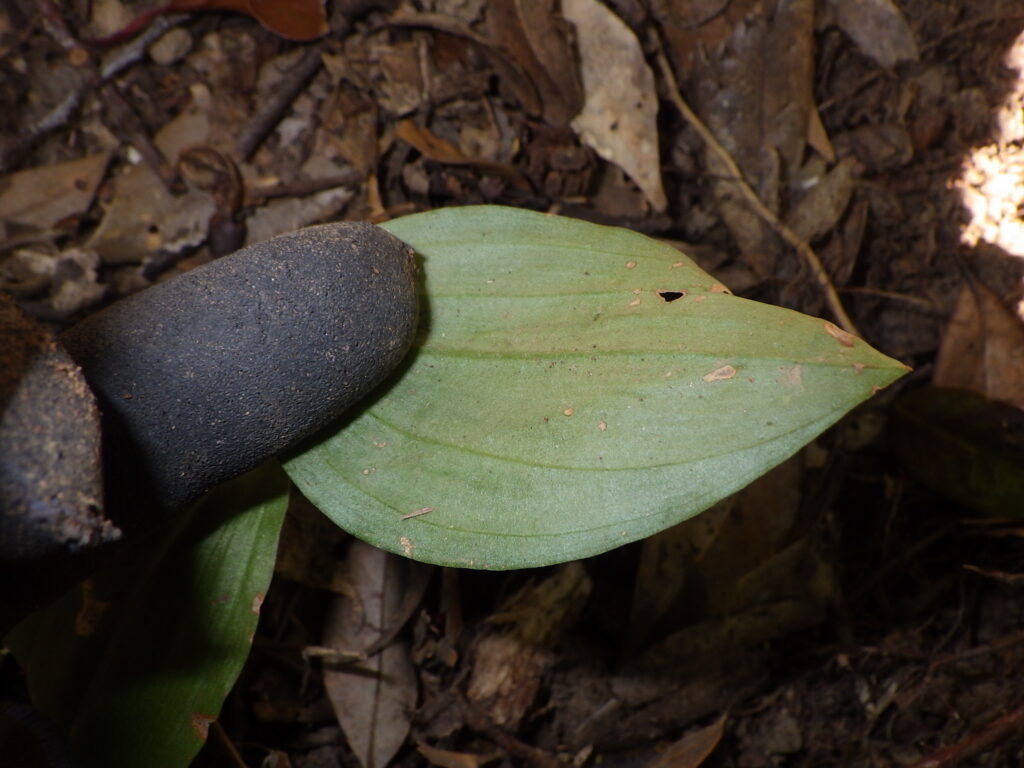
This is a terrestrial perennial herb. The pseudobulb is cylindrical with 2-3 nodes and is about 6 cm tall. The leaves are broadly oval, with 2-3 leaves growing close together at the top. The flower stalk is 15-30 cm tall. It flowers from June to July. 5-10 flowers are borne on the flower stalk and are dark reddish-purple. The bracts are membranous and triangular. The sepals are narrowly oblong. The lateral petals are oblanceolate-linear. The labellum is wedge-shaped-obovate with minute serrations on the margin and a shallow groove in the center. The upper half is recurved, and there are pointed projections on both sides of the inner surface of the base. The column is slightly curved forward and 3 mm long. The capsule is club-shaped-fusiform. It is distributed in Honshu (south of Fukushima Prefecture), Shikoku, Kyushu, the Ryukyu Islands, Korea (Jeju Island), China, Taiwan, and Southeast Asia. It grows on the forest floor of evergreen broad-leaved forests.
No.0456 Ebine Calanthe discolor
This is an evergreen perennial herb. The pseudobulbs are ovate and grow in a rosary-like pattern near the ground. The leaves are 2-3 in number, elliptical, basal, and hairless. The flower stalk is 20-40 cm tall, with 1-2 lanceolate scale leaves and short hairs. It flowers from April to May. 5-20 flowers bloom on the upper half of the flower stalk, usually dark brown to pale purplish-brown (flower shape and color vary considerably depending on the distribution area). The bracts are lanceolate. The sepals are narrowly ovate and spread flat, and the lateral petals are narrower than the sepals. The labellum is fan-shaped and 3-lobed, with the central lobe shallowly 2-lobed at the tip. It also has 3 raised lines in the center. The spur is 5-10 mm long. The capsule is obovate. It is distributed in Hokkaido (southwestern part), Honshu, Shikoku, Kyushu, Ryukyu Islands; Korea (southern part); and China. It grows in woodlands in mountainous areas and often forms colonies in suitable habitats. However, its population has drastically decreased due to land development and overharvesting.
No.0461.a Phaius tankervilleae
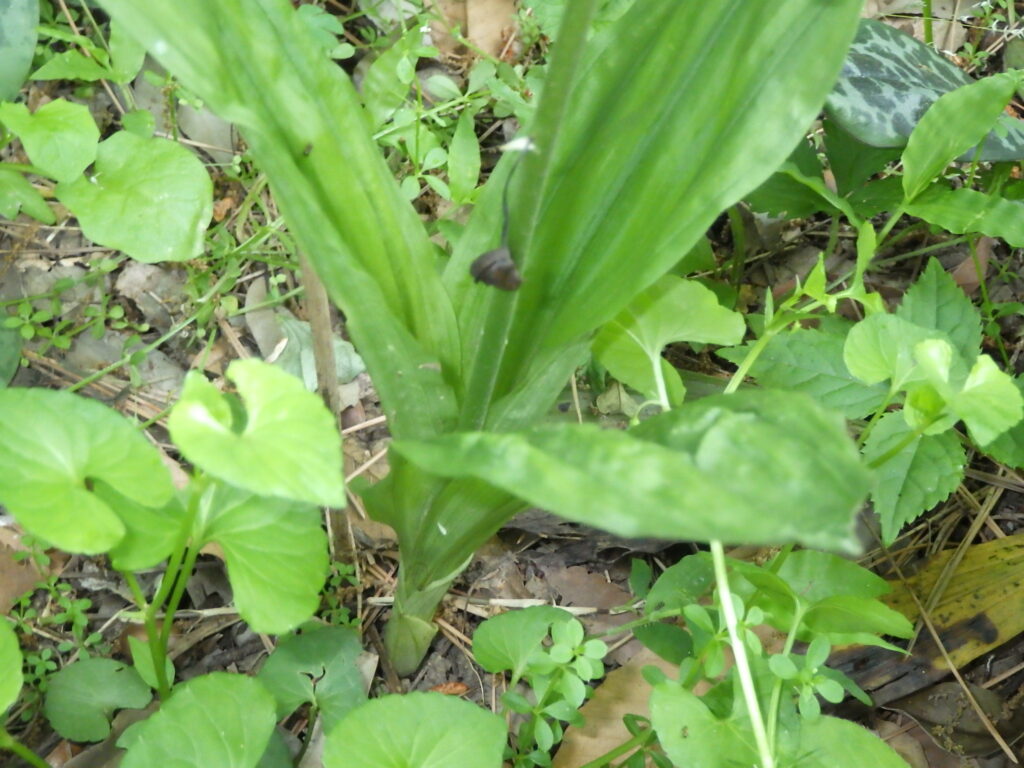
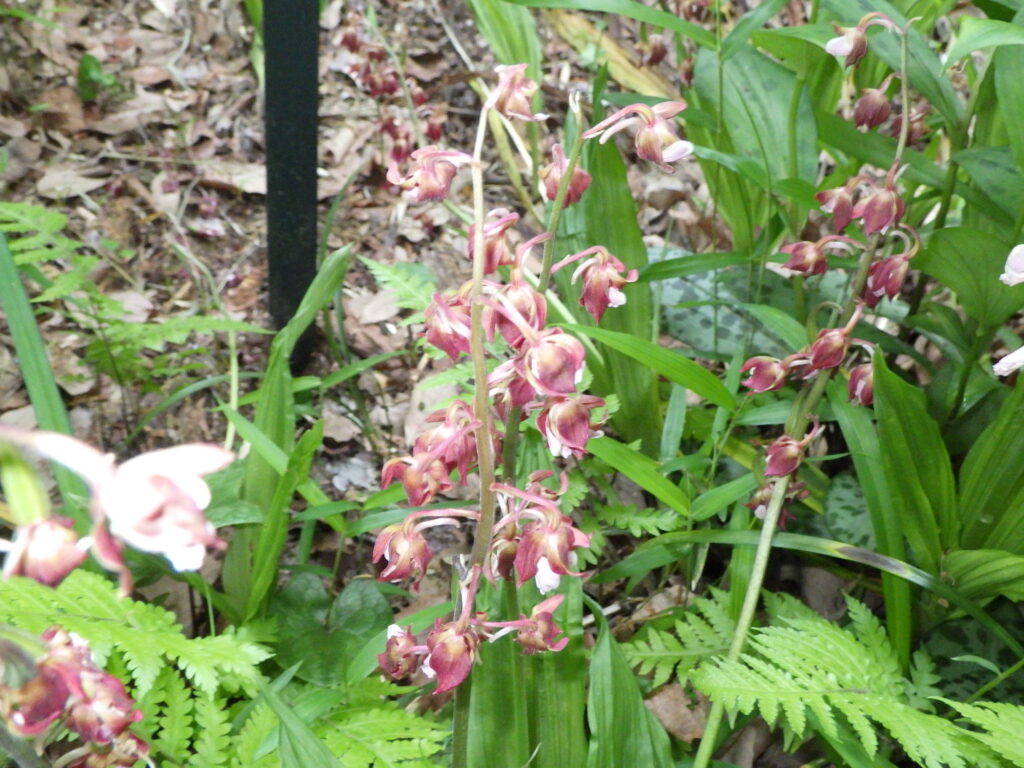
This is a perennial herb, growing to a height of 60-120 cm. It has an ovate-conical pseudobulb at its base. Four to six leaves grow on the pseudobulb; the leaf blades are oblong-lanceolate to oblong, 40-80 cm long and 6-15 cm wide. The tips are acute, the leaves are thick and herbaceous, slightly glossy, and have many longitudinal wrinkles. It flowers from April to June. Four to ten flowers are borne in a raceme at the top of the stem. The bracts are oblanceolate and fall off after flowering. The sepals and lateral petals spread flat, 5 cm long and 1-1.5 cm wide, white on the outside and reddish-brown on the inside. The labellum is rectangular-elliptic and rolled into a tube, 4-5 cm long, white at the base and dark reddish-purple in the upper half, shallowly 3-lobed at the tip, with rounded lobes and wavy margins. The spur is cylindrical, about 1 cm long, and the column is about 2 cm long. It is distributed in Japan from Kyushu (south of Tanegashima) to Okinawa, southern China, Taiwan, tropical Asia, and Oceania. It inhabits the forest edges under evergreen trees.
No. 0462 Cremastra variabilis
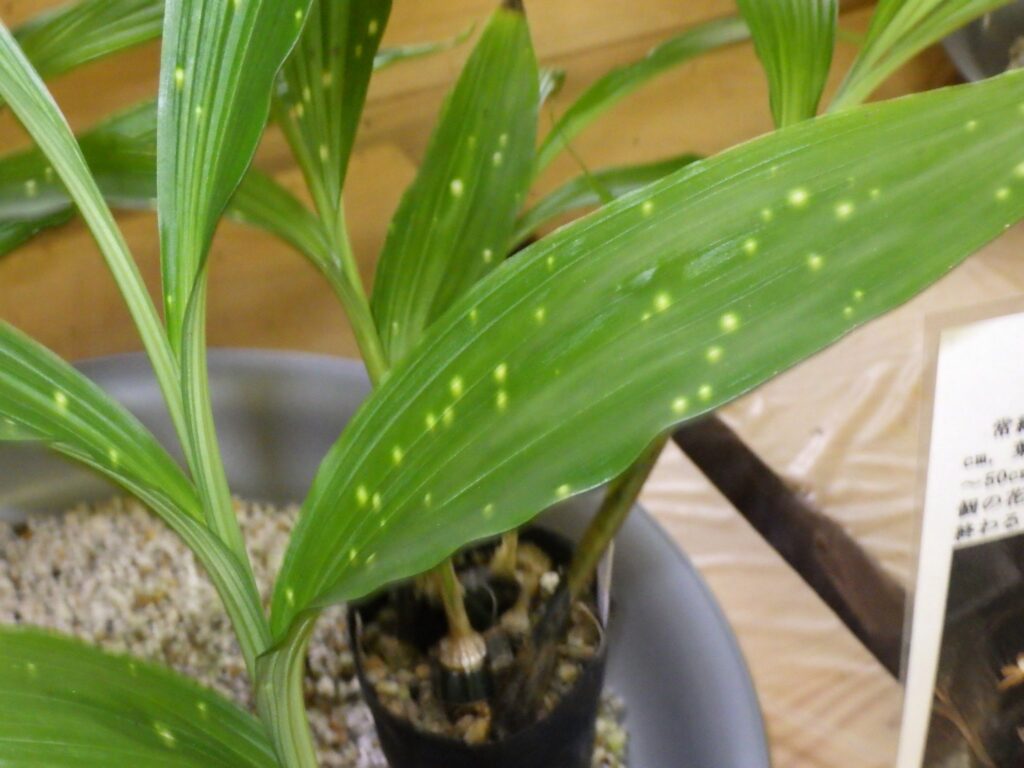
This is a perennial herb. The pseudobulbs grow shallowly underground, somewhat spaced apart and arranged horizontally. The leaves are leathery, oblong, with a narrowed petiole at the base and three prominent main veins. After flowering, the leaves temporarily wither, and new leaves emerge in autumn to overwinter. The flower stalks arise from the sides of the pseudobulb apex and reach a height of 30-50 cm. The flowering period is from May to June. The flowers number 8-20 and are borne laterally, with much variation in color from pale green to reddish-purple. The sepals and lateral petals are linear-lanceolate. The labellum is 3 cm long and has vivid reddish-purple markings. The base is swollen and surrounds the column. The lateral lobes are small and lanceolate, while the central lobe is oblong and greatly recurved. The column is 2.5 cm long and slightly thickened at the tip. The capsule is oblong. It is distributed in Hokkaido, Honshu, Shikoku, Kyushu, Ryukyu Islands, southern Sakhalin, Korea, China, Taiwan, Indochina, Thailand, and the Himalayas. It grows in forests in mountainous and hilly areas. The species previously identified as C. appendiculata is now considered a separate species. In 'Ylist', it is listed as C. appendiculata var. variabilis.
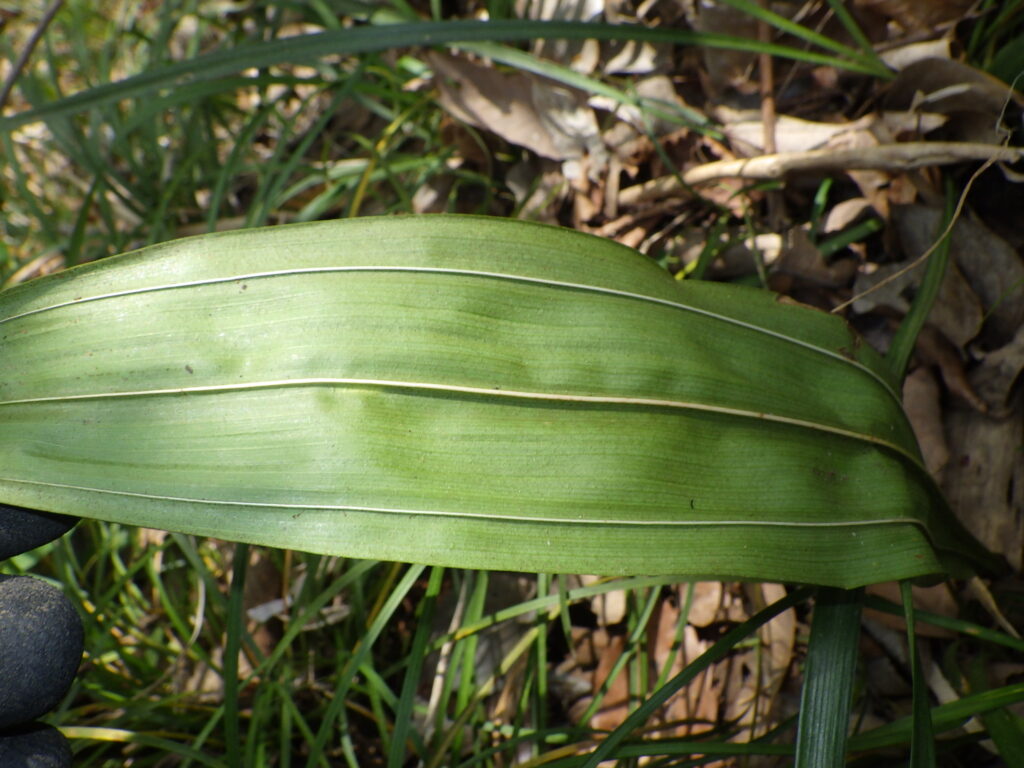
No.0465 Dendrobium moniliforme
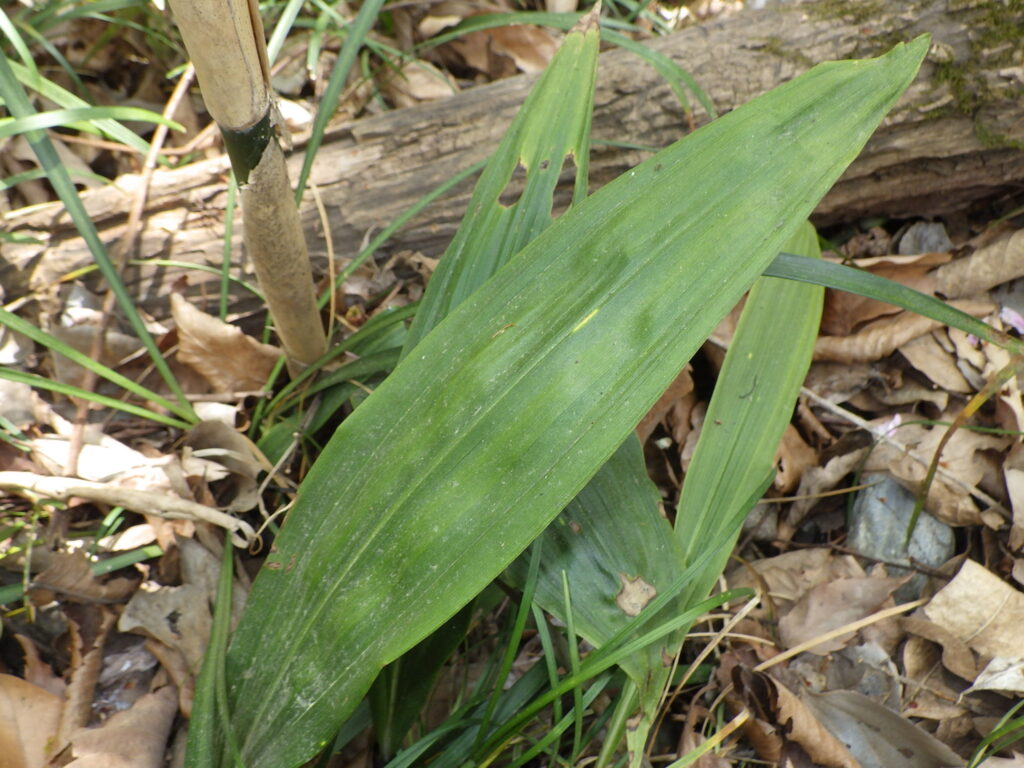
This is an evergreen perennial herb. The stems grow in clumps, are slender and cylindrical, and reach a height of 5-30 cm. The leaves are lanceolate, with the base forming a leaf sheath that encloses the internodes. It flowers from May to June. The flowers grow in inflorescences from the nodes of the stems that have shed their leaves the previous year, bearing 1-2 flowers, and vary greatly in color from white to pale pink. The sepals are lanceolate. The lateral petals are the same shape as the sepals but slightly shorter. The labellum is ovate-triangular, with the base edge curving outward upwards and surrounding the column. It also has pale purple spots and glandular hairs from the center to the base. The glandular hairs become longer towards the base. The column is very short. The capsule is obovate-lanceolate. It is distributed in Honshu (south of Iwate Prefecture), Shikoku, Kyushu, the Ryukyu Islands, southern Korea, China, and Taiwan. It grows in clusters on tree trunks and rocks in sunny locations. Those growing in particularly conspicuous locations are often lost due to horticultural collection, and only a few remain in high places along steep stream beds.
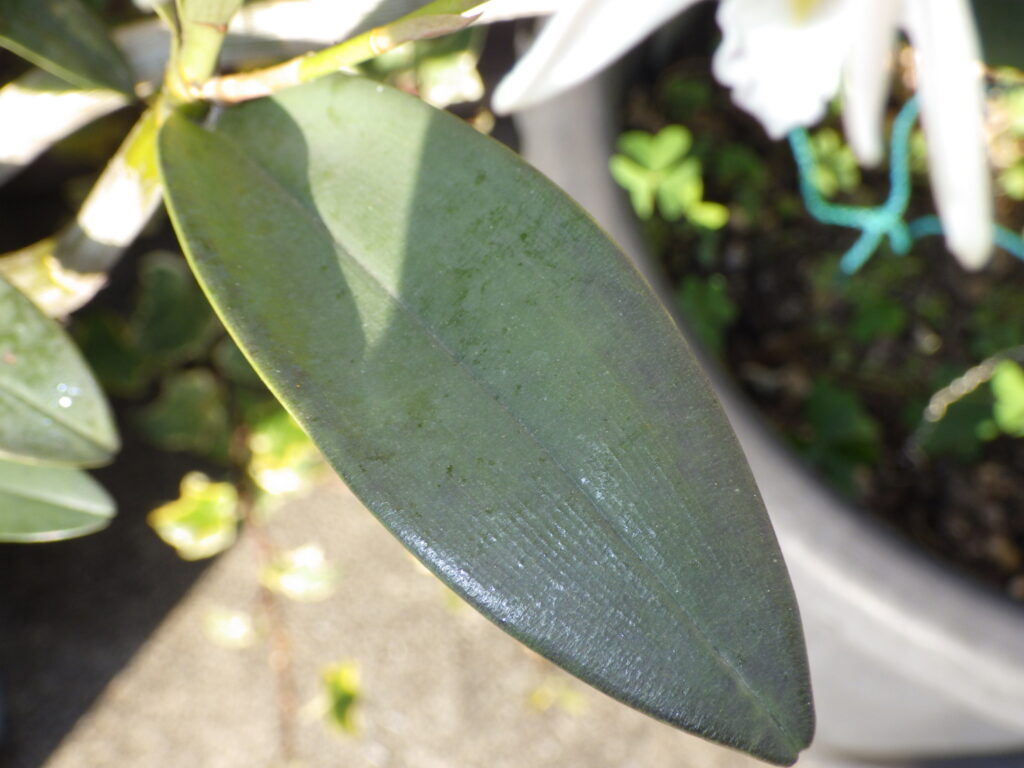
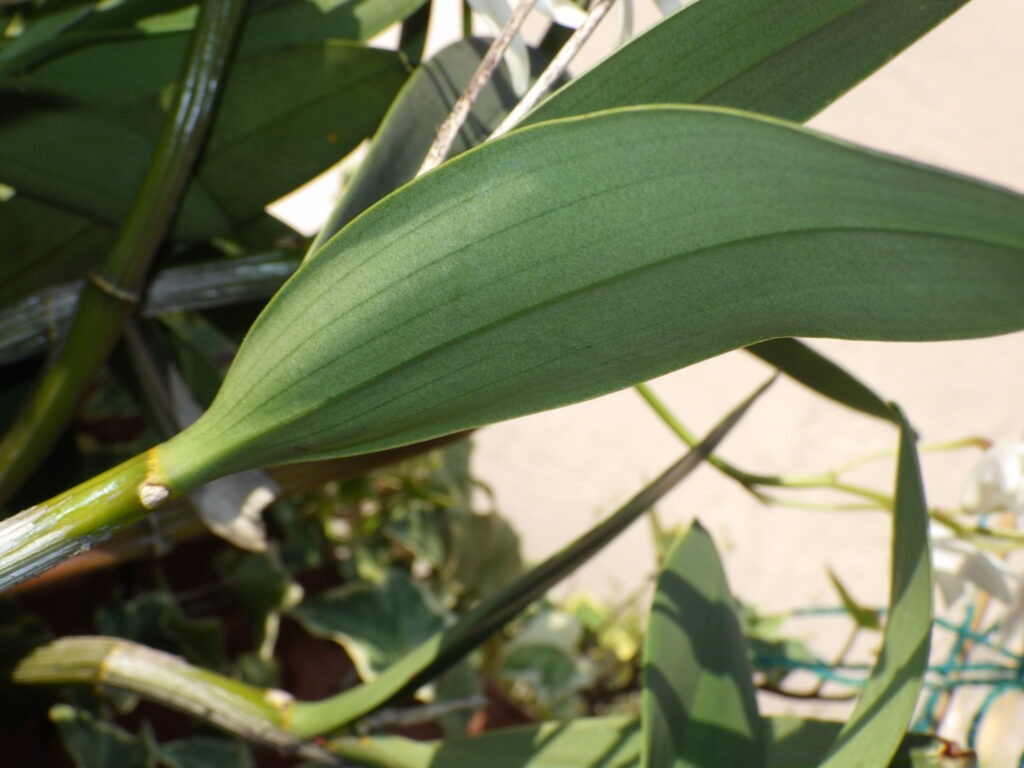
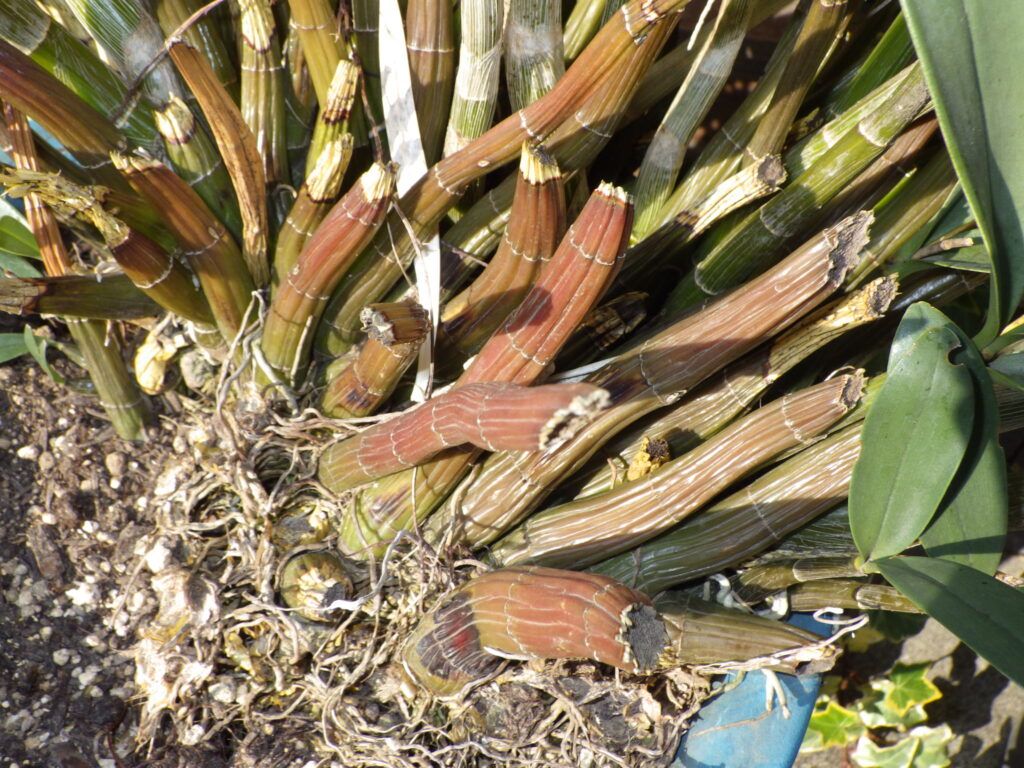
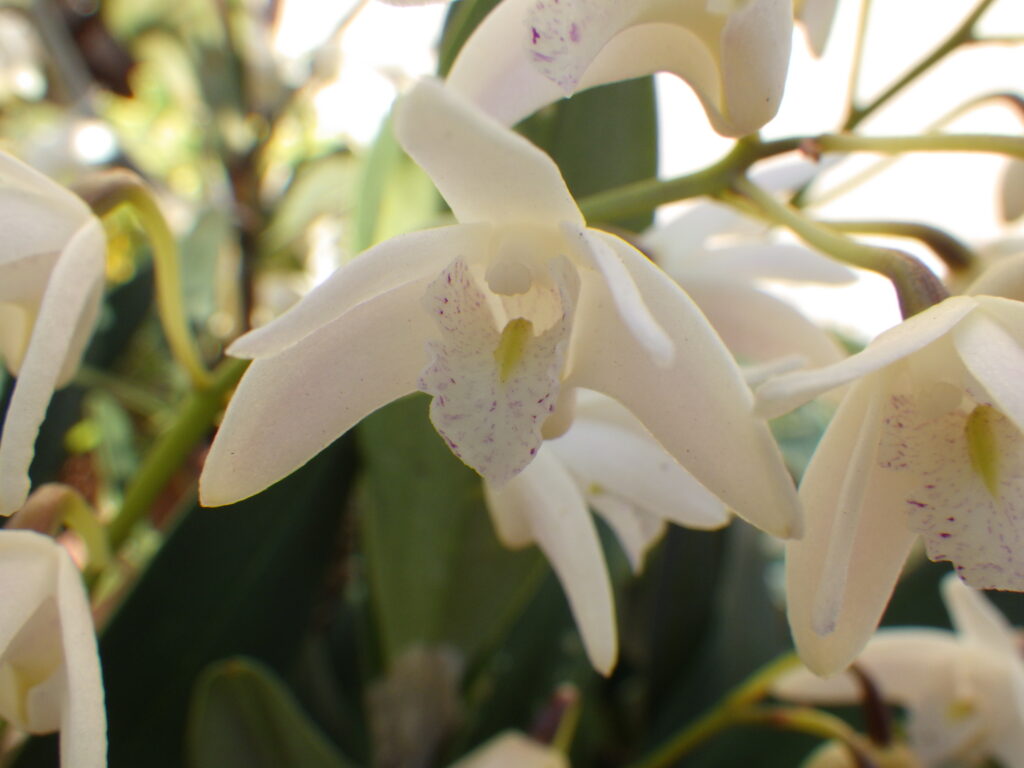
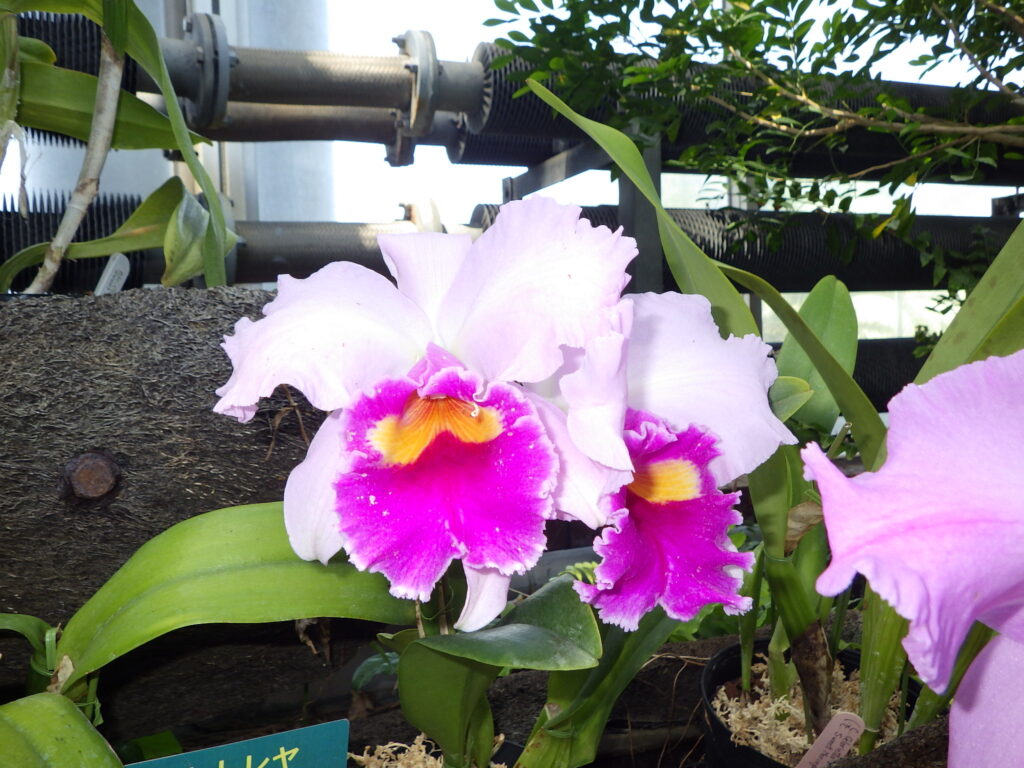
No. 0468 Hinoderan Cattleya labiata
Also known as Cattleya, this epiphytic plant has a flower stalk that grows upright from the top and bears 1 to 30 flowers. The flowers are large and beautiful. The sepals and lateral petals are separate, with the lateral petals being wider than the sepals. The labellum is separate and usually three-lobed, with the base rolled into a tube to enclose the column, and the central lobe spreading widely. The column is almost rod-shaped. There are four pollinia. It is distributed in the mountain ranges of the Atlantic coast at the mouth of the Amazon River in northwestern Brazil, at altitudes of 500 to 1000m. It inhabits hard granite rocky areas with a few shrubs and grasses. It was once discovered by William Swainson and presented to a botanical garden, becoming an indispensable part of horticulture, but the exact collection location was lost, leading to its rediscovery. The horticultural population commonly called "Cattleya" includes intergeneric hybrids. The following specimen appears to be a variety called Irene Finney 'Spring Best', but since the variety name is enclosed in single quotes, and there are additional single quotes within that name, I am not sure if this is the correct variety name.
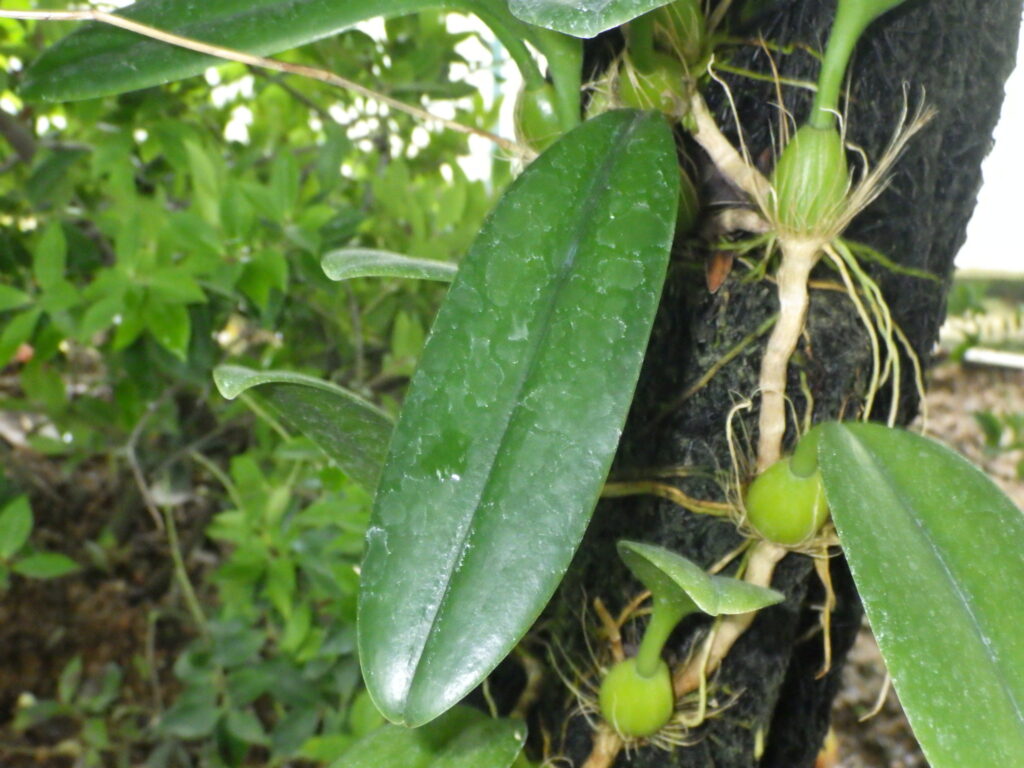
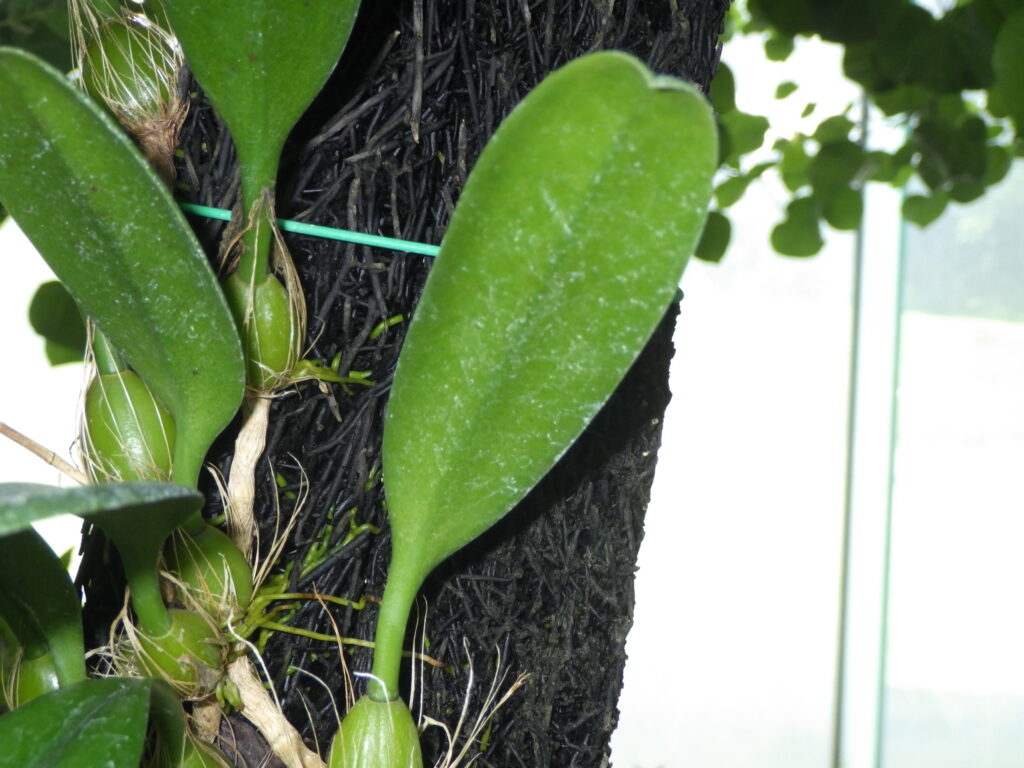
No.0472.a Bulbophyllum boninense (Ogasawara's shikoran)
This is a perennial herb, growing to a height of 15-20 cm. It is epiphytic. The rhizome is long, bearing pseudobulbs at 3-4 cm intervals at the nodes. The pseudobulbs are 1.3-2 cm long and 0.6-1 cm wide. A single leaf grows at the tip of each pseudobulb; the leaf blade is oblong, 7-12 cm long and 1.8-2.7 cm wide. It is leathery and glossy. It flowers from June to July. Three to five flowers grow at the end of a drooping flower stalk 15-20 cm long, elongated in shape, about 2.5 cm long, pale yellow with a dark reddish-purple spot in the center. The dorsal sepal is broadly ovate, with a short, pointed tip that is semi-curved, about 1 cm long. The lateral sepals are broadly ovate with a blunt tip, fused in the apex, about 3 cm long. The lateral petals have shallowly lobed edges and are about 7 mm long. The labellum is five-shaped, with a joint at the base. The labellum and petals are dark reddish-purple. There is a pair of sickle-shaped white appendages at the tip of the column. It resembles *Shikoran*, but differs in that its rhizome is elongated, hard, and thick, the pseudobulbs are spaced 3-4 cm apart, the lateral sepals are broadly ovate with blunt tips and fused at the ends, and they do not extend long enough to have a dark reddish-purple spot in the center of the flower, and instead fuse at the tips. It is endemic to Japan and is distributed in the Ogasawara Islands, growing epiphytically on rocks and tree trunks.
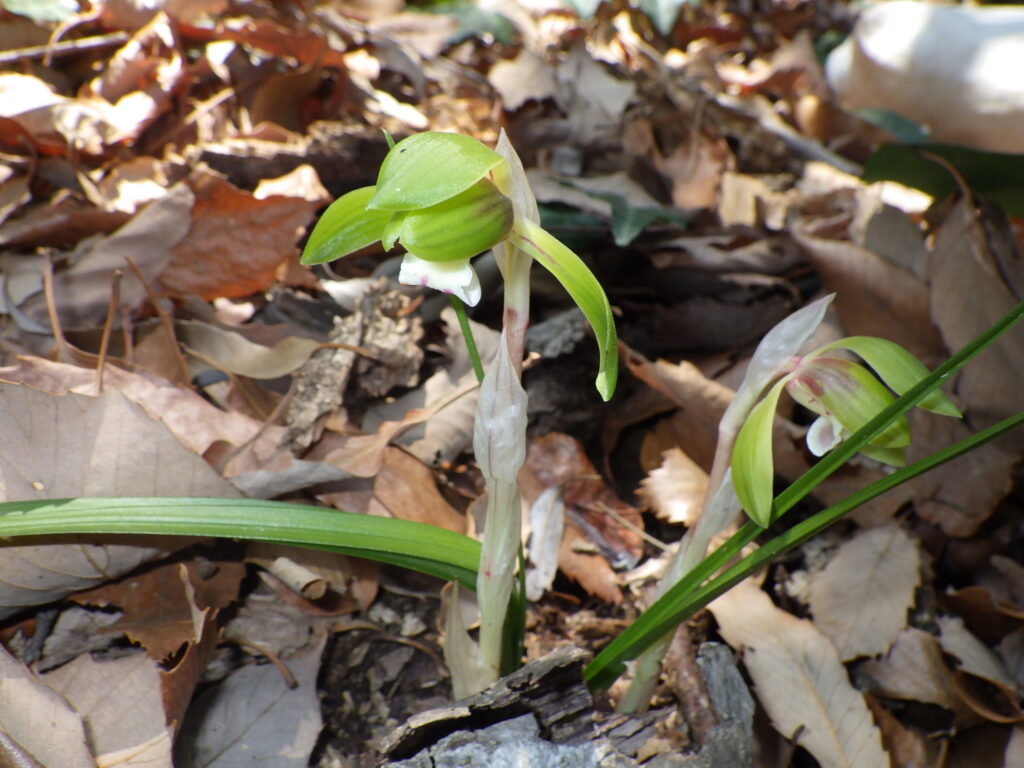
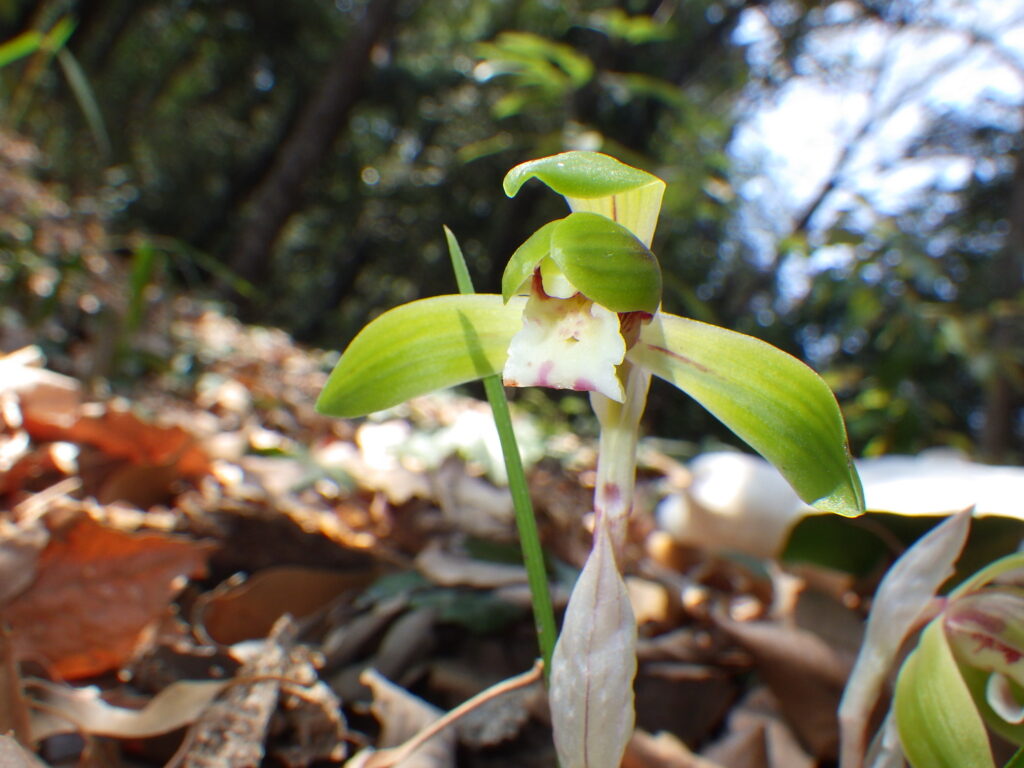
No. 0474 Cymbidium goeringii
Also known as "mole," this is an evergreen terrestrial species. The pseudobulb is small and ovoid. The leaves have finely serrated edges and grow in clusters of several. The flower stalk is erect, 10-20 cm tall, and its base is enclosed in a membranous sheath. It flowers from March to April. The flower is solitary and pale yellowish-green. The bracts are lanceolate. The sepals are obovate. The lateral petals are the same shape as the sepals but slightly shorter. The labellum is oblong, slightly shorter than the sepals, fleshy, shallowly 3-lobed, and white with purple markings. The lateral lobes are erect, and the central lobe is elliptical with a recurved tip. The column is about 15 mm long. There is considerable variation in flower shape and color depending on the habitat. The capsule is columnar-elliptic. It is distributed in Hokkaido (Okushiri Island), Honshu, Shikoku, Kyushu, the Ogasawara Islands, Korea, China, and Taiwan. It grows in somewhat dry woodlands. Like the Calanthe orchid, it is endangered by human activity and is rare.
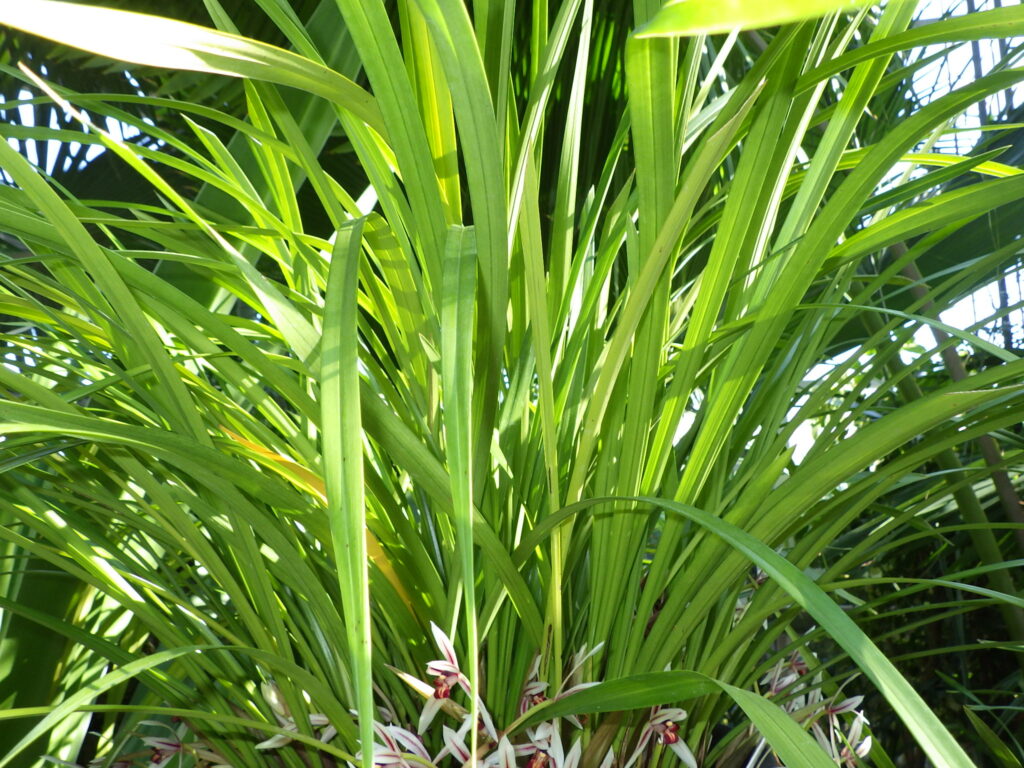
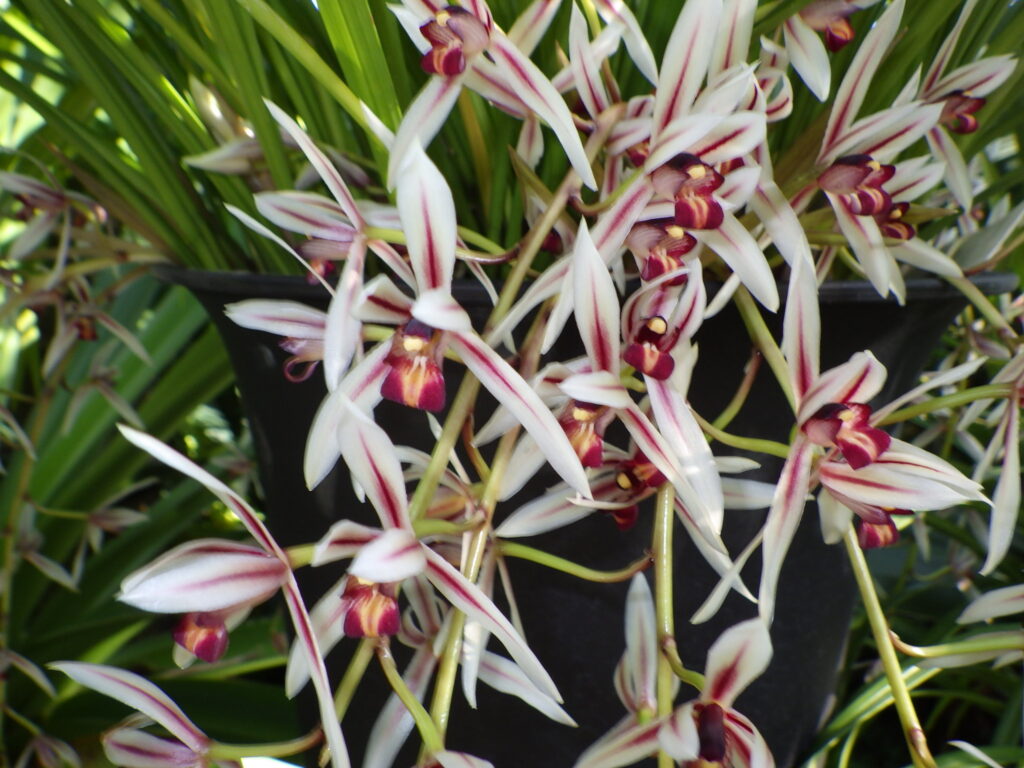
No. 0476 Cymbidium dayanum
This is an evergreen perennial herb. The leaves are 30-50 cm long, flexible, and herbaceous. In winter, a 30 cm long inflorescence emerges from the base of the plant, accompanied by membranous sheath-like leaves, bearing white to pale reddish-purple flowers. The perianth segments are about 3 cm long, with a long spot in the center of the inner surface. The Japanese name, Kanpōran, means "winter phoenix orchid," referring to the orchid that blooms in the cold. It is distributed from Assam, India to the Malay Archipelago. A smaller variety of this species grows wild from southern Kyushu to the Ryukyu Islands and is sometimes distinguished as Hetsukaran. It has been in Japan since ancient times and is cultivated to some extent.
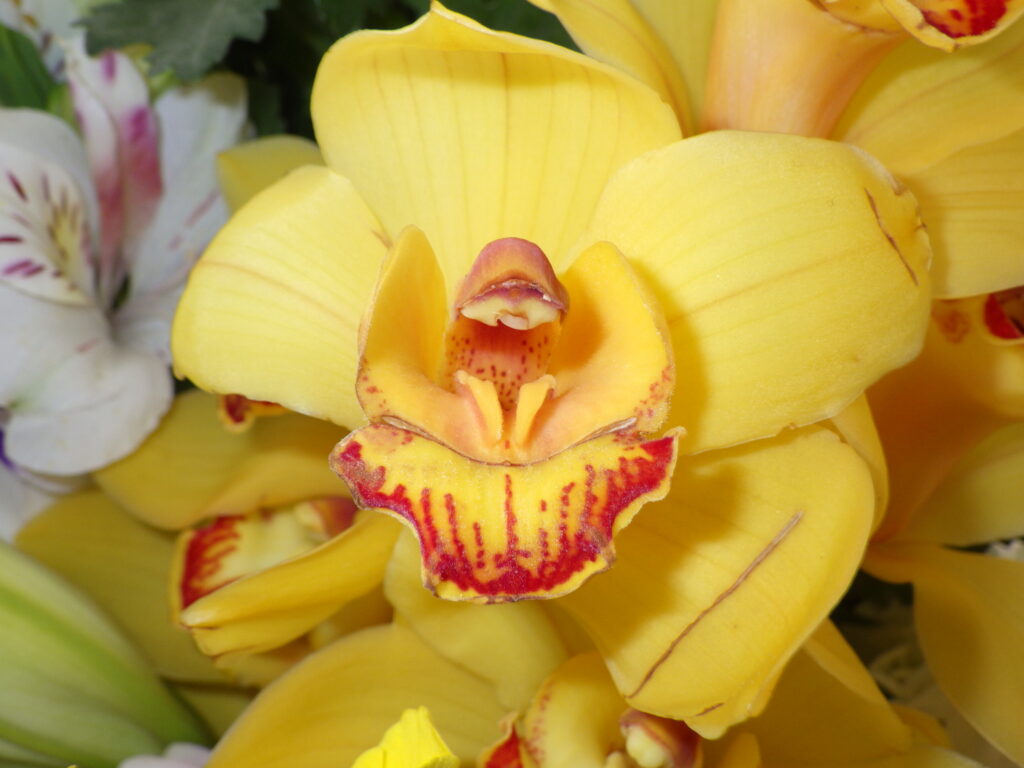
No.0478.a Cymbidium cv. (a cultivated variety of the genus Cymbidium).
The group of orchids known as "Cymbidium" in horticulture is generally limited to cultivated varieties of orchids native to Southeast Asia. The original species is likely unknown. They have orchid-like pseudobulbs from which long, slender leaves grow in a basal manner. Flowers are borne singly or in racemes on stems that emerge from the base of the pseudobulbs. The flower stalks are upright, slightly drooping, or drooping and growing long downwards.
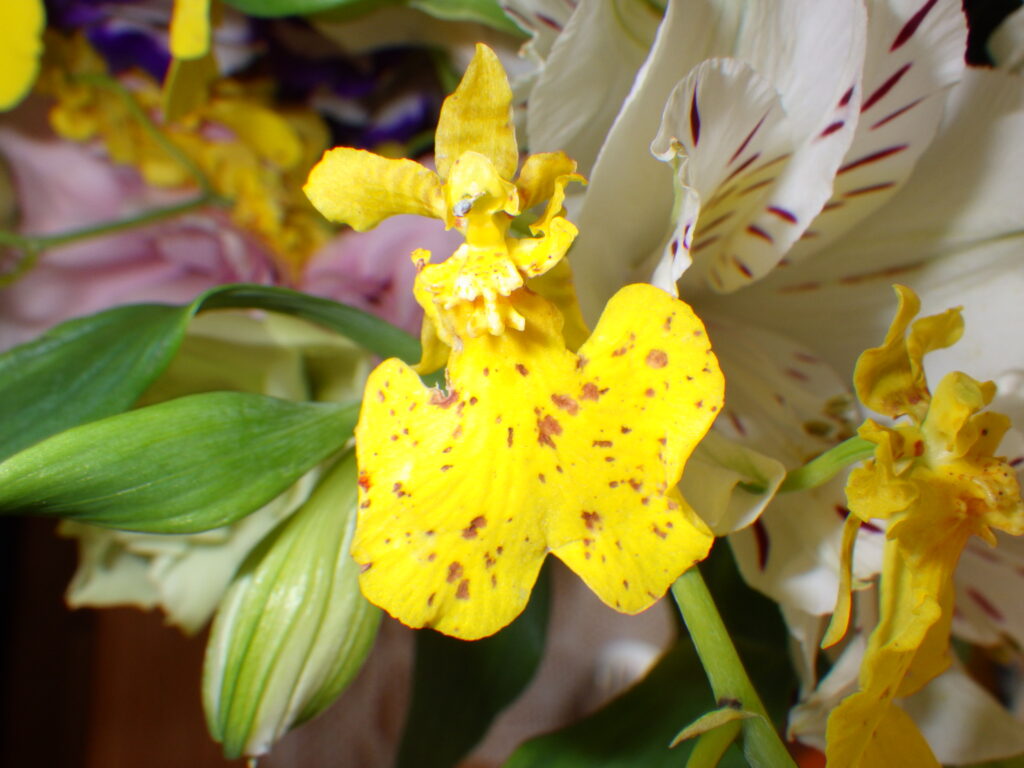
No.0478.b Oncidium sphacelatum
This is a perennial plant belonging to the Oncidium or Oncidium genus. It grows to a height of 10-70 cm, is an epiphytic plant, and occasionally grows as a lithophyte. It flowers from September to October. In spring, it produces 10-50 flowers on short branches extending horizontally and vertically from the leaf sheath of the mature rhizoid, reaching up to 180 cm in length. The calyx and lateral petals are almost identical in shape, narrower and smaller than the labellum. It produces showy flowers with a weak fragrance. The labellum is large and spreads out, making up the majority of the flower. The fruit is a capsule. The fruit does not split open, and the seeds are released through the gaps. It is distributed in Central and South America, specifically Mexico, Guatemala, Belize, El Salvador, Honduras, Nicaragua, Costa Rica, and Venezuela, at altitudes below 1000m. The following specimens are cut flowers sold in Japanese horticulture, and therefore may be different species or cultivars of unknown origin.
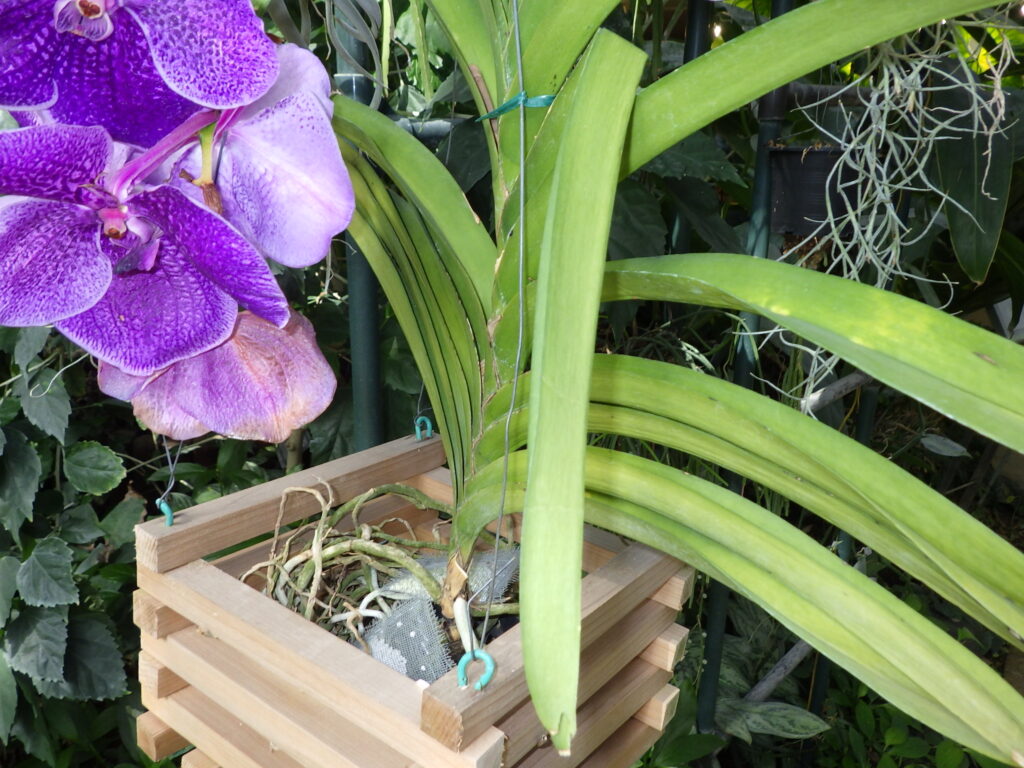
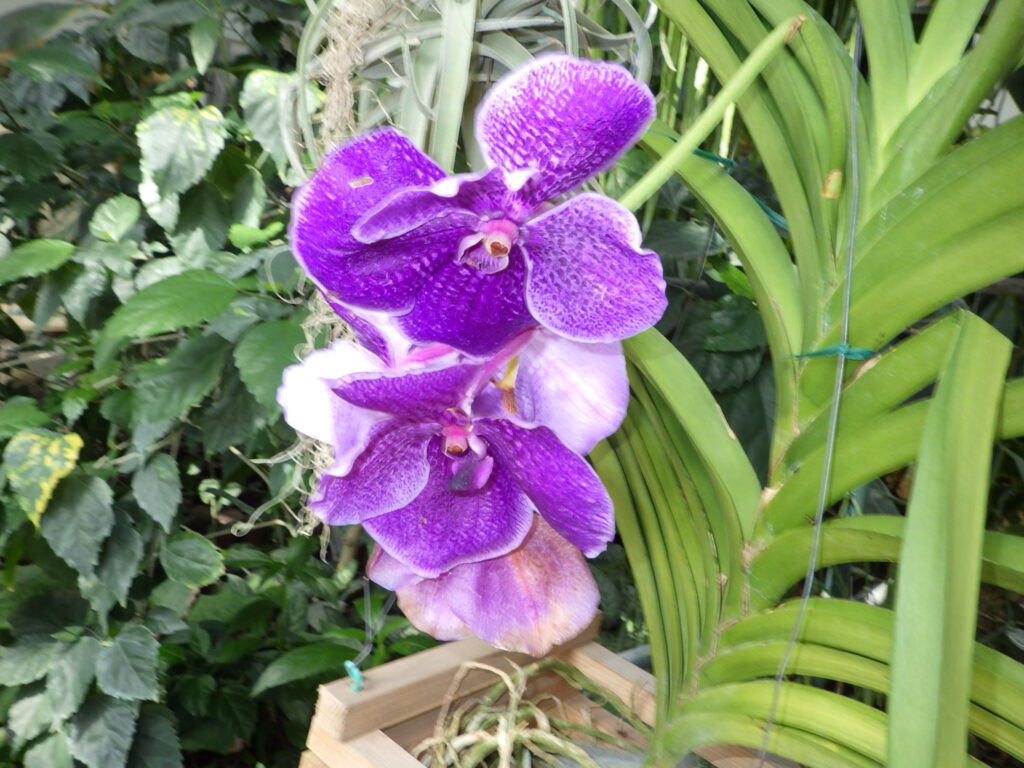
No.0487.a Jade Orchid (Vanda coerulea)
Also known as Vanda. Stems are 5–23 cm long and 0.8–1.5 cm in diameter (Flora of China). Leaf blades are (7–)14–18 cm long and 1.3–2 (–3) cm wide, thick and leathery, with an unevenly shallow 2-lobed tip. Inflorescences are borne in groups of 1–3, 20–42 cm long, with sparsely arranged (4–)6–14 flowers. They bear large, long blue, mosaic-patterned flowers. The peduncle is 16–22 cm long. The inflorescence axis is weakly zigzag and 9–28 cm long. The flower bracts are broadly ovate, 8–11 mm long and 5– mm wide, with an obtuse to acute tip. The flowers are thin in texture, open wide, and 6–9 cm in diameter. The pedicels and ovaries are white or bluish, 45–60 mm long. The sepals and petals are sky blue and have a mosaic pattern. The sepals are equiform, broadly obovate, with a narrowing base and a short claw-like structure, and a rounded apex. The petals are elliptic-obovate, with a narrowing base and a short claw-like structure, and a rounded apex. The labellum is sky blue, shorter than the sepals, fleshy, and has a spur. The lateral lobes are erect, narrowly sickle-shaped, white on the inside with yellow spots, and nearly acute at the apex. The central lobe is dark blue, tongue-shaped, with a pair of calli at the base, a truncate and concave apex, and the disc (the area between the lateral lobes of the lower half of the labellum) has three longitudinal ridges. The spur is short tubular, slightly conical, 5-7 mm long and 2-3 mm wide, with an obtuse apex. It mainly flowers from October to November and is distributed in northeastern India, Myanmar, and northern Thailand, inhabiting open forests and tree trunks along rivers. There are many horticultural varieties, and various hybrid species with red and yellow flowers have been created.
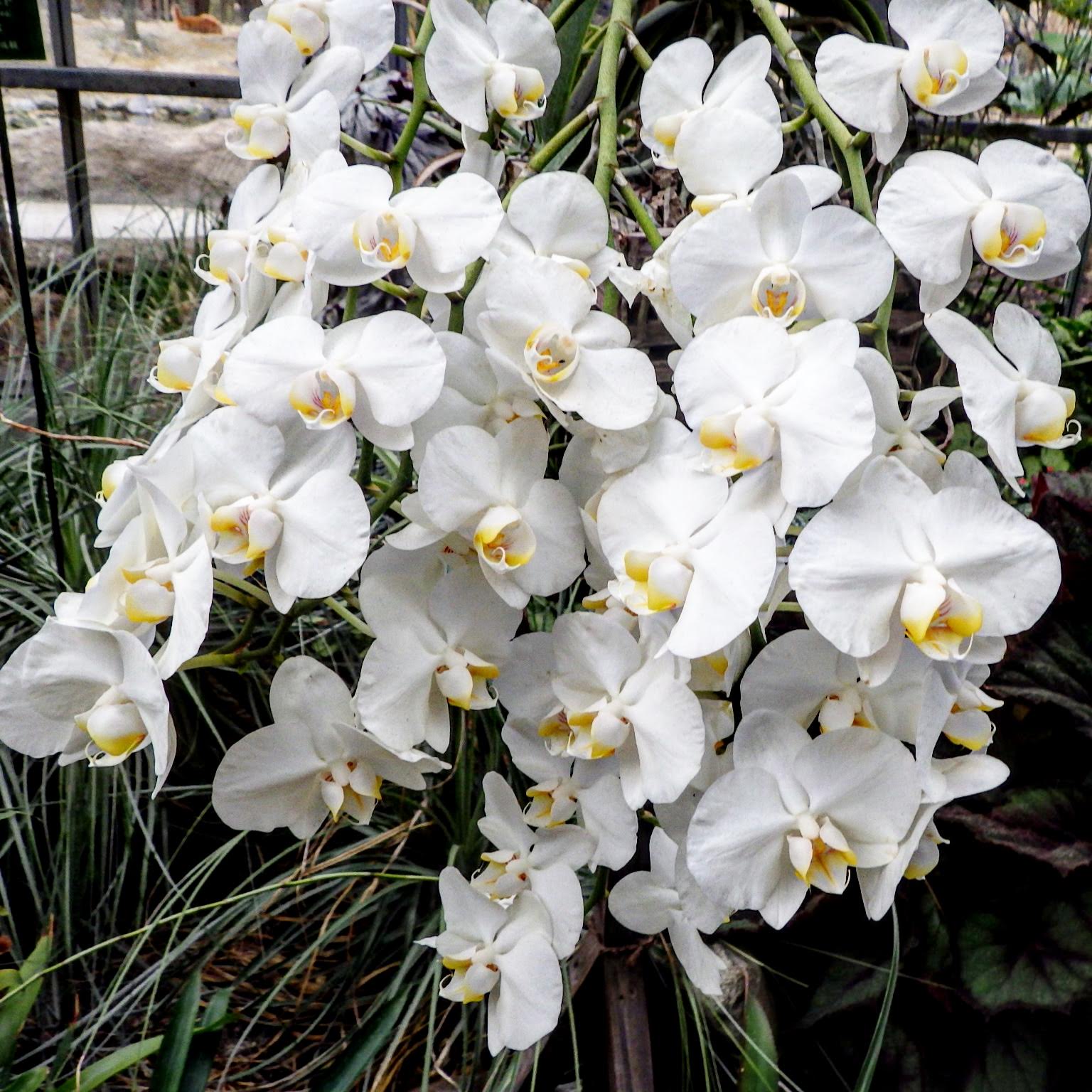
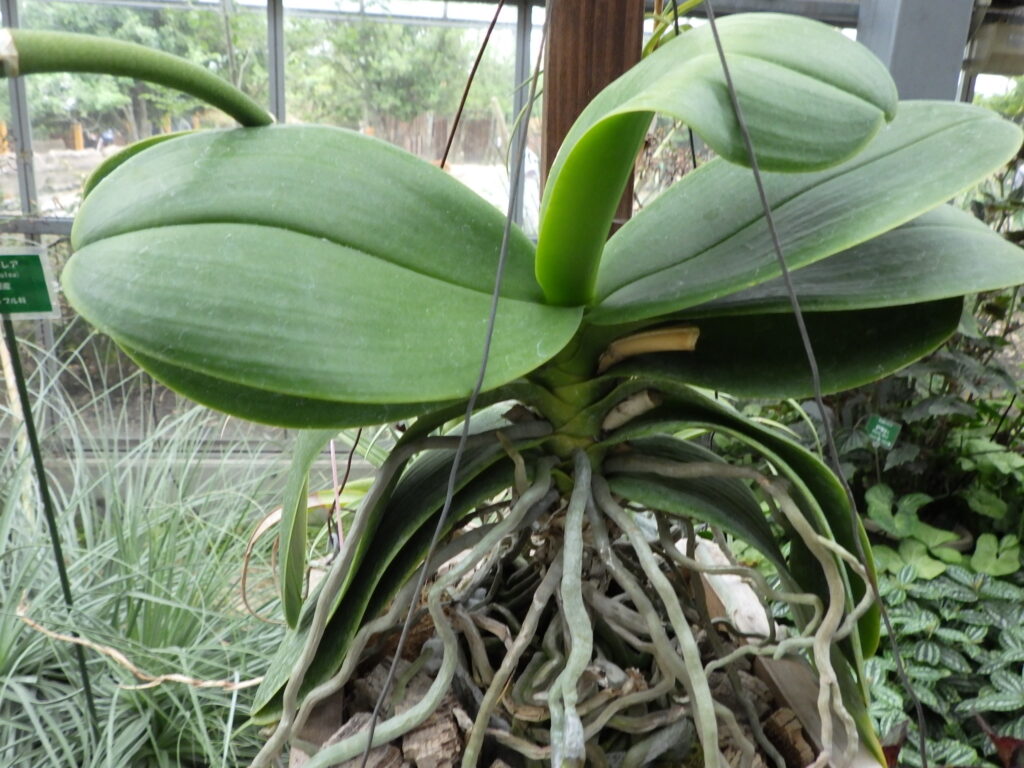
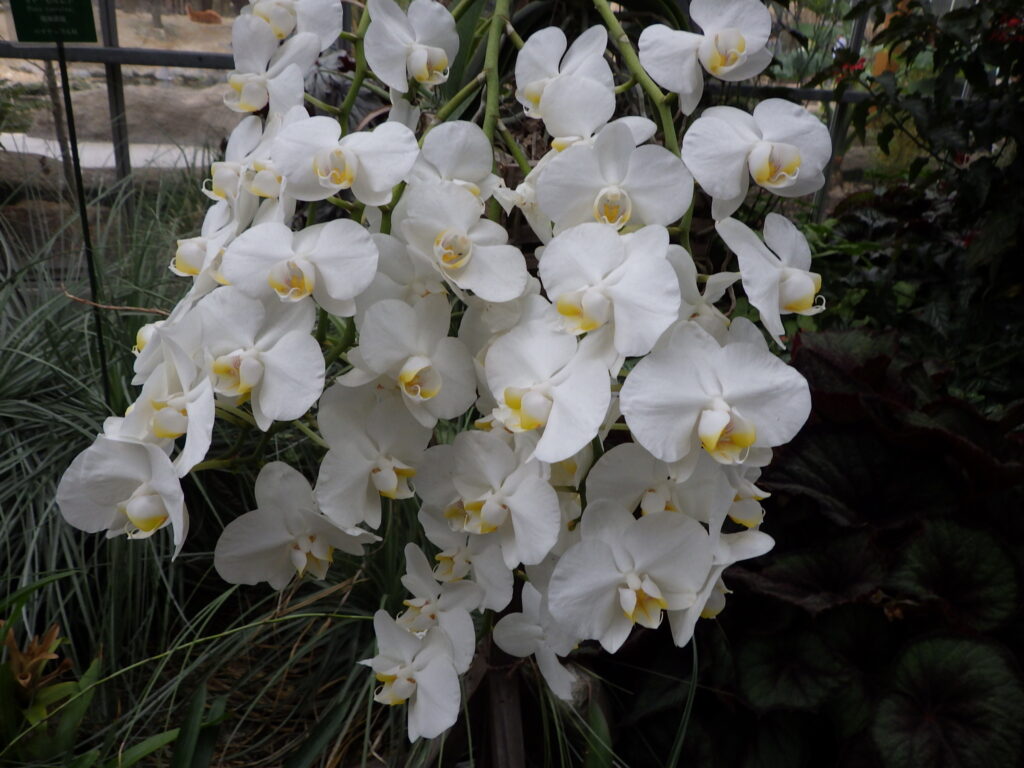
No. 0488 Phalaenopsis aphrodite
This is a monopodial orchid that grows on trees and other plants. It is an epiphytic orchid. The stem is very short and erect, with about four leaves densely packed at the top and numerous roots emerging from the bottom. The roots are thick and grow well. The leaves are arranged in two rows, overlapping each other, and are oval to oblong in shape with a green surface. The flower stalk grows from the side of the stem, ascending obliquely and drooping at the tip, reaching a length of 50-80 cm, sometimes branching. It bears a dozen or so flowers near the tip. The flowers are white, about 7 cm in diameter, with broad lateral petals, giving the entire flower a round appearance. The labellum is yellowish with reddish markings. The tip of the labellum protrudes to the left and right, forming a tendril-like structure. It is evergreen and performs CAM photosynthesis. It is distributed in Southeast Asia, including the Philippines, southern China, and Taiwan, as well as tropical and subtropical regions, growing epiphytically on trees in hot, humid, and high-altitude areas such as tropical rainforests, and thrives in well-ventilated environments. It is very popular as a high-end potted plant and cut flower.
References
Hayakawa, M. & Sueji, K. 2017. Morphological variation and classification of Spiranthes sinensis. Journal of Plant Science 51(4): 115-117. ISSN: 0289-8233, https://da.lib.kobe-u.ac.jp/da/kernel/90005098/
Kanagawa Prefecture Flora Survey Association. 2018. Kanagawa Prefecture Flora 2018 (Electronic Edition). Kanagawa Prefecture Flora Survey Association, Odawara. 1803pp. ISBN: 9784991053726
Odoux, E., & Grisoni, M. 2010. Vanilla, Medicinal and Aromatic Plants – Industrial Profiles. CRC Press. 420pp. ISBN: 9781420083385
Tsukamoto, Yotaro. 1994. Encyclopedia of Horticultural Plants, Compact Edition. Shogakukan, Tokyo. 3710pp. ISBN: 9784093051118