The family Ceratophyllaceae consists of brittle, hard, submerged freshwater herbs. They lack roots and are anchored by rhizoids, which are modified branches. The stems are elongated and branched, and the leaves are whorled and branch several times. There are no stipules. The flowers are monoecious or dioecious, with about 10 perianth segments (also called involucral bracts). Male flowers are protogynous and have 10-20 stamens. Female flowers appear later than the male flowers, above them, and have a single carpel (ovary). The fruit is a drupe, oblong-ovate, with a persistent style and a few spines at the base, or sometimes spineless. In winter, the tip of the stem shortens to become an overwintering bud. It consists of one genus and is widely distributed in freshwater environments worldwide.
This article provides a comprehensive, field guide-style introduction to plants belonging to the Ceratophyllumaceae family.
The basic information is based on the Kanagawa Prefecture Flora Survey Association (2018). Photos are replaced as better ones become available. While the identification is done by the author, please note that misidentifications may be corrected without notice.
No. 1126 Ceratophyllum demersum
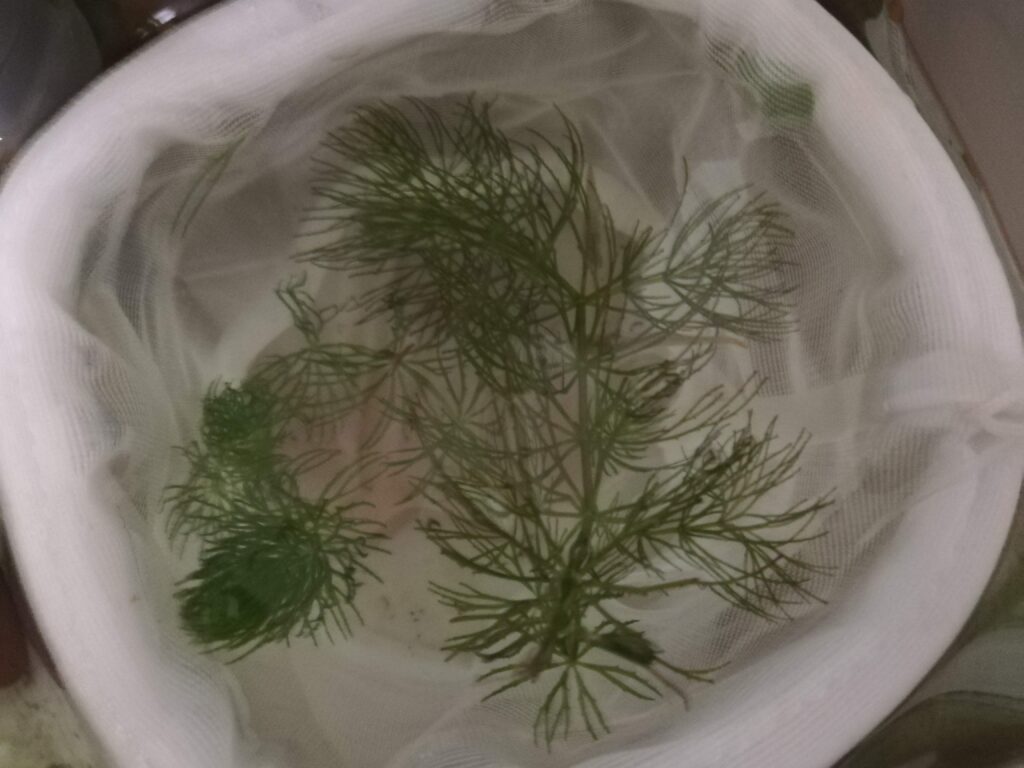
A perennial herb. One of the aquatic plants known as goldfish weed. It usually floats below the water surface. The stems branch frequently, reaching a total length of 20-100 cm. The leaves are 8-30 mm long and arranged in whorls of 5-8. It flowers from June to August. The flowers are monoecious, with separate male and female flowers on the same plant. Pollen drifts in the water, reaches the female flowers, and pollination occurs. The fruit has two long, spine-like projections at its base, and together with the long, persistent stigma, it appears to have three spines. It is widely distributed from tropical to temperate regions worldwide, including Hokkaido, Honshu, Shikoku, Kyushu, and the Ryukyu Islands. It grows in ponds, reservoirs, and waterways. When the fruit has two spine-like projections at its base, for a total of four spines, it is called four-spined goldfish weed (or five-spined goldfish weed) C. platyacanthum subsp. oryzetorum, but since some plants on the same plant have only two projections, it is necessary to observe multiple fruits. "Kakuno Aquatic Plants 94" (which uses *Ceratophyllum demersum*) may have continuity with the fruits of *Ceratophyllum demersum*, and therefore requires further examination.
References
Kanagawa Prefecture Flora Survey Association. 2018. Kanagawa Prefecture Flora 2018 (Electronic Edition). Kanagawa Prefecture Flora Survey Association, Odawara. 1803pp. ISBN: 9784991053726