Portulaca grandiflora and Portulaca triangularis are two species of Portulaca grandiflora that produce pink flowers. Both are found in Japan as invasive species, either as cultivated plants or as escaped individuals. Both species are native to the Americas. These two species can be easily distinguished by many morphological differences, such as the arrangement of the inflorescence, the presence or absence of ridges on the flower axis, the size of the petals, and the shape of the stigma. The pink flowers of Portulaca grandiflora and Portulaca triangularis are very conspicuous, so one might think that many insects visit them, but overseas studies have shown that only a few bees visit Portulaca grandiflora, and no visiting insects were found at all on Portulaca triangularis. It appears that Portulaca grandiflora and Portulaca triangularis self-pollinate to a considerable extent. The alternative name "three o'clock grass" comes from the fact that they bloom around 3 to 4 pm, which is probably to shorten the flowering time, reduce the number of visiting insects, and allow for self-pollination. The fruit is a capsule, and one theory about the origin of the name is that the seeds burst open and scatter. However, only Portulaca grandiflora truly "explodes" its seeds. There are significant differences in seed dispersal methods between Portulaca grandiflora and Portulaca grandiflora. This article will explain the classification, pollination ecology, and seed dispersal of Portulaca grandiflora and Portulaca grandiflora.
- Two species of the Portulaca family that produce pink flowers.
- What is the difference between Portulaca grandiflora and Portulaca triangularis?
- Despite the conspicuous appearance of the Portulaca grandiflora flowers, surprisingly few insects were attracted to them!
- Why is it called "three o'clock flower"? Why does it bloom at three o'clock?
- Are the flowers of the triangular-leaved moss plant useful?
- Is it true that the fruit is a capsule and "bursts open"?
- References
- Source
Two species of the Portulaca family that produce pink flowers.
Talinum paniculatum, also known as "bomb orchid," is native to North America, Mexico, the West Indies, Central America, and South America. In its native habitat, it grows in a wide range of environments, from humid to dry forests, savannas, desert shrublands, grasslands, coasts, plains, hills, slopes, rocky areas, sand, clay, limestone, sandstone, igneous rocks, and rocky soils and fissures. In Africa and Asia, including Japan, it has been introduced as a horticultural plant for medicinal and ornamental purposes, and has escaped cultivation, sometimes growing along roadsides in urban areas. It is originally a perennial plant, but in Japan it is treated as an annual (Shimizu et al., 2001; Kanagawa Prefecture Flora Survey Association, 2018). Its very long, orange roots, reaching about 80 cm in length, easily root and propagate. In Asia, it has been used in traditional medicine.
Talinum fruticosum (synonym: Talinum triangulare), also known as the triangular burrowing orchid, is a perennial plant native to North America, Mexico, the West Indies, Central America, and South America, growing in pine forests, disturbed areas, and sandy soils (Flora of North America Editorial Committee, 2004). In tropical regions (West Africa, South Asia, and Southeast Asia), it is eaten after being boiled, and in Okinawa, it is also eaten after being boiled and called Brazilian spinach.
While some sources on the internet claim that Portulaca grandiflora is edible in tropical regions, it seems that Portulaca triangularis is more commonly used for food. However, Portulaca grandiflora is also edible.
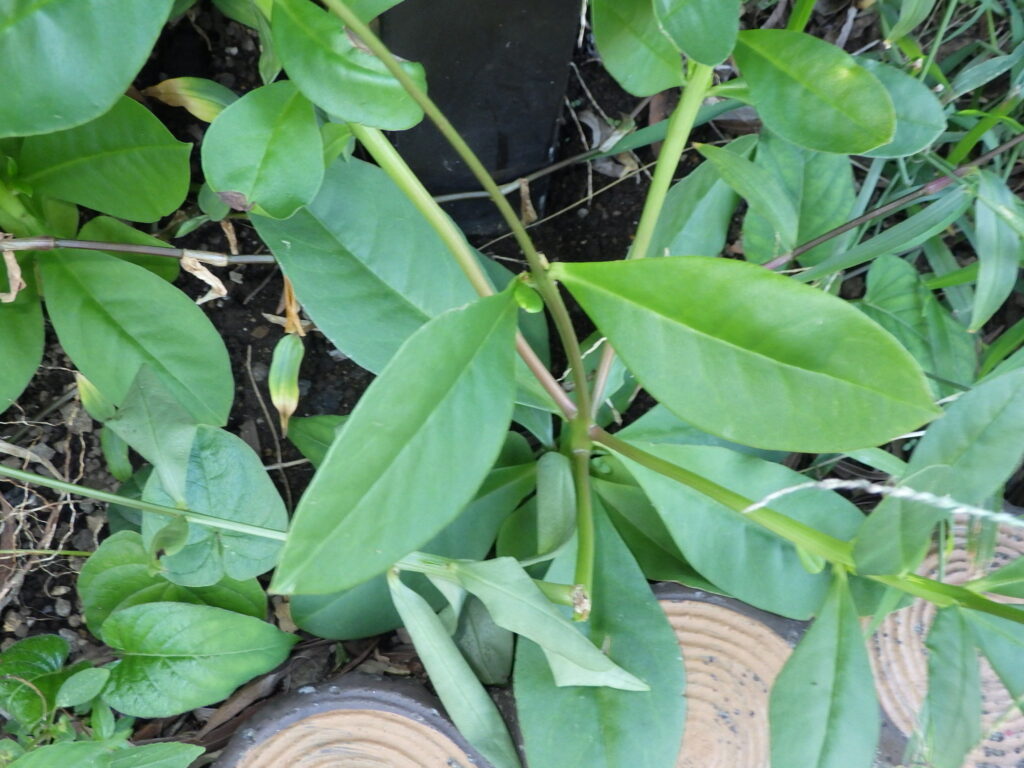
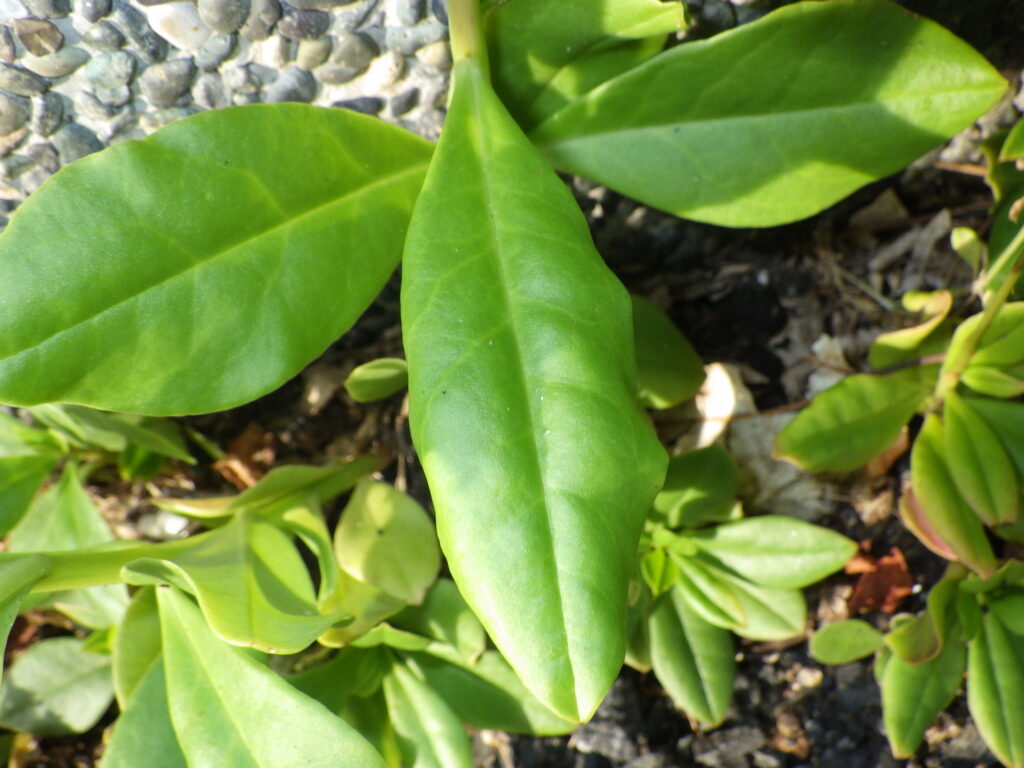
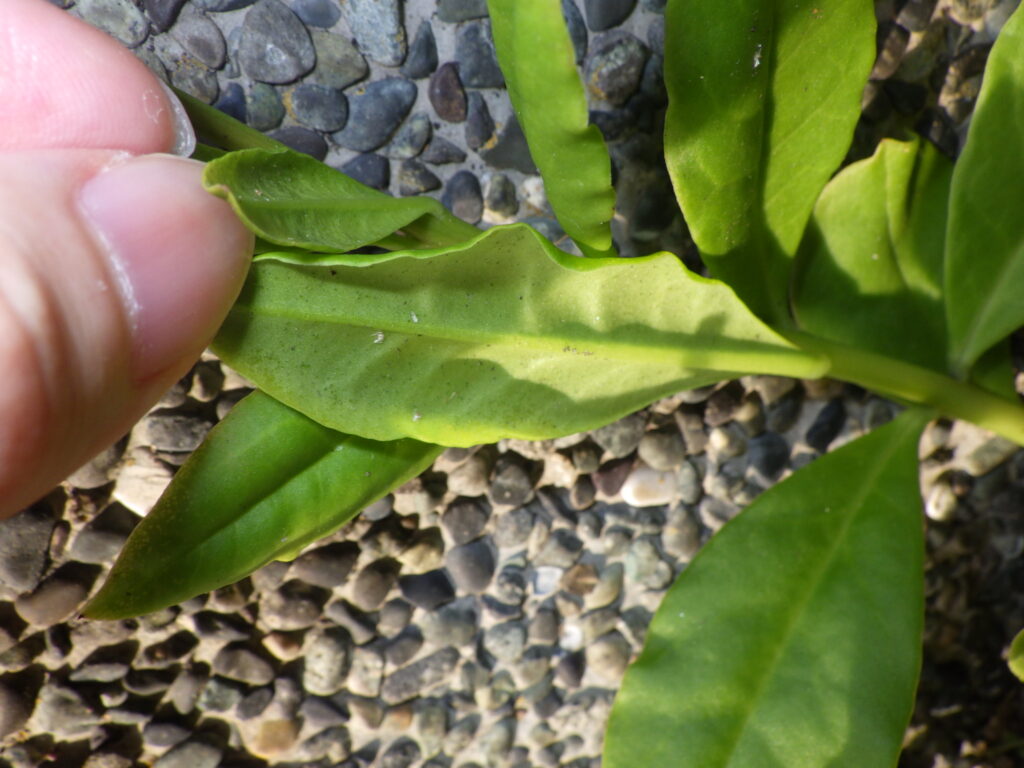
Both belong to the genus Portulaca in the family Portulaca, and they may be confused with each other because they both have oval to obovate leaves and pink flowers.
What is the difference between Portulaca grandiflora and Portulaca triangularis?
However, Portulaca grandiflora and Portulaca triangularis are fairly clearly distinguishable (Flora of North America Editorial Committee, 2004; Uemura et al., 2015).
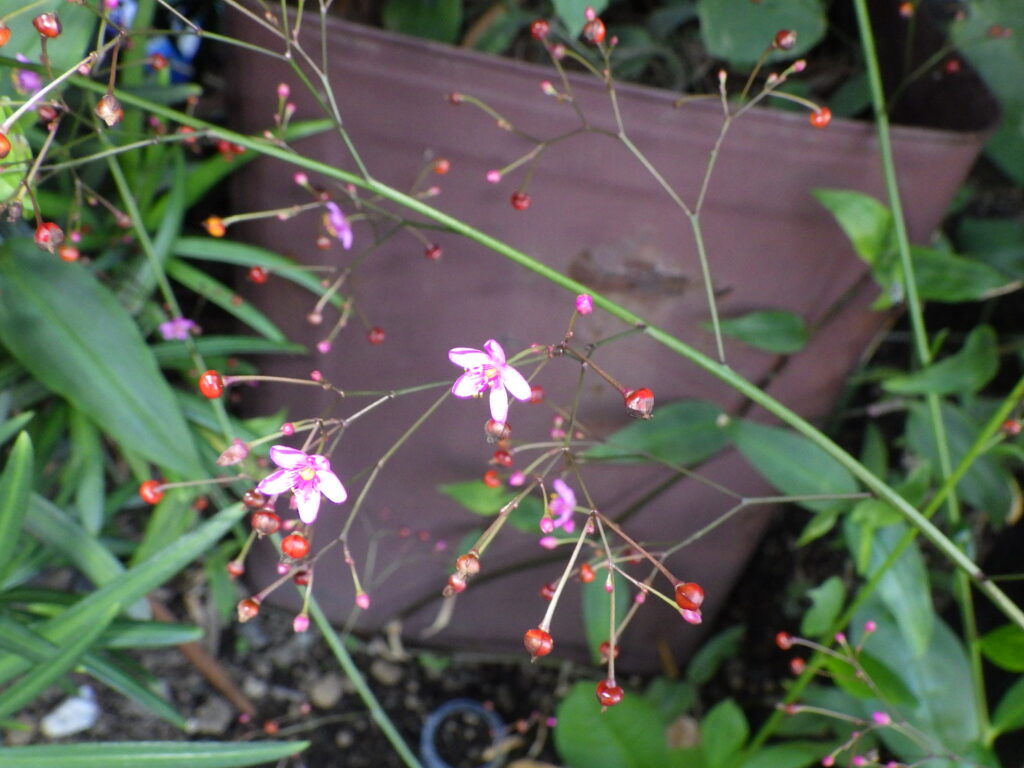
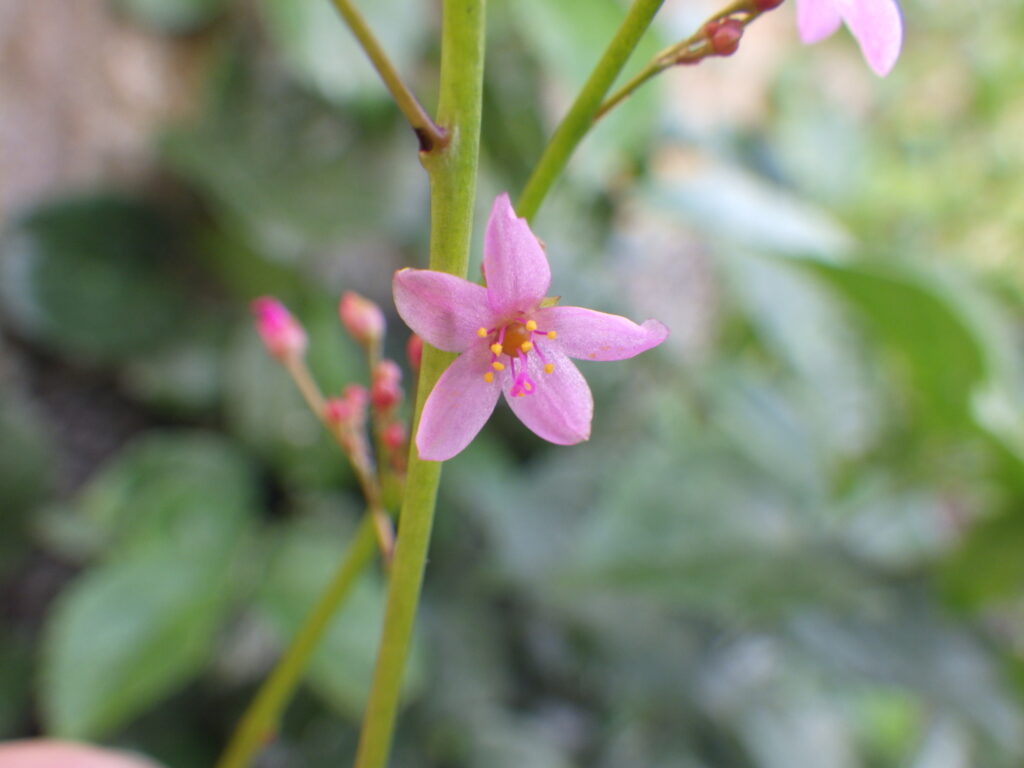
In Portulaca oleracea, the inflorescence is a panicle, the rachis is uniformly slender with no ridges, the petals are 6 mm or less (flower diameter about 7 mm), and the three lobes of the stigma are shallowly lobed. In contrast, in Portulaca triangularis, the inflorescence is a raceme or cymose inflorescence, the rachis has triangular ridges as its name suggests, and is clearly thicker at the distal end, the petals are 7 mm or more (flower diameter about 15 mm), and the three lobes of the stigma are deeply lobed and open.
If you check these points, you should be able to see the difference without any problems. You can understand "陵" as a flat part that protrudes from the plant body. The flower stalk refers to the part from where the flower is attached to where it connects to the stem.
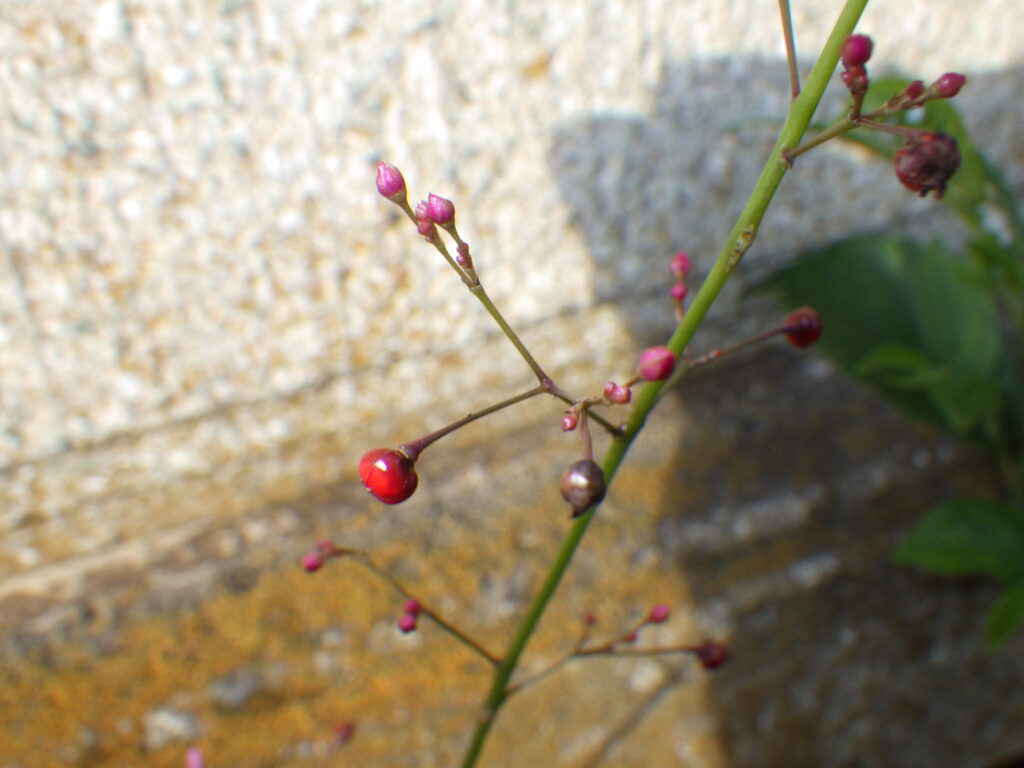
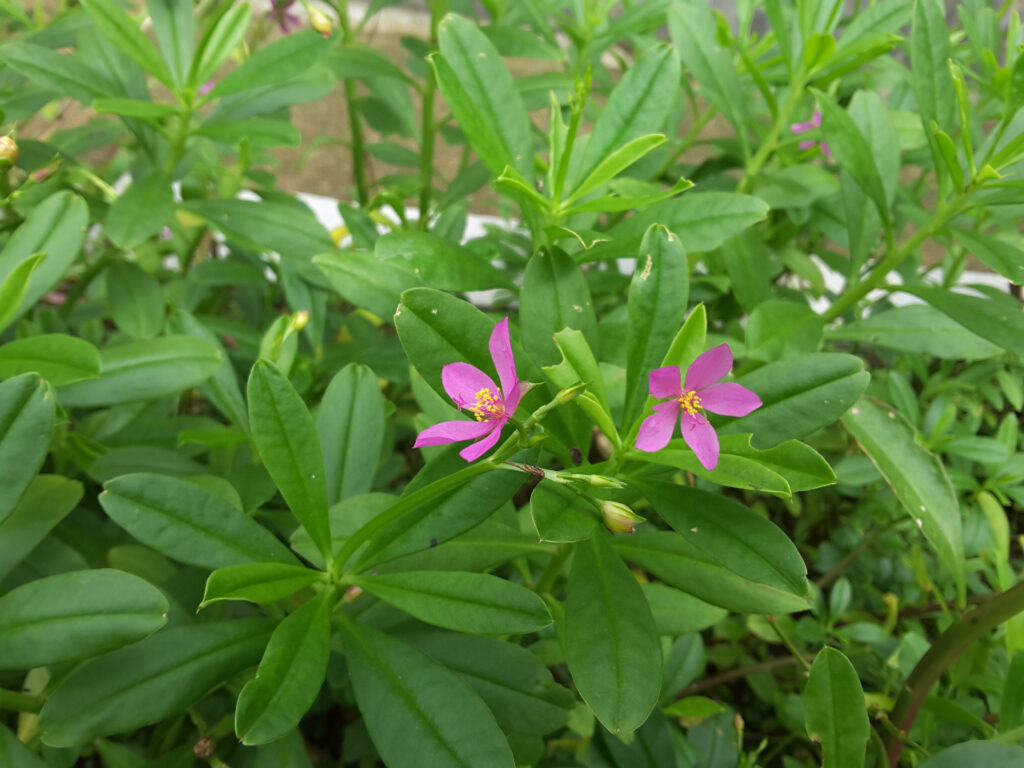
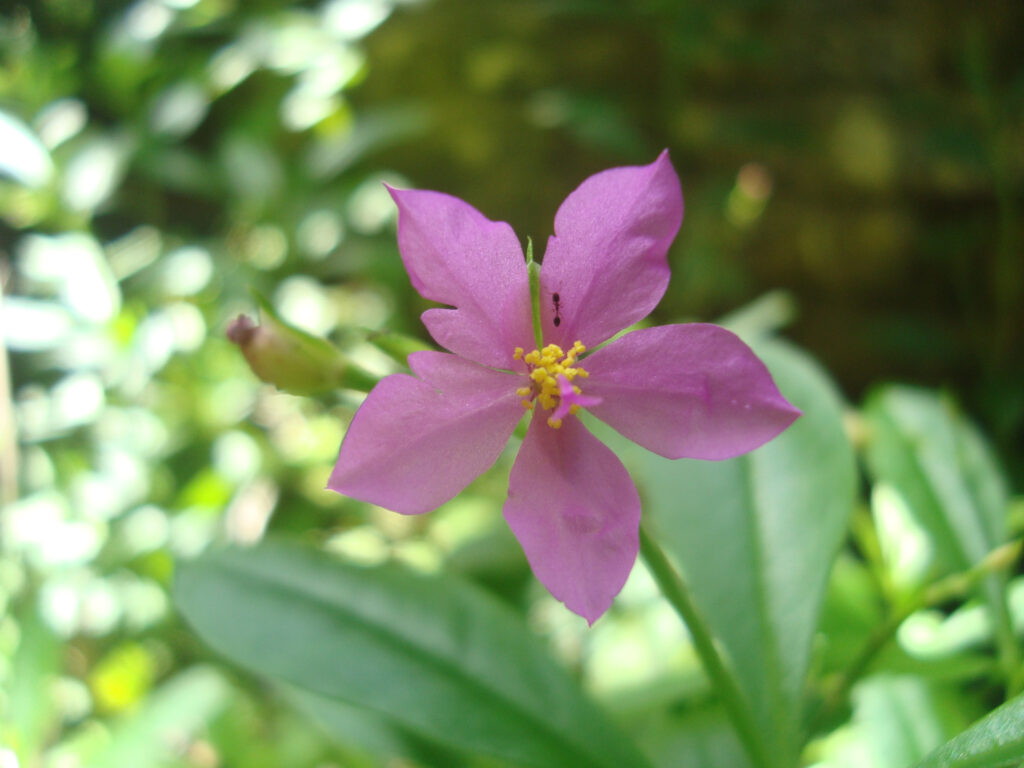
Despite the conspicuous appearance of the Portulaca grandiflora flowers, surprisingly few insects were attracted to them!
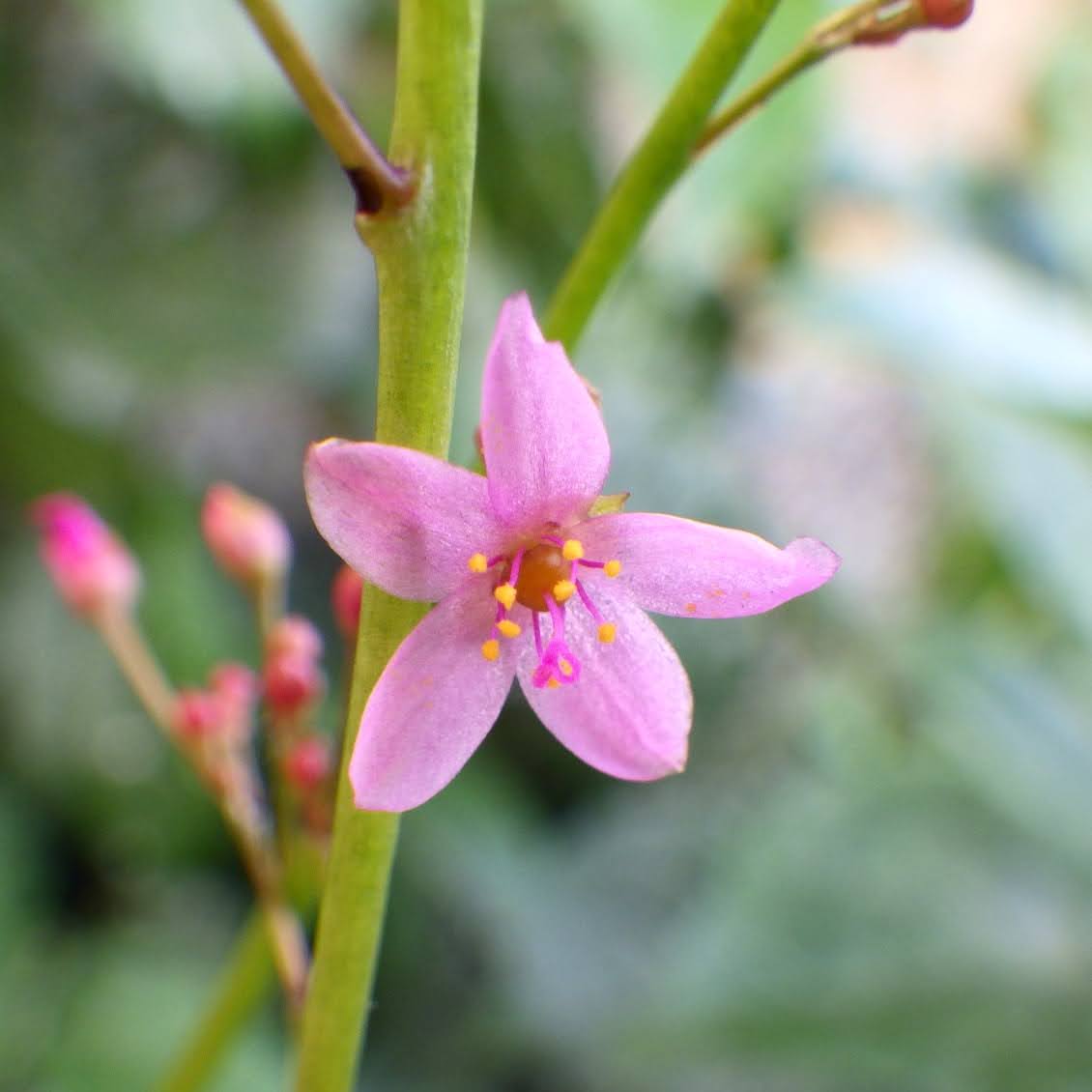
Portulaca grandiflora flowers from June to September. The petals are five in number, red to pale pink, rarely orange-yellow, and 3-6 mm long. The sepals are deciduous and 2.5-4 mm long. There are approximately 15-20 stamens. The stigma is three-lobed. The pedicel can reach up to 20 mm in length.
The flowering period of Portulaca grandiflora is year-round. The inflorescence is a raceme or cymose. The flowers have persistent sepals, which are lanceolate to ovate, 5-6 mm long. The petals are purplish, pink, or white, sometimes yellow, elliptic to ovate, 7-13 mm long. There are 20-35 stamens. The stigma is 1, 3-lobed. The pedicel is triangular, thicker at the top, and less than 12 mm long.
With flowers this bright pink, it's safe to assume that a lot of insects will come to them.
However, a study in Venezuela, near the native habitat of Portulaca grandiflora, found that only two bees of the family Carangidae, five bees of the family Apidae (mainly stingless bees), two wasps, and one leafcutter bee visited the flowers of Portulaca grandiflora in 20 hours (Valerio & Ramirez, 2003).
In other words, flowers are visited almost exclusively by bees, and even then, the number of bees that do visit is quite small.
This is likely largely due to the fact that it does not secrete nectar, and pollen is the only reward for insects. Furthermore, its small size, lack of scent, and the small number of flowers opening per day indicate that it is not very appealing to insects.
Also, this is just my guess, but perhaps the variety is limited because they are small and the footing is unstable.
In addition, it has been found that the rate of self-pollination is higher.
These results are quite surprising. Why are they doing this?
This study was conducted in secondary forests in urban areas. In such environments, it would be advantageous to maintain highly adapted genotypes. Therefore, self-pollination allows for the direct transmission of genes adapted to urban environments to offspring.
However, adapting to pests, diseases, fungi, and environmental changes requires a certain amount of gene exchange. Therefore, they seem to employ a win-win approach: relying on a small number of bees to minimize cross-pollination.
It might be considered a somewhat ambiguous and extravagant approach. However, it's undoubtedly crucial for survival.
However, the results in environments other than urban areas have not yet been studied.
Furthermore, since they can escape and grow on roadsides in urban areas in Japan, it means they are producing seeds. But what is the ratio of self-pollination to cross-pollination? This point has not yet been investigated and is quite interesting.
Why is it called "three o'clock flower"? Why does it bloom at three o'clock?
The plant *Portulaca japonica* is also known as *Sanjisou* or *Yojisou*.
It is said that this flower was named because it blooms around 3 or 4 p.m.
Why do Portulaca grandiflora flowers bloom around 3-4 pm?
Other plants with short flowering times include Trachelospermum asiaticum and Lonicera japonica, which bloom in the evening. These plants often do this to attract insects that are active after dusk.
However, in the case of Portulaca grandiflora, considering the Venezuelan study mentioned earlier, it seems that there are many diurnal bees, so this reason is unlikely.
It seems no one has studied this, but it is likely that the fact that Portulaca grandiflora primarily self-pollinates significantly limits the number of visiting insects.
In other words, it seems to me that shortening the flowering period reduces the number of insects that visit the flowers.
Are the flowers of the triangular-leaved moss plant useful?
While self-pollination is the primary method for Portulaca oleracea, what about Portulaca triangularis?
Although not its native habitat, a study conducted in Karnataka, southern India, found no records of pollinating insects during a 36-hour observation period (Shivanna, 2019). Preliminary investigations for this study also found no such records.
However, it was pollinated and produced seeds properly. In other words, the triangular moss plant also relied on self-pollination.
Moreover, it can be said that *Portulaca oleracea* is more dependent on self-pollination than *Portulaca oleracea*.
In the survey area, the flowers begin to open along with the stems and leaves around 9:00 AM, and become horizontal around 12:00 PM. Around 2:00 PM, the tips of the stems and leaves curve and fully open. Around 3:00 PM, the petals and involucral bracts begin to close, but no insects visit the flowers until this point. Around 5:00 PM, the petals and involucral bracts are completely closed. Self-pollination occurs inside at this stage.
Because the flowers are only open for 5-6 hours during the day, it is believed that there is a shortage of pollinators.
However, if insect pollinators were truly unnecessary, flowers should have completely degenerated, but that hasn't happened yet.
Therefore, in environments where pollinators are present, it is natural to assume that, like Portulaca grandiflora, it undergoes mixed pollination involving both cross-pollination by visitors and self-pollination through petal closure.
Is it true that the fruit is a capsule and "bursts open"?
Both fruits are capsules.
In Portulaca grandiflora, the capsule is nearly spherical with three ridges, 3-5 mm in diameter. When mature, it splits into three sections. The seeds are black, distorted disc-shaped, and about 0.8 mm long.
In Portulaca japonica, the capsule is nearly spherical, with a diameter of 4-6 mm. The exocarp and endocarp usually do not separate after dehiscence, and the valves are deciduous.
While these two species showed little difference in their floral ecology, their fruit ecology is quite different (Veselova et al., 2012).
Both species have arils (appendages covering the surface of the seed), but in Portulaca oleracea, the arils do not contain extra nutrients and are not attractive to ants. However, in Portulaca triangularis, the arils contain a lot of protein and lipids, and it has been found that ants are attracted to these and carry the seeds away.
In Portulaca grandiflora, the seeds remain inside the fruit for a considerable period, even after ripening. Subsequently, the capsule is broken open by weathering, or by ants attracted to the capsule, causing it to break open and the seeds inside to be dispersed by gravity and wind. However, although the authors of this paper state this, it seems that they have not observed whether ants actually visit the capsules.
On the other hand, in the case of Portulaca oleracea, when the fruit ripens, it bursts open and actively scatters its seeds, resulting in automatic dispersal. After this, the scattered seeds on the ground are carried away by ants that come looking for the aril.
That's not the only difference. Portulaca oleracea lacks an appendage called omphaladium on its seeds, whereas Portulaca oleracea var. triangularis has it. Why is that? Omphalodium absorbs moisture, regulates the moisture balance of the seed, and promotes germination.
In Portulaca grandiflora, the seeds remain inside the fruit for a considerable period, so it takes time for them to germinate. In such cases, it is necessary to reduce the amount of water and maintain a dry state, allowing germination to occur at the appropriate time. Therefore, it does not contain Omphalodium.
In contrast, the seeds of *Potamogeton crispus* are quickly scattered on the ground and carried away by ants. In semi-arid areas, the seeds need to germinate before the moisture dries up. This is why it seems to possess *Omphalodium*.
Although these two species have quite different fruit life cycles, the reason for this difference remains unclear. However, since *Potamogeton crispus* has a life cycle that depends on ants, whether or not suitable ants for seed dispersal existed in the environment where its ancestors lived likely had a significant impact. The environment in which the seeds can freely roll on the ground in the wind may also be a contributing factor.
There are several theories about the origin of the Japanese name "hazeran," including that it comes from the way the flowers bloom one after another as if bursting (hazeru), that the round red fruit resembles a bursting sparkler, and that it comes from the way the seeds burst and scatter. However, it can be said that this description applies most to the triangular hazeran.
References
Flora of North America Editorial Committee. 2004. Flora of North America (Vol. 4 Magnoliophyta: Caryophyllidae, Part 1). Oxford University Press, 584pp. ISBN: 9780195173895
Kanagawa Prefecture Flora Survey Association. 2018. Kanagawa Prefecture Flora 2018 (Electronic Edition). Kanagawa Prefecture Flora Survey Association, Odawara. 1803pp. ISBN: 9784991053726
Shimizu, K., Morita, H., & Hirota, S. 2001. Illustrated Guide to Naturalized Plants of Japan: 600 Species of Plant Invaders (Revised). National Rural Education Association, Tokyo. 553pp. ISBN: 9784881370858
Shivanna, KR 2019. A Novel Autogamous Self-Pollination Strategy Involving Closing of Perianth Lobes in Talinum fruticosum (L.) Juss. Proceedings of the National Academy of Sciences, India Section B: Biological Sciences 89(4): 1407-1411. https://doi.org/10.1007/s40011-018-01066-6
Uemura, Shuji; Katsuyama, Teruo; Shimizu, Norihiro; Mizuta, Mitsuo; Morita, Hirohiko; Hirota, Shinichi; and Ikehara, Naoki. 2015. Illustrated Guide to Naturalized Plants of Japan: 500 Species of Plant Invaders (Revised and Expanded Edition, Vol. 2). National Rural Education Association, Tokyo. 595pp. ISBN: 9784881371855
Valerio, R. & Ramirez, N. 2003. Exogamic depression and reproductive biology of Talinum paniculatum (Jacq.) Gaertner (Portulacaceae). Acta Botánica Venezuelica 26(2): 111-124. ISSN: 0084-5906, http://ve.scielo.org/scielo.php?script=sci_abstract&pid=S0084-59062003000200001&lng=en&nrm=iso&tlng=en
Veselova, T. D., Dzhalilova, K. K., Remizowa, M. V., & Timonin, A. C. 2012. Embryology of Talinum paniculatum (Jacq.) Gaertn. and T. triangulare (Jacq.) Willd. (Portulacaceae sl, Caryophyllales). Wulfenia 19: 107-129. ISSN: 1561-882X, http://msu-botany.ru/gallery/veselova%20et%20al-3.pdf
Source
This article is a significantly expanded version of a piece originally published in the following book.