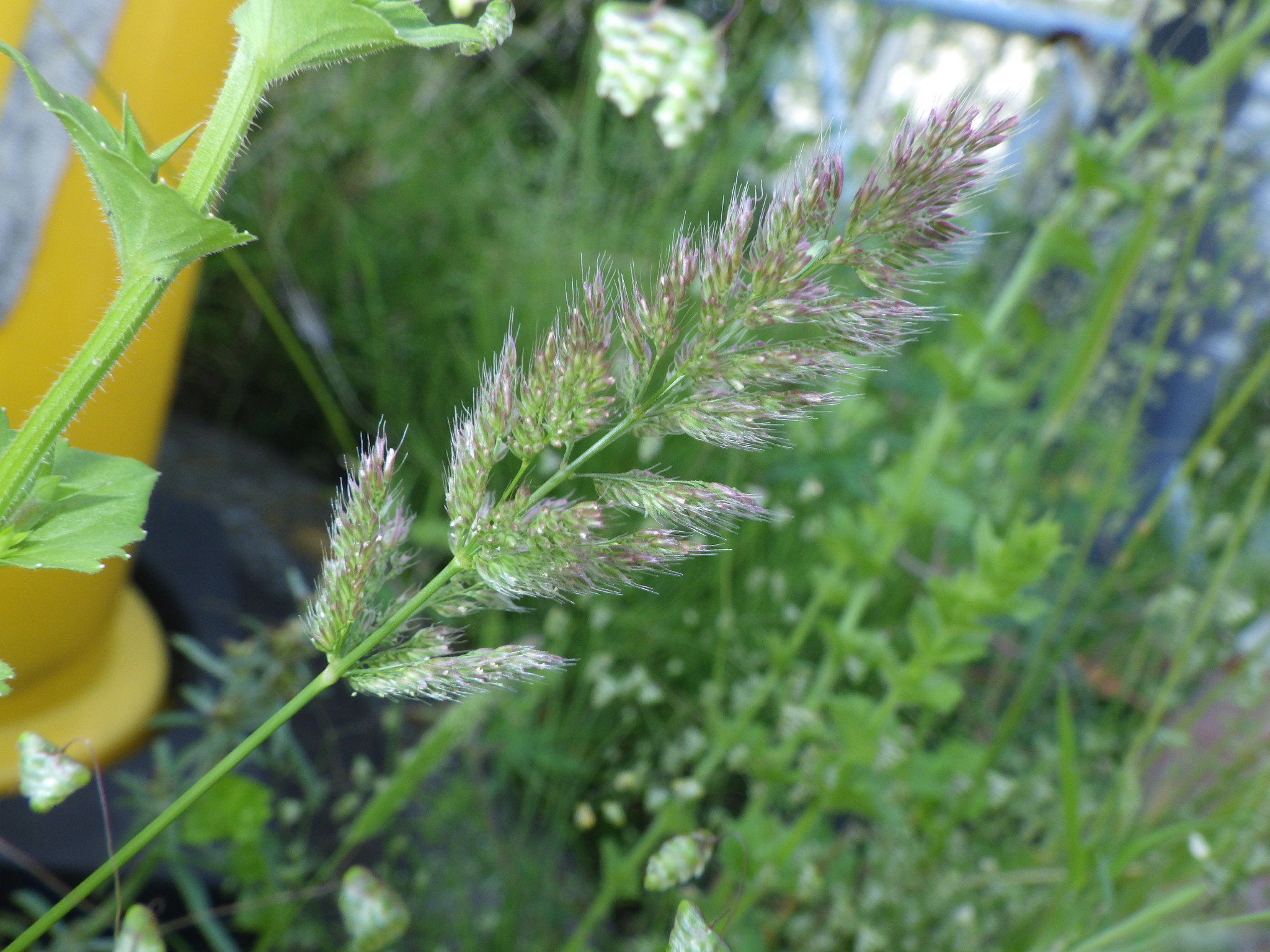
Barnyard grass, striped barnyard grass, upright barnyard grass, and American barnyard grass are all perennial grasses belonging to the genus Barnyard grass in the grass family Poaceae, and are commonly found as weeds in a wide range of areas from urban areas to farmlands. Their most distinctive feature is that their spikelets are flat and nearly circular to oval in shape. However, they are all very similar and can be difficult to distinguish. The best way to differentiate the four species is to check the characteristics of their spikelets. There are also other subtle differences. This article will explain the classification and morphology of the genus Barnyard grass.
What are barnyard grass, striped barnyard grass, tall barnyard grass, and American barnyard grass?
Paspalum thunbergii, also known as sparrow's barnyard grass, is a perennial herb that grows along roadsides and in wastelands, distributed throughout East Asia, including Honshu, Shikoku, Kyushu, the Ryukyu Islands, and the Ogasawara Islands in Japan, as well as Korea and China.
Paspalum dilatatum, also known as island barnyard grass, is native to South America and has naturalized in warm regions around the world. In Japan, it has naturalized south of Honshu and is a perennial plant that grows along roadsides and in wastelands.
Paspalum urvillei, also known as upright sparrow's barnyard grass, is native to South America and has naturalized in warm regions around the world. In Japan, it has naturalized west of the Kanto region and is a perennial plant that grows along roadsides and in wastelands.
American barnyard grass (Paspalum notatum) is native to tropical America and has naturalized in warm regions worldwide. In Japan, it has naturalized in various areas and can be found throughout the country except in mountainous regions. It is believed to have escaped cultivation as pasture grass.
Both belong to the genus Paspalum in the grass family and are perennial plants that can be found as weeds in a wide range of areas, from urban areas to farmlands.
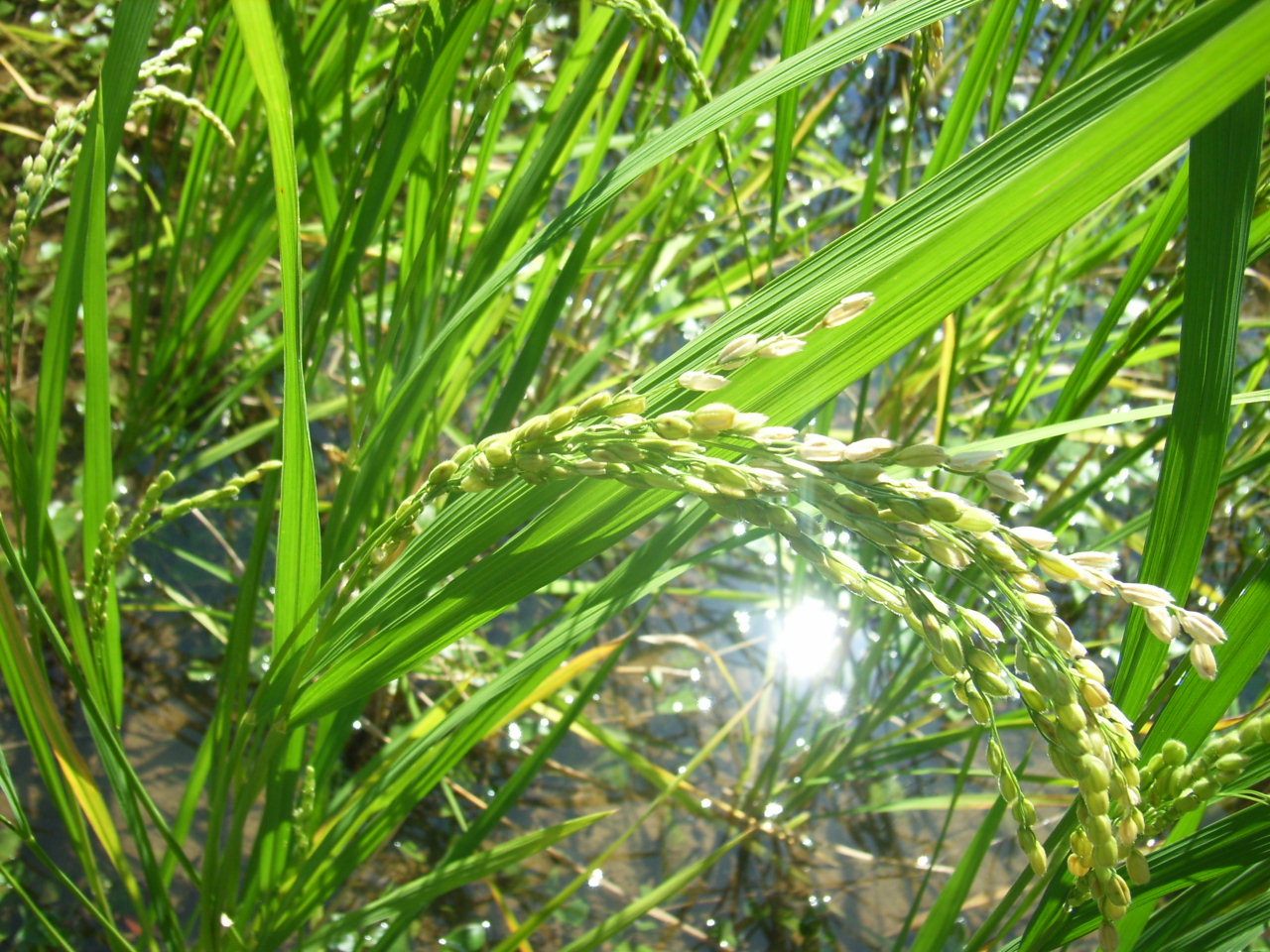
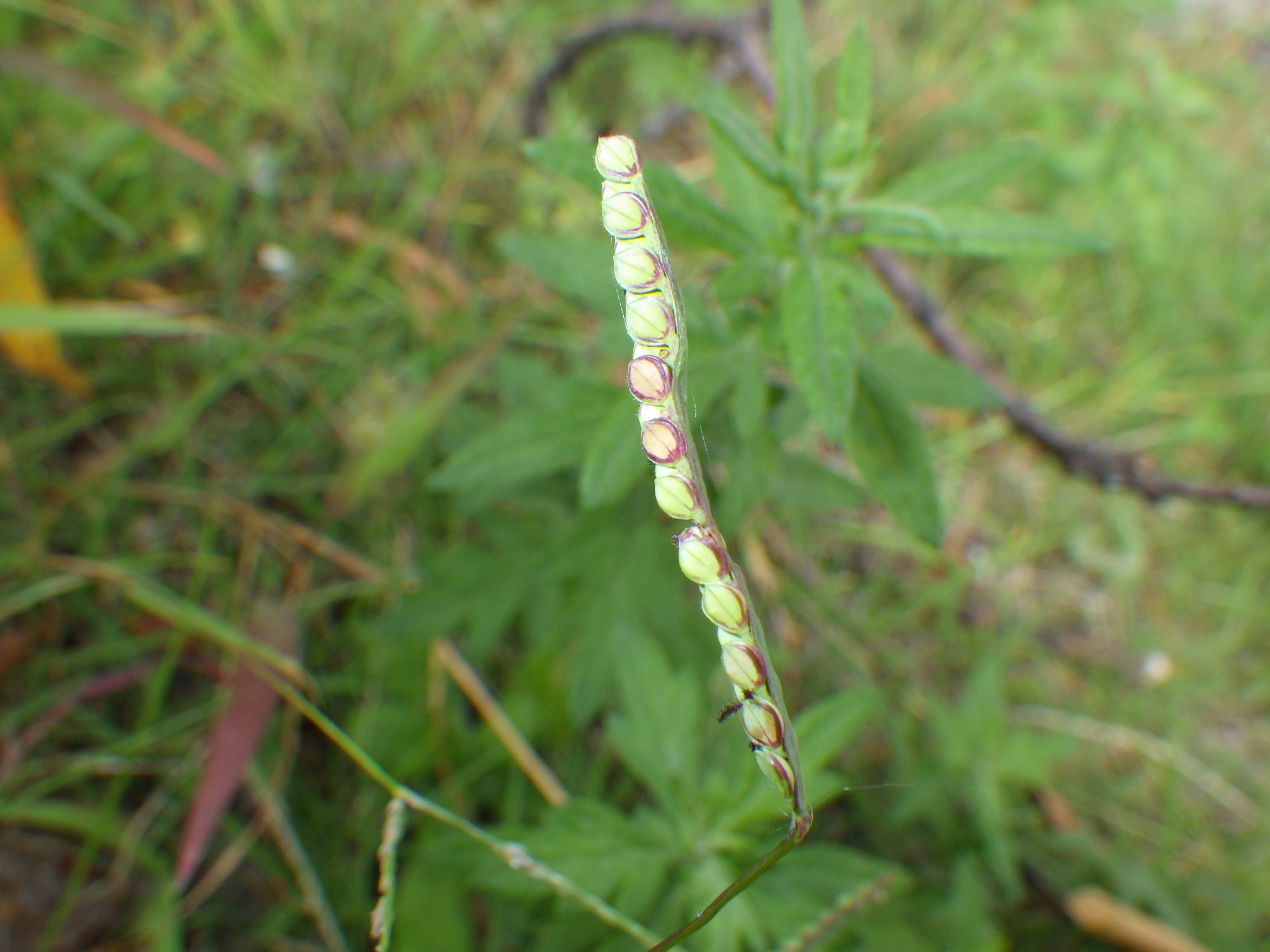
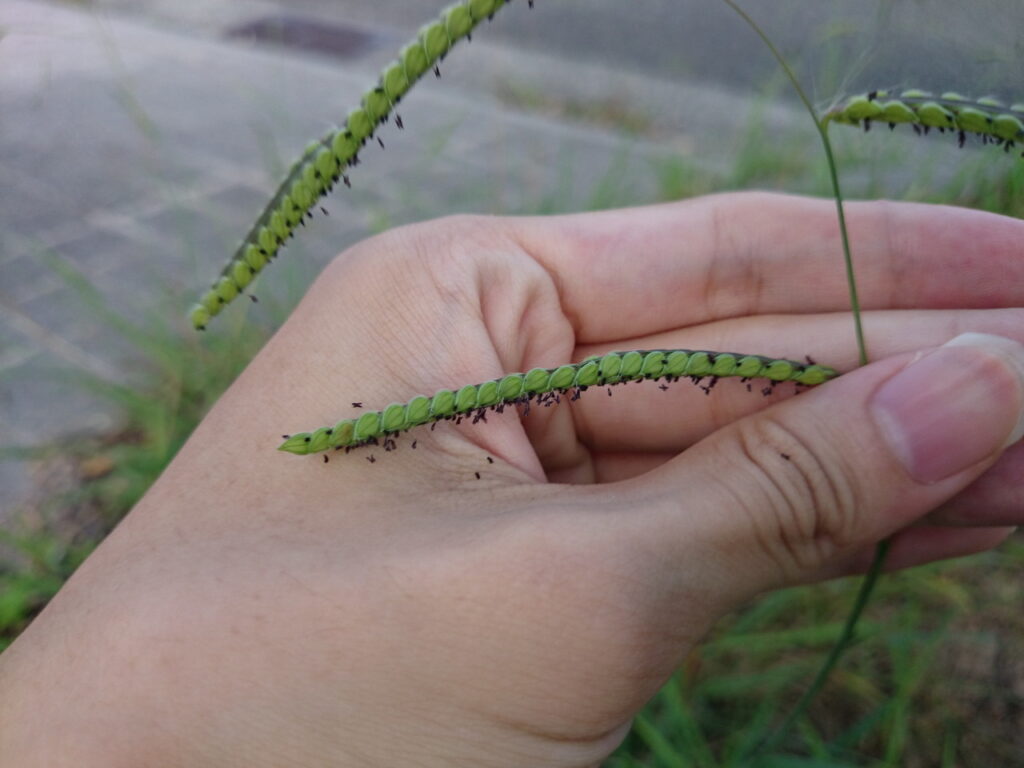
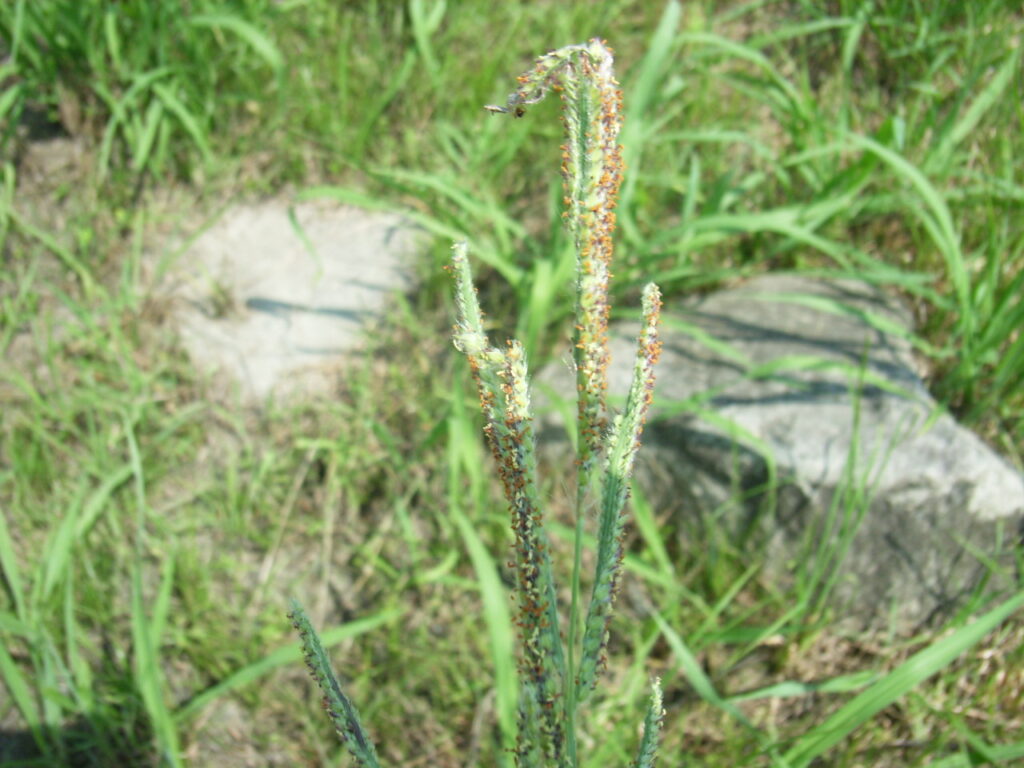
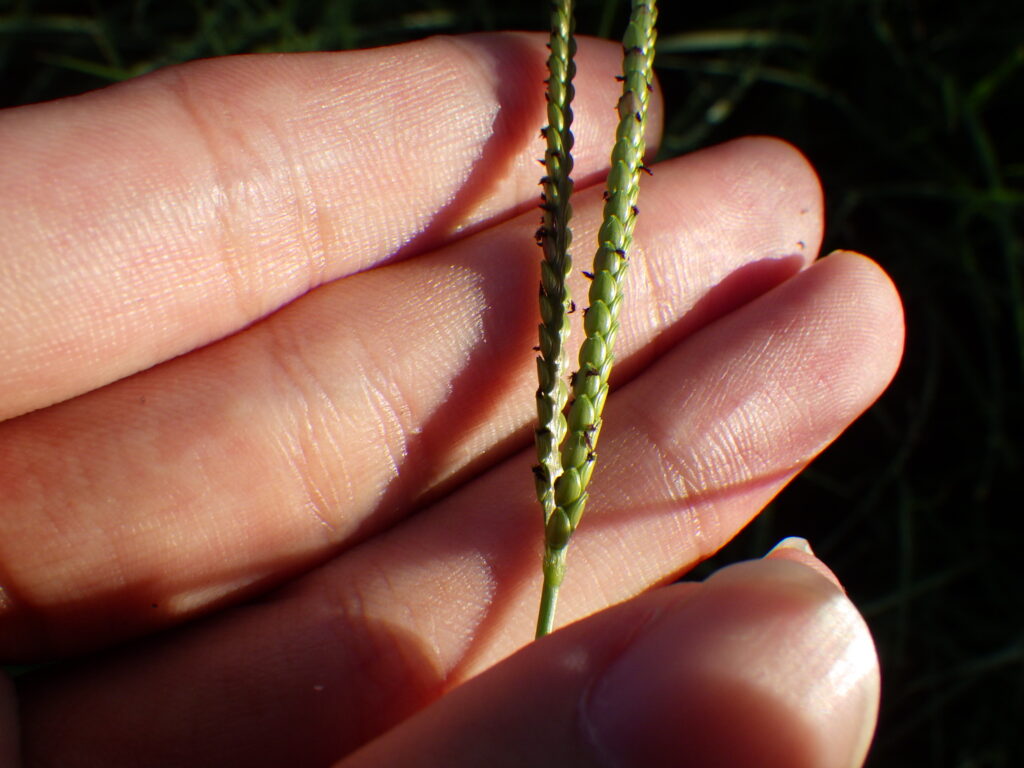
This group of plants bears several racemes called "sou" (or "fusa"), and these racemes have even smaller clusters of inflorescences called "shōsui," where flowers (specifically called florets) bloom and develop into fruits when ripe.
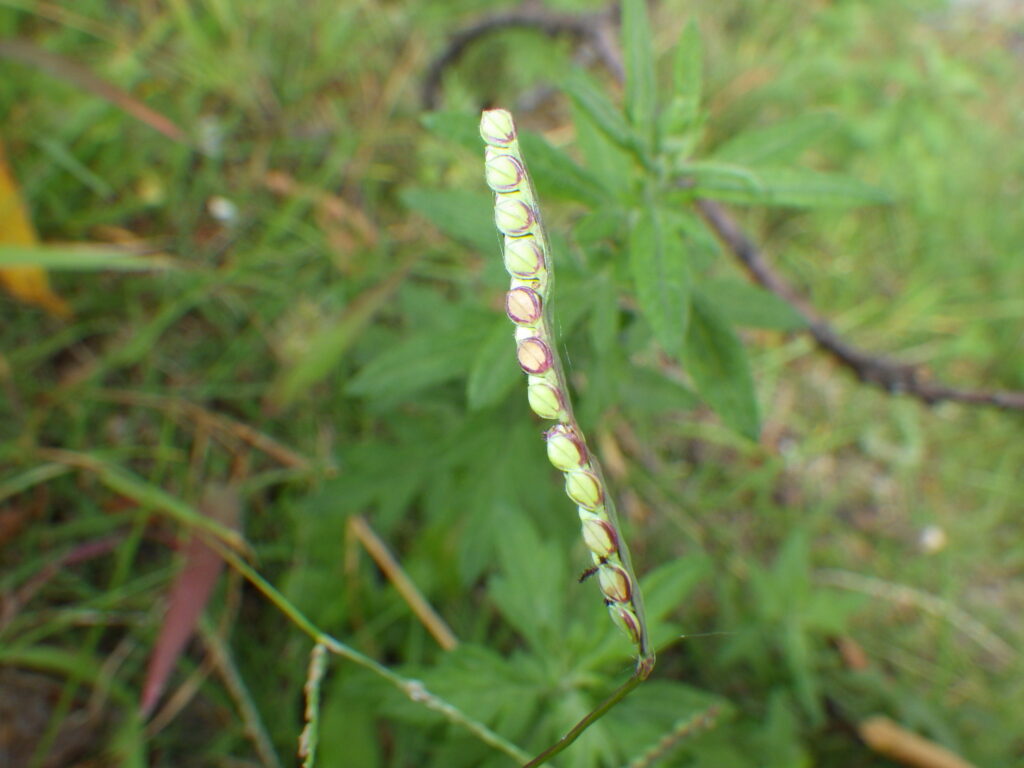
The spikelets of the genus Paspalum are flat and nearly circular to oval in shape, which is perhaps their most distinctive feature. The Japanese name "Suzume-no-hie" (sparrow's density) is said to originate from the fact that "the spikelets resemble those of barnyard grass, which is not edible for humans but is used as food for sparrows," but it's also possible that the name was given because of the large size of the spikelets.
However, the genus *Paspalum* includes many species that have naturalized in addition to the native *Paspalum*, and they are very similar, so some people may have trouble distinguishing them.
What are the differences between Barnyard Grass, Striped Barnyard Grass, Upright Barnyard Grass, and American Barnyard Grass?
When distinguishing between the four species, examining the spikelets is probably the most accurate method.
First, there is a difference in that the spikelets of Barnyard grass, Striped Barnyard grass, and Upright Barnyard grass are not glossy, while those of American Barnyard grass are glossy.
Regarding the remaining three species, the difference lies in the fact that in Barnyard Grass (Paspalum indicum), the spikelets are circular to oval and have fine hairs or are hairless along the edges, while in Striped Barnyard Grass (Paspalum indicum) and Upright Barnyard Grass (Paspalum erythrorhizon), the spikelets are oval and have long, white hairs along the edges.
Regarding Barnyard grass and upright barnyard grass, Barnyard grass has spikelets that are 3-3.5 mm long, and the stigma of the pistil and the anthers (the part with pollen) of the stamens are blackish-purple, while upright barnyard grass has spikelets that are 2-2.5 mm long, and the stigma of the pistil is blackish-purple and the anthers of the stamens are yellow.
The above should be sufficient to distinguish them, but there are a few more differences that may be helpful, so I will list them here.
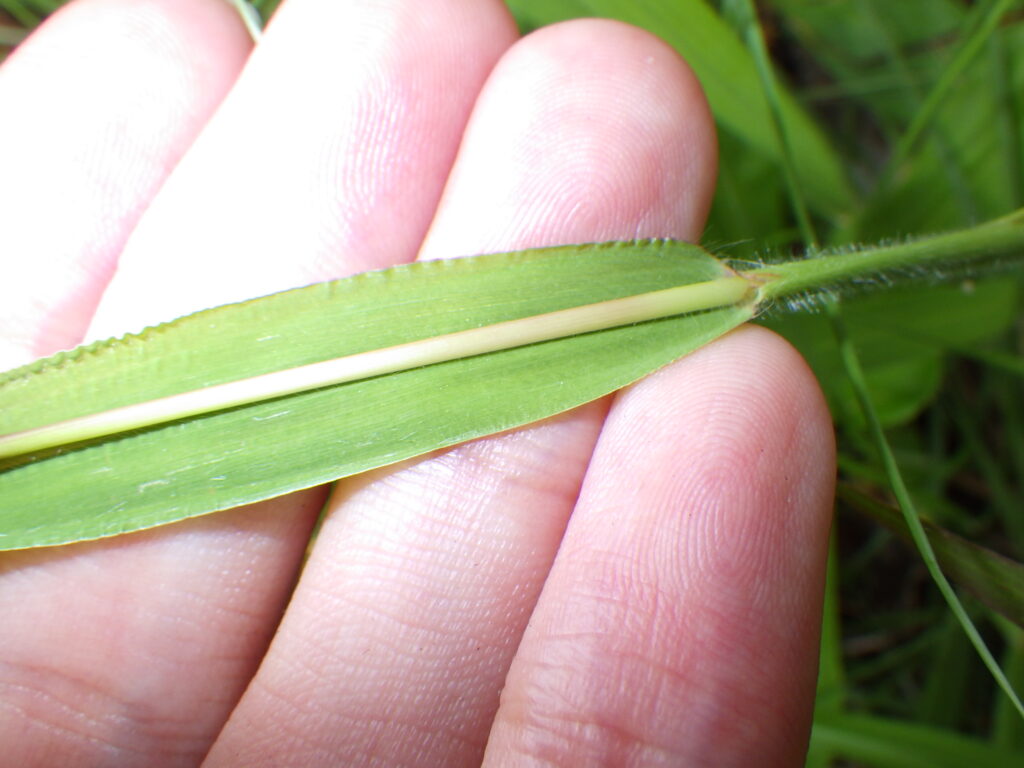
In Barnyard grass, striped barnyard grass, and upright barnyard grass, they grow in clumps, lack long rhizomes or stolons, and have a membranous ligule, whereas in American barnyard grass, there are long rhizomes and stolons, and the ligule is membranous or covered with rows of fine hairs.
In Barnyard grass, the involucre consists of 3 to 7 leaves, and the mouth of the leaf sheath at the top of the culm is sparsely covered with long hairs or is hairless, whereas in Barnyard grass, the involucre consists of 10 to 20 leaves, and the mouth of the leaf sheath at the top of the culm is densely covered with long hairs.
Are there any other similar species?
Nine species of the genus *Paspalum* are known in Japan, but the four species mentioned above are quite dominant, with the others being less common.
Paspalum distchum is a relatively common species among them. Like American barnyard grass, it has long rhizomes and stolons, but it grows in wetlands, has long hairs at the opening of the leaf sheath, and its spikelets are not glossy and are narrow in width, giving them a shape that is close to oblong.
References
Kanagawa Prefecture Flora Survey Association. 2018. Kanagawa Prefecture Flora 2018 (Electronic Edition). Kanagawa Prefecture Flora Survey Association, Odawara. 1803pp. ISBN: 9784991053726