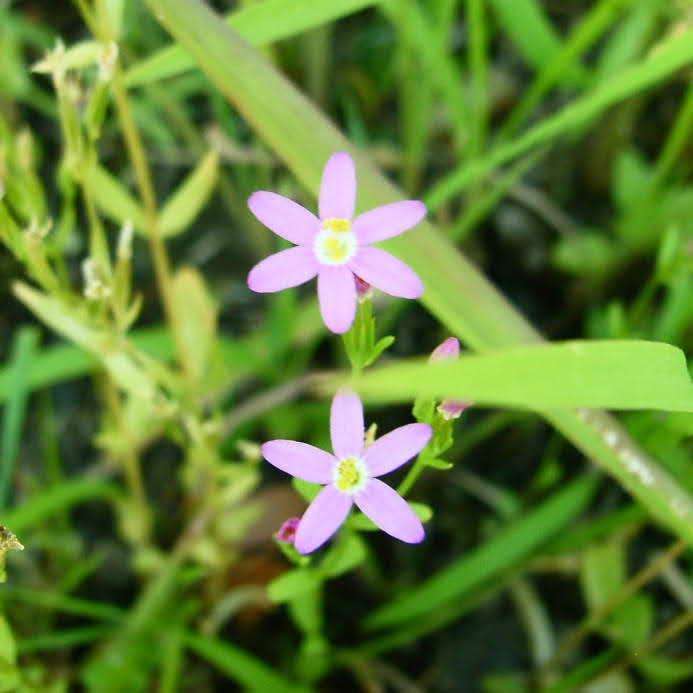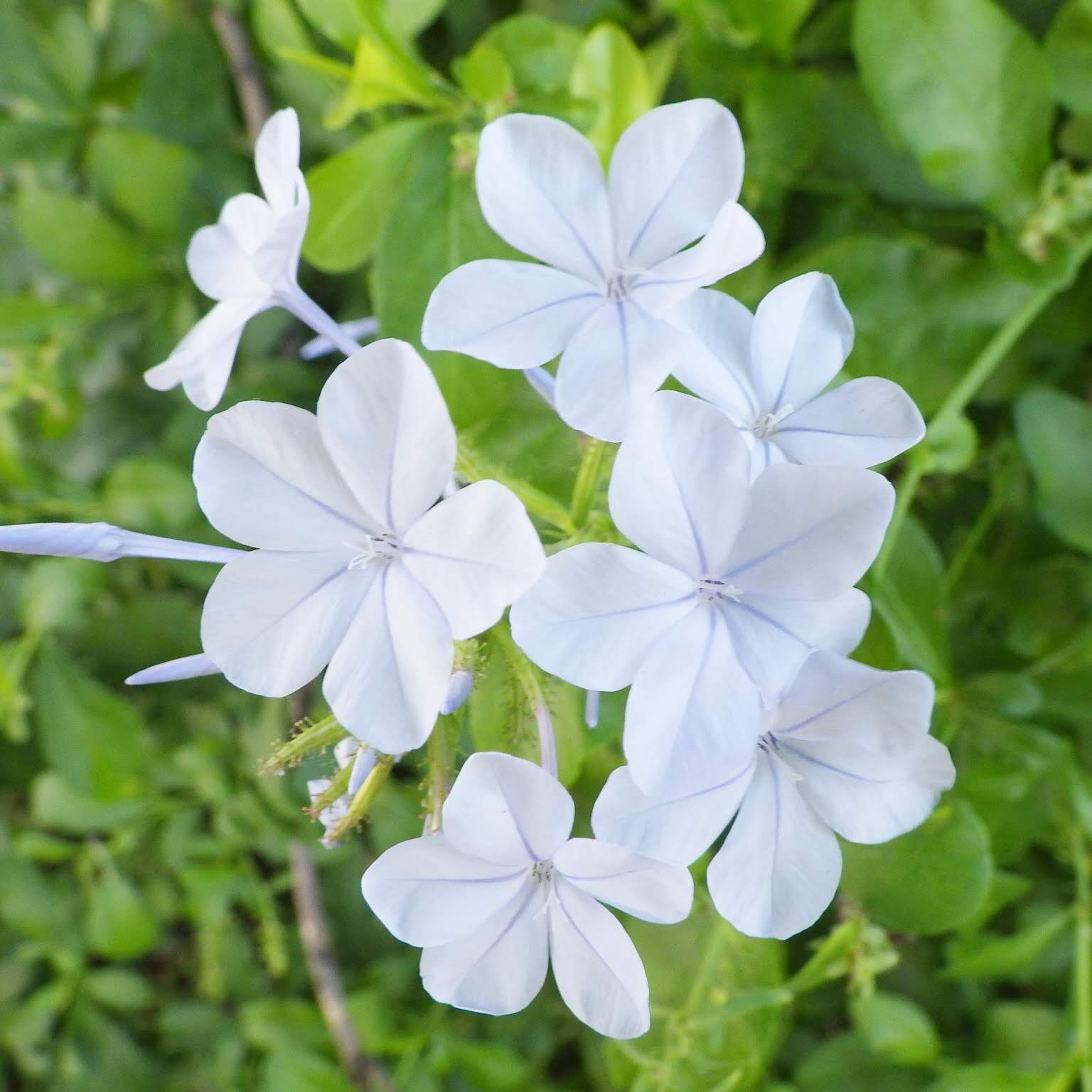
Plumbago (Plumbago auriculata) and Plumbago rhododendron (Plumbago rhododendron var. japonica) are two horticultural varieties of the Plumbaginaceae family that produce somewhat unusual blue flowers. In Japan, they are cultivated in gardens for ornamental purposes, and are easily confused with each other due to their similar names, blue flowers, and similar shapes. However, they belong to different genera and can be clearly distinguished. The easiest way to tell them apart is by the presence or absence of large, glandular bristles on the calyx tube of the flower. The length of the flower tube is also a major distinguishing factor. They can also be distinguished by their leaves; Plumbago rhododendron var. japonica has hairs on the leaf margins. Several ecological studies have been conducted on Plumbago auriculata and Plumbago rhododendron var. japonica. The flowers have two types: one with long stamens and the other with long pistils. This is thought to be an evolutionary adaptation to prevent self-pollination. Insects that visit them in the wild have also been studied, and it has been found that members of the Bryoptera and Papilionidae families, which are endemic to Africa and have particularly long proboscises, visit them. This article will explain the classification and pollination ecology of Plumbago auriculata and Plumbago prunifolia.
- Two horticultural varieties of the Plumbaginaceae family that produce somewhat unusual blue flowers.
- What is the difference between Plumbago auriculata and Plumbago prunifolia?
- What is the structure of a flower?
- Why are there types with long stamens and types with long pistils?
- Only insects with long mouths can suck nectar from flowers!?
- Are the fruits capsules dispersed by gravity?
- References
- Source
Two horticultural varieties of the Plumbaginaceae family that produce somewhat unusual blue flowers.
Plumbago auriculata, also known as Plumbago, is an evergreen shrub native to eastern South Africa, where it grows in lowland woodlands (Ferrero et al., 2009). In Japan, it is cultivated as an ornamental plant.
Ceratostigma plumbaginoides, also known as Plumbago auriculata, is a perennial herb native to China (Beijing, Henan, Jiangsu, Shanxi, and Zhejiang provinces) that grows in rocky areas and often on foothills (Wu & Raven, 1996). In Japan, it is cultivated as an ornamental plant.
Both belong to the Plumbaginaceae family and are cultivated in gardens in Japan for ornamental purposes. Their blue flowers and similar shapes make them easily confused. Both also have entire, rounded leaves. Even their names, such as the Japanese word for "imitation," contribute to this confusion.
What is the difference between Plumbago auriculata and Plumbago prunifolia?
However, botanically, Plumbago auriculata belongs to the genus Plumbago, while Ceratostigma auriculata belongs to the genus Ceratostigma, meaning they are classified differently.
First, one key difference is that Plumbago auriculata is an evergreen shrub, while Plumbago prunifolia is a perennial herb. Therefore, Plumbago auriculata tends to be more woody, with stiffer branches and stems. Plumbago prunifolia, on the other hand, is softer. However, young Plumbago auriculata also has many soft parts, so it may be difficult to distinguish between the two depending on the individual plant.
The most significant botanical difference is evident in the shape of the flowers (Wu & Raven, 1996).
In Plumbago auriculata, the calyx tube of the flower has large, glandular, head-shaped bristles about 1 mm long, whereas in Plumbago auriculata, the calyx tube has nothing.
Furthermore, while the overall length of the flower in Plumbago auriculata is very long, ranging from 3.7 to 5.3 cm, with a particularly long corolla tube (the slender, elongated part of the corolla), in Plumbago prunifolia it is shorter, ranging from 2.5 to 2.8 cm, and its corolla tube is not as long as that of Plumbago auriculata.
Furthermore, in Plumbago auriculata, the limb of the corolla (the tip of the corolla that resembles a petal) is close to an oblong shape, while in Plumbago auriculata, it is closer to a delta-shaped isosceles triangle.
The flower color also differs; while the flowers of Plumbago auriculata are pale blue, those of Plumbago prunifolia are blue. This may vary depending on the variety and individual plant, so please take this as a general guideline only. The Plumbago prunifolia variety 'Blue Sapphire' appears to have a deep blue color.
There are also differences in the leaves. In Plumbago auriculata, the leaf margins are smooth, but in Plumbago prunifolia, inward-facing hairs are prominent.
By checking the above, you should be able to distinguish them reliably.
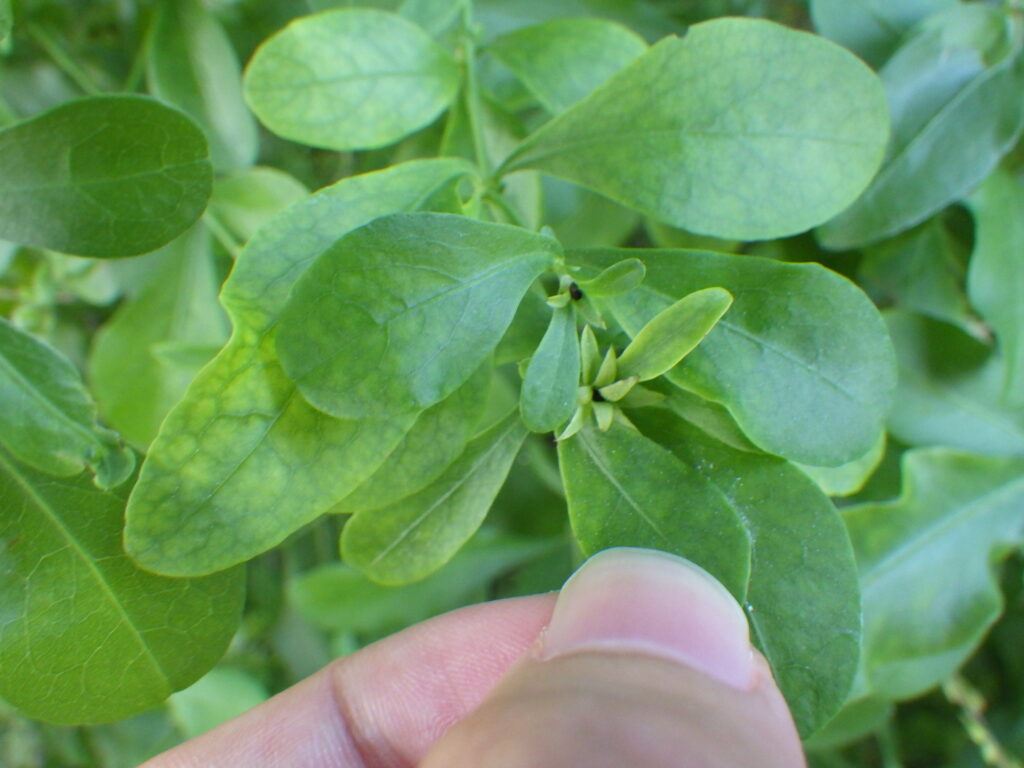
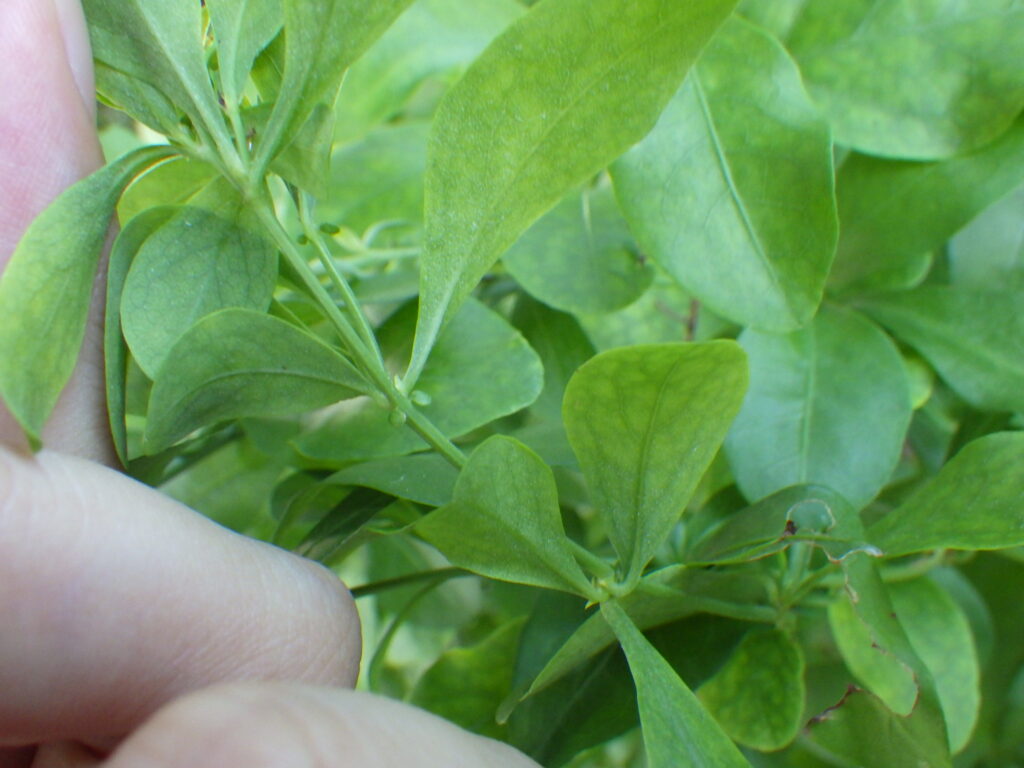


What is the structure of a flower?
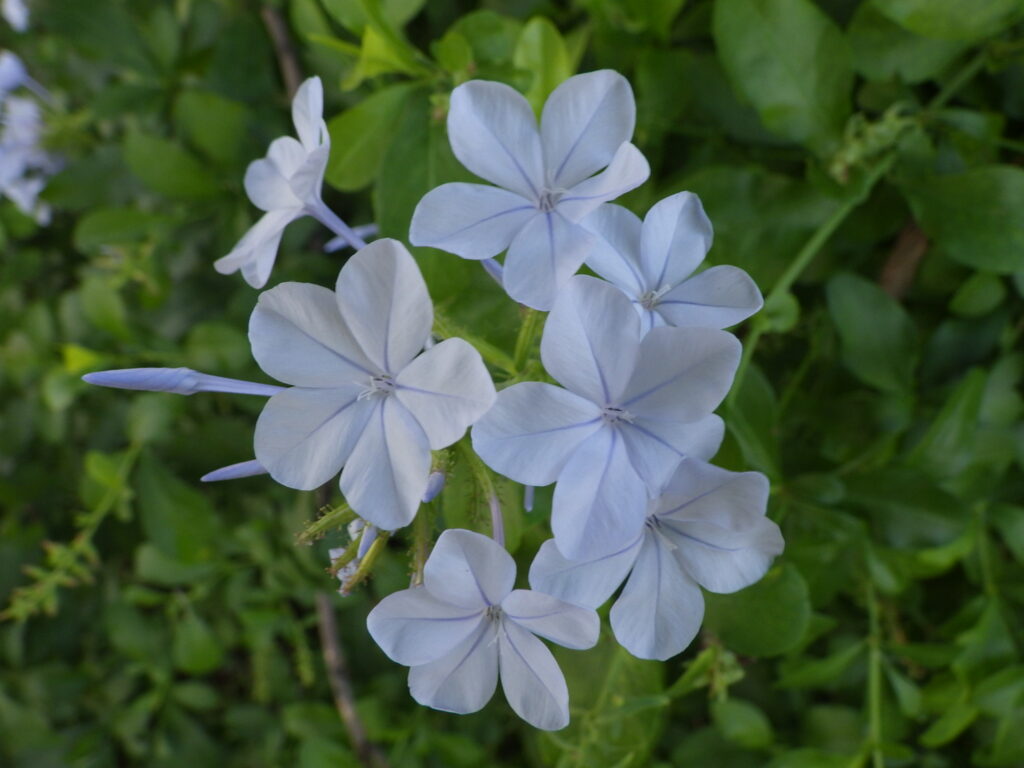
Plumbago auriculata flowers from May to November. The inflorescence is 2.5–3 cm long, and the inflorescence axis has short soft hairs but no glandular hairs. The bracts are lanceolate, 3–9 mm long and 1–2 mm wide. The flowers have three styles. The calyx is 10–13 mm long, and the calyx tube is usually covered with short soft hairs, with large, glandular, capitate bristles about 1 mm long on about the apical half of the ribs. The corolla is pale blue, slender and funnel-shaped, with a narrow tubular section, about 15 mm in diameter and 37–53 mm long. The limb (the tip of the corolla) is 5-lobed (Tsukamoto, 1994), and the tube is 28–40 mm long. The corolla lobes are 10–16 mm long and 6–15 mm wide.
Plumbago auriculata flowers from July to September. The inflorescence is terminal or axillary, bearing 15 to 30 or more flowers, each flower having a lanceolate to oblong bract at its base. The bracteoles are ovate, with an acute and mucronate apex. The calyx is 13 to 15 mm long and 1.5 to 2 mm wide, with sparse bristles on the veins, and the sepals are about 2 mm long. The corolla is 2.5 to 2.8 cm long, slender and funnel-shaped, with a narrow tubular section. The tube is reddish-purple, and the limb is 5-lobed, blue, inverted delta-shaped, 8 mm long and 8 mm wide, with a narrow, notched, triangular, mucronate apex.
Although both are blue and similar in appearance, there are differences, as mentioned above. Their flowering periods also differ significantly. This is likely a result of their evolution in completely different regions: South Africa and China.
Why are there types with long stamens and types with long pistils?
The stamens of the genera Plumbago and Plumbago have something a little unusual about them.
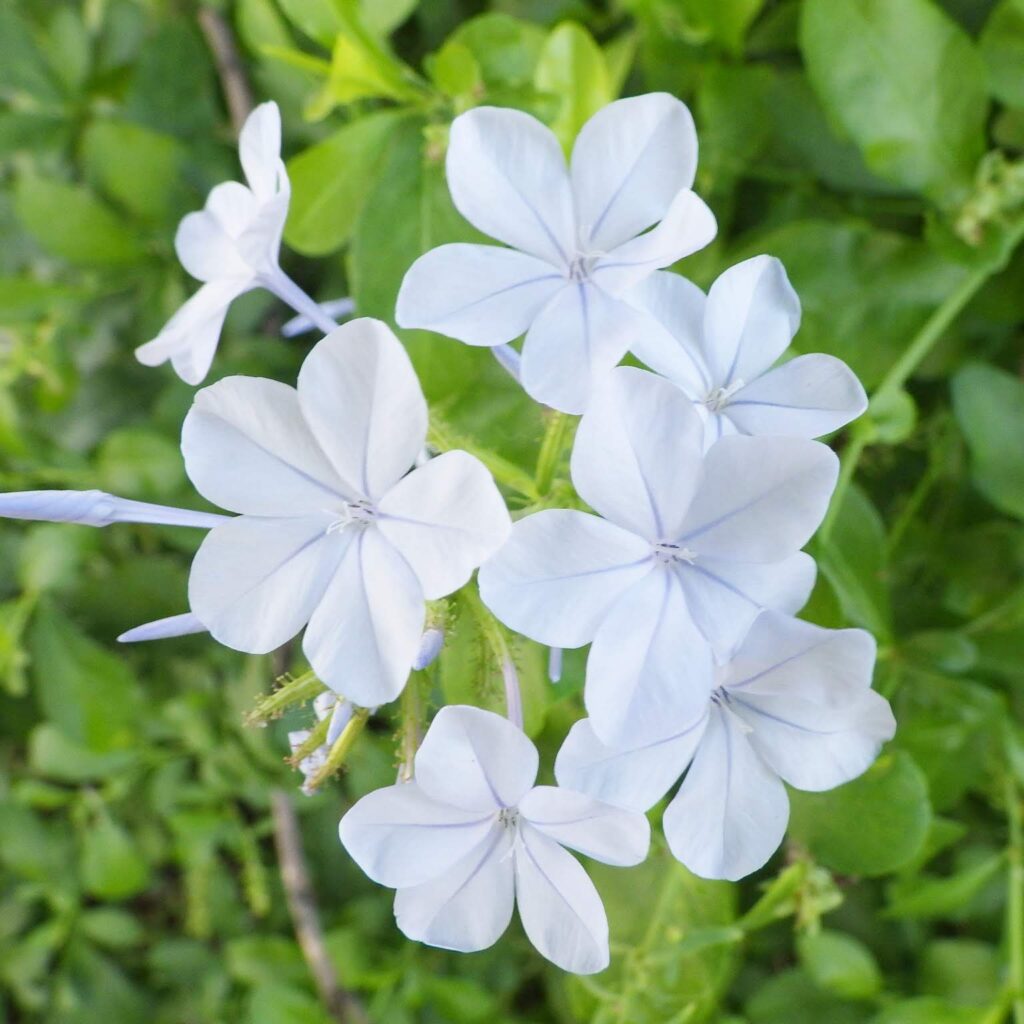
This means there are individuals with long stamens and individuals with long pistils (Ferrero et al., 2009). My photo appears to be of the former type. Why is this the case?
This is thought to be a mechanism to prevent self-pollination. In this way, when insects visit the flowers, in the case of flowers with long stamens, the pollen from the flowers with long stamens will land on the stigma of the flowers with long pistils. Conversely, in the case of flowers with long pistils, the pollen from the flowers with long pistils will land on the stigma of the flowers with long stamens.
This might be a little difficult to understand, but essentially, it means that the male and female sexes are spatially separated, and pollination occurs between plants with long stamens and plants with long pistils, but not between plants with long stamens or between plants with long pistils.
This characteristic is called "heterostyly" and can be found in a variety of plants.
However, the establishment of heterostylicity is considered a rare phenomenon because it is genetically extremely complex (Watanabe, 2022). Also, since it divides into two types, it effectively means that it can only crossbreed with half of the population. This is also a major disadvantage. Therefore, although it reliably prevents self-pollination, it is a strategy used by a minority group.
This likely depends heavily on the characteristics of the visiting insects, but unfortunately, research in this area has not progressed much.
However, you might think, "Why not just produce flowers with only stamens or flowers with only pistils?" In other words, they would become dioecious (having separate male and female plants). Some plants actually do this. So why does the plumbago plant do this without clearly separating the sexes?
This is still not entirely clear, but if a plant is dioecious, the possibility of passing on its genes is entrusted to the sexual function of one of the sexes, meaning that the chances of leaving offspring are halved even further than in monoecious plants. Perhaps the plant dislikes this disadvantage.
Heterostyle may be an evolutionary intermediate stage to dioecity (Lloyd, 1979), but much about the evolution of sexuality in plants remains unresolved and is being investigated by researchers worldwide.
Only insects with long mouths can suck nectar from flowers!?
So, what kinds of insects visit these plumbago and false plumbago? While this may not be a concern when viewing them in Japan, it's actually a very important question.
The flower tube is clearly long, so it must be dependent on insects with long mouthparts.
Regarding Plumbago auriculata, studies conducted in South Africa have shown that insects such as Philoliche aethiopica (a species of the family Bryopteriidae), Papilio demodocus (African swallowtail), Papilio nireus (Urese swallowtail), Colotis auxo (a species of the genus Pieris), and Pieris sp. (a species of the genus Pieris) visit the plant (Ferrero et al., 2009). All of these insects have exceptionally long proboscises, and it seems that they cannot feed on nectar without such a long proboscis.
However, it is also known that a species of bee called Nomia sp., which belongs to the genus Nomia, is attracted by the pollen. There have also been instances of European honeybees visiting the area in Japan (Yamada et al., 2011).
From the above, it seems that two types of insects visit the flowers. However, since bees visit very infrequently, it is not well understood how much they influence pollination. In theory, when bees do visit, it seems that the longer stamens and pistils can be pollinated, but the shorter stamens and pistils are unlikely to be pollinated.
The fact that the flowers of Plumbago auriculata, which tend to be specialists in pollinating insects, have evolved heterostylicity seems to be related in some way, but it is not yet well understood.
While no comprehensive studies on Plumbago auriculata have been found, a study in North America recorded visits to its flowers by a species of skipper butterfly, Poanes taxiles (Scott, 2014). Of course, since Plumbago auriculata is native to China, this is not a record of its visit in the wild, but based on research on Plumbago auriculata, it is highly likely that an insect like a butterfly is visiting. However, because its flower tube is shorter than that of Plumbago auriculata, it is possible that it has undergone a completely different evolution in China.
Why not take a moment to admire the plumbago while imagining its life in Africa?
Are the fruits capsules dispersed by gravity?
Both fruits are capsules. In Plumbago auriculata, the fruit is oblong, about 8 mm long. The seeds are brown, about 7 mm long, while in Plumbago prunifolia, the seeds are pale yellowish-brown, oval-ovate, about 6 mm long. The seeds are reddish-brown. Dispersion is likely by gravity, but the details are unknown.
References
Ferrero, V., De Vega, C., Stafford, GI, Van Staden, J., & Johnson, SD 2009. Heterostyly and pollinators in Plumbago auriculata (Plumbaginaceae). South African Journal of Botany 75(4): 778-784. ISSN: 0254-6299, https://doi.org/10.1016/j.sajb.2009.06.014
Lloyd, DG 1979. Evolution towards dioecy in heterostymous populations. Plant Systematics and Evolution 131(1): 71-80. https://doi.org/10.1007/BF00984123
Scott, JA 2014. Lepidoptera of North America 13. Flower visitation by Colorado butterflies (40,615 records) with a review of the literature on pollination of Colorado plants and butterfly attraction (Lepidoptera: Hesperioidea and Papilionoidea) [Doctoral dissertation, Colorado State University]. http://hdl.handle.net/10217/81411
Tsukamoto, Yotaro. 1994. Encyclopedia of Horticultural Plants, Compact Edition. Shogakukan, Tokyo. 3710pp. ISBN: 9784093051118
Watanabe, Kenta. 2022. Current Ecological and Evolutionary Biological Perspectives on "Heterostyle." Okinawa National College of Technology Bulletin 16: 31-45. https://doi.org/10.51104/nitokinawacollege.16.0_31
Wu, ZY, & Raven, PH (Eds.). 1996. Flora of China (Vol. 15 Myrsinaceae through Loganiaceae). Science Press, Beijing, and Missouri Botanical Garden Press, St. Louis. 387pp. ISBN: 9780915279371, http://www.efloras.org/florataxon.aspx?flora_id=2&taxon_id=10710
Yamada, Junji; Sone, Yuta; and Furuya, Katsunori. 2011. A study on the honeybee project as a nature experience activity in urban areas. Landscape Studies 74(5): 585-590. ISSN: 1340-8984, https://doi.org/10.5632/jila.74.585
Source
This article is a significantly expanded version of a piece included in the following book.