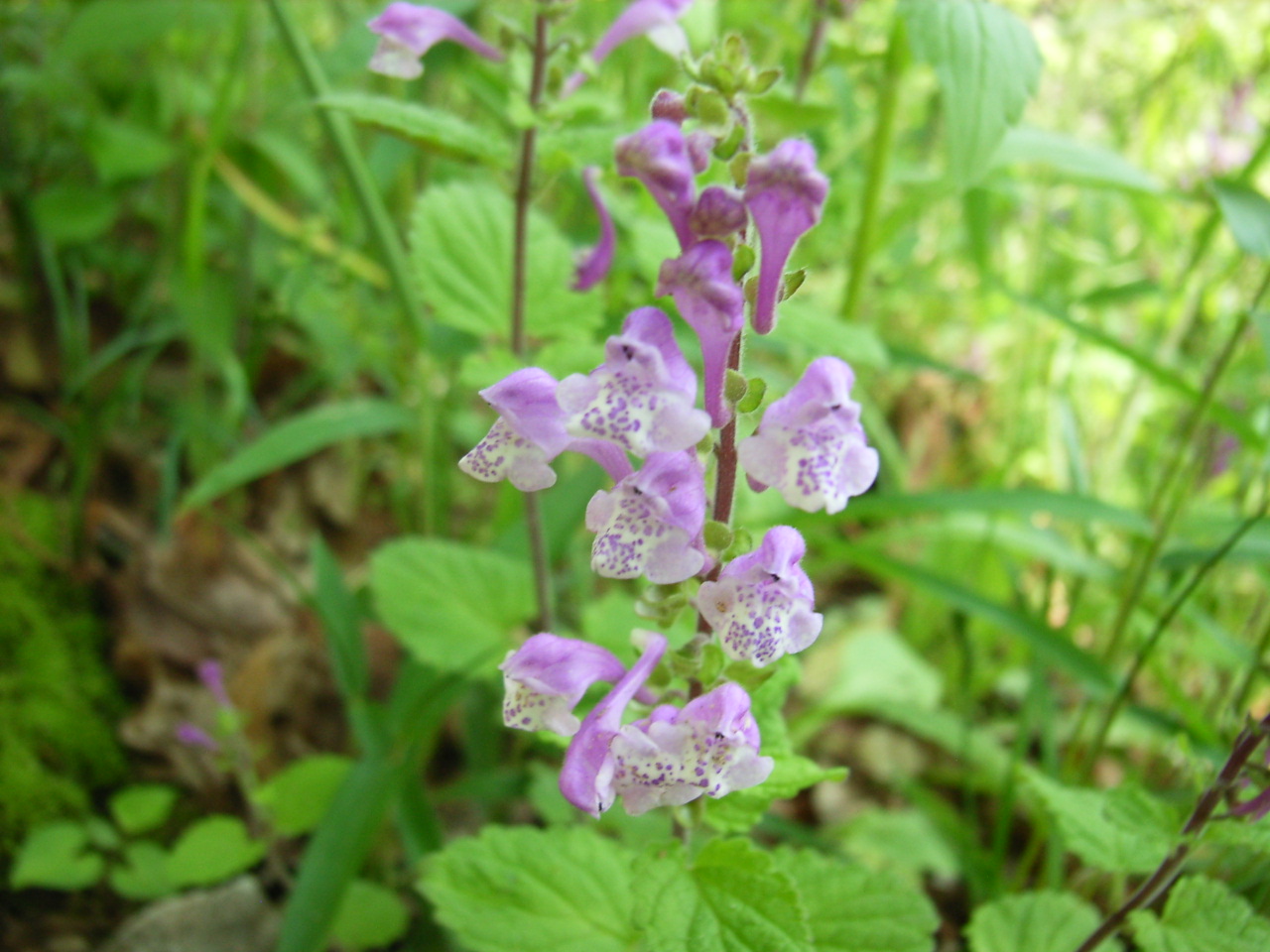
Scutellaria indica, Scutellaria baicalensis, Scutellaria japonica, and Scutellaria japonica all belong to the genus Scutellaria in the family Lamiaceae. They are often confused in horticulture, and because they frequently grow in forest edges and on the forest floor, their large, swollen corollas are similar in shape, making them difficult to distinguish by observing only the flowers. While there are many species in the genus Scutellaria, these four species can be distinguished by comprehensively observing the inflorescence, stem hairs, and leaf shape. The flowers are characterized by a helmet-shaped corolla and a long corolla tube, and it is likely that bees such as bumblebees with long mouthparts are the primary visitors, although this has not been studied sufficiently. After flowering, the lip-shaped calyx enlarges, enclosing the fruit (schizocarp), and when ripe, the upper part falls off, scattering the fruit when it rains. This article will explain the classification, pollination ecology, and seed dispersal of *Scutellaria indica*, *Scutellaria parvifolia*, *Scutellaria japonica*, and *Scutellaria longiseta*.
- What are Tatsunamisou, Kobano Tatsunami, Okatatsunamisou, and Namikisou?
- What are the differences between *Tatsunamisou*, *Kobano Tatsunami*, *Okata Tatsunamisou*, and *Namikisou*?
- What is the structure of a flower?
- How does pollination occur? Bumblebees come!?
- What is the structure of the fruit?
- How were seeds dispersed? Were they relying on the power of raindrops?!
- References
What are Tatsunamisou, Kobano Tatsunami, Okatatsunamisou, and Namikisou?
Scutellaria indica var. indica, also known as Tatsunamisou, is a perennial herb distributed in Honshu (west of Fukushima Prefecture), Shikoku, and Kyushu in Japan; the Korean Peninsula, Taiwan, China, and Indochina, growing in forest edges and grasslands on hillsides.
Scutellaria indica var. parvifolia, also known as velvet tatsunami or small tatsunamisou, is a perennial plant distributed throughout Honshu, Shikoku, and Kyushu in Japan. It grows along roadsides, in crevices in stone walls, and is also common along coastlines. It is widely cultivated for ornamental purposes.
Scutellaria brachyspica, also known as Okatatsunamisou, is a perennial herb distributed in Honshu (west of Fukushima Prefecture) and Shikoku in Japan, growing in forest floors and other areas on hillsides.
Scutellaria strigillosa, also known as Namikisou, is a perennial herb that grows in sandy areas along the coast and is distributed in Hokkaido, Honshu, Shikoku, and northern Kyushu in Japan; the Korean Peninsula; China; Northeast China; Ussuri; Sakhalin; and the Kuril Islands.
Both belong to the genus Scutellaria in the Lamiaceae family and often grow at the edge or on the forest floor. Their large, swollen corollas are similar in shape, and it may be difficult to distinguish them by observing only the flowers. In particular, in horticulture, what is actually Scutellaria indica is sometimes called Scutellaria indica.
What are the differences between *Tatsunamisou*, *Kobano Tatsunami*, *Okata Tatsunamisou*, and *Namikisou*?
日本にはタツナミソウ属が18種も知られており、ここでは全ては扱いきれませんが、よく検索されている4種について区別点を挙げてみます。全ての区別点を知りたい人は大橋ら(2017)や神奈川県植物誌調査会(2018)を参照することをおすすめします。
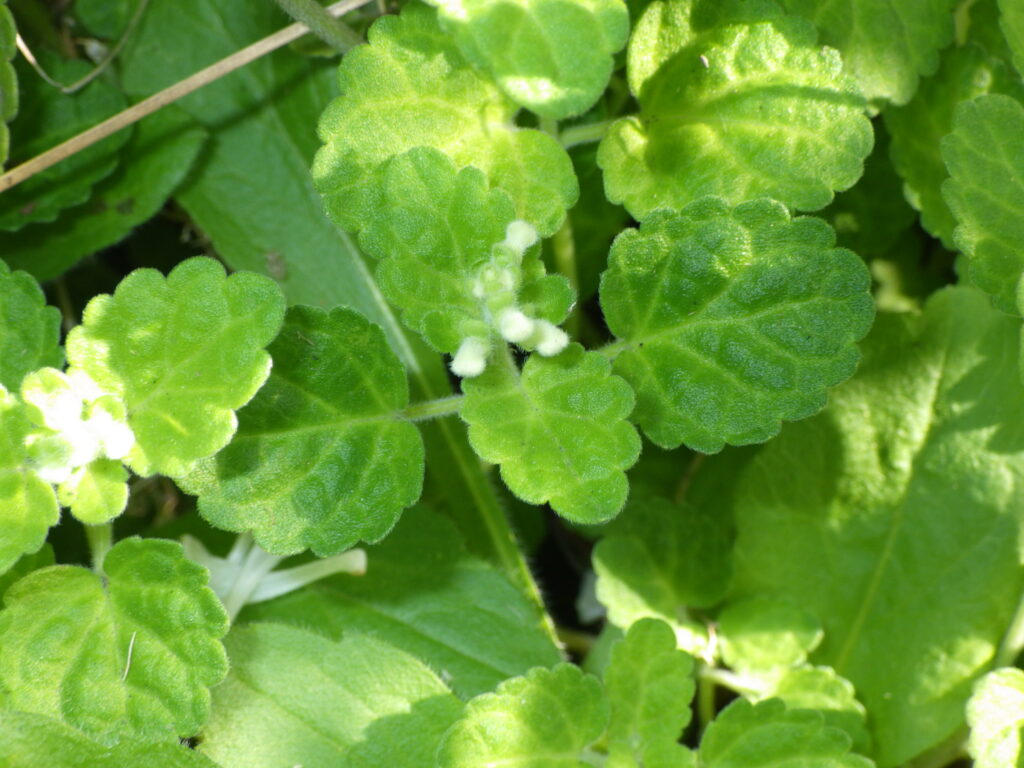
First, in *Scutellaria indica*, the flowers grow singly in the leaf axils (they do not form inflorescences), whereas in other species such as *Scutellaria indica*, *Scutellaria baicalensis*, and *Scutellaria japonica*, the flowers form terminal racemes.
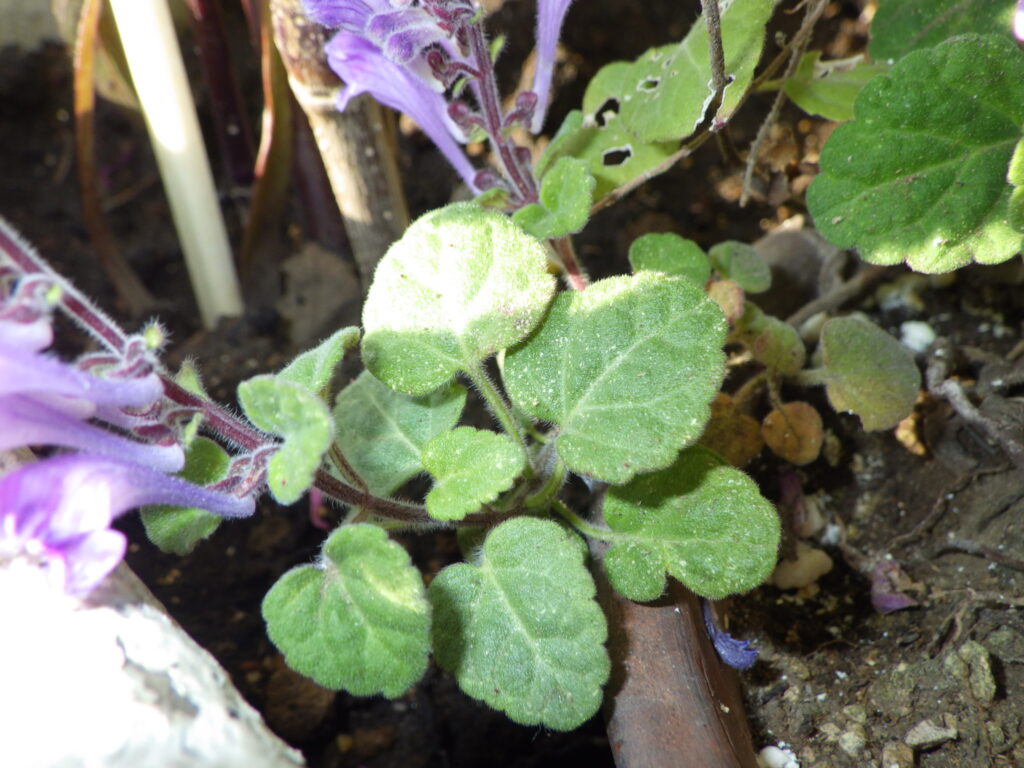
Regarding the remaining three species, *Scutellaria indica* has short, downward-pointing hairs on its stems and prominent glandular dots on the underside of its leaves, while *Scutellaria indica* and *Scutellaria baicalensis* have prominent spreading hairs on their stems and inconspicuous glandular dots on the underside of their leaves. Additionally, the inflorescence of *Scutellaria indica* does not lengthen vertically, with the flowers clustered at roughly the same height, whereas there are differences in the height at which the flowers are located within the inflorescence of *Scutellaria indica* and *Scutellaria baicalensis*.
Regarding *Scutellaria indica* and *Scutellaria baicalensis*, *Scutellaria indica* has an upright stem that grows to 20-40 cm, leaves that are 10-25 mm long, and 7-14 pairs of lateral serrations, while *Scutellaria baicalensis* has a stem that creeps along the ground at the base, growing to 5-20 cm, leaves that are 5-15 mm long, and 3-7 pairs of lateral serrations.
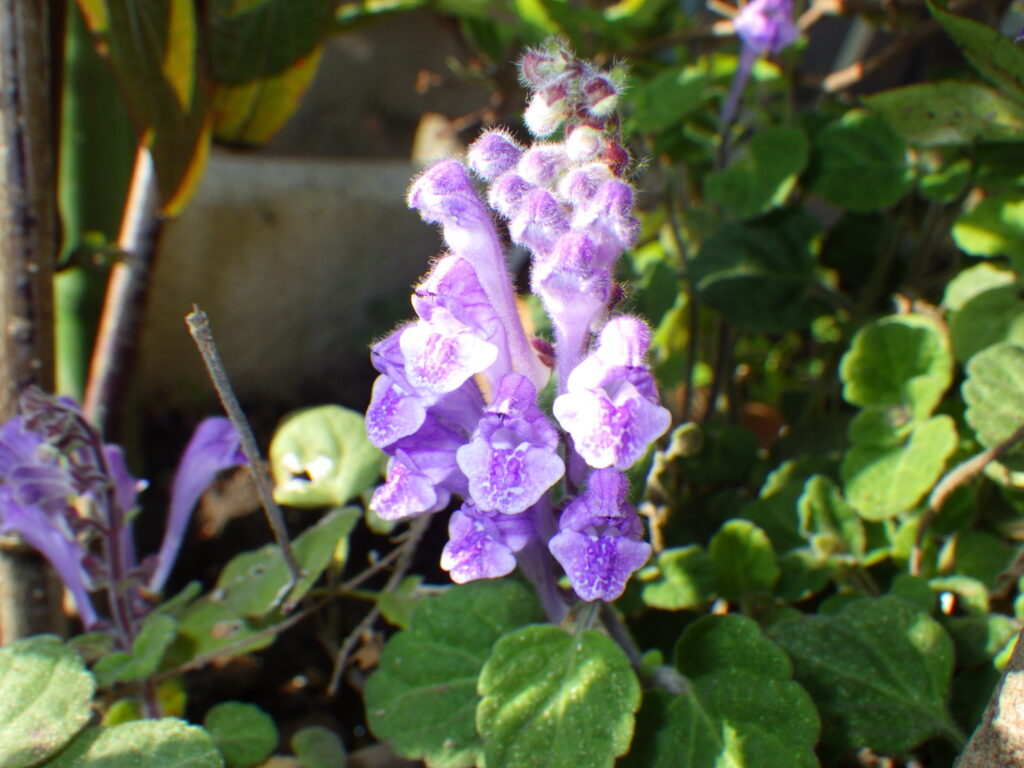
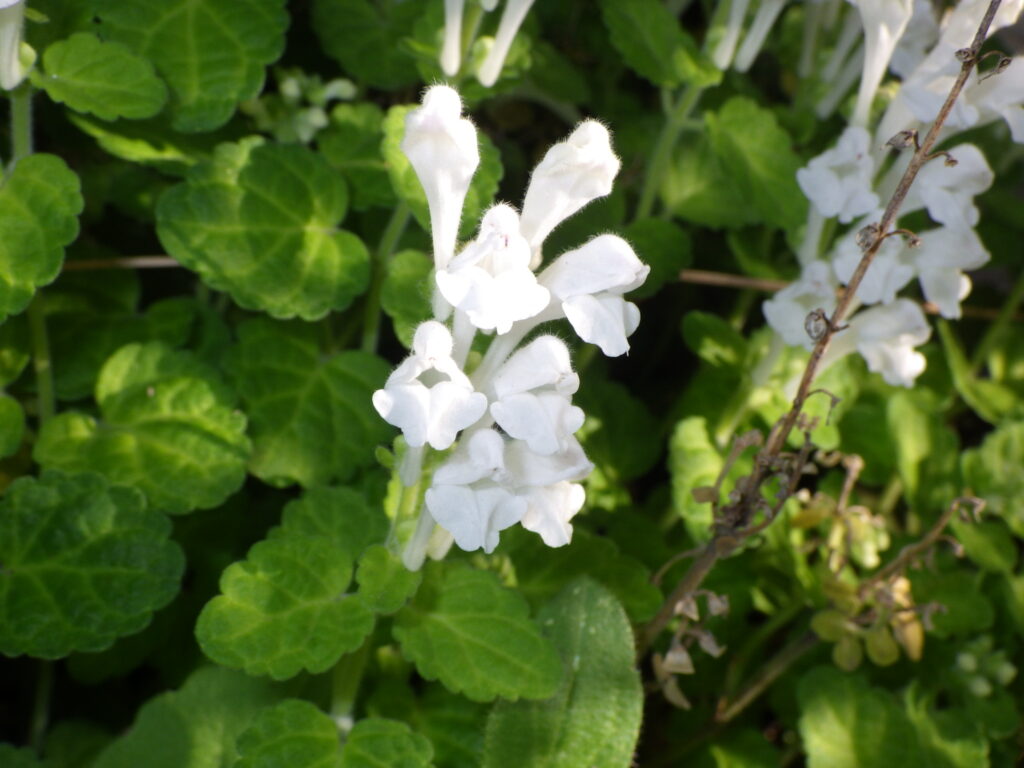
Other differences between *Scutellaria indica* and *Scutellaria baicalensis* include the fact that *Scutellaria baicalensis* has more fine hairs on the corolla and pedicel, the corolla is bluish-purple (white in the cultivar *Scutellaria baicalensis* f. alba, and pale pink in *Scutellaria baicalensis* f. lilacina), and the intensity and shape of the markings on the central and lateral lobes of the lower lip vary, sometimes being almost absent. Regarding habitat, *Scutellaria baicalensis* tends to prefer coastal areas, but there are many escaped individuals from cultivation, so this alone is not sufficient for identification.
What is the structure of a flower?
The flower's structure is that of a "labiate flower," as it belongs to the mint family. A labiate flower is one in which the tip of the tubular corolla is divided into two parts, upper and lower, resembling lips.
In the genus Scutellaria, the calyx is lip-shaped and has both an upper and lower lip. Another distinctive structure is the presence of a "scutellum." The scutellum is a large projection attached to the upper lip of the calyx, which persists into the fruiting stage and serves to enclose the fruit.
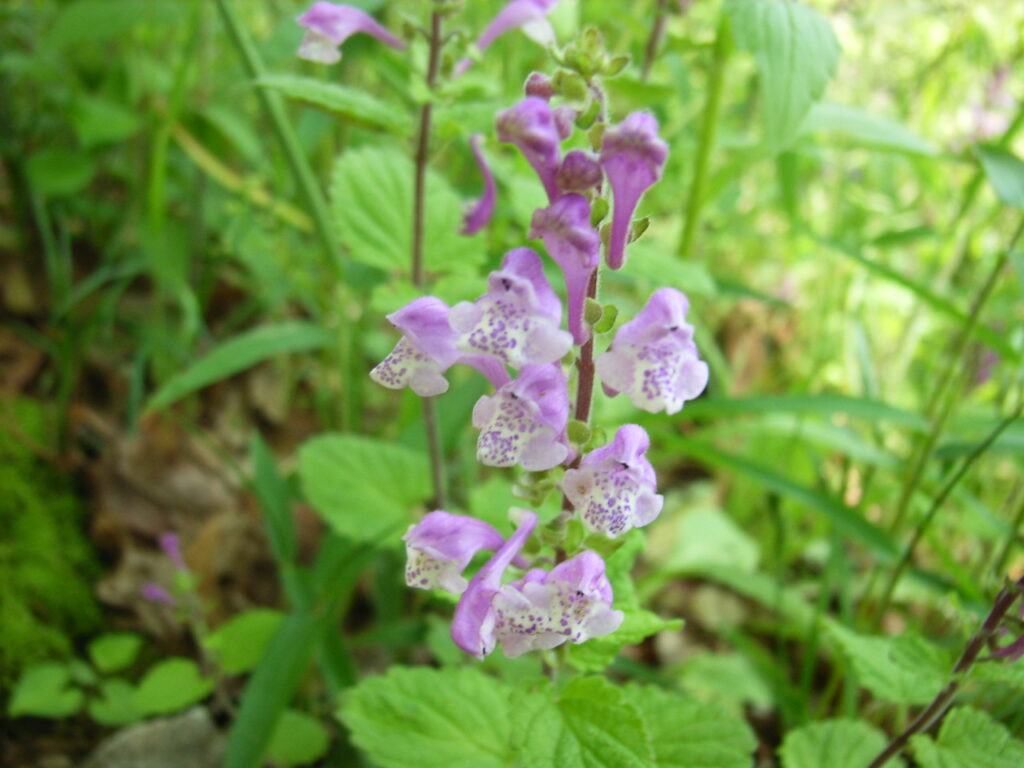
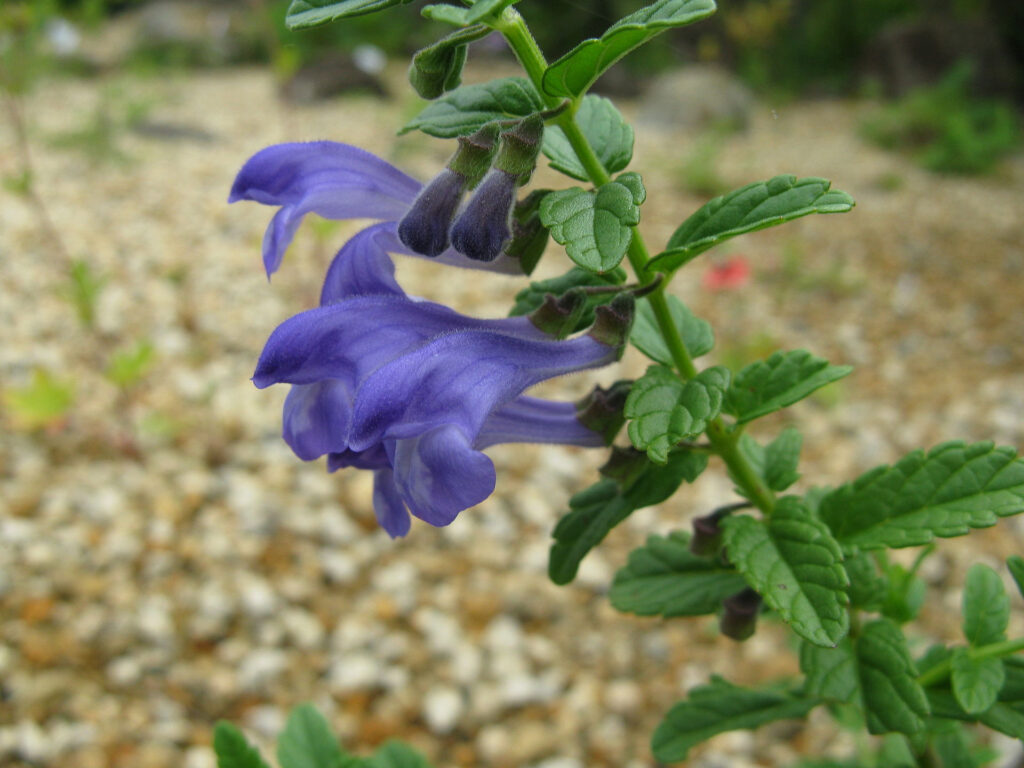
Scutellaria indica blooms from May to June. It produces flower spikes 3 to 8 cm long at the tips of its stems, with the flowers clustered in one direction. The flowers are bluish-purple or pale reddish-purple, and rarely white, which is called white-flowered Scutellaria indica f. amagiensis. The corolla is lip-shaped, about 2 cm long, with a long tube that curves sharply at the base and stands upright. The upper lip is helmet-shaped and swollen. The lower lip is three-lobed and has purple spots on the inside. The calyx is lip-shaped, with a rounded bulge (scutellum) on the back of the upper lip. After flowering, the calyx lengthens slightly and closes its mouth.
Scutellaria indica blooms from May to June. It is almost identical to Scutellaria indica, but the corolla and pedicel have more fine hairs, the corolla is bluish-purple (white in the white-flowered variety Scutellaria indica f. alba, and pale pink in Scutellaria indica f. lilacina), and there are markings on the central and lateral lobes of the lower lip, but the intensity and shape of the markings vary and they may be almost absent.
Okatatsunamisou blooms from May to June. Its inflorescence is shorter than that of Tatsunamisou, with flowers clustered at the end of the stem. The flowers are about 2 cm long. The lower lip is folded, and the markings on the petals are faint, sometimes almost nonexistent. The calyx is divided into upper and lower lips, with a large, circular scutellum rising from the upper lip of the calyx. The corolla and calyx also have glandular dots and glandular hairs.
Namikisou (a type of orchid) blooms from June to September. The flowers grow in pairs at each node, leaning towards one direction, with one flower per leaf axil at the top. They are 1.8-2.2 cm long, bluish-purple, and bent at the base, growing almost upright. The calyx is 3 mm long when in bloom.
How does pollination occur? Bumblebees come!?
It is known that at least some species of the genus Scutellaria produce both open and closed flowers. In the case of Scutellaria indica, there are populations that produce both open and closed flowers, and populations that produce only closed flowers (Sun, 1999).
Cleistogamous flowers can self-pollinate by keeping their corollas closed, eliminating the need for cross-pollination by insects and enabling stable reproduction. However, they have the disadvantage of lacking genetic diversity.
In open flowers, pollination is carried out by insects. While it is unclear for *Scutellaria indica *, it has been found that in three species—*Scutellaria indica var. satokoae*, *Scutellaria indica var. parvifolia *, and *Scutellaria muramatsui* —the upper and lower lips of the corolla weakly absorb ultraviolet light to make them conspicuous to pollinating insects, while the edges of the corolla pores, i.e., the space between the upper and lower lips and the base of the lower lip, weakly reflect ultraviolet light (Naruhashi et al., 2004).
However, no studies on specific pollinating insects attracted by these characteristics could be found in mainland Japan. However, using Google Image Search, one blog shows a bumblebee (Bombus ignitus) visiting a flower (tonji, 2023). Also, although it does not contribute to pollination, another site shows a long-horned bee (Bombus nipponicus) inserting its mouthparts into the base of the corolla and stealing nectar (Fukuhara, 2025).
The mint family is generally closely associated with specific types of bees, and it seems likely that bumblebees, such as those found in the Scutellaria genus, would also visit plants of this genus, given the length of their flower tubes and the size of their corollas.
As an exception, *Scutellaria indica* is unique, characterized by its even more elongated, tubular white flowers than *Scutellaria indica*, and is thought to be pollinated by hawk moths, which likely have proboscises longer than those of bees (Abe, 2006). *Scutellaria indica* is considered to have a relatively long flower tube within its genus, and it has been suggested that it may have evolved after reaching the Ogasawara Islands (Abe, 2009).
What is the structure of the fruit?
All species in the genus Scutellaria have fruits that are divided into four segments. After flowering, the calyx remains, the lips of the upper and lower calyx close, and the scutellum develops to enclose the fruit (schizocarp). Some internet articles mistakenly refer to the calyx as the "fruit" and the fruit as the "seed," but this is incorrect.
In *Scutellaria indica*, when the fruit matures, the upper lip of the large, saucer-shaped calyx falls off, leaving the lower lip like a receptacle, exposing the four fruitlets. The fruitlets are small, chestnut to dark brown, oval-shaped, and about 1.2 to less than 1.5 mm in length, densely covered with small protrusions.
In *Scutellaria indica*, the fruit is almost identical to that of *Scutellaria indica*, but the length of the fruit segments is 1-1.2 mm.
In *Scutellaria indica*, when the fruit matures, the upper lip of the large, saucer-shaped calyx falls off, leaving the lower lip like a receptacle, exposing the four fruitlets. The fruitlets are about 2 mm long and densely covered with small protrusions.
In *Namikisou*, the upper lip of the calyx remains attached even after the fruit matures, continuing to enclose the four fruitlets. The fruitlets are approximately 1.25 mm in diameter, yellowish-brown, nearly spherical, and densely covered with small protrusions.
How were seeds dispersed? Were they relying on the power of raindrops?!
While *Scutellaria indica* is an exception, many species of the *Scutellaria* genus have saucer-shaped calyxes that expose the fruit on the upper side. This is thought to serve the purpose of dispersing the fruit by trapping raindrops on the calyx (Kobayashi, 2007). In other words, this is a form of "rain dispersal." This is a fairly uncommon method of seed dispersal in Japan and is likely to have an impact on its habitat.
References
Abe, T. 2006. Threatened pollination systems in native flora of the Ogasawara (Bonin) Islands. Annals of Botany 98(2): 317-334. https://doi.org/10.1093/aob/mcl117
Tetsuto Abe. 2009. Current status of pollination system disturbances in the Ogasawara Islands and their management strategies. Global Environment 14(1): 47-55. http://www.airies.or.jp/attach.php/6a6f75726e616c5f31342d316a706e/save/0/0/14_1-08.pdf
Tatsuhito Fukuhara. 2025, October 21. Various Pollination Methods. Fukuhara's Page (Plant Morphology, Biological Image Collection, etc.). https://staff.fukuoka-edu.ac.jp/fukuhara/keitai/6-3.html
Kanagawa Prefecture Flora Survey Association. 2018. Kanagawa Prefecture Flora 2018 (Electronic Edition). Kanagawa Prefecture Flora Survey Association, Odawara. 1803pp. ISBN: 9784991053726
Kobayashi, Masaaki. 2007. From Flower to Seed: The Science of Seed Dispersal. National Rural Education Association, Tokyo. 247pp. ISBN: 9784881371251
Ohashi, Hiroyoshi; Kadota, Yuichi; Murata, Hitoshi; Yonekura, Koji; and Kihara, Hiroshi. 2017. Wild Plants of Japan (Revised New Edition, Vol. 5: Convolvulaceae to Caprifoliaceae). Heibonsha, Tokyo. 760pp. ISBN: 9784582535358
Naruhashi, N., Sawanomukai, T., Wakasugi, T., & Iwatsubo, Y. 2004. A new variety of Scutellaria (Lamiaceae) from Japan. The Journal of Phytogeography and Toxonomy 52(2): 127-135. http://hdl.handle.net/2297/48678
Sun, M. 1999. Cleistogamy in Scutellaria indica (Labiatae): effective mating system and population genetic structure. Molecular Ecology 8(8): 1285-1295. https://doi.org/10.1046/j.1365-294X.1999.00691.x
tonji. April 26, 2023. A rare bee, the black bumblebee. It's the season in Miyazaki! https://www.nekoton.com/entry/2023/04/26/000000

