Liriope muscari, Liriope japonica, and Liriope serrata are all evergreen perennial herbs belonging to the genus Liriope in the family Asparagaceae, and they grow in forests. They are also cultivated as ornamental plants, and because their flowers and leaves are very similar, these three species are often confused. Distinguishing between them can be difficult, but recording the leaf width, the number of flowers, and the length of the flower stalk will help clarify the distinction. This article will explain the classification of the genus Liriope.
What are Liriope muscari, Liriope japonica, and Liriope serrata?
Liriope muscari, also known as lilyturf or bush orchid, is an evergreen perennial herb distributed in Honshu (west of the Kanto region), Shikoku, Kyushu, and the Ryukyu Islands in Japan; as well as in Korea, China, and Taiwan, growing in forests of evergreen broad-leaved trees and cedar plantations (Kanagawa Prefecture Flora Survey Association, 2018). It flowers from August to October.
Liriope minor, also known as dwarf lilyturf, is distributed in Hokkaido, Honshu, Shikoku, Kyushu, and the Ryukyu Islands in Japan; as well as in Korea and China. It is an evergreen perennial herb that grows in grasslands, embankments, and sparse forests from the coast to areas with oak and chestnut trees. It flowers from July to September.
Liriope spicata, also known as Ryukyu Liriope, is an evergreen perennial herb distributed in central Honshu, Japan (up to Kagoshima and Yakushima), Korea, Taiwan, China, and Indochina, growing in mountain forests and other similar environments. It flowers from July to September.
All three are evergreen perennial herbs belonging to the genus Liriope in the Asparagaceae family (formerly known as the Asparagaceae family), and they grow in forests. They are also cultivated as ornamental plants in gardens, and the three species are often confused because their flowers and leaves are very similar. Liriope muscari is often sold as "Liriope muscari," so distinguishing between them can be difficult.
What are the differences between Liriope muscari, Liriope japonica, and Liriope serrata?
Distinguishing between these three species can be quite difficult without practice, but the differences have been clearly confirmed (Wu & Raven, 2000).
First, there is a difference between Liriope muscari and Liriope japonica: Liriope muscari does not have stolons, while Liriope japonica and Liriope leucocephala do produce stolons.
This is a crucial difference, and while it might become clear if you look for the root cause, it might be difficult to find.
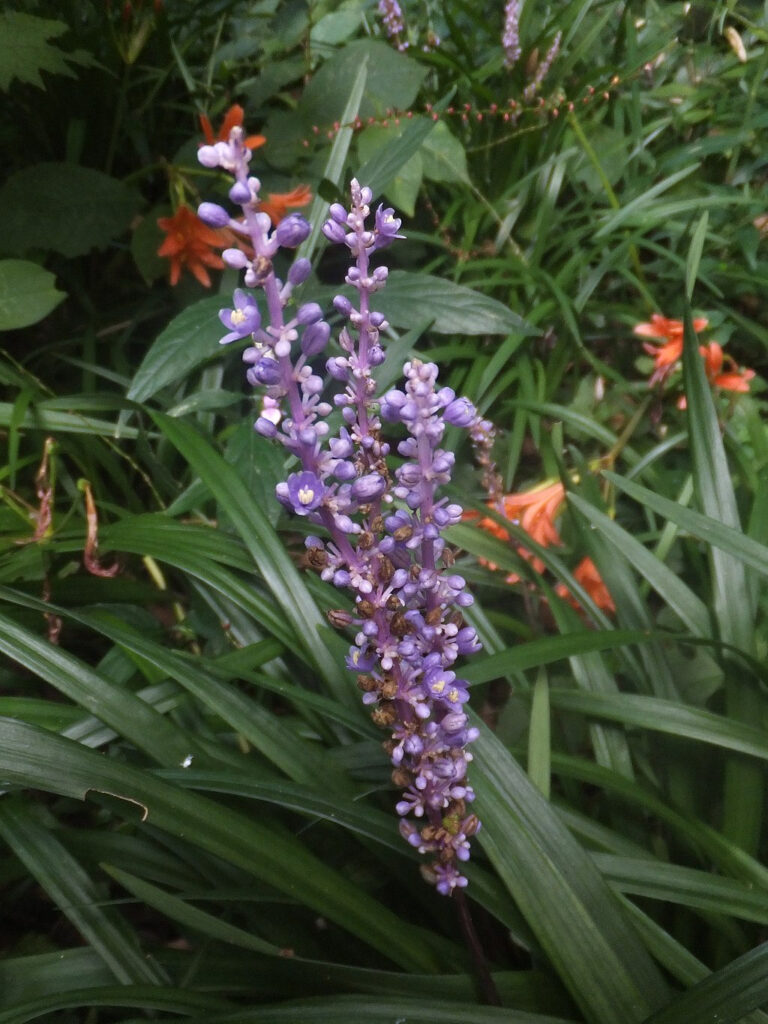
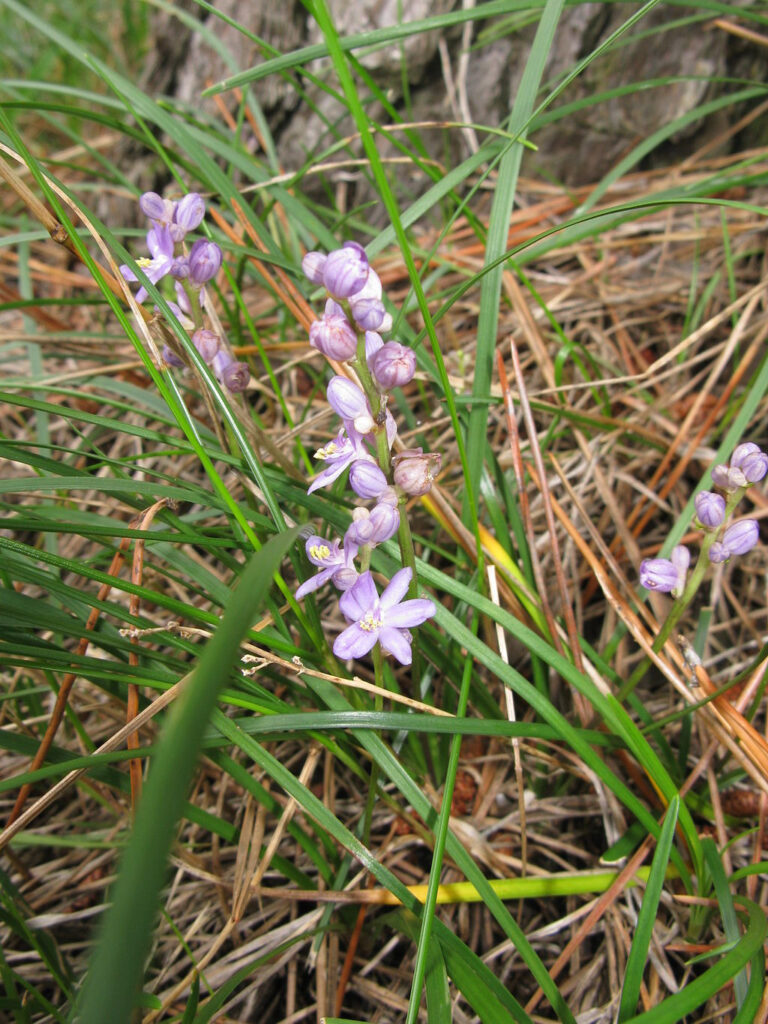
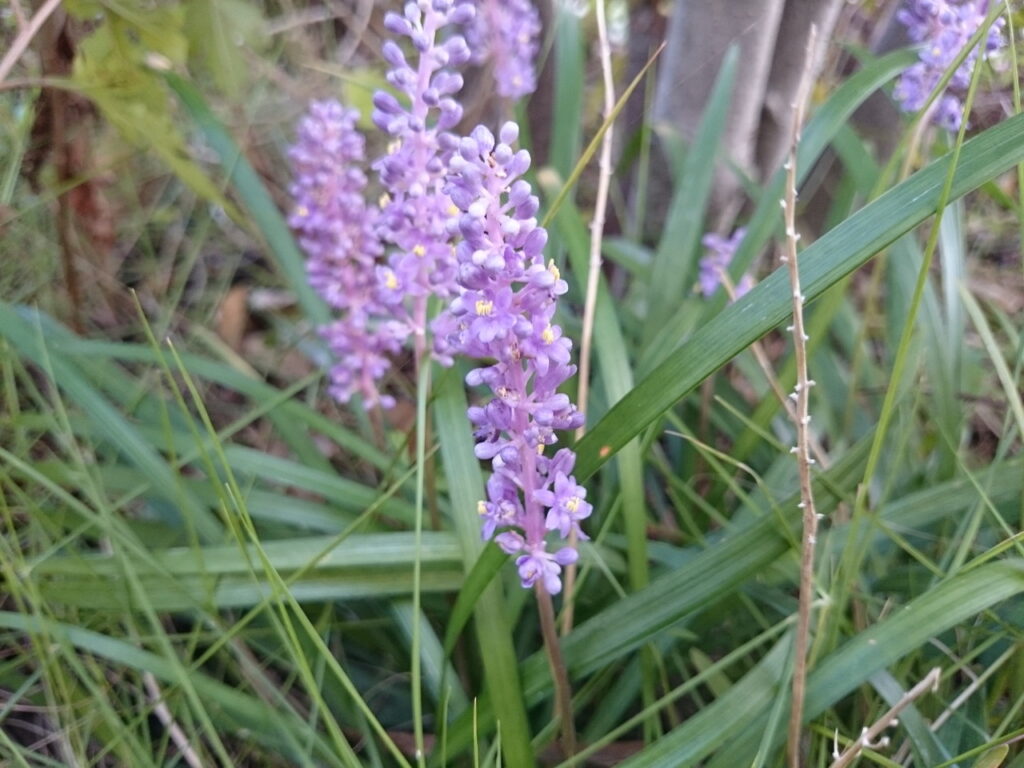
There are other differences in the flowers as well. All species in the genus Liriope typically bear numerous small, pale purple flowers in racemes.
In contrast to Liriope muscari, which has dark-colored flowers and large flower stalks (30-50 cm tall) with numerous flowers densely packed together, Liriope muscari and Liriope japonica have lighter-colored flowers, smaller flower stalks (less than 20 cm tall), and are only sparsely arranged.
This should allow us to categorize them broadly.
Regarding Liriope muscari and Liriope japonica, botanically speaking, the main difference is that the anthers of the stamens in Liriope muscari are 1-1.5 mm long, while those in Liriope japonica are 2 mm long.
However, it's probably not very practical.
Another difference lies in the flowers: while Liriope muscari produces only 5 to 12 flowers per stem, Liriope japonica produces 20 to 200 flowers per stem.
Furthermore, regarding the leaves, while the leaves of Liriope muscari are only 1.5-3 mm wide, those of Liriope japonica are 4-7 (up to 10) mm wide.
These two points represent crucial differences.
What is the variety of liriope?
Several varieties of Liriope are known.
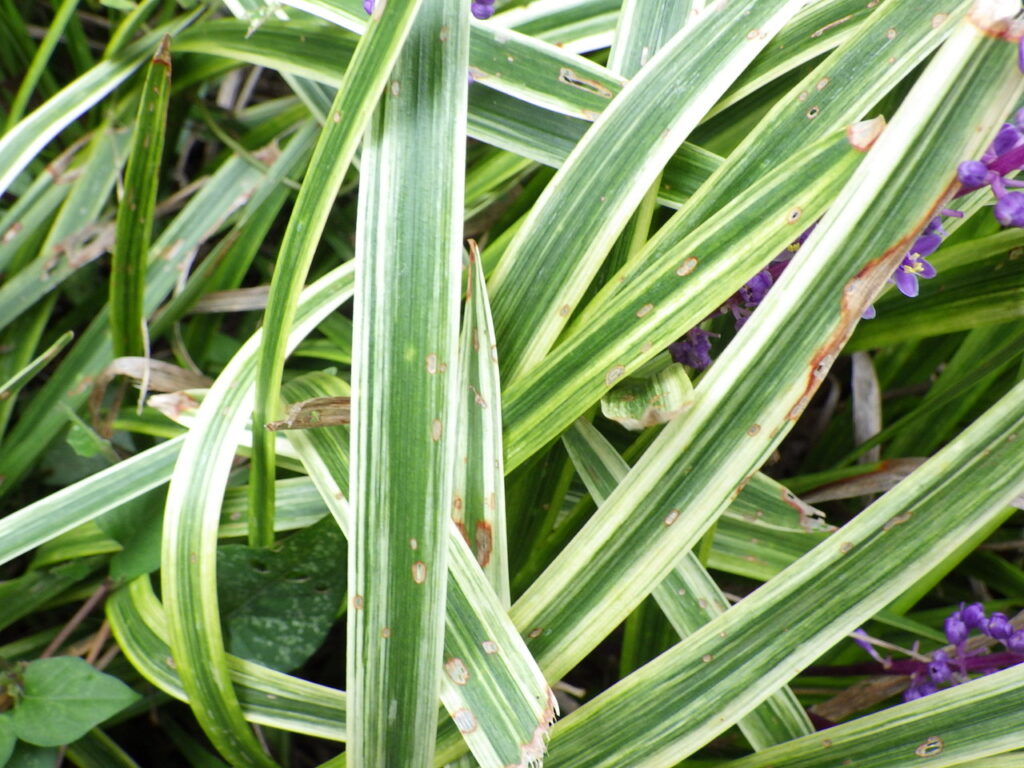
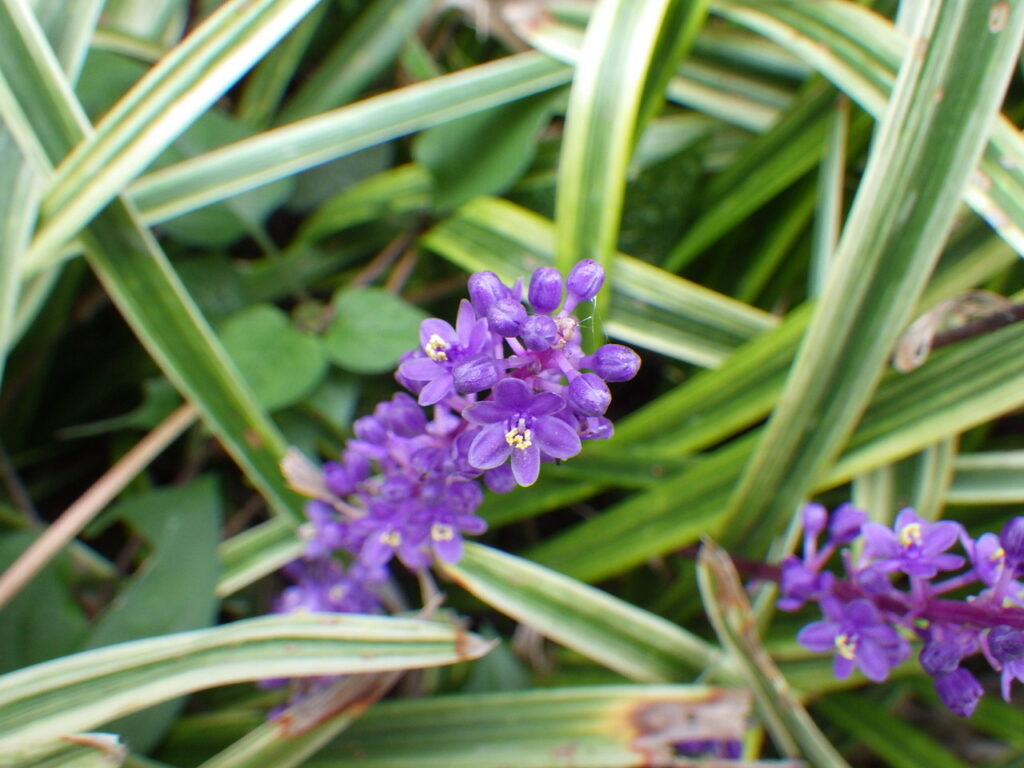
Liriope muscari f. variegata is a variety with variegated leaves.
Liriope muscari f. albiflora is a variety with white flowers.
Okinawa Liriope f. praealba is a variety whose newly sprouted leaves are white.
References
Kanagawa Prefecture Flora Survey Association. 2018. Kanagawa Prefecture Flora 2018 (Electronic Edition). Kanagawa Prefecture Flora Survey Association, Odawara. 1803pp. ISBN: 9784991053726
Wu, ZY, & Raven, PH (Eds.). 2000. Flora of China (Vol. 24 Flagellariaceae through Marantaceae). Science Press, Beijing, and Missouri Botanical Garden Press, St. Louis. 431pp. ISBN: 9780915279838