Coreopsis lanceolata, Coreopsis lanceolata, Coreopsis humilis, and Coreopsis radicans all belong to the genus Coreopsis in the Asteraceae family. While they don't share many distinctive features, they are annual or biennial plants that give the impression of being "very showy yellow chrysanthemums with single to double flowers." Coreopsis lanceolata, in particular, is a species that has attracted attention as it has been designated as a specific invasive alien species. These are often introduced as similar species by the Ministry of the Environment and local governments, which may lead to confusion. However, Coreopsis humilis and Coreopsis radicans have different flower colors from Coreopsis lanceolata and Coreopsis radicans, so it is unlikely that they will be mistaken for each other. Distinguishing between Coreopsis lanceolata and Coreopsis radicans is quite difficult, but currently, it is safe to assume that most of the plants growing in clusters are Coreopsis lanceolata. They are quite different from Cosmos sulphureus in both ecology and morphology, so be careful not to confuse them. This article will explain the classification of the genus Coreopsis.
- What are Coreopsis lanceolata, Coreopsis grandiflora, Coreopsis radicans, and Coreopsis lanceolata?
- What are the differences between Coreopsis lanceolata, Coreopsis grandiflora, Coreopsis radicans, and Coreopsis lanceolata?
- What is the difference between Coreopsis lanceolata and Cosmos sulphureus?
- References
What are Coreopsis lanceolata, Coreopsis grandiflora, Coreopsis radicans, and Coreopsis lanceolata?
Coreopsis basalis, also known as golden bellflower, is native to North America (United States) and is an annual or biennial herb that grows in open, often disturbed, sandy areas. It has become naturalized in parts of East Asia, including Europe and Japan, where it was cultivated for ornamental purposes (Flora of North America Committee, 2006; Kanagawa Prefecture Flora Survey Association, 2018; RBG Kew, 2023).
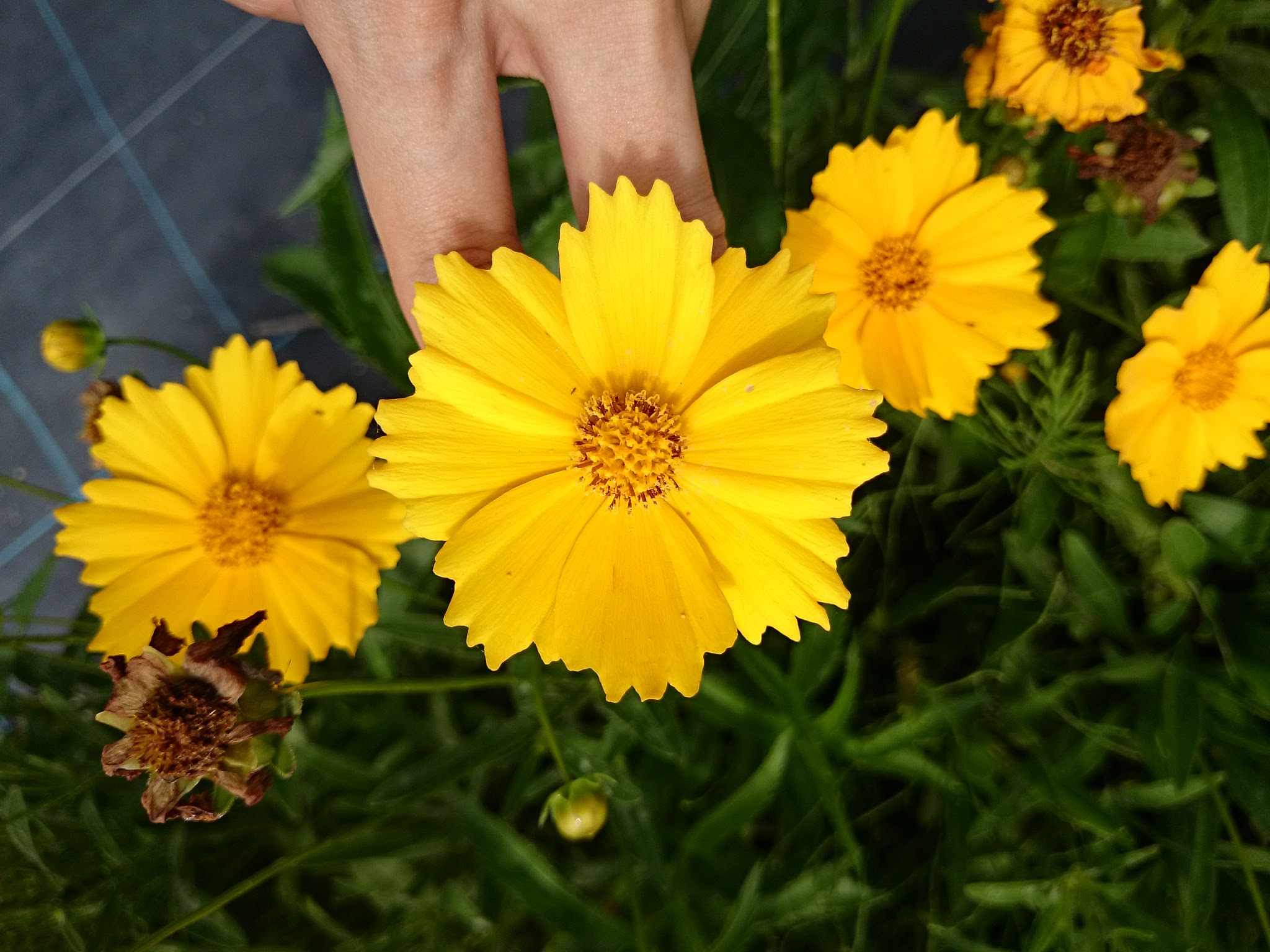
Coreopsis lanceolata, also known as large-flowered primrose, is a perennial plant native to North America (Canada to the United States) that grows in sandy areas, ditches, roadsides, and other disturbed areas. It has been cultivated for ornamental purposes and landscaping and has become naturalized worldwide. In Japan, it is the most commonly naturalized species and is designated as a specified invasive alien species.
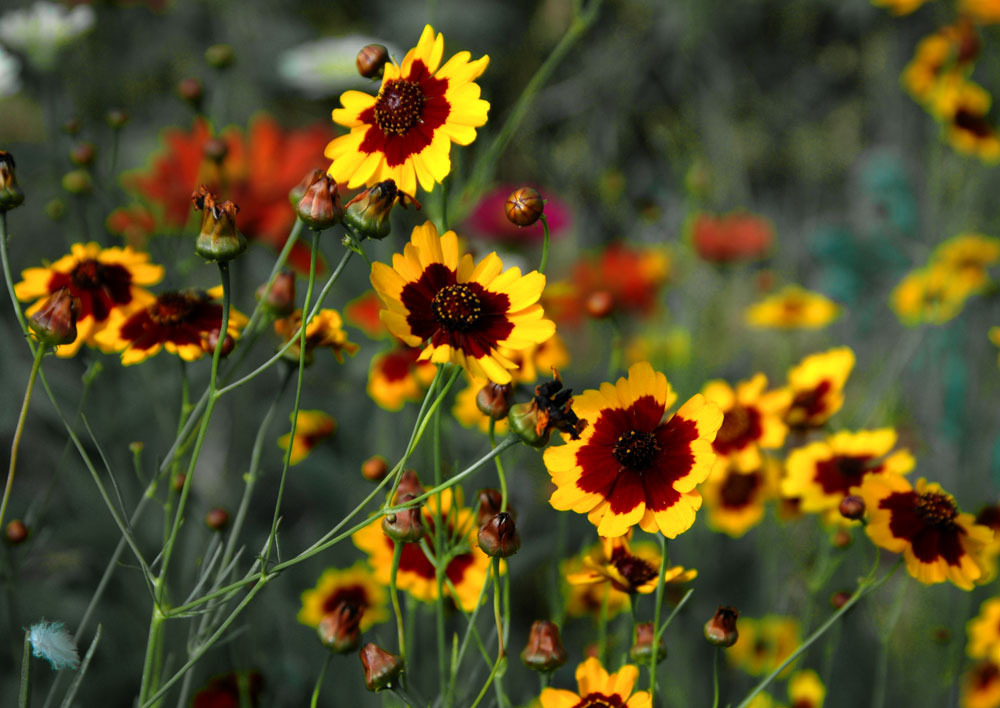
Coreopsis tinctoria, also known as Persian coreflower, is native to North America (Canada to Mexico) and is an annual or biennial herb that grows in moist sandy or clayey soils, alkaline plains, grasslands, ditches, and disturbed areas. It has naturalized worldwide after being cultivated as an ornamental plant. In Japan, it only escapes cultivation to a limited extent.
Coreopsis grandiflora, also known as narrow-leaved coreopsis, is a perennial plant native to North America (Canada to the United States) that grows in sandy areas, ditches, roadsides, other disturbed areas, and granite and sandstone outcrops. It has naturalized in parts of Eurasia and South America after being cultivated for ornamental purposes. It is rarely cultivated in Japan, and no escaped species have been confirmed.
All of these plants belong to the genus Coreopsis in the Asteraceae family, and although they don't have many distinguishing features, they are annual or biennial plants that give the impression of being "very showy yellow chrysanthemums with single to double flowers."
In particular, Coreopsis lanceolata is designated as a specified invasive alien species under the Invasive Alien Species Act, and its cultivation, transfer, sale, and import/export are prohibited in principle. It has also been selected as one of Japan's 100 worst invasive alien species, and may be targeted for eradication (although there is no obligation to eradicate it). In any case, it is a species that is important to distinguish from other species.
The genus Coreopsis is distinguished from other members of the Asteraceae family by its opposite leaves, disc-shaped receptacle with scales, 1-2 rows of herbaceous to membranous bracts, and the absence of a long beak on the achene.
These four species are often presented as similar species by the Ministry of the Environment and local governments, which may actually lead to many people confusing them.
What are the differences between Coreopsis lanceolata, Coreopsis grandiflora, Coreopsis radicans, and Coreopsis lanceolata?
However, these four types are surprisingly quite different.
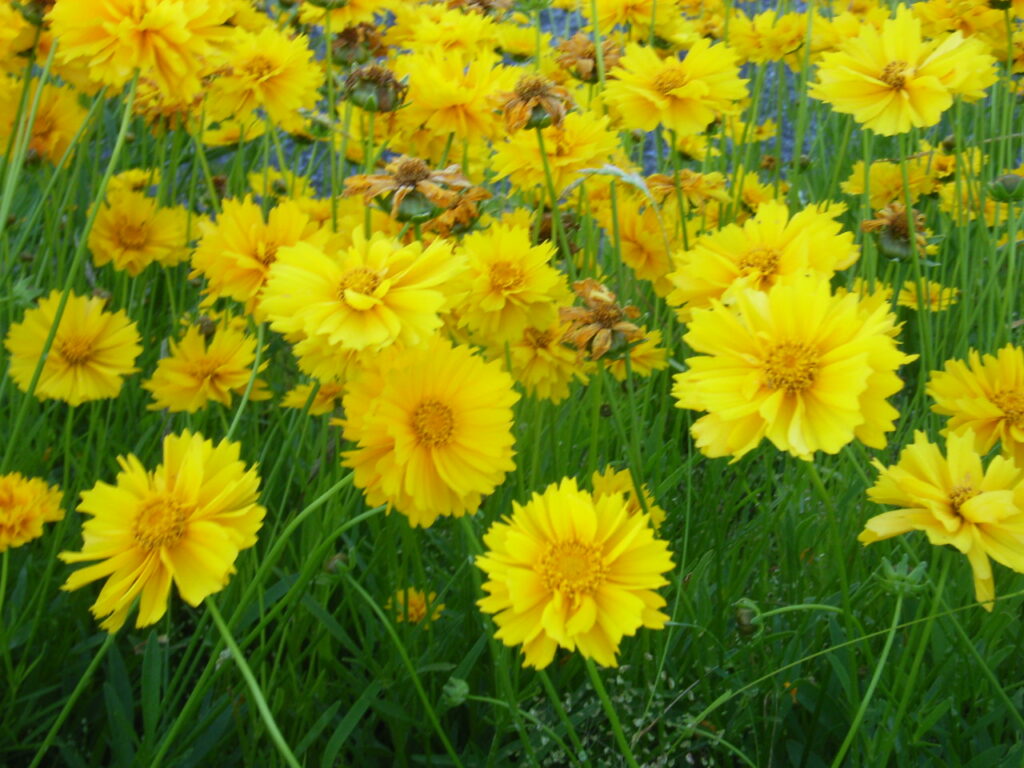
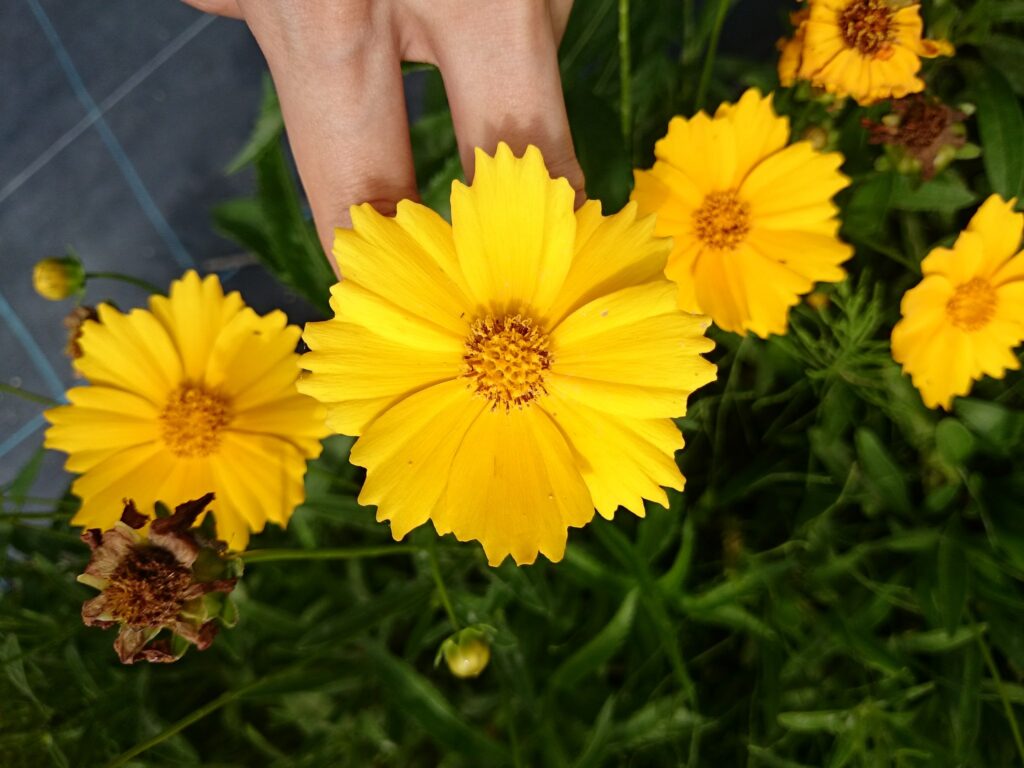
First, a common characteristic of all four species is that what appears at first glance to be a "flower" is actually a "flower head," which is a cluster of flowers (inflorescence). This is common to all members of the Asteraceae family. A flower head consists of "tubular florets" in the center and "ray florets" surrounding them, and the corolla of the ray florets is what creates its beauty.
In Coreopsis lanceolata and Coreopsis radicata, both the tubular florets and ray florets are yellow, whereas in Coreopsis lanceolata and Coreopsis radicata, the tubular florets are purplish-brown, and the ray florets have yellow tips but purplish-brown bases.
In other words, visually, the center of the flower head of Coreopsis lanceolata and Coreopsis humilis is clearly purple, creating a two-color contrast with the yellow tip. This contrast is absent in Coreopsis grandiflora and Coreopsis humilis. This is immediately obvious.
Therefore, I don't think they are the kind of species that are "conflated" to the extent that they are often mentioned in internet articles.
On the other hand, distinguishing between Coreopsis lanceolata and Coreopsis radicans can indeed be difficult.
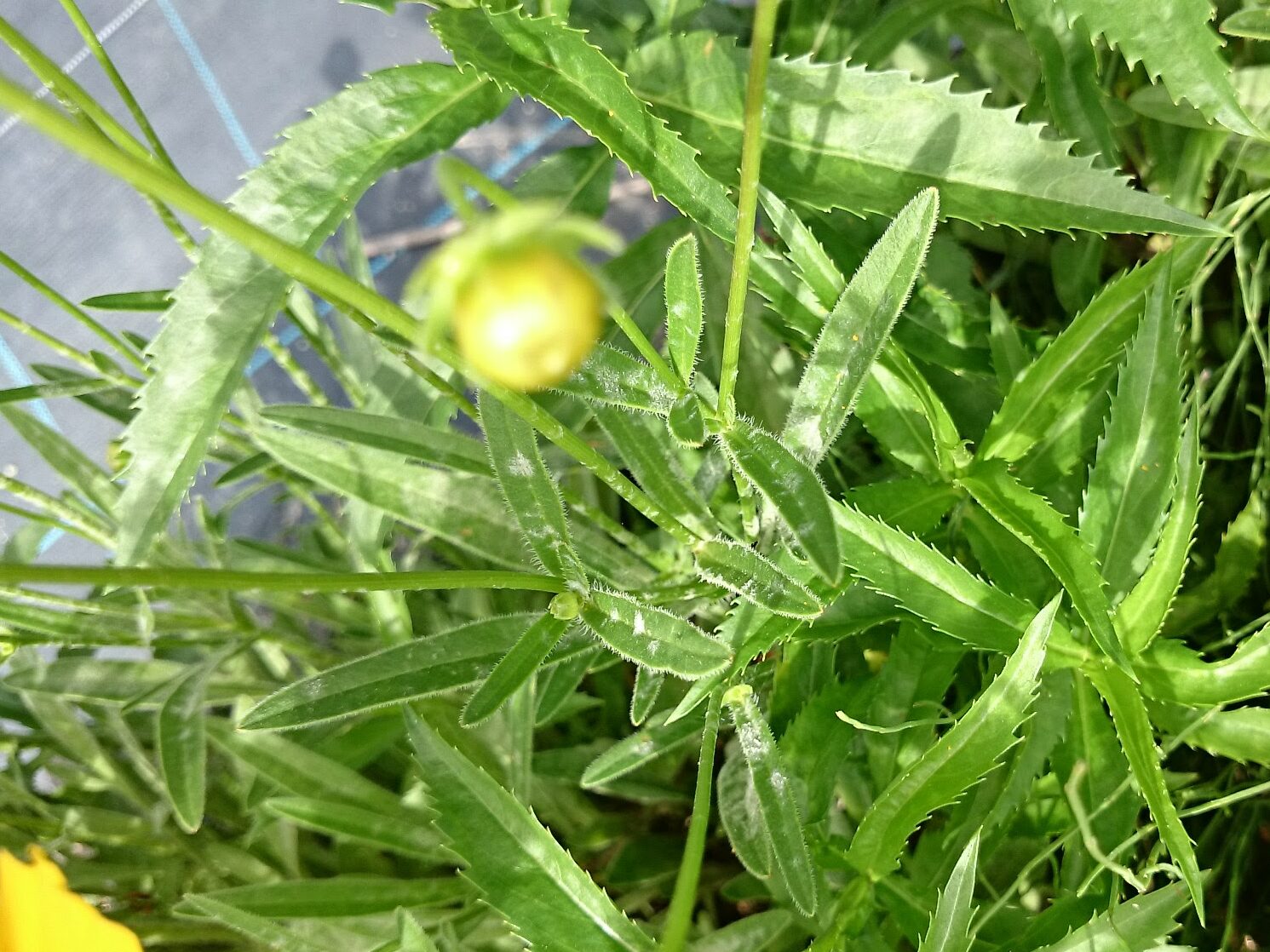
One of the main differences between Coreopsis lanceolata and Coreopsis radicans is that in Coreopsis lanceolata, the leaves are concentrated on the lower half of the stem, while in Coreopsis radicans, the leaves are distributed along the entire stem.
This is quite literal, but it might be a little difficult to judge if you're not used to it.
There are other differences as well. In Coreopsis lanceolata, the leaf lobes are oval and covered with coarse hairs, while in Coreopsis radicans, the leaf lobes are narrow, linear-lanceolate, and not as hairy. This can be a significant factor in distinguishing between the two.
However, some believe that these characteristics are often exceptions in cultivated varieties.
In reality, *Coreopsis lanceolata* is rarely cultivated, and there are currently very few examples of it becoming established as a naturalized species.
After confirming the two points mentioned above, it seems safe to assume that most of the plants growing in clusters in Japan are likely to be Coreopsis lanceolata.
The difference between Coreopsis lanceolata and Coreopsis humilis is that in Coreopsis lanceolata, the leaf lobes on the stem are oblong to ovate and the plant body is hairy, while in Coreopsis humilis, the leaf lobes on the stem are linear and the plant body is hairless.


What is the difference between Coreopsis lanceolata and Cosmos sulphureus?
The difference between Coreopsis lanceolata and Cosmos sulphureus seems to be a frequently searched topic on the internet.
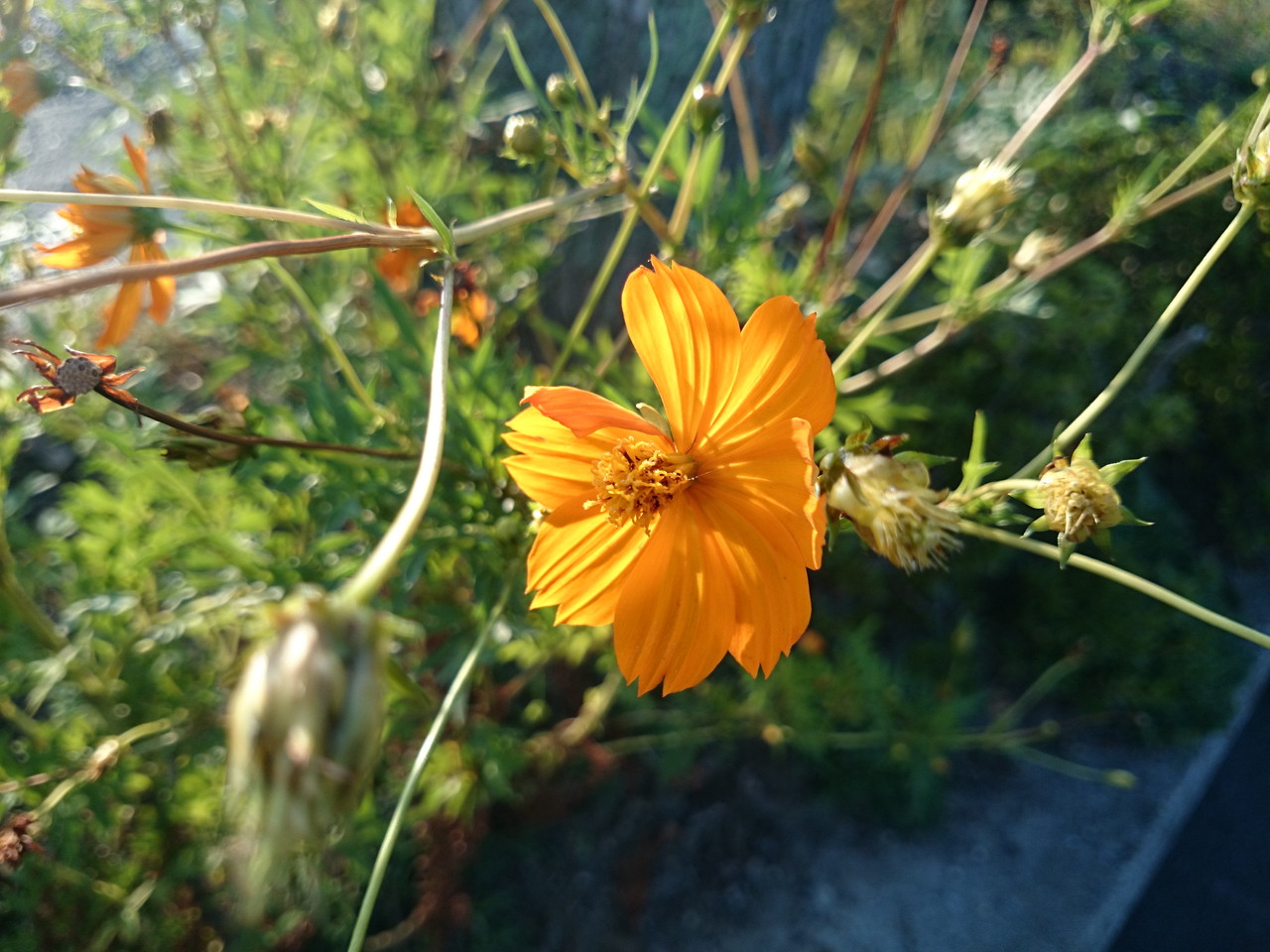
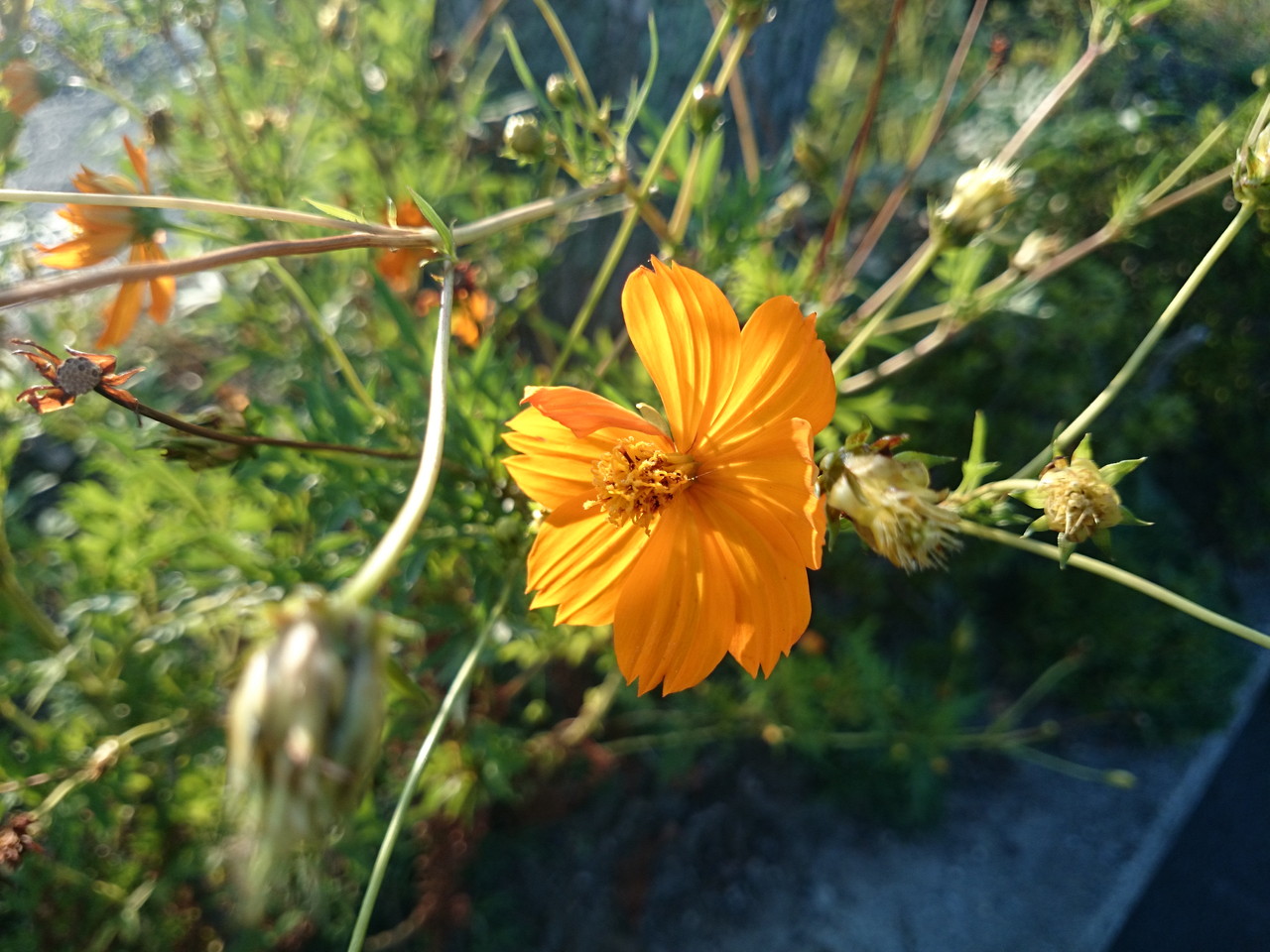
Indeed, the yellow cosmos (Cosmos sulphureus) also belongs to the Asteraceae family and has very similar yellow flower heads, so it may sometimes be confused with it.
However, taxonomically, Coreopsis lanceolata belongs to the genus Coreopsis, while Cosmos sulphureus belongs to the genus Cosmos. Therefore, significant differences can be expected.
The flowering season for Coreopsis lanceolata is early summer (May to July), while the flowering season for Cosmos sulphureus (yellow cosmos) is autumn (August to October), hence the name "cosmos." Therefore, there is usually a difference in when they can be seen.
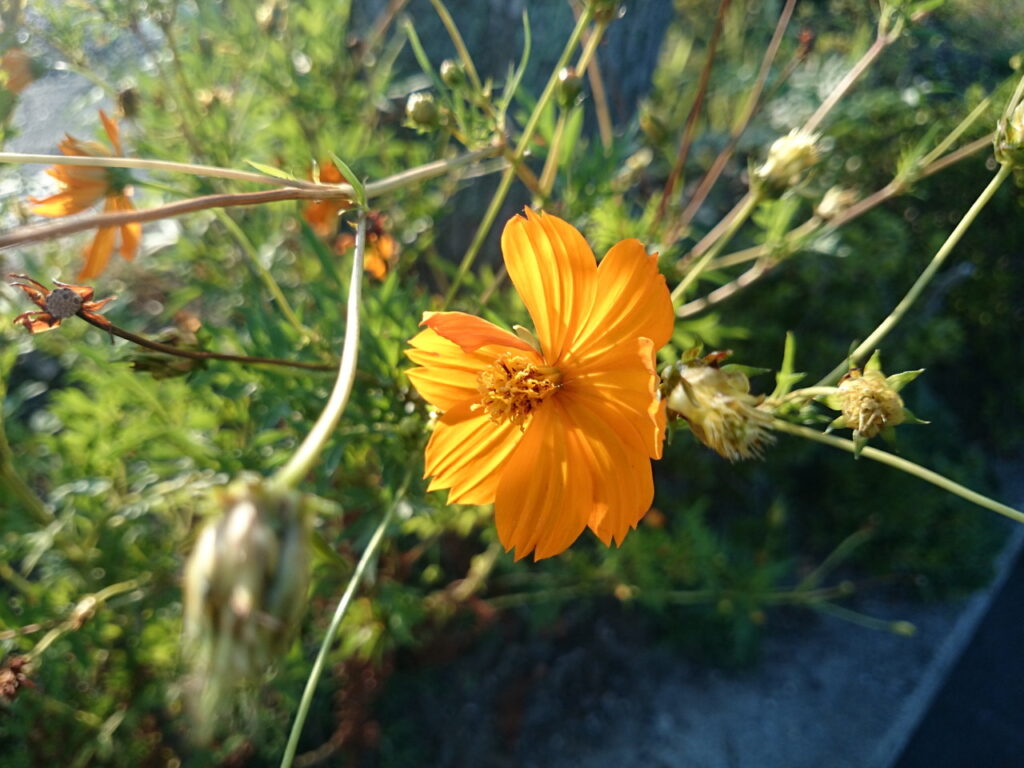
Morphologically, in Coreopsis lanceolata, the tubular florets are arranged flat and the tips of the ray florets' corollas are irregularly and finely notched, while in Cosmos sulphureus, the tubular florets are arranged in a raised manner and the tips of the ray florets' corollas are less notched, giving them a fork-like appearance.
The color of the yellow cosmos is usually a deeper yellow.
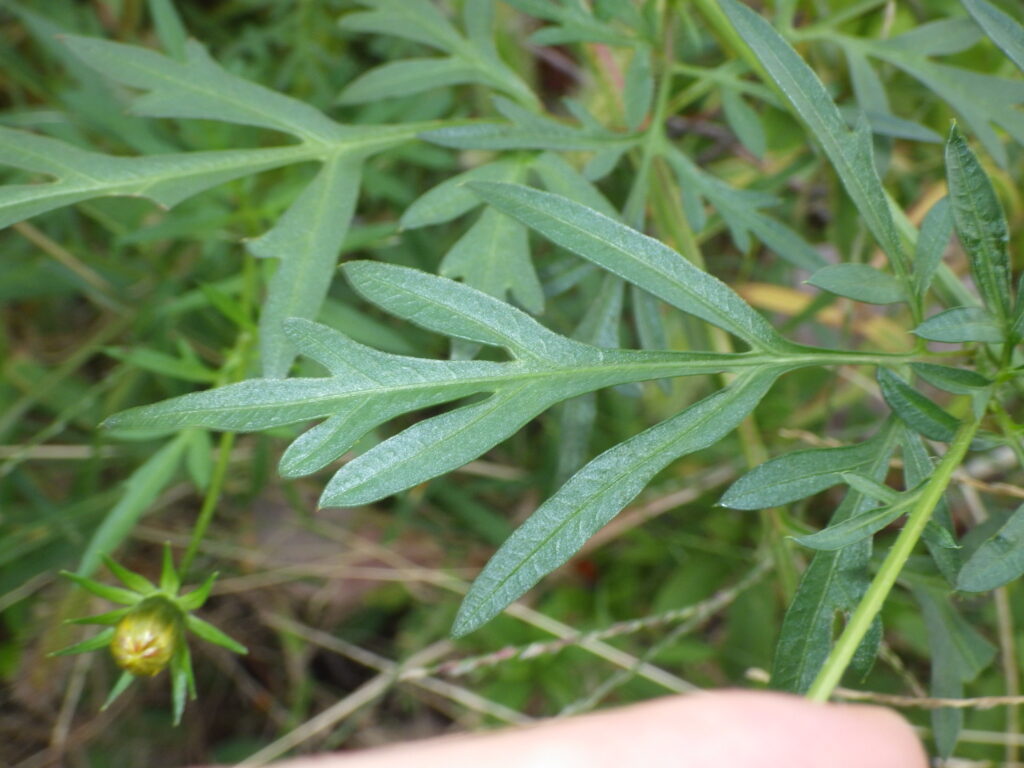
The leaves of the yellow cosmos are also more deeply lobed.
Regarding the achenes of the fruit, yellow cosmos (Cosmos genus) has a long beak (pointed part), but large-flowered coreopsis (Coreopsis genus) does not.
As you can see from the above, they are completely different types.
If you'd like to know more about the different species of the Cosmos genus, please see our other article.
References
Flora of North America Committee. 2006. Flora of North America (Vol. 21 Magnoliophyta: Asteridae, Part 8 Asteraceae, Part 3). Oxford University Press, Oxford. 616pp. ISBN: 9780195305654
Kanagawa Prefecture Flora Survey Association. 2018. Kanagawa Prefecture Flora 2018 (Electronic Edition). Kanagawa Prefecture Flora Survey Association, Odawara. 1803pp. ISBN: 9784991053726
RBG Kew. 2023. The International Plant Names Index and World Checklist of Vascular Plants. Plants of the World Online. http://www.ipni.org and https://powo.science.kew.org/